ZIGBEE TECHNOLOGY
ABSTRACT
•
•
•
•
•
•
•
•
•
What is ZigBee?
ZigBee Overview
IEEE 802.15.4 WPAN
ZigBee Networking Basics
Technology Comparisons
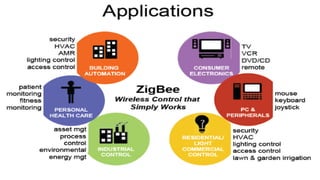
Applications
Advantage & Disadvantage
Zigbee vs Bluetooth
Conclusion
WHAT IS ZIGBEE?
•
•
•
•
ZigBee is a wireless networking technology.
ZigBee is the set of specifications built around the IEEE 802.15.4
wireless protocol.
ZigBee technology is a low data rate, low power consumption, low cost,
wireless networking protocol targeted towards automation and remote
control applications.
ZigBee is ideal for harsh radio environments in isolated locations
NEED FOR ZIGBEE
•
•
ZigBee was created to satisfy the market's need of a
standards-based wireless network that is
- cost-effective
- supports low data rates
- low power consumption
- secure and reliable
ZigBee is the only wireless standards-based technology:
- that addresses the unique needs of remote monitoring & control and sensory
network applications.
- enables broad-based deployment of wireless networks with low-cost low-power
solutions.
- provides the ability to run for years on inexpensive primary batteries for a typical
monitoring application
ZIGBEE ALLIANCE
•
•
The ZigBee Alliance is an association of companies working together
to enable reliable, cost-effective, low-power, wirelessly networked,
monitoring and control products based on an open global standard (
IEEE 802.15.4 PAN )
Open and global
► Anyone can join and participate
► Membership is global
WHY THE NAME ZIGBEE ?
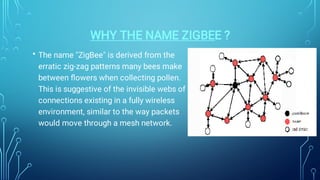
• The name "ZigBee" is derived from the
erratic zig-zag patterns many bees make
between flowers when collecting pollen.
This is suggestive of the invisible webs of
connections existing in a fully wireless
environment, similar to the way packets
would move through a mesh network.
IEEE 802.15.4 WPAN
•
•
Wireless personal area networks (WPANs) are used to convey
information over relatively short distances.
The main features of this standard are network flexibility, low cost,
very low power consumption, and low data rate in an Adhoc self-
organizing network among inexpensive fixed, portable, and moving
devices
ZIGBEE CHARACTERISTICS


ZigBee operates as one of three license-free bands
2.4 GHz, 915 MHz for North America, and 868 MHz for Europe
At 2.4 GHz, there are a total of 16 channels available with a maximum
data transfer of 250 kbps
At 915 MHz: 10 channels for a max 40 kbps transfer rate
At 868 MHz: 1 channel for a max 20 kbps transfer rate
ZigBee incorporates a CSMA-CA protocol
This protocol reduces the probability of interfering with other users and
automatic retransmission of data ensures robustness.
Yields high throughput and low latency for low-duty cycle devices like
sensors and control.
CONTINUED







Multiple topologies: star, peer-to-peer, mesh topologies
Low power consumption with battery life ranging from months to
years
128-bit AES encryption – Provides secure connections between
devices
Addressing space of up to 64-bit IEEE address devices
Up to 65,535 nodes on a network
Optional guaranteed time slot for applications requiring low latency
Fully reliable hand-shake protocol for transfer reliability
Range: 10 to 100m. Typical (Up to 400m max.)
DEVICE TYPES
•
•
•
•
There are three different ZigBee device types :
The ZigBee (PAN) coordinator node(ZC)
The Zigbee router(ZR)
The Zigbee end device(ZED)
TYPES EXPLAINED
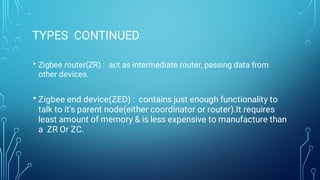
• Zigbee coordinator (ZC) : root of the network tree and might
bridge to other networks. Only 1 zigbee coordinator in each
network, that stores information about the network including
acting as repository for security keys.
TYPES CONTINUED
•
•
Zigbee router(ZR) : act as intermediate router, passing data from
other devices.
Zigbee end device(ZED) : contains just enough functionality to
talk to it's parent node(either coordinator or router).It requires
least amount of memory & is less expensive to manufacture than
a ZR Or ZC.
ZIGBEE TOPOLOGY
•
1.
2.
3.
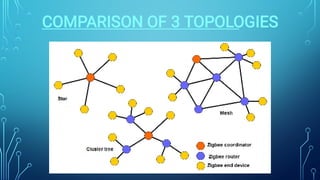
ZigBee Supports 3 Topologies
Star topology
Peer to Peer topology
Cluster Tree or Mesh Topology
COMPARISON OF 3 TOPOLOGIES
COMPARISON BETWEEN TOPOLOGIES
Star Topology
Star topology is a
network topology in
which each network
component is
physically connected
to a central node such
as a router, hub or
switch. In a star
topology, the central
hub acts like a server
and the connecting
nodes act like clients.
Peer-to-Peer Topology
In peer to peer
architecture, every
node is connected to
another node directly.
Every computer node
is referred to as a
peer.
Every peer provides
services to other
peers as well as uses
services of them.
There is no central
server present.
Mesh Topology
In a mesh topology, there
is no central connection
point. Instead, each node
is connected to at least
one other node and
usually to more than one.
Each node is capable of
sending messages to
and receiving messages
from other nodes. The
nodes act as relays,
passing on a message
toward its final
destination.
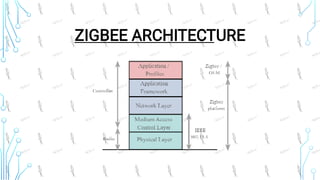
ZIGBEE ARCHITECTURE
NETWORK LAYER AND
APPLICATION LAYER
•
1.
2.
3.
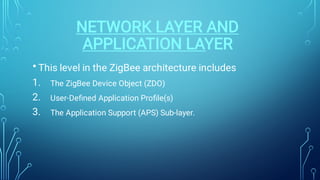
This level in the ZigBee architecture includes
The ZigBee Device Object (ZDO)
User-Defined Application Profile(s)
The Application Support (APS) Sub-layer.
PHYSICAL LAYER
•
•





The PHY service enables the transmission and reception of PHY
protocol data units (PPDU) across the physical radio channel.
The features of the IEEE 802.15.4 PHY physical layer are
Activation and deactivation of the radio transceiver,
energy detection (ED),
Link quality indication (LQI),
Clear channel assessment (CCA),
Channel selection.
MAC LAYER
•
•




The MAC service enables the transmission and reception of MAC
protocol data units (MPDU) across the PHY data service.
The features of the MAC sublayer are
Beacon Management,
CSMA-CA Mechanism,
GTS management,
Acknowledged frame delivery,
DATA TRANSFER
•
•
•
•
•
Information in a ZigBee network is transferred in packets
Each packet has a maximum size of 128 bytes, allowing for a maximum
payload of 104 bytes.
The ZigBee specification supports a maximum data transfer rate of 250
kbps for a range of up to 100 meters
A ZigBee network has an optimal superframe structure with a method
for time synchronization
For priority messages, a guaranteed time slot mechanism has been
incorporated. This allows high-priority messages to be sent across the
network as rapidly as possible.
DATA TRANSFER
•
•
•
•
•
•
•
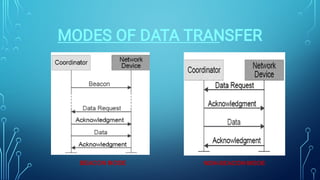
This data transfer transaction is the mechanism for transferring data from a coordinator to a device.
When the coordinator wishes to transfer data to a device in a beacon-enabled network, it indicates
in the network beacon that the data message is pending.
The device periodically listens to the network beacon and, if a message is pending, transmits a
MAC command requesting the data, using slotted CSMA-CA. The coordinator acknowledges the
successful reception of the data request by transmitting an optional acknowledgment frame.
The pending data frame is then sent using slotted CSMA-CA. The device acknowledges the
successful reception of the data by transmitting an acknowledgment frame. The transaction is now
complete. Upon receiving the acknowledgment, the message is removed from the list of pending
messages in the beacon.
When a coordinator wishes to transfer data to a device in a non-beacon-enabled network, it stores
the data for the appropriate device to make contact and request the data. A device may make
contact by transmitting a MAC command requesting the data, using unslotted CSMA-CA, to its
coordinator at an application-defined rate.
The coordinator acknowledges the successful reception of the data request by transmitting an
acknowledgment frame. If data are pending, the coordinator transmits the data frame, using
unslotted CSMA-CA, to the device. If data are not pending, the coordinator transmits a data frame
with a zero-length
payload to indicate that no data were pending. The device acknowledges the successful reception
of the data by transmitting an acknowledgment frame.
MODES OF DATA TRANSFER
COMPARISON
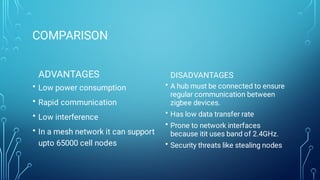
ADVANTAGES
•
•
•
•
Low power consumption
Rapid communication
Low interference
In a mesh network it can support
upto 65000 cell nodes
DISADVANTAGES
•
•
•
•
A hub must be connected to ensure
regular communication between
zigbee devices.
Has low data transfer rate
Prone to network interfaces
because itit uses band of 2.4GHz.
Security threats like stealing nodes
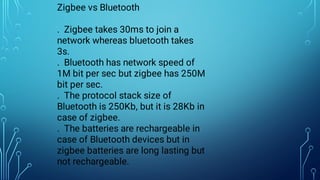
Zigbee vs Bluetooth
. Zigbee takes 30ms to join a
network whereas bluetooth takes
3s.
. Bluetooth has network speed of
1M bit per sec but zigbee has 250M
bit per sec.
. The protocol stack size of
Bluetooth is 250Kb, but it is 28Kb in
case of zigbee.
. The batteries are rechargeable in
case of Bluetooth devices but in
zigbee batteries are long lasting but
not rechargeable.
CONCLUSION
•
•
•
Comparing ZigBee technology with the present Bluetooth technology it
is evident that ZigBee can have a safe future in this effervescent world
of technology.
It enables the broadbased deployment of reliable wireless networks with
low complexity, low cost solutions and provides ability for a product to
run for years on primary inexpensive batteries.
There is definitely a place on the market for ZigBee, since no global
standard exists today in the wireless sensor network area.
THANK YOU!!

Seminar.pdf

  • 1.
  • 2.
    ABSTRACT • • • • • • • • • What is ZigBee? ZigBeeOverview IEEE 802.15.4 WPAN ZigBee Networking Basics Technology Comparisons Applications Advantage & Disadvantage Zigbee vs Bluetooth Conclusion
  • 3.
    WHAT IS ZIGBEE? • • • • ZigBeeis a wireless networking technology. ZigBee is the set of specifications built around the IEEE 802.15.4 wireless protocol. ZigBee technology is a low data rate, low power consumption, low cost, wireless networking protocol targeted towards automation and remote control applications. ZigBee is ideal for harsh radio environments in isolated locations
  • 4.
    NEED FOR ZIGBEE • • ZigBeewas created to satisfy the market's need of a standards-based wireless network that is - cost-effective - supports low data rates - low power consumption - secure and reliable ZigBee is the only wireless standards-based technology: - that addresses the unique needs of remote monitoring & control and sensory network applications. - enables broad-based deployment of wireless networks with low-cost low-power solutions. - provides the ability to run for years on inexpensive primary batteries for a typical monitoring application
  • 5.
    ZIGBEE ALLIANCE • • The ZigBeeAlliance is an association of companies working together to enable reliable, cost-effective, low-power, wirelessly networked, monitoring and control products based on an open global standard ( IEEE 802.15.4 PAN ) Open and global ► Anyone can join and participate ► Membership is global
  • 6.
    WHY THE NAMEZIGBEE ? • The name "ZigBee" is derived from the erratic zig-zag patterns many bees make between flowers when collecting pollen. This is suggestive of the invisible webs of connections existing in a fully wireless environment, similar to the way packets would move through a mesh network.
  • 7.
    IEEE 802.15.4 WPAN • • Wirelesspersonal area networks (WPANs) are used to convey information over relatively short distances. The main features of this standard are network flexibility, low cost, very low power consumption, and low data rate in an Adhoc self- organizing network among inexpensive fixed, portable, and moving devices
  • 8.
    ZIGBEE CHARACTERISTICS   ZigBee operatesas one of three license-free bands 2.4 GHz, 915 MHz for North America, and 868 MHz for Europe At 2.4 GHz, there are a total of 16 channels available with a maximum data transfer of 250 kbps At 915 MHz: 10 channels for a max 40 kbps transfer rate At 868 MHz: 1 channel for a max 20 kbps transfer rate ZigBee incorporates a CSMA-CA protocol This protocol reduces the probability of interfering with other users and automatic retransmission of data ensures robustness. Yields high throughput and low latency for low-duty cycle devices like sensors and control.
  • 9.
    CONTINUED        Multiple topologies: star,peer-to-peer, mesh topologies Low power consumption with battery life ranging from months to years 128-bit AES encryption – Provides secure connections between devices Addressing space of up to 64-bit IEEE address devices Up to 65,535 nodes on a network Optional guaranteed time slot for applications requiring low latency Fully reliable hand-shake protocol for transfer reliability Range: 10 to 100m. Typical (Up to 400m max.)
  • 10.
    DEVICE TYPES • • • • There arethree different ZigBee device types : The ZigBee (PAN) coordinator node(ZC) The Zigbee router(ZR) The Zigbee end device(ZED)
  • 11.
    TYPES EXPLAINED • Zigbeecoordinator (ZC) : root of the network tree and might bridge to other networks. Only 1 zigbee coordinator in each network, that stores information about the network including acting as repository for security keys.
  • 12.
    TYPES CONTINUED • • Zigbee router(ZR): act as intermediate router, passing data from other devices. Zigbee end device(ZED) : contains just enough functionality to talk to it's parent node(either coordinator or router).It requires least amount of memory & is less expensive to manufacture than a ZR Or ZC.
  • 13.
    ZIGBEE TOPOLOGY • 1. 2. 3. ZigBee Supports3 Topologies Star topology Peer to Peer topology Cluster Tree or Mesh Topology
  • 14.
    COMPARISON OF 3TOPOLOGIES
  • 15.
    COMPARISON BETWEEN TOPOLOGIES StarTopology Star topology is a network topology in which each network component is physically connected to a central node such as a router, hub or switch. In a star topology, the central hub acts like a server and the connecting nodes act like clients. Peer-to-Peer Topology In peer to peer architecture, every node is connected to another node directly. Every computer node is referred to as a peer. Every peer provides services to other peers as well as uses services of them. There is no central server present. Mesh Topology In a mesh topology, there is no central connection point. Instead, each node is connected to at least one other node and usually to more than one. Each node is capable of sending messages to and receiving messages from other nodes. The nodes act as relays, passing on a message toward its final destination.
  • 16.
  • 17.
    NETWORK LAYER AND APPLICATIONLAYER • 1. 2. 3. This level in the ZigBee architecture includes The ZigBee Device Object (ZDO) User-Defined Application Profile(s) The Application Support (APS) Sub-layer.
  • 18.
    PHYSICAL LAYER • •      The PHYservice enables the transmission and reception of PHY protocol data units (PPDU) across the physical radio channel. The features of the IEEE 802.15.4 PHY physical layer are Activation and deactivation of the radio transceiver, energy detection (ED), Link quality indication (LQI), Clear channel assessment (CCA), Channel selection.
  • 19.
    MAC LAYER • •     The MACservice enables the transmission and reception of MAC protocol data units (MPDU) across the PHY data service. The features of the MAC sublayer are Beacon Management, CSMA-CA Mechanism, GTS management, Acknowledged frame delivery,
  • 20.
    DATA TRANSFER • • • • • Information ina ZigBee network is transferred in packets Each packet has a maximum size of 128 bytes, allowing for a maximum payload of 104 bytes. The ZigBee specification supports a maximum data transfer rate of 250 kbps for a range of up to 100 meters A ZigBee network has an optimal superframe structure with a method for time synchronization For priority messages, a guaranteed time slot mechanism has been incorporated. This allows high-priority messages to be sent across the network as rapidly as possible.
  • 21.
    DATA TRANSFER • • • • • • • This datatransfer transaction is the mechanism for transferring data from a coordinator to a device. When the coordinator wishes to transfer data to a device in a beacon-enabled network, it indicates in the network beacon that the data message is pending. The device periodically listens to the network beacon and, if a message is pending, transmits a MAC command requesting the data, using slotted CSMA-CA. The coordinator acknowledges the successful reception of the data request by transmitting an optional acknowledgment frame. The pending data frame is then sent using slotted CSMA-CA. The device acknowledges the successful reception of the data by transmitting an acknowledgment frame. The transaction is now complete. Upon receiving the acknowledgment, the message is removed from the list of pending messages in the beacon. When a coordinator wishes to transfer data to a device in a non-beacon-enabled network, it stores the data for the appropriate device to make contact and request the data. A device may make contact by transmitting a MAC command requesting the data, using unslotted CSMA-CA, to its coordinator at an application-defined rate. The coordinator acknowledges the successful reception of the data request by transmitting an acknowledgment frame. If data are pending, the coordinator transmits the data frame, using unslotted CSMA-CA, to the device. If data are not pending, the coordinator transmits a data frame with a zero-length payload to indicate that no data were pending. The device acknowledges the successful reception of the data by transmitting an acknowledgment frame.
  • 22.
    MODES OF DATATRANSFER
  • 24.
    COMPARISON ADVANTAGES • • • • Low power consumption Rapidcommunication Low interference In a mesh network it can support upto 65000 cell nodes DISADVANTAGES • • • • A hub must be connected to ensure regular communication between zigbee devices. Has low data transfer rate Prone to network interfaces because itit uses band of 2.4GHz. Security threats like stealing nodes
  • 25.
    Zigbee vs Bluetooth .Zigbee takes 30ms to join a network whereas bluetooth takes 3s. . Bluetooth has network speed of 1M bit per sec but zigbee has 250M bit per sec. . The protocol stack size of Bluetooth is 250Kb, but it is 28Kb in case of zigbee. . The batteries are rechargeable in case of Bluetooth devices but in zigbee batteries are long lasting but not rechargeable.
  • 26.
    CONCLUSION • • • Comparing ZigBee technologywith the present Bluetooth technology it is evident that ZigBee can have a safe future in this effervescent world of technology. It enables the broadbased deployment of reliable wireless networks with low complexity, low cost solutions and provides ability for a product to run for years on primary inexpensive batteries. There is definitely a place on the market for ZigBee, since no global standard exists today in the wireless sensor network area.
  • 27.