A Technical seminar
On
ZIGBEE TECHNOLOGY
(A WIRELESS TECHNOLOGY)
By
A.SRUJANA
13VE1A05D0
Department of Computer Science & Engineering
SREYAS INSTITUTE OF ENGINEERING & TECHNOLOGY 1
INTRODUCTION
•ZigBee is a wireless technology designed for control and sensor networks.
• It defines a set of communication protocols for low-data-rate& Short-range wireless networking.
• ZigBee was named after erratic, zig - zagging patterns, waggle dance made by bees between the
flowers which symbolizes communication between the nodes in network.
• It operates in Personal Area Networks (PAN’s) and device-to-device networks.
•ZigBee is one of the global standards of communication protocol formulated by the significant
task force under the IEEE 802.15 working group.
•Zigbee technology was created by “ZIGBEE ALLIANCE”. 2
3
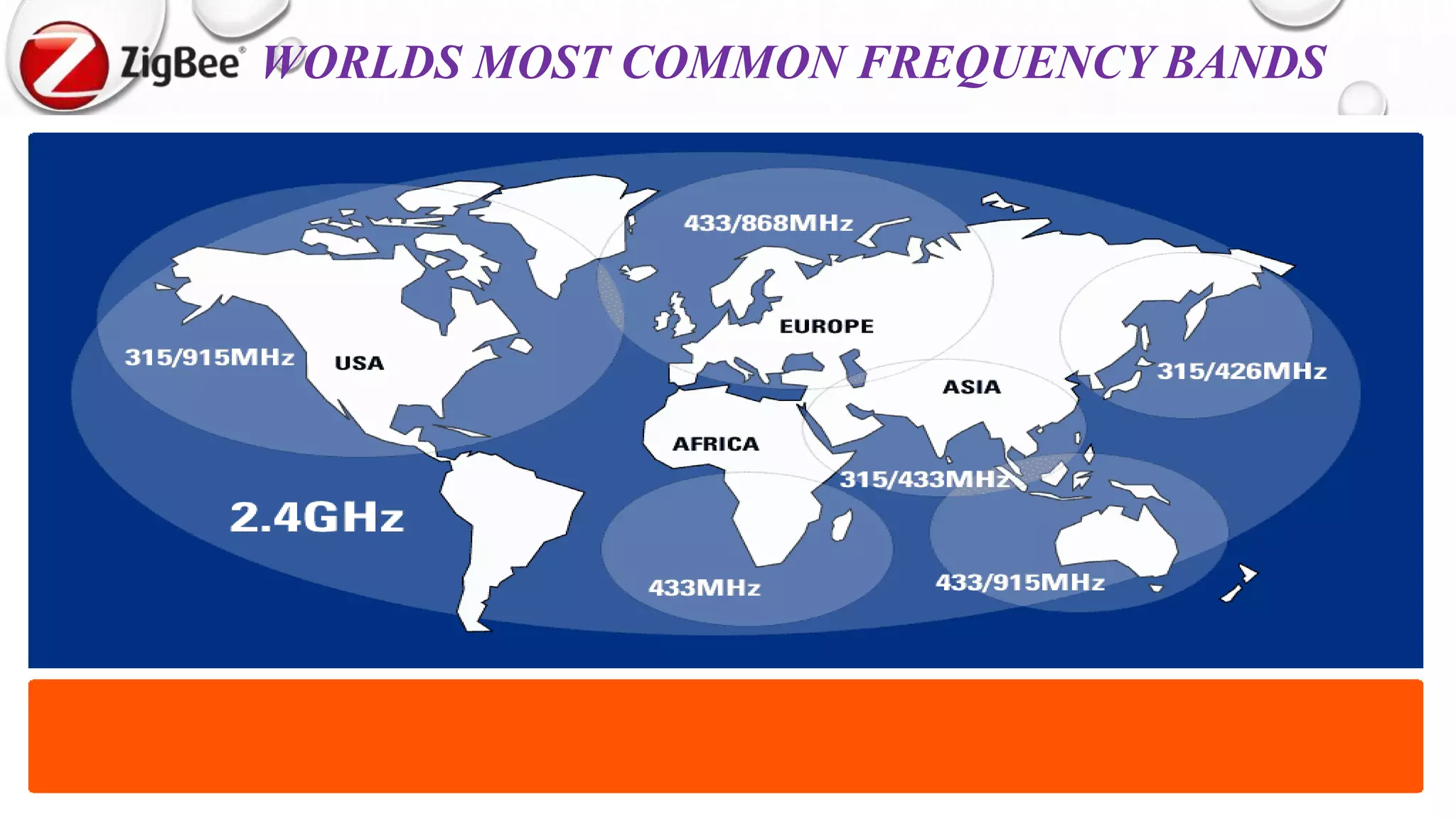
WORLDS MOST COMMON FREQUENCY BANDS
EXISTING SYSTEM
• The wireless sensors are much easier to install than the sensors that need wiring as 80% of cost
is spent on the sensor installation incase of wired sensors.
•Automatic controlling process takes place by fully based on microcontroller based circuit.
•Other standards like Bluetooth and IrDA address high data rate applications such as voice, video
and LAN communications.
• Unlike traditional networks, sensor networks needs to compact arrangement and collaborations
to accomplish a requiring task.
4
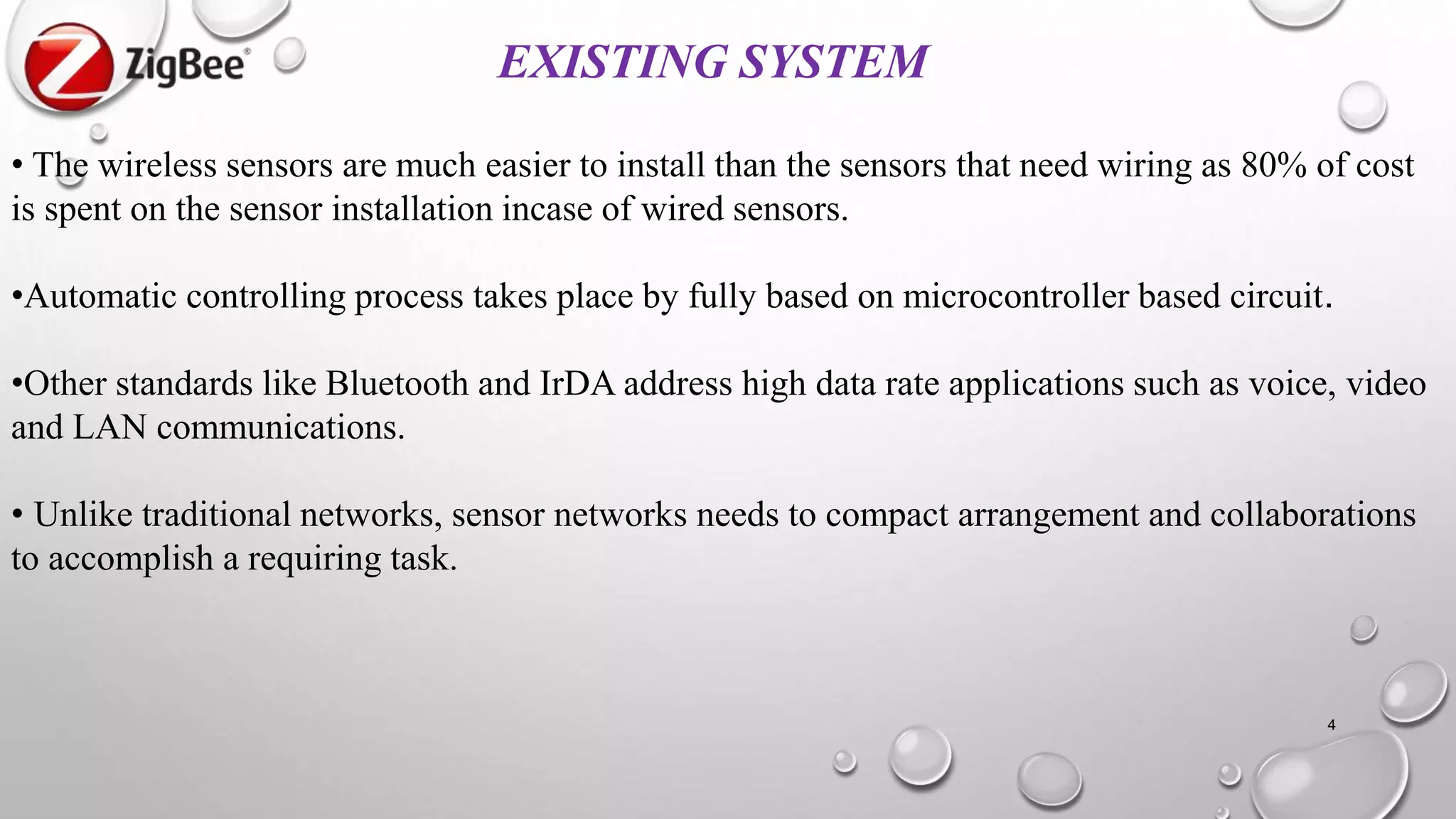
• There was a problem with wireless sensors as it consumed too much power.
• No standard approach is present today that addresses the unique needs of most remote
monitoring and control applications.
• In the Wireless sensor networks, the coordinator is responsible for sending the signal to all the
sensor nodes connected to it.
• As the distance from the coordinator increases, the signal strength becomes weak causing
communication with target nodes difficult.
• Therefore, it is difficult to perform stable and reliable communication with wide range nodes.
DEMERITS OF EXISTING SYSTEM
5
PROPOSED SYSTEM
• ZigBee resolves the issues when co-existing networks select the same PAN_ID on the same
channel with the introduction of Network Manager.
•ŠAll zigbee devices monitor neighbor communication during joining to identify duplicate PAN Š.
• Here, a coordinator is introduced in topologies by which zigbee natively supports.
• The introduction of three different ZigBee device types that operate on the layers in any self-
organizing application network:
1. Zigbee Coordinator node
2. Full Function Device (FFD)
3. Reduced Function Device(RFD)
6
MERITS OF ZIGBEE TECHNOLOGY
• Low Power Usage consumption.
•Support for low latency devices.
•Can be used globally.
•Easy to deploy and reliable.
•Supports large number of nodes.
•Adequate security features.
•Ease of installation.
7
DEMERITS OF ZIGBEE TECHNOLOGY
•Replacement of zigbee devices can be costly.
•No many end devices available yet .
•Low transmission rate.
•Can cover only smaller distances.
•Low complexity & data speed.
•Not more secure than a typical 802.11 wireless network.
8
9
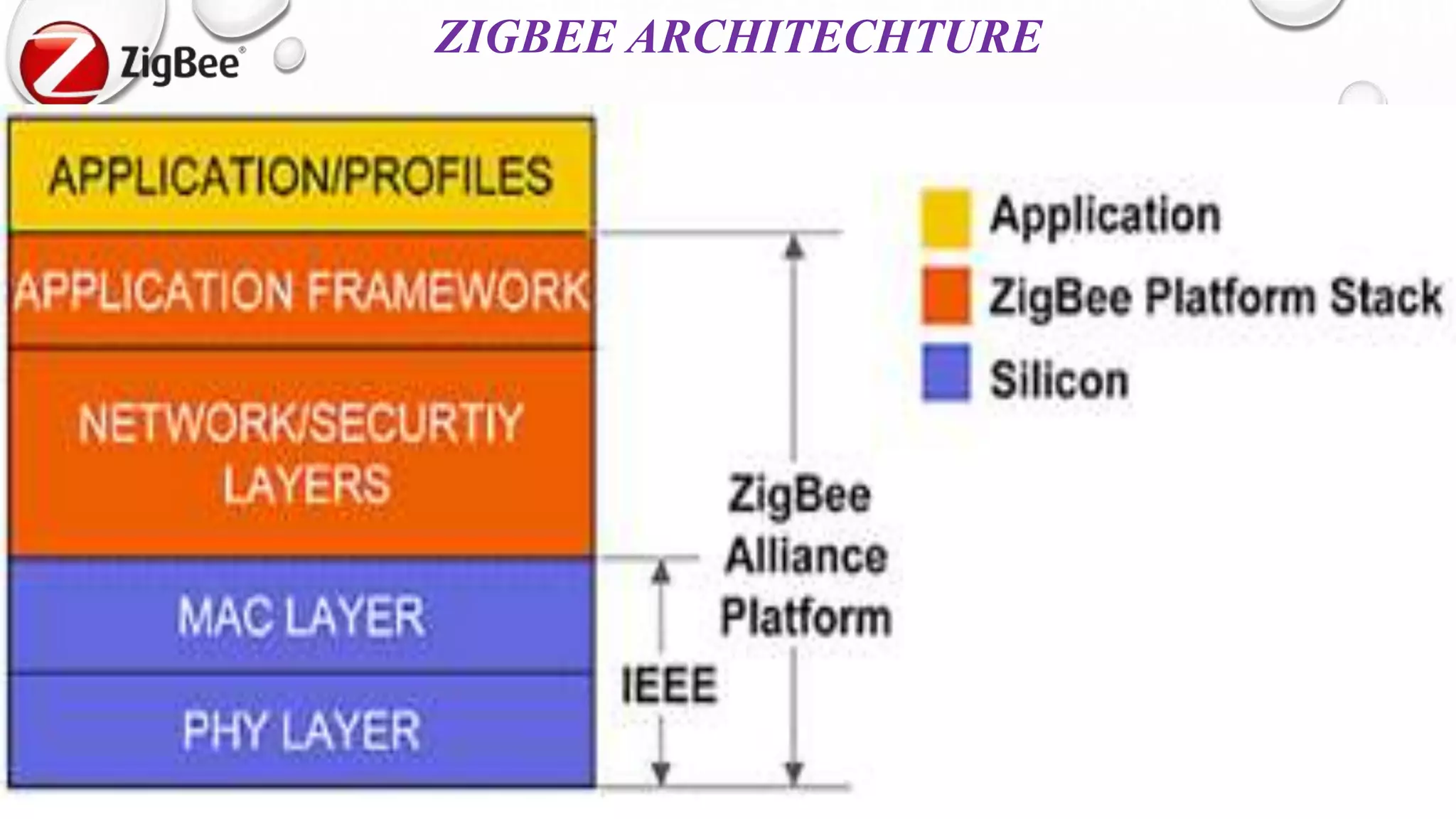
ZIGBEE ARCHITECHTURE
10
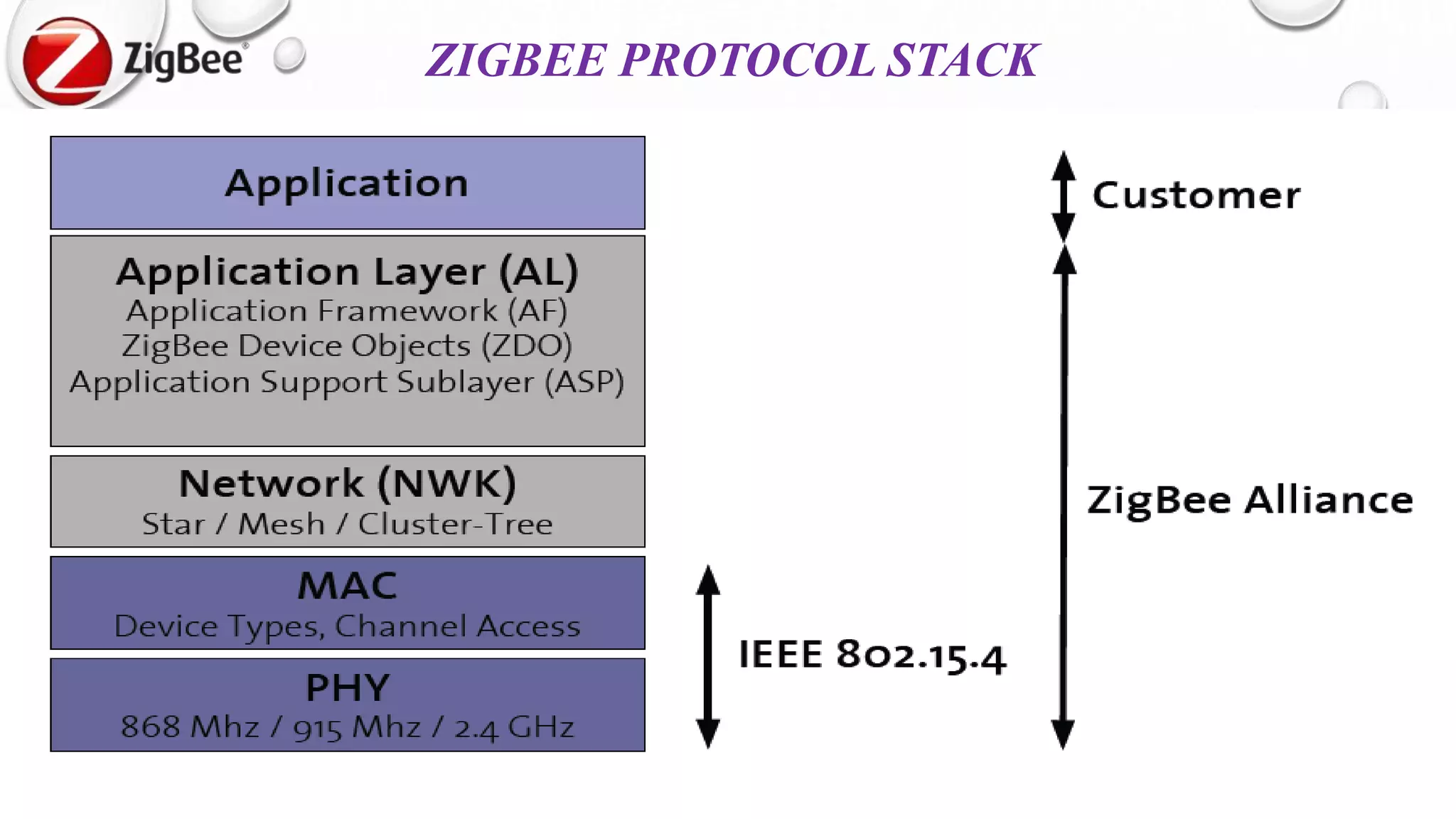
ZIGBEE PROTOCOL STACK
11
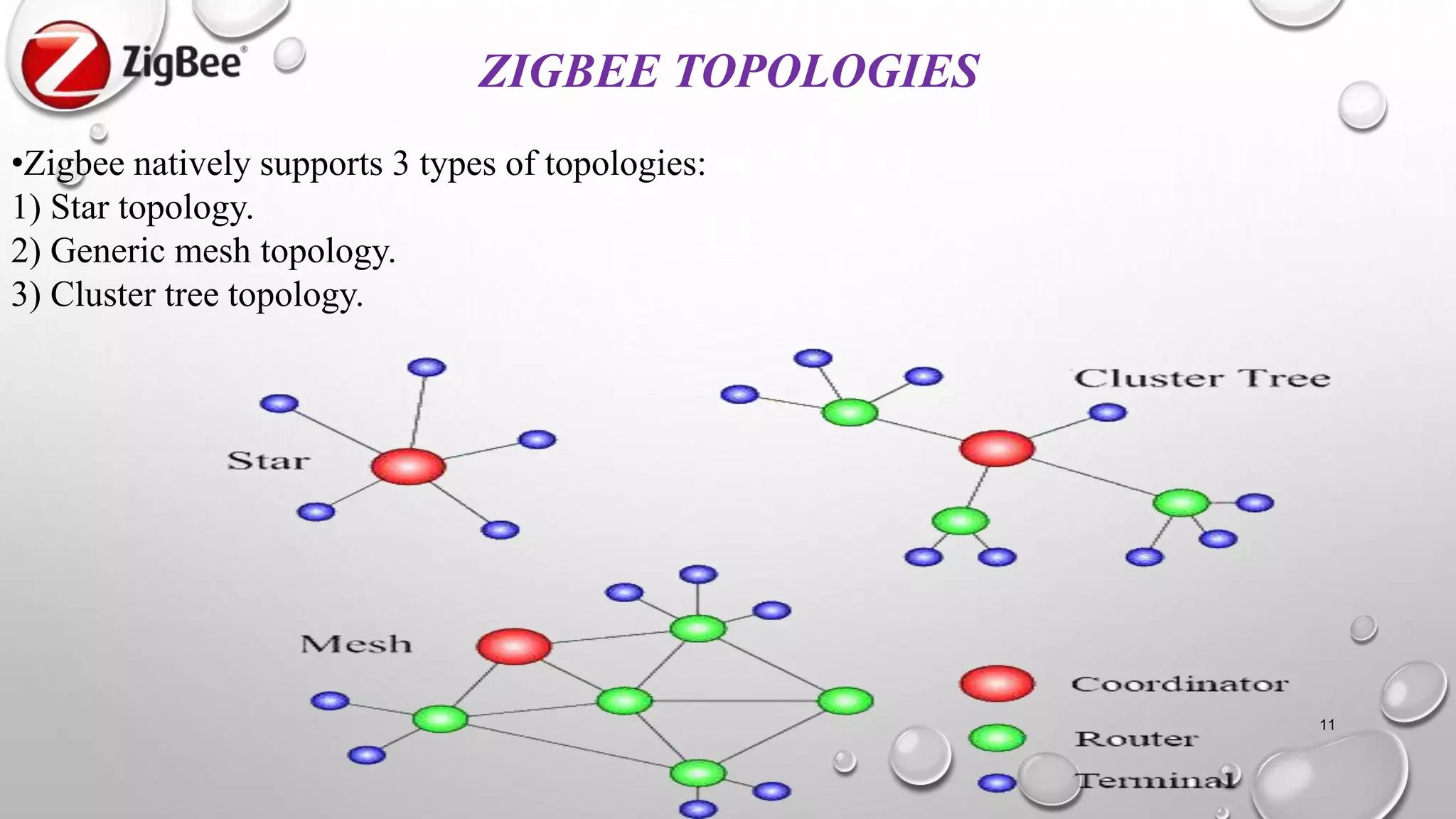
ZIGBEE TOPOLOGIES
•Zigbee natively supports 3 types of topologies:
1) Star topology.
2) Generic mesh topology.
3) Cluster tree topology.
12
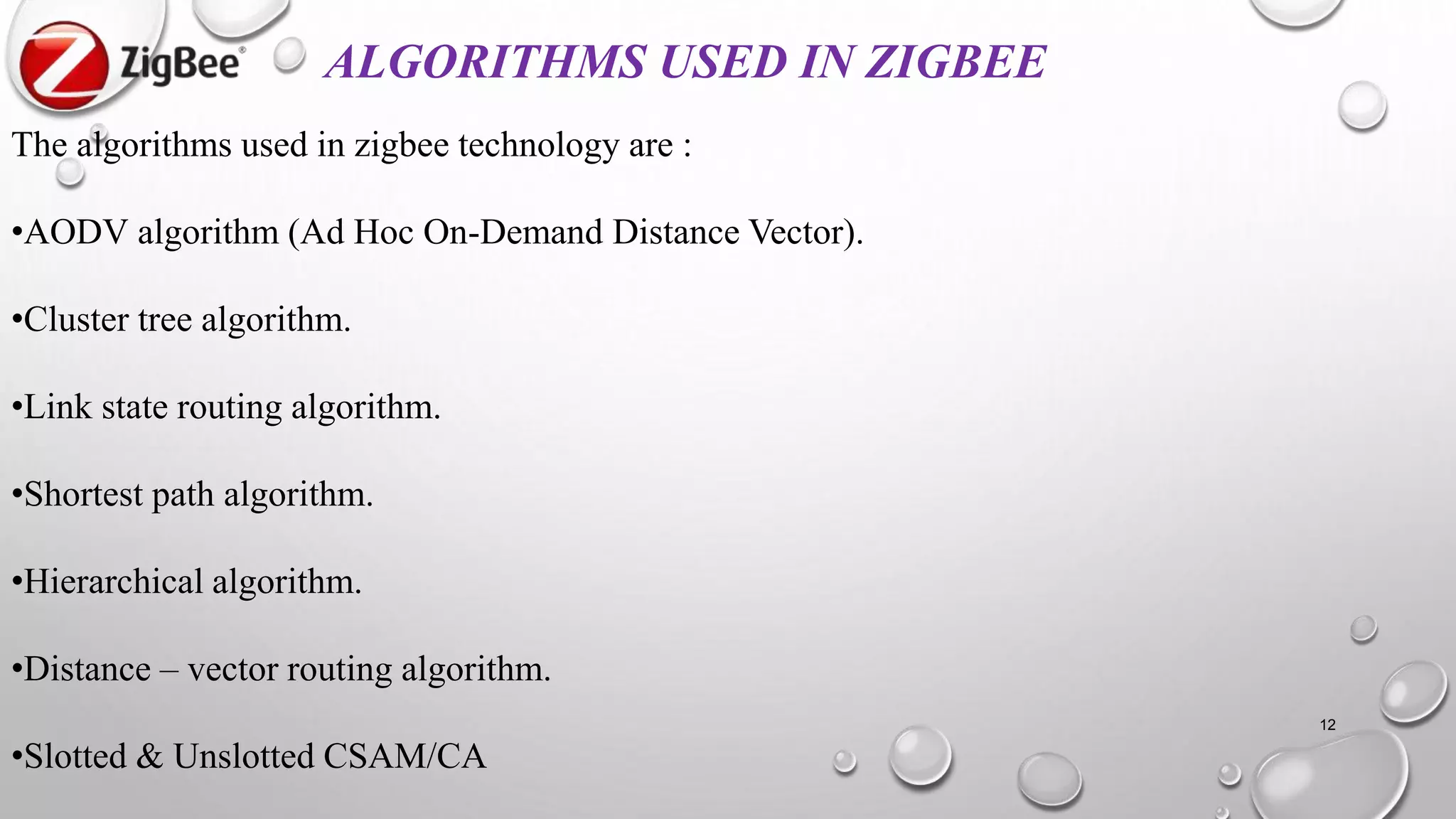
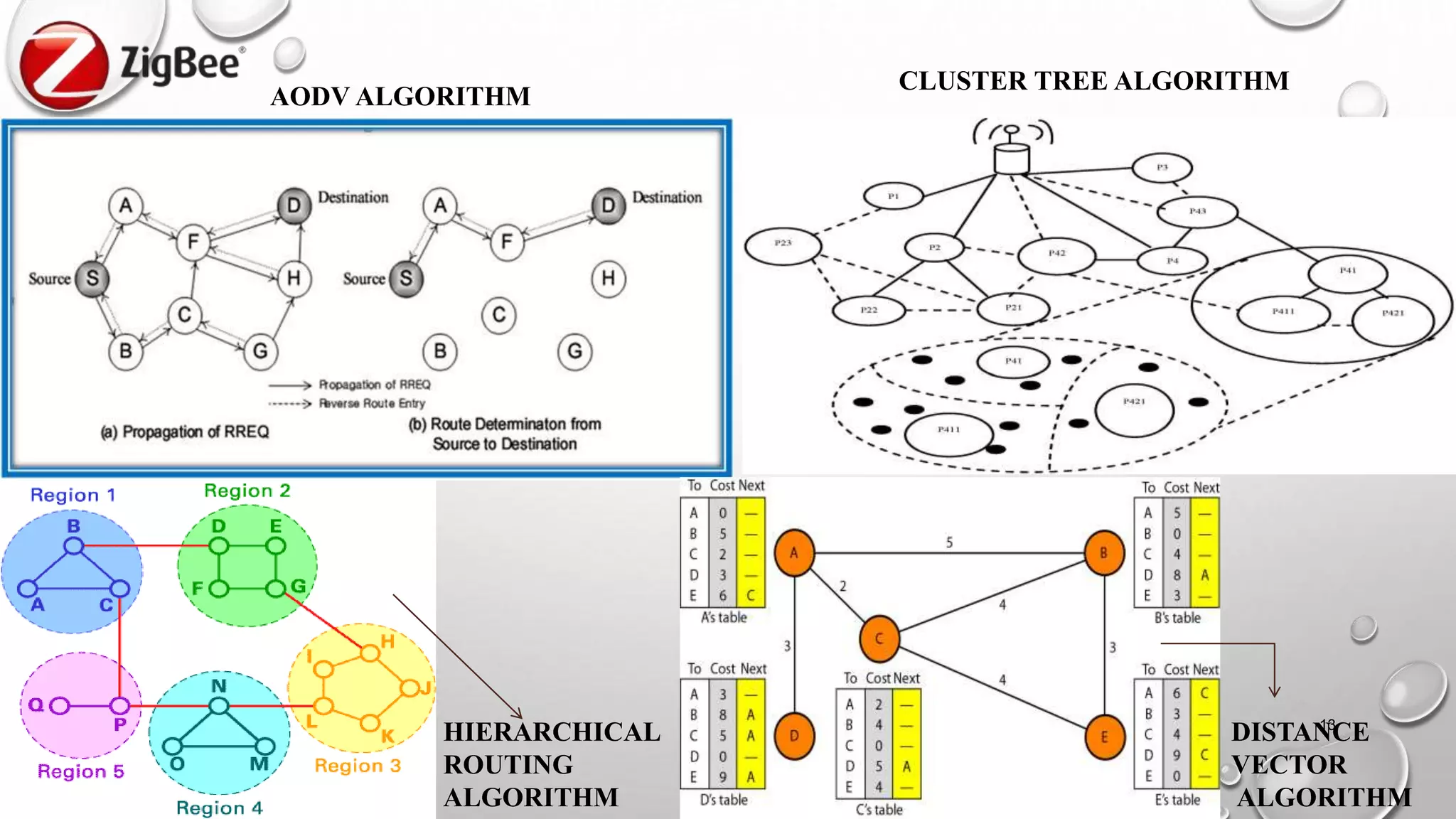
ALGORITHMS USED IN ZIGBEE
The algorithms used in zigbee technology are :
•AODV algorithm (Ad Hoc On-Demand Distance Vector).
•Cluster tree algorithm.
•Link state routing algorithm.
•Shortest path algorithm.
•Hierarchical algorithm.
•Distance – vector routing algorithm.
•Slotted & Unslotted CSAM/CA
13
AODV ALGORITHM
CLUSTER TREE ALGORITHM
DISTANCE
VECTOR
ALGORITHM
HIERARCHICAL
ROUTING
ALGORITHM
14
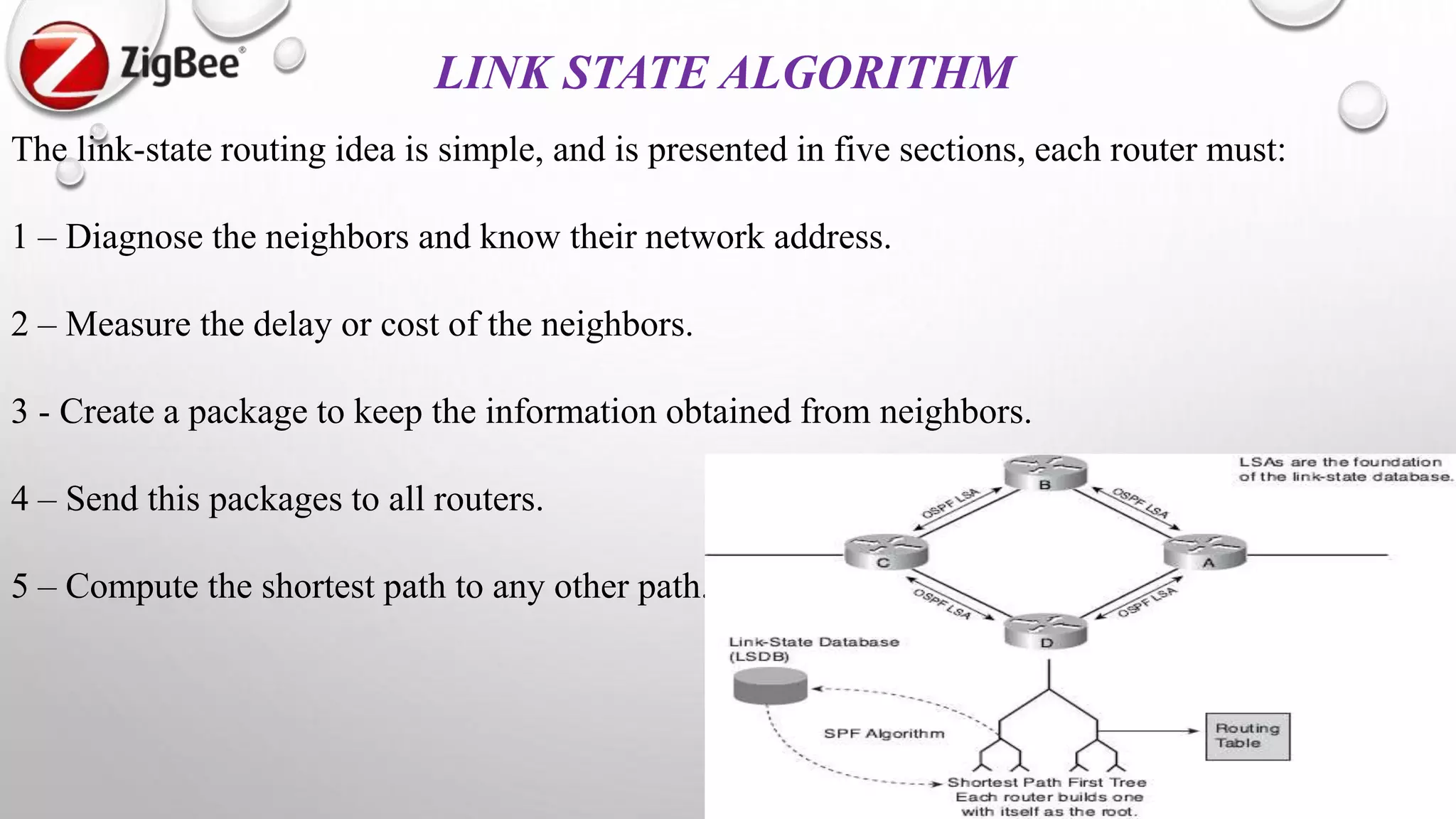
The link-state routing idea is simple, and is presented in five sections, each router must:
1 – Diagnose the neighbors and know their network address.
2 – Measure the delay or cost of the neighbors.
3 - Create a package to keep the information obtained from neighbors.
4 – Send this packages to all routers.
5 – Compute the shortest path to any other path.
LINK STATE ALGORITHM
15
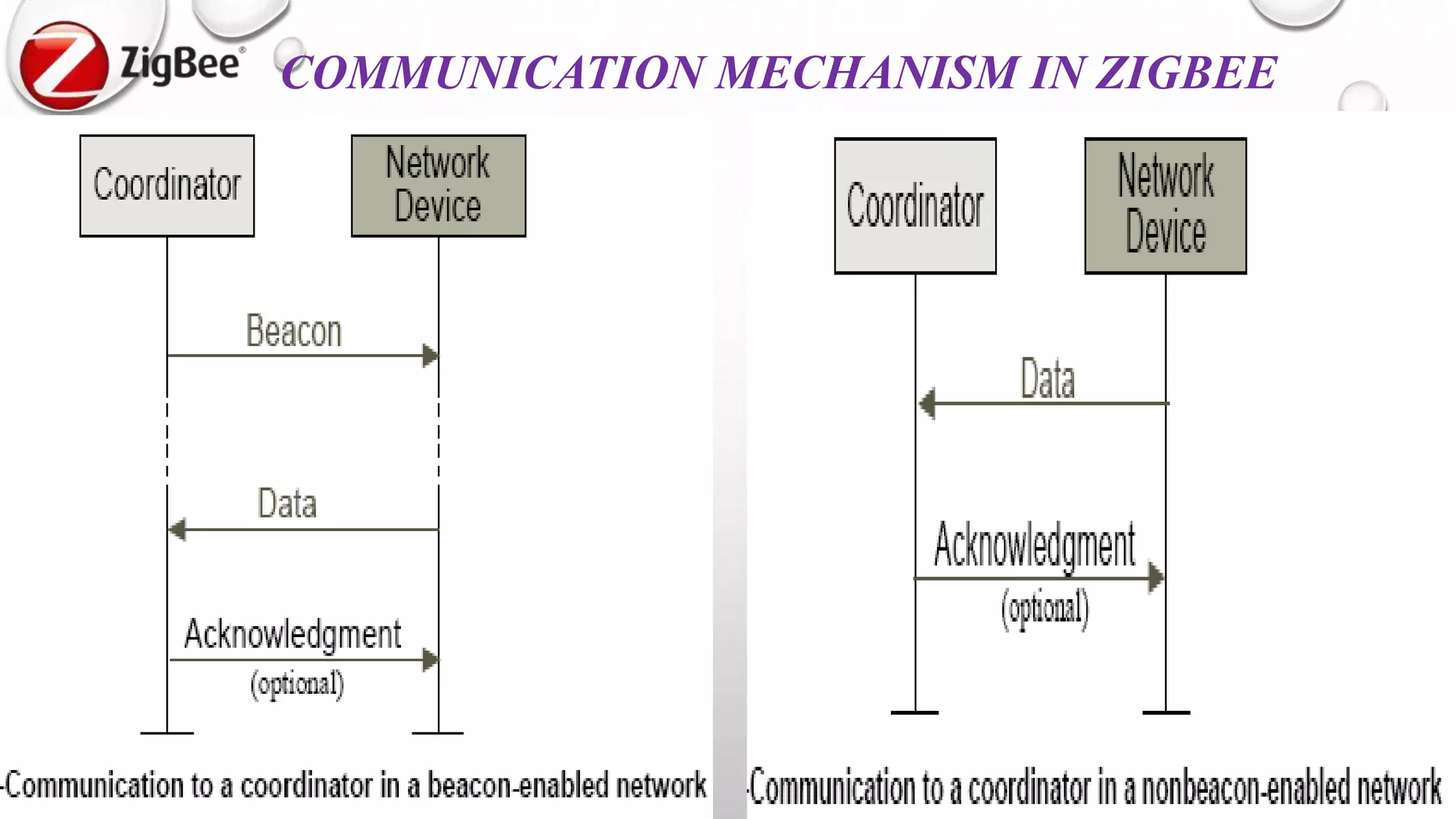
COMMUNICATION MECHANISM IN ZIGBEE
16
16
vs
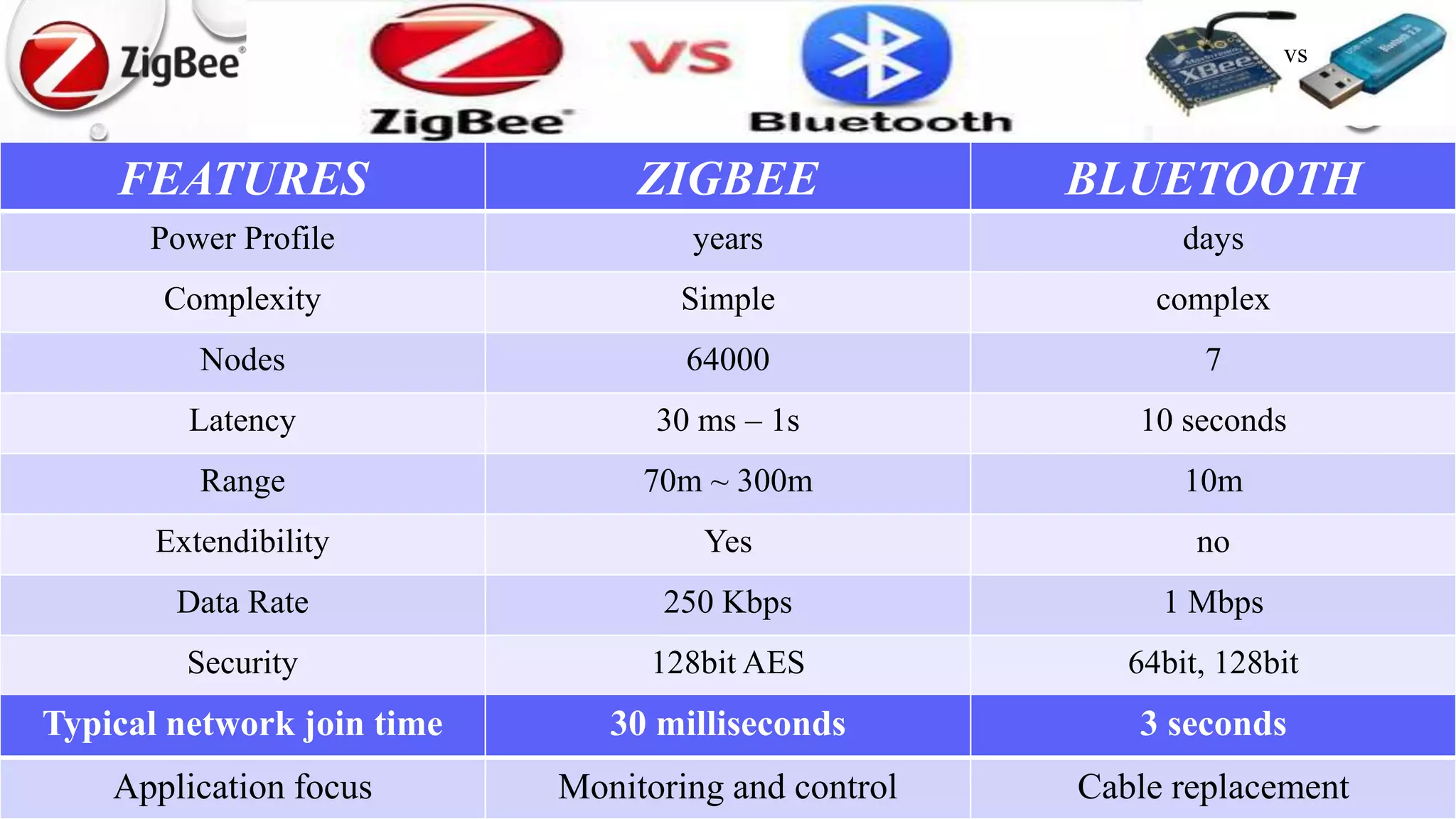
FEATURES ZIGBEE BLUETOOTH
Power Profile years days
Complexity Simple complex
Nodes 64000 7
Latency 30 ms – 1s 10 seconds
Range 70m ~ 300m 10m
Extendibility Yes no
Data Rate 250 Kbps 1 Mbps
Security 128bit AES 64bit, 128bit
Typical network join time 30 milliseconds 3 seconds
Application focus Monitoring and control Cable replacement
17
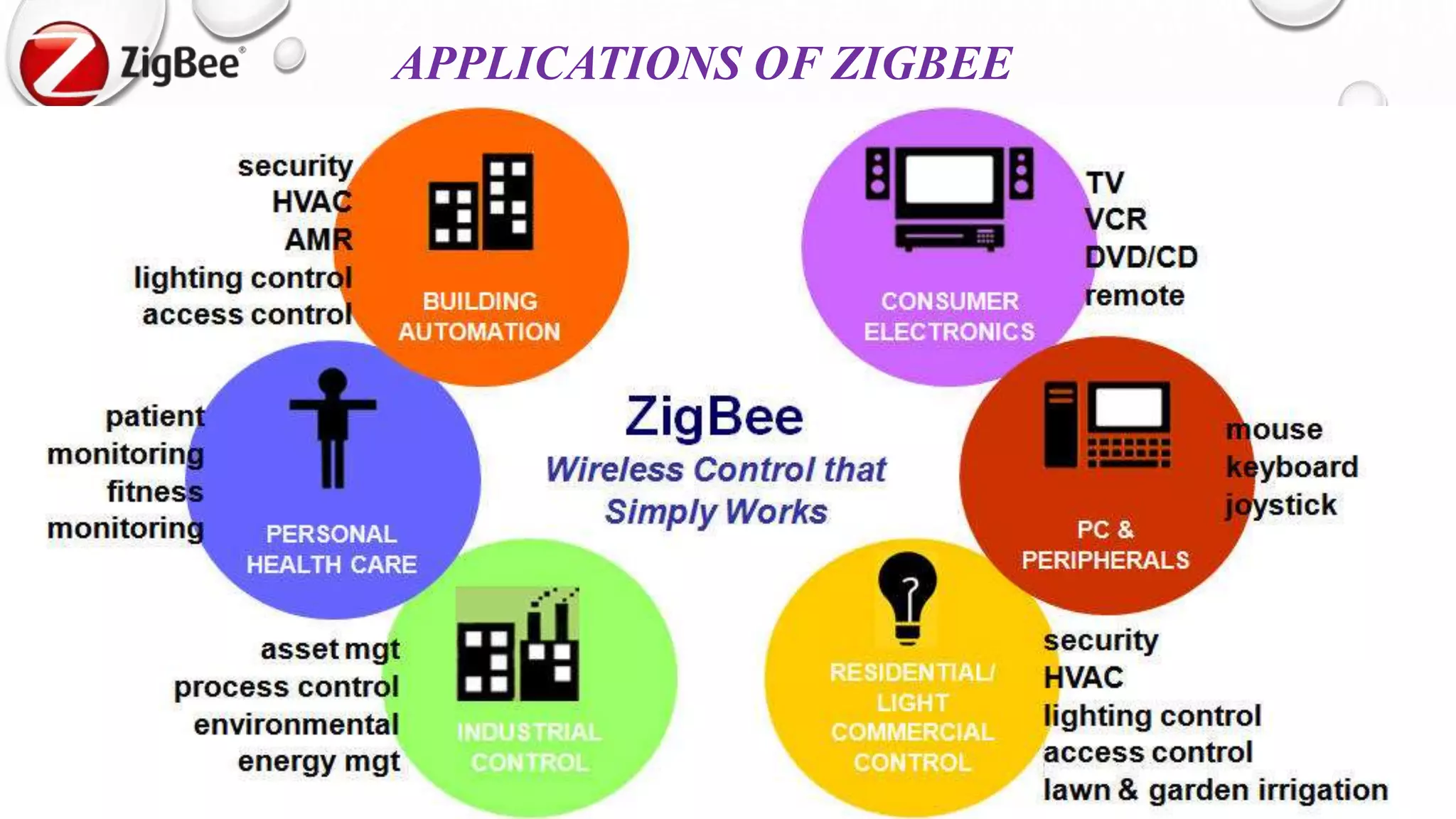
APPLICATIONS OF ZIGBEE
18
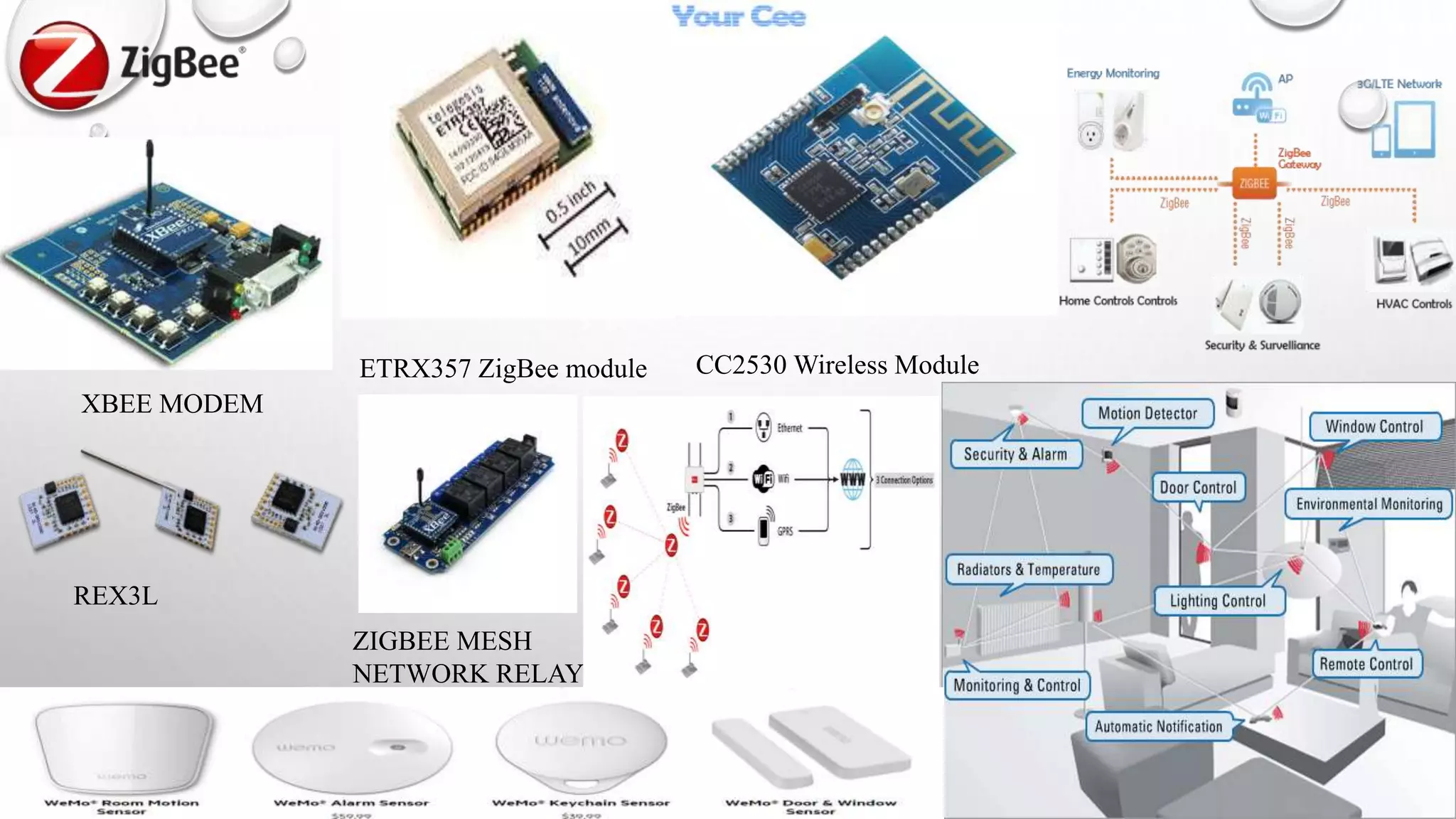
XBEE MODEM
ETRX357 ZigBee module CC2530 Wireless Module
REX3L
ZIGBEE MESH
NETWORK RELAY
19
ZIGBEE MEMBERS
Participants
Promoters
20
FUTURE SCOPE
• Zigbee has a very promising future in front of it.
• By rapid rise in home networking, Zigbee would provide revolutionizing statistics in the
upcoming years which would entirely change to the wireless world.
• Various types of areas such as defense, national security, monitoring and control etc can be
facilitated by devices based on zigbee standard.
• It leads to the cheap wireless technology, so that it can be widely used for low rate data transfer.
•Zigbee aims to achieve greater efficiency.
21
CONCLUSION
• ZigBee has been developed to meet the growing demand for capable wireless networking
between numerous low-power devices.
• These networks are easy to deploy which is cheaper as compared to other technologies.
•Used for campus-wide electrical and security systems from a single computer.
•ZigBee networks can be configured and operate in many different and often subtle ways.
22
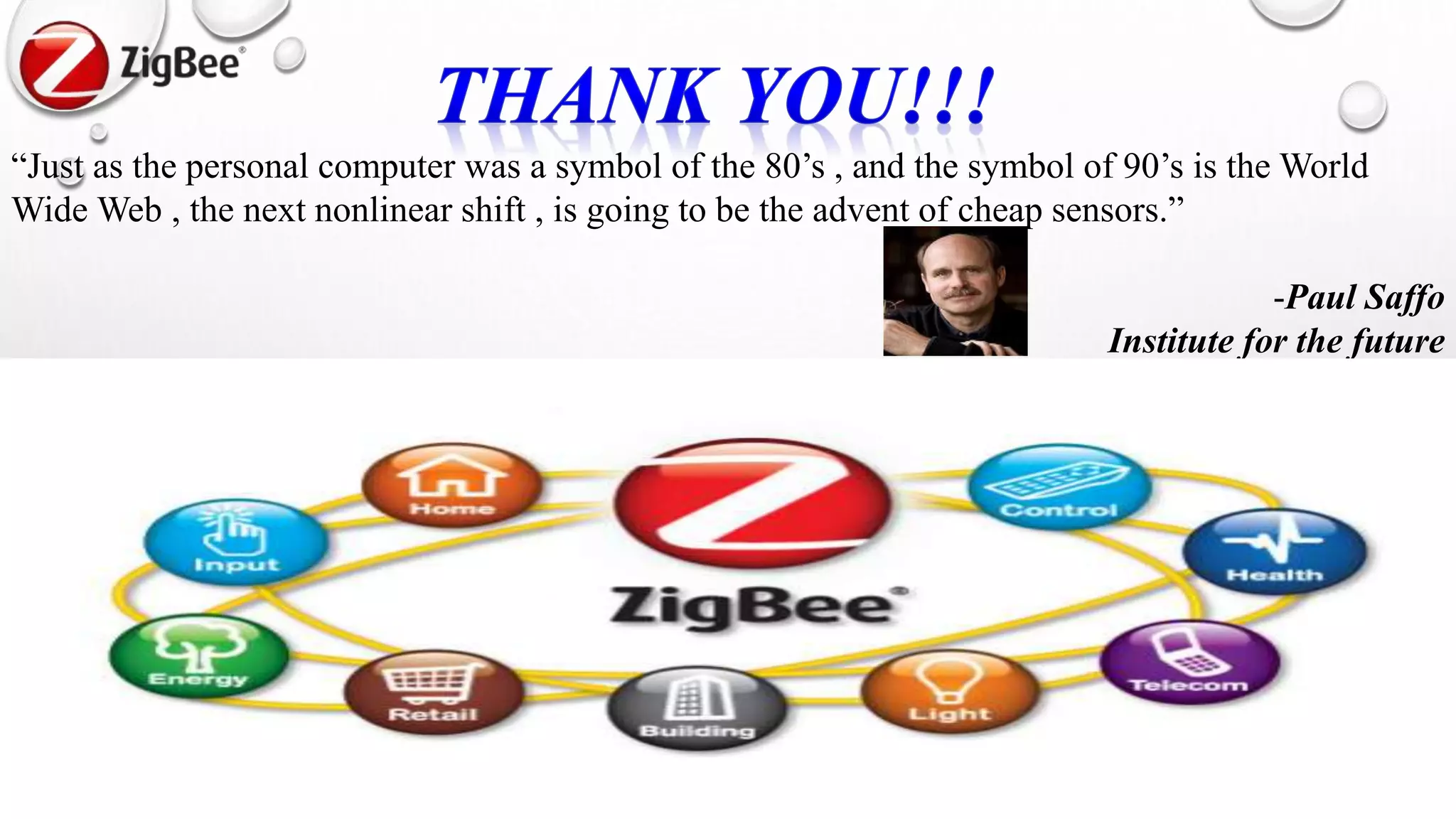
“Just as the personal computer was a symbol of the 80’s , and the symbol of 90’s is the World
Wide Web , the next nonlinear shift , is going to be the advent of cheap sensors.”
-Paul Saffo
Institute for the future

Zigbee technology

  • 1.
    A Technical seminar On ZIGBEETECHNOLOGY (A WIRELESS TECHNOLOGY) By A.SRUJANA 13VE1A05D0 Department of Computer Science & Engineering SREYAS INSTITUTE OF ENGINEERING & TECHNOLOGY 1
  • 2.
    INTRODUCTION •ZigBee is awireless technology designed for control and sensor networks. • It defines a set of communication protocols for low-data-rate& Short-range wireless networking. • ZigBee was named after erratic, zig - zagging patterns, waggle dance made by bees between the flowers which symbolizes communication between the nodes in network. • It operates in Personal Area Networks (PAN’s) and device-to-device networks. •ZigBee is one of the global standards of communication protocol formulated by the significant task force under the IEEE 802.15 working group. •Zigbee technology was created by “ZIGBEE ALLIANCE”. 2
  • 3.
    3 WORLDS MOST COMMONFREQUENCY BANDS
  • 4.
    EXISTING SYSTEM • Thewireless sensors are much easier to install than the sensors that need wiring as 80% of cost is spent on the sensor installation incase of wired sensors. •Automatic controlling process takes place by fully based on microcontroller based circuit. •Other standards like Bluetooth and IrDA address high data rate applications such as voice, video and LAN communications. • Unlike traditional networks, sensor networks needs to compact arrangement and collaborations to accomplish a requiring task. 4
  • 5.
    • There wasa problem with wireless sensors as it consumed too much power. • No standard approach is present today that addresses the unique needs of most remote monitoring and control applications. • In the Wireless sensor networks, the coordinator is responsible for sending the signal to all the sensor nodes connected to it. • As the distance from the coordinator increases, the signal strength becomes weak causing communication with target nodes difficult. • Therefore, it is difficult to perform stable and reliable communication with wide range nodes. DEMERITS OF EXISTING SYSTEM 5
  • 6.
    PROPOSED SYSTEM • ZigBeeresolves the issues when co-existing networks select the same PAN_ID on the same channel with the introduction of Network Manager. •ŠAll zigbee devices monitor neighbor communication during joining to identify duplicate PAN Š. • Here, a coordinator is introduced in topologies by which zigbee natively supports. • The introduction of three different ZigBee device types that operate on the layers in any self- organizing application network: 1. Zigbee Coordinator node 2. Full Function Device (FFD) 3. Reduced Function Device(RFD) 6
  • 7.
    MERITS OF ZIGBEETECHNOLOGY • Low Power Usage consumption. •Support for low latency devices. •Can be used globally. •Easy to deploy and reliable. •Supports large number of nodes. •Adequate security features. •Ease of installation. 7
  • 8.
    DEMERITS OF ZIGBEETECHNOLOGY •Replacement of zigbee devices can be costly. •No many end devices available yet . •Low transmission rate. •Can cover only smaller distances. •Low complexity & data speed. •Not more secure than a typical 802.11 wireless network. 8
  • 9.
  • 10.
  • 11.
    11 ZIGBEE TOPOLOGIES •Zigbee nativelysupports 3 types of topologies: 1) Star topology. 2) Generic mesh topology. 3) Cluster tree topology.
  • 12.
    12 ALGORITHMS USED INZIGBEE The algorithms used in zigbee technology are : •AODV algorithm (Ad Hoc On-Demand Distance Vector). •Cluster tree algorithm. •Link state routing algorithm. •Shortest path algorithm. •Hierarchical algorithm. •Distance – vector routing algorithm. •Slotted & Unslotted CSAM/CA
  • 13.
    13 AODV ALGORITHM CLUSTER TREEALGORITHM DISTANCE VECTOR ALGORITHM HIERARCHICAL ROUTING ALGORITHM
  • 14.
    14 The link-state routingidea is simple, and is presented in five sections, each router must: 1 – Diagnose the neighbors and know their network address. 2 – Measure the delay or cost of the neighbors. 3 - Create a package to keep the information obtained from neighbors. 4 – Send this packages to all routers. 5 – Compute the shortest path to any other path. LINK STATE ALGORITHM
  • 15.
  • 16.
    16 16 vs FEATURES ZIGBEE BLUETOOTH PowerProfile years days Complexity Simple complex Nodes 64000 7 Latency 30 ms – 1s 10 seconds Range 70m ~ 300m 10m Extendibility Yes no Data Rate 250 Kbps 1 Mbps Security 128bit AES 64bit, 128bit Typical network join time 30 milliseconds 3 seconds Application focus Monitoring and control Cable replacement
  • 17.
  • 18.
    18 XBEE MODEM ETRX357 ZigBeemodule CC2530 Wireless Module REX3L ZIGBEE MESH NETWORK RELAY
  • 19.
  • 20.
    20 FUTURE SCOPE • Zigbeehas a very promising future in front of it. • By rapid rise in home networking, Zigbee would provide revolutionizing statistics in the upcoming years which would entirely change to the wireless world. • Various types of areas such as defense, national security, monitoring and control etc can be facilitated by devices based on zigbee standard. • It leads to the cheap wireless technology, so that it can be widely used for low rate data transfer. •Zigbee aims to achieve greater efficiency.
  • 21.
    21 CONCLUSION • ZigBee hasbeen developed to meet the growing demand for capable wireless networking between numerous low-power devices. • These networks are easy to deploy which is cheaper as compared to other technologies. •Used for campus-wide electrical and security systems from a single computer. •ZigBee networks can be configured and operate in many different and often subtle ways.
  • 22.
    22 “Just as thepersonal computer was a symbol of the 80’s , and the symbol of 90’s is the World Wide Web , the next nonlinear shift , is going to be the advent of cheap sensors.” -Paul Saffo Institute for the future