
Writing Learning Objectives Using Bloom's taxonomy Tutorial
mic-01-20-17 1
HOW TO WRITE EFFECTIVE LEARNING OBJECTIVES
Marc Cray, MD
Transcript
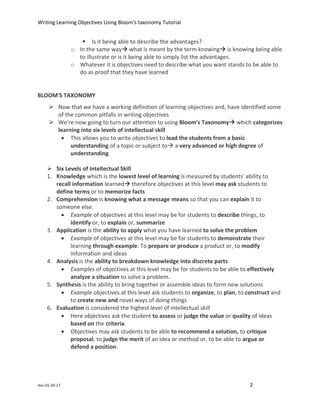
At the end of this presentation you will be able to
 Describe the purpose of learning objectives
 Avoid the common pitfalls in writing objectives, and
 Use Bloom’s taxonomy as an aid to writing effective course and lesson objectives
DEFINITION
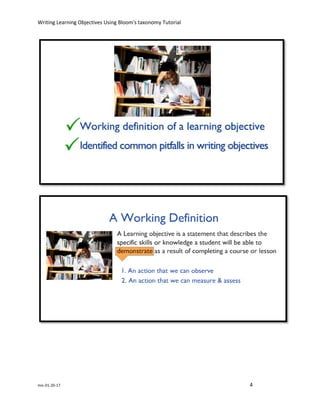
A learning objective is a statement that describes the specific skills or knowledge a student will
be able to demonstrate as a result of completing a course or lesson.
The term demonstrate is key, as it highlights the fact that an objective must describe student
learning
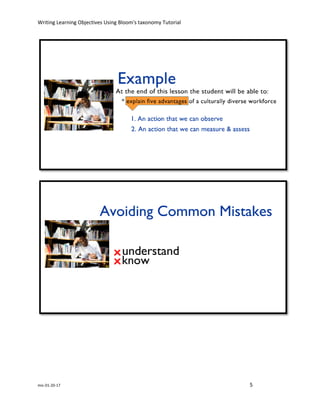
1. As an action that we can observe, and
2. As an action that we can measure and assess
 Example: At the end of this lesson the student will be able to
 Explain five advantages of a culturally diverse workforce
 In this example the action the student must demonstrate as proof that they have
learned is to explain five advantages
 The learning can be observed by having the student explain these out loud or in
writing
 Likewise, we can access the learning by measuring whether it does explain five
advantage or not and how well they explain these advantages
COMMON MISTAKES
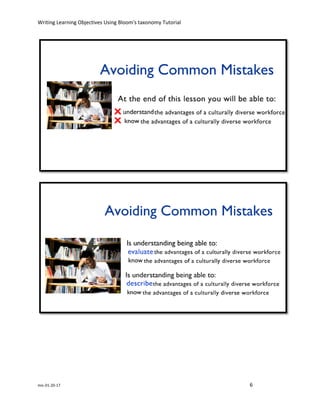
 One of the most common mistakes we make when writing objectives is to use the
terms understanding and know to describe student learning
 As in, at the end of this lesson you be able to understand the advantages of a
culturally diverse workforce, or
 You will know the advantages of a culturally diverse workforce.
o The problem with these terms is that you can't observe a student
understanding something or knowing something, as these are thoughts, not
actions
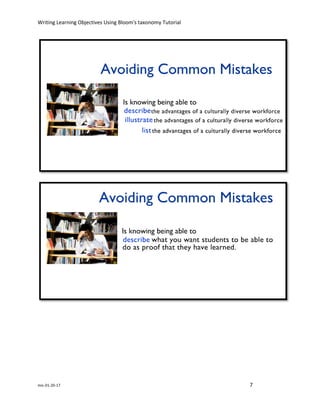
o Therefore instead of asking you to understand something Ask yourself “what
would the student need to do that would demonstrate that they understand?”
 Is understanding being able to evaluate the advantages of a culturally
diverse workforce? or;
Writing Learning Objectives Using Bloom's taxonomy Tutorial
mic-01-20-17 2
 Is it being able to describe the advantages?
o In the same way what is meant by the term knowing is knowing being able
to illustrate or is it being able to simply list the advantages.
o Whatever it is objectives need to describe what you want stands to be able to
do as proof that they have learned
BLOOM'S TAXONOMY
 Now that we have a working definition of learning objectives and, have identified some
of the common pitfalls in writing objectives
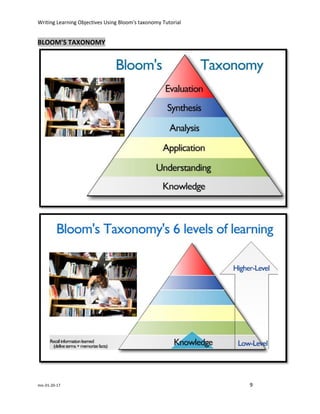
 We're now going to turn our attention to using Bloom's Taxonomy which categorizes
learning into six levels of intellectual skill
 This allows you to write objectives to lead the students from a basic
understanding of a topic or subject to a very advanced or high degree of
understanding
 Six Levels of Intellectual Skill
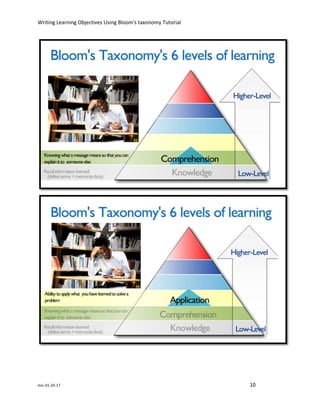
1. Knowledge which is the lowest level of learning is measured by students' ability to
recall information learned therefore objectives at this level may ask students to
define terms or to memorize facts
2. Comprehension is knowing what a message means so that you can explain it to
someone else.
 Example of objectives at this level may be for students to describe things, to
identify or, to explain or, summarize
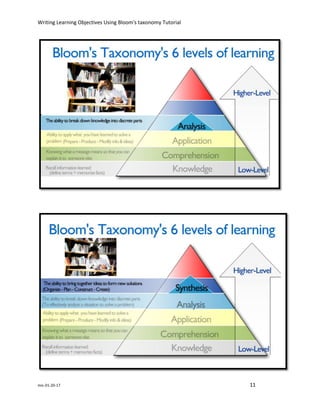
3. Application is the ability to apply what you have learned to solve the problem
 Example of objectives at this level may be for students to demonstrate their
learning through example. To prepare or produce a product or, to modify
information and ideas
4. Analysis is the ability to breakdown knowledge into discrete parts
 Examples of objectives at this level may be for students to be able to effectively
analyze a situation to solve a problem.
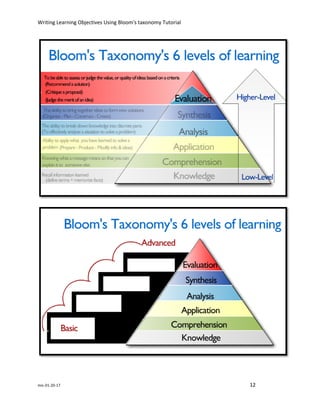
5. Synthesis is the ability to bring together or assemble ideas to form new solutions
 Example objectives at this level ask students to organize, to plan, to construct and
to create new and novel ways of doing things
6. Evaluation is considered the highest level of intellectual skill
 Here objectives ask the student to assess or judge the value or quality of ideas
based on the criteria.
 Objectives may ask students to be able to recommend a solution, to critique
proposal, to judge the merit of an idea or method or, to be able to argue or
defend a position.
Writing Learning Objectives Using Bloom's taxonomy Tutorial
mic-01-20-17 3
 Bloom’s Model is effective because it makes it easy to write objectives that scaffold
the learner from a basic or fundamental understanding of concepts presented in the
course to advanced or high level knowledge
Presentation
What follows is a visual version of the same information presented above.
Created using data from http://teachonline.asu.edu/objectives-builder/
WRITING LEARNING OBJECTIVES
Writing Learning Objectives Using Bloom's taxonomy Tutorial
mic-01-20-17 4
Writing Learning Objectives Using Bloom's taxonomy Tutorial
mic-01-20-17 5
Writing Learning Objectives Using Bloom's taxonomy Tutorial
mic-01-20-17 6
Writing Learning Objectives Using Bloom's taxonomy Tutorial
mic-01-20-17 7
Writing Learning Objectives Using Bloom's taxonomy Tutorial
mic-01-20-17 8
Writing Learning Objectives Using Bloom's taxonomy Tutorial
mic-01-20-17 9
BLOOM’S TAXONOMY
Writing Learning Objectives Using Bloom's taxonomy Tutorial
mic-01-20-17 10
Writing Learning Objectives Using Bloom's taxonomy Tutorial
mic-01-20-17 11
Writing Learning Objectives Using Bloom's taxonomy Tutorial
mic-01-20-17 12
Writing Learning Objectives Using Bloom's taxonomy Tutorial
mic-01-20-17 13
Arizona State University’s Cyber campus has developed an online tool
(Objectives Builder) that makes it easy to write well-structured course and lesson
learning objectives. This tutorial was created using that website.
Learn more:
The Performance Juxtaposition Website, Bloom's Taxonomy of Learning Domain

Writing Effective Learning Objectives Using Bloom's Taxonomy_Notes

  • 1.
    Writing Learning ObjectivesUsing Bloom's taxonomy Tutorial mic-01-20-17 1 HOW TO WRITE EFFECTIVE LEARNING OBJECTIVES Marc Cray, MD Transcript At the end of this presentation you will be able to  Describe the purpose of learning objectives  Avoid the common pitfalls in writing objectives, and  Use Bloom’s taxonomy as an aid to writing effective course and lesson objectives DEFINITION A learning objective is a statement that describes the specific skills or knowledge a student will be able to demonstrate as a result of completing a course or lesson. The term demonstrate is key, as it highlights the fact that an objective must describe student learning 1. As an action that we can observe, and 2. As an action that we can measure and assess  Example: At the end of this lesson the student will be able to  Explain five advantages of a culturally diverse workforce  In this example the action the student must demonstrate as proof that they have learned is to explain five advantages  The learning can be observed by having the student explain these out loud or in writing  Likewise, we can access the learning by measuring whether it does explain five advantage or not and how well they explain these advantages COMMON MISTAKES  One of the most common mistakes we make when writing objectives is to use the terms understanding and know to describe student learning  As in, at the end of this lesson you be able to understand the advantages of a culturally diverse workforce, or  You will know the advantages of a culturally diverse workforce. o The problem with these terms is that you can't observe a student understanding something or knowing something, as these are thoughts, not actions o Therefore instead of asking you to understand something Ask yourself “what would the student need to do that would demonstrate that they understand?”  Is understanding being able to evaluate the advantages of a culturally diverse workforce? or;
  • 2.
    Writing Learning ObjectivesUsing Bloom's taxonomy Tutorial mic-01-20-17 2  Is it being able to describe the advantages? o In the same way what is meant by the term knowing is knowing being able to illustrate or is it being able to simply list the advantages. o Whatever it is objectives need to describe what you want stands to be able to do as proof that they have learned BLOOM'S TAXONOMY  Now that we have a working definition of learning objectives and, have identified some of the common pitfalls in writing objectives  We're now going to turn our attention to using Bloom's Taxonomy which categorizes learning into six levels of intellectual skill  This allows you to write objectives to lead the students from a basic understanding of a topic or subject to a very advanced or high degree of understanding  Six Levels of Intellectual Skill 1. Knowledge which is the lowest level of learning is measured by students' ability to recall information learned therefore objectives at this level may ask students to define terms or to memorize facts 2. Comprehension is knowing what a message means so that you can explain it to someone else.  Example of objectives at this level may be for students to describe things, to identify or, to explain or, summarize 3. Application is the ability to apply what you have learned to solve the problem  Example of objectives at this level may be for students to demonstrate their learning through example. To prepare or produce a product or, to modify information and ideas 4. Analysis is the ability to breakdown knowledge into discrete parts  Examples of objectives at this level may be for students to be able to effectively analyze a situation to solve a problem. 5. Synthesis is the ability to bring together or assemble ideas to form new solutions  Example objectives at this level ask students to organize, to plan, to construct and to create new and novel ways of doing things 6. Evaluation is considered the highest level of intellectual skill  Here objectives ask the student to assess or judge the value or quality of ideas based on the criteria.  Objectives may ask students to be able to recommend a solution, to critique proposal, to judge the merit of an idea or method or, to be able to argue or defend a position.
  • 3.
    Writing Learning ObjectivesUsing Bloom's taxonomy Tutorial mic-01-20-17 3  Bloom’s Model is effective because it makes it easy to write objectives that scaffold the learner from a basic or fundamental understanding of concepts presented in the course to advanced or high level knowledge Presentation What follows is a visual version of the same information presented above. Created using data from http://teachonline.asu.edu/objectives-builder/ WRITING LEARNING OBJECTIVES
  • 4.
    Writing Learning ObjectivesUsing Bloom's taxonomy Tutorial mic-01-20-17 4
  • 5.
    Writing Learning ObjectivesUsing Bloom's taxonomy Tutorial mic-01-20-17 5
  • 6.
    Writing Learning ObjectivesUsing Bloom's taxonomy Tutorial mic-01-20-17 6
  • 7.
    Writing Learning ObjectivesUsing Bloom's taxonomy Tutorial mic-01-20-17 7
  • 8.
    Writing Learning ObjectivesUsing Bloom's taxonomy Tutorial mic-01-20-17 8
  • 9.
    Writing Learning ObjectivesUsing Bloom's taxonomy Tutorial mic-01-20-17 9 BLOOM’S TAXONOMY
  • 10.
    Writing Learning ObjectivesUsing Bloom's taxonomy Tutorial mic-01-20-17 10
  • 11.
    Writing Learning ObjectivesUsing Bloom's taxonomy Tutorial mic-01-20-17 11
  • 12.
    Writing Learning ObjectivesUsing Bloom's taxonomy Tutorial mic-01-20-17 12
  • 13.
    Writing Learning ObjectivesUsing Bloom's taxonomy Tutorial mic-01-20-17 13 Arizona State University’s Cyber campus has developed an online tool (Objectives Builder) that makes it easy to write well-structured course and lesson learning objectives. This tutorial was created using that website. Learn more: The Performance Juxtaposition Website, Bloom's Taxonomy of Learning Domain