SOH Curriculum Camp July 2010
SUHSD - EDI - Learning Objectives
Content Standard : Describes what students will be taught over the course of a year Contain multiple Learning Targets Learning Target : Describes what students will be able to do successfully & independently at the end of a specific lesson as a result of your classroom instruction Describes what you will teach your students to do
Many schools think they are covering all the standards because they have a pacing calendar identifying standards in their textbooks. If you check off that students were taught the standard, not realizing it has ten separate Learning Targets, the worksheet you gave may have only covered one! BIG IDEA : To maximize student learning (and raise test scores), teach your students  all  the Learning Targets contained in all the tested standards before the test date.
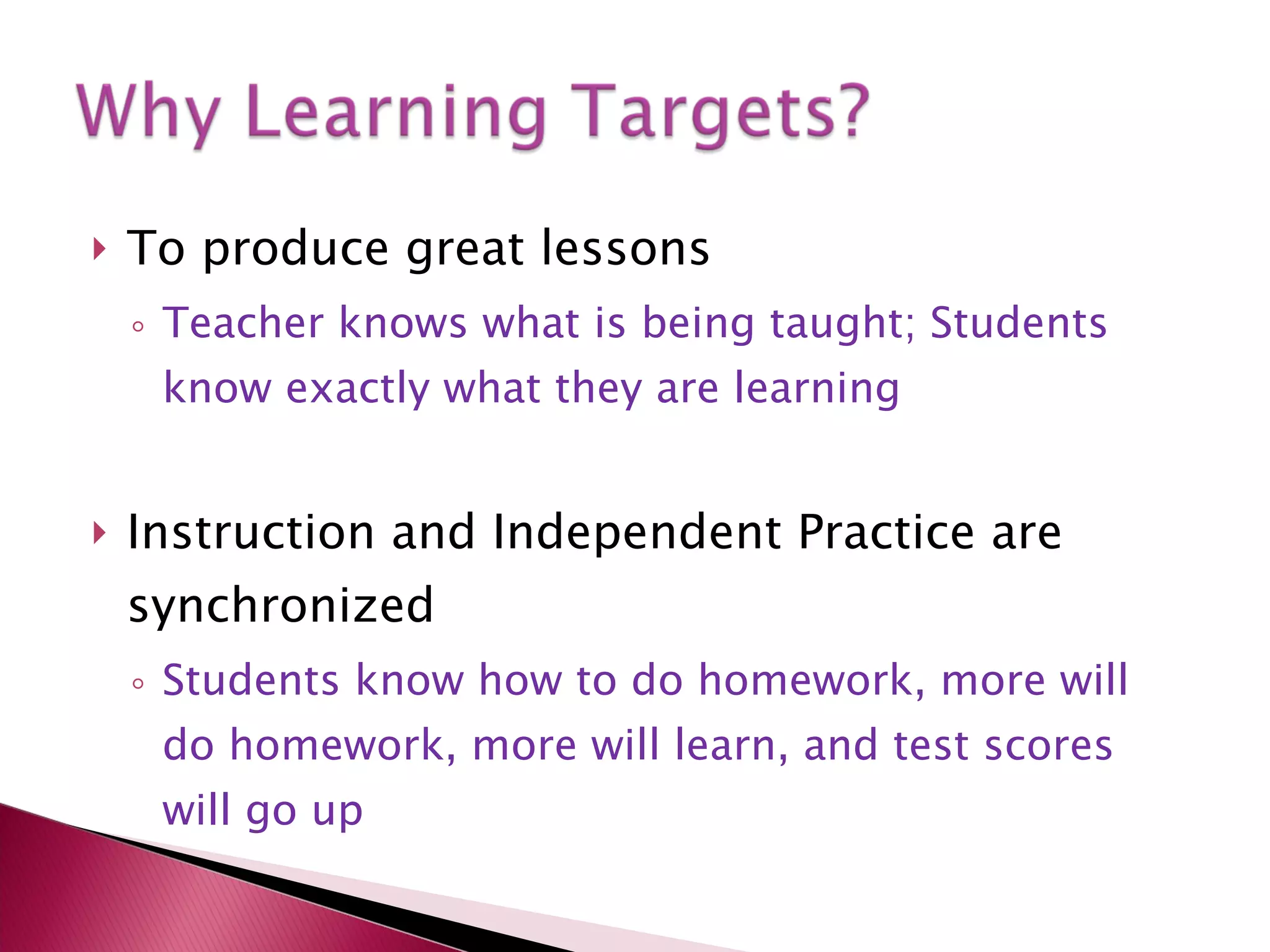
To produce great lessons  Teacher knows what is being taught; Students know exactly what they are learning Instruction and Independent Practice are synchronized Students know how to do homework, more will do homework, more will learn, and test scores will go up
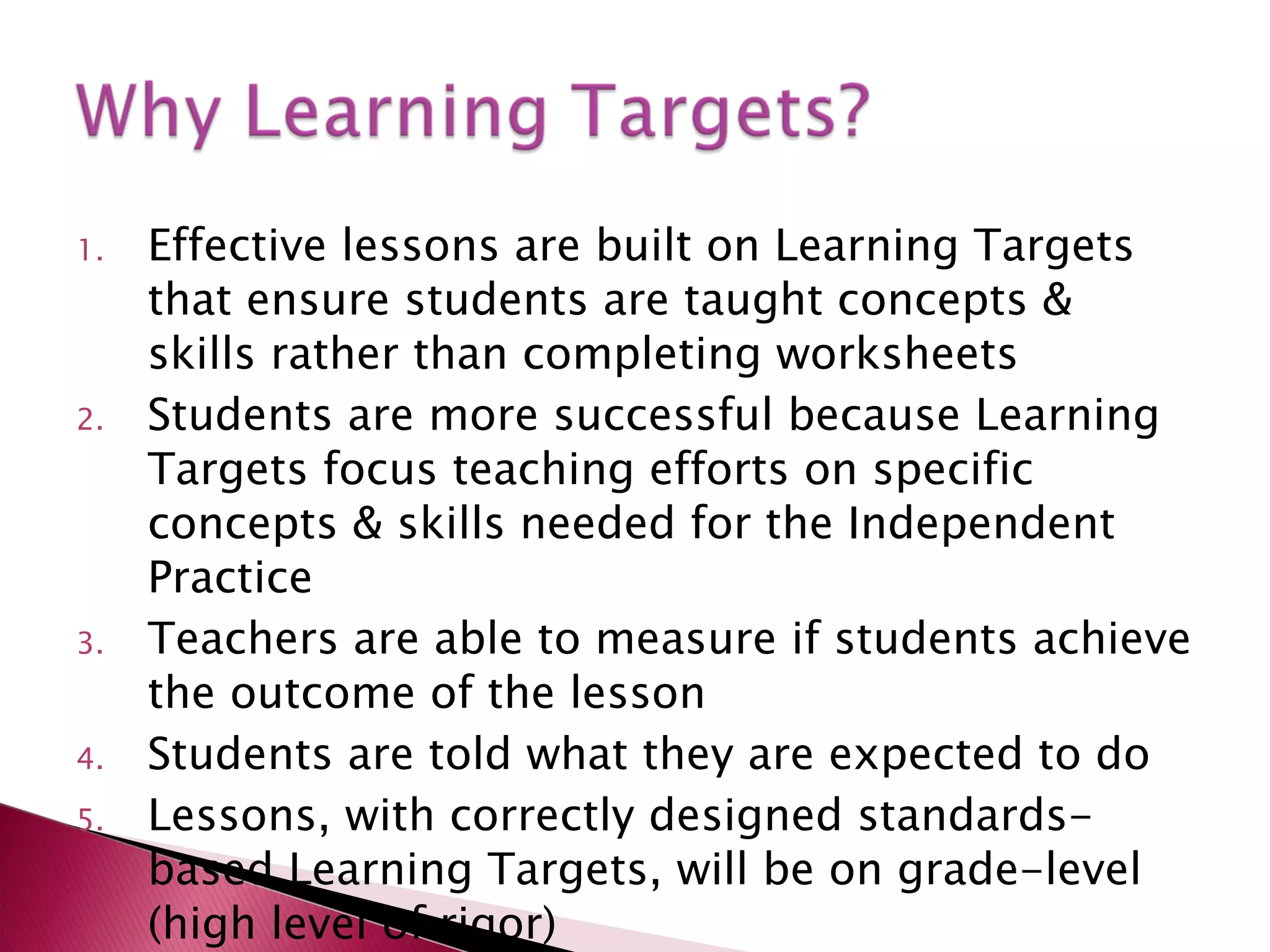
Effective lessons are built on Learning Targets that ensure students are taught concepts & skills rather than completing worksheets Students are more successful because Learning Targets focus teaching efforts on specific concepts & skills needed for the Independent Practice Teachers are able to measure if students achieve the outcome of the lesson Students are told what they are expected to do Lessons, with correctly designed standards-based Learning Targets, will be on grade-level (high level of rigor)
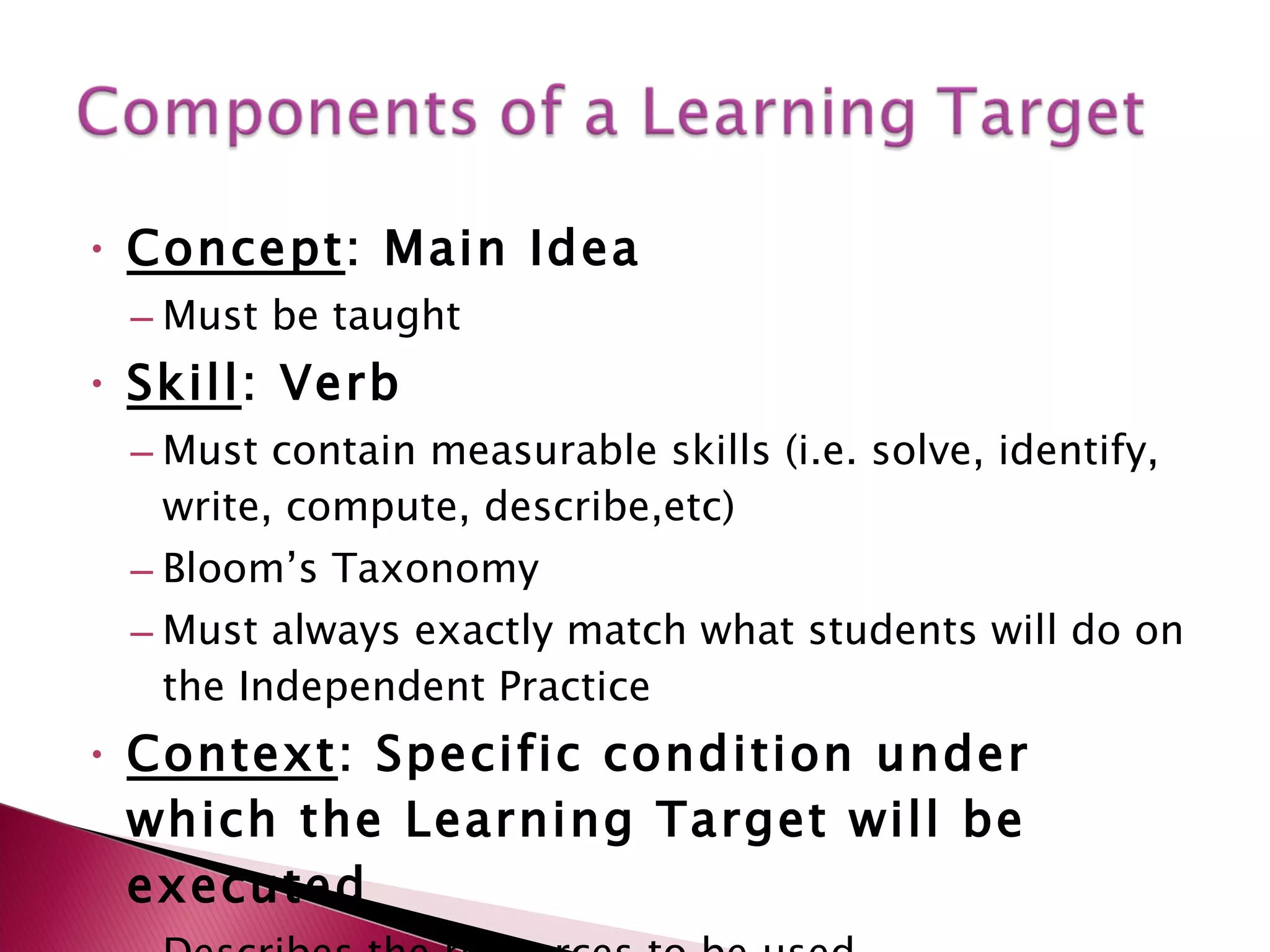
Concept : Main Idea  Must be taught Skill : Verb  Must contain measurable skills (i.e. solve, identify, write, compute, describe,etc) Bloom’s Taxonomy Must always exactly match what students will do on the Independent Practice Context : Specific condition under which the Learning Target will be executed Describes the resources to be used Can include the specific methods to be used
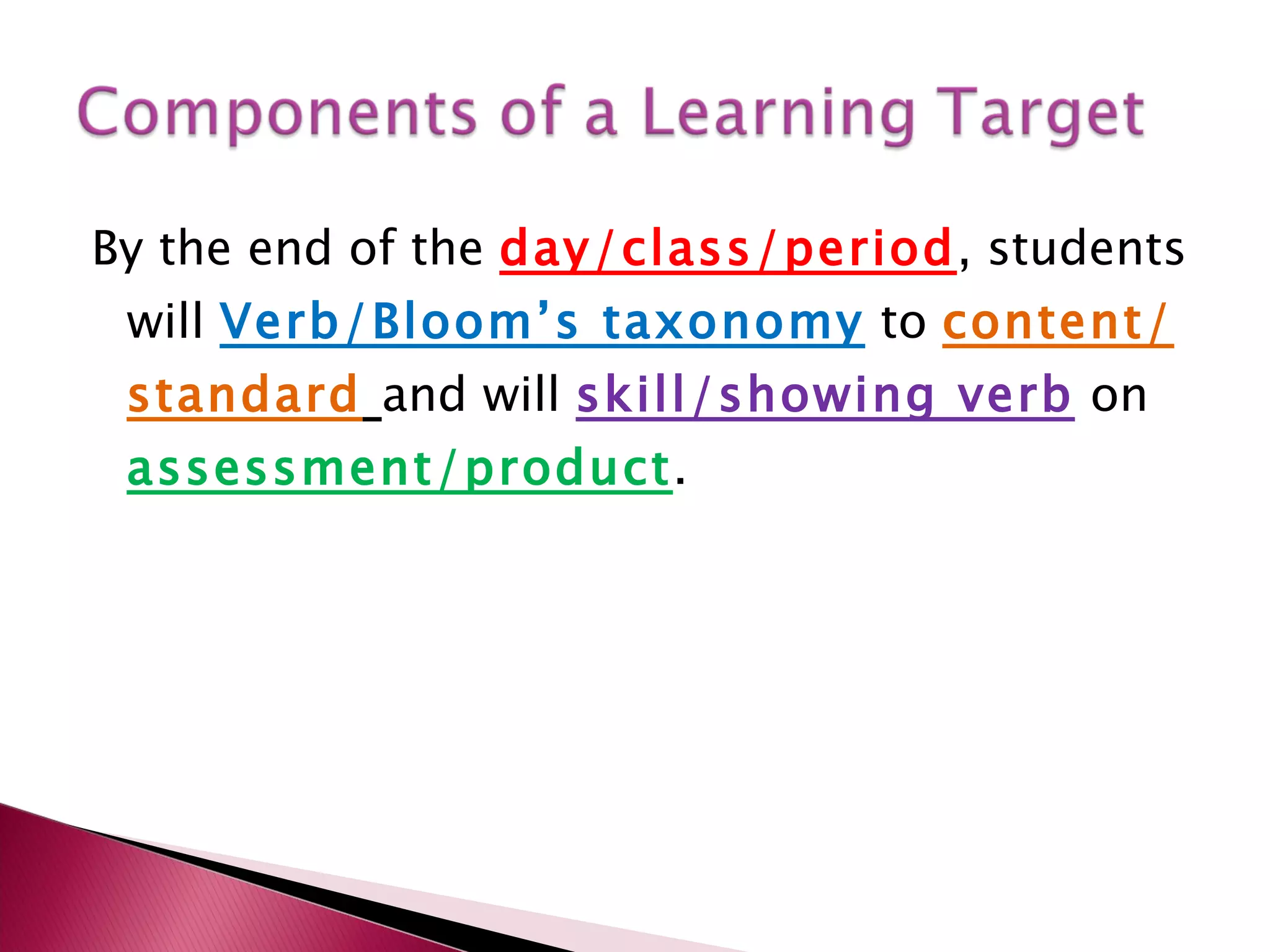
By the end of the  day/class/period , students will  Verb/Bloom’s taxonomy   to  content/standard   and will  skill/showing verb   on  assessment/product .
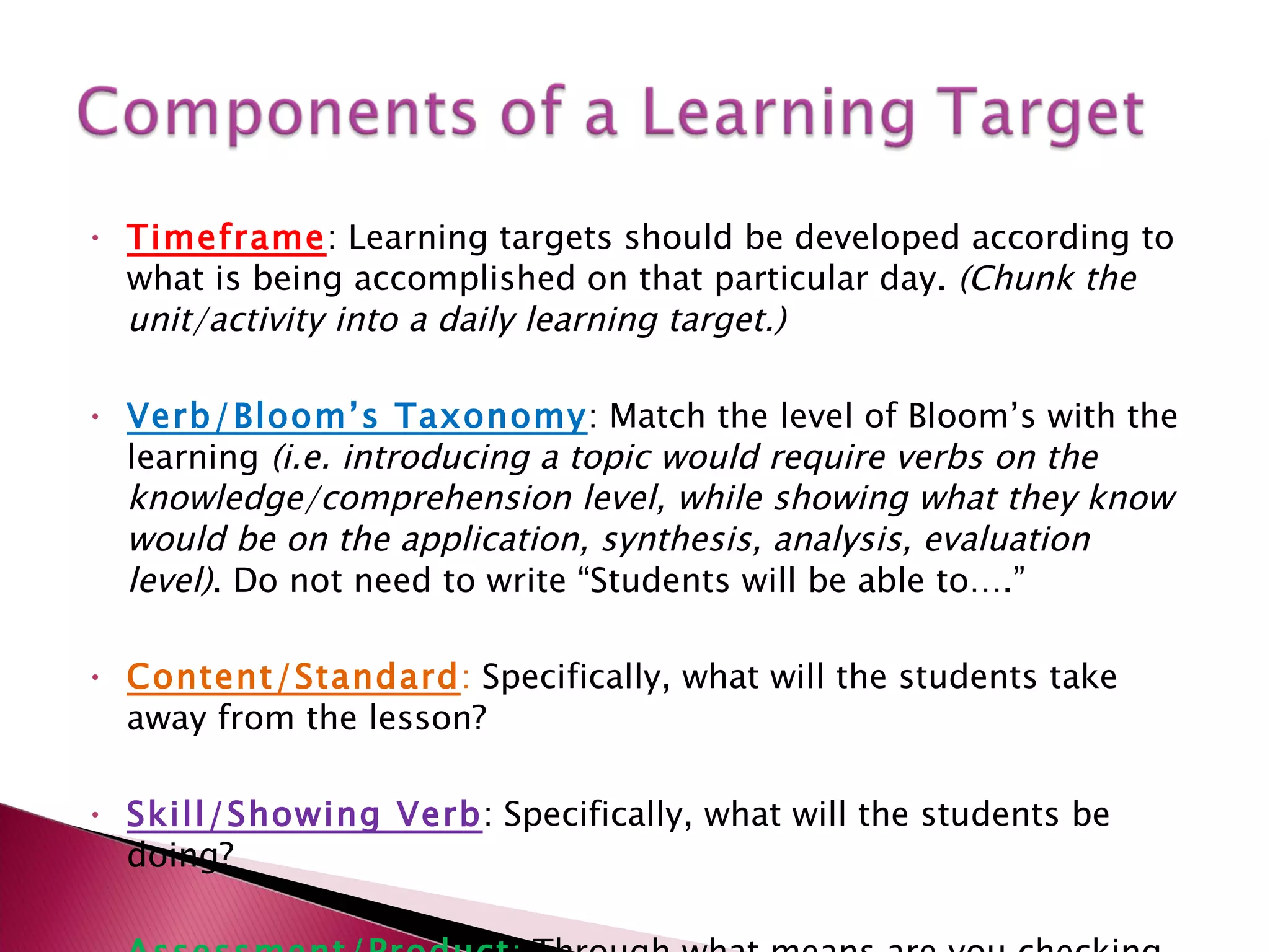
Timeframe : Learning targets should be developed according to what is being accomplished on that particular day.  (Chunk the unit/activity into a daily learning target.) Verb/Bloom’s Taxonomy : Match the level of Bloom’s with the learning  (i.e. introducing a topic would require verbs on the knowledge/comprehension level, while showing what they know would be on the application, synthesis, analysis, evaluation level) . Do not need to write “Students will be able to….”  Content/Standard :  Specifically, what will the students take away from the lesson? Skill/Showing Verb : Specifically, what will the students be doing? Assessment/Product :  Through what means are you checking for understanding of  all  students on that particular day?
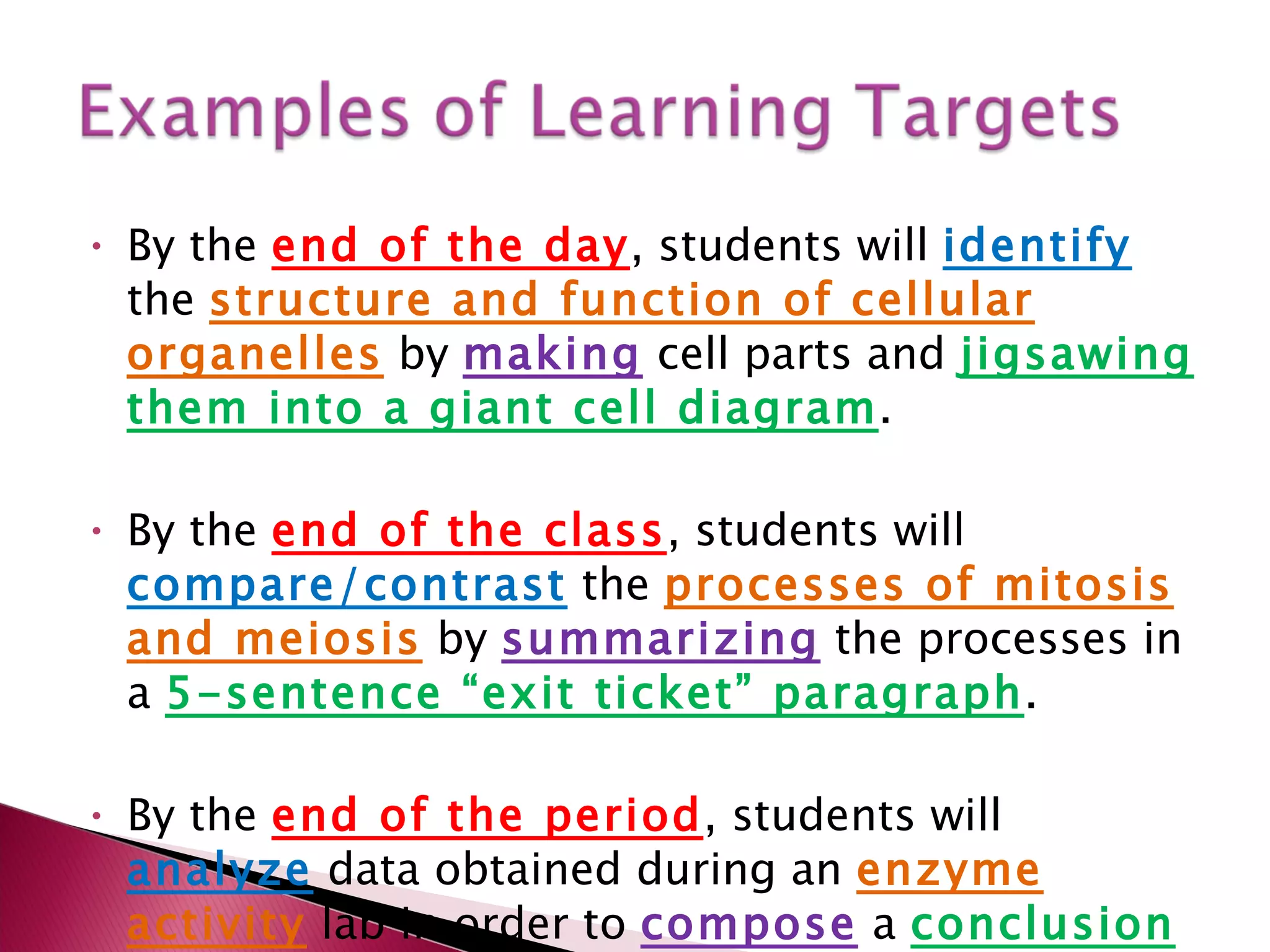
By the  end of the day , students will  identify   the  structure and function of cellular organelles   by  making  cell parts and  jigsawing them into a giant cell diagram . By the  end of the class , students will  compare/contrast  the  processes of mitosis and meiosis  by  summarizing  the processes in a  5-sentence “exit ticket” paragraph .  By the  end of the period , students will  analyze  data obtained during an  enzyme activity   lab in order to  compose  a  conclusion to a lab report .
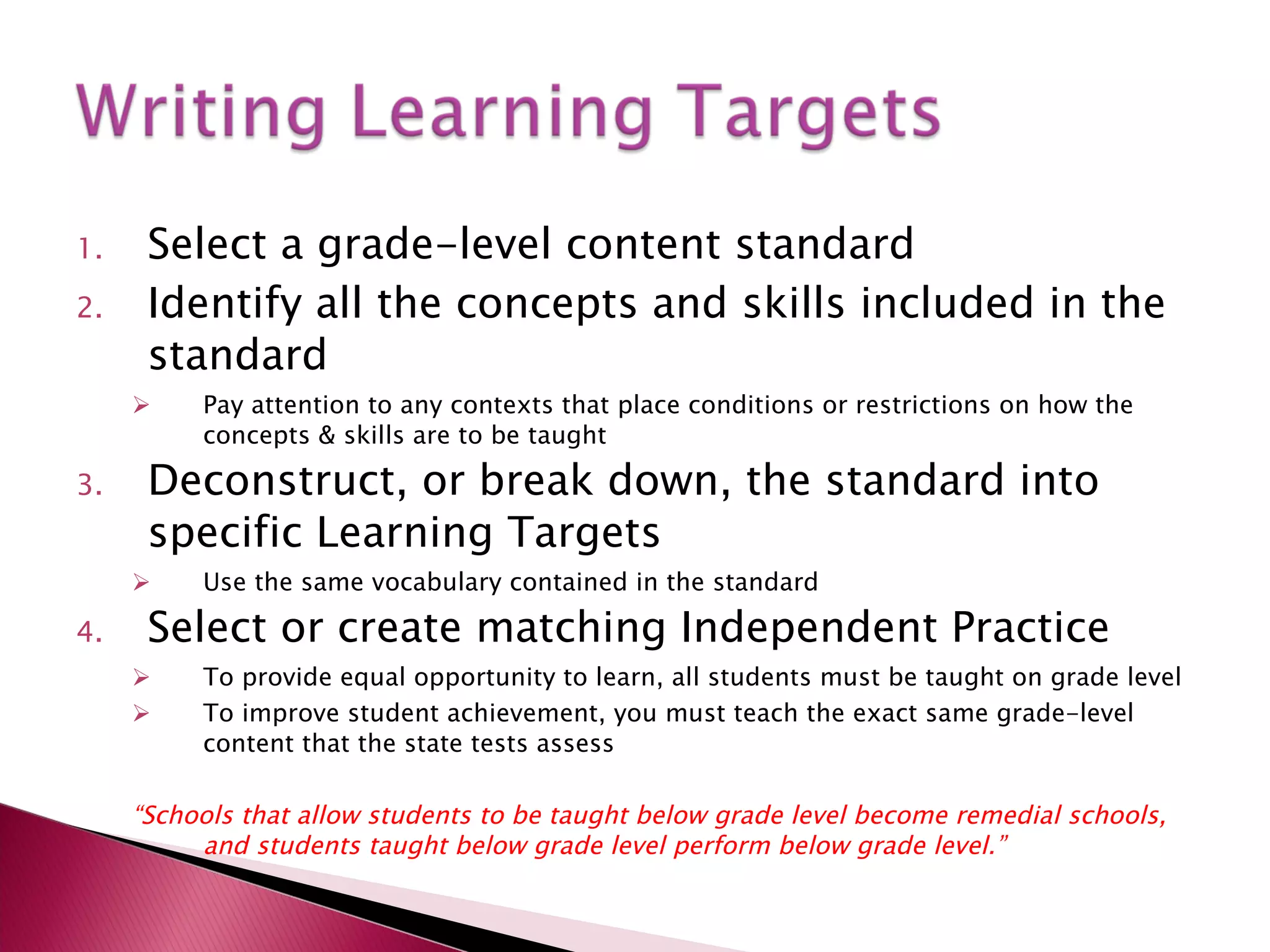
Select a grade-level content standard Identify all the concepts and skills included in the standard Pay attention to any contexts that place conditions or restrictions on how the concepts & skills are to be taught Deconstruct, or break down, the standard into specific Learning Targets Use the same vocabulary contained in the standard Select or create matching Independent Practice To provide equal opportunity to learn, all students must be taught on grade level To improve student achievement, you must teach the exact same grade-level content that the state tests assess “ Schools that allow students to be taught below grade level become remedial schools, and students taught below grade level perform below grade level.”
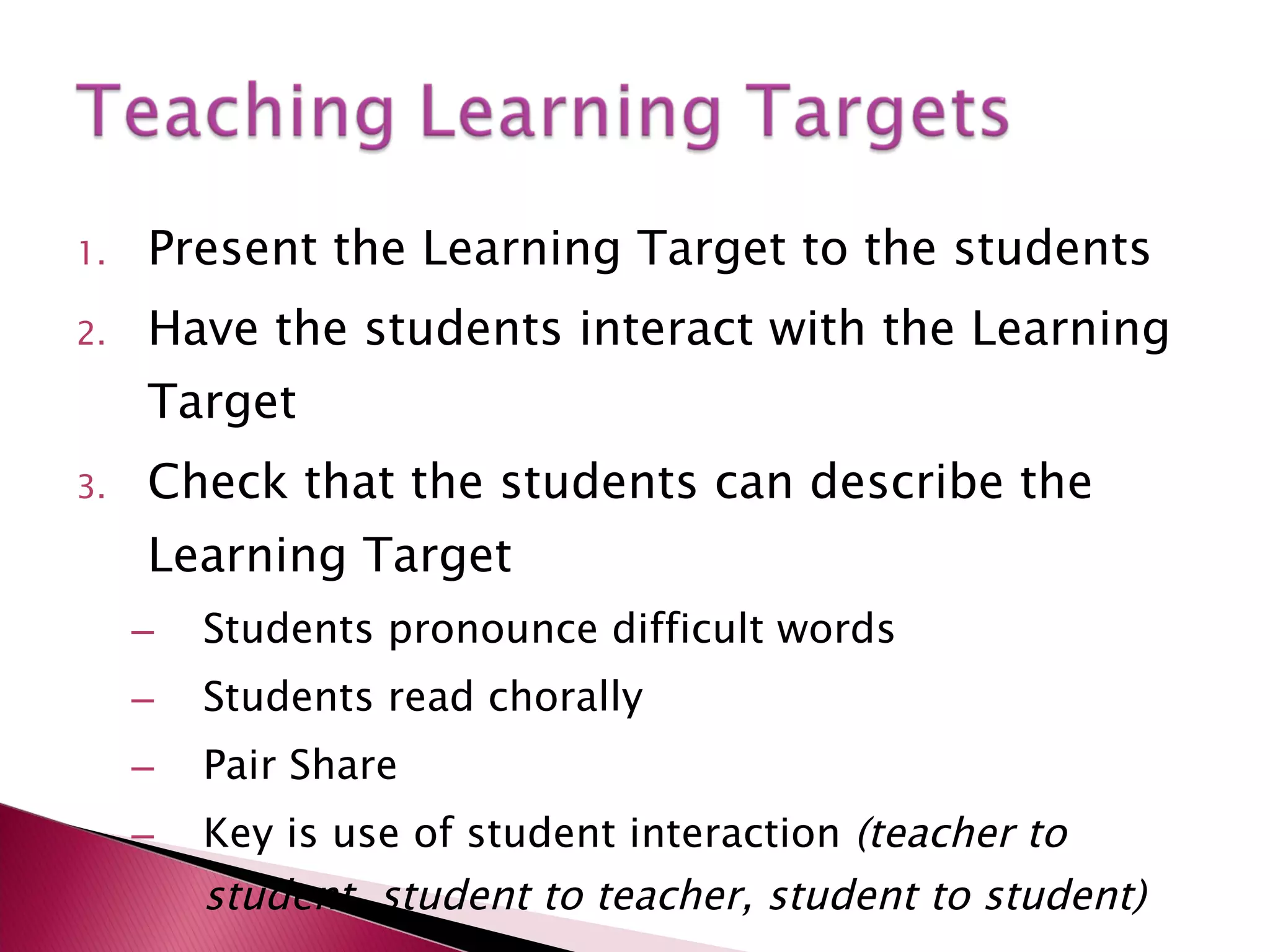
Present the Learning Target to the students Have the students interact with the Learning Target Check that the students can describe the Learning Target Students pronounce difficult words Students read chorally Pair Share Key is use of student interaction  (teacher to student, student to teacher, student to student)
Ways  NOT  to teach Learning Targets 1. Writing the whole content standard on the board as a Learning Target 2. Teacher doesn’t refer to a Learning Target at all during the entire lesson Maybe on board, but it is never mentioned Weekly agenda is posted, that may have page numbers or assignments, rather than a Learning Target

Learning Targets Edi

  • 1.
  • 2.
    SUHSD - EDI- Learning Objectives
  • 3.
    Content Standard :Describes what students will be taught over the course of a year Contain multiple Learning Targets Learning Target : Describes what students will be able to do successfully & independently at the end of a specific lesson as a result of your classroom instruction Describes what you will teach your students to do
  • 4.
    Many schools thinkthey are covering all the standards because they have a pacing calendar identifying standards in their textbooks. If you check off that students were taught the standard, not realizing it has ten separate Learning Targets, the worksheet you gave may have only covered one! BIG IDEA : To maximize student learning (and raise test scores), teach your students all the Learning Targets contained in all the tested standards before the test date.
  • 5.
    To produce greatlessons Teacher knows what is being taught; Students know exactly what they are learning Instruction and Independent Practice are synchronized Students know how to do homework, more will do homework, more will learn, and test scores will go up
  • 6.
    Effective lessons arebuilt on Learning Targets that ensure students are taught concepts & skills rather than completing worksheets Students are more successful because Learning Targets focus teaching efforts on specific concepts & skills needed for the Independent Practice Teachers are able to measure if students achieve the outcome of the lesson Students are told what they are expected to do Lessons, with correctly designed standards-based Learning Targets, will be on grade-level (high level of rigor)
  • 7.
    Concept : MainIdea Must be taught Skill : Verb Must contain measurable skills (i.e. solve, identify, write, compute, describe,etc) Bloom’s Taxonomy Must always exactly match what students will do on the Independent Practice Context : Specific condition under which the Learning Target will be executed Describes the resources to be used Can include the specific methods to be used
  • 8.
    By the endof the day/class/period , students will Verb/Bloom’s taxonomy to content/standard and will skill/showing verb on assessment/product .
  • 9.
    Timeframe : Learningtargets should be developed according to what is being accomplished on that particular day. (Chunk the unit/activity into a daily learning target.) Verb/Bloom’s Taxonomy : Match the level of Bloom’s with the learning (i.e. introducing a topic would require verbs on the knowledge/comprehension level, while showing what they know would be on the application, synthesis, analysis, evaluation level) . Do not need to write “Students will be able to….” Content/Standard : Specifically, what will the students take away from the lesson? Skill/Showing Verb : Specifically, what will the students be doing? Assessment/Product : Through what means are you checking for understanding of all students on that particular day?
  • 10.
    By the end of the day , students will identify the structure and function of cellular organelles by making cell parts and jigsawing them into a giant cell diagram . By the end of the class , students will compare/contrast the processes of mitosis and meiosis by summarizing the processes in a 5-sentence “exit ticket” paragraph . By the end of the period , students will analyze data obtained during an enzyme activity lab in order to compose a conclusion to a lab report .
  • 11.
    Select a grade-levelcontent standard Identify all the concepts and skills included in the standard Pay attention to any contexts that place conditions or restrictions on how the concepts & skills are to be taught Deconstruct, or break down, the standard into specific Learning Targets Use the same vocabulary contained in the standard Select or create matching Independent Practice To provide equal opportunity to learn, all students must be taught on grade level To improve student achievement, you must teach the exact same grade-level content that the state tests assess “ Schools that allow students to be taught below grade level become remedial schools, and students taught below grade level perform below grade level.”
  • 12.
    Present the LearningTarget to the students Have the students interact with the Learning Target Check that the students can describe the Learning Target Students pronounce difficult words Students read chorally Pair Share Key is use of student interaction (teacher to student, student to teacher, student to student)
  • 13.
    Ways NOT to teach Learning Targets 1. Writing the whole content standard on the board as a Learning Target 2. Teacher doesn’t refer to a Learning Target at all during the entire lesson Maybe on board, but it is never mentioned Weekly agenda is posted, that may have page numbers or assignments, rather than a Learning Target