Joe McVeigh NYSTESOL Melville, NY, USA October 29, 2011 Writing Effective Learning Outcomes
What   is   a   learning   outcome?
How do you use learning outcomes?
Definitions and underlying concepts An outcome is the desired result of the learning experience.
Definitions and underlying concepts Outcomes  are the  achieved results  of what was learned. They are the  evidence  that learning has taken place. Outcomes are the  abilities or products  students have shown  after  instruction. Outcomes are  what teachers will assess .
Definitions and underlying concepts A student learning outcome is “a specific statement that describes the knowledge, skills/abilities, or attitudes that students are expected to learn upon successful completion of a course of study, such as a course, seminar, or certification program.” (Wood, 2008)
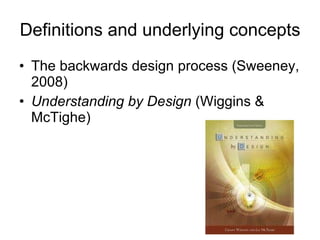
Definitions and underlying concepts The backwards design process (Sweeney, 2008)  Understanding by Design  (Wiggins & McTighe)
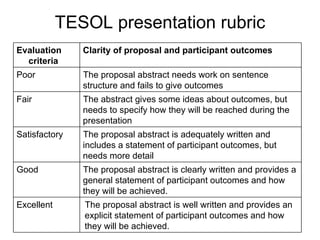
Contexts in which learning outcomes are used TESOL presentation evaluation rubric
TESOL presentation rubric The proposal abstract is well written and provides an explicit statement of participant outcomes and how they will be achieved. Excellent The proposal abstract is clearly written and provides a general statement of participant outcomes and how they will be achieved. Good The proposal abstract is adequately written and includes a statement of participant outcomes, but needs more detail Satisfactory The abstract gives some ideas about outcomes, but needs to specify how they will be reached during the presentation Fair The proposal abstract needs work on sentence structure and fails to give outcomes Poor Clarity of proposal and participant outcomes Evaluation criteria
Contexts in which learning outcomes are used U.S. state boards of education
Contexts in which learning outcomes are used Common European Framework of Reference for Languages: Learning, teaching, assessment A1, A2, B1, B2, C1, C2 Council of Europe CEFR “Can do” statements. “ Can scan texts for relevant information and grasp main topic of text, reading almost as quickly as a native speaker.”
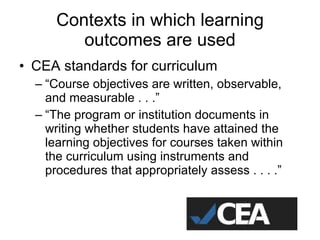
Contexts in which learning outcomes are used CEA standards for curriculum “ Course objectives are written, observable, and measurable . . .” “ The program or institution documents in writing whether students have attained the learning objectives for courses taken within the curriculum using instruments and procedures that appropriately assess . . . .”
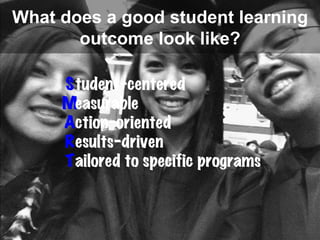
What does a good student learning outcome look like? S M A R T tudent-centered easurable ction-oriented esults-driven ailored to specific programs
What does a good student learning outcome look like?   Not too broad
What does a good student learning outcome look like?   Not too narrow
Uses strong, clear, concrete verbs such  as those found in Bloom’s Taxonomy. What does a good student learning outcome look like?
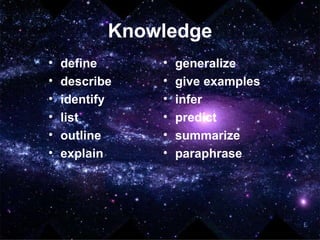
Knowledge define describe identify list outline explain generalize give examples infer predict  summarize paraphrase
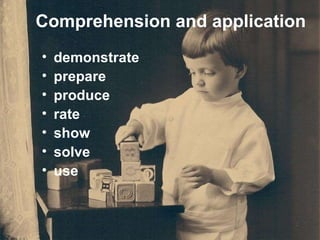
Comprehension and application demonstrate prepare produce rate show solve use
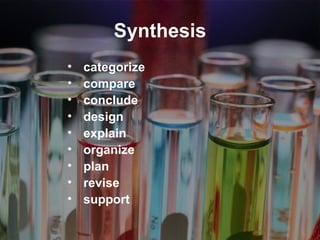
Synthesis categorize compare conclude design explain organize plan revise support
What does a good student  learning outcome look like? Uses parallel language
What does a good student  learning outcome look like? Doesn’t mix verb tenses: choose either future or present and stick with it:  Students can . . .  or Students will be  able to . . .
What does a good student  learning outcome look like? Avoids this language: Be familiar with . . .  Gain an understanding of . . . Learn about . . .  Demonstrate knowledge of . . . (Wood 2008)
What does a good student  learning outcome look like? Makes it clear: by when? End of course or program vs. beginning placement
What does a good student learning outcome look like?   Make sure that the outcome is  measurable.
How do we assess learning outcomes?   Tests, quizzes, exams Written work, oral presentations Assignments Portfolio assessment What about class participation and effort?
Try your hand at writing effective learning outcomes You are teaching a basic cooking class to junior high students who have little or no previous cooking experience. One desired result of your course is to have students successfully prepare a plate of scrambled eggs. Write one learning outcome that your course could include. Describe how you will measure or assess the outcome.
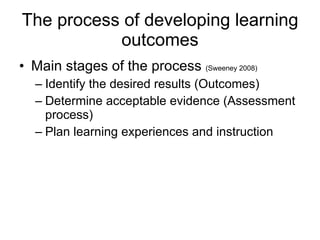
The process of developing learning outcomes Main stages of the process  (Sweeney 2008)   Identify the desired results (Outcomes) Determine acceptable evidence (Assessment process) Plan learning experiences and instruction
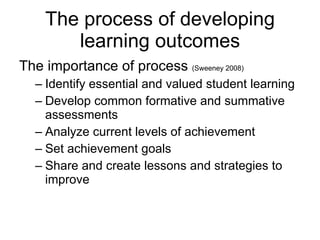
The importance of process  (Sweeney 2008)   Identify essential and valued student learning Develop common formative and summative assessments Analyze current levels of achievement Set achievement goals Share and create lessons and strategies to improve The process of developing learning outcomes
The process of developing learning outcomes Dealing with resistance
Questions
 
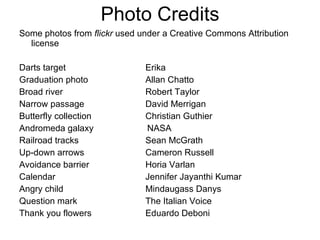
Photo Credits Some photos from  flickr  used under a Creative Commons Attribution license  Darts target Erika Graduation photo Allan Chatto Broad river Robert Taylor Narrow passage David Merrigan Butterfly collection Christian Guthier Andromeda galaxy NASA Railroad tracks Sean McGrath Up-down arrows Cameron Russell Avoidance barrier Horia Varlan Calendar Jennifer Jayanthi Kumar Angry child Mindaugass Danys Question mark The Italian Voice Thank you flowers Eduardo Deboni
Download copies of the handout  and PowerPoint slides at www.joemcveigh.org/resources Thank you !

Writing Effective Learning Outcomes

  • 1.
    Joe McVeigh NYSTESOLMelville, NY, USA October 29, 2011 Writing Effective Learning Outcomes
  • 2.
    What is a learning outcome?
  • 3.
    How do youuse learning outcomes?
  • 4.
    Definitions and underlyingconcepts An outcome is the desired result of the learning experience.
  • 5.
    Definitions and underlyingconcepts Outcomes are the achieved results of what was learned. They are the evidence that learning has taken place. Outcomes are the abilities or products students have shown after instruction. Outcomes are what teachers will assess .
  • 6.
    Definitions and underlyingconcepts A student learning outcome is “a specific statement that describes the knowledge, skills/abilities, or attitudes that students are expected to learn upon successful completion of a course of study, such as a course, seminar, or certification program.” (Wood, 2008)
  • 7.
    Definitions and underlyingconcepts The backwards design process (Sweeney, 2008) Understanding by Design (Wiggins & McTighe)
  • 8.
    Contexts in whichlearning outcomes are used TESOL presentation evaluation rubric
  • 9.
    TESOL presentation rubricThe proposal abstract is well written and provides an explicit statement of participant outcomes and how they will be achieved. Excellent The proposal abstract is clearly written and provides a general statement of participant outcomes and how they will be achieved. Good The proposal abstract is adequately written and includes a statement of participant outcomes, but needs more detail Satisfactory The abstract gives some ideas about outcomes, but needs to specify how they will be reached during the presentation Fair The proposal abstract needs work on sentence structure and fails to give outcomes Poor Clarity of proposal and participant outcomes Evaluation criteria
  • 10.
    Contexts in whichlearning outcomes are used U.S. state boards of education
  • 11.
    Contexts in whichlearning outcomes are used Common European Framework of Reference for Languages: Learning, teaching, assessment A1, A2, B1, B2, C1, C2 Council of Europe CEFR “Can do” statements. “ Can scan texts for relevant information and grasp main topic of text, reading almost as quickly as a native speaker.”
  • 12.
    Contexts in whichlearning outcomes are used CEA standards for curriculum “ Course objectives are written, observable, and measurable . . .” “ The program or institution documents in writing whether students have attained the learning objectives for courses taken within the curriculum using instruments and procedures that appropriately assess . . . .”
  • 13.
    What does agood student learning outcome look like? S M A R T tudent-centered easurable ction-oriented esults-driven ailored to specific programs
  • 14.
    What does agood student learning outcome look like? Not too broad
  • 15.
    What does agood student learning outcome look like? Not too narrow
  • 16.
    Uses strong, clear,concrete verbs such as those found in Bloom’s Taxonomy. What does a good student learning outcome look like?
  • 17.
    Knowledge define describeidentify list outline explain generalize give examples infer predict summarize paraphrase
  • 18.
    Comprehension and applicationdemonstrate prepare produce rate show solve use
  • 19.
    Synthesis categorize compareconclude design explain organize plan revise support
  • 20.
    What does agood student learning outcome look like? Uses parallel language
  • 21.
    What does agood student learning outcome look like? Doesn’t mix verb tenses: choose either future or present and stick with it: Students can . . . or Students will be able to . . .
  • 22.
    What does agood student learning outcome look like? Avoids this language: Be familiar with . . . Gain an understanding of . . . Learn about . . . Demonstrate knowledge of . . . (Wood 2008)
  • 23.
    What does agood student learning outcome look like? Makes it clear: by when? End of course or program vs. beginning placement
  • 24.
    What does agood student learning outcome look like? Make sure that the outcome is measurable.
  • 25.
    How do weassess learning outcomes? Tests, quizzes, exams Written work, oral presentations Assignments Portfolio assessment What about class participation and effort?
  • 26.
    Try your handat writing effective learning outcomes You are teaching a basic cooking class to junior high students who have little or no previous cooking experience. One desired result of your course is to have students successfully prepare a plate of scrambled eggs. Write one learning outcome that your course could include. Describe how you will measure or assess the outcome.
  • 27.
    The process ofdeveloping learning outcomes Main stages of the process (Sweeney 2008) Identify the desired results (Outcomes) Determine acceptable evidence (Assessment process) Plan learning experiences and instruction
  • 28.
    The importance ofprocess (Sweeney 2008) Identify essential and valued student learning Develop common formative and summative assessments Analyze current levels of achievement Set achievement goals Share and create lessons and strategies to improve The process of developing learning outcomes
  • 29.
    The process ofdeveloping learning outcomes Dealing with resistance
  • 30.
  • 31.
  • 32.
    Photo Credits Somephotos from flickr used under a Creative Commons Attribution license Darts target Erika Graduation photo Allan Chatto Broad river Robert Taylor Narrow passage David Merrigan Butterfly collection Christian Guthier Andromeda galaxy NASA Railroad tracks Sean McGrath Up-down arrows Cameron Russell Avoidance barrier Horia Varlan Calendar Jennifer Jayanthi Kumar Angry child Mindaugass Danys Question mark The Italian Voice Thank you flowers Eduardo Deboni
  • 33.
    Download copies ofthe handout and PowerPoint slides at www.joemcveigh.org/resources Thank you !

Editor's Notes

  • #8 Think first of the final outcome. What do you want students to be able to do? Decide what ACCEPTABLE EVIDENCE will be that they reach the outcome.NEXT think of what they will need to learn. What GAPS in knowledge do they have? What do I need to teach them? How will I teach. PLAN the learning experiences. British Council--clear explanation