Prepared by:
Mia Ruth L. Barroga
BSE English 2-1
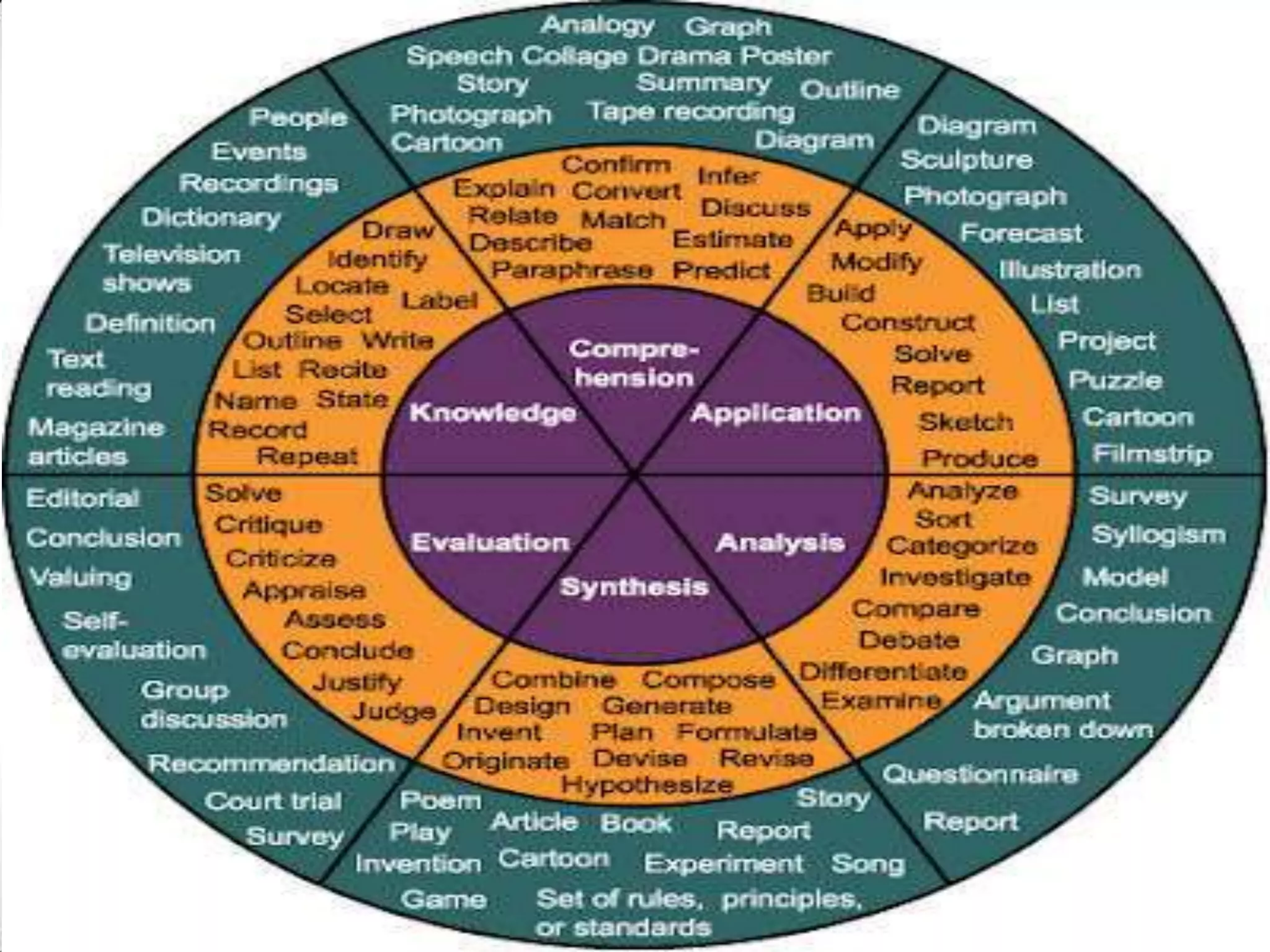
►Is a classification of learning
objectives within education proposed
in 1956 by a committee of educators
chaired by Benjamin Bloom
► Created in order to promote higher
forms of thinking in education, such
as analyzing and evaluating, rather
than just remembering facts.
►Bloom’s taxonomy divides educational
objectives into three types:
Cognitive(knowing/head),
Affective(Feeling/heart) and
Psychomotor(doing/hands)
►Bloom's Taxonomy is considered to be a
foundational and essential element within
the education community as evidenced in
the 1981 survey Significant writings that
have influenced the curriculum: 1906-
1981, by H.G. Shane and the 1994
yearbook of the National Society for the
Study of Education
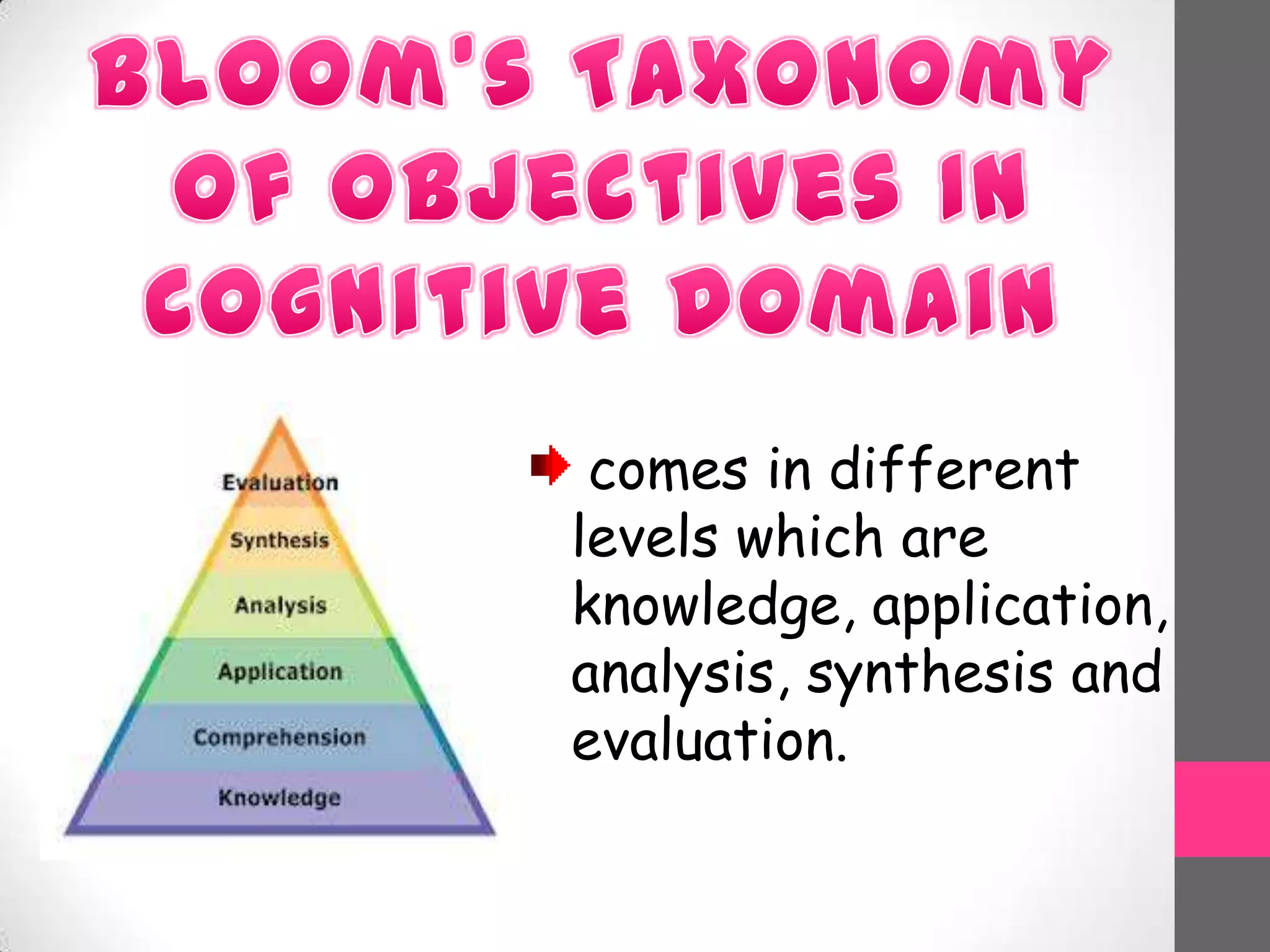
comes in different
levels which are
knowledge, application,
analysis, synthesis and
evaluation.
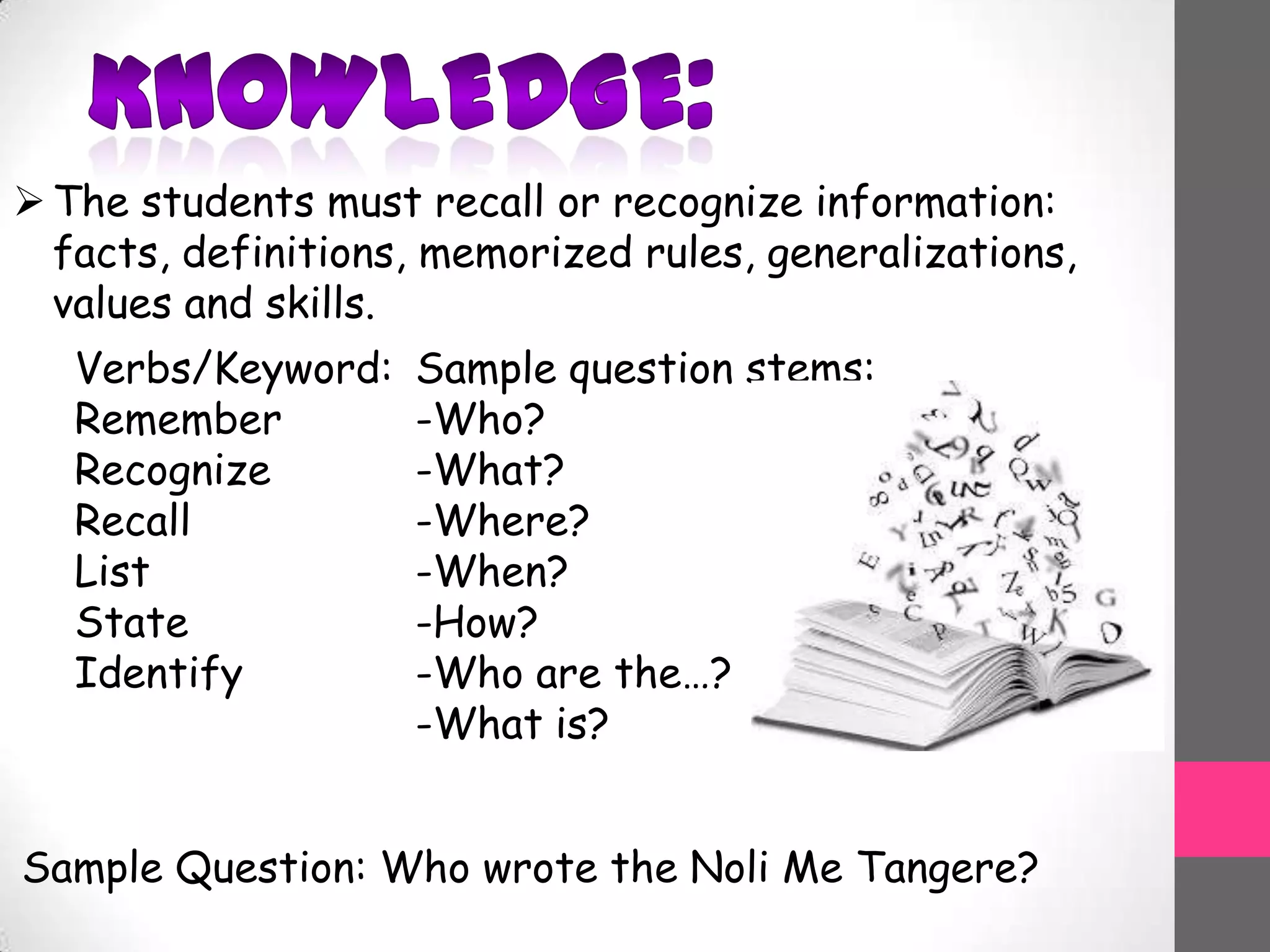
The students must recall or recognize information:
facts, definitions, memorized rules, generalizations,
values and skills.
Verbs/Keyword:
Remember
Recognize
Recall
List
State
Identify
Sample question stems:
-Who?
-What?
-Where?
-When?
-How?
-Who are the…?
-What is?
Sample Question: Who wrote the Noli Me Tangere?
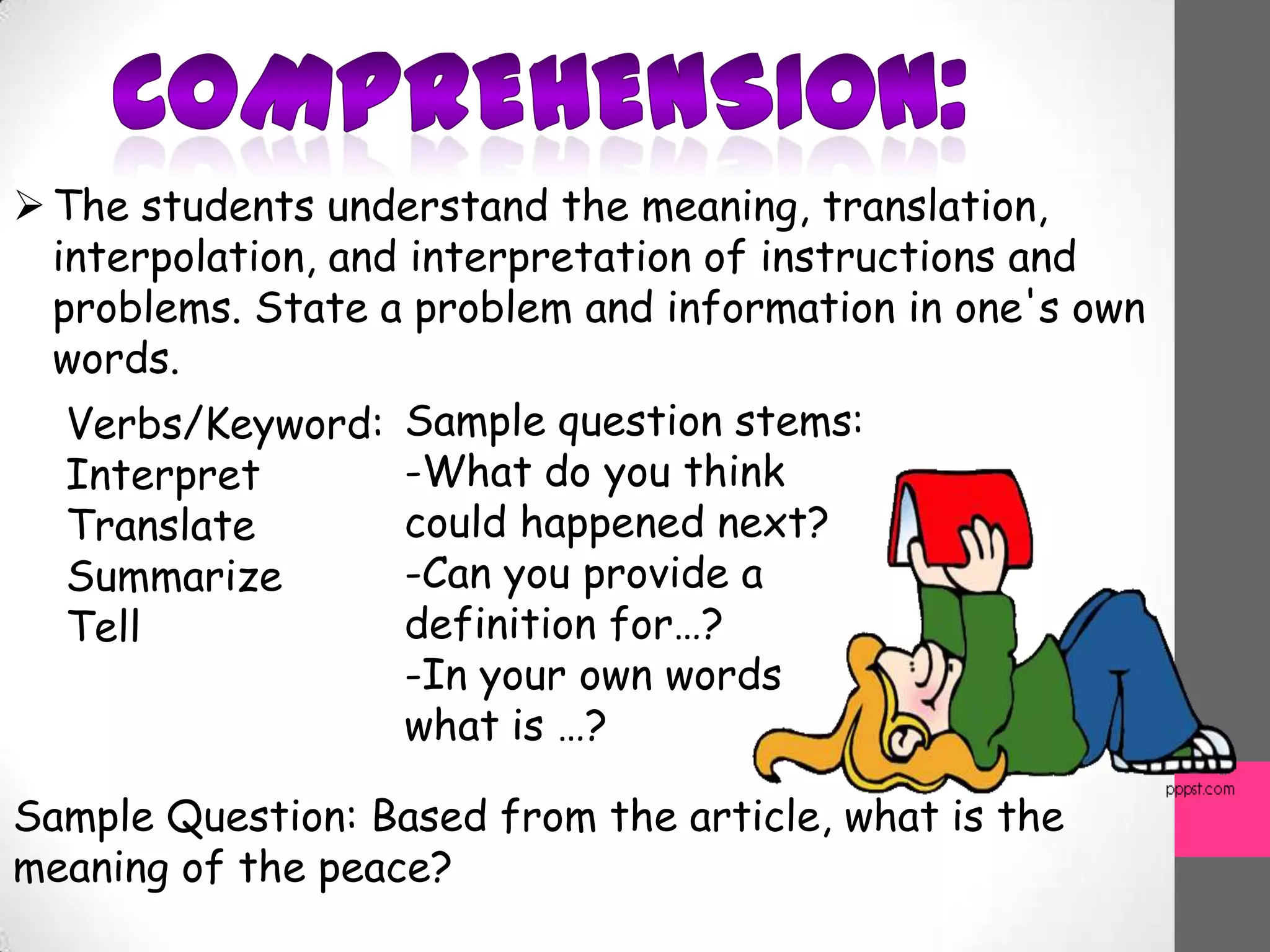
The students understand the meaning, translation,
interpolation, and interpretation of instructions and
problems. State a problem and information in one's own
words.
Verbs/Keyword:
Interpret
Translate
Summarize
Tell
Sample question stems:
-What do you think
could happened next?
-Can you provide a
definition for…?
-In your own words
what is …?
Sample Question: Based from the article, what is the
meaning of the peace?
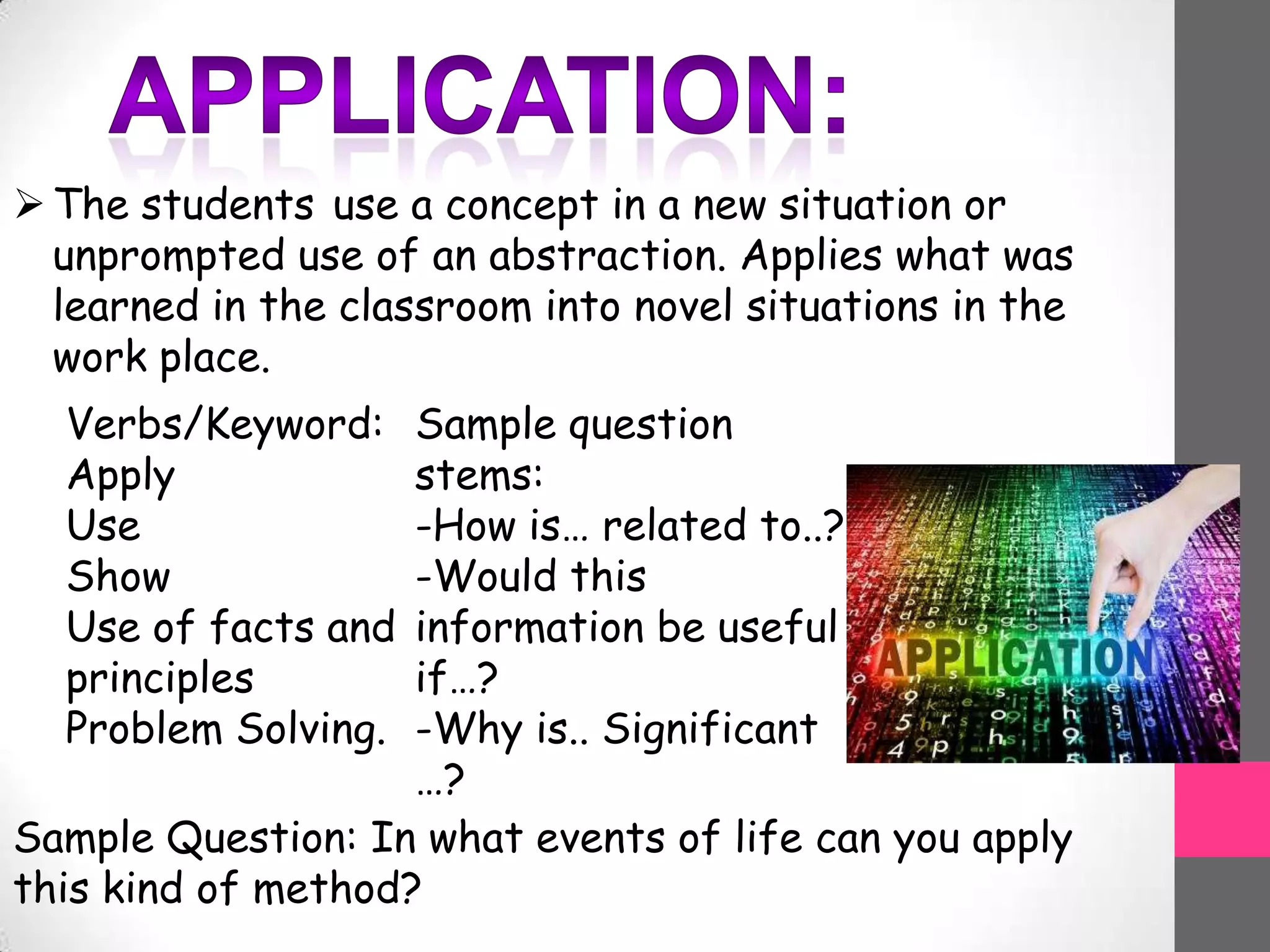
The students use a concept in a new situation or
unprompted use of an abstraction. Applies what was
learned in the classroom into novel situations in the
work place.
Verbs/Keyword:
Apply
Use
Show
Use of facts and
principles
Problem Solving.
Sample question
stems:
-How is… related to..?
-Would this
information be useful
if…?
-Why is.. Significant
…?
Sample Question: In what events of life can you apply
this kind of method?
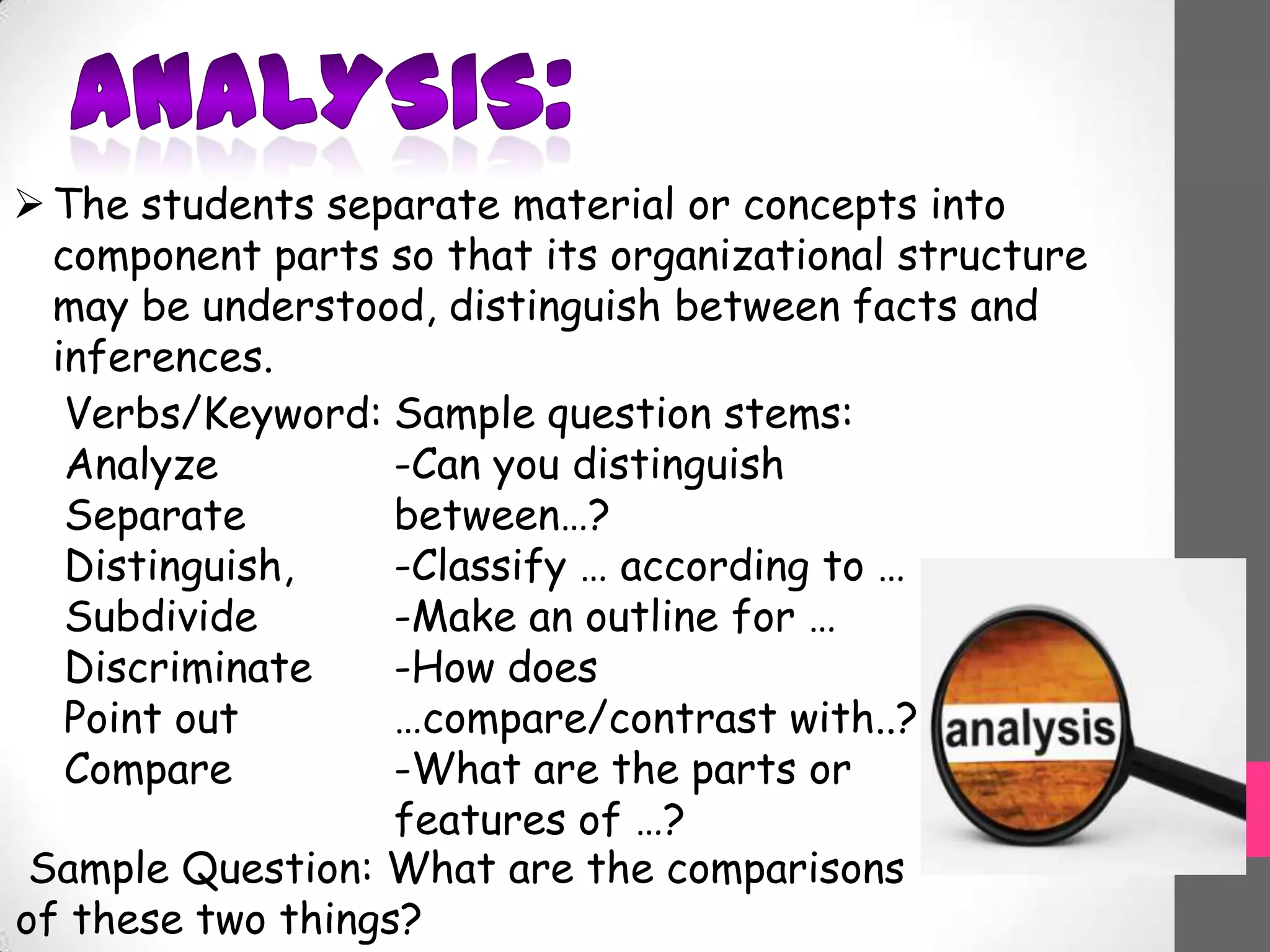
The students separate material or concepts into
component parts so that its organizational structure
may be understood, distinguish between facts and
inferences.
Verbs/Keyword:
Analyze
Separate
Distinguish,
Subdivide
Discriminate
Point out
Compare
Sample question stems:
-Can you distinguish
between…?
-Classify … according to …
-Make an outline for …
-How does
…compare/contrast with..?
-What are the parts or
features of …?
Sample Question: What are the comparisons
of these two things?
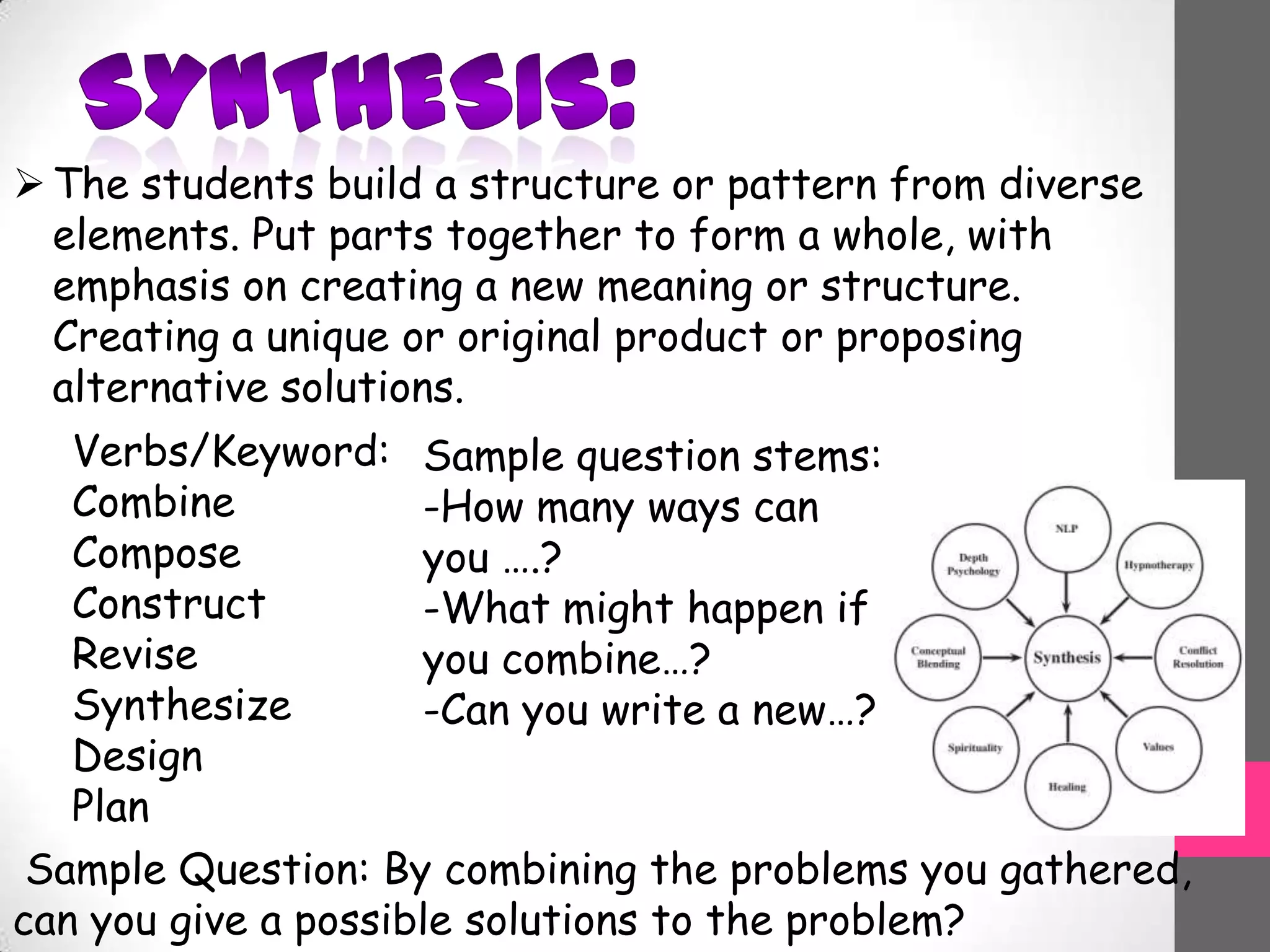
The students build a structure or pattern from diverse
elements. Put parts together to form a whole, with
emphasis on creating a new meaning or structure.
Creating a unique or original product or proposing
alternative solutions.
Verbs/Keyword:
Combine
Compose
Construct
Revise
Synthesize
Design
Plan
Sample question stems:
-How many ways can
you ….?
-What might happen if
you combine…?
-Can you write a new…?
Sample Question: By combining the problems you gathered,
can you give a possible solutions to the problem?
 The students make judgments about the value of ideas
or materials. Development of opinions or decisions.
Verbs/Keyword:
Criticize
Defend
Assess
Justify
Judge
Evaluate
Sample question stems:
Can you defend your …?
What is the most
important…?
Do you agree…?
What do you think
about…?
Sample Question: Do you think Mrs. Janet
Lim-Napoles can be used as state witness?
Why or why not?
As teachers we tend to
ask questions in the
"knowledge" category
80% to 90% of the
time. These questions
are not bad, but using
them all the time is.
Try to utilize higher
order level of
questions. These
questions require much
more "brain power" and
a more extensive and
elaborate answer.
Bloom's taxonomy of Objectives

Bloom's taxonomy of Objectives

  • 1.
    Prepared by: Mia RuthL. Barroga BSE English 2-1
  • 2.
    ►Is a classificationof learning objectives within education proposed in 1956 by a committee of educators chaired by Benjamin Bloom ► Created in order to promote higher forms of thinking in education, such as analyzing and evaluating, rather than just remembering facts.
  • 3.
    ►Bloom’s taxonomy divideseducational objectives into three types: Cognitive(knowing/head), Affective(Feeling/heart) and Psychomotor(doing/hands) ►Bloom's Taxonomy is considered to be a foundational and essential element within the education community as evidenced in the 1981 survey Significant writings that have influenced the curriculum: 1906- 1981, by H.G. Shane and the 1994 yearbook of the National Society for the Study of Education
  • 4.
    comes in different levelswhich are knowledge, application, analysis, synthesis and evaluation.
  • 6.
    The students mustrecall or recognize information: facts, definitions, memorized rules, generalizations, values and skills. Verbs/Keyword: Remember Recognize Recall List State Identify Sample question stems: -Who? -What? -Where? -When? -How? -Who are the…? -What is? Sample Question: Who wrote the Noli Me Tangere?
  • 7.
    The students understandthe meaning, translation, interpolation, and interpretation of instructions and problems. State a problem and information in one's own words. Verbs/Keyword: Interpret Translate Summarize Tell Sample question stems: -What do you think could happened next? -Can you provide a definition for…? -In your own words what is …? Sample Question: Based from the article, what is the meaning of the peace?
  • 8.
    The students usea concept in a new situation or unprompted use of an abstraction. Applies what was learned in the classroom into novel situations in the work place. Verbs/Keyword: Apply Use Show Use of facts and principles Problem Solving. Sample question stems: -How is… related to..? -Would this information be useful if…? -Why is.. Significant …? Sample Question: In what events of life can you apply this kind of method?
  • 9.
    The students separatematerial or concepts into component parts so that its organizational structure may be understood, distinguish between facts and inferences. Verbs/Keyword: Analyze Separate Distinguish, Subdivide Discriminate Point out Compare Sample question stems: -Can you distinguish between…? -Classify … according to … -Make an outline for … -How does …compare/contrast with..? -What are the parts or features of …? Sample Question: What are the comparisons of these two things?
  • 10.
    The students builda structure or pattern from diverse elements. Put parts together to form a whole, with emphasis on creating a new meaning or structure. Creating a unique or original product or proposing alternative solutions. Verbs/Keyword: Combine Compose Construct Revise Synthesize Design Plan Sample question stems: -How many ways can you ….? -What might happen if you combine…? -Can you write a new…? Sample Question: By combining the problems you gathered, can you give a possible solutions to the problem?
  • 11.
     The studentsmake judgments about the value of ideas or materials. Development of opinions or decisions. Verbs/Keyword: Criticize Defend Assess Justify Judge Evaluate Sample question stems: Can you defend your …? What is the most important…? Do you agree…? What do you think about…? Sample Question: Do you think Mrs. Janet Lim-Napoles can be used as state witness? Why or why not?
  • 12.
    As teachers wetend to ask questions in the "knowledge" category 80% to 90% of the time. These questions are not bad, but using them all the time is. Try to utilize higher order level of questions. These questions require much more "brain power" and a more extensive and elaborate answer.

Editor's Notes