

Presentation
            On
CoGnitivE Domain oF Blooms’
        taxanomy


    By Javed Iqbal Professional
    Development Teacher of AKU-IED,
          Powerpoint Template
    PDCN for EDIP Project and Arif
Outline Powerpoint Template
 Session learning outcomes
 Background of Blooms taxonomy
 Old and new versions of Bloom’s taxonomy
 Domains of blooms taxonomy
 Cognitive
 Affective
 Psychomotor
 Chart of Cognitive Domain
                              Javed Iqbal Anjum   6/22/2012   Page 2
                                                                   2
Session learning Outcome
          Powerpoint Template


By the end of this session C.Ps could be able to;
   Discuss cognitive, domain of blooms’
    taxonomy in detail with its level.
   Share the levels of affective and psychomotor
    domain
   Use action words of cognitive domain levels
    in developing SLOs for their lesson plans.
   Relate Cognitive domain with their daily life
    experiences.
                            Javed Iqbal Anjum   6/22/2012   Page 3
                                                                 3
Background of Blooms taxonomy
                 Powerpoint Template


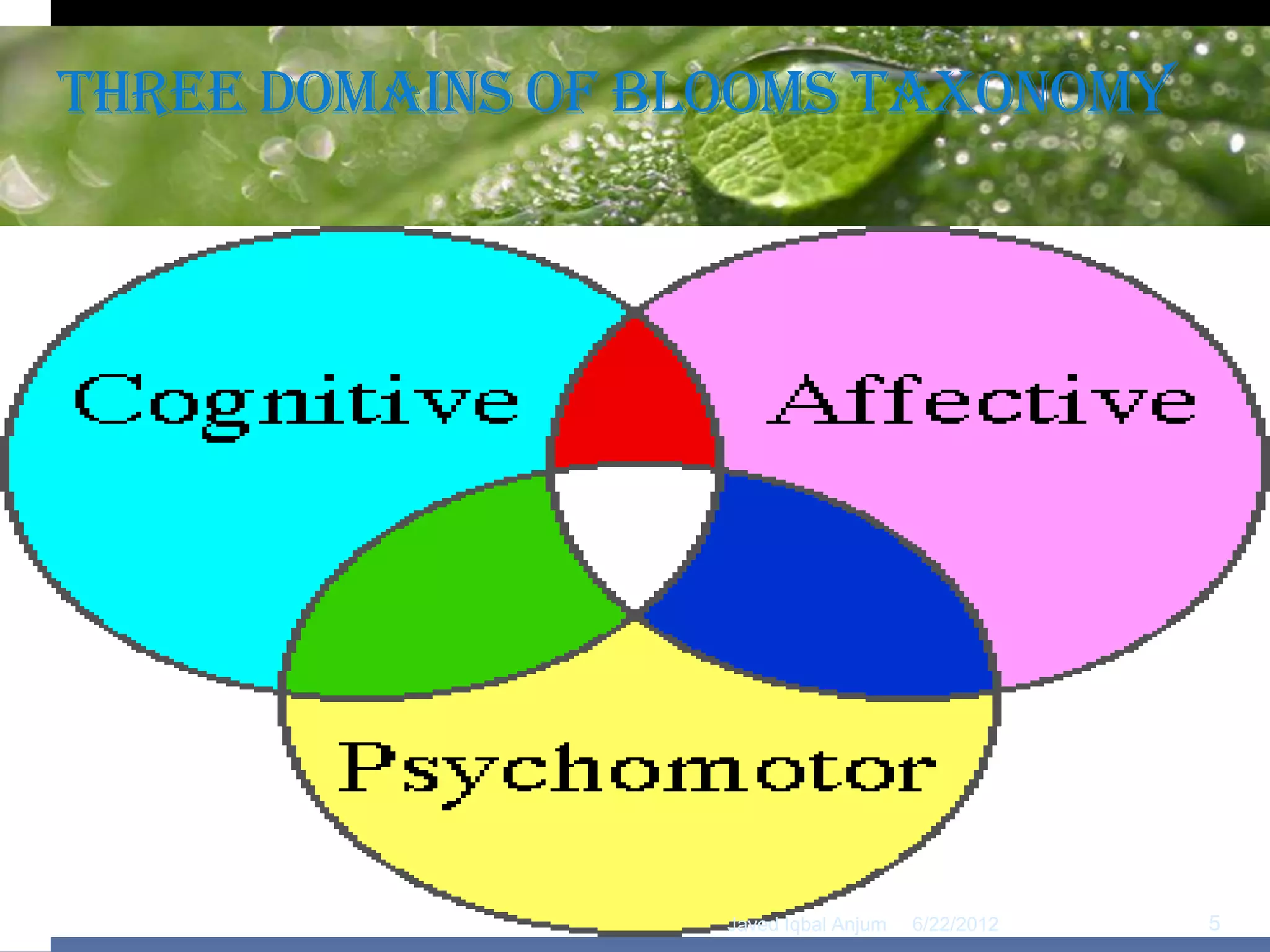
 A committee of colleges, led by Benjamin Bloom
  (1956), identified three domains of educational
  activities:
 Cognitive: mental skills (Knowledge)
 Affective: growth in feelings or emotional areas
  (Attitude)
 Psychomotor: manual or physical skills (Skills)
  www.nwlink.com/~donclark/hrd/bloom.html


                                  Javed Iqbal Anjum   6/22/2012   Page 4
                                                                       4
Three Domains of Blooms Taxonomy
           Powerpoint Template


                   Javed Iqbal Anjum   6/22/2012   Page 5
                                                        5
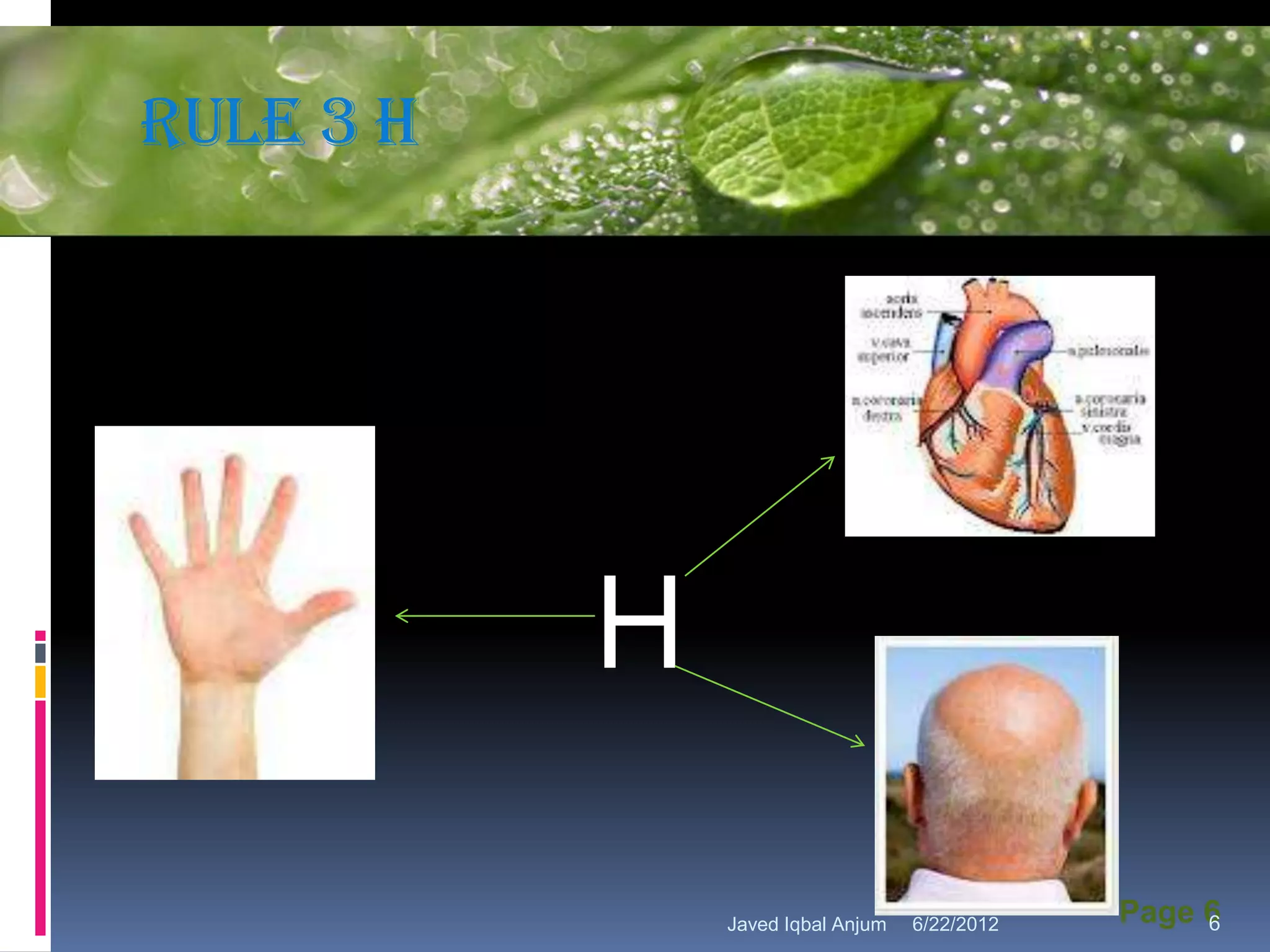
Rule 3 H   Powerpoint Template


                    H
                            Javed Iqbal Anjum   6/22/2012   Page 6
                                                                 6
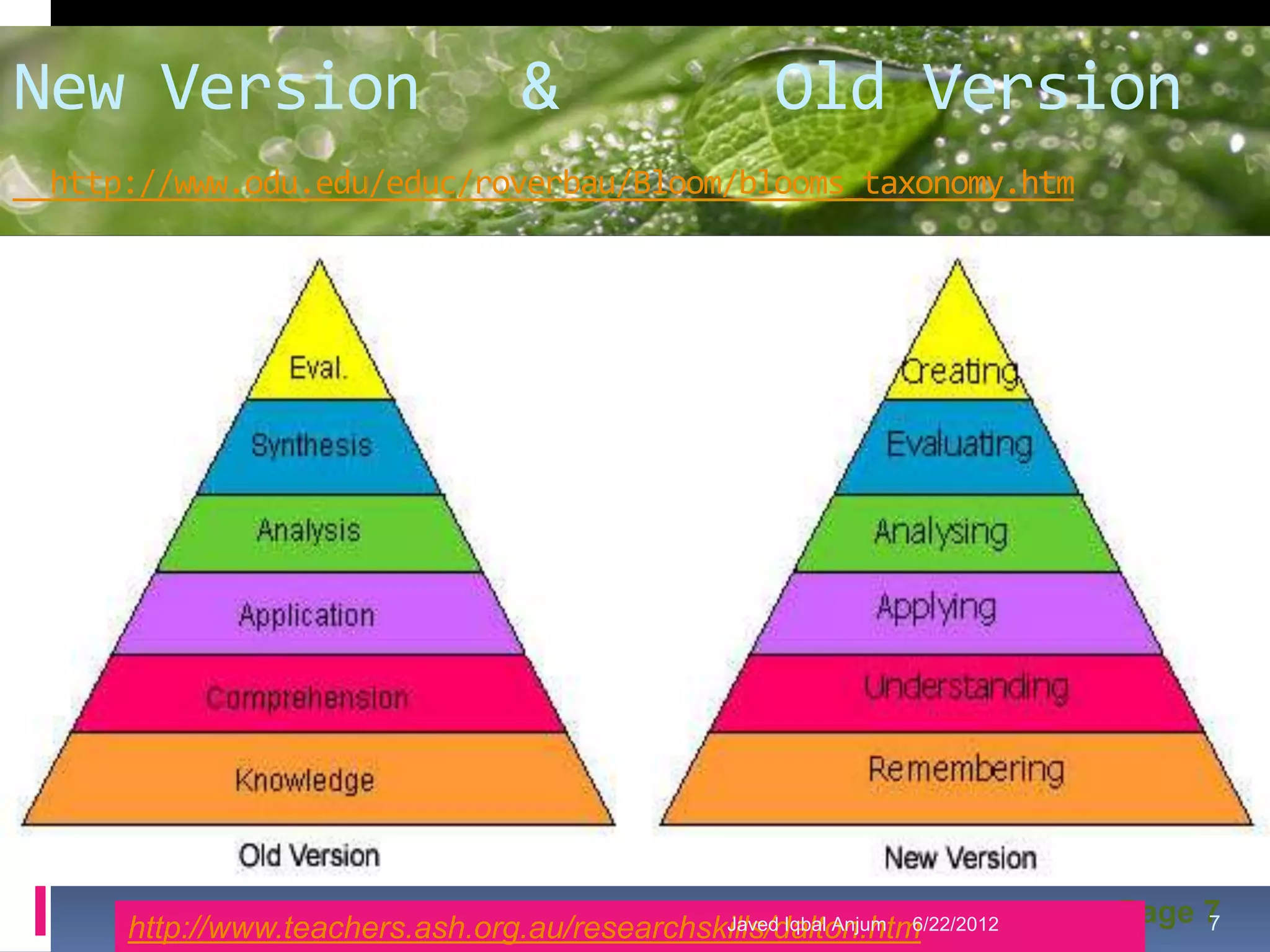
New Version                     & Template Old Version
                            Powerpoint
http://www.odu.edu/educ/roverbau/Bloom/blooms_taxonomy.htm


    http://www.teachers.ash.org.au/researchskills/dalton.htm
                                             Javed Iqbal Anjum 6/22/2012   Page 7
                                                                                7
Cognitive
           Powerpoint Template


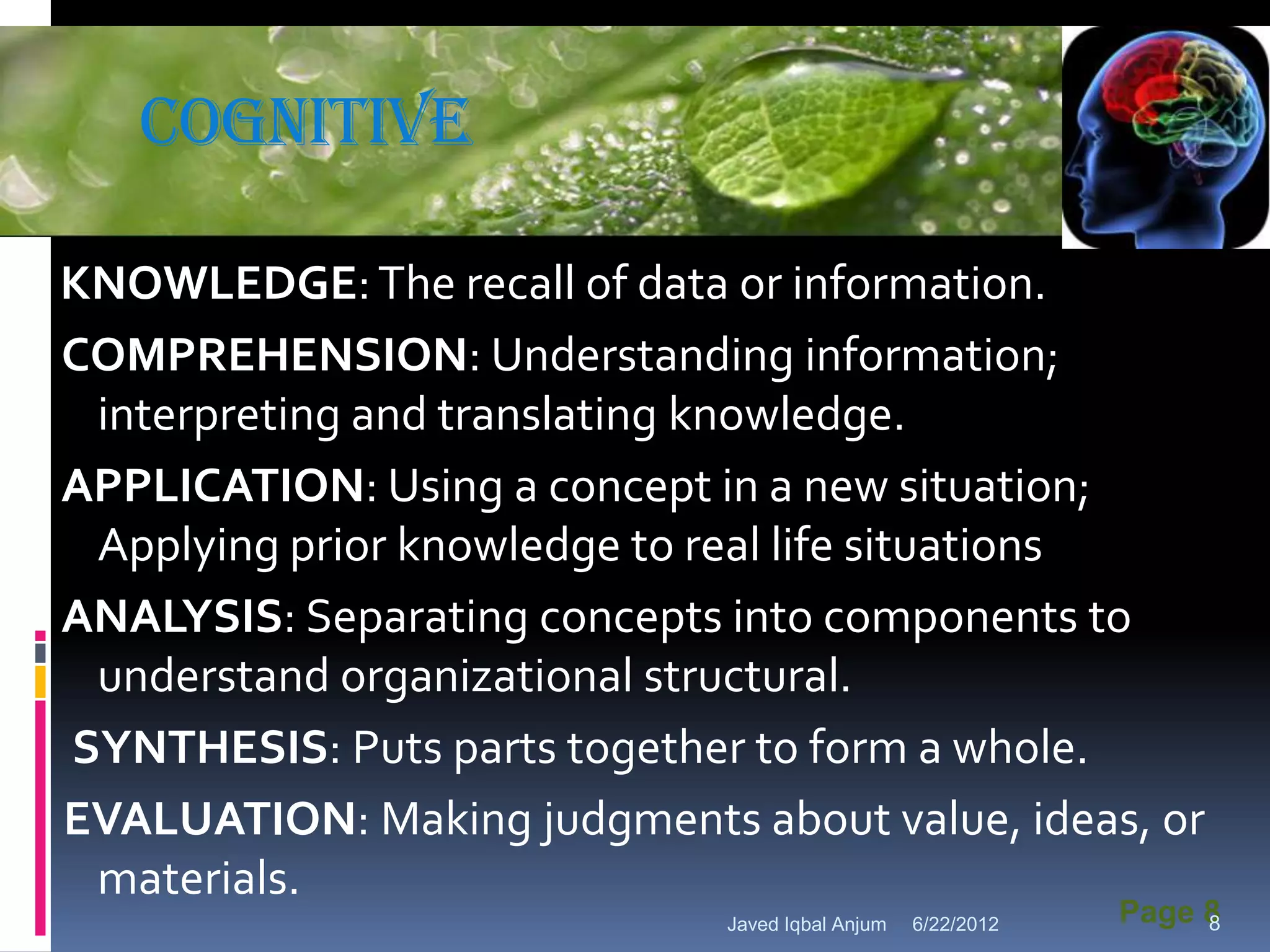
KNOWLEDGE: The recall of data or information.
COMPREHENSION: Understanding information;
 interpreting and translating knowledge.
APPLICATION: Using a concept in a new situation;
 Applying prior knowledge to real life situations
ANALYSIS: Separating concepts into components to
 understand organizational structural.
SYNTHESIS: Puts parts together to form a whole.
EVALUATION: Making judgments about value, ideas, or
 materials.
                             Javed Iqbal Anjum   6/22/2012   Page 8
                                                                  8
Cognitive Domain Chart
                  Powerpoint Template


Category                            Example and Key Words
Knowledge: Recall data or           Examples: Define a concept. Knows the safety rules.
information.                        Key Words: defines, describes, identifies, knows, labels, lists, matches,
                                    names, outlines, recalls, recognizes, reproduces, selects, states.


Comprehension: Understand           Examples: Explain something in their own words
the meaning, translation,           steps for performing a complex task. Translates an equation .
interpolation, and State a          Key Words: comprehends, converts, defends, distinguishes, estimates,
problem in one's own words.         explains, extends, generalizes, gives Examples, infers, interprets,
                                    paraphrases, predicts, rewrites, summarizes, translates

Application: Use a concept in a     Examples: use the concept of addition, subtraction, law of gravity,
new situation. Applies what         inertia in his daily life.
was learned in the classroom        Key Words: applies, changes, computes, construct, demonstrates,
into novel situations in the work   discovers, modifies, operates, predicts, prepares, produces, relates,
place.                              shows, solves, uses.

                                                               Javed Iqbal Anjum   6/22/2012      Page 9
                                                                                                       9
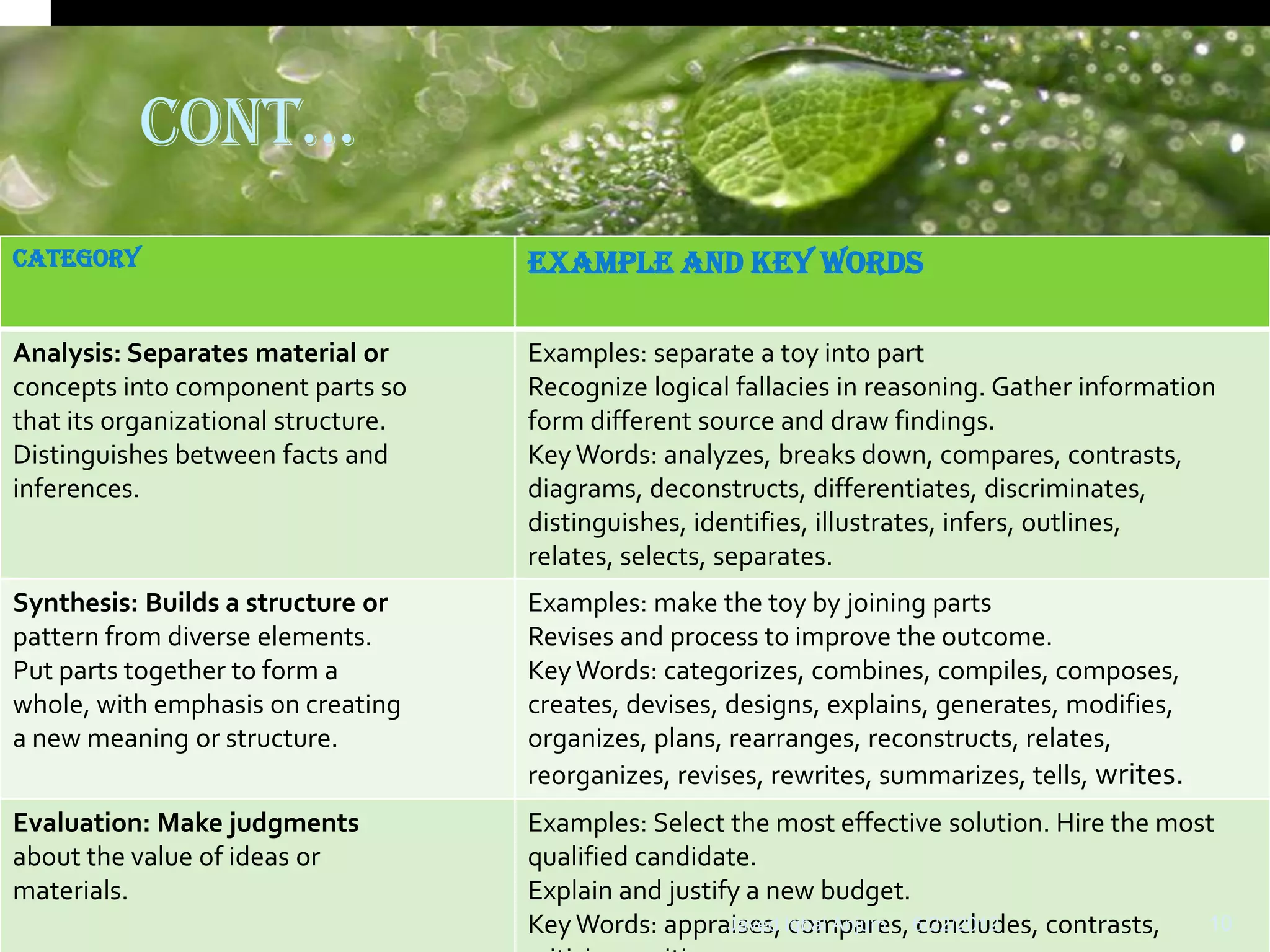
Cont…                      Powerpoint Template


Category                                  Example and Key Words

Analysis: Separates material or           Examples: separate a toy into part
concepts into component parts so          Recognize logical fallacies in reasoning. Gather information
that its organizational structure.        form different source and draw findings.
Distinguishes between facts and           Key Words: analyzes, breaks down, compares, contrasts,
inferences.                               diagrams, deconstructs, differentiates, discriminates,
                                          distinguishes, identifies, illustrates, infers, outlines,
                                          relates, selects, separates.
Synthesis: Builds a structure or          Examples: make the toy by joining parts
pattern from diverse elements.            Revises and process to improve the outcome.
Put parts together to form a              Key Words: categorizes, combines, compiles, composes,
whole, with emphasis on creating          creates, devises, designs, explains, generates, modifies,
a new meaning or structure.               organizes, plans, rearranges, reconstructs, relates,
                                          reorganizes, revises, rewrites, summarizes, tells, writes.
Evaluation: Make judgments                Examples: Select the most effective solution. Hire the most
about the value of ideas or               qualified candidate.
materials.                                Explain and justify a new budget.
                                          Key Words: appraises, Iqbal Anjum 6/22/2012         Page 10
                                                            Javed compares, concludes, contrasts,   10
It is YourPowerpoint Template
           Turn

 Thanks for Listening and
            Sharing Ideas


                            Javed Iqbal Anjum   6/22/2012   Page 11
                                                                 11

Congnitive domain of blooms' taxonomy

  • 1.
    Presentation On CoGnitivE Domain oF Blooms’ taxanomy By Javed Iqbal Professional Development Teacher of AKU-IED, Powerpoint Template PDCN for EDIP Project and Arif
  • 2.
    Outline Powerpoint Template Session learning outcomes  Background of Blooms taxonomy  Old and new versions of Bloom’s taxonomy  Domains of blooms taxonomy  Cognitive  Affective  Psychomotor  Chart of Cognitive Domain Javed Iqbal Anjum 6/22/2012 Page 2 2
  • 3.
    Session learning Outcome Powerpoint Template By the end of this session C.Ps could be able to; Discuss cognitive, domain of blooms’ taxonomy in detail with its level. Share the levels of affective and psychomotor domain Use action words of cognitive domain levels in developing SLOs for their lesson plans. Relate Cognitive domain with their daily life experiences. Javed Iqbal Anjum 6/22/2012 Page 3 3
  • 4.
    Background of Bloomstaxonomy Powerpoint Template  A committee of colleges, led by Benjamin Bloom (1956), identified three domains of educational activities:  Cognitive: mental skills (Knowledge)  Affective: growth in feelings or emotional areas (Attitude)  Psychomotor: manual or physical skills (Skills) www.nwlink.com/~donclark/hrd/bloom.html Javed Iqbal Anjum 6/22/2012 Page 4 4
  • 5.
    Three Domains ofBlooms Taxonomy Powerpoint Template Javed Iqbal Anjum 6/22/2012 Page 5 5
  • 6.
    Rule 3 H Powerpoint Template H Javed Iqbal Anjum 6/22/2012 Page 6 6
  • 7.
    New Version & Template Old Version Powerpoint http://www.odu.edu/educ/roverbau/Bloom/blooms_taxonomy.htm http://www.teachers.ash.org.au/researchskills/dalton.htm Javed Iqbal Anjum 6/22/2012 Page 7 7
  • 8.
    Cognitive Powerpoint Template KNOWLEDGE: The recall of data or information. COMPREHENSION: Understanding information; interpreting and translating knowledge. APPLICATION: Using a concept in a new situation; Applying prior knowledge to real life situations ANALYSIS: Separating concepts into components to understand organizational structural. SYNTHESIS: Puts parts together to form a whole. EVALUATION: Making judgments about value, ideas, or materials. Javed Iqbal Anjum 6/22/2012 Page 8 8
  • 9.
    Cognitive Domain Chart Powerpoint Template Category Example and Key Words Knowledge: Recall data or Examples: Define a concept. Knows the safety rules. information. Key Words: defines, describes, identifies, knows, labels, lists, matches, names, outlines, recalls, recognizes, reproduces, selects, states. Comprehension: Understand Examples: Explain something in their own words the meaning, translation, steps for performing a complex task. Translates an equation . interpolation, and State a Key Words: comprehends, converts, defends, distinguishes, estimates, problem in one's own words. explains, extends, generalizes, gives Examples, infers, interprets, paraphrases, predicts, rewrites, summarizes, translates Application: Use a concept in a Examples: use the concept of addition, subtraction, law of gravity, new situation. Applies what inertia in his daily life. was learned in the classroom Key Words: applies, changes, computes, construct, demonstrates, into novel situations in the work discovers, modifies, operates, predicts, prepares, produces, relates, place. shows, solves, uses. Javed Iqbal Anjum 6/22/2012 Page 9 9
  • 10.
    Cont… Powerpoint Template Category Example and Key Words Analysis: Separates material or Examples: separate a toy into part concepts into component parts so Recognize logical fallacies in reasoning. Gather information that its organizational structure. form different source and draw findings. Distinguishes between facts and Key Words: analyzes, breaks down, compares, contrasts, inferences. diagrams, deconstructs, differentiates, discriminates, distinguishes, identifies, illustrates, infers, outlines, relates, selects, separates. Synthesis: Builds a structure or Examples: make the toy by joining parts pattern from diverse elements. Revises and process to improve the outcome. Put parts together to form a Key Words: categorizes, combines, compiles, composes, whole, with emphasis on creating creates, devises, designs, explains, generates, modifies, a new meaning or structure. organizes, plans, rearranges, reconstructs, relates, reorganizes, revises, rewrites, summarizes, tells, writes. Evaluation: Make judgments Examples: Select the most effective solution. Hire the most about the value of ideas or qualified candidate. materials. Explain and justify a new budget. Key Words: appraises, Iqbal Anjum 6/22/2012 Page 10 Javed compares, concludes, contrasts, 10
  • 11.
    It is YourPowerpointTemplate Turn  Thanks for Listening and Sharing Ideas Javed Iqbal Anjum 6/22/2012 Page 11 11