Deconstructing Standards:
Achievable Targets for Teaching
        and Learning


        Bullitt County Public Schools
                September 2007
Our Learning Targets

 We can articulate the difference
  between a „standard‟ and a „objective.‟
 We can deconstruct standards and
  evaluate our work for quality, accuracy,
  and usefulness.
 We can transform learning objectives
  into student friendly language.
Research-based Strategies

5 Research-based strategies that
  significantly improve student learning:
     Sharing criteria (clear learning objectives
      with success criteria)
     Questioning
     Feedback
     Peer assessment
     Self-assessment
Learning/Achievement
     Objectives
  Statements of what
  we want students to
  learn and be able to
  do.
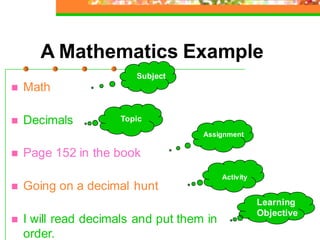
A Mathematics Example
                         Subject
   Math

   Decimals          Topic
                                     Assignment

   Page 152 in the book
                                           Activity
   Going on a decimal hunt
                                                      Learning
                                                      Objective
   I will read decimals and put them in
    order.
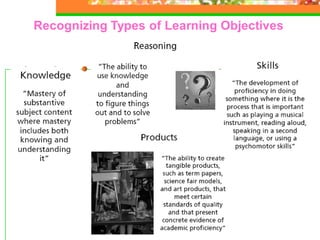
Recognizing Types of Learning Objectives
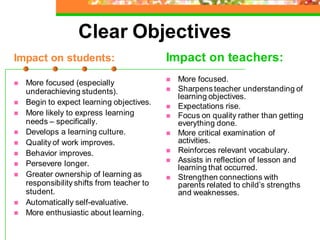
Clear Objectives
Impact on students:                         Impact on teachers:
   More focused (especially                   More focused.
    underachieving students).                  Sharpens teacher understanding of
                                                learning objectives.
   Begin to expect learning objectives.
                                               Expectations rise.
   More likely to express learning            Focus on quality rather than getting
    needs – specifically.                       everything done.
   Develops a learning culture.               More critical examination of
   Quality of work improves.                   activities.
   Behavior improves.                         Reinforces relevant vocabulary.
   Persevere longer.                          Assists in reflection of lesson and
                                                learning that occurred.
   Greater ownership of learning as           Strengthen connections with
    responsibility shifts from teacher to       parents related to child‟s strengths
    student.                                    and weaknesses.
   Automatically self-evaluative.
   More enthusiastic about learning.
Student Friendly Terms
   “In order for the learning intention to be shared effectively, it needs to
    be clear and unambiguous, so that the teacher can explain it in a
    way that makes sense to her children.”
   “…the task has to match the learning intention for the children to have
    a chance of fulfilling it.”
   “…the learning intention has the greatest impact on children’s
    understanding of the task and their progress if it includes success
    criteria as well as the learning intention itself…”
   “Teachers need to separate the task instructions clearly from the
    learning intention and success criteria, or children can begin their
    work without knowing clearly the difference between what you want
    them to do and what you want them to learn.”
   The learning intention “needs to be the main focus of feedback.”
        Shirley Clarke in Unlocking Formative Assessment
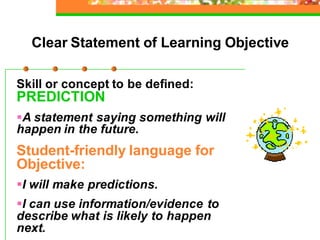
Clear Statement of Learning Objective

Skill or concept to be defined:
PREDICTION
A statement saying something will
happen in the future.
Student-friendly language for
Objective:
I will make predictions.
I can use information/evidence to
describe what is likely to happen
next.
Students who can identify what they
  are learning significantly outscore
  those who cannot.
                               Robert Marzano
Student Friendly Language

From K-3 Deconstruction
“Observe and describe properties of material
                   objects”

   Student Friendly Language:
   I will describe physical properties.
   I can describe the physical properties of
    objects that I can see, touch, and/or smell.
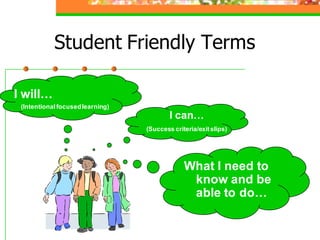
Student Friendly Terms

I will…
 (Intentional focused learning)
                                          I can…
                                  (Success criteria/exit slips)


                                               What I need to
                                                know and be
                                                able to do…
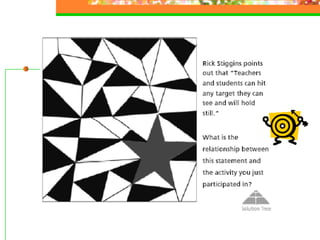
“Any student who leaves school still needing
  their teacher to tell them that they’ve done
  well has not yet learned to hit the target.
  They’ve not yet learned to recognize good
  thinking.”
                                       Rick Stiggins
Learning Outcome Examples

   Combined Curriculum Document
       POS/Big Idea
       Academic Expectations
       POS: Understandings (Column 1)
       POS: Skills and Conepts (Column 2)
       Related Core Content for Assessment
        (Column 3)
       Lesson Outcomes (Column 4)
Steps to Deconstructing Standards

**Read the “Big Idea” for the unit and the POS:
   Understandings
  Using a highlighter, mark all verbs in the first
   POS: Skills and Concepts. (Column 2)
  Using a different colored highlighter, mark the
   nouns in the same POS: Skills and Concepts.
  Repeat for each skill and concept within that unit.
  Repeat the same steps in the Related Core
   Concept for Assessment column. (Column 3)
Steps to Deconstructing
               Standards
   Using all verbs from the POS: Skills and
    Concepts column, write learning targets.
     (Column 4)
Deconstructing Standards

   Time to practice with your grade level.
Identifying the Learning Objectives

  Are your objectives clear with respect to
   what students should learn and be able
   to do?
  Are they in terms students will
   understand?
Group Debrief

How did the process
feel?
                               D
What is the value of
going through this
process?
What support materials
are needed to facilitate the
process?
Without Clear Objectives We Can’t
        Do Any of the Following…
   Know if the assessment adequately covers and
    samples what we taught.
   Correctly identify what students know and don‟t know
    and their level of achievement.
   Plan next steps in instruction.
   Give detailed, descriptive feedback to students.
   Have students self-assess or set goals likely to help
    them learn more.
   Keep track of student learning objective by objective or
    standard by standard.
Remember This…

 Learning objectives need to be clear
  to all students.
 Not all learning objectives are
  unclear and need to be converted
  into student friendly language.
 Activities should be selected/planned
  AFTER the learning objectives are
  established.
Deconstructing Standards  Learning Targets

Deconstructing Standards Learning Targets

  • 1.
    Deconstructing Standards: Achievable Targetsfor Teaching and Learning Bullitt County Public Schools September 2007
  • 2.
    Our Learning Targets We can articulate the difference between a „standard‟ and a „objective.‟  We can deconstruct standards and evaluate our work for quality, accuracy, and usefulness.  We can transform learning objectives into student friendly language.
  • 7.
    Research-based Strategies 5 Research-basedstrategies that significantly improve student learning:  Sharing criteria (clear learning objectives with success criteria)  Questioning  Feedback  Peer assessment  Self-assessment
  • 8.
    Learning/Achievement Objectives Statements of what we want students to learn and be able to do.
  • 9.
    A Mathematics Example Subject  Math  Decimals Topic Assignment  Page 152 in the book Activity  Going on a decimal hunt Learning Objective  I will read decimals and put them in order.
  • 11.
    Recognizing Types ofLearning Objectives
  • 12.
    Clear Objectives Impact onstudents: Impact on teachers:  More focused (especially  More focused. underachieving students).  Sharpens teacher understanding of learning objectives.  Begin to expect learning objectives.  Expectations rise.  More likely to express learning  Focus on quality rather than getting needs – specifically. everything done.  Develops a learning culture.  More critical examination of  Quality of work improves. activities.  Behavior improves.  Reinforces relevant vocabulary.  Persevere longer.  Assists in reflection of lesson and learning that occurred.  Greater ownership of learning as  Strengthen connections with responsibility shifts from teacher to parents related to child‟s strengths student. and weaknesses.  Automatically self-evaluative.  More enthusiastic about learning.
  • 13.
    Student Friendly Terms  “In order for the learning intention to be shared effectively, it needs to be clear and unambiguous, so that the teacher can explain it in a way that makes sense to her children.”  “…the task has to match the learning intention for the children to have a chance of fulfilling it.”  “…the learning intention has the greatest impact on children’s understanding of the task and their progress if it includes success criteria as well as the learning intention itself…”  “Teachers need to separate the task instructions clearly from the learning intention and success criteria, or children can begin their work without knowing clearly the difference between what you want them to do and what you want them to learn.”  The learning intention “needs to be the main focus of feedback.”  Shirley Clarke in Unlocking Formative Assessment
  • 14.
    Clear Statement ofLearning Objective Skill or concept to be defined: PREDICTION A statement saying something will happen in the future. Student-friendly language for Objective: I will make predictions. I can use information/evidence to describe what is likely to happen next.
  • 15.
    Students who canidentify what they are learning significantly outscore those who cannot.  Robert Marzano
  • 16.
    Student Friendly Language FromK-3 Deconstruction “Observe and describe properties of material objects”  Student Friendly Language:  I will describe physical properties.  I can describe the physical properties of objects that I can see, touch, and/or smell.
  • 17.
    Student Friendly Terms Iwill… (Intentional focused learning) I can… (Success criteria/exit slips) What I need to know and be able to do…
  • 18.
    “Any student wholeaves school still needing their teacher to tell them that they’ve done well has not yet learned to hit the target. They’ve not yet learned to recognize good thinking.”  Rick Stiggins
  • 19.
    Learning Outcome Examples  Combined Curriculum Document  POS/Big Idea  Academic Expectations  POS: Understandings (Column 1)  POS: Skills and Conepts (Column 2)  Related Core Content for Assessment (Column 3)  Lesson Outcomes (Column 4)
  • 20.
    Steps to DeconstructingStandards **Read the “Big Idea” for the unit and the POS: Understandings  Using a highlighter, mark all verbs in the first POS: Skills and Concepts. (Column 2)  Using a different colored highlighter, mark the nouns in the same POS: Skills and Concepts.  Repeat for each skill and concept within that unit.  Repeat the same steps in the Related Core Concept for Assessment column. (Column 3)
  • 21.
    Steps to Deconstructing Standards  Using all verbs from the POS: Skills and Concepts column, write learning targets. (Column 4)
  • 22.
    Deconstructing Standards  Time to practice with your grade level.
  • 23.
    Identifying the LearningObjectives  Are your objectives clear with respect to what students should learn and be able to do?  Are they in terms students will understand?
  • 24.
    Group Debrief How didthe process feel? D What is the value of going through this process? What support materials are needed to facilitate the process?
  • 25.
    Without Clear ObjectivesWe Can’t Do Any of the Following…  Know if the assessment adequately covers and samples what we taught.  Correctly identify what students know and don‟t know and their level of achievement.  Plan next steps in instruction.  Give detailed, descriptive feedback to students.  Have students self-assess or set goals likely to help them learn more.  Keep track of student learning objective by objective or standard by standard.
  • 26.
    Remember This…  Learningobjectives need to be clear to all students.  Not all learning objectives are unclear and need to be converted into student friendly language.  Activities should be selected/planned AFTER the learning objectives are established.