Learning Targets   October 1, 2010 Welcome Please sign-in
Today’s Learning Targets Identify the essential components of clear learning targets and develop a common understanding of how to write targets. Know how learning targets differ from goals or standards, and be able to translate standards into targets for Math Expressions lessons.
Learning Target A Learning Target is a specific goal of what students should know. It is a clear conception of the end point that teachers and students know and understand.
Characteristics of Clear Learning Targets Linked to adopted curriculum and state standards Usually include both declarative (“I know...”) and procedural (“I can…”) knowledge Measurable and tied directly to classroom assessment Specific, meaning daily,  or at most for a few days. (examples later) In student friendly language Describe the Cognitive Demand, or Depth of Knowledge of the standard Shared and reviewed with students
Research on Learning Targets Classrooms where students understand the learning outcomes for daily lessons see performance rates 20 percent higher than those where learning outcomes are unclear. Marzano, 2003 Setting goals/Objectives = 22% gain  Marzano meta-analysis 2009 Learning Intentions/goals = 40% gain meta-analysis of 604 studies, John Hattie, 2009
“ Learning Targets” in Real Life Food Music Sports Hobbies Other examples
Targets vs. Goals or Standards Standard 1.1.A:  Count by ones forward and backward from 1 to 120, starting at any number , and count by twos, fives, and tens to 100.   4.4.F:  Describe and compare the likelihood of events. Possible Learning Target I can count by 2s to 100 and am able to identify a pattern using a hundreds chart. I know what  certain, impossible, likely, unlikely, and equally likely or unlikely  mean and can categorize events based on likelihood.
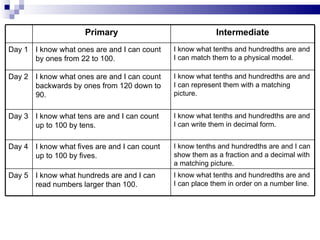
Primary Intermediate Day 1 I know what ones are and I can count by ones from 22 to 100. I know what tenths and hundredths are and I can match them to a physical model. Day 2 I know what ones are and I can count backwards by ones from 120 down to 90. I know what tenths and hundredths are and I can represent them with a matching picture. Day 3 I know what tens are and I can count up to 100 by tens. I know what tenths and hundredths are and I can write them in decimal form. Day 4 I know what fives are and I can count up to 100 by fives. I know tenths and hundredths are and I can show them as a fraction and a decimal with a matching picture. Day 5 I know what hundreds are and I can read numbers larger than 100. I know what tenths and hundredths are and I can place them in order on a number line.


Possible knowledge stems 1. Today I will know that....  (a venn diagram is used to display data) 2. Students will know what... (the value is of a dime and nickel) 3. I know the definition of...  (attribute) 4. Student will define....  (growing pattern) 5. I am learning what! ! ! ! ! is.  (doubles plus 1 is) 6. I know ! ! ! is different than! ! ! ! because...  (a quadrilateral is different than a triangle because...) 7. Students will know that! ! ! ! ! is a strategy used to...  (guess and check) is a strategy used to (problem solve) 8. I know! ! ! ! ! is the symbol for! ! ! .  (+) is the  symbol for (addition) 9. I can tell my friend what CALM stands for.  (Consistent scale, Appropriate scale, Labels are appropriate, Math is displayed accurately)
Possible knowledge stems 10. I know what! ! ! ! ! is.  (a supplementary angle) 11. I know how the ! ! ! ! ! cycle works.  (moon phase) 12. I know how the ! ! ! ! ! ! model works.  (array) 13. I am learning that! ! ! ! is a! ! ! ! ! .  (a fraction) is a (part of a whole) 14. Today I am learning that! ! ! ! . (100 could be grouped in sets of 2 or 5 or 10) 15. I know ! ! ! ! by using! ! ! !  . (points have a linear relationship) by using (a coordinate grid) 16.Students will know how!! ! is related to/different from ! ! !  (multiplication) is related to (division) 17.I know how! ! ! ! is used to estimate!! ! .  (place value)  is used to estimate  (products) 18.I understand what the ! ! ! ! ! represent(s).  (numerator and denominator of a fraction)
From Standard to Learning Target Students are expected to: K.1.D Order numbers from 1 to 10. 1.1.E Write, compare, and order numbers to 120. 2.1.E  Group three-digit numbers into hundreds, tens, and ones in more than one way. 3.1.A read, write, compare, order, and represent numbers to 10,000 using numbers, words, and symbols. 4.1.E Compare the values represented by digits in whole numbers using place value. 5.1.B  Determine quotients for multiples of 10 and 100 by applying knowledge of place value and properties of operations. With a partner, write a possible learning target for one standard.
Reflection and Discussion Take two minutes to reflect on what you have learned so far today. Share your ideas with a partner.
Practice Use your Math Expressions teacher’s guide, your standards, and the “Characteristics of Learning Targets” sheet to write Learning Targets for the next several lessons you will be teaching.
Feedback Please complete the Daily Reflection Sheet (pink paper). Thank you!!

Learning Targets

  • 1.
    Learning Targets October 1, 2010 Welcome Please sign-in
  • 2.
    Today’s Learning TargetsIdentify the essential components of clear learning targets and develop a common understanding of how to write targets. Know how learning targets differ from goals or standards, and be able to translate standards into targets for Math Expressions lessons.
  • 3.
    Learning Target ALearning Target is a specific goal of what students should know. It is a clear conception of the end point that teachers and students know and understand.
  • 4.
    Characteristics of ClearLearning Targets Linked to adopted curriculum and state standards Usually include both declarative (“I know...”) and procedural (“I can…”) knowledge Measurable and tied directly to classroom assessment Specific, meaning daily, or at most for a few days. (examples later) In student friendly language Describe the Cognitive Demand, or Depth of Knowledge of the standard Shared and reviewed with students
  • 5.
    Research on LearningTargets Classrooms where students understand the learning outcomes for daily lessons see performance rates 20 percent higher than those where learning outcomes are unclear. Marzano, 2003 Setting goals/Objectives = 22% gain Marzano meta-analysis 2009 Learning Intentions/goals = 40% gain meta-analysis of 604 studies, John Hattie, 2009
  • 6.
    “ Learning Targets”in Real Life Food Music Sports Hobbies Other examples
  • 7.
    Targets vs. Goalsor Standards Standard 1.1.A: Count by ones forward and backward from 1 to 120, starting at any number , and count by twos, fives, and tens to 100. 4.4.F: Describe and compare the likelihood of events. Possible Learning Target I can count by 2s to 100 and am able to identify a pattern using a hundreds chart. I know what certain, impossible, likely, unlikely, and equally likely or unlikely mean and can categorize events based on likelihood.
  • 8.
    Primary Intermediate Day1 I know what ones are and I can count by ones from 22 to 100. I know what tenths and hundredths are and I can match them to a physical model. Day 2 I know what ones are and I can count backwards by ones from 120 down to 90. I know what tenths and hundredths are and I can represent them with a matching picture. Day 3 I know what tens are and I can count up to 100 by tens. I know what tenths and hundredths are and I can write them in decimal form. Day 4 I know what fives are and I can count up to 100 by fives. I know tenths and hundredths are and I can show them as a fraction and a decimal with a matching picture. Day 5 I know what hundreds are and I can read numbers larger than 100. I know what tenths and hundredths are and I can place them in order on a number line.
  • 9.
  • 10.
  • 11.
  • 12.
  • 13.
  • 14.
  • 15.
  • 16.
    Possible knowledge stems1. Today I will know that.... (a venn diagram is used to display data) 2. Students will know what... (the value is of a dime and nickel) 3. I know the definition of... (attribute) 4. Student will define.... (growing pattern) 5. I am learning what! ! ! ! ! is. (doubles plus 1 is) 6. I know ! ! ! is different than! ! ! ! because... (a quadrilateral is different than a triangle because...) 7. Students will know that! ! ! ! ! is a strategy used to... (guess and check) is a strategy used to (problem solve) 8. I know! ! ! ! ! is the symbol for! ! ! . (+) is the symbol for (addition) 9. I can tell my friend what CALM stands for. (Consistent scale, Appropriate scale, Labels are appropriate, Math is displayed accurately)
  • 17.
    Possible knowledge stems10. I know what! ! ! ! ! is. (a supplementary angle) 11. I know how the ! ! ! ! ! cycle works. (moon phase) 12. I know how the ! ! ! ! ! ! model works. (array) 13. I am learning that! ! ! ! is a! ! ! ! ! . (a fraction) is a (part of a whole) 14. Today I am learning that! ! ! ! . (100 could be grouped in sets of 2 or 5 or 10) 15. I know ! ! ! ! by using! ! ! ! . (points have a linear relationship) by using (a coordinate grid) 16.Students will know how!! ! is related to/different from ! ! ! (multiplication) is related to (division) 17.I know how! ! ! ! is used to estimate!! ! . (place value) is used to estimate (products) 18.I understand what the ! ! ! ! ! represent(s). (numerator and denominator of a fraction)
  • 18.
    From Standard toLearning Target Students are expected to: K.1.D Order numbers from 1 to 10. 1.1.E Write, compare, and order numbers to 120. 2.1.E Group three-digit numbers into hundreds, tens, and ones in more than one way. 3.1.A read, write, compare, order, and represent numbers to 10,000 using numbers, words, and symbols. 4.1.E Compare the values represented by digits in whole numbers using place value. 5.1.B Determine quotients for multiples of 10 and 100 by applying knowledge of place value and properties of operations. With a partner, write a possible learning target for one standard.
  • 19.
    Reflection and DiscussionTake two minutes to reflect on what you have learned so far today. Share your ideas with a partner.
  • 20.
    Practice Use yourMath Expressions teacher’s guide, your standards, and the “Characteristics of Learning Targets” sheet to write Learning Targets for the next several lessons you will be teaching.
  • 21.
    Feedback Please completethe Daily Reflection Sheet (pink paper). Thank you!!

Editor's Notes

  • #4 From Administrative book study
  • #7 After reading the cooking example on pages 24-25, I thought it might be fun to relate the idea of learning targets to things in their “life” away from school. If this is dorky, we can take it out.