Writing Learning Objectives:


Beginning With the End in Mind
By the end of class today, you will
be able to:
• Write learning objectives that contain a
  measurable verb.
• Write learning objectives which demonstrate
  Bloom’s higher levels of thinking.
• Align learning objectives to the Tennessee
  Department of Education Content Standards.
What is a Learning Objective?

A learning objective is a
statement of what students will
be able to do when they have
completed instruction.
What does a learning objective
look like?

“By the end of this lesson, the
student will...
Why Do We Need Learning
 Objectives?
Learning objectives are guides to:
• Selection of content
• Development of an instructional strategy.
• Development and selection of instructional
  materials.
• Construction of tests and other
  instruments for assessing and then
  evaluating student learning outcomes.
What Are the Parts of a
Learning Objective?
• A description of what the student will be
  able to do
• The conditions under which the student
  will perform the task.
• The criteria for evaluating student
  performance.
Description
What will the student know or be
able to do after instruction?
• A learning objective must describe what is
  to be learned in performance terms.
• A learning objective has an action verb.
• DO NOT use these verbs:
Know Comprehend Understand Appreciate Learn
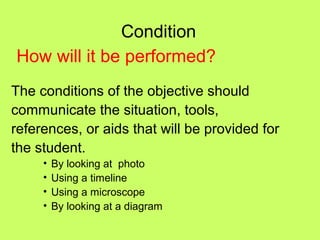
Condition
How will it be performed?
The conditions of the objective should
communicate the situation, tools,
references, or aids that will be provided for
the student.
     •   By looking at photo
     •   Using a timeline
     •   Using a microscope
     •   By looking at a diagram
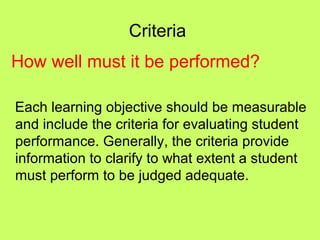
Criteria
How well must it be performed?

Each learning objective should be measurable
and include the criteria for evaluating student
performance. Generally, the criteria provide
information to clarify to what extent a student
must perform to be judged adequate.
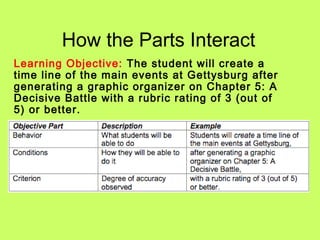
How the Parts Interact
Learning Objective: The student will create a
time line of the main events at Gettysburg after
generating a graphic organizer on Chapter 5: A
Decisive Battle with a rubric rating of 3 (out of
5) or better.
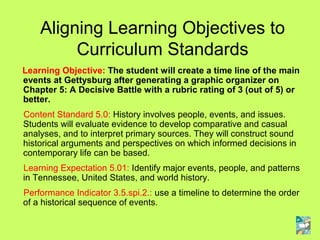
Aligning Learning Objectives to
         Curriculum Standards
Learning Objective: The student will create a time line of the main
events at Gettysburg after generating a graphic organizer on
Chapter 5: A Decisive Battle with a rubric rating of 3 (out of 5) or
better.
Content Standard 5.0: History involves people, events, and issues.
Students will evaluate evidence to develop comparative and casual
analyses, and to interpret primary sources. They will construct sound
historical arguments and perspectives on which informed decisions in
contemporary life can be based.
Learning Expectation 5.01: Identify major events, people, and patterns
in Tennessee, United States, and world history.
Performance Indicator 3.5.spi.2.: use a timeline to determine the order
of a historical sequence of events.
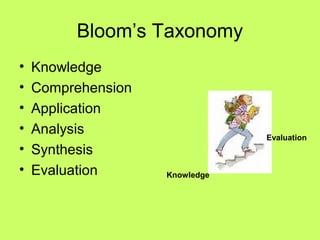
Bloom’s Taxonomy
•   Knowledge
•   Comprehension
•   Application
•   Analysis                    Evaluation
•   Synthesis
•   Evaluation      Knowledge
Knowledge
• Remembering previously learned material.
  This skill may involve recall of a wide
  range of material
• An example - Make a list of the main
  events
Comprehension
• The ability to grasp meaning of material.
  This skill may be shown by translating
  material from one form to another (words
  or numbers), by interpreting material
  (explaining or summarizing) and by
  estimating future trends (predicting
  consequences or effects)
• An example - Retell the story in your
  words.
Application
• The ability to use learned materiel in new
  and concrete situations
• An example - Make a diorama to illustrate
  an important event.
Analysis
• The ability to break down material into its
  component parts so that its organizational
  structure may be understood
• An example - Write a biography of the
  study person.
Synthesis
• The ability to put parts together to form a
  new whole. Use old ideas to create new
  ones, generalize from given facts
• An Example - Design a record, book, or
  magazine cover for...?
Evaluation
• The ability to judge the value of material
  (statement, novel, poem, research report)
  for a given purpose, Make choices based
  on reasoned argument
• An example - Conduct a debate about an
  issue of special interest.
Remember!
A well-written learning objective provides a
clear picture of the outcome or
performance you expect as a result of the
lesson. It should be specific, concise,
and, most importantly, observable or
measurable.
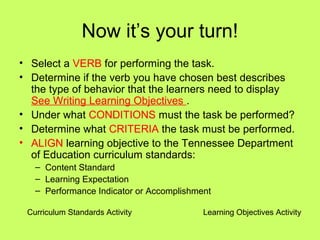
Now it’s your turn!
• Select a VERB for performing the task.
• Determine if the verb you have chosen best describes
  the type of behavior that the learners need to display
  See Writing Learning Objectives .
• Under what CONDITIONS must the task be performed?
• Determine what CRITERIA the task must be performed.
• ALIGN learning objective to the Tennessee Department
  of Education curriculum standards:
   – Content Standard
   – Learning Expectation
   – Performance Indicator or Accomplishment

 Curriculum Standards Activity            Learning Objectives Activity

Learning Objectives

  • 1.
  • 2.
    By the endof class today, you will be able to: • Write learning objectives that contain a measurable verb. • Write learning objectives which demonstrate Bloom’s higher levels of thinking. • Align learning objectives to the Tennessee Department of Education Content Standards.
  • 3.
    What is aLearning Objective? A learning objective is a statement of what students will be able to do when they have completed instruction.
  • 4.
    What does alearning objective look like? “By the end of this lesson, the student will...
  • 5.
    Why Do WeNeed Learning Objectives? Learning objectives are guides to: • Selection of content • Development of an instructional strategy. • Development and selection of instructional materials. • Construction of tests and other instruments for assessing and then evaluating student learning outcomes.
  • 6.
    What Are theParts of a Learning Objective? • A description of what the student will be able to do • The conditions under which the student will perform the task. • The criteria for evaluating student performance.
  • 7.
    Description What will thestudent know or be able to do after instruction? • A learning objective must describe what is to be learned in performance terms. • A learning objective has an action verb. • DO NOT use these verbs: Know Comprehend Understand Appreciate Learn
  • 8.
    Condition How will itbe performed? The conditions of the objective should communicate the situation, tools, references, or aids that will be provided for the student. • By looking at photo • Using a timeline • Using a microscope • By looking at a diagram
  • 9.
    Criteria How well mustit be performed? Each learning objective should be measurable and include the criteria for evaluating student performance. Generally, the criteria provide information to clarify to what extent a student must perform to be judged adequate.
  • 10.
    How the PartsInteract Learning Objective: The student will create a time line of the main events at Gettysburg after generating a graphic organizer on Chapter 5: A Decisive Battle with a rubric rating of 3 (out of 5) or better.
  • 11.
    Aligning Learning Objectivesto Curriculum Standards Learning Objective: The student will create a time line of the main events at Gettysburg after generating a graphic organizer on Chapter 5: A Decisive Battle with a rubric rating of 3 (out of 5) or better. Content Standard 5.0: History involves people, events, and issues. Students will evaluate evidence to develop comparative and casual analyses, and to interpret primary sources. They will construct sound historical arguments and perspectives on which informed decisions in contemporary life can be based. Learning Expectation 5.01: Identify major events, people, and patterns in Tennessee, United States, and world history. Performance Indicator 3.5.spi.2.: use a timeline to determine the order of a historical sequence of events.
  • 12.
    Bloom’s Taxonomy • Knowledge • Comprehension • Application • Analysis Evaluation • Synthesis • Evaluation Knowledge
  • 13.
    Knowledge • Remembering previouslylearned material. This skill may involve recall of a wide range of material • An example - Make a list of the main events
  • 14.
    Comprehension • The abilityto grasp meaning of material. This skill may be shown by translating material from one form to another (words or numbers), by interpreting material (explaining or summarizing) and by estimating future trends (predicting consequences or effects) • An example - Retell the story in your words.
  • 15.
    Application • The abilityto use learned materiel in new and concrete situations • An example - Make a diorama to illustrate an important event.
  • 16.
    Analysis • The abilityto break down material into its component parts so that its organizational structure may be understood • An example - Write a biography of the study person.
  • 17.
    Synthesis • The abilityto put parts together to form a new whole. Use old ideas to create new ones, generalize from given facts • An Example - Design a record, book, or magazine cover for...?
  • 18.
    Evaluation • The abilityto judge the value of material (statement, novel, poem, research report) for a given purpose, Make choices based on reasoned argument • An example - Conduct a debate about an issue of special interest.
  • 19.
    Remember! A well-written learningobjective provides a clear picture of the outcome or performance you expect as a result of the lesson. It should be specific, concise, and, most importantly, observable or measurable.
  • 20.
    Now it’s yourturn! • Select a VERB for performing the task. • Determine if the verb you have chosen best describes the type of behavior that the learners need to display See Writing Learning Objectives . • Under what CONDITIONS must the task be performed? • Determine what CRITERIA the task must be performed. • ALIGN learning objective to the Tennessee Department of Education curriculum standards: – Content Standard – Learning Expectation – Performance Indicator or Accomplishment Curriculum Standards Activity Learning Objectives Activity