Educational measurement and
evaluation
Preparing instructional objectives
Objectives
• Objectives are statements which describe
what the learner is expected to achieve as a
result of instruction.
• An objective describes an intended result of
instruction, rather than the process of
instruction itself
What are instructional objectives?
• Instructional objectives may also be
called performance objectives, behavioral
objectives, or simply objectives. All of these
terms are used interchangeably. Objectives
are specific, outcome based, measurable, and
describe the learner's behavior after
instruction. In other words what a learner will
be able to do as a result of instruction.
Characteristics of instructional
objectives
specific
• Objectives are very specific. This means that they
should describe exactly what the learner is
expected to do
• Outcome based
• Objectives are outcome based. This means that
the objective is going to state what the learner
should be able to do after the instruction is
complete. The process of how the instruction
happens is not considered in an objective.
Cont…
measurable
• Objectives are measurable. This means that
objectives should describe learning outcomes
that can be measured; objectives should be seen
or heard.
describe student behavior
• Objectives describe student behaviors. This
means that objectives should relate what the
student should be able to do after the
instruction.
Why use instructional objectives
In addition, there are three reasons that
instructional objectives are so important.
• Serve as a guide for students.
• Serve as a basis for the selection of
instructional media & materials and
procedures.
• Determine the appropriate ways to evaluate
the learning.
Learning Outcomes and Objectives
• What are learning outcomes and objectives?
• Learning outcomes represent the skills that
learners can expect to demonstrate after
completing the instruction. Outcome
statements must be specific, observable, and
measurable
• Objectives are clear and concise statements
that describe the intended outcomes of
instruction.
What is the difference between
objectives and outcomes?
• Objectives are intended results of instruction.
Outcomes are achieved (measured) results of
what was learned. They describe significant
and essential learning that learners have
achieved and can demonstrate at the end of a
learning event.
How to write learning objectives:
• First, determine the learning outcomes for the
lesson. In other words, what should the
student be able to do when the lesson is over?
Following the ABCDs of instructional objectives is
a great way to make sure you include all the
necessary information in an objective.
• A is the audience, always the student. B is the
behavior or the action verb. C is the condition for
the objective and D is the degree of achievement
or acceptable criteria
Conditions
Conditions describe the relevant factors
associated with the desired performance. For
example:
1. after attending a lecture. . . .
2. Following review of a demonstration. . . .
3. Given a case study. . . .
4. After completing the assignment. . . .
5. Given a specific instrument. . . .
Criteria
The criteria are specified as the acceptable level of
achievement desired. They tell how well the
learner must perform. This part of the objective
may be omitted when there is no deviation from
standard procedures . For example:
1. percent of correct responses
2. Within a given time period
3. in compliance with criteria presented by the
faculty
Order and Tense
• There is a preferred order when writing
objectives. The condition is usually placed
first, followed by the behavior or verb, and
then the criteria. Objectives are written in the
future tense. For example:
Recall: After attending lecture and reading the
assigned materials, the student will state the
function of a thermometer.
Cont…
Interpretation: After attending lecture and
studying the assigned materials, the student will
demonstrate how a thermometer works.
 Problem-Solving: After attending lecture and
studying the assigned materials (including
problem sets), the student will formulate the
degrees in C given the degrees in F, or vice versa.
Cont…
• To avoid redundancy in writing objectives an
educator often lists a single condition with the
objectives below. After attending lecture and
studying the assigned materials, the student
will:
• 1. . . . . .
• 2. . . . . .
• 3. . . . . .
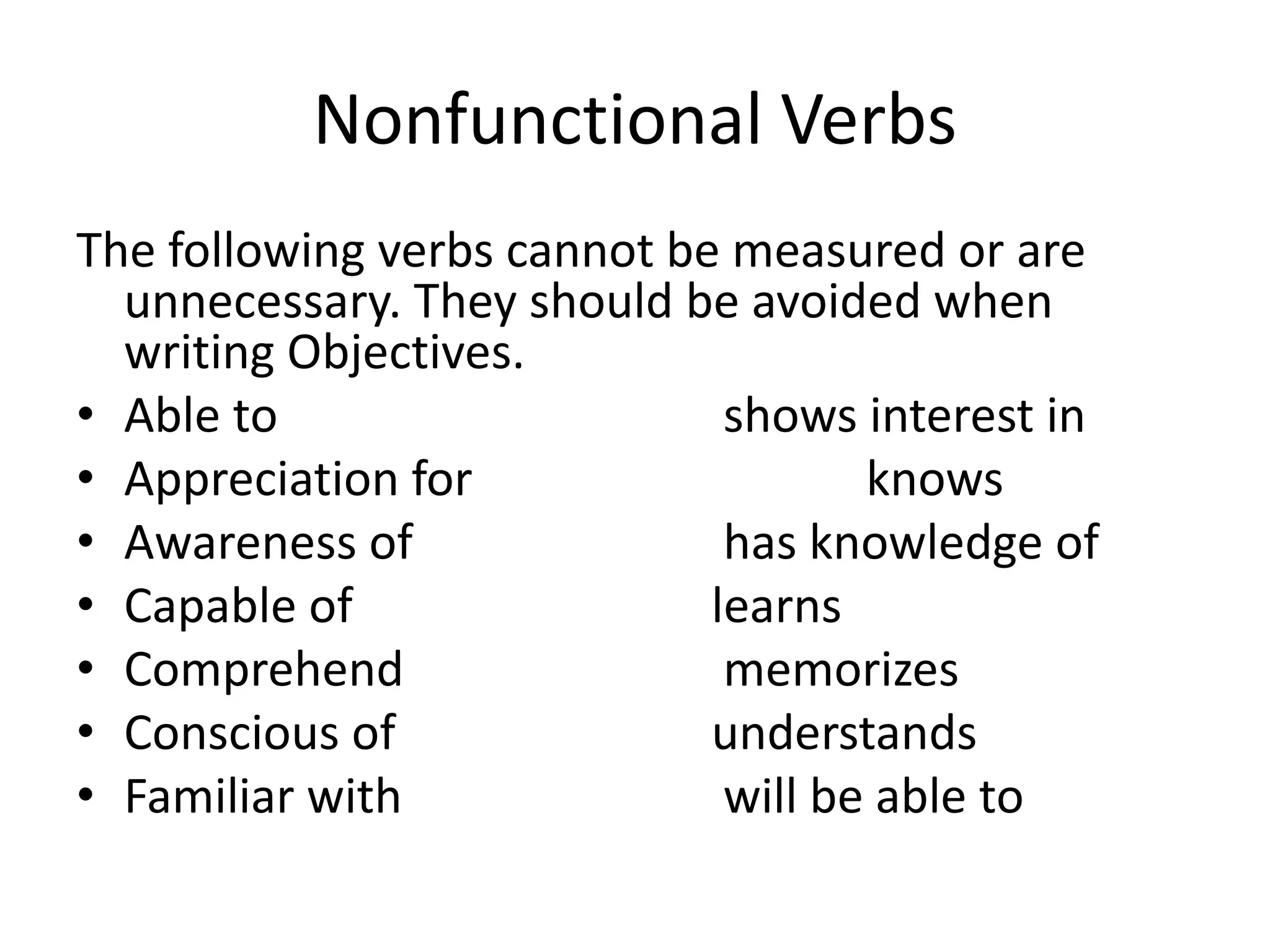
Nonfunctional Verbs
The following verbs cannot be measured or are
unnecessary. They should be avoided when
writing Objectives.
• Able to shows interest in
• Appreciation for knows
• Awareness of has knowledge of
• Capable of learns
• Comprehend memorizes
• Conscious of understands
• Familiar with will be able to
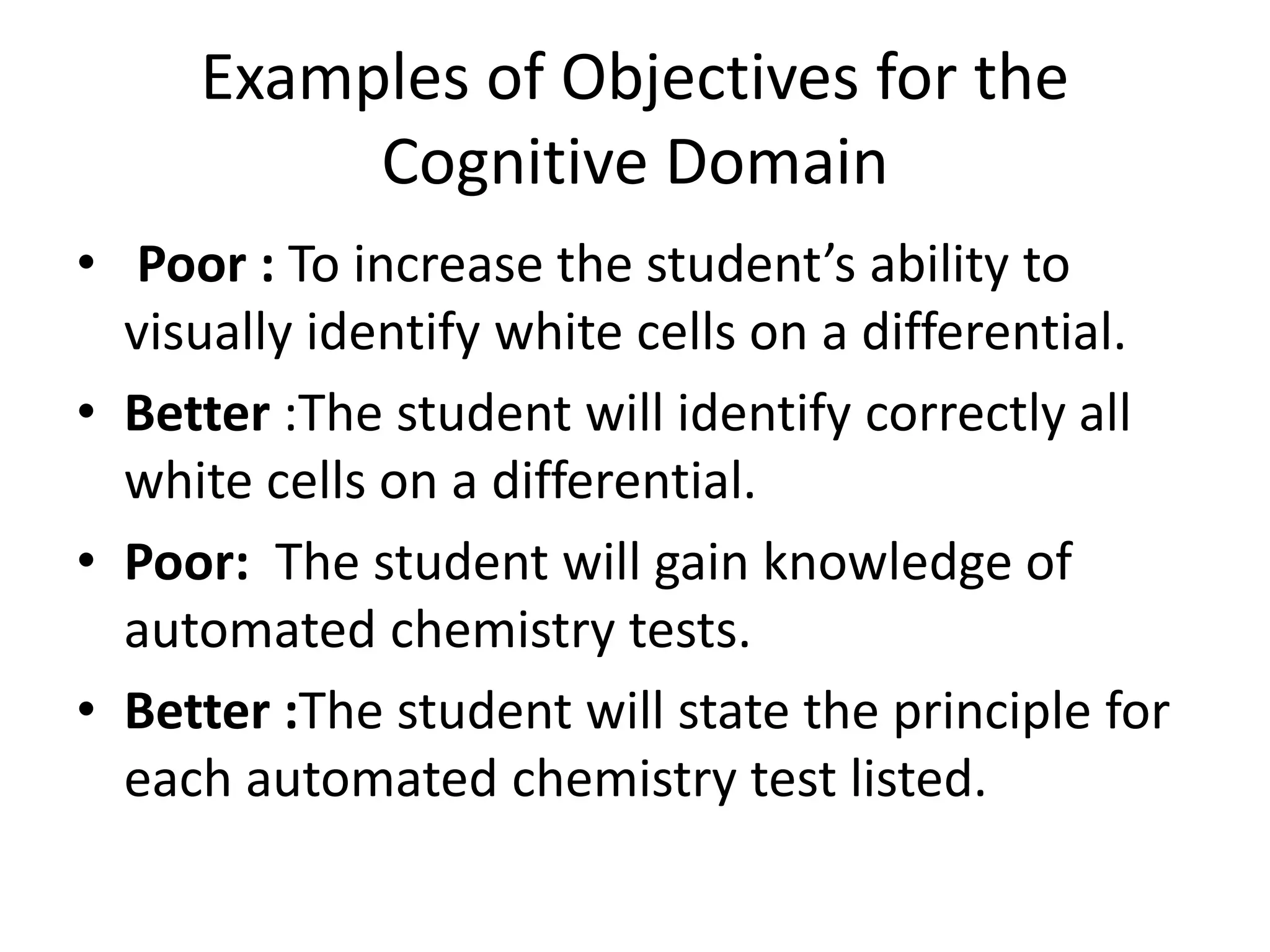
Examples of Objectives for the
Cognitive Domain
• Poor : To increase the student’s ability to
visually identify white cells on a differential.
• Better :The student will identify correctly all
white cells on a differential.
• Poor: The student will gain knowledge of
automated chemistry tests.
• Better :The student will state the principle for
each automated chemistry test listed.
Bloom’s taxonomy of
educational objectives
• Bloom’s domains
Three domains:
• cognitive (about knowing)
• affective (about attitudes, feelings)
• psychomotor (about doing)
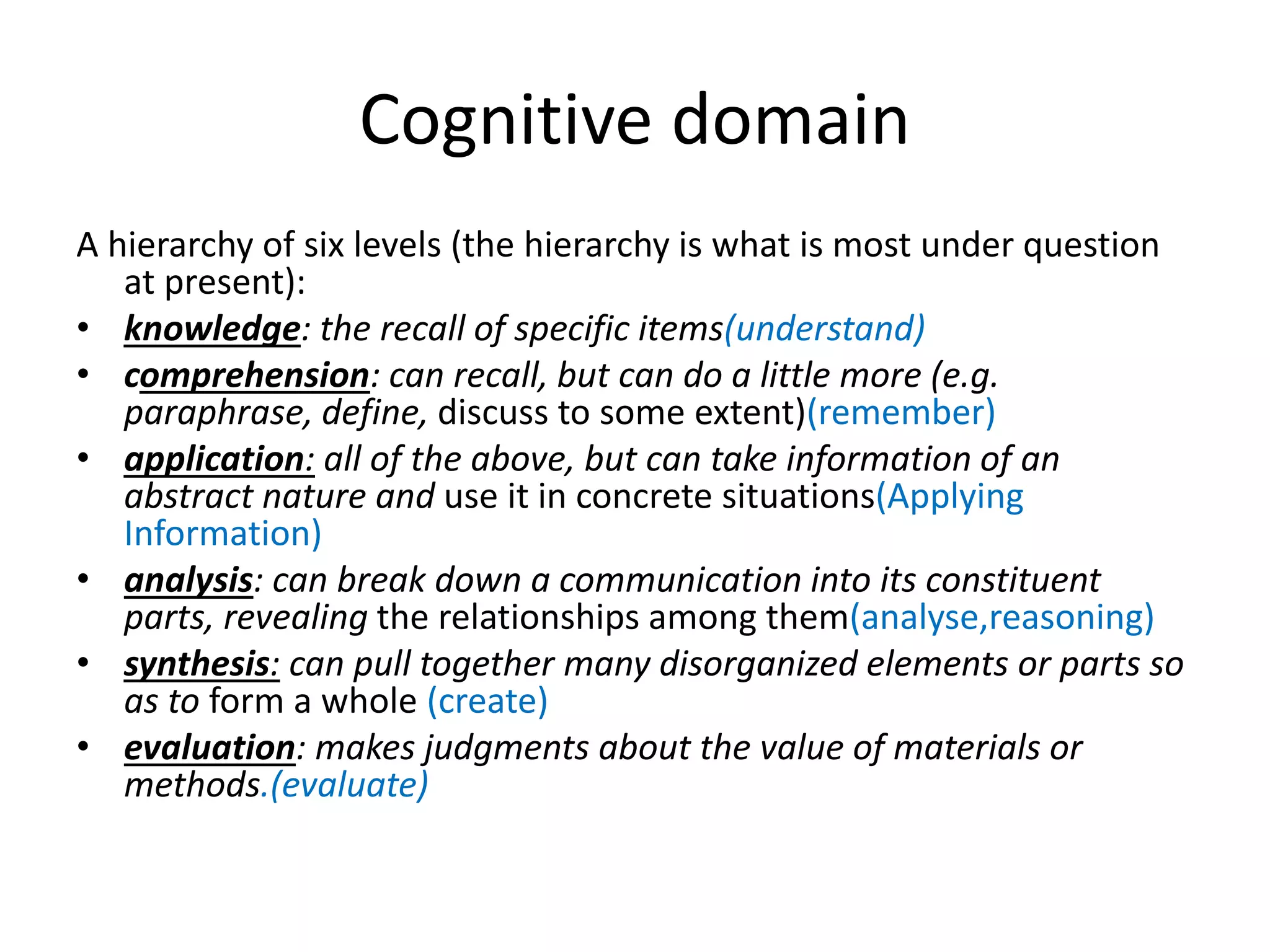
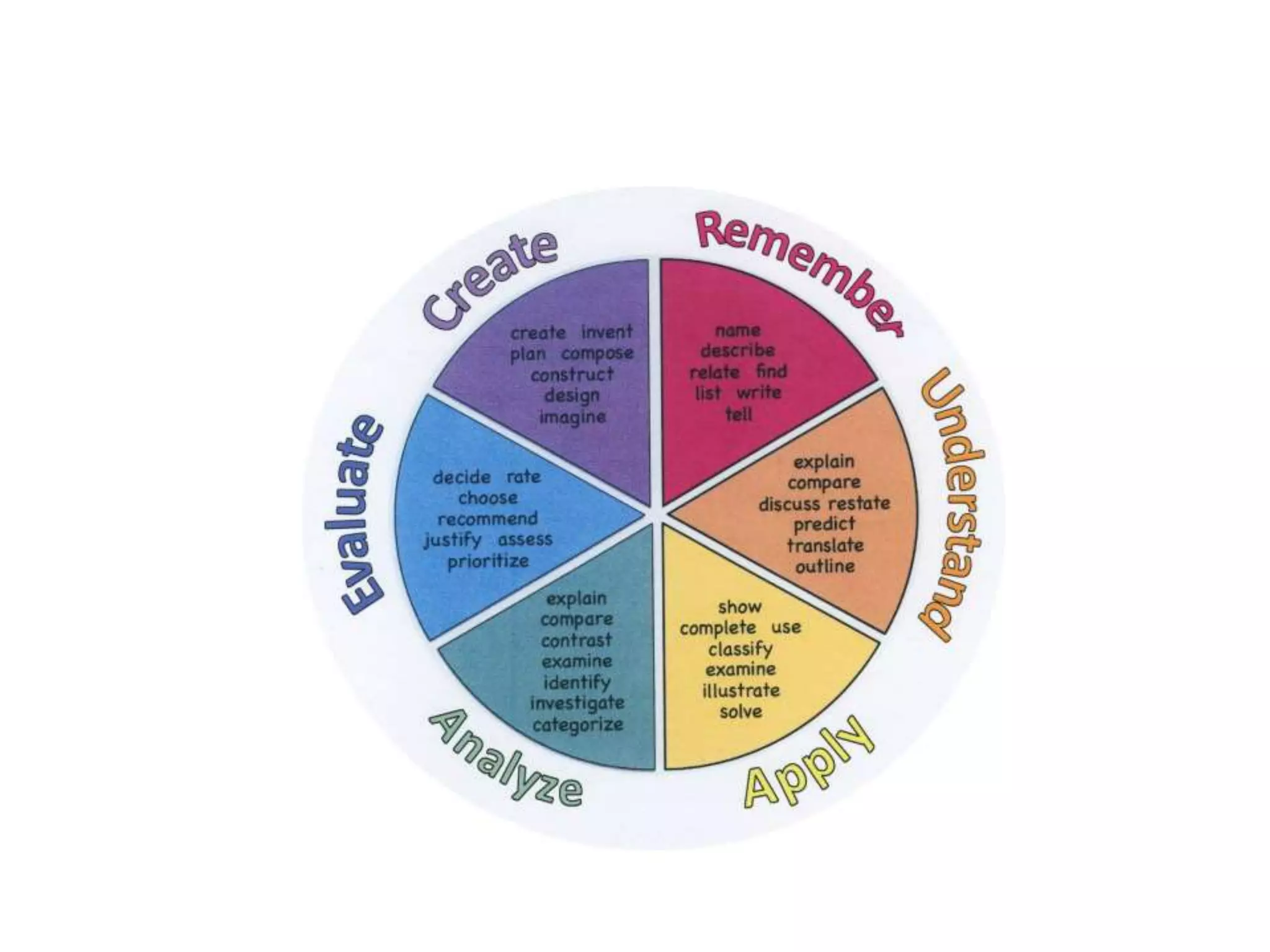
Cognitive domain
A hierarchy of six levels (the hierarchy is what is most under question
at present):
• knowledge: the recall of specific items(understand)
• comprehension: can recall, but can do a little more (e.g.
paraphrase, define, discuss to some extent)(remember)
• application: all of the above, but can take information of an
abstract nature and use it in concrete situations(Applying
Information)
• analysis: can break down a communication into its constituent
parts, revealing the relationships among them(analyse,reasoning)
• synthesis: can pull together many disorganized elements or parts so
as to form a whole (create)
• evaluation: makes judgments about the value of materials or
methods.(evaluate)
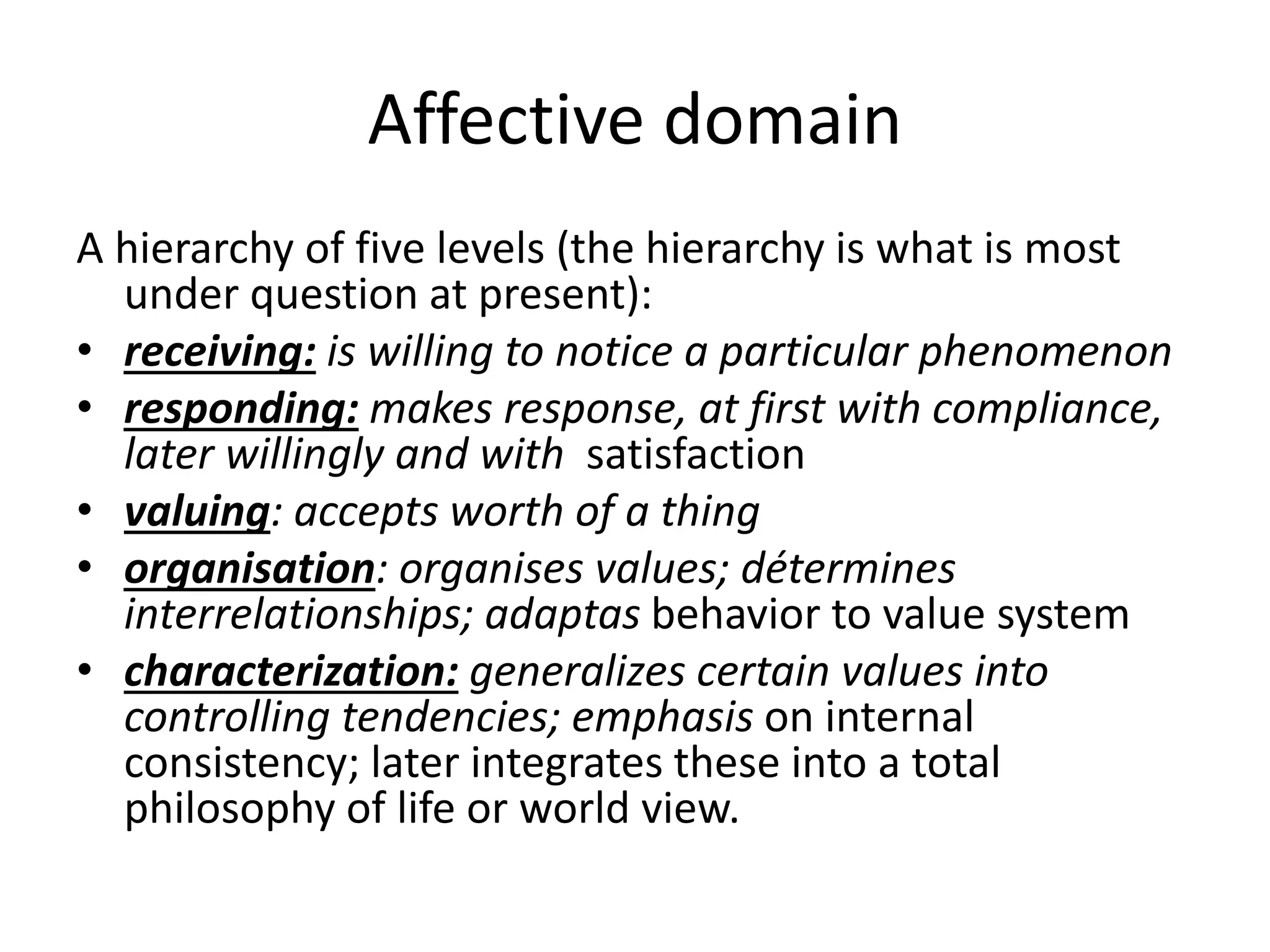
Affective domain
A hierarchy of five levels (the hierarchy is what is most
under question at present):
• receiving: is willing to notice a particular phenomenon
• responding: makes response, at first with compliance,
later willingly and with satisfaction
• valuing: accepts worth of a thing
• organisation: organises values; détermines
interrelationships; adaptas behavior to value system
• characterization: generalizes certain values into
controlling tendencies; emphasis on internal
consistency; later integrates these into a total
philosophy of life or world view.
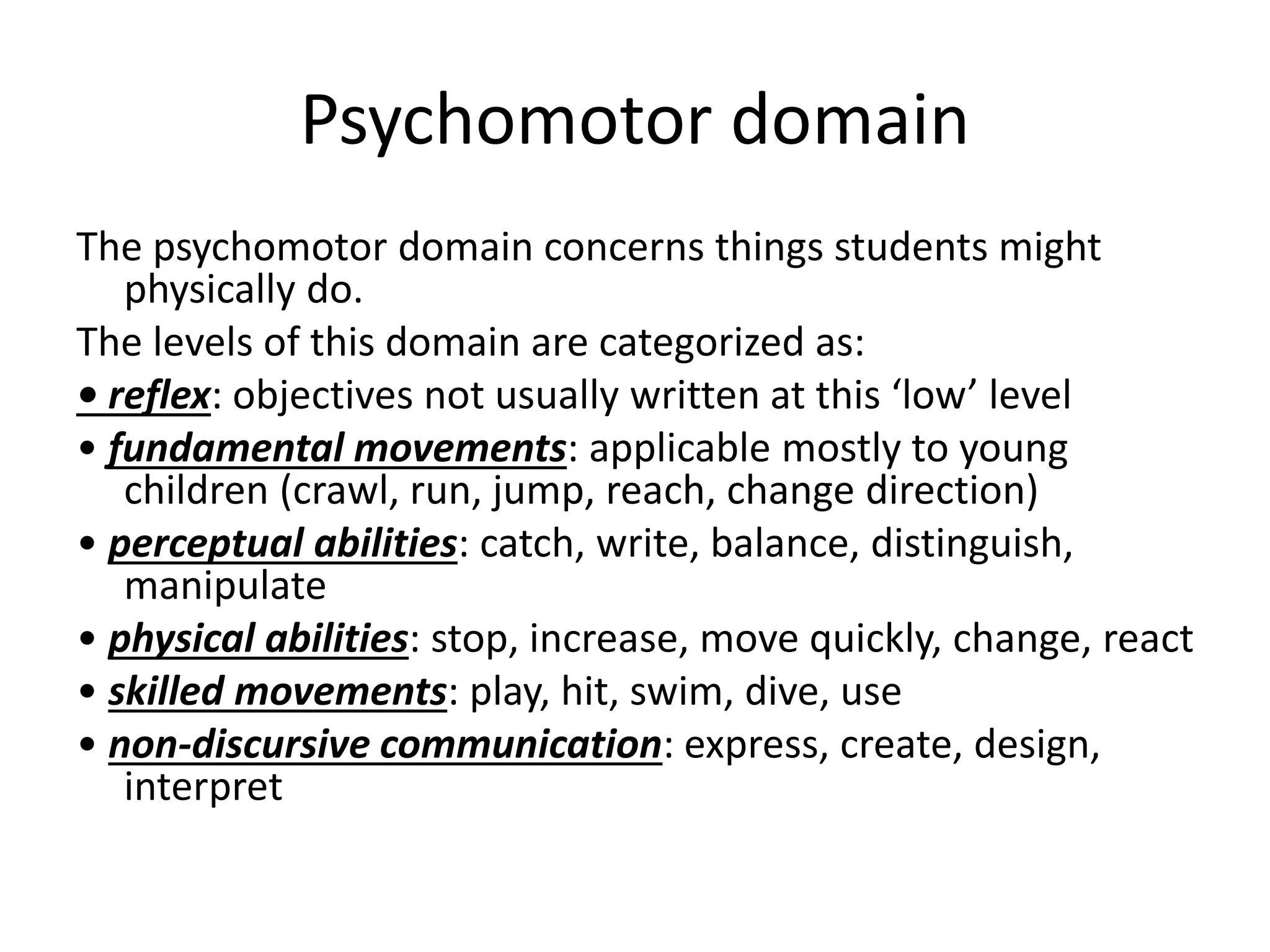
Psychomotor domain
The psychomotor domain concerns things students might
physically do.
The levels of this domain are categorized as:
• reflex: objectives not usually written at this ‘low’ level
• fundamental movements: applicable mostly to young
children (crawl, run, jump, reach, change direction)
• perceptual abilities: catch, write, balance, distinguish,
manipulate
• physical abilities: stop, increase, move quickly, change, react
• skilled movements: play, hit, swim, dive, use
• non-discursive communication: express, create, design,
interpret
Preparing instructional objectives

Preparing instructional objectives

  • 1.
  • 2.
    Objectives • Objectives arestatements which describe what the learner is expected to achieve as a result of instruction. • An objective describes an intended result of instruction, rather than the process of instruction itself
  • 3.
    What are instructionalobjectives? • Instructional objectives may also be called performance objectives, behavioral objectives, or simply objectives. All of these terms are used interchangeably. Objectives are specific, outcome based, measurable, and describe the learner's behavior after instruction. In other words what a learner will be able to do as a result of instruction.
  • 4.
    Characteristics of instructional objectives specific •Objectives are very specific. This means that they should describe exactly what the learner is expected to do • Outcome based • Objectives are outcome based. This means that the objective is going to state what the learner should be able to do after the instruction is complete. The process of how the instruction happens is not considered in an objective.
  • 5.
    Cont… measurable • Objectives aremeasurable. This means that objectives should describe learning outcomes that can be measured; objectives should be seen or heard. describe student behavior • Objectives describe student behaviors. This means that objectives should relate what the student should be able to do after the instruction.
  • 6.
    Why use instructionalobjectives In addition, there are three reasons that instructional objectives are so important. • Serve as a guide for students. • Serve as a basis for the selection of instructional media & materials and procedures. • Determine the appropriate ways to evaluate the learning.
  • 7.
    Learning Outcomes andObjectives • What are learning outcomes and objectives? • Learning outcomes represent the skills that learners can expect to demonstrate after completing the instruction. Outcome statements must be specific, observable, and measurable • Objectives are clear and concise statements that describe the intended outcomes of instruction.
  • 8.
    What is thedifference between objectives and outcomes? • Objectives are intended results of instruction. Outcomes are achieved (measured) results of what was learned. They describe significant and essential learning that learners have achieved and can demonstrate at the end of a learning event.
  • 9.
    How to writelearning objectives: • First, determine the learning outcomes for the lesson. In other words, what should the student be able to do when the lesson is over? Following the ABCDs of instructional objectives is a great way to make sure you include all the necessary information in an objective. • A is the audience, always the student. B is the behavior or the action verb. C is the condition for the objective and D is the degree of achievement or acceptable criteria
  • 10.
    Conditions Conditions describe therelevant factors associated with the desired performance. For example: 1. after attending a lecture. . . . 2. Following review of a demonstration. . . . 3. Given a case study. . . . 4. After completing the assignment. . . . 5. Given a specific instrument. . . .
  • 11.
    Criteria The criteria arespecified as the acceptable level of achievement desired. They tell how well the learner must perform. This part of the objective may be omitted when there is no deviation from standard procedures . For example: 1. percent of correct responses 2. Within a given time period 3. in compliance with criteria presented by the faculty
  • 12.
    Order and Tense •There is a preferred order when writing objectives. The condition is usually placed first, followed by the behavior or verb, and then the criteria. Objectives are written in the future tense. For example: Recall: After attending lecture and reading the assigned materials, the student will state the function of a thermometer.
  • 13.
    Cont… Interpretation: After attendinglecture and studying the assigned materials, the student will demonstrate how a thermometer works.  Problem-Solving: After attending lecture and studying the assigned materials (including problem sets), the student will formulate the degrees in C given the degrees in F, or vice versa.
  • 14.
    Cont… • To avoidredundancy in writing objectives an educator often lists a single condition with the objectives below. After attending lecture and studying the assigned materials, the student will: • 1. . . . . . • 2. . . . . . • 3. . . . . .
  • 15.
    Nonfunctional Verbs The followingverbs cannot be measured or are unnecessary. They should be avoided when writing Objectives. • Able to shows interest in • Appreciation for knows • Awareness of has knowledge of • Capable of learns • Comprehend memorizes • Conscious of understands • Familiar with will be able to
  • 16.
    Examples of Objectivesfor the Cognitive Domain • Poor : To increase the student’s ability to visually identify white cells on a differential. • Better :The student will identify correctly all white cells on a differential. • Poor: The student will gain knowledge of automated chemistry tests. • Better :The student will state the principle for each automated chemistry test listed.
  • 17.
    Bloom’s taxonomy of educationalobjectives • Bloom’s domains Three domains: • cognitive (about knowing) • affective (about attitudes, feelings) • psychomotor (about doing)
  • 18.
    Cognitive domain A hierarchyof six levels (the hierarchy is what is most under question at present): • knowledge: the recall of specific items(understand) • comprehension: can recall, but can do a little more (e.g. paraphrase, define, discuss to some extent)(remember) • application: all of the above, but can take information of an abstract nature and use it in concrete situations(Applying Information) • analysis: can break down a communication into its constituent parts, revealing the relationships among them(analyse,reasoning) • synthesis: can pull together many disorganized elements or parts so as to form a whole (create) • evaluation: makes judgments about the value of materials or methods.(evaluate)
  • 20.
    Affective domain A hierarchyof five levels (the hierarchy is what is most under question at present): • receiving: is willing to notice a particular phenomenon • responding: makes response, at first with compliance, later willingly and with satisfaction • valuing: accepts worth of a thing • organisation: organises values; détermines interrelationships; adaptas behavior to value system • characterization: generalizes certain values into controlling tendencies; emphasis on internal consistency; later integrates these into a total philosophy of life or world view.
  • 21.
    Psychomotor domain The psychomotordomain concerns things students might physically do. The levels of this domain are categorized as: • reflex: objectives not usually written at this ‘low’ level • fundamental movements: applicable mostly to young children (crawl, run, jump, reach, change direction) • perceptual abilities: catch, write, balance, distinguish, manipulate • physical abilities: stop, increase, move quickly, change, react • skilled movements: play, hit, swim, dive, use • non-discursive communication: express, create, design, interpret