Intended Learning Outcomes  and  Student Assessment Dr. Ahmed-Refat  AG Refat FOM-ZU
What are intended learning outcomes? Statements describing what students know, understand, and  can do  with their knowledge, as well as what they feel and believe, as a result of their learning experiences Can be written for a course, a program, or an entire institution
Learning Outcomes   Students  will   DO   WHAT ( how )
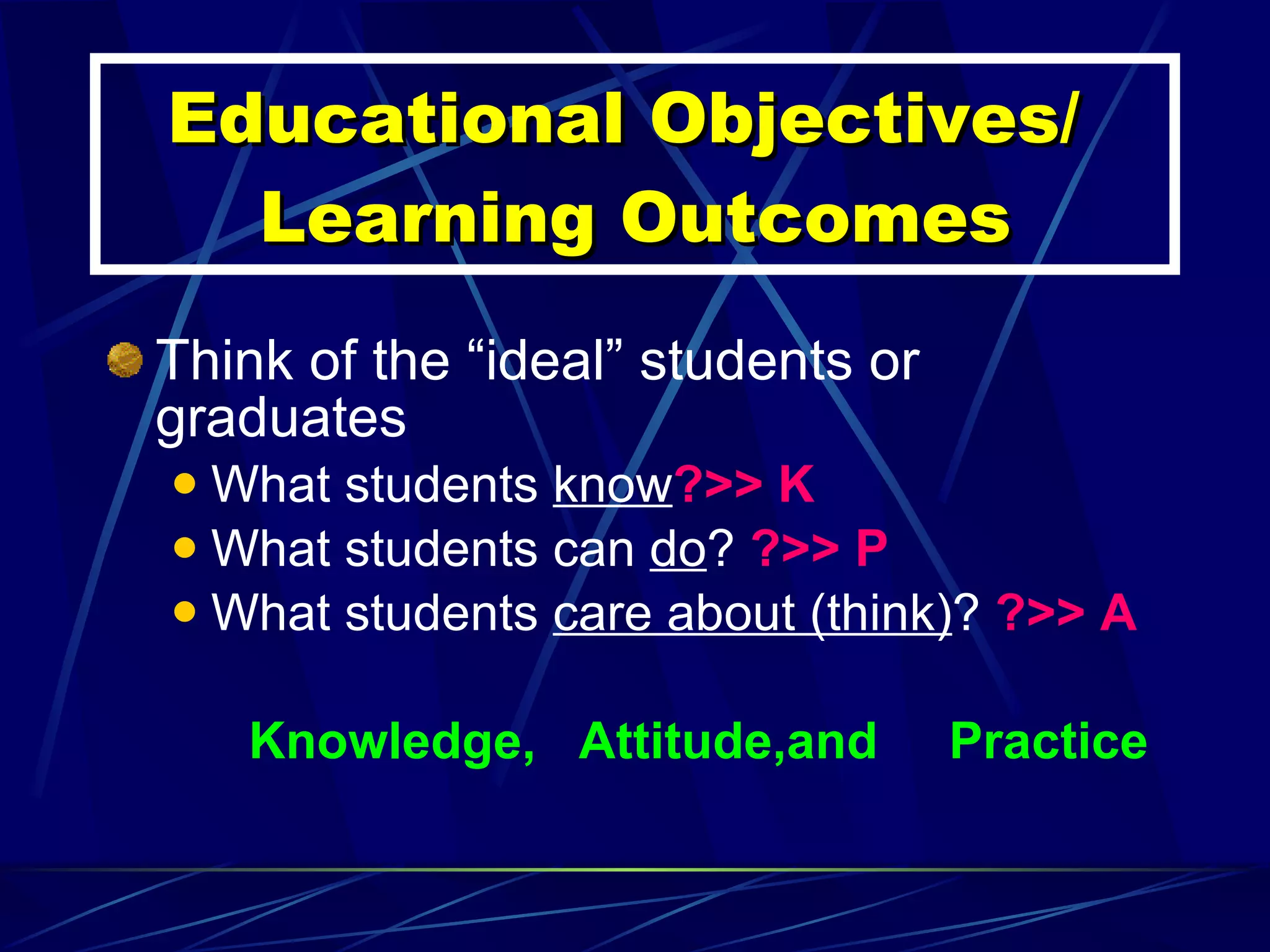
Educational Objectives/  Learning Outcomes Think of the “ideal” students or graduates What students  know ?>> K What students can  do ?  ?>> P What students  care about (think) ?  ?>> A Knowledge,  Attitude,and  Practice
ILOs Learning Outcomes: Some Examples
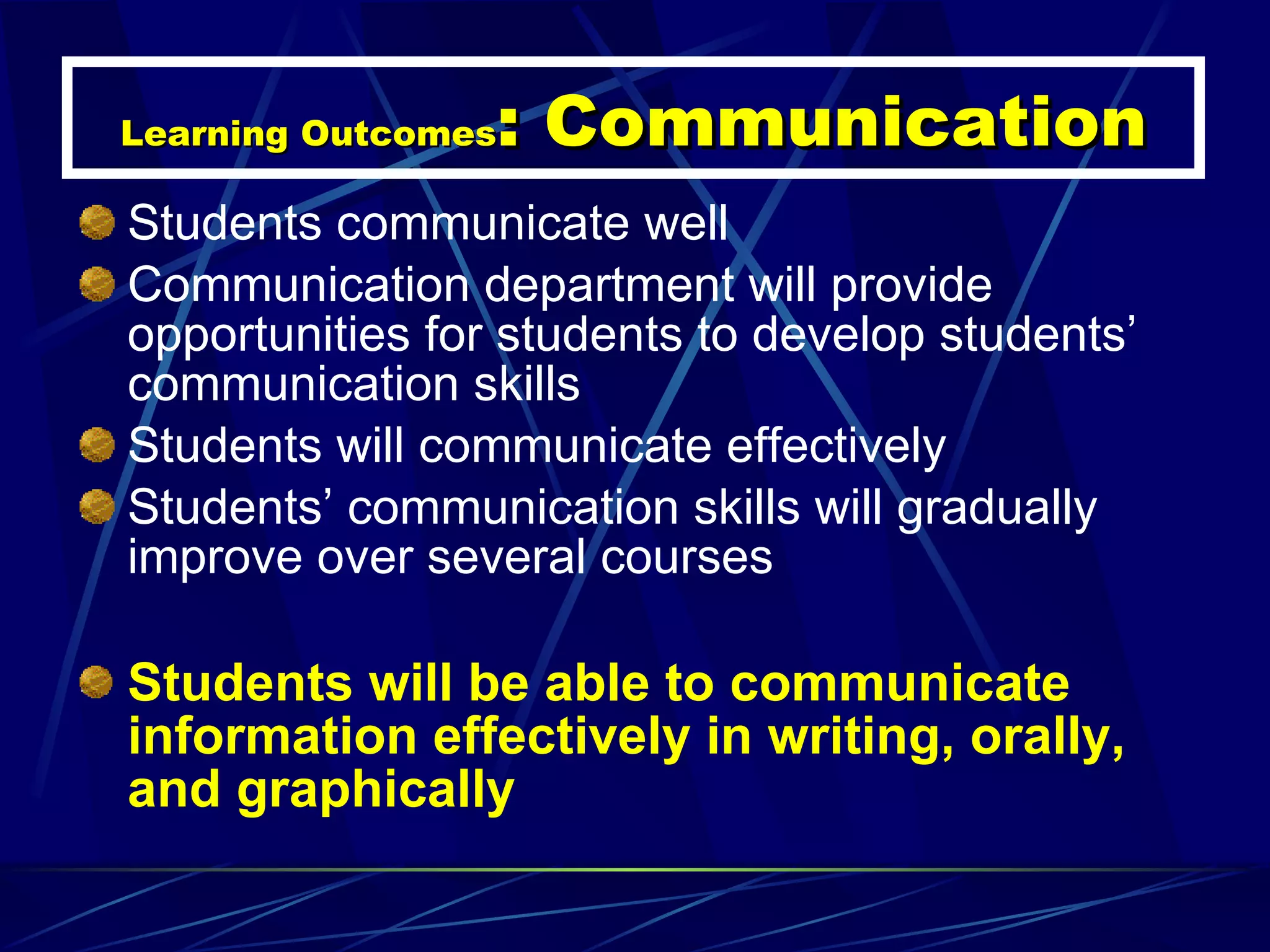
Learning Outcomes : Communication Students communicate well Communication department will provide opportunities for students to develop students’ communication skills Students will communicate effectively Students’ communication skills will gradually improve over several courses Students will be able to communicate information effectively in writing, orally, and graphically
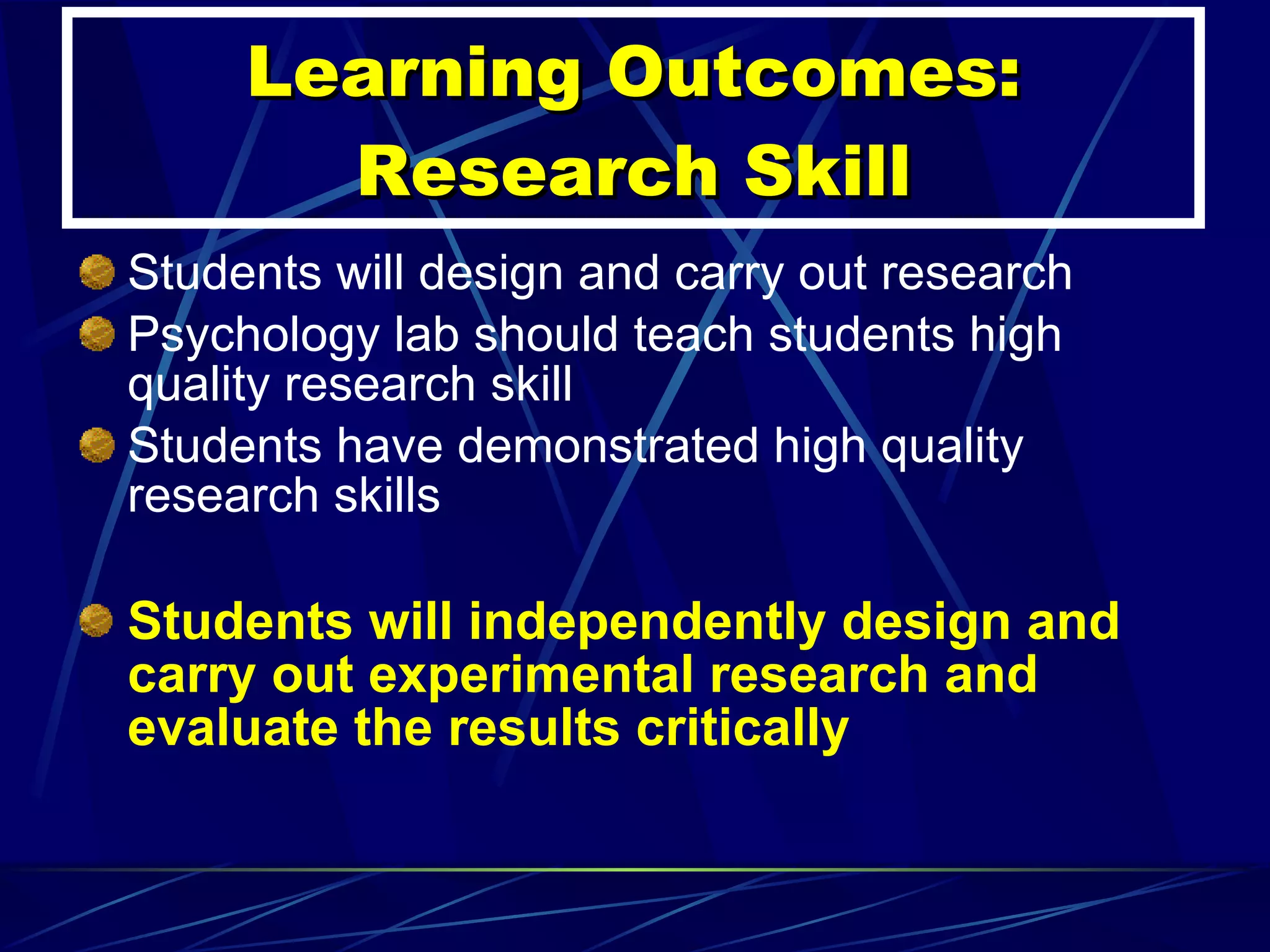
Learning Outcomes: Research Skill Students will design and carry out research Psychology lab should teach students high quality research skill  Students have demonstrated high quality research skills Students will independently design and carry out experimental research and evaluate the results critically
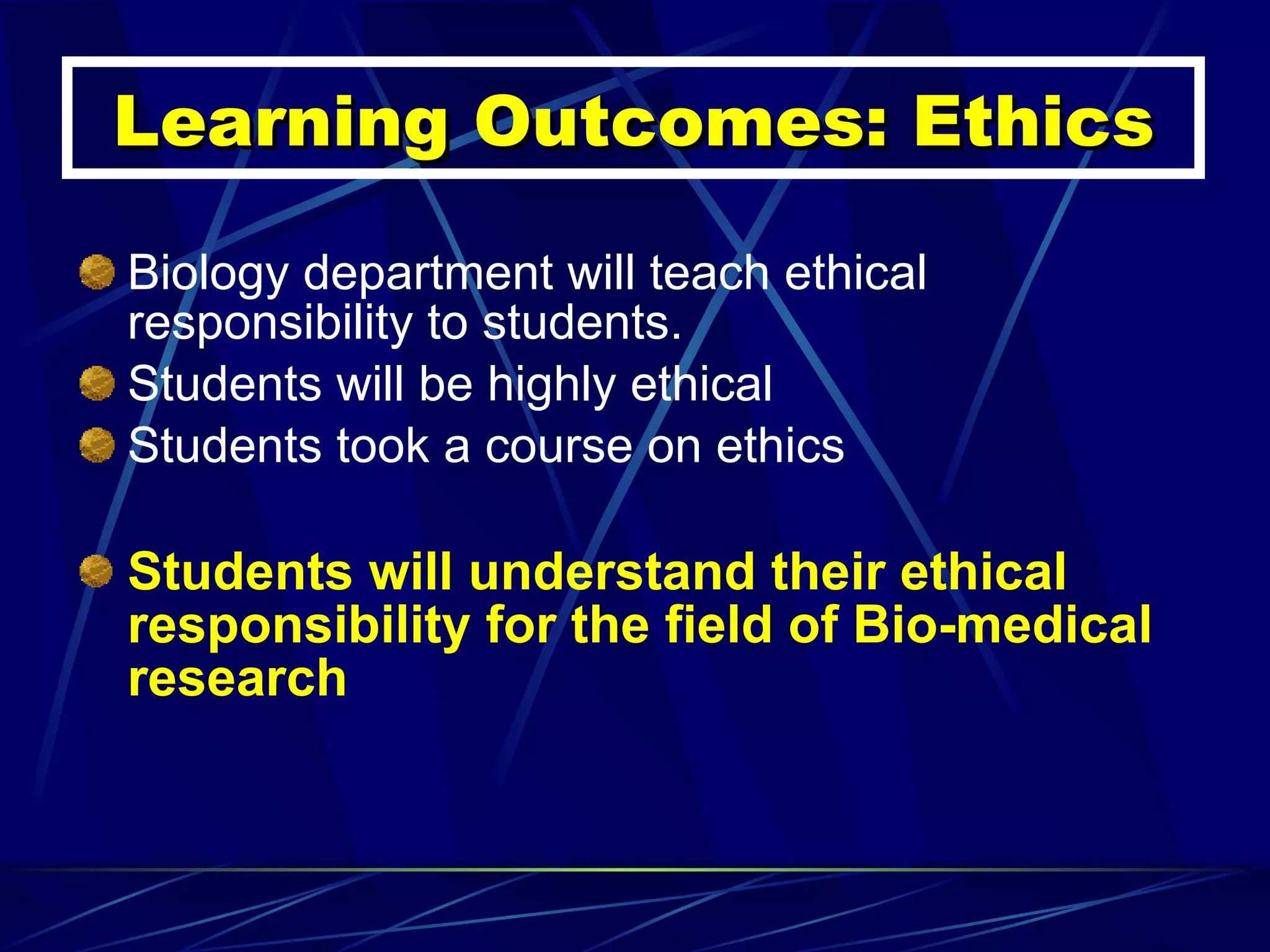
Learning Outcomes: Ethics Biology department will teach ethical responsibility to students.  Students will be highly ethical  Students took a course on ethics Students will understand their ethical responsibility for the field of Bio-medical research
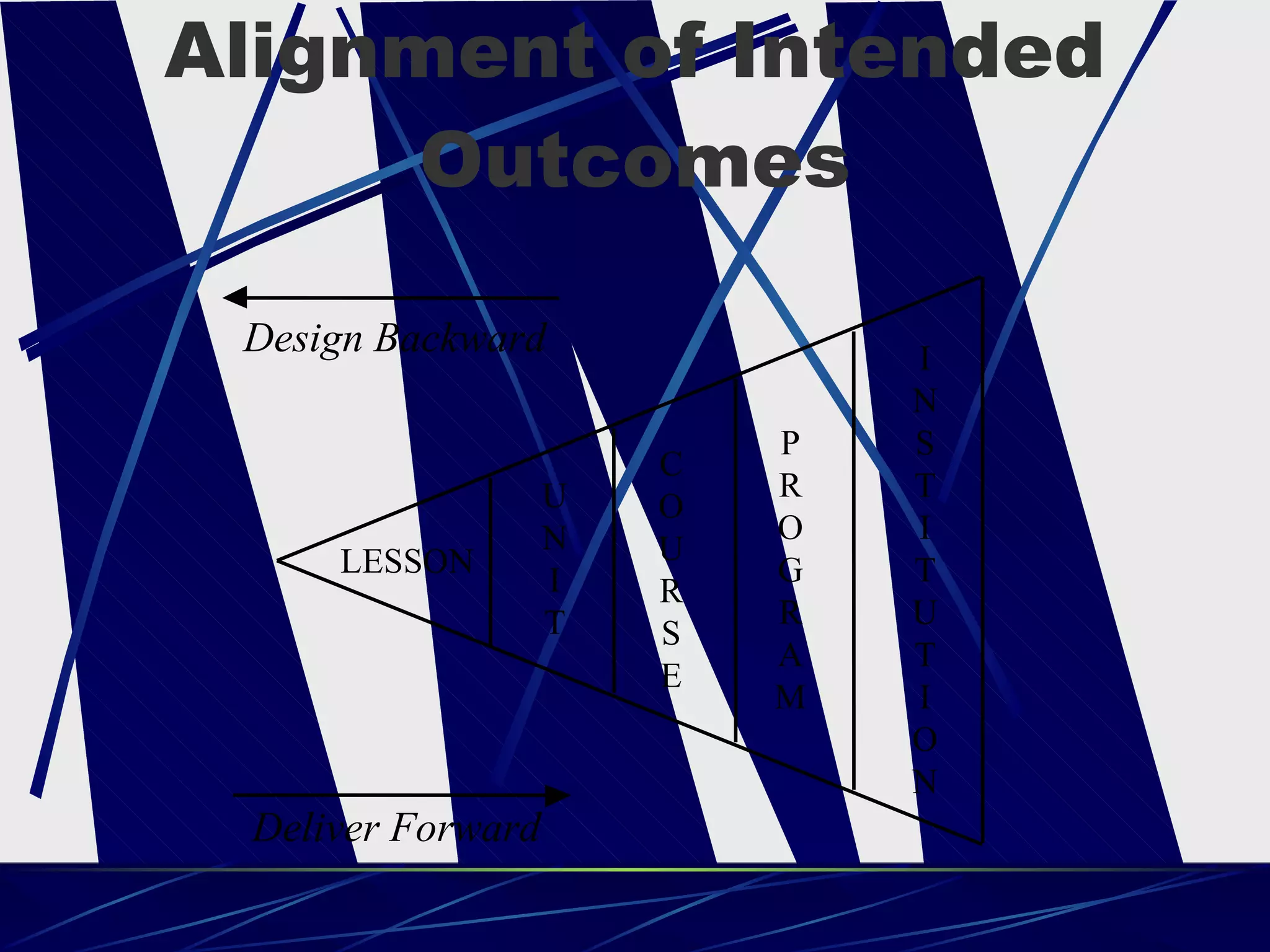
Alignment of Intended Outcomes Deliver Forward Design Backward I N S T I T U T I O N LESSON U N I T C O U R S E P R O G R A M
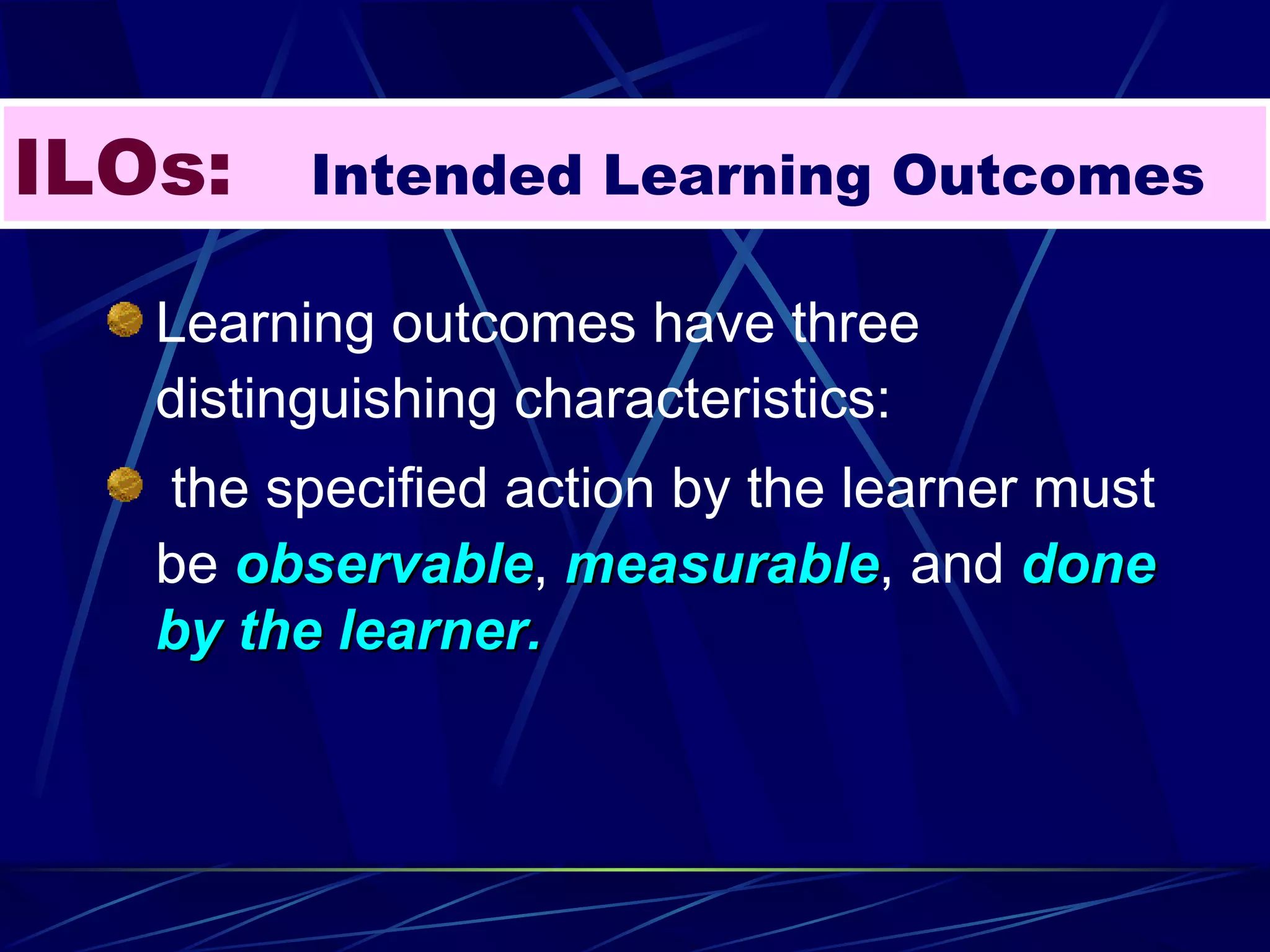
ILOs:   Intended Learning Outcomes Learning outcomes have three distinguishing characteristics: the specified action by the learner must be  observable ,  measurable , and  done by the learner.
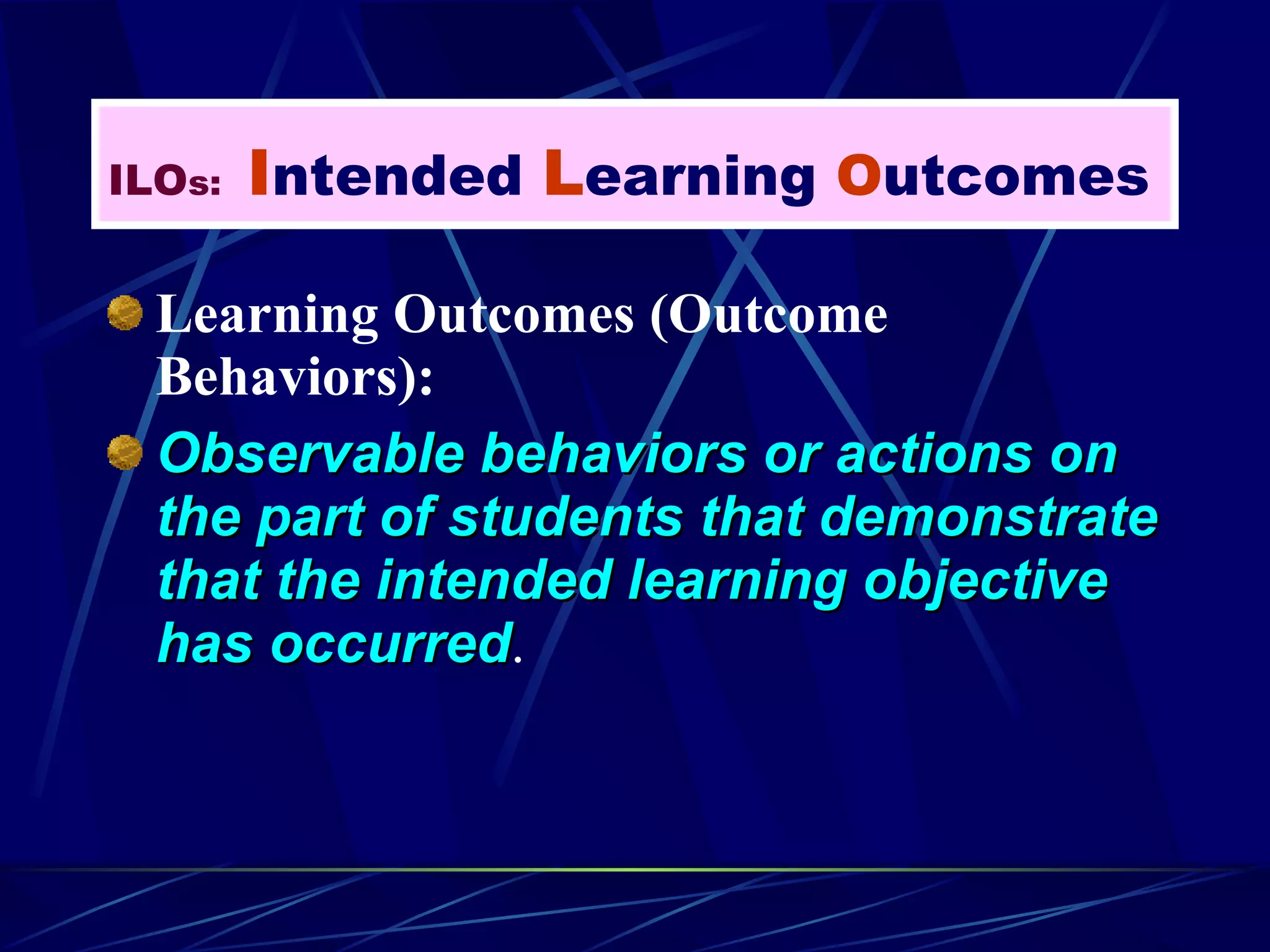
Learning Outcomes (Outcome Behaviors):  Observable behaviors or actions on the part of students that demonstrate that the intended learning objective has occurred . ILO s:   I ntended  L earning  O utcomes
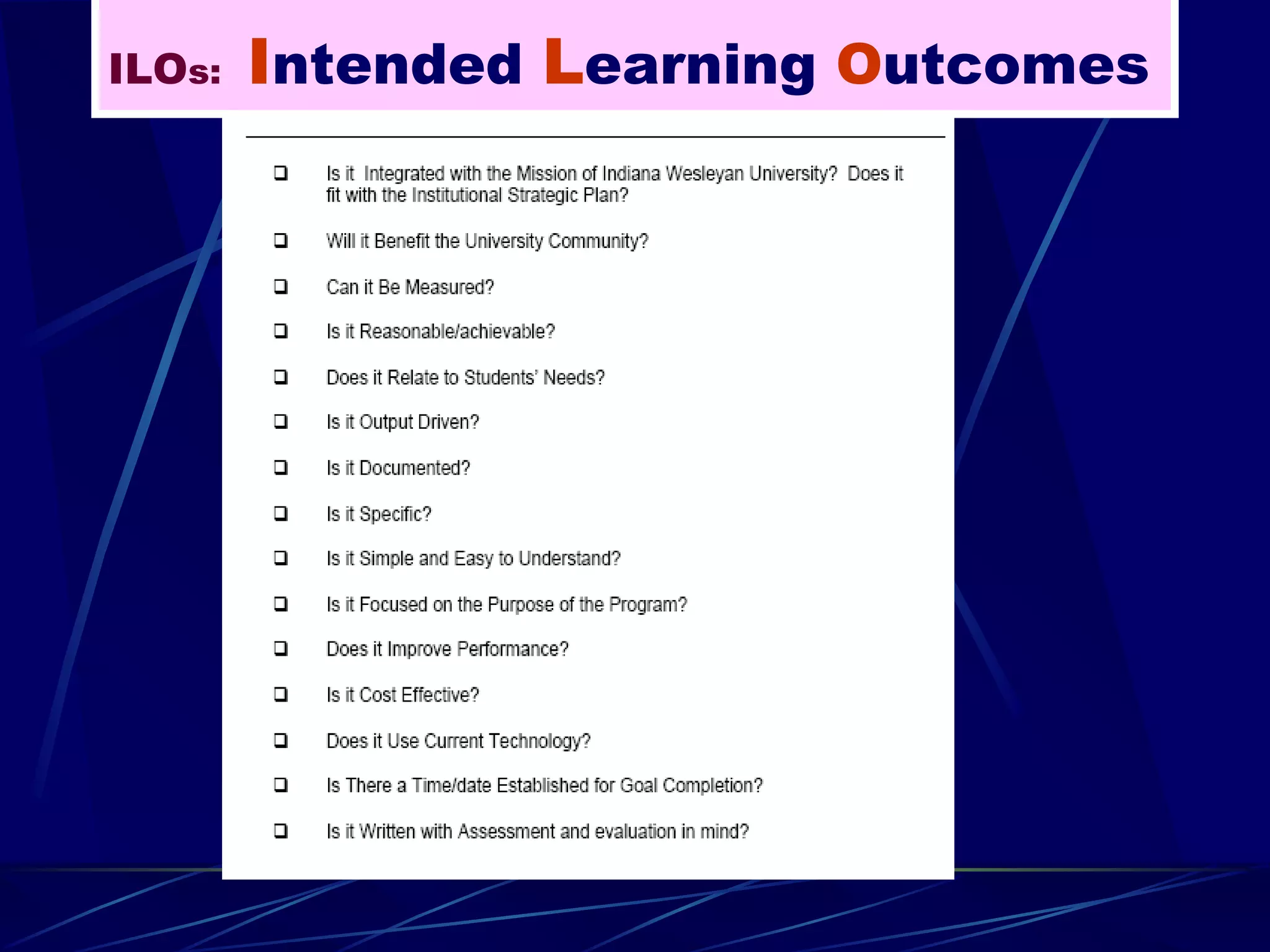
ILO s:   I ntended  L earning  O utcomes
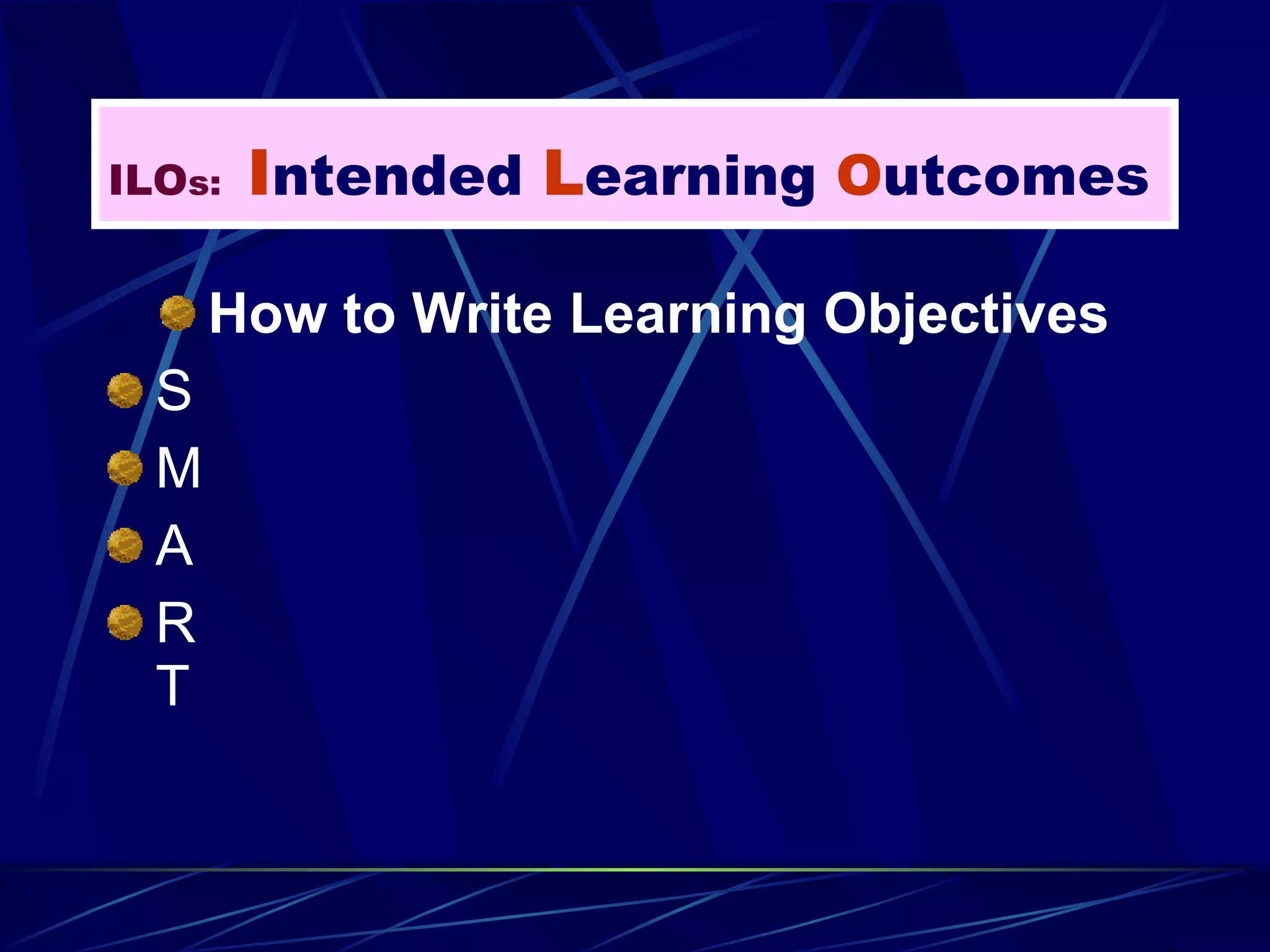
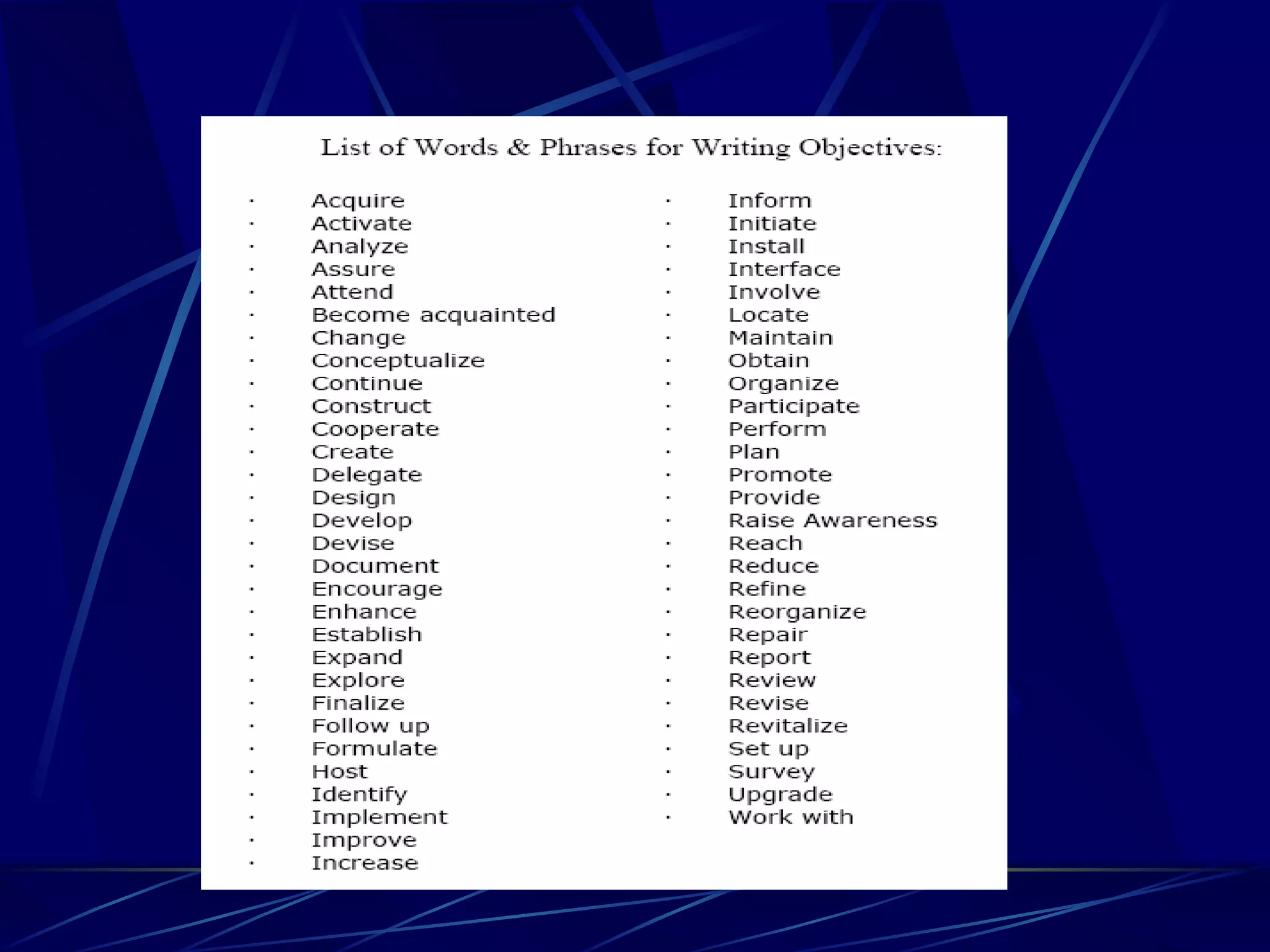
How to Write Learning Objectives S M A R T ILO s:   I ntended  L earning  O utcomes
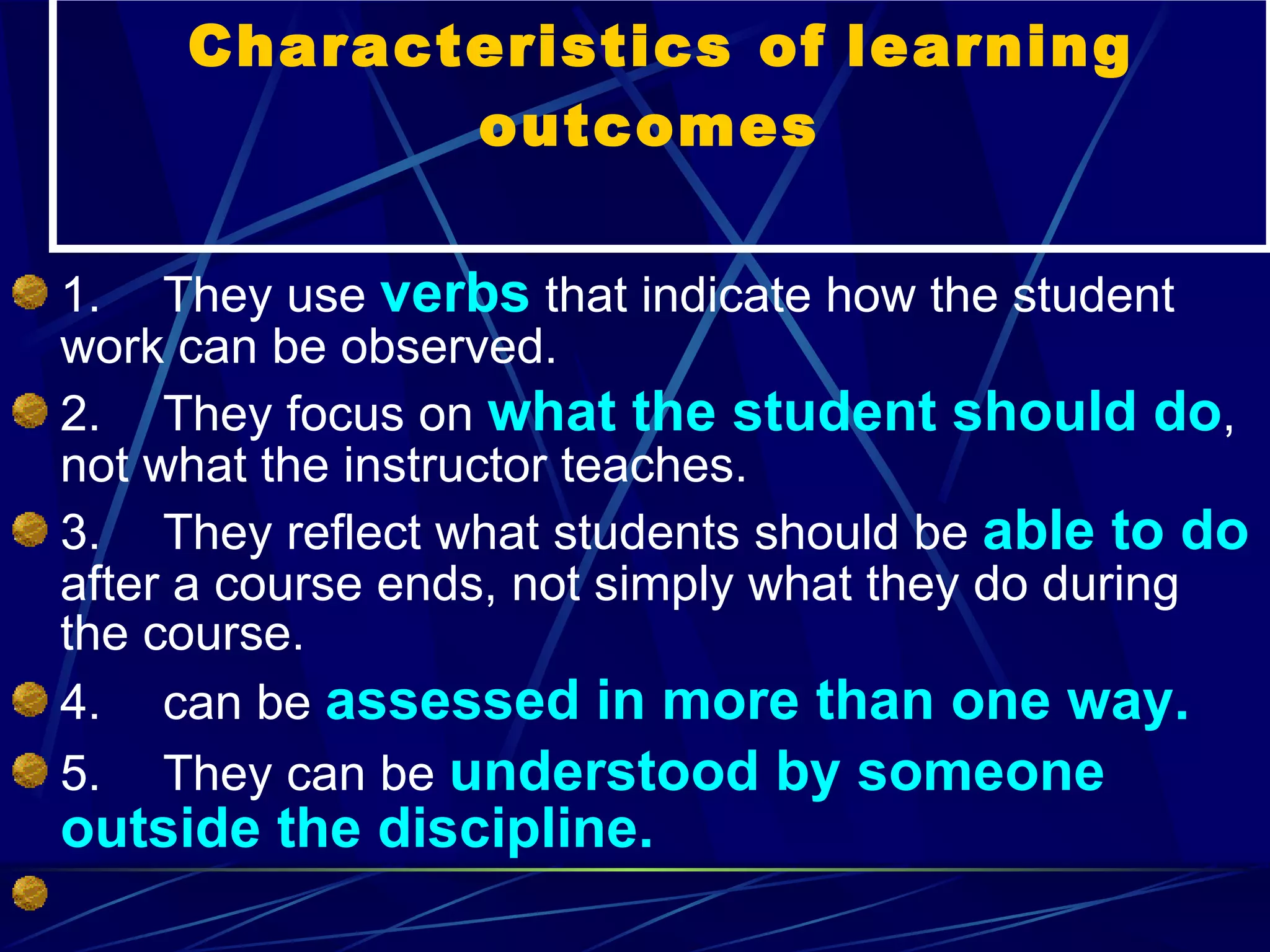
Characteristics of   learning outcomes  1.       They use  verbs  that indicate how the student work can be observed. 2.       They focus on  what the student should do , not what the instructor teaches. 3.       They reflect what students should be  able to do  after a course ends, not simply what they do during the course. 4.       can be  assessed in more than one way. 5.       They can be  understood by someone outside the discipline.  
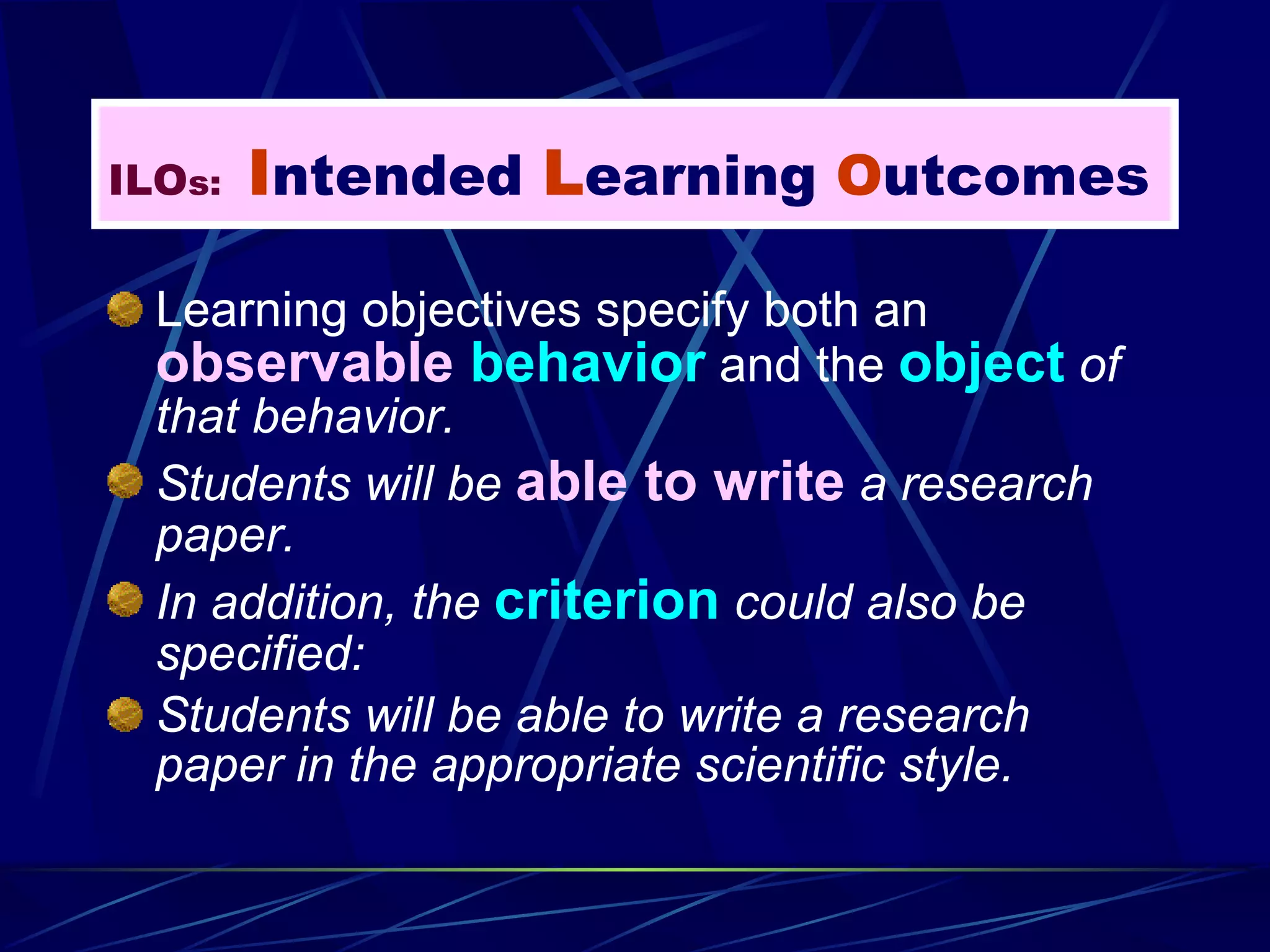
Learning objectives specify both an  observable  behavior   and the  object  of that behavior. Students will be  able to write  a research paper. In addition, the  criterion  could also be specified: Students will be able to write a research paper in the appropriate scientific style. ILO s:   I ntended  L earning  O utcomes
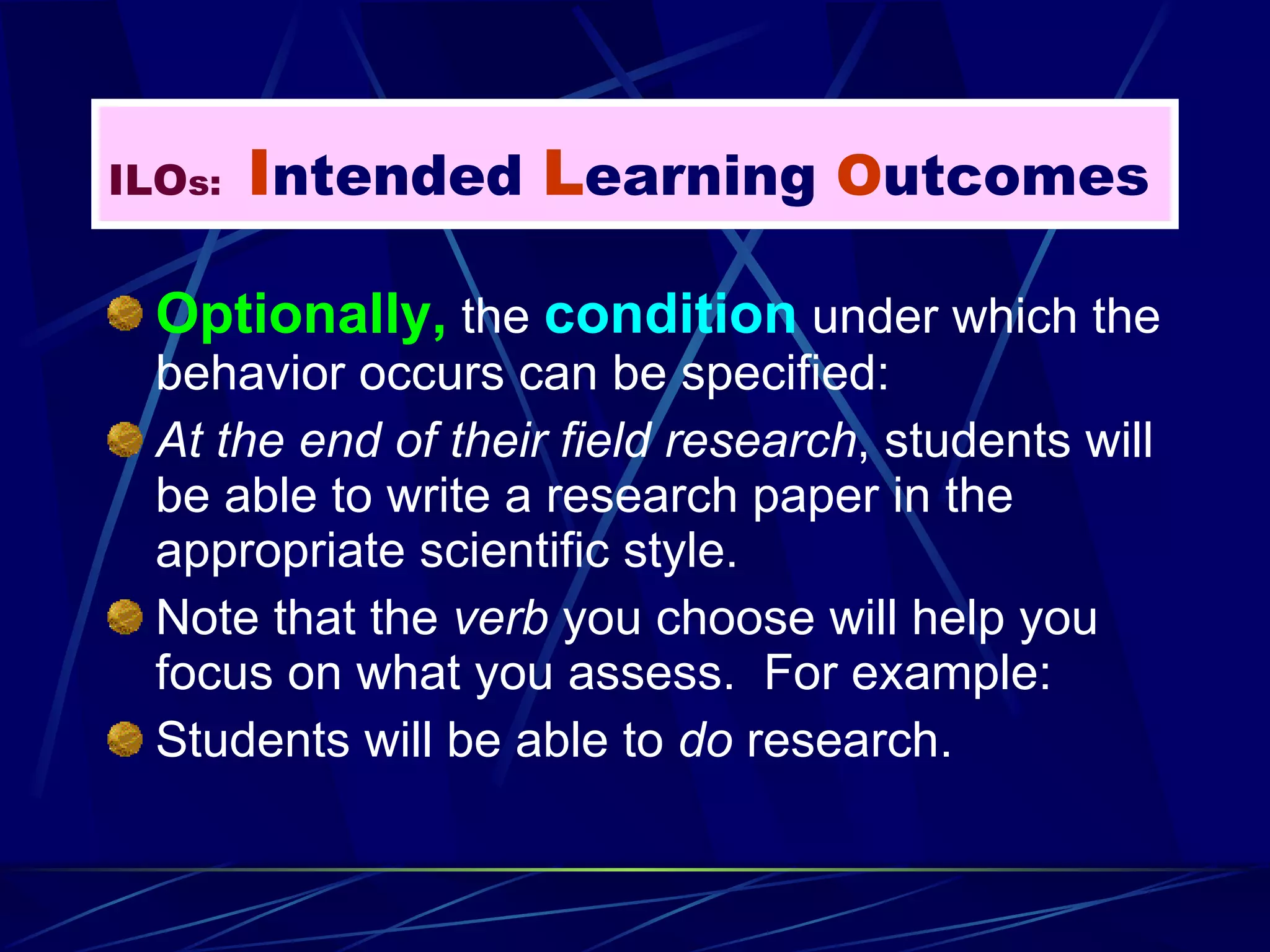
Optionally,  the  condition  under which the behavior occurs can be specified: At the end of their field research , students will be able to write a research paper in the appropriate scientific style. Note that the  verb  you choose will help you focus on what you assess.  For example: Students will be able to  do  research.  ILO s:   I ntended  L earning  O utcomes
 
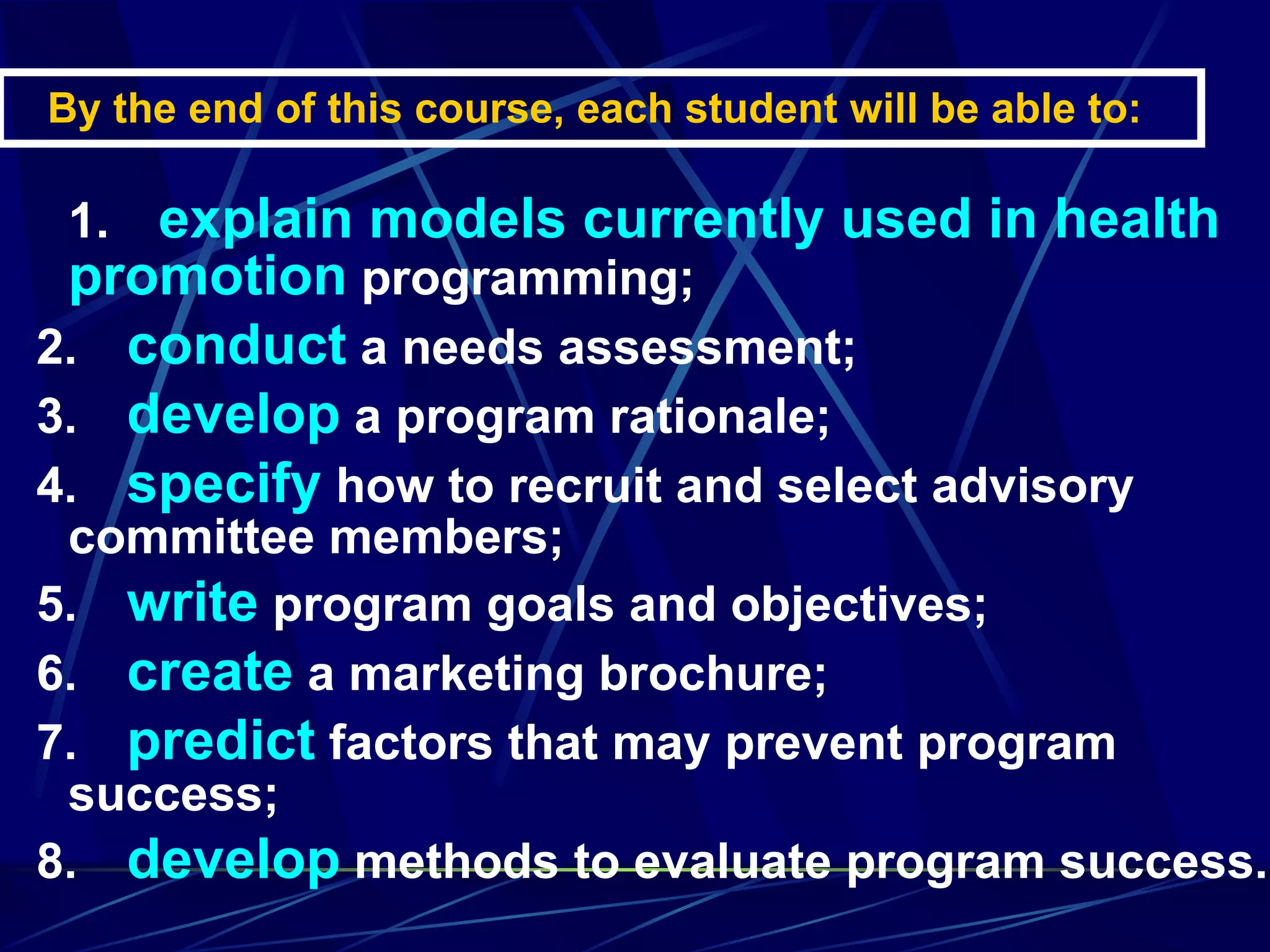
By the end of this course, each student will be able to:  1.      explain models currently used in health promotion  programming; 2.      conduct  a needs assessment; 3.      develop  a program rationale; 4.      specify  how to recruit and select advisory committee members; 5.      write  program goals and objectives; 6.      create  a marketing brochure; 7.      predict  factors that may prevent program success; 8.      develop  methods to evaluate program success.
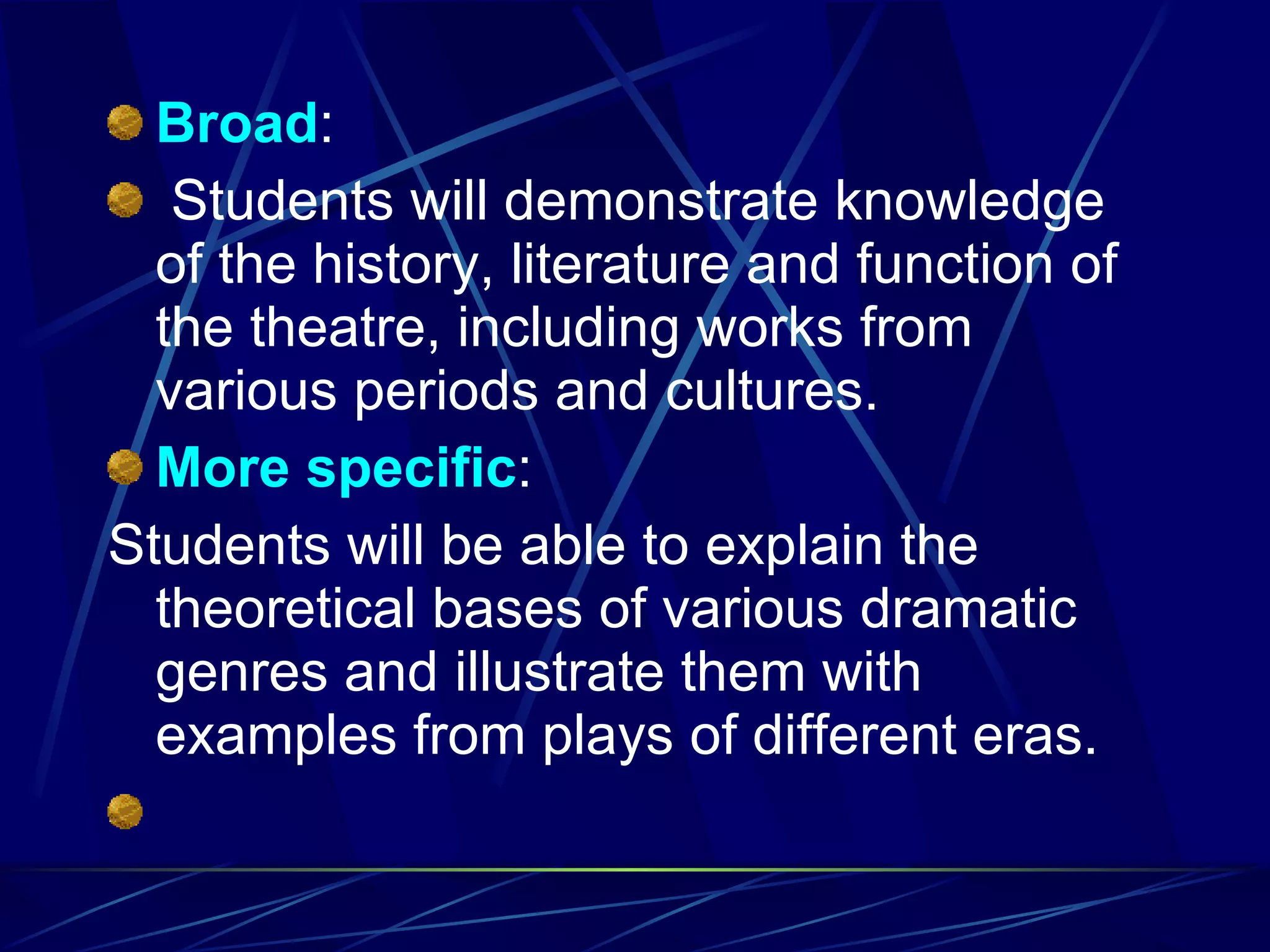
Broad :    Students will demonstrate knowledge of the history, literature and function of the theatre, including works from various periods and cultures. More   specific : Students will be able to explain the theoretical bases of various dramatic genres and illustrate them with examples from plays of different eras.
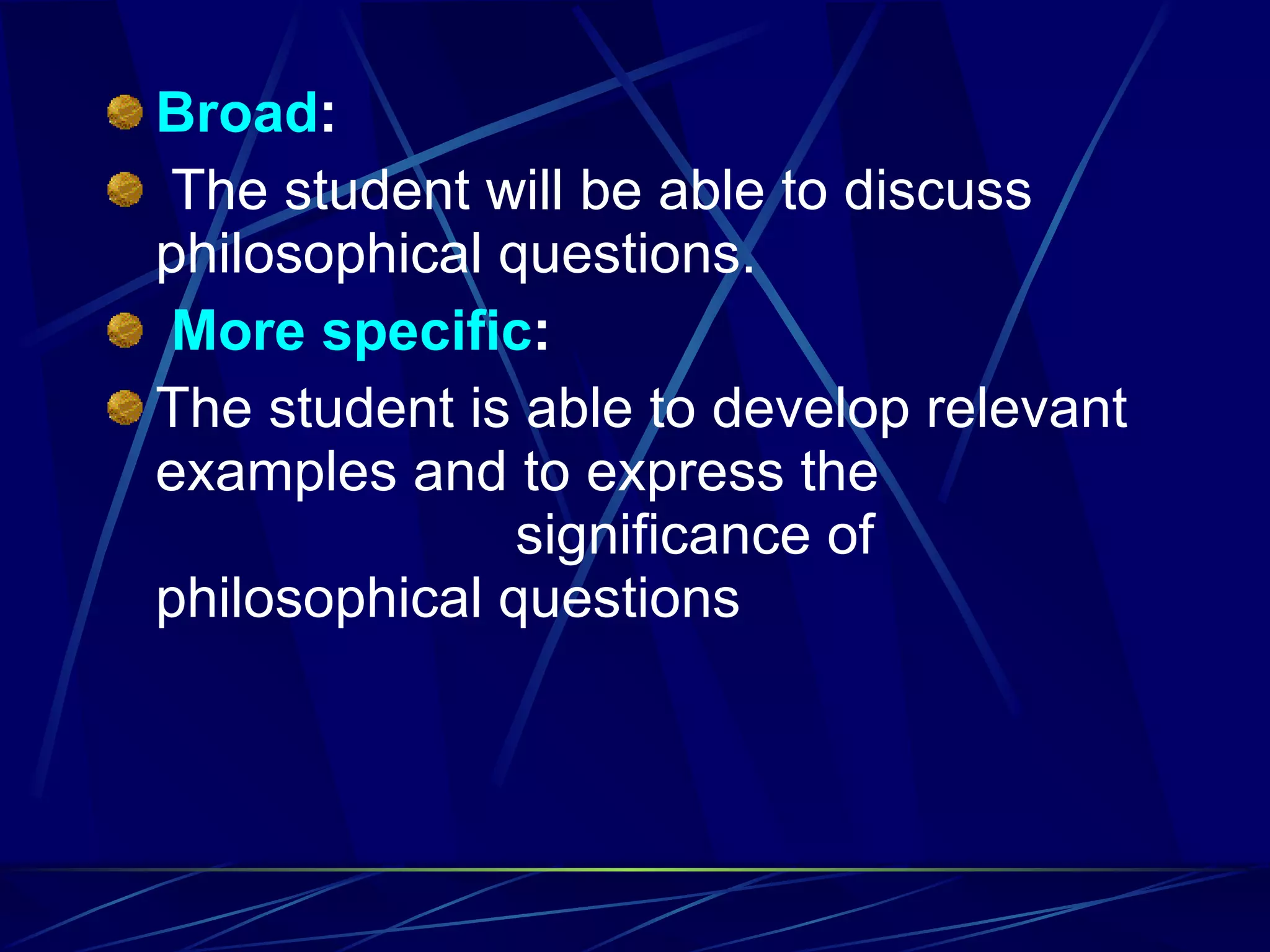
Broad :   The student will be able to discuss philosophical questions.   More   specific : The student is able to develop relevant examples and to express the  significance of philosophical questions
Broad :   Each student will be able to function as a team member.   More   specific : Each student will reflect upon his or her contributions to a team effort, ability to accept other team members as resources, and willingness to accept compromises if required to achieve a team goal.
Broad : Students will understand how to use technology effectively. More   specific : Each student will be able to use word processing, spreadsheets, databases, and presentation graphics in preparing their final research project and report.
assessable learning outcomes:   1.       They use  verbs  that indicate how the student work can be observed. 2.       They  focus on what the student should  do, not what the instructor teaches. 3.       They  reflect what students should be able  to do after a course ends, not simply what they do during the course. 4.       They usually can be  assessed in more than one way. 5.       They can be  understood  by someone outside the discipline.
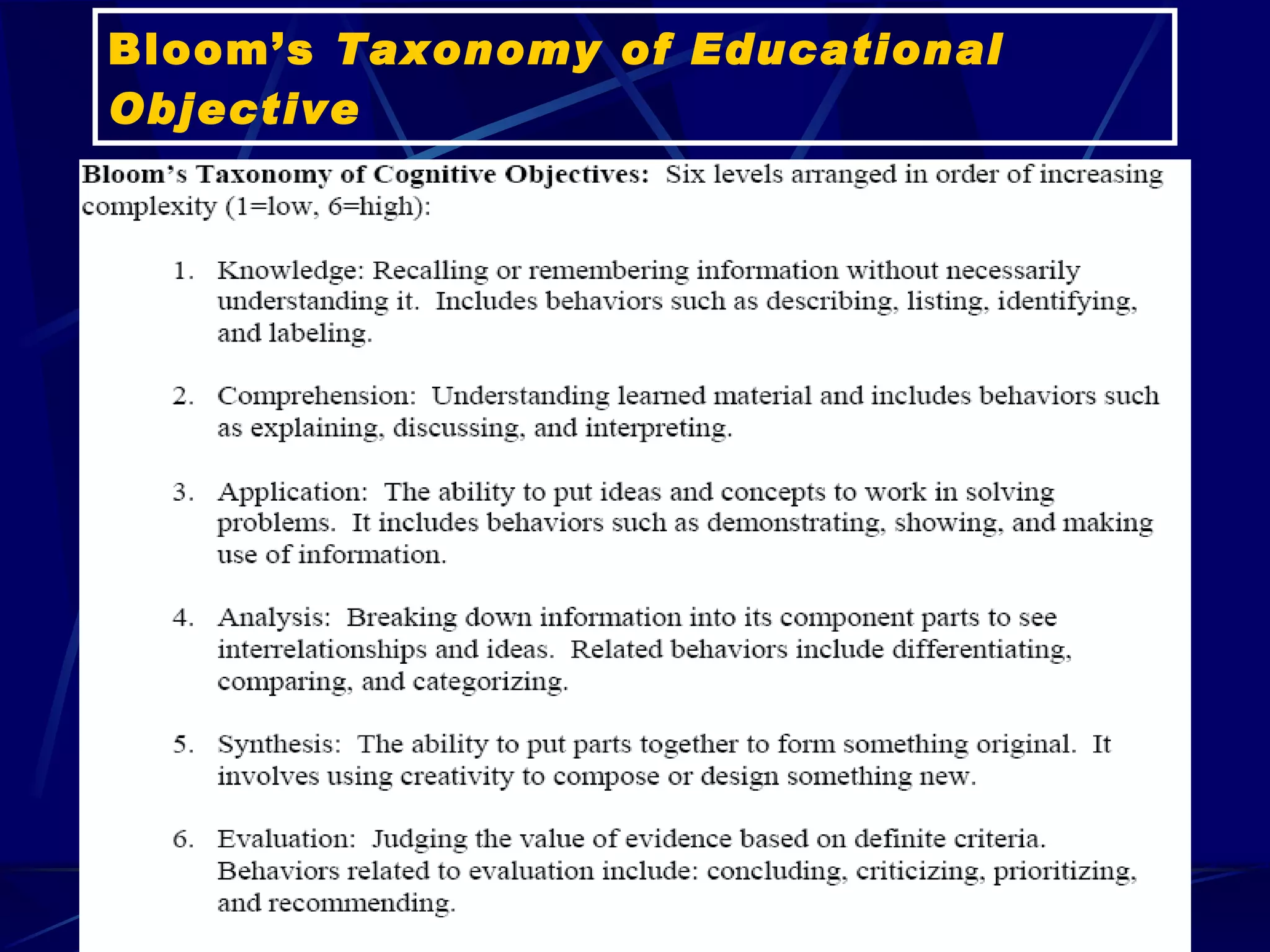
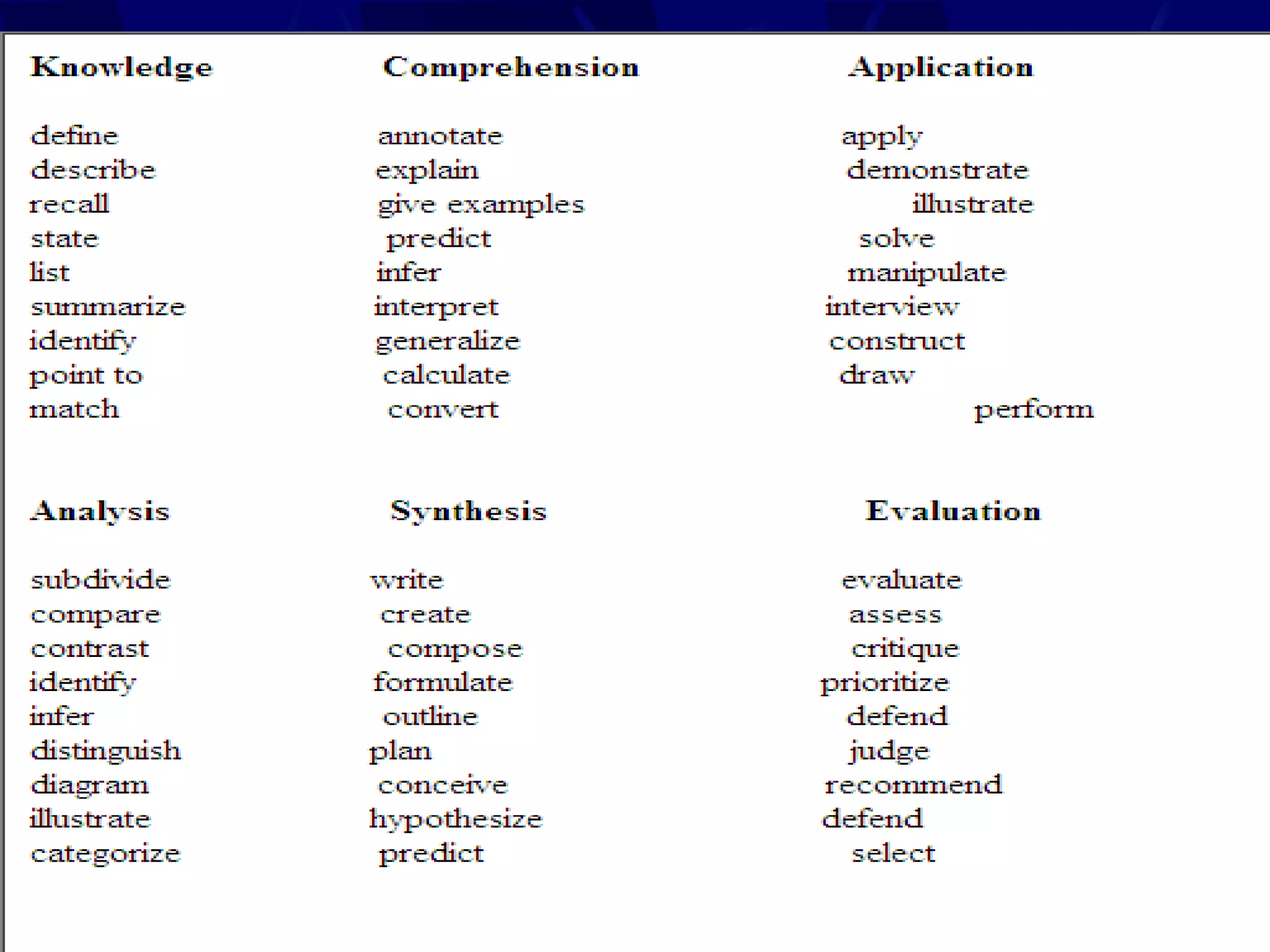
Bloom’s  Taxonomy of Educational Objective
 
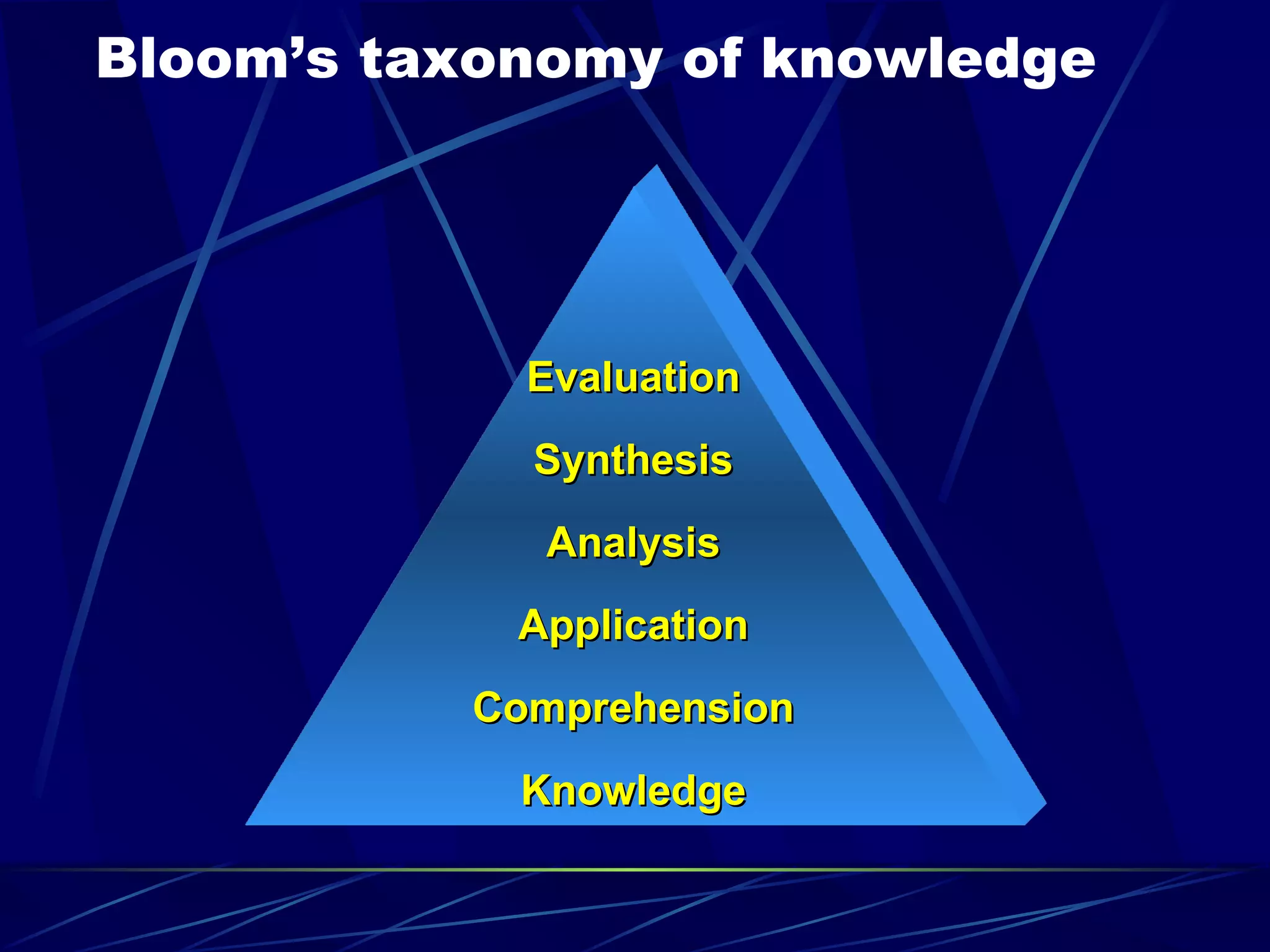
Bloom’s taxonomy of knowledge  Knowledge Comprehension Application Analysis Synthesis Evaluation
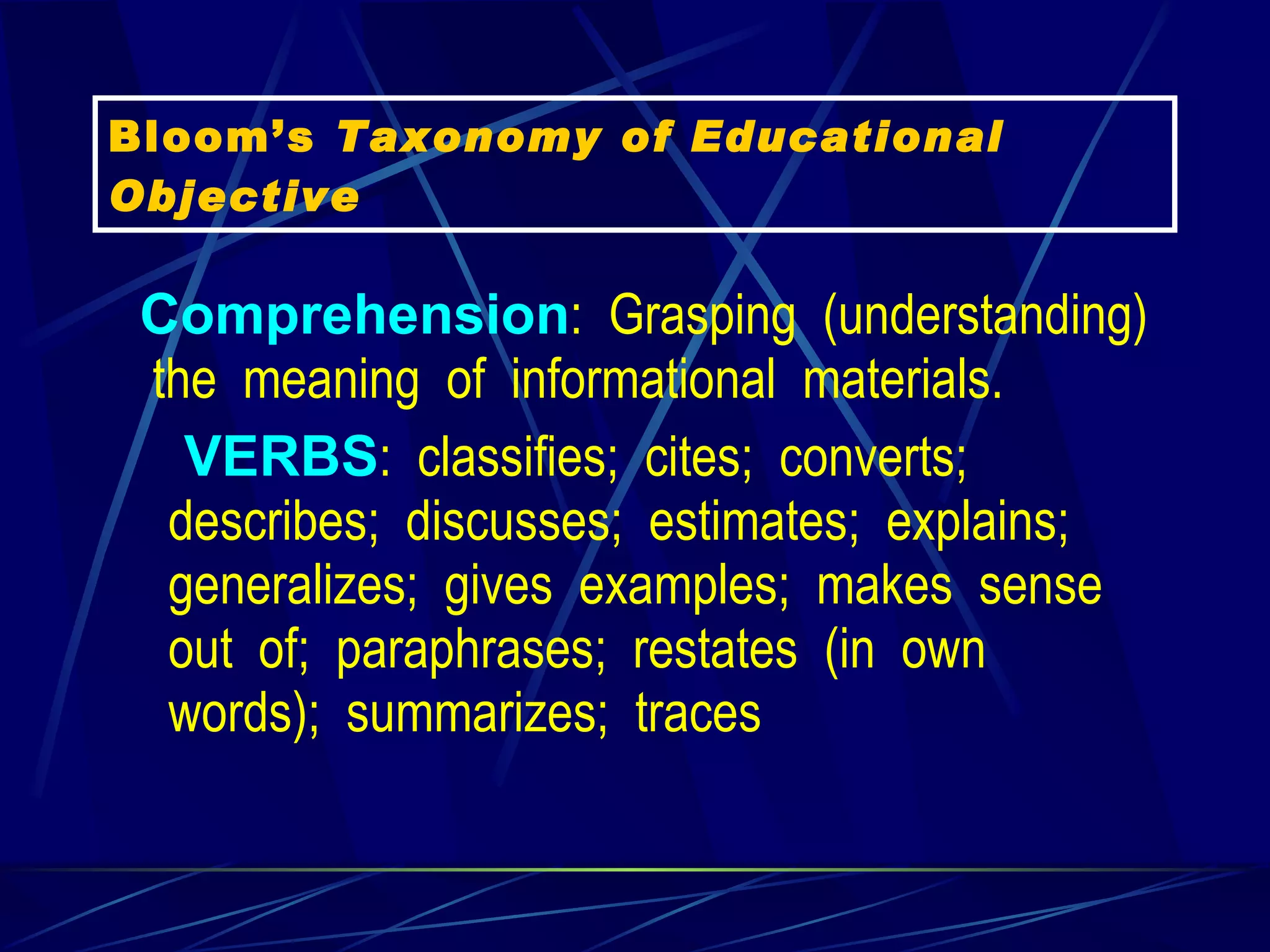
Comprehension :  Grasping  (understanding)  the  meaning  of  informational  materials.     VERBS :  classifies;  cites;  converts;  describes;  discusses;  estimates;  explains;  generalizes;  gives  examples;  makes  sense  out  of;  paraphrases;  restates  (in  own  words);  summarizes;  traces   Bloom’s  Taxonomy of Educational Objective
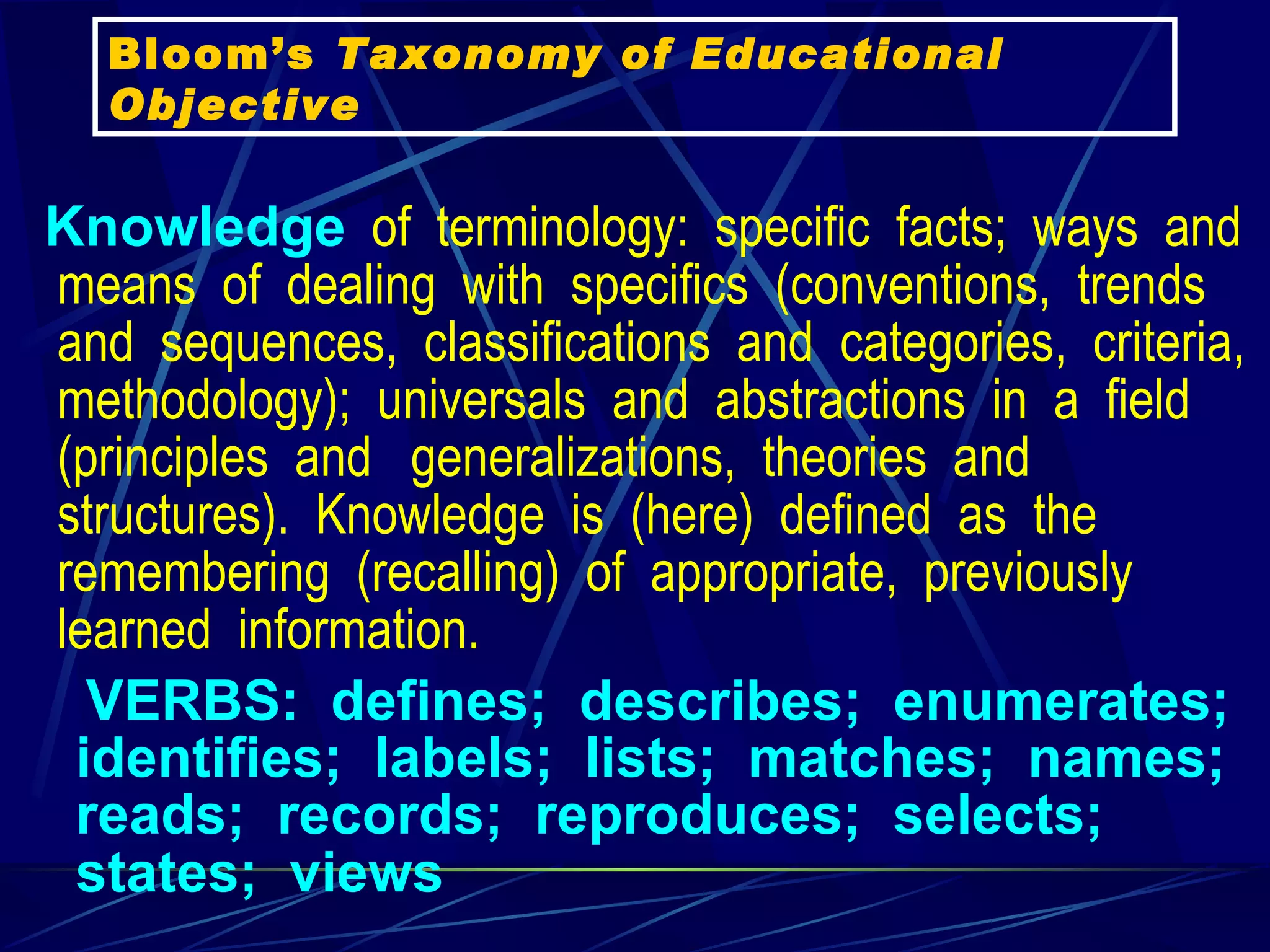
Knowledge   of  terminology:  specific  facts;  ways  and  means  of  dealing  with  specifics  (conventions,  trends  and  sequences,  classifications  and  categories,  criteria,  methodology);  universals  and  abstractions  in  a  field  (principles  and   generalizations,  theories  and  structures).  Knowledge  is  (here)  defined  as  the  remembering  (recalling)  of  appropriate,  previously  learned  information.     VERBS:  defines;  describes;  enumerates;  identifies;  labels;  lists;  matches;  names;  reads;  records;  reproduces;  selects;  states;  views    Bloom’s  Taxonomy of Educational Objective
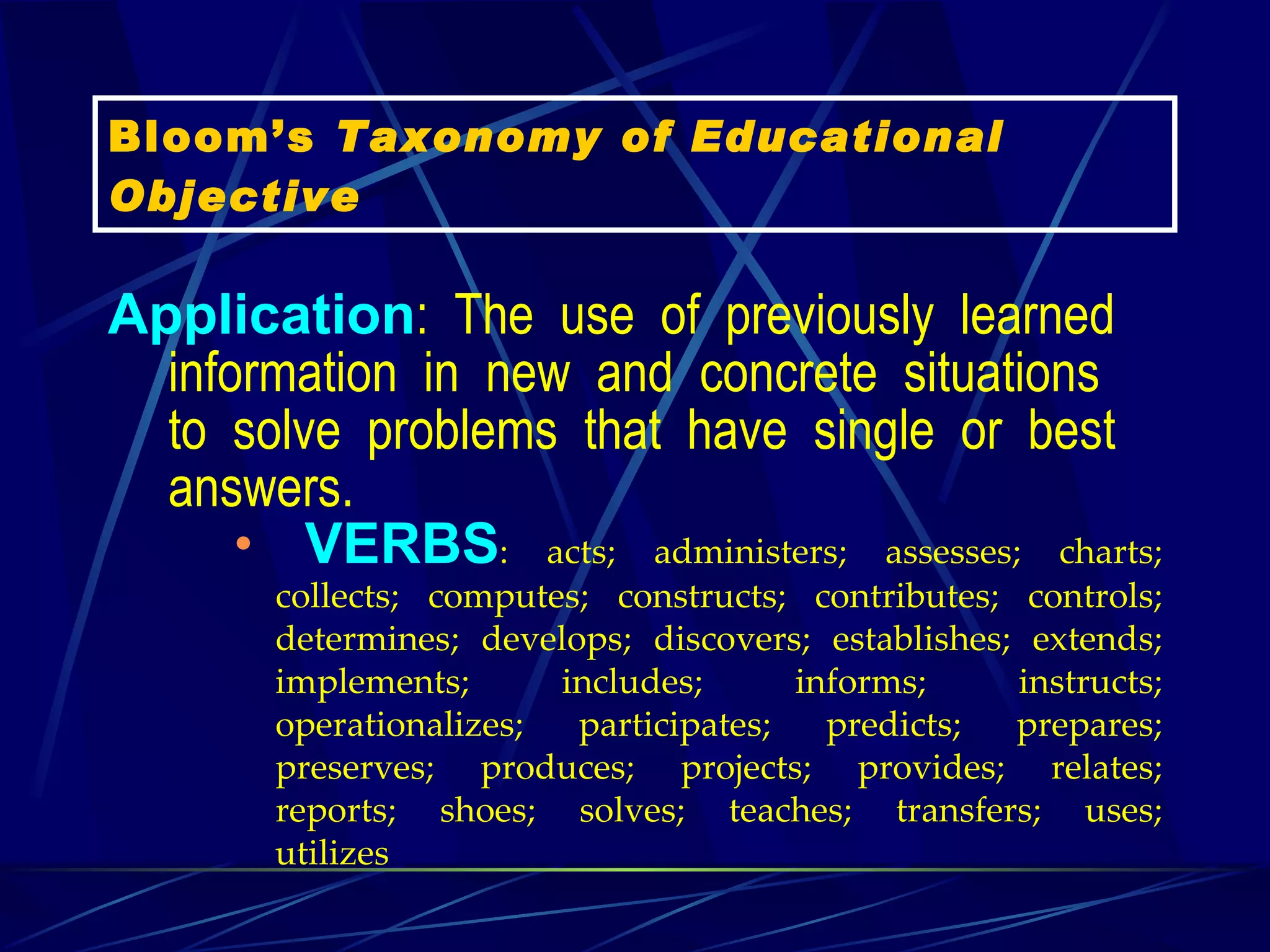
Application :  The  use  of  previously  learned  information  in  new  and  concrete  situations  to  solve  problems  that  have  single  or  best  answers.      VERBS :  acts;  administers;  assesses;  charts;  collects;  computes;  constructs;  contributes;  controls;  determines;  develops;  discovers;  establishes;  extends;  implements;  includes;  informs;  instructs;  operationalizes;  participates;  predicts;  prepares;  preserves;  produces;  projects;  provides;  relates;  reports;  shoes;  solves;  teaches;  transfers;  uses;  utilizes    Bloom’s  Taxonomy of Educational Objective
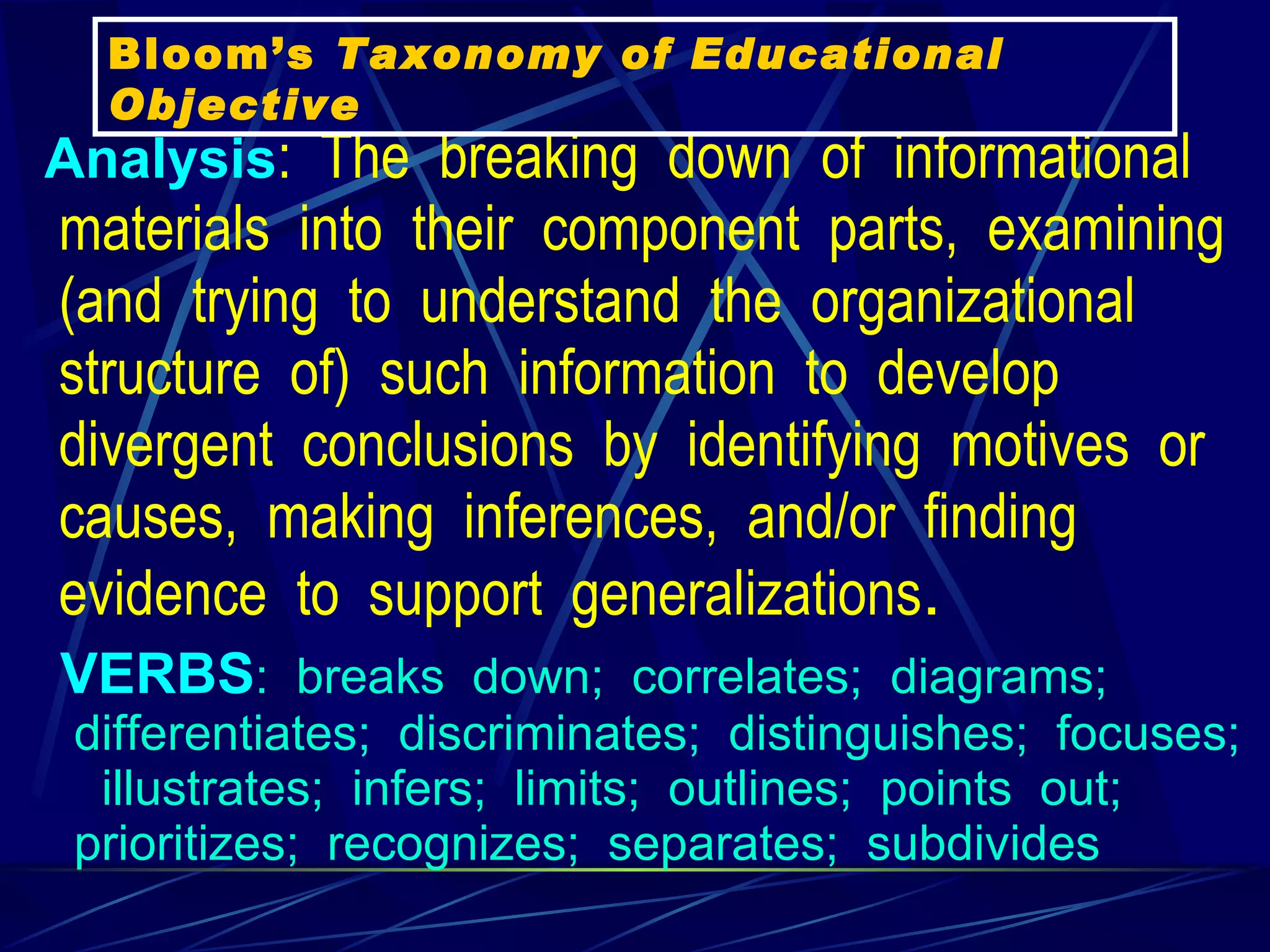
Analysis :  The  breaking  down  of  informational  materials  into  their  component  parts,  examining  (and  trying  to  understand  the  organizational  structure  of)  such  information  to  develop  divergent  conclusions  by  identifying  motives  or  causes,  making  inferences,  and/or  finding  evidence  to  support  generalizations .   VERBS :  breaks  down;  correlates;  diagrams;  differentiates;  discriminates;  distinguishes;  focuses;    illustrates;  infers;  limits;  outlines;  points  out;  prioritizes;  recognizes;  separates;  subdivides   Bloom’s  Taxonomy of Educational Objective
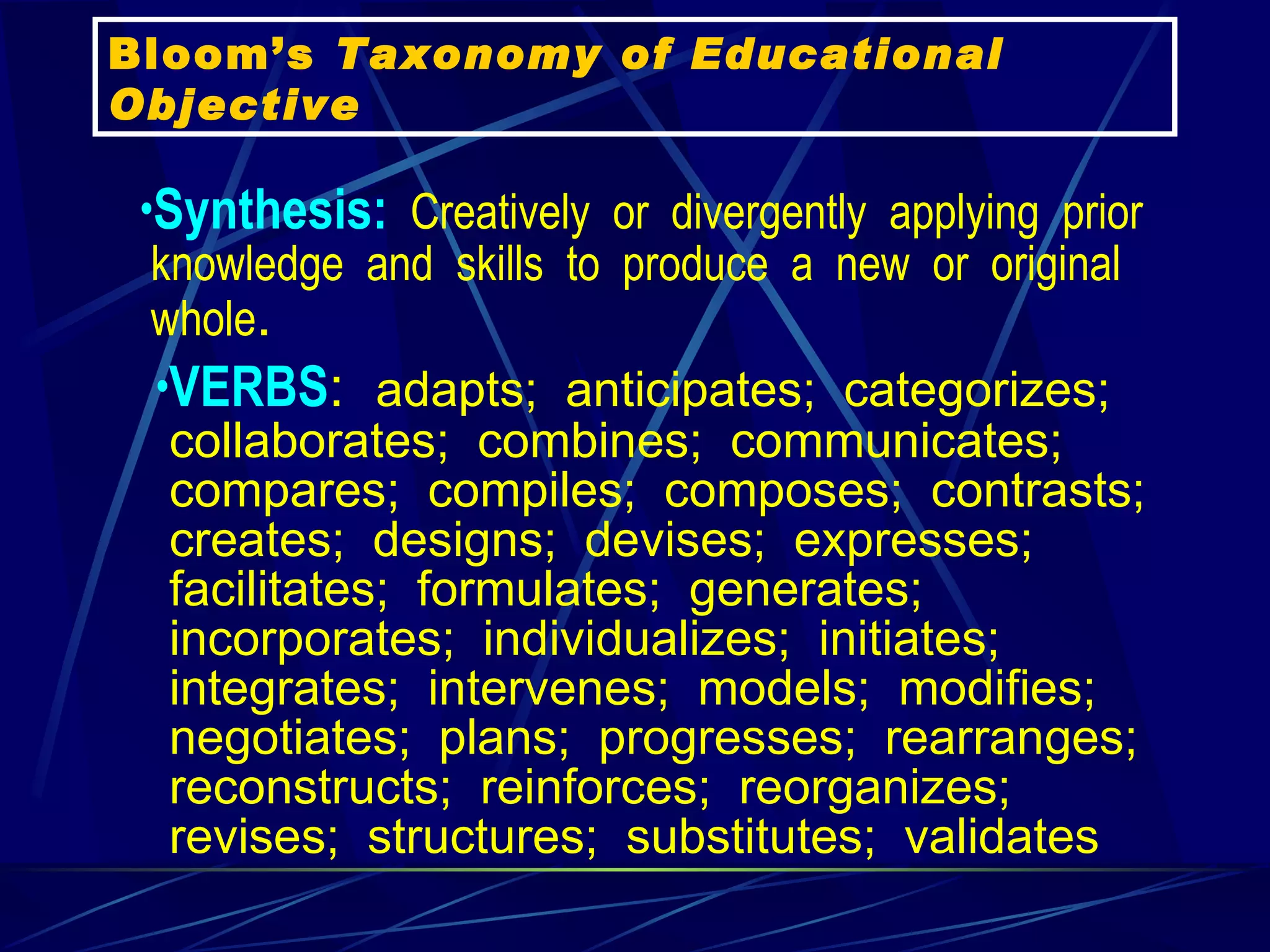
Synthesis:   Creatively  or  divergently  applying  prior  knowledge  and  skills  to  produce  a  new  or  original  whole .   VERBS :   adapts;  anticipates;  categorizes;  collaborates;  combines;  communicates;  compares;  compiles;  composes;  contrasts;  creates;  designs;  devises;  expresses;  facilitates;  formulates;  generates;  incorporates;  individualizes;  initiates;  integrates;  intervenes;  models;  modifies;  negotiates;  plans;  progresses;  rearranges;  reconstructs;  reinforces;  reorganizes;  revises;  structures;  substitutes;  validates   Bloom’s  Taxonomy of Educational Objective
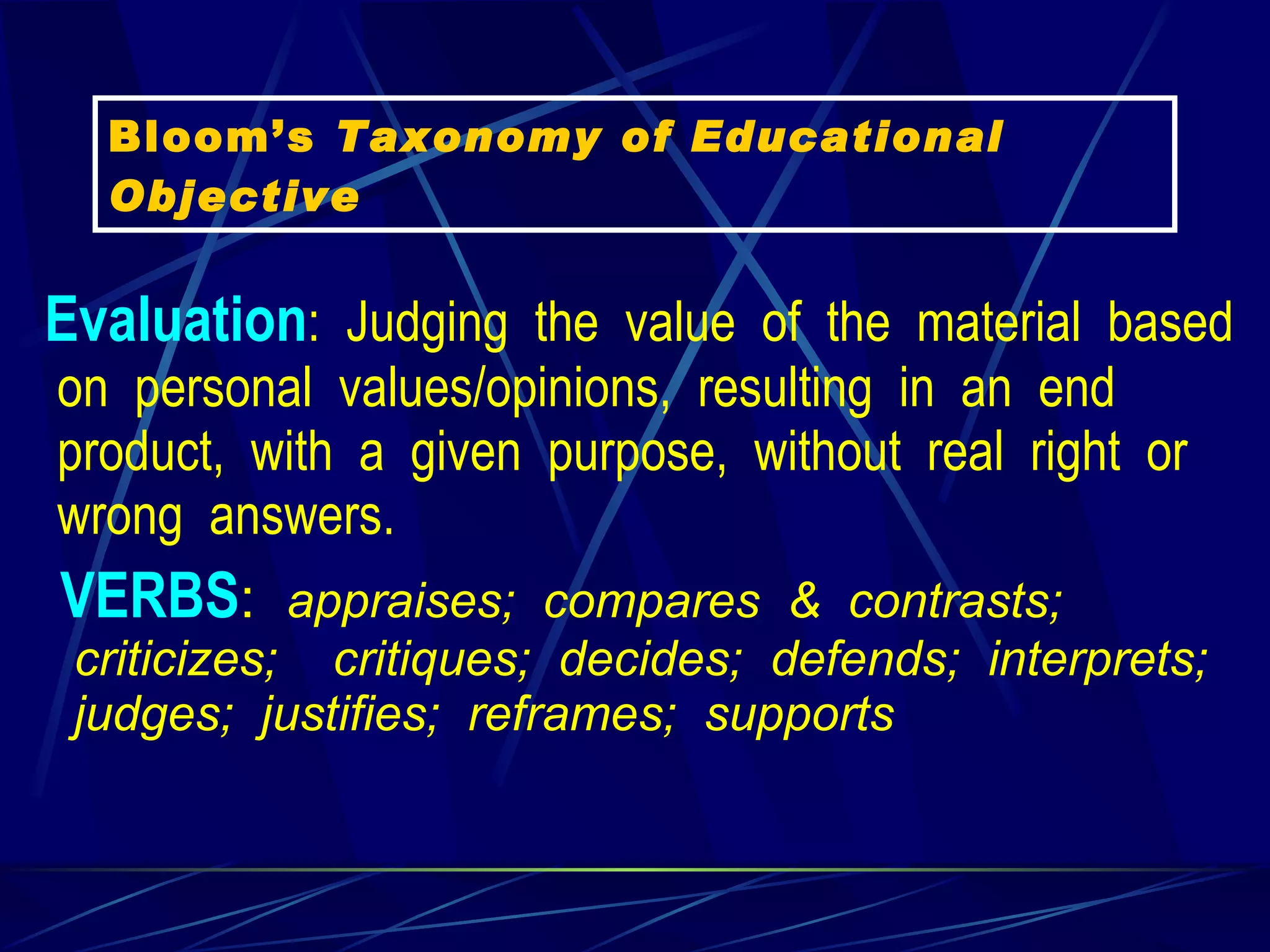
Evaluation :  Judging  the  value  of  the  material  based  on  personal  values/opinions,  resulting  in  an  end  product,  with  a  given  purpose,  without  real  right  or  wrong  answers.   VERBS :   appraises;  compares  &  contrasts;  criticizes;    critiques;  decides;  defends;  interprets;  judges;  justifies;  reframes;  supports    Bloom’s  Taxonomy of Educational Objective
Terms for Asking & answering questions your life depends on your power to master words
Compare : Examine qualities, or characteristics, to discover resemblances. "Compare" is usually stated as "compare with": you are to emphasize similarities, although differences may be mentioned . Contrast : Stress dissimilarities, differences, or unlikeness of things, qualities, events, or problems.
Criticize : Express your judgment or correctness or merit. Discuss the limitations and good points or contributions of the plan or work in question. Define : Definitions call for concise, clear, authoritative meanings. Details are not required but limitations of the definition should be briefly cited. You must keep in mind the class to which a thing belongs and whatever differentiates the particular object from all others in the class.
Describe : In a descriptive answer you should recount, characterize, sketch or relate in narrative form. Diagram : For a question which specifies a diagram you should present a drawing, chart, plan, or graphic representation in your answer. Generally you are expected to label the diagram and in some cases add a brief explanation or description.
Discuss: The term discuss, which appears often in essay questions , directs you to examine, analyze carefully, and present considerations pro and con regarding the problems or items involved. This type of question calls for a complete and entailed answer . Enumerate : The word enumerate specifies a list or outline form of reply. In such questions you should recount, one by one, in concise form, the points   required .
Evaluate: In an evaluation question you are expected to present a careful  appraisal of the problem stressing both advantages and limitations. Evaluation implies authoritative and, to a lesser degree, personal appraisal of both contributions and limitations. Explain : In explanatory answers it is imperative that you clarify and interpret the material you present. In such an answer it is best to state the "how or why," reconcile any differences in opinion or experimental results, and, where possible, state causes. The aim is to make plain the conditions which give rise to whatever you are examining .
Illustrate: A question which asks you to illustrate usually requires you to explain or clarify your answer to the problem by presenting  a figure, picture, diagram, or concrete example. Interpret : An interpretation question is similar to one requiring explanation. You are expected to translate, exemplify, solve, or comment upon the subject and usually to give your judgment or reaction to the problem. Justify : When you are instructed to justify your answer you must prove or show grounds for decisions. In such an answer, evidence should be presented in convincing form.
List : Listing is similar to enumeration. You are expected in such questions to present an itemized series or tabulation. Such answers should always be given  in  concise   form . Outline: An outline answer is organized description. You should give main points and essential supplementary materials, omitting minor details, and present the information in a systematic arrangement or classification .
Prove : A question which requires proof is one which demands confirmation or verification. In such discussions you should establish something with certainty by evaluating and citing experimental evidence or by logical reasoning. Relate : In a question which asks you to show the relationship or to relate, your answer should emphasize connections and associations in descriptive form.
Review : A review specifies a critical examination. You should analyze and comment briefly in organized sequence upon the major points of the problem. State :   In questions which direct you to specify, give, state, or present, you are called upon to express the high points in brief, clear narrative form. Details, and usually illustrations or examples, may be omitted.
Summarize : When you are asked to summarize or present a summarization, you should give in condensed form the main points or facts. All details, illustrations and elaboration are to be omitted.

Intended Learning Outcomes and Students Assessment

  • 1.
    Intended Learning Outcomes and Student Assessment Dr. Ahmed-Refat AG Refat FOM-ZU
  • 2.
    What are intendedlearning outcomes? Statements describing what students know, understand, and can do with their knowledge, as well as what they feel and believe, as a result of their learning experiences Can be written for a course, a program, or an entire institution
  • 3.
    Learning Outcomes Students will DO WHAT ( how )
  • 4.
    Educational Objectives/ Learning Outcomes Think of the “ideal” students or graduates What students know ?>> K What students can do ? ?>> P What students care about (think) ? ?>> A Knowledge, Attitude,and Practice
  • 5.
  • 6.
    Learning Outcomes :Communication Students communicate well Communication department will provide opportunities for students to develop students’ communication skills Students will communicate effectively Students’ communication skills will gradually improve over several courses Students will be able to communicate information effectively in writing, orally, and graphically
  • 7.
    Learning Outcomes: ResearchSkill Students will design and carry out research Psychology lab should teach students high quality research skill Students have demonstrated high quality research skills Students will independently design and carry out experimental research and evaluate the results critically
  • 8.
    Learning Outcomes: EthicsBiology department will teach ethical responsibility to students. Students will be highly ethical Students took a course on ethics Students will understand their ethical responsibility for the field of Bio-medical research
  • 9.
    Alignment of IntendedOutcomes Deliver Forward Design Backward I N S T I T U T I O N LESSON U N I T C O U R S E P R O G R A M
  • 10.
    ILOs: Intended Learning Outcomes Learning outcomes have three distinguishing characteristics: the specified action by the learner must be observable , measurable , and done by the learner.
  • 11.
    Learning Outcomes (OutcomeBehaviors): Observable behaviors or actions on the part of students that demonstrate that the intended learning objective has occurred . ILO s: I ntended L earning O utcomes
  • 12.
    ILO s: I ntended L earning O utcomes
  • 13.
    How to WriteLearning Objectives S M A R T ILO s: I ntended L earning O utcomes
  • 14.
    Characteristics of learning outcomes 1.      They use verbs that indicate how the student work can be observed. 2.      They focus on what the student should do , not what the instructor teaches. 3.      They reflect what students should be able to do after a course ends, not simply what they do during the course. 4.      can be assessed in more than one way. 5.      They can be understood by someone outside the discipline.  
  • 15.
    Learning objectives specifyboth an observable behavior and the object of that behavior. Students will be able to write a research paper. In addition, the criterion could also be specified: Students will be able to write a research paper in the appropriate scientific style. ILO s: I ntended L earning O utcomes
  • 16.
    Optionally, the condition under which the behavior occurs can be specified: At the end of their field research , students will be able to write a research paper in the appropriate scientific style. Note that the verb you choose will help you focus on what you assess. For example: Students will be able to do research. ILO s: I ntended L earning O utcomes
  • 17.
  • 18.
    By the endof this course, each student will be able to:  1.     explain models currently used in health promotion programming; 2.     conduct a needs assessment; 3.     develop a program rationale; 4.     specify how to recruit and select advisory committee members; 5.     write program goals and objectives; 6.     create a marketing brochure; 7.     predict factors that may prevent program success; 8.     develop methods to evaluate program success.
  • 19.
    Broad :   Students will demonstrate knowledge of the history, literature and function of the theatre, including works from various periods and cultures. More specific : Students will be able to explain the theoretical bases of various dramatic genres and illustrate them with examples from plays of different eras.
  • 20.
    Broad :  The student will be able to discuss philosophical questions.   More specific : The student is able to develop relevant examples and to express the significance of philosophical questions
  • 21.
    Broad :  Each student will be able to function as a team member.   More specific : Each student will reflect upon his or her contributions to a team effort, ability to accept other team members as resources, and willingness to accept compromises if required to achieve a team goal.
  • 22.
    Broad : Studentswill understand how to use technology effectively. More specific : Each student will be able to use word processing, spreadsheets, databases, and presentation graphics in preparing their final research project and report.
  • 23.
    assessable learning outcomes:  1.      They use verbs that indicate how the student work can be observed. 2.      They focus on what the student should do, not what the instructor teaches. 3.      They reflect what students should be able to do after a course ends, not simply what they do during the course. 4.      They usually can be assessed in more than one way. 5.      They can be understood by someone outside the discipline.
  • 24.
    Bloom’s Taxonomyof Educational Objective
  • 25.
  • 26.
    Bloom’s taxonomy ofknowledge Knowledge Comprehension Application Analysis Synthesis Evaluation
  • 27.
    Comprehension :  Grasping (understanding)  the  meaning  of  informational  materials.     VERBS :  classifies;  cites;  converts;  describes;  discusses;  estimates;  explains;  generalizes;  gives  examples;  makes  sense  out  of;  paraphrases;  restates  (in  own  words);  summarizes;  traces   Bloom’s Taxonomy of Educational Objective
  • 28.
    Knowledge  of terminology:  specific  facts;  ways  and  means  of  dealing  with  specifics  (conventions,  trends  and  sequences,  classifications  and  categories,  criteria,  methodology);  universals  and  abstractions  in  a  field  (principles  and   generalizations,  theories  and  structures).  Knowledge  is  (here)  defined  as  the  remembering  (recalling)  of  appropriate,  previously  learned  information.     VERBS:  defines;  describes;  enumerates;  identifies;  labels;  lists;  matches;  names;  reads;  records;  reproduces;  selects;  states;  views   Bloom’s Taxonomy of Educational Objective
  • 29.
    Application :  The use  of  previously  learned  information  in  new  and  concrete  situations  to  solve  problems  that  have  single  or  best  answers.      VERBS :  acts;  administers;  assesses;  charts;  collects;  computes;  constructs;  contributes;  controls;  determines;  develops;  discovers;  establishes;  extends;  implements;  includes;  informs;  instructs;  operationalizes;  participates;  predicts;  prepares;  preserves;  produces;  projects;  provides;  relates;  reports;  shoes;  solves;  teaches;  transfers;  uses;  utilizes   Bloom’s Taxonomy of Educational Objective
  • 30.
    Analysis :  The breaking  down  of  informational  materials  into  their  component  parts,  examining  (and  trying  to  understand  the  organizational  structure  of)  such  information  to  develop  divergent  conclusions  by  identifying  motives  or  causes,  making  inferences,  and/or  finding  evidence  to  support  generalizations .   VERBS :  breaks  down;  correlates;  diagrams;  differentiates;  discriminates;  distinguishes;  focuses;    illustrates;  infers;  limits;  outlines;  points  out;  prioritizes;  recognizes;  separates;  subdivides   Bloom’s Taxonomy of Educational Objective
  • 31.
    Synthesis:  Creatively or  divergently  applying  prior  knowledge  and  skills  to  produce  a  new  or  original  whole .   VERBS :   adapts;  anticipates;  categorizes;  collaborates;  combines;  communicates;  compares;  compiles;  composes;  contrasts;  creates;  designs;  devises;  expresses;  facilitates;  formulates;  generates;  incorporates;  individualizes;  initiates;  integrates;  intervenes;  models;  modifies;  negotiates;  plans;  progresses;  rearranges;  reconstructs;  reinforces;  reorganizes;  revises;  structures;  substitutes;  validates   Bloom’s Taxonomy of Educational Objective
  • 32.
    Evaluation :  Judging the  value  of  the  material  based  on  personal  values/opinions,  resulting  in  an  end  product,  with  a  given  purpose,  without  real  right  or  wrong  answers.   VERBS :   appraises;  compares  &  contrasts;  criticizes;    critiques;  decides;  defends;  interprets;  judges;  justifies;  reframes;  supports   Bloom’s Taxonomy of Educational Objective
  • 33.
    Terms for Asking& answering questions your life depends on your power to master words
  • 34.
    Compare : Examinequalities, or characteristics, to discover resemblances. "Compare" is usually stated as "compare with": you are to emphasize similarities, although differences may be mentioned . Contrast : Stress dissimilarities, differences, or unlikeness of things, qualities, events, or problems.
  • 35.
    Criticize : Expressyour judgment or correctness or merit. Discuss the limitations and good points or contributions of the plan or work in question. Define : Definitions call for concise, clear, authoritative meanings. Details are not required but limitations of the definition should be briefly cited. You must keep in mind the class to which a thing belongs and whatever differentiates the particular object from all others in the class.
  • 36.
    Describe : Ina descriptive answer you should recount, characterize, sketch or relate in narrative form. Diagram : For a question which specifies a diagram you should present a drawing, chart, plan, or graphic representation in your answer. Generally you are expected to label the diagram and in some cases add a brief explanation or description.
  • 37.
    Discuss: The termdiscuss, which appears often in essay questions , directs you to examine, analyze carefully, and present considerations pro and con regarding the problems or items involved. This type of question calls for a complete and entailed answer . Enumerate : The word enumerate specifies a list or outline form of reply. In such questions you should recount, one by one, in concise form, the points required .
  • 38.
    Evaluate: In anevaluation question you are expected to present a careful appraisal of the problem stressing both advantages and limitations. Evaluation implies authoritative and, to a lesser degree, personal appraisal of both contributions and limitations. Explain : In explanatory answers it is imperative that you clarify and interpret the material you present. In such an answer it is best to state the "how or why," reconcile any differences in opinion or experimental results, and, where possible, state causes. The aim is to make plain the conditions which give rise to whatever you are examining .
  • 39.
    Illustrate: A questionwhich asks you to illustrate usually requires you to explain or clarify your answer to the problem by presenting a figure, picture, diagram, or concrete example. Interpret : An interpretation question is similar to one requiring explanation. You are expected to translate, exemplify, solve, or comment upon the subject and usually to give your judgment or reaction to the problem. Justify : When you are instructed to justify your answer you must prove or show grounds for decisions. In such an answer, evidence should be presented in convincing form.
  • 40.
    List : Listingis similar to enumeration. You are expected in such questions to present an itemized series or tabulation. Such answers should always be given in concise form . Outline: An outline answer is organized description. You should give main points and essential supplementary materials, omitting minor details, and present the information in a systematic arrangement or classification .
  • 41.
    Prove : Aquestion which requires proof is one which demands confirmation or verification. In such discussions you should establish something with certainty by evaluating and citing experimental evidence or by logical reasoning. Relate : In a question which asks you to show the relationship or to relate, your answer should emphasize connections and associations in descriptive form.
  • 42.
    Review : Areview specifies a critical examination. You should analyze and comment briefly in organized sequence upon the major points of the problem. State :   In questions which direct you to specify, give, state, or present, you are called upon to express the high points in brief, clear narrative form. Details, and usually illustrations or examples, may be omitted.
  • 43.
    Summarize : Whenyou are asked to summarize or present a summarization, you should give in condensed form the main points or facts. All details, illustrations and elaboration are to be omitted.