Instructional
Objectives
Joseph Gerson A. Balana
Master in English Language & Literature
(MELL) 2
Instructional
Objectives
Quo vadis?
(Where are you going?)
Instructional
Objectives
“If you don’t know
where you’re going, you
can’t get there.”
Instructional
Objectives
Goals are general
statements of intent.
Instructional
Objectives
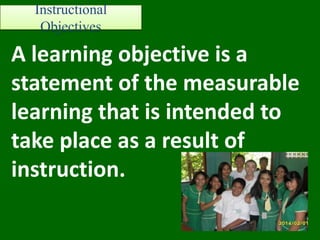
A learning objective is a
statement of the measurable
learning that is intended to
take place as a result of
instruction.
Instructional
Objectives
…are statements that describe the
abilities students should be able to
display to demonstrate the important
concepts and principles have
been incorporated into
their own structures of
knowledge.
Instructional
Objectives
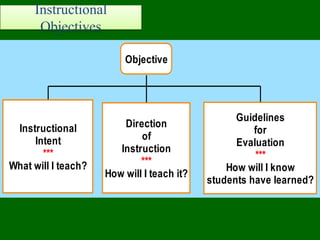
Guidelines
for
Evaluation
***
How will I know
students have learned?
Direction
of
Instruction
***
How will I teach it?
Instructional
Intent
***
What will I teach?
Objective
Learning Outcomes:
Classification
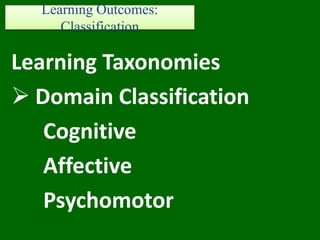
Learning Taxonomies
 Domain Classification
Cognitive
Affective
Psychomotor
Learning Outcomes:
Classification
Cognitive Domain
BLOOM’S TAXONOMY
Knowledge
Comprehension
Application
Analysis
Synthesis
Evaluation
ANDSERSON’S TAXONOMY
Remembering
Understanding
Applying
Analyzing
Evaluating
Creating
Learning Outcomes:
Classification
Affective Domain
Receiving- Willing to listen or see
Responding - Active participation
Valuing - Internalize the worthiness
Organization - Ability to see the value
Characterization by a value - Behavior
consistent with a value system
Learning Outcomes:
Classification
Psychomotor Domain
Imitation- overt learning; repitition
Manipulation- continued practice
Precision- skill attainment
Articulation- higher level precision
Naturalization- automatic response
Learning Outcomes:
CATEGORIES
DECLARATIVE
KNOWLEDGE
PROCEDURAL
KNOWLEDGE
Information
that one can
state verbally
Knowledge to
do things
Instructional Objectives:
COMPONENTS
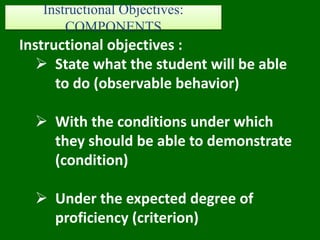
Instructional objectives :
 State what the student will be able
to do (observable behavior)
 With the conditions under which
they should be able to demonstrate
(condition)
 Under the expected degree of
proficiency (criterion)
Instructional Objectives:
COMPONENTS
ABCD
Objectives
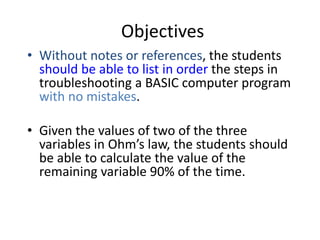
• Without notes or references, the students
should be able to list in order the steps in
troubleshooting a BASIC computer program
with no mistakes.
Objectives
• Without notes or references, the students
should be able to list in order the steps in
troubleshooting a BASIC computer program
with no mistakes.
Objectives
• Without notes or references, the students
should be able to list in order the steps in
troubleshooting a BASIC computer program
with no mistakes.
Objectives
• Without notes or references, the students
should be able to list in order the steps in
troubleshooting a BASIC computer program
with no mistakes.
Objectives
• Without notes or references, the students
should be able to list in order the steps in
troubleshooting a BASIC computer program
with no mistakes.
Objectives
• Without notes or references, the students
should be able to list in order the steps in
troubleshooting a BASIC computer program
with no mistakes.
Objectives
• Without notes or references, the students
should be able to list in order the steps in
troubleshooting a BASIC computer program
with no mistakes.
• Given the values of two of the three
variables in Ohm’s law, the students should
be able to calculate the value of the
remaining variable 90% of the time.
Objectives
• Without notes or references, the students
should be able to list in order the steps in
troubleshooting a BASIC computer program
with no mistakes.
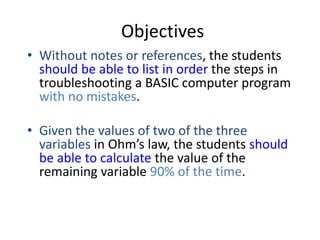
• Given the values of two of the three
variables in Ohm’s law, the students should
be able to calculate the value of the
remaining variable 90% of the time.
Objectives
• Without notes or references, the students
should be able to list in order the steps in
troubleshooting a BASIC computer program
with no mistakes.
• Given the values of two of the three
variables in Ohm’s law, the students should
be able to calculate the value of the
remaining variable 90% of the time.
Objectives
• Without notes or references, the students
should be able to list in order the steps in
troubleshooting a BASIC computer program
with no mistakes.
• Given the values of two of the three
variables in Ohm’s law, the students should
be able to calculate the value of the
remaining variable 90% of the time.
And this ends my sharing….
Thank You!

Instructional objectives ppt.