ASSESSMENT PURPOSE,
LEARNING TARGETS,
AND APPROPRIATE
METHODS
Lesson 2
Objectives:
At the end of this lesson, you are
expected to;
● Identify and describe the different purpose of
classroom assessment,
● Formulate learning targets for specific lessons,
and
● Match appropriate assessment method with
specific learning targets.
Introduction
Assessment are not merely evaluations;
they serve a purpose, have specific
targets, and require appropriate methods
for effective implementation. Teachers
should understand their roles and know
how to formulate the best learning
objectives for their students.
Purpose of
Classroom
Assessment
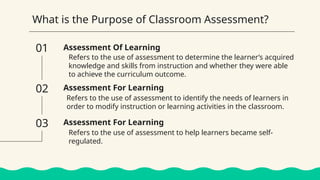
01
Refers to the use of assessment to determine the learner’s acquired
knowledge and skills from instruction and whether they were able
to achieve the curriculum outcome.
Assessment Of Learning
Refers to the use of assessment to identify the needs of learners in
order to modify instruction or learning activities in the classroom.
Assessment For Learning
03
01
What is the Purpose of Classroom Assessment?
02
Assessment For Learning
Refers to the use of assessment to help learners became self-
regulated.
Roles of Classroom
Assessment in the
Teaching-Learning
Process
02
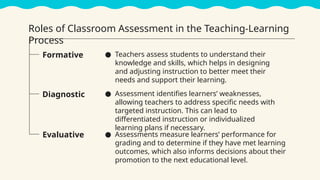
Roles of Classroom Assessment in the Teaching-Learning
Process
● Teachers assess students to understand their
knowledge and skills, which helps in designing
and adjusting instruction to better meet their
needs and support their learning.
● Assessment identifies learners’ weaknesses,
allowing teachers to address specific needs with
targeted instruction. This can lead to
differentiated instruction or individualized
learning plans if necessary.
● Assessments measure learners’ performance for
grading and to determine if they have met learning
outcomes, which also informs decisions about their
promotion to the next educational level.
Formative
Diagnostic
Evaluative
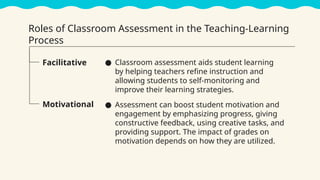
Roles of Classroom Assessment in the Teaching-Learning
Process
● Classroom assessment aids student learning
by helping teachers refine instruction and
allowing students to self-monitoring and
improve their learning strategies.
● Assessment can boost student motivation and
engagement by emphasizing progress, giving
constructive feedback, using creative tasks, and
providing support. The impact of grades on
motivation depends on how they are utilized.
Facilitative
Motivational
What are Learning Targets?
03
Educational Goals, Standards and Objectives
Educational Goals, Standards and
Objectives
Goals.
Are general statements about desired learner outcomes in a giver
year or during the duration of a program. (e.g., senior high school)
Defines what students should know and be able to do at specific
grade levels, subjects, or courses. McMillan(2014) identifies four
types: (1) content, (2) performance, (3) developmental, (4) grade-
level.
Educational Objectives
01
02
03
Standards.
Are specific statements describing what learners should achieve by
the end of an instructional unit, often using action verbs.
Bloom’s Taxonomy of
Learning Objectives
04
Bloom’s Taxonomy of Learning Objectives
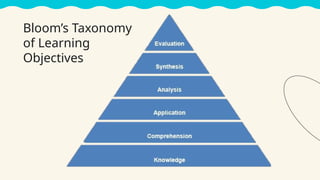
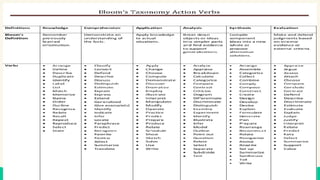
Bloom’s Taxonomy is a framework for categorizing
educational goals and objectives. Developed by
Benjamin Bloom and his colleagues in 1956, it
classifies cognitive skills into a hierarchy of levels ,
ranging from simple to complex. This taxonomy
helps educators design curriculum and
assessments by providing a structured approach to
developing higher-order thinking skills.
Bloom’s Taxonomy
of Learning
Objectives
Bloom’s Taxonomy of Learning Objectives
Bloom's taxonomies of educational objectives provide
teachers with a structured guide in formulating more
specific learning targets as they provide an exhaustive
list of learning objectives. The taxonomies do not only
serve as a guide for teachers but also as a guide for the
assessment of the student learning in the classroom.
This well then inform the assessment method required
to properly asses student learning.
Revised Bloom's
Taxonomy of
Educational Objectives
05
Rived Bloom’s Taxonomy of Learning
Objectives
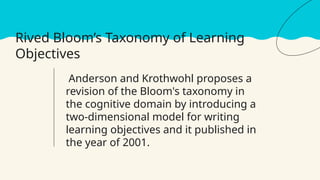
Anderson and Krothwohl proposes a
revision of the Bloom's taxonomy in
the cognitive domain by introducing a
two-dimensional model for writing
learning objectives and it published in
the year of 2001.
The Revised Bloom’s Taxonomy of Educational Objectives
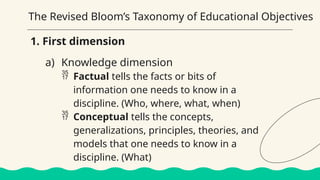
a) Knowledge dimension
 Factual tells the facts or bits of
information one needs to know in a
discipline. (Who, where, what, when)
 Conceptual tells the concepts,
generalizations, principles, theories, and
models that one needs to know in a
discipline. (What)
1. First dimension
The Revised Bloom’s Taxonomy of Educational Objectives
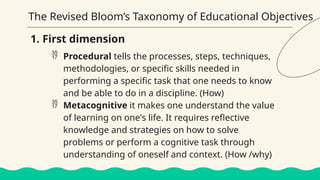
 Procedural tells the processes, steps, techniques,
methodologies, or specific skills needed in
performing a specific task that one needs to know
and be able to do in a discipline. (How)
 Metacognitive it makes one understand the value
of learning on one's life. It requires reflective
knowledge and strategies on how to solve
problems or perform a cognitive task through
understanding of oneself and context. (How /why)
1. First dimension
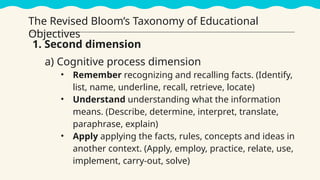
a) Cognitive process dimension
• Remember recognizing and recalling facts. (Identify,
list, name, underline, recall, retrieve, locate)
• Understand understanding what the information
means. (Describe, determine, interpret, translate,
paraphrase, explain)
• Apply applying the facts, rules, concepts and ideas in
another context. (Apply, employ, practice, relate, use,
implement, carry-out, solve)
1. Second dimension
The Revised Bloom’s Taxonomy of Educational
Objectives
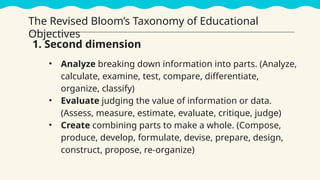
• Analyze breaking down information into parts. (Analyze,
calculate, examine, test, compare, differentiate,
organize, classify)
• Evaluate judging the value of information or data.
(Assess, measure, estimate, evaluate, critique, judge)
• Create combining parts to make a whole. (Compose,
produce, develop, formulate, devise, prepare, design,
construct, propose, re-organize)
1. Second dimension
The Revised Bloom’s Taxonomy of Educational
Objectives
Learning Targets
06
Learning Targets
Learning targets are clear, specific statements
that outline what students should know and be
able to do after a lesson. They are more detailed
than educational goals and help guide teaching
and assessment. Learning targets should align
with standards, be communicated to students,
and often use "I can" statements to clarify
expectations.
McMillan (2014) five criteria for selecting effective
learning targets:
1. Determine the right number of targets.
2. Ensure targets cover all essential types of learning.
3. Align targets with school goals and 21st-century
skills.
4. Make targets challenging yet achievable.
5. Ensure targets are feasible and encourage students
to do their best work.
Learning Targets
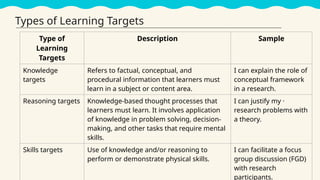
Types of Learning Targets
Type of
Learning
Targets
Description Sample
Knowledge
targets
Refers to factual, conceptual, and
procedural information that learners must
learn in a subject or content area.
I can explain the role of
conceptual framework
in a research.
Reasoning targets Knowledge-based thought processes that
learners must learn. It involves application
of knowledge in problem solving, decision-
making, and other tasks that require mental
skills.
I can justify my ·
research problems with
a theory.
Skills targets Use of knowledge and/or reasoning to
perform or demonstrate physical skills.
I can facilitate a focus
group discussion (FGD)
with research
participants.
Appropriate
Methos of
Assessment
07
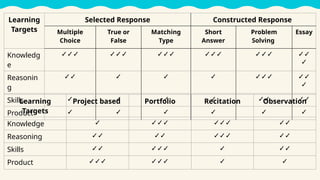
Learning
Targets
Selected Response Constructed Response
Multiple
Choice
True or
False
Matching
Type
Short
Answer
Problem
Solving
Essay
Knowledg
e
✓✓✓ ✓✓✓ ✓✓✓ ✓✓✓ ✓✓✓ ✓✓
✓
Reasonin
g
✓✓ ✓ ✓ ✓ ✓✓✓ ✓✓
✓
Skills ✓ ✓ ✓ ✓ ✓✓ ✓✓
Product ✓ ✓ ✓ ✓ ✓ ✓
Learning
Targets
Project based Portfolio Recitation Observation
Knowledge ✓ ✓✓✓ ✓✓✓ ✓✓
Reasoning ✓✓ ✓✓ ✓✓✓ ✓✓
Skills ✓✓ ✓✓✓ ✓ ✓✓
Product ✓✓✓ ✓✓✓ ✓ ✓
THANK
YOU

LESSON-2-ASSESSMENT-IN-LEARNING_052032.pptx

  • 1.
    ASSESSMENT PURPOSE, LEARNING TARGETS, ANDAPPROPRIATE METHODS Lesson 2
  • 2.
    Objectives: At the endof this lesson, you are expected to; ● Identify and describe the different purpose of classroom assessment, ● Formulate learning targets for specific lessons, and ● Match appropriate assessment method with specific learning targets.
  • 3.
    Introduction Assessment are notmerely evaluations; they serve a purpose, have specific targets, and require appropriate methods for effective implementation. Teachers should understand their roles and know how to formulate the best learning objectives for their students.
  • 4.
  • 5.
    Refers to theuse of assessment to determine the learner’s acquired knowledge and skills from instruction and whether they were able to achieve the curriculum outcome. Assessment Of Learning Refers to the use of assessment to identify the needs of learners in order to modify instruction or learning activities in the classroom. Assessment For Learning 03 01 What is the Purpose of Classroom Assessment? 02 Assessment For Learning Refers to the use of assessment to help learners became self- regulated.
  • 6.
    Roles of Classroom Assessmentin the Teaching-Learning Process 02
  • 7.
    Roles of ClassroomAssessment in the Teaching-Learning Process ● Teachers assess students to understand their knowledge and skills, which helps in designing and adjusting instruction to better meet their needs and support their learning. ● Assessment identifies learners’ weaknesses, allowing teachers to address specific needs with targeted instruction. This can lead to differentiated instruction or individualized learning plans if necessary. ● Assessments measure learners’ performance for grading and to determine if they have met learning outcomes, which also informs decisions about their promotion to the next educational level. Formative Diagnostic Evaluative
  • 8.
    Roles of ClassroomAssessment in the Teaching-Learning Process ● Classroom assessment aids student learning by helping teachers refine instruction and allowing students to self-monitoring and improve their learning strategies. ● Assessment can boost student motivation and engagement by emphasizing progress, giving constructive feedback, using creative tasks, and providing support. The impact of grades on motivation depends on how they are utilized. Facilitative Motivational
  • 9.
    What are LearningTargets? 03 Educational Goals, Standards and Objectives
  • 10.
    Educational Goals, Standardsand Objectives Goals. Are general statements about desired learner outcomes in a giver year or during the duration of a program. (e.g., senior high school) Defines what students should know and be able to do at specific grade levels, subjects, or courses. McMillan(2014) identifies four types: (1) content, (2) performance, (3) developmental, (4) grade- level. Educational Objectives 01 02 03 Standards. Are specific statements describing what learners should achieve by the end of an instructional unit, often using action verbs.
  • 11.
  • 12.
    Bloom’s Taxonomy ofLearning Objectives Bloom’s Taxonomy is a framework for categorizing educational goals and objectives. Developed by Benjamin Bloom and his colleagues in 1956, it classifies cognitive skills into a hierarchy of levels , ranging from simple to complex. This taxonomy helps educators design curriculum and assessments by providing a structured approach to developing higher-order thinking skills.
  • 13.
  • 15.
    Bloom’s Taxonomy ofLearning Objectives Bloom's taxonomies of educational objectives provide teachers with a structured guide in formulating more specific learning targets as they provide an exhaustive list of learning objectives. The taxonomies do not only serve as a guide for teachers but also as a guide for the assessment of the student learning in the classroom. This well then inform the assessment method required to properly asses student learning.
  • 16.
  • 17.
    Rived Bloom’s Taxonomyof Learning Objectives Anderson and Krothwohl proposes a revision of the Bloom's taxonomy in the cognitive domain by introducing a two-dimensional model for writing learning objectives and it published in the year of 2001.
  • 18.
    The Revised Bloom’sTaxonomy of Educational Objectives a) Knowledge dimension  Factual tells the facts or bits of information one needs to know in a discipline. (Who, where, what, when)  Conceptual tells the concepts, generalizations, principles, theories, and models that one needs to know in a discipline. (What) 1. First dimension
  • 19.
    The Revised Bloom’sTaxonomy of Educational Objectives  Procedural tells the processes, steps, techniques, methodologies, or specific skills needed in performing a specific task that one needs to know and be able to do in a discipline. (How)  Metacognitive it makes one understand the value of learning on one's life. It requires reflective knowledge and strategies on how to solve problems or perform a cognitive task through understanding of oneself and context. (How /why) 1. First dimension
  • 20.
    a) Cognitive processdimension • Remember recognizing and recalling facts. (Identify, list, name, underline, recall, retrieve, locate) • Understand understanding what the information means. (Describe, determine, interpret, translate, paraphrase, explain) • Apply applying the facts, rules, concepts and ideas in another context. (Apply, employ, practice, relate, use, implement, carry-out, solve) 1. Second dimension The Revised Bloom’s Taxonomy of Educational Objectives
  • 21.
    • Analyze breakingdown information into parts. (Analyze, calculate, examine, test, compare, differentiate, organize, classify) • Evaluate judging the value of information or data. (Assess, measure, estimate, evaluate, critique, judge) • Create combining parts to make a whole. (Compose, produce, develop, formulate, devise, prepare, design, construct, propose, re-organize) 1. Second dimension The Revised Bloom’s Taxonomy of Educational Objectives
  • 22.
  • 23.
    Learning Targets Learning targetsare clear, specific statements that outline what students should know and be able to do after a lesson. They are more detailed than educational goals and help guide teaching and assessment. Learning targets should align with standards, be communicated to students, and often use "I can" statements to clarify expectations.
  • 24.
    McMillan (2014) fivecriteria for selecting effective learning targets: 1. Determine the right number of targets. 2. Ensure targets cover all essential types of learning. 3. Align targets with school goals and 21st-century skills. 4. Make targets challenging yet achievable. 5. Ensure targets are feasible and encourage students to do their best work. Learning Targets
  • 25.
    Types of LearningTargets Type of Learning Targets Description Sample Knowledge targets Refers to factual, conceptual, and procedural information that learners must learn in a subject or content area. I can explain the role of conceptual framework in a research. Reasoning targets Knowledge-based thought processes that learners must learn. It involves application of knowledge in problem solving, decision- making, and other tasks that require mental skills. I can justify my · research problems with a theory. Skills targets Use of knowledge and/or reasoning to perform or demonstrate physical skills. I can facilitate a focus group discussion (FGD) with research participants.
  • 26.
  • 27.
    Learning Targets Selected Response ConstructedResponse Multiple Choice True or False Matching Type Short Answer Problem Solving Essay Knowledg e ✓✓✓ ✓✓✓ ✓✓✓ ✓✓✓ ✓✓✓ ✓✓ ✓ Reasonin g ✓✓ ✓ ✓ ✓ ✓✓✓ ✓✓ ✓ Skills ✓ ✓ ✓ ✓ ✓✓ ✓✓ Product ✓ ✓ ✓ ✓ ✓ ✓ Learning Targets Project based Portfolio Recitation Observation Knowledge ✓ ✓✓✓ ✓✓✓ ✓✓ Reasoning ✓✓ ✓✓ ✓✓✓ ✓✓ Skills ✓✓ ✓✓✓ ✓ ✓✓ Product ✓✓✓ ✓✓✓ ✓ ✓
  • 28.