Learning Outcomes
• Learning outcomes are an explicit description of what a
learner should know, understand and be able to do as a
result of learning.
• Learning Outcomes are specific statements of what
students should know and be able to do as a result of
learning
- Morss and Murray, 2005
Features:
• Learning outcomes are capable of being validly assessed.
• Learning outcomes are not simply a ‘wish list’ of what a
student is capable of doing on completion of the learning
activity.
• Learning outcomes are simply and clearly described.
• Emphasis on the learner and the learning.
• Emphasis on the learner’s ability to do something.
• LOs tell students what they should be able to do at the end of
the course
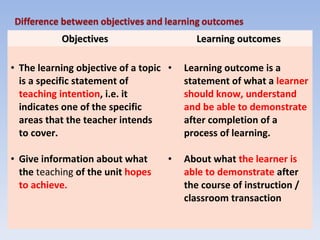
ObjectivesObjectives Learning outcomesLearning outcomes
• The learning objective of a topic
is a specific statement of
teaching intention, i.e. it
indicates one of the specific
areas that the teacher intends
to cover.
• Give information about what
the teaching of the unit hopes
to achieve.
• Learning outcome is a
statement of what a learner
should know, understand
and be able to demonstrate
after completion of a
process of learning.
• About what the learner is
able to demonstrate after
the course of instruction /
classroom transaction
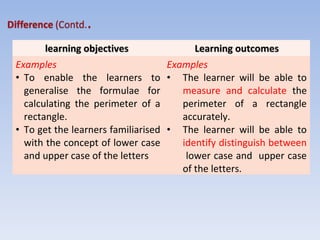
learning objectiveslearning objectives Learning outcomesLearning outcomes
Examples
• To enable the learners to
generalise the formulae for
calculating the perimeter of a
rectangle.
• To get the learners familiarised
with the concept of lower case
and upper case of the letters
Examples
• The learner will be able to
measure and calculate the
perimeter of a rectangle
accurately.
• The learner will be able to
identify distinguish between
lower case and upper case
of the letters.
Unit Title: ........................................
On successful completion of this module, learner will be able to:
• Summarise relevant information regarding ………
• Formulate an appropriate …….
• Arrange appropriate tests and demonstrate the ability to interpret
…………………
• Perform basic …………
• Recognise, evaluate and manage …………………
• Differentiate between ……………………………
• Master the ……………………
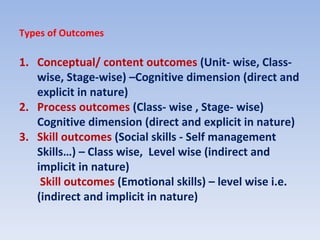
Types of Outcomes
1. Conceptual/ content outcomes (Unit- wise, Class-
wise, Stage-wise) –Cognitive dimension (direct and
explicit in nature)
2. Process outcomes (Class- wise , Stage- wise)
Cognitive dimension (direct and explicit in nature)
3. Skill outcomes (Social skills - Self management
Skills…) – Class wise, Level wise (indirect and
implicit in nature)
Skill outcomes (Emotional skills) – level wise i.e.
(indirect and implicit in nature)
Learning outcomes
Learning outcomes
Learning outcomes

Learning outcomes

  • 2.
    Learning Outcomes • Learningoutcomes are an explicit description of what a learner should know, understand and be able to do as a result of learning. • Learning Outcomes are specific statements of what students should know and be able to do as a result of learning - Morss and Murray, 2005
  • 3.
    Features: • Learning outcomesare capable of being validly assessed. • Learning outcomes are not simply a ‘wish list’ of what a student is capable of doing on completion of the learning activity. • Learning outcomes are simply and clearly described. • Emphasis on the learner and the learning. • Emphasis on the learner’s ability to do something. • LOs tell students what they should be able to do at the end of the course
  • 4.
    ObjectivesObjectives Learning outcomesLearningoutcomes • The learning objective of a topic is a specific statement of teaching intention, i.e. it indicates one of the specific areas that the teacher intends to cover. • Give information about what the teaching of the unit hopes to achieve. • Learning outcome is a statement of what a learner should know, understand and be able to demonstrate after completion of a process of learning. • About what the learner is able to demonstrate after the course of instruction / classroom transaction
  • 5.
    learning objectiveslearning objectivesLearning outcomesLearning outcomes Examples • To enable the learners to generalise the formulae for calculating the perimeter of a rectangle. • To get the learners familiarised with the concept of lower case and upper case of the letters Examples • The learner will be able to measure and calculate the perimeter of a rectangle accurately. • The learner will be able to identify distinguish between lower case and upper case of the letters.
  • 6.
    Unit Title: ........................................ Onsuccessful completion of this module, learner will be able to: • Summarise relevant information regarding ……… • Formulate an appropriate ……. • Arrange appropriate tests and demonstrate the ability to interpret ………………… • Perform basic ………… • Recognise, evaluate and manage ………………… • Differentiate between …………………………… • Master the ……………………
  • 7.
    Types of Outcomes 1.Conceptual/ content outcomes (Unit- wise, Class- wise, Stage-wise) –Cognitive dimension (direct and explicit in nature) 2. Process outcomes (Class- wise , Stage- wise) Cognitive dimension (direct and explicit in nature) 3. Skill outcomes (Social skills - Self management Skills…) – Class wise, Level wise (indirect and implicit in nature) Skill outcomes (Emotional skills) – level wise i.e. (indirect and implicit in nature)