Developing Course-Level Learning
Outcomes: Enhancing Learning
Through Shared Expectations
A Workshop Hosted by:
The College of Arts and Science,
the Thompson Center for Learning and Teaching, and
the Assistant Provost for Assessment and Institutional
Accreditation
December 1, 2006
University of Michigan-Flint
Agenda:
 Introduction (Definitions and Objectives)
 Writing Well Stated Outcomes
 One Framework: Bloom’s Taxonomy
 Independent Work 1:
 Articulating your course objectives and outcomes
 Course Alignment
 Independent Work 2:
 Specifying Teaching & Learning Activities
 Stating Assessments of Student Learning
 Beyond Course Alignment
Why transform to a language of
assessment?
 Specific learning outcomes lead to:
 More measurable outcomes
 Better assessment
 Higher quality feedback
 Improved courses and programs
 Improved student learning and
achievement
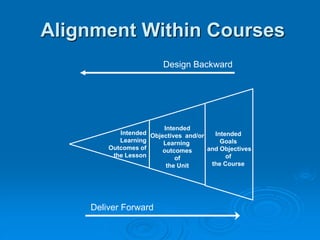
Intended
Learning
Outcomes of
the Lesson
Intended
Objectives and/or
Learning
outcomes
of
the Unit
Intended
Goals
and Objectives
of
the Course
Deliver Forward
Design Backward
Alignment Within Courses
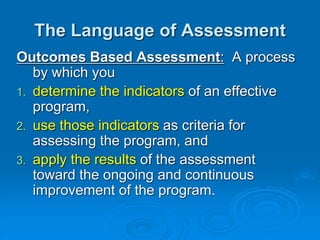
Outcomes Based Assessment: A process
by which you
1. determine the indicators of an effective
program,
2. use those indicators as criteria for
assessing the program, and
3. apply the results of the assessment
toward the ongoing and continuous
improvement of the program.
The Language of Assessment
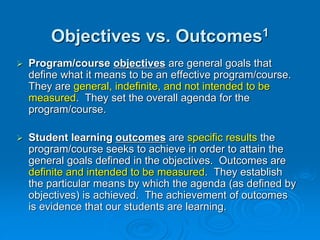
Objectives vs. Outcomes1
 Program/course objectives are general goals that
define what it means to be an effective program/course.
They are general, indefinite, and not intended to be
measured. They set the overall agenda for the
program/course.
 Student learning outcomes are specific results the
program/course seeks to achieve in order to attain the
general goals defined in the objectives. Outcomes are
definite and intended to be measured. They establish
the particular means by which the agenda (as defined by
objectives) is achieved. The achievement of outcomes
is evidence that our students are learning.
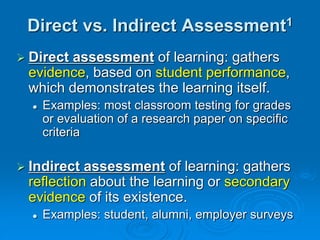
 Direct assessment of learning: gathers
evidence, based on student performance,
which demonstrates the learning itself.
 Examples: most classroom testing for grades
or evaluation of a research paper on specific
criteria
 Indirect assessment of learning: gathers
reflection about the learning or secondary
evidence of its existence.
 Examples: student, alumni, employer surveys
Direct vs. Indirect Assessment1
 Embedded assessment: a means of gathering
information about student learning that is built
into, and is a natural part of the teaching-
learning process.
 Example: as part of a course, expecting each senior
to complete a research paper that is graded for
content and style, but is also assessed for advanced
ability to locate and evaluate Web-based information
(as part of a program level, or a college-wide outcome
to demonstrate information literacy).
Assessment is not always an “add-on”1
 Formative assessment: the gathering of
information about student learning - during the
progression of a course or program and usually
repeatedly - to improve the learning of current
students.
 Summative assessment: the gathering of
information at the conclusion of a course,
program, or undergraduate career to improve
learning of the next cohort of students or to meet
accountability demands.
Formative vs. Summative
Assessment 1
 Assessment for accountability: assessment of
some unit (could be a department, program or
entire institution) to satisfy stakeholders external
to the unit itself. Results are often compared
across units, compared to state and national
norms, and always summative.
 Assessment for improvement: assessment
that feeds directly, and often immediately, back
into revising the course, program or institution to
improve student learning results. This can be
formative or summative.
Accountability and
Improvement1
 Assessment of individuals: uses the individual student,
and his/her learning, as the level of analysis.
 Assessment of programs: uses the department or
program as the level of analysis. Ideally program goals
and objectives would serve as the basis for the
assessment.
 Assessment of institutions: uses the institution as the
level of analysis. Ideally, institution-wide goals and
objectives would serve as a basis for the assessment.
At this level it is essential to examine institutional
documents such as mission and vision statements, as
well as strategic plans.
Levels of Assessment
1
Characteristics of Well Stated
Learning Outcomes
2
student-focused rather than professor focused
focused on the learning resulting from an activity
rather than on the activity itself
focused on skills and abilities central to the
discipline and based on professional standards of
excellence
general enough to capture important learning but
clear and specific enough to be measurable
focused on aspects of learning that will develop
and endure but that can be assessed in some
form now
Common Problems with
Learning Outcomes
 Using vague terms, such as:
 Appreciate
 Become aware of
 Become familiar with
 Develop
 Know
 Learn
 Understand
 Describing action taken by someone other than
the learner.
 “The program will...” or
 “The course will…”
A Comparison of Poorly and Well
Stated Outcomes
 Students will understand
Erikson’s developmental
stages.
 Students will be familiar with
the major sociological
perspectives and how they
relate to their daily lives.
 Students will develop the skills
necessary for conducting
research in the natural
sciences.
 Students will identify and
summarize each of Erikson’s
stages of development.
 Students will describe each of
the major sociological
perspectives and will illustrate
how each perspective relates
to events in their daily lives.
 Students will design, conduct,
and analyze a research project
using appropriate scientific
theory and methodology
Why Classify Learning
Outcomes?
 All learning outcomes are not developed,
delivered, or measured equally
Learning Domains
 Three primary domains for classifying
educational goals:
 Cognitive (knowledge)
 Affective (attitudes)
 Psychomotor (skills)
Bloom’s Taxonomy of
Educational Objectives3 (Cognitive domain)
 A now classic system that classifies educational
goals to facilitate the development and
evaluation of college and university curricula.
 A hierarchical taxonomy of student behaviors
that reflect the development of increasingly
complex cognitive abilities and skills as a result
of instructional experiences.
Bloom’s Taxonomy of Cognitive
Levels
 There are 6 categories, listed hierarchically from
simplest to most complex
 Knowledge
 Comprehension
 Application
 Analysis
 Synthesis
 Evaluation
Bloom’s Taxonomy:
Knowledge4
Definition:
 ability to remember information from
simple (facts, terminology) to more
complex/abstract (theories, principles)
Student Learning Verbs:
 List, name, identify, show, define,
recognize, recall, state, describe, label,
match, outline, reproduce, select
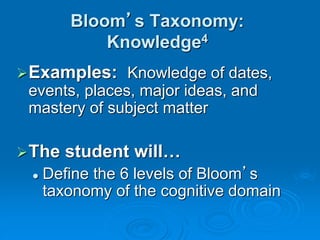
Bloom’s Taxonomy:
Knowledge4
Examples: Knowledge of dates,
events, places, major ideas, and
mastery of subject matter
The student will…
 Define the 6 levels of Bloom’s
taxonomy of the cognitive domain
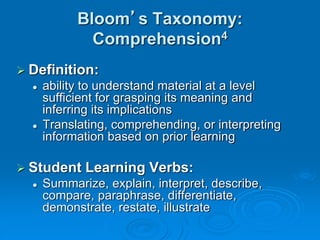
Bloom’s Taxonomy:
Comprehension4
 Definition:
 ability to understand material at a level
sufficient for grasping its meaning and
inferring its implications
 Translating, comprehending, or interpreting
information based on prior learning
 Student Learning Verbs:
 Summarize, explain, interpret, describe,
compare, paraphrase, differentiate,
demonstrate, restate, illustrate
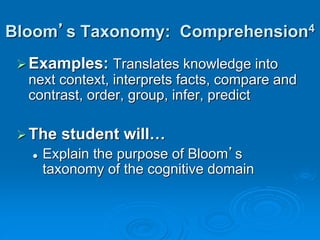
Bloom’s Taxonomy: Comprehension4
Examples: Translates knowledge into
next context, interprets facts, compare and
contrast, order, group, infer, predict
The student will…
 Explain the purpose of Bloom’s
taxonomy of the cognitive domain
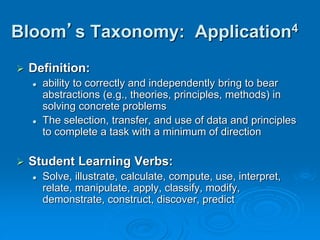
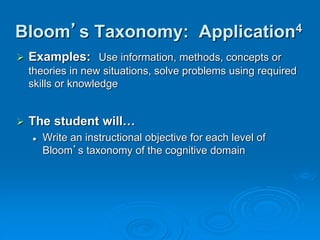
Bloom’s Taxonomy: Application4
 Definition:
 ability to correctly and independently bring to bear
abstractions (e.g., theories, principles, methods) in
solving concrete problems
 The selection, transfer, and use of data and principles
to complete a task with a minimum of direction
 Student Learning Verbs:
 Solve, illustrate, calculate, compute, use, interpret,
relate, manipulate, apply, classify, modify,
demonstrate, construct, discover, predict
Bloom’s Taxonomy: Application4
 Examples: Use information, methods, concepts or
theories in new situations, solve problems using required
skills or knowledge
 The student will…
 Write an instructional objective for each level of
Bloom’s taxonomy of the cognitive domain
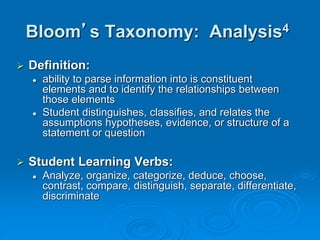
Bloom’s Taxonomy: Analysis4
 Definition:
 ability to parse information into is constituent
elements and to identify the relationships between
those elements
 Student distinguishes, classifies, and relates the
assumptions hypotheses, evidence, or structure of a
statement or question
 Student Learning Verbs:
 Analyze, organize, categorize, deduce, choose,
contrast, compare, distinguish, separate, differentiate,
discriminate
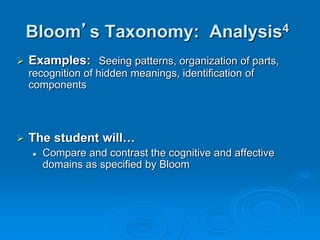
Bloom’s Taxonomy: Analysis4
 Examples: Seeing patterns, organization of parts,
recognition of hidden meanings, identification of
components
 The student will…
 Compare and contrast the cognitive and affective
domains as specified by Bloom
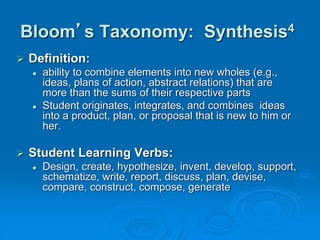
Bloom’s Taxonomy: Synthesis4
 Definition:
 ability to combine elements into new wholes (e.g.,
ideas, plans of action, abstract relations) that are
more than the sums of their respective parts
 Student originates, integrates, and combines ideas
into a product, plan, or proposal that is new to him or
her.
 Student Learning Verbs:
 Design, create, hypothesize, invent, develop, support,
schematize, write, report, discuss, plan, devise,
compare, construct, compose, generate
Bloom’s Taxonomy: Synthesis4
 Examples: Use old ideas to create new ones,
generalize from given facts, relate knowledge from
several areas
 The student will…
 Design a classification scheme for writing educational
objectives that combines the cognitive, affective, and
psychomotor domains.
Bloom’s Taxonomy: Evaluation4
 Definition:
 Ability to offer quantitative and qualitative judgments
about the value of ideas and methods
 Student appraises, assesses, or critiques on a basis
of specific standards and criteria
 Student Learning Verbs:
 Evaluate, choose, estimate, judge, defend, criticize,
justify, recommend, critique, interpret, support
Bloom’s Taxonomy: Evaluation4
 Examples: Compare and discriminate
between ideas, assess value of theories or
presentations, make choices based on reasoned
argument, verify value of evidence, recognize
subjectivity
 The student will…
 Judge the effectiveness of writing objectives
using Bloom’s taxonomy
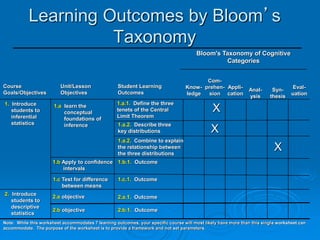
Learning Outcomes by Bloom’s
Taxonomy
Note: While this worksheet accommodates 7 learning outcomes, your specific course will most likely have more than this single worksheet can
accommodate. The purpose of the worksheet is to provide a framework and not set parameters.
2.b.1. Outcome
1.c.1. Outcome
2.a objective
2. Introduce
students to
descriptive
statistics
1.c Test for difference
between means
X
1.b.1. Outcome
1.b Apply to confidence
intervals
X
1.a.2. Describe three
key distributions
X
1.a.1. Define the three
tenets of the Central
Limit Theorem
1.a learn the
conceptual
foundations of
inference
1. Introduce
students to
inferential
statistics
Eval-
uation
Syn-
thesis
Anal-
ysis
Appli-
cation
Com-
prehen-
sion
Know-
ledge
Bloom's Taxonomy of Cognitive
Categories
Student Learning
Outcomes
Unit/Lesson
Objectives
Course
Goals/Objectives
2.b objective
2.a.1. Outcome
1.a.2. Combine to explain
the relationship between
the three distributions
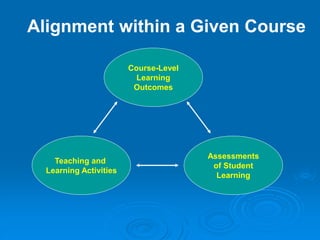
Course-Level
Learning
Outcomes
Teaching and
Learning Activities
Assessments
of Student
Learning
Alignment within a Given Course
The Next Step:
 Given your student learning outcomes,
what specific tasks or activities will you
have students complete to promote
learning?
 Given these student learning outcomes,
how will you know when your students
have achieved the outcomes for that
lesson or course (what assessments will
you use)?
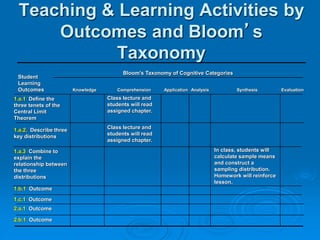
Teaching & Learning Activities by
Outcomes and Bloom’s
Taxonomy
2.b.1 Outcome
2.a.1 Outcome
1.c.1 Outcome
In class, students will
calculate sample means
and construct a
sampling distribution.
Homework will reinforce
lesson.
1.b.1 Outcome
1.a.3 Combine to
explain the
relationship between
the three
distributions
1.a.2. Describe three
key distributions
Class lecture and
students will read
assigned chapter.
1.a.1 Define the
three tenets of the
Central Limit
Theorem
Evaluation
Synthesis
Analysis
Application
Comprehension
Knowledge
Bloom's Taxonomy of Cognitive Categories
Student
Learning
Outcomes
Class lecture and
students will read
assigned chapter.
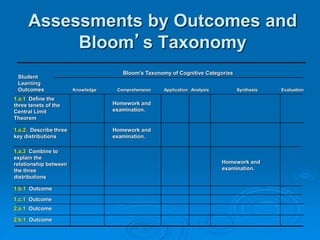
Assessments by Outcomes and
Bloom’s Taxonomy
2.b.1 Outcome
2.a.1 Outcome
1.c.1 Outcome
Homework and
examination.
1.b.1 Outcome
1.a.3 Combine to
explain the
relationship between
the three
distributions
1.a.2. Describe three
key distributions
Homework and
examination.
1.a.1 Define the
three tenets of the
Central Limit
Theorem
Evaluation
Synthesis
Analysis
Application
Comprehension
Knowledge
Bloom's Taxonomy of Cognitive Categories
Student
Learning
Outcomes
Homework and
examination.
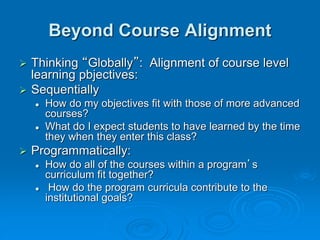
Beyond Course Alignment
 Thinking “Globally”: Alignment of course level
learning pbjectives:
 Sequentially
 How do my objectives fit with those of more advanced
courses?
 What do I expect students to have learned by the time
they when they enter this class?
 Programmatically:
 How do all of the courses within a program’s
curriculum fit together?
 How do the program curricula contribute to the
institutional goals?
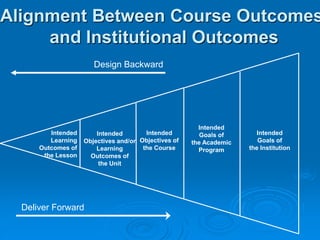
Intended
Learning
Outcomes of
the Lesson
Intended
Objectives and/or
Learning
Outcomes of
the Unit
Intended
Objectives of
the Course
Intended
Goals of
the Academic
Program
Intended
Goals of
the Institution
Deliver Forward
Design Backward
Alignment Between Course Outcomes
and Institutional Outcomes
References
 1 Leskes (2002) “Beyond Confusion: An Assessment
Glossary,” Peer Review.
 2 Huba and Freed. 2000. Learner-Centered
Assessment on College Campuses.
 3 Bloom.1956. Taxonomy of Educational Objectives,
Handbook I: The Cognitive Domain
 4 From Don Clark,
http://www.nwlink.com/~dpmc;arl/hrd/bloom.html, the
Learning Skills Program at the University of Victoria
(htttp://www.coun.uvic.ca/learn/program/hndouts/bloom.
html) , the Faculty Roles and Rewards Program at
Portland State University
(http://edtech.clas.pdx.edu/presentations/frr99/blooms.ht
m), and W. Huitt,
http://chiron.valdosta.edu/whuitt/col/cogsys/bloom.html.

Developing Course-Level Learning Objectives4.ppt

  • 1.
    Developing Course-Level Learning Outcomes:Enhancing Learning Through Shared Expectations A Workshop Hosted by: The College of Arts and Science, the Thompson Center for Learning and Teaching, and the Assistant Provost for Assessment and Institutional Accreditation December 1, 2006 University of Michigan-Flint
  • 2.
    Agenda:  Introduction (Definitionsand Objectives)  Writing Well Stated Outcomes  One Framework: Bloom’s Taxonomy  Independent Work 1:  Articulating your course objectives and outcomes  Course Alignment  Independent Work 2:  Specifying Teaching & Learning Activities  Stating Assessments of Student Learning  Beyond Course Alignment
  • 3.
    Why transform toa language of assessment?  Specific learning outcomes lead to:  More measurable outcomes  Better assessment  Higher quality feedback  Improved courses and programs  Improved student learning and achievement
  • 4.
    Intended Learning Outcomes of the Lesson Intended Objectivesand/or Learning outcomes of the Unit Intended Goals and Objectives of the Course Deliver Forward Design Backward Alignment Within Courses
  • 5.
    Outcomes Based Assessment:A process by which you 1. determine the indicators of an effective program, 2. use those indicators as criteria for assessing the program, and 3. apply the results of the assessment toward the ongoing and continuous improvement of the program. The Language of Assessment
  • 6.
    Objectives vs. Outcomes1 Program/course objectives are general goals that define what it means to be an effective program/course. They are general, indefinite, and not intended to be measured. They set the overall agenda for the program/course.  Student learning outcomes are specific results the program/course seeks to achieve in order to attain the general goals defined in the objectives. Outcomes are definite and intended to be measured. They establish the particular means by which the agenda (as defined by objectives) is achieved. The achievement of outcomes is evidence that our students are learning.
  • 7.
     Direct assessmentof learning: gathers evidence, based on student performance, which demonstrates the learning itself.  Examples: most classroom testing for grades or evaluation of a research paper on specific criteria  Indirect assessment of learning: gathers reflection about the learning or secondary evidence of its existence.  Examples: student, alumni, employer surveys Direct vs. Indirect Assessment1
  • 8.
     Embedded assessment:a means of gathering information about student learning that is built into, and is a natural part of the teaching- learning process.  Example: as part of a course, expecting each senior to complete a research paper that is graded for content and style, but is also assessed for advanced ability to locate and evaluate Web-based information (as part of a program level, or a college-wide outcome to demonstrate information literacy). Assessment is not always an “add-on”1
  • 9.
     Formative assessment:the gathering of information about student learning - during the progression of a course or program and usually repeatedly - to improve the learning of current students.  Summative assessment: the gathering of information at the conclusion of a course, program, or undergraduate career to improve learning of the next cohort of students or to meet accountability demands. Formative vs. Summative Assessment 1
  • 10.
     Assessment foraccountability: assessment of some unit (could be a department, program or entire institution) to satisfy stakeholders external to the unit itself. Results are often compared across units, compared to state and national norms, and always summative.  Assessment for improvement: assessment that feeds directly, and often immediately, back into revising the course, program or institution to improve student learning results. This can be formative or summative. Accountability and Improvement1
  • 11.
     Assessment ofindividuals: uses the individual student, and his/her learning, as the level of analysis.  Assessment of programs: uses the department or program as the level of analysis. Ideally program goals and objectives would serve as the basis for the assessment.  Assessment of institutions: uses the institution as the level of analysis. Ideally, institution-wide goals and objectives would serve as a basis for the assessment. At this level it is essential to examine institutional documents such as mission and vision statements, as well as strategic plans. Levels of Assessment 1
  • 12.
    Characteristics of WellStated Learning Outcomes 2 student-focused rather than professor focused focused on the learning resulting from an activity rather than on the activity itself focused on skills and abilities central to the discipline and based on professional standards of excellence general enough to capture important learning but clear and specific enough to be measurable focused on aspects of learning that will develop and endure but that can be assessed in some form now
  • 13.
    Common Problems with LearningOutcomes  Using vague terms, such as:  Appreciate  Become aware of  Become familiar with  Develop  Know  Learn  Understand  Describing action taken by someone other than the learner.  “The program will...” or  “The course will…”
  • 14.
    A Comparison ofPoorly and Well Stated Outcomes  Students will understand Erikson’s developmental stages.  Students will be familiar with the major sociological perspectives and how they relate to their daily lives.  Students will develop the skills necessary for conducting research in the natural sciences.  Students will identify and summarize each of Erikson’s stages of development.  Students will describe each of the major sociological perspectives and will illustrate how each perspective relates to events in their daily lives.  Students will design, conduct, and analyze a research project using appropriate scientific theory and methodology
  • 15.
    Why Classify Learning Outcomes? All learning outcomes are not developed, delivered, or measured equally
  • 16.
    Learning Domains  Threeprimary domains for classifying educational goals:  Cognitive (knowledge)  Affective (attitudes)  Psychomotor (skills)
  • 17.
    Bloom’s Taxonomy of EducationalObjectives3 (Cognitive domain)  A now classic system that classifies educational goals to facilitate the development and evaluation of college and university curricula.  A hierarchical taxonomy of student behaviors that reflect the development of increasingly complex cognitive abilities and skills as a result of instructional experiences.
  • 18.
    Bloom’s Taxonomy ofCognitive Levels  There are 6 categories, listed hierarchically from simplest to most complex  Knowledge  Comprehension  Application  Analysis  Synthesis  Evaluation
  • 19.
    Bloom’s Taxonomy: Knowledge4 Definition:  abilityto remember information from simple (facts, terminology) to more complex/abstract (theories, principles) Student Learning Verbs:  List, name, identify, show, define, recognize, recall, state, describe, label, match, outline, reproduce, select
  • 20.
    Bloom’s Taxonomy: Knowledge4 Examples: Knowledgeof dates, events, places, major ideas, and mastery of subject matter The student will…  Define the 6 levels of Bloom’s taxonomy of the cognitive domain
  • 21.
    Bloom’s Taxonomy: Comprehension4  Definition: ability to understand material at a level sufficient for grasping its meaning and inferring its implications  Translating, comprehending, or interpreting information based on prior learning  Student Learning Verbs:  Summarize, explain, interpret, describe, compare, paraphrase, differentiate, demonstrate, restate, illustrate
  • 22.
    Bloom’s Taxonomy: Comprehension4 Examples:Translates knowledge into next context, interprets facts, compare and contrast, order, group, infer, predict The student will…  Explain the purpose of Bloom’s taxonomy of the cognitive domain
  • 23.
    Bloom’s Taxonomy: Application4 Definition:  ability to correctly and independently bring to bear abstractions (e.g., theories, principles, methods) in solving concrete problems  The selection, transfer, and use of data and principles to complete a task with a minimum of direction  Student Learning Verbs:  Solve, illustrate, calculate, compute, use, interpret, relate, manipulate, apply, classify, modify, demonstrate, construct, discover, predict
  • 24.
    Bloom’s Taxonomy: Application4 Examples: Use information, methods, concepts or theories in new situations, solve problems using required skills or knowledge  The student will…  Write an instructional objective for each level of Bloom’s taxonomy of the cognitive domain
  • 25.
    Bloom’s Taxonomy: Analysis4 Definition:  ability to parse information into is constituent elements and to identify the relationships between those elements  Student distinguishes, classifies, and relates the assumptions hypotheses, evidence, or structure of a statement or question  Student Learning Verbs:  Analyze, organize, categorize, deduce, choose, contrast, compare, distinguish, separate, differentiate, discriminate
  • 26.
    Bloom’s Taxonomy: Analysis4 Examples: Seeing patterns, organization of parts, recognition of hidden meanings, identification of components  The student will…  Compare and contrast the cognitive and affective domains as specified by Bloom
  • 27.
    Bloom’s Taxonomy: Synthesis4 Definition:  ability to combine elements into new wholes (e.g., ideas, plans of action, abstract relations) that are more than the sums of their respective parts  Student originates, integrates, and combines ideas into a product, plan, or proposal that is new to him or her.  Student Learning Verbs:  Design, create, hypothesize, invent, develop, support, schematize, write, report, discuss, plan, devise, compare, construct, compose, generate
  • 28.
    Bloom’s Taxonomy: Synthesis4 Examples: Use old ideas to create new ones, generalize from given facts, relate knowledge from several areas  The student will…  Design a classification scheme for writing educational objectives that combines the cognitive, affective, and psychomotor domains.
  • 29.
    Bloom’s Taxonomy: Evaluation4 Definition:  Ability to offer quantitative and qualitative judgments about the value of ideas and methods  Student appraises, assesses, or critiques on a basis of specific standards and criteria  Student Learning Verbs:  Evaluate, choose, estimate, judge, defend, criticize, justify, recommend, critique, interpret, support
  • 30.
    Bloom’s Taxonomy: Evaluation4 Examples: Compare and discriminate between ideas, assess value of theories or presentations, make choices based on reasoned argument, verify value of evidence, recognize subjectivity  The student will…  Judge the effectiveness of writing objectives using Bloom’s taxonomy
  • 31.
    Learning Outcomes byBloom’s Taxonomy Note: While this worksheet accommodates 7 learning outcomes, your specific course will most likely have more than this single worksheet can accommodate. The purpose of the worksheet is to provide a framework and not set parameters. 2.b.1. Outcome 1.c.1. Outcome 2.a objective 2. Introduce students to descriptive statistics 1.c Test for difference between means X 1.b.1. Outcome 1.b Apply to confidence intervals X 1.a.2. Describe three key distributions X 1.a.1. Define the three tenets of the Central Limit Theorem 1.a learn the conceptual foundations of inference 1. Introduce students to inferential statistics Eval- uation Syn- thesis Anal- ysis Appli- cation Com- prehen- sion Know- ledge Bloom's Taxonomy of Cognitive Categories Student Learning Outcomes Unit/Lesson Objectives Course Goals/Objectives 2.b objective 2.a.1. Outcome 1.a.2. Combine to explain the relationship between the three distributions
  • 32.
  • 33.
    The Next Step: Given your student learning outcomes, what specific tasks or activities will you have students complete to promote learning?  Given these student learning outcomes, how will you know when your students have achieved the outcomes for that lesson or course (what assessments will you use)?
  • 34.
    Teaching & LearningActivities by Outcomes and Bloom’s Taxonomy 2.b.1 Outcome 2.a.1 Outcome 1.c.1 Outcome In class, students will calculate sample means and construct a sampling distribution. Homework will reinforce lesson. 1.b.1 Outcome 1.a.3 Combine to explain the relationship between the three distributions 1.a.2. Describe three key distributions Class lecture and students will read assigned chapter. 1.a.1 Define the three tenets of the Central Limit Theorem Evaluation Synthesis Analysis Application Comprehension Knowledge Bloom's Taxonomy of Cognitive Categories Student Learning Outcomes Class lecture and students will read assigned chapter.
  • 35.
    Assessments by Outcomesand Bloom’s Taxonomy 2.b.1 Outcome 2.a.1 Outcome 1.c.1 Outcome Homework and examination. 1.b.1 Outcome 1.a.3 Combine to explain the relationship between the three distributions 1.a.2. Describe three key distributions Homework and examination. 1.a.1 Define the three tenets of the Central Limit Theorem Evaluation Synthesis Analysis Application Comprehension Knowledge Bloom's Taxonomy of Cognitive Categories Student Learning Outcomes Homework and examination.
  • 36.
    Beyond Course Alignment Thinking “Globally”: Alignment of course level learning pbjectives:  Sequentially  How do my objectives fit with those of more advanced courses?  What do I expect students to have learned by the time they when they enter this class?  Programmatically:  How do all of the courses within a program’s curriculum fit together?  How do the program curricula contribute to the institutional goals?
  • 37.
    Intended Learning Outcomes of the Lesson Intended Objectivesand/or Learning Outcomes of the Unit Intended Objectives of the Course Intended Goals of the Academic Program Intended Goals of the Institution Deliver Forward Design Backward Alignment Between Course Outcomes and Institutional Outcomes
  • 38.
    References  1 Leskes(2002) “Beyond Confusion: An Assessment Glossary,” Peer Review.  2 Huba and Freed. 2000. Learner-Centered Assessment on College Campuses.  3 Bloom.1956. Taxonomy of Educational Objectives, Handbook I: The Cognitive Domain  4 From Don Clark, http://www.nwlink.com/~dpmc;arl/hrd/bloom.html, the Learning Skills Program at the University of Victoria (htttp://www.coun.uvic.ca/learn/program/hndouts/bloom. html) , the Faculty Roles and Rewards Program at Portland State University (http://edtech.clas.pdx.edu/presentations/frr99/blooms.ht m), and W. Huitt, http://chiron.valdosta.edu/whuitt/col/cogsys/bloom.html.