BLOOM’S 
TAXONOMY 
A B R I E F I N T R O D U C T I O N 
T O T H E O R I G I N A L A N D 
R E V I S E D T A X O N O M I E S
WHAT IS BLOOM’S 
TAXONOMY? 
• A classification system for levels of 
behavior that are important in learning 
– Knowledge is acquired at certain definable 
levels 
• The taxonomy is cumulative and 
hierarchical 
– Levels build on top of each other 
– Each level contains all behaviors from 
previous levels 
– Simple recall of facts at the lowest level 
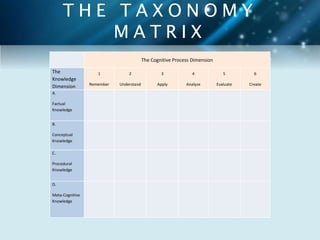
– Mastery of a level required before moving up 
to the next higher one 
– Students continue moving up levels to the 
highest one (Evaluation in original, Create in
H O W D I D I T 
H A P P E N ? 
Benjamin Bloom headed a committee of 
educational psychologists that devised the 
classification system in 1956. 
The committee was formed out of a meeting 
of the American Psychological Association 
(APA). 
The group came up with three major areas of 
educational activities: 
- Cognitive: mental skills (Knowledge) 
- Psychomotor: manual or physical skills (Skills) 
- Affective: growth in feelings or emotional areas (Attitude) 
The committee focused on the cognitive 
domain and developed six levels within it.
W H A T I S I T 
F O R ? 
Writing educational objectives 
Development of most testing formats 
Identifying critical thinking in students 
Taxonomy does not explicitly 
define critical thinking 
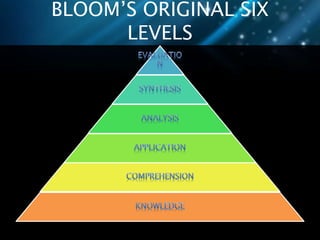
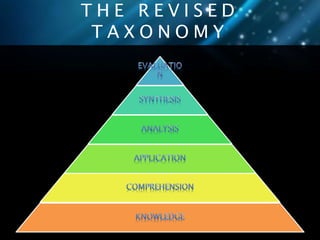
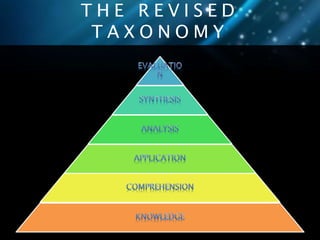
Six knowledge levels constitute 
critical thinking 
Levels clarify what critical thinking 
and understanding mean
BLOOM’S ORIGINAL SIX 
LEVELS
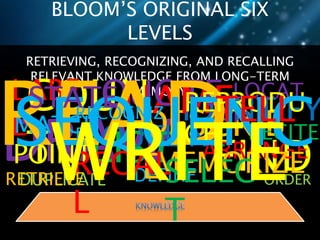
BLOOM’S ORIGINAL SIX 
LEVELS 
RETRIEVING, RECOGNIZING, AND RECALLING 
RELEVANT KNOWLEDGE FROM LONG-TERM 
QUOTE READ 
NAME 
SEQUENCE STATE MEMORY 
IDENTIFY 
TELL 
WRITE 
AFRRIANNGDE 
LABE 
COUN 
DTRAWL 
DEFINE 
DESCRIB 
LIST 
E DUPLICATE 
LOCAT 
MATCH E 
MEMORIZE 
ORDER 
OUTLINE 
POINT 
RECAL 
L 
RECITE 
RECOGNIZ 
E 
REPRODU 
CE 
RETRIEVE SELEC 
T
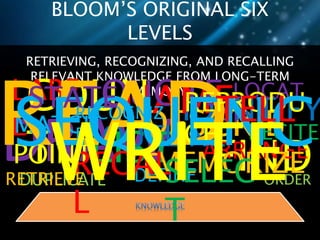
BLOOM’S ORIGINAL SIX 
LEVELS 
RETRIEVING, RECOGNIZING, AND RECALLING 
RELEVANT KNOWLEDGE FROM LONG-TERM 
QUOTE READ 
NAME 
SEQUENCE STATE MEMORY 
IDENTIFY 
TELL 
WRITE 
AFRRIANNGDE 
LABE 
COUN 
DTRAWL 
DEFINE 
DESCRIB 
LIST 
E DUPLICATE 
LOCAT 
MATCH E 
MEMORIZE 
ORDER 
OUTLINE 
POINT 
RECAL 
L 
RECITE 
RECOGNIZ 
E 
REPRODU 
CE 
RETRIEVE SELEC 
T
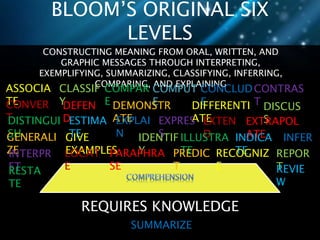
BLOOM’S ORIGINAL SIX 
LEVELS 
CONSTRUCTING MEANING FROM ORAL, WRITTEN, AND 
GRAPHIC MESSAGES THROUGH INTERPRETING, 
EXEMPLIFYING, SUMMARIZING, CLASSIFYING, INFERRING, 
COMPARING, AND EXPLAINING ASSOCIA 
TE 
CLASSIF 
Y 
COMPAR 
E 
COMPUT 
E 
CONCLUD 
E 
REQUIRES KNOWLEDGE 
CONTRAS 
CONVER T 
T 
DEFEN 
D 
DEMONSTR 
ATE 
DIFFERENTI 
ATE 
DISCUS 
DISTINGUI ESTIMA 
EXPLAI 
EXPRES 
S 
SH 
TE 
N 
S 
EXTEN 
D 
EXTRAPOL 
GENERALI ATE 
ZE 
GIVE 
EXAMPLES 
IDENTIF 
Y 
ILLUSTRA 
TE 
INDICA 
TE 
INFER 
INTERPR 
ET 
LOCAT 
E 
PARAPHRA 
SE 
PREDIC 
T 
RECOGNIZ 
E 
REPOR 
RESTA T 
TE 
REVIE 
W 
SUMMARIZE
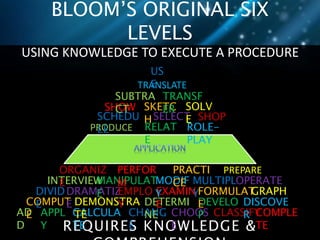
BLOOM’S ORIGINAL SIX 
LEVELS 
USING KNOWLEDGE TO EXECUTE A PROCEDURE 
US 
E 
TRANSLATE 
SHOW SKETC 
REQUIRES KNOWLEDGE & 
COMPREHENSION 
AD 
D 
APPL 
Y 
CALCULA 
TE 
CHANG 
E 
CHOOS 
E 
CLASSIFYCOMPLE 
TE 
COMPUT 
E 
DEMONSTRA 
TE 
DETERMI 
NE 
DEVELO 
P 
DISCOVE 
R 
DIVID 
E 
DRAMATIZ 
E 
EMPLO 
Y 
EXAMIN 
E 
FORMULAT 
E 
GRAPH 
INTERVIEWMANIPULAT 
E 
MODIF 
Y 
MULTIPL 
Y 
OPERATE 
ORGANIZ 
E 
PERFOR 
M 
PRACTI 
CE 
PREPARE 
PRODUCE RELAT 
E 
ROLE-PLAY 
SCHEDU 
LE 
SELECT SHOP 
H 
SOLV 
E 
SUBTRA 
CT 
TRANSF 
ER
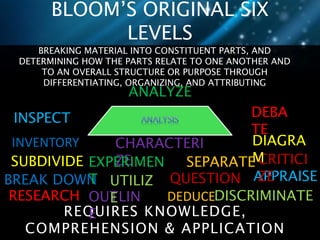
BLOOM’S ORIGINAL SIX 
LEVELS 
BREAKING MATERIAL INTO CONSTITUENT PARTS, AND 
breaking material into constituent parts, and determining how the parts relate to one another 
and to an overall structure or purpose through differentiating, organizing, and attributing 
DETERMINING HOW THE PARTS RELATE TO ONE ANOTHER AND 
TO AN OVERALL STRUCTURE OR PURPOSE THROUGH 
DIFFERENTIATING, ORGANIZING, AND ATTRIBUTING 
ANALYZE 
DEBA 
TE 
DIAGRA 
M 
CHARACTERI 
ZE CRITICI 
SUBDIVIDE SEPARATE 
EXPERIMEN 
T 
INSPECT 
INVENTORY 
BREAK DOWN QUESTION 
APPRAISE 
DISCRIMINATE 
DEDUCE 
UTILIZ 
E 
OUTLIN 
E 
RESEARCH 
REQUIRES KNOWLEDGE, 
APPRAISE 
ZE 
COMPREHENSION & APPLICATION
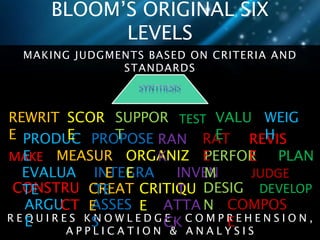
BLOOM’S ORIGINAL SIX 
LEVELS 
MAKING JUDGMENTS BASED ON CRITERIA AND 
STANDARDS 
R E Q U I R E S K N O W L E D G E , C O M P R E H E N S I O N , 
A P P L I C A T I O N & A N A L Y S I S 
ARGU 
E 
ASSES 
S 
ATTA 
CK 
COMPOS 
E 
CONSTRU 
CT 
CREAT 
E 
CRITIQU 
E 
DESIG 
N 
DEVELOP 
EVALUA 
TE 
INTEGRA 
TE 
INVEN 
T 
JUDGE 
MAKE MEASUR 
E 
ORGANIZ 
E 
PERFOR 
M 
PLAN 
PRODUC 
E 
PROPOSE RAN 
K 
RAT 
E 
REVIS 
E 
REWRIT 
E 
SCOR 
E 
SUPPOR 
T 
TEST VALU 
E 
WEIG 
H
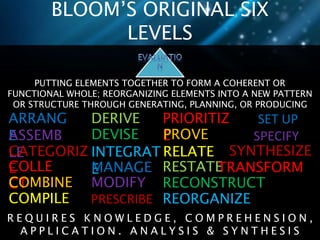
BLOOM’S ORIGINAL SIX 
LEVELS 
PUTTING ELEMENTS TOGETHER TO FORM A COHERENT OR 
FUNCTIONAL WHOLE; REORGANIZING ELEMENTS INTO A NEW PATTERN 
OR STRUCTURE THROUGH GENERATING, PLANNING, OR PRODUCING 
ARRANG 
EASSEMB 
LCEATEGORIZ 
ECOLLE 
CTOMBINE 
COMPILE 
DERIVE 
DEVISE 
INTEGRAT 
EMANAGE 
MODIFY 
PRESCRIBE 
PRIORITIZ 
EPROVE 
RELATE 
T 
SYNTHESIZE 
TRANSFORM T 
RESTATE T 
SET UP T 
SPECIFY T 
RECONSTRUCTT 
REORGANIZE T 
R E Q U I R E S K N O W L E D G E , C O M P R E H E N S I O N , 
A P P L I C A T I O N . A N A L Y S I S & S Y N T H E S I S
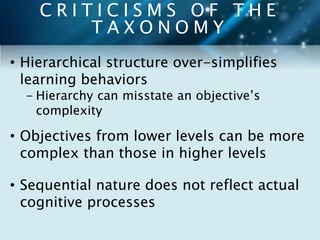
C R I T I C I S M S O F T H E 
T A X O N O M Y 
• Hierarchical structure over-simplifies 
learning behaviors 
- Hierarchy can misstate an objective’s 
complexity 
• Objectives from lower levels can be more 
complex than those in higher levels 
• Sequential nature does not reflect actual 
cognitive processes
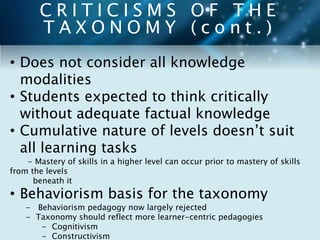
C R I T I C I S M S O F T H E 
T A X O N O M Y ( c o n t . ) 
• Does not consider all knowledge 
modalities 
• Students expected to think critically 
without adequate factual knowledge 
• Cumulative nature of levels doesn’t suit 
all learning tasks 
- Mastery of skills in a higher level can occur prior to mastery of skills 
from the levels 
beneath it 
• Behaviorism basis for the taxonomy 
- Behaviorism pedagogy now largely rejected 
- Taxonomy should reflect more learner-centric pedagogies 
- Cognitivism 
- Constructivism
R E V I S I N G T H E 
T A X O N O M Y 
1 9 9 5 
Responding to criticisms, Lorin W. Anderson (a 
former student of Bloom’s) met with a 
consortium of educational experts in 1995 in 
order to revise the taxonomy. 
Over the next six years, the consortium met 
annually to make recommendations and report 
findings. 
In 2001, the group released Bloom’s Revised 
Taxonomy, with significant differences from the 
original taxonomy.
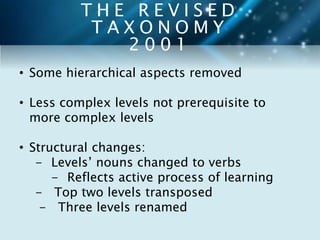
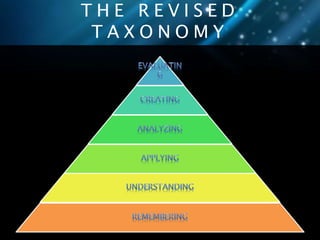
T H E R E V I S E D 
T A X O N O M Y 
2 0 0 1 
• Some hierarchical aspects removed 
• Less complex levels not prerequisite to 
more complex levels 
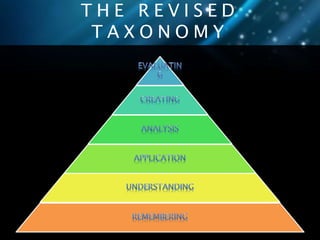
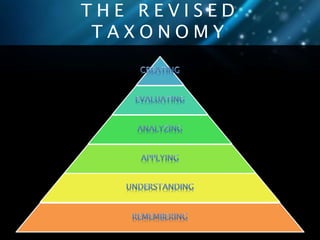
• Structural changes: 
- Levels’ nouns changed to verbs 
- Reflects active process of learning 
- Top two levels transposed 
- Three levels renamed
T H E R E V I S E D 
T A X O N O M Y 
2 0 0 1 ( c o n t . ) 
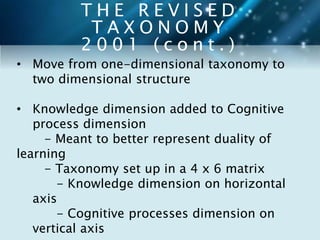
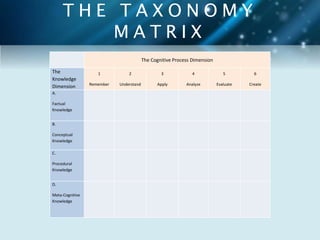
• Move from one-dimensional taxonomy to 
two dimensional structure 
• Knowledge dimension added to Cognitive 
process dimension 
- Meant to better represent duality of 
learning 
- Taxonomy set up in a 4 x 6 matrix 
- Knowledge dimension on horizontal 
axis 
- Cognitive processes dimension on 
vertical axis
T H E R E V I S E D 
T A X O N O M Y
T H E R E V I S E D 
T A X O N O M Y
T H E R E V I S E D 
T A X O N O M Y
T H E R E V I S E D 
T A X O N O M Y
T H E R E V I S E D 
T A X O N O M Y
T H E R E V I S E D 
T A X O N O M Y
T H E T A X O N O M Y 
The Cognitive Process Dimension 
The 
Knowledge 
Dimension 
1 
Remember 
2 
Understand 
3 
Apply 
4 
Analyze 
5 
Evaluate 
6 
Create 
A. 
Factual 
Knowledge 
B. 
Conceptual 
Knowledge 
C. 
Procedural 
Knowledge 
D. 
Meta-Cognitive 
Knowledge 
M A T R I X
T H E T A X O N O M Y 
The Cognitive Process Dimension 
The 
Knowledge 
Dimension 
1 
Remember 
2 
Understand 
3 
Apply 
4 
Analyze 
5 
Evaluate 
6 
Create 
A. 
Factual 
Knowledge 
B. 
Conceptual 
Knowledge 
C. 
Procedural 
Knowledge 
D. 
Meta-Cognitive 
Knowledge 
M A T R I X
T A X O N O M Y T O O L 
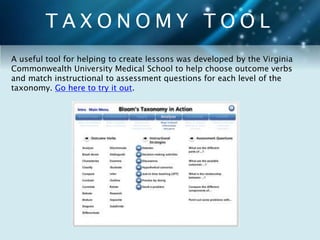
A useful tool for helping to create lessons was developed by the Virginia 
Commonwealth University Medical School to help choose outcome verbs 
and match instructional to assessment questions for each level of the 
taxonomy. Go here to try it out.
R E F E R E N C E S 
Aviles, C.B. (1999). Understanding and testing for "critical thinking" with Bloom's Taxonomy 
of educational objectives. Paper presented at the Annual Meeting of the Council 
on Social Work Education (45th, San Francisco, CA, March 10-13, 1999. Retrieved 
from http://files.eric.ed.gov/fulltext/ED446025.pdf 
Bloom, B., S. (1956). Taxonomy of educational objectives: Cognitive domain. NY: Longman. 
Chan, C.V., Matthews, L.A. & Kaufman, D.R. (2009). A taxonomy characterizing complexity of 
consumer ehealth literacy. AMIA Annual Symposiums Proceedings, 2009, 86-90. 
Retrieved from http://www.ncbi.nlm.nih.gov/pmc/articles/PMC2815448/ 
Tigerskins Unreleased Ambient & Electronika Nuggets Mixtape 1994-96. [Audio recording]. 
Retrieved from Tigerskins Unreleased Ambient & Electronika Nuggets Mixtape 1994-96 
Van Der Volgen, J. (2014, April 9). Bloom’s taxonomy tool [Blog post]. National Network of 
Libraries of Medicine. Retrieved from http://nnlm.gov/ntc/2014/04/09/blooms-taxonomy- 
tool/ 
Wiggins, G., McTighe, J. (1998). Understanding by design. Alexandria, VA:Association for 
Supervision and Curriculum Development.
Bloom’s taxonomy

Bloom’s taxonomy

  • 1.
    BLOOM’S TAXONOMY AB R I E F I N T R O D U C T I O N T O T H E O R I G I N A L A N D R E V I S E D T A X O N O M I E S
  • 2.
    WHAT IS BLOOM’S TAXONOMY? • A classification system for levels of behavior that are important in learning – Knowledge is acquired at certain definable levels • The taxonomy is cumulative and hierarchical – Levels build on top of each other – Each level contains all behaviors from previous levels – Simple recall of facts at the lowest level – Mastery of a level required before moving up to the next higher one – Students continue moving up levels to the highest one (Evaluation in original, Create in
  • 3.
    H O WD I D I T H A P P E N ? Benjamin Bloom headed a committee of educational psychologists that devised the classification system in 1956. The committee was formed out of a meeting of the American Psychological Association (APA). The group came up with three major areas of educational activities: - Cognitive: mental skills (Knowledge) - Psychomotor: manual or physical skills (Skills) - Affective: growth in feelings or emotional areas (Attitude) The committee focused on the cognitive domain and developed six levels within it.
  • 4.
    W H AT I S I T F O R ? Writing educational objectives Development of most testing formats Identifying critical thinking in students Taxonomy does not explicitly define critical thinking Six knowledge levels constitute critical thinking Levels clarify what critical thinking and understanding mean
  • 5.
  • 6.
    BLOOM’S ORIGINAL SIX LEVELS RETRIEVING, RECOGNIZING, AND RECALLING RELEVANT KNOWLEDGE FROM LONG-TERM QUOTE READ NAME SEQUENCE STATE MEMORY IDENTIFY TELL WRITE AFRRIANNGDE LABE COUN DTRAWL DEFINE DESCRIB LIST E DUPLICATE LOCAT MATCH E MEMORIZE ORDER OUTLINE POINT RECAL L RECITE RECOGNIZ E REPRODU CE RETRIEVE SELEC T
  • 7.
    BLOOM’S ORIGINAL SIX LEVELS RETRIEVING, RECOGNIZING, AND RECALLING RELEVANT KNOWLEDGE FROM LONG-TERM QUOTE READ NAME SEQUENCE STATE MEMORY IDENTIFY TELL WRITE AFRRIANNGDE LABE COUN DTRAWL DEFINE DESCRIB LIST E DUPLICATE LOCAT MATCH E MEMORIZE ORDER OUTLINE POINT RECAL L RECITE RECOGNIZ E REPRODU CE RETRIEVE SELEC T
  • 8.
    BLOOM’S ORIGINAL SIX LEVELS CONSTRUCTING MEANING FROM ORAL, WRITTEN, AND GRAPHIC MESSAGES THROUGH INTERPRETING, EXEMPLIFYING, SUMMARIZING, CLASSIFYING, INFERRING, COMPARING, AND EXPLAINING ASSOCIA TE CLASSIF Y COMPAR E COMPUT E CONCLUD E REQUIRES KNOWLEDGE CONTRAS CONVER T T DEFEN D DEMONSTR ATE DIFFERENTI ATE DISCUS DISTINGUI ESTIMA EXPLAI EXPRES S SH TE N S EXTEN D EXTRAPOL GENERALI ATE ZE GIVE EXAMPLES IDENTIF Y ILLUSTRA TE INDICA TE INFER INTERPR ET LOCAT E PARAPHRA SE PREDIC T RECOGNIZ E REPOR RESTA T TE REVIE W SUMMARIZE
  • 9.
    BLOOM’S ORIGINAL SIX LEVELS USING KNOWLEDGE TO EXECUTE A PROCEDURE US E TRANSLATE SHOW SKETC REQUIRES KNOWLEDGE & COMPREHENSION AD D APPL Y CALCULA TE CHANG E CHOOS E CLASSIFYCOMPLE TE COMPUT E DEMONSTRA TE DETERMI NE DEVELO P DISCOVE R DIVID E DRAMATIZ E EMPLO Y EXAMIN E FORMULAT E GRAPH INTERVIEWMANIPULAT E MODIF Y MULTIPL Y OPERATE ORGANIZ E PERFOR M PRACTI CE PREPARE PRODUCE RELAT E ROLE-PLAY SCHEDU LE SELECT SHOP H SOLV E SUBTRA CT TRANSF ER
  • 10.
    BLOOM’S ORIGINAL SIX LEVELS BREAKING MATERIAL INTO CONSTITUENT PARTS, AND breaking material into constituent parts, and determining how the parts relate to one another and to an overall structure or purpose through differentiating, organizing, and attributing DETERMINING HOW THE PARTS RELATE TO ONE ANOTHER AND TO AN OVERALL STRUCTURE OR PURPOSE THROUGH DIFFERENTIATING, ORGANIZING, AND ATTRIBUTING ANALYZE DEBA TE DIAGRA M CHARACTERI ZE CRITICI SUBDIVIDE SEPARATE EXPERIMEN T INSPECT INVENTORY BREAK DOWN QUESTION APPRAISE DISCRIMINATE DEDUCE UTILIZ E OUTLIN E RESEARCH REQUIRES KNOWLEDGE, APPRAISE ZE COMPREHENSION & APPLICATION
  • 11.
    BLOOM’S ORIGINAL SIX LEVELS MAKING JUDGMENTS BASED ON CRITERIA AND STANDARDS R E Q U I R E S K N O W L E D G E , C O M P R E H E N S I O N , A P P L I C A T I O N & A N A L Y S I S ARGU E ASSES S ATTA CK COMPOS E CONSTRU CT CREAT E CRITIQU E DESIG N DEVELOP EVALUA TE INTEGRA TE INVEN T JUDGE MAKE MEASUR E ORGANIZ E PERFOR M PLAN PRODUC E PROPOSE RAN K RAT E REVIS E REWRIT E SCOR E SUPPOR T TEST VALU E WEIG H
  • 12.
    BLOOM’S ORIGINAL SIX LEVELS PUTTING ELEMENTS TOGETHER TO FORM A COHERENT OR FUNCTIONAL WHOLE; REORGANIZING ELEMENTS INTO A NEW PATTERN OR STRUCTURE THROUGH GENERATING, PLANNING, OR PRODUCING ARRANG EASSEMB LCEATEGORIZ ECOLLE CTOMBINE COMPILE DERIVE DEVISE INTEGRAT EMANAGE MODIFY PRESCRIBE PRIORITIZ EPROVE RELATE T SYNTHESIZE TRANSFORM T RESTATE T SET UP T SPECIFY T RECONSTRUCTT REORGANIZE T R E Q U I R E S K N O W L E D G E , C O M P R E H E N S I O N , A P P L I C A T I O N . A N A L Y S I S & S Y N T H E S I S
  • 13.
    C R IT I C I S M S O F T H E T A X O N O M Y • Hierarchical structure over-simplifies learning behaviors - Hierarchy can misstate an objective’s complexity • Objectives from lower levels can be more complex than those in higher levels • Sequential nature does not reflect actual cognitive processes
  • 14.
    C R IT I C I S M S O F T H E T A X O N O M Y ( c o n t . ) • Does not consider all knowledge modalities • Students expected to think critically without adequate factual knowledge • Cumulative nature of levels doesn’t suit all learning tasks - Mastery of skills in a higher level can occur prior to mastery of skills from the levels beneath it • Behaviorism basis for the taxonomy - Behaviorism pedagogy now largely rejected - Taxonomy should reflect more learner-centric pedagogies - Cognitivism - Constructivism
  • 15.
    R E VI S I N G T H E T A X O N O M Y 1 9 9 5 Responding to criticisms, Lorin W. Anderson (a former student of Bloom’s) met with a consortium of educational experts in 1995 in order to revise the taxonomy. Over the next six years, the consortium met annually to make recommendations and report findings. In 2001, the group released Bloom’s Revised Taxonomy, with significant differences from the original taxonomy.
  • 16.
    T H ER E V I S E D T A X O N O M Y 2 0 0 1 • Some hierarchical aspects removed • Less complex levels not prerequisite to more complex levels • Structural changes: - Levels’ nouns changed to verbs - Reflects active process of learning - Top two levels transposed - Three levels renamed
  • 17.
    T H ER E V I S E D T A X O N O M Y 2 0 0 1 ( c o n t . ) • Move from one-dimensional taxonomy to two dimensional structure • Knowledge dimension added to Cognitive process dimension - Meant to better represent duality of learning - Taxonomy set up in a 4 x 6 matrix - Knowledge dimension on horizontal axis - Cognitive processes dimension on vertical axis
  • 18.
    T H ER E V I S E D T A X O N O M Y
  • 19.
    T H ER E V I S E D T A X O N O M Y
  • 20.
    T H ER E V I S E D T A X O N O M Y
  • 21.
    T H ER E V I S E D T A X O N O M Y
  • 22.
    T H ER E V I S E D T A X O N O M Y
  • 23.
    T H ER E V I S E D T A X O N O M Y
  • 24.
    T H ET A X O N O M Y The Cognitive Process Dimension The Knowledge Dimension 1 Remember 2 Understand 3 Apply 4 Analyze 5 Evaluate 6 Create A. Factual Knowledge B. Conceptual Knowledge C. Procedural Knowledge D. Meta-Cognitive Knowledge M A T R I X
  • 25.
    T H ET A X O N O M Y The Cognitive Process Dimension The Knowledge Dimension 1 Remember 2 Understand 3 Apply 4 Analyze 5 Evaluate 6 Create A. Factual Knowledge B. Conceptual Knowledge C. Procedural Knowledge D. Meta-Cognitive Knowledge M A T R I X
  • 26.
    T A XO N O M Y T O O L A useful tool for helping to create lessons was developed by the Virginia Commonwealth University Medical School to help choose outcome verbs and match instructional to assessment questions for each level of the taxonomy. Go here to try it out.
  • 27.
    R E FE R E N C E S Aviles, C.B. (1999). Understanding and testing for "critical thinking" with Bloom's Taxonomy of educational objectives. Paper presented at the Annual Meeting of the Council on Social Work Education (45th, San Francisco, CA, March 10-13, 1999. Retrieved from http://files.eric.ed.gov/fulltext/ED446025.pdf Bloom, B., S. (1956). Taxonomy of educational objectives: Cognitive domain. NY: Longman. Chan, C.V., Matthews, L.A. & Kaufman, D.R. (2009). A taxonomy characterizing complexity of consumer ehealth literacy. AMIA Annual Symposiums Proceedings, 2009, 86-90. Retrieved from http://www.ncbi.nlm.nih.gov/pmc/articles/PMC2815448/ Tigerskins Unreleased Ambient & Electronika Nuggets Mixtape 1994-96. [Audio recording]. Retrieved from Tigerskins Unreleased Ambient & Electronika Nuggets Mixtape 1994-96 Van Der Volgen, J. (2014, April 9). Bloom’s taxonomy tool [Blog post]. National Network of Libraries of Medicine. Retrieved from http://nnlm.gov/ntc/2014/04/09/blooms-taxonomy- tool/ Wiggins, G., McTighe, J. (1998). Understanding by design. Alexandria, VA:Association for Supervision and Curriculum Development.

Editor's Notes

  • #3 Bloom’s Taxonomy outlines six levels of cognitive processes: knowledge, comprehension, application, analysis, synthesis, and evaluation. These levels were ordered from concrete to abstract and have been categorized between lower- and higher-order thinking skills. Lower-order thinking is often characterized by the recall of information or the application of concepts or knowledge to familiar situations and contexts. Higher- order thinking calls for more cognitively complex processes that require conceiving, manipulating, and dealing abstractly with ideas.
  • #4 Formally released as the Taxonomy of Educational Objectives, The classification of Educational Goals, Handbook I: Cognitive Domain it has become simply become known as Bloom’s Taxonomy to educators, educational psychologists and learning theorists.
  • #5 Educators and researchers have been using the taxonomy as a guide not only for writing and evaluating objectives and assessments but also for the use and evaluation of questioning strategies. Critical thinking is a theoretical construct; instead of measuring it directly, we must measure behaviors that point to it.
  • #6 In the original taxonomy, lower-order thinking skills provided the prerequisites required for achieving higher-order thinking skills. In the schema of Bloom’s original taxonomy, the cognitive process levels build in increasing sophistication and complexity, moving from knowledge to comprehension to application to analysis to synthesis and, finally, to evaluation.
  • #7 At the lowest level, Knowledge, the student exhibits mastery of previously learned material by recalling facts, terminology, basic concepts and answers attached to specific questions. At the knowledge level, expectations of learning are about simple recall, the ability to access facts from long-tem memory and then state them as appropriate responses. These verbs characterize cognitive processes at the knowledge level.
  • #9 Having mastered the basic knowledge of a subject, the student then moves to the comprehension level by demonstrating an elementary understanding of facts and ideas. That mastery is exhibited by organizing, comparing, translating, interpreting, giving descriptions and stating main ideas of a particular subject. Rather than just repeating information about a particular subject, the student can assign meaning to previously learned facts,
  • #10 With knowledge and comprehension as a foundation, the student can begin solving problems in the application level, applying acquired knowledge, facts, techniques and rules in different ways
  • #11  examining the breaking information into parts of identifying motives or causes; making inferences and finding evidence to support generalizations.
  • #12  compiling information together in a different way by combining elements in a new pattern or proposing alternative solutions.
  • #13  presenting and defending opinions by making judgments about information, validity of ideas or quality of work based on a set of criteria.