Taxonomy of
Educational
Objectives
Taxonomy of Educational Objectives
 An instructional objective consists of behavior that specifies
a learning outcome.
 A classification scheme categorizes a wide range
of learning outcome into more manageable clusters that
share some common dimensions.
 Is a useful guide for developing a
comprehensive list of instructional
objectives.
Dr. Benjamin
Bloom
3 Domains
A. Cognitive Domain
- consists of objectives that relate to
mental or thinking processes.
Mental activity such as
memorizing, reading
problem solving, analyzing,
synthesizing and drawing
conclusion.
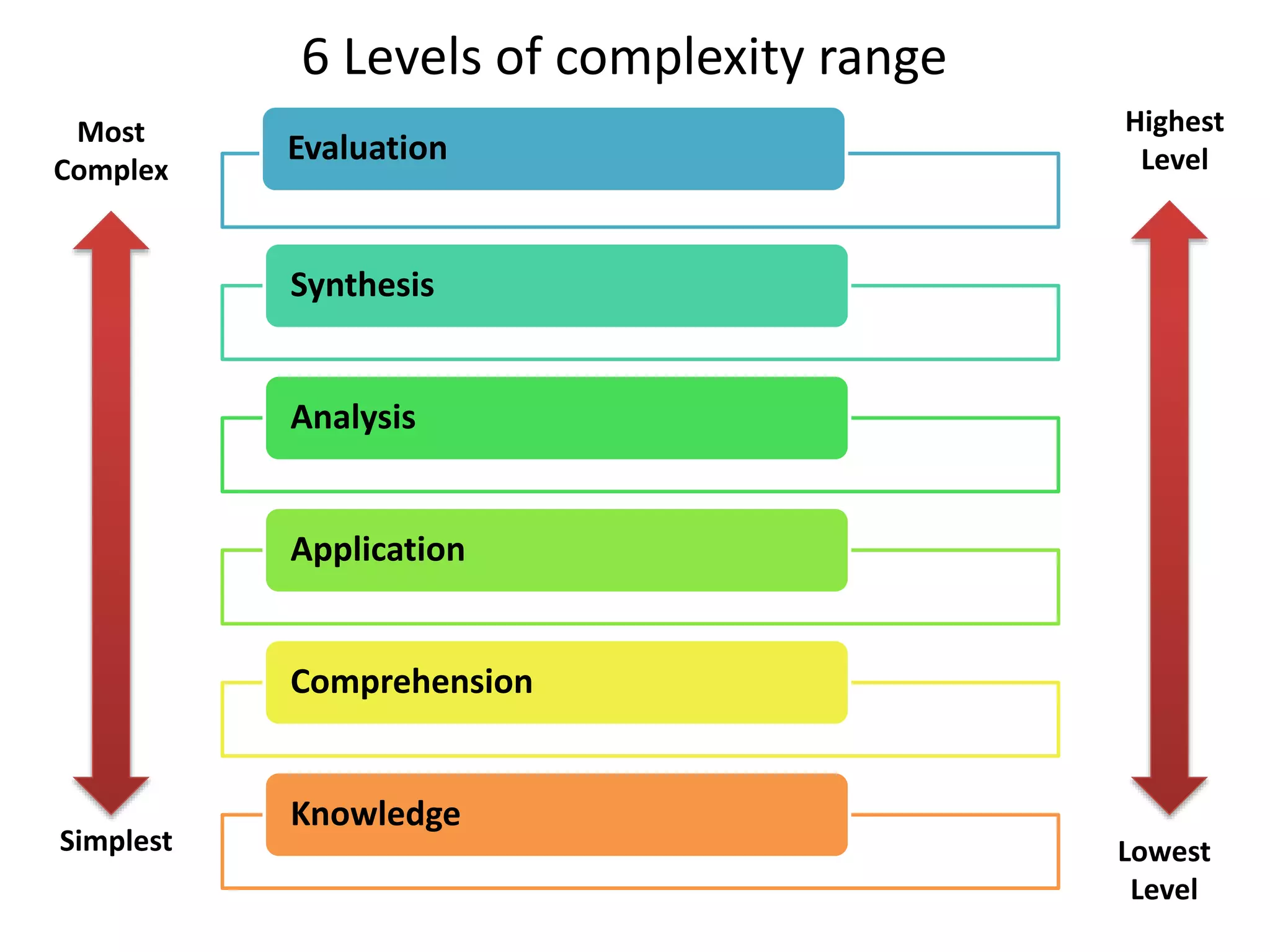
6 Levels of complexity range
Evaluation
Synthesis
Analysis
Application
Comprehension
Knowledge
Simplest
Most
Complex
Lowest
Level
Highest
Level
6 levels of complexity range
1. KNOWLEDGE – involves the recall of specifics and universals, the
recall of methods and processes, or the recall of a pattern, structure or
setting.
Some action verbs that describes learning outcomes at this level are as
follows: Tell List Match
Define Name Label
Identify State Recite
Some Examples of instructional objectives at the
knowledge level are:
1. Tell the most important parts of a flower
2. List the three major food groups.
3. State the setting of the story.
2. COMPREHENSION – refers to a type of understanding such that the individual
can make use of the material or the idea being communicated without necessary
relating to other materials or seeing its fullest implications.
Some action verbs that describe learning outcomes at this
level are as follows:
Explain Rewrite Extend
Estimate Paraphrase Convert
Infer Predict Interpret
Some examples of comprehension objectives are:
1. Explain the process of circulation of the blood.
2. Estimate the cost of production of the book.
3. Predict the ending of the story.
3. ANALYSIS – the breaking up of communication or text into its constituent
elements or parts such that the relative hierarchy of ideas is made clear and/or
the relations between the ideas expressed are made explicit.
Some action verbs that describes learning outcomes at
this level are as follows:
Break down Separate out Subdivide
Differentiate Analyze Select
Distinguish Point out Relate
Some examples of analysis objectives are:
1. Point out the main characters in the story.
2. Distinguish the relevant from irrelevant details in the
passage.
3. Relate the ending of the story to the beginning of the
fable.
4. Application – The use of abstractions which my be technical
principles, ides, and theories in particular and concrete situations.
Some action verbs that describes learning outcomes at this level are as
follow:
Compute Operate Manipulate
Solve Draw Change
Use Demonstrate Employ
Some examples of application objectives are:
1. Compute the rte of interest when given
these facts.
2. Solve 2-step word problem.
3. Draw the parts of the eyes.
5. SYNTHESIS – the putting together of elements and parts to form whole. This
involves the process of working with pieces, parts, elements, etc., and arranging
and combining the constitute a pattern or structure not clearly seen or observed
before.
Some action verbs that describes learning outcomes at this level are as follows:
Compose Formulate Rewrite
Design Reorganize Create
Reconstruction Categorize Classify
Some examples of synthesis objectives at this level are:
1. Rewrite the ending of the story.
2. Compose a haiku about raindrops.
3. Classify animals according to their habitat.
6. EVAUATION –the judgements about the value of the
material and methods for given purposes. Evaluation
involves quantitative and qualitative judgements about
the extent to which materials and methods satisfy
criteria.
Some action verbs that describes learning outcomes at this level are as
follows:
Appraise Criticize Judge
Compare Defend Conclude
Contrast Justify Support
Some examples of evaluation objectives at this level are:
1. Justify the use of parables in the President’s
speech.
2. Judge the worth of the literary piece according to
the criteria previously discussed.
3. Compare the economic conditions of the country
during the Spanish regime and the New republic.
B. Affective Domain
- describes instructional
objectives that reflect
feelings, emotions, and
values.
Taxonomy of educational objectives
for affective domain
Receiving
Responding
Valuing
Organization
Characterization by values or Value - Complex
1. Receiving
At this level, the concern is for the learners to be sensitive to the
existence of certain phenomena and stimuli, that is, he is willing to
receive or attend to them.
 3 category of receiving
Awareness – learners is conscious of something that accounts
for situation, phenomenon, object, or state of affairs.
Willingness to receive – the behavior is willingness to tolerate a
given stimulus, not to avoid it.
Controlled or Selected attention – the learners
controls the attention so that the favored
stimulus is selected and attended to, despite
competing and distracting stimuli.
2. Responding
At this level, the concern is with responses that
go beyond merely attending to the
phenomenon. One is doing something with the
phenomenon besides merely perceiving it.
3. Valuing
Behavior categorized at this level is consistent and stable to have taken on
the characteristics of a belief or an attitude.
4. Organization
Is intended as the proper classification for objectives that describe
the beginnings of the building of a value system.
5. Characterization by Value or Value – Complex
At this level of internalization, the values already have
a place in the individual's values hierarchy. They are
organized into some kind of internally consistent
system which controls the behavior of the
individual.
3. Psychomotor Domain
• Involve reflex, basic, perceptual, skilled, and
non-discursive (non-verbal) communication. This
domain includes basic movements such as
walking, running, jumping, and skilled movements
related to dances, sports, and other
performing arts.
• It involves abilities that can be
directly observed.
Taxonomy for Psychomotor Domain
1. PERCEPTION – It is the process of becoming aware of objects,
qualities, or relations by using the sense organs.
2. SET – it is a preparatory adjustment of readiness for particular kind of
action in experience.
3. GUIDED RESPONSE – is the overt behavioral act of an individual under
the guidance of an instructor or in response to self – evaluation where
the student has a model or criteria with which to judge personal
performance.
4. MECHANISM – at this level, the student has
achieved a certain confidence and degree of
proficiency in the performance of the act.
5. COMPLEX OVERT RESPONSE – at this level, the
individual can perform a motor act. Skill has been
attained.
6. ADAPTATION – at this level, motor activities are
altered to meet the demands of a new problematic
situation requiring physical response.
7. ORIGINATION – involves in creating new motor acts or ways of
manipulating materials based on understandings, abilities, and skills
developed in the psychomotor are.
CRITERIA OF SELECTING APPROPRIATE OBJECTIVES
1. Objectives should include all important outcomes of the course or
subject matter.
2. The objectives should be in harmony with the content
standards of the state and with the general goals of the
school.
3. The objectives should be in harmony with
the sound principles of learning.
4. The objectives should be realistic in terms of
the abilities of the students, time and the
available facilities.
CLEAR STATEMENT OF INSTRUCTIONAL OBJECTIVES
First, state the general objectives of instruction as intended learning
outcomes.
Second, list under each objective a sample of the specific types of
performance that the students should be able to demonstrate when
they have achieved the objective.
Example: Understands the scientific principles
a. Describes the principle in their own words.
b. Identifies examples of the principle.
c. States reasonable hypotheses based on the
principle.
d. Uses the principle n solving problem.
e. Distinguishes between two given principles.
f. Explains the relationships between the given
principles.
MATCHING TEST ITEMS TO INSTRUCTIONAL OBJECTIVES
Rules to follow in constructing test items:
1. Always remember that they should
match the instructional objectives.
2. The learning outcomes and
the learning conditions specified
in the test items should match
with the learning outcomes
and conditions stated in the
objectives.
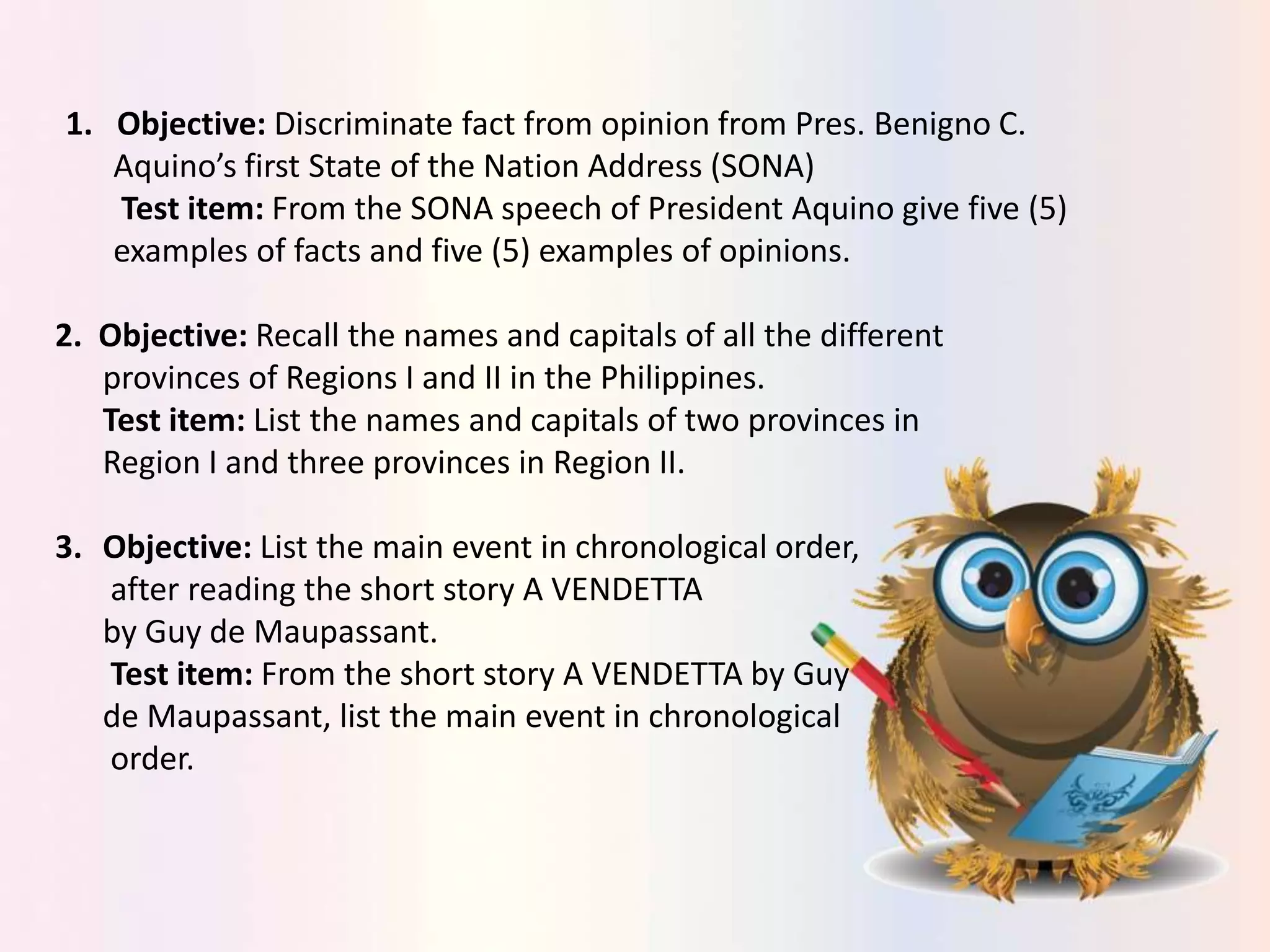
1. Objective: Discriminate fact from opinion from Pres. Benigno C.
Aquino’s first State of the Nation Address (SONA)
Test item: From the SONA speech of President Aquino give five (5)
examples of facts and five (5) examples of opinions.
2. Objective: Recall the names and capitals of all the different
provinces of Regions I and II in the Philippines.
Test item: List the names and capitals of two provinces in
Region I and three provinces in Region II.
3. Objective: List the main event in chronological order,
after reading the short story A VENDETTA
by Guy de Maupassant.
Test item: From the short story A VENDETTA by Guy
de Maupassant, list the main event in chronological
order.
4. Objective: Circle the nouns and pronouns from the given list of
the words.
Test item: Give five examples of pronouns and five examples for
verbs.
5. Objective: Make a freehand drawing about Region II using
your map as a guide.
Test item: Without using your map, draw the map of
Region II.
Thank you!
  

Assessment 1 (Blooms Taxonomy)

  • 1.
  • 2.
    Taxonomy of EducationalObjectives  An instructional objective consists of behavior that specifies a learning outcome.  A classification scheme categorizes a wide range of learning outcome into more manageable clusters that share some common dimensions.  Is a useful guide for developing a comprehensive list of instructional objectives.
  • 3.
  • 4.
    3 Domains A. CognitiveDomain - consists of objectives that relate to mental or thinking processes. Mental activity such as memorizing, reading problem solving, analyzing, synthesizing and drawing conclusion.
  • 5.
    6 Levels ofcomplexity range Evaluation Synthesis Analysis Application Comprehension Knowledge Simplest Most Complex Lowest Level Highest Level
  • 6.
    6 levels ofcomplexity range 1. KNOWLEDGE – involves the recall of specifics and universals, the recall of methods and processes, or the recall of a pattern, structure or setting. Some action verbs that describes learning outcomes at this level are as follows: Tell List Match Define Name Label Identify State Recite Some Examples of instructional objectives at the knowledge level are: 1. Tell the most important parts of a flower 2. List the three major food groups. 3. State the setting of the story.
  • 7.
    2. COMPREHENSION –refers to a type of understanding such that the individual can make use of the material or the idea being communicated without necessary relating to other materials or seeing its fullest implications. Some action verbs that describe learning outcomes at this level are as follows: Explain Rewrite Extend Estimate Paraphrase Convert Infer Predict Interpret
  • 8.
    Some examples ofcomprehension objectives are: 1. Explain the process of circulation of the blood. 2. Estimate the cost of production of the book. 3. Predict the ending of the story. 3. ANALYSIS – the breaking up of communication or text into its constituent elements or parts such that the relative hierarchy of ideas is made clear and/or the relations between the ideas expressed are made explicit. Some action verbs that describes learning outcomes at this level are as follows: Break down Separate out Subdivide Differentiate Analyze Select Distinguish Point out Relate Some examples of analysis objectives are: 1. Point out the main characters in the story. 2. Distinguish the relevant from irrelevant details in the passage. 3. Relate the ending of the story to the beginning of the fable.
  • 9.
    4. Application –The use of abstractions which my be technical principles, ides, and theories in particular and concrete situations. Some action verbs that describes learning outcomes at this level are as follow: Compute Operate Manipulate Solve Draw Change Use Demonstrate Employ Some examples of application objectives are: 1. Compute the rte of interest when given these facts. 2. Solve 2-step word problem. 3. Draw the parts of the eyes.
  • 10.
    5. SYNTHESIS –the putting together of elements and parts to form whole. This involves the process of working with pieces, parts, elements, etc., and arranging and combining the constitute a pattern or structure not clearly seen or observed before. Some action verbs that describes learning outcomes at this level are as follows: Compose Formulate Rewrite Design Reorganize Create Reconstruction Categorize Classify Some examples of synthesis objectives at this level are: 1. Rewrite the ending of the story. 2. Compose a haiku about raindrops. 3. Classify animals according to their habitat. 6. EVAUATION –the judgements about the value of the material and methods for given purposes. Evaluation involves quantitative and qualitative judgements about the extent to which materials and methods satisfy criteria.
  • 11.
    Some action verbsthat describes learning outcomes at this level are as follows: Appraise Criticize Judge Compare Defend Conclude Contrast Justify Support Some examples of evaluation objectives at this level are: 1. Justify the use of parables in the President’s speech. 2. Judge the worth of the literary piece according to the criteria previously discussed. 3. Compare the economic conditions of the country during the Spanish regime and the New republic.
  • 12.
    B. Affective Domain -describes instructional objectives that reflect feelings, emotions, and values.
  • 13.
    Taxonomy of educationalobjectives for affective domain Receiving Responding Valuing Organization Characterization by values or Value - Complex
  • 14.
    1. Receiving At thislevel, the concern is for the learners to be sensitive to the existence of certain phenomena and stimuli, that is, he is willing to receive or attend to them.  3 category of receiving Awareness – learners is conscious of something that accounts for situation, phenomenon, object, or state of affairs. Willingness to receive – the behavior is willingness to tolerate a given stimulus, not to avoid it. Controlled or Selected attention – the learners controls the attention so that the favored stimulus is selected and attended to, despite competing and distracting stimuli. 2. Responding At this level, the concern is with responses that go beyond merely attending to the phenomenon. One is doing something with the phenomenon besides merely perceiving it.
  • 15.
    3. Valuing Behavior categorizedat this level is consistent and stable to have taken on the characteristics of a belief or an attitude. 4. Organization Is intended as the proper classification for objectives that describe the beginnings of the building of a value system. 5. Characterization by Value or Value – Complex At this level of internalization, the values already have a place in the individual's values hierarchy. They are organized into some kind of internally consistent system which controls the behavior of the individual.
  • 16.
    3. Psychomotor Domain •Involve reflex, basic, perceptual, skilled, and non-discursive (non-verbal) communication. This domain includes basic movements such as walking, running, jumping, and skilled movements related to dances, sports, and other performing arts. • It involves abilities that can be directly observed.
  • 17.
    Taxonomy for PsychomotorDomain 1. PERCEPTION – It is the process of becoming aware of objects, qualities, or relations by using the sense organs. 2. SET – it is a preparatory adjustment of readiness for particular kind of action in experience. 3. GUIDED RESPONSE – is the overt behavioral act of an individual under the guidance of an instructor or in response to self – evaluation where the student has a model or criteria with which to judge personal performance. 4. MECHANISM – at this level, the student has achieved a certain confidence and degree of proficiency in the performance of the act. 5. COMPLEX OVERT RESPONSE – at this level, the individual can perform a motor act. Skill has been attained. 6. ADAPTATION – at this level, motor activities are altered to meet the demands of a new problematic situation requiring physical response.
  • 18.
    7. ORIGINATION –involves in creating new motor acts or ways of manipulating materials based on understandings, abilities, and skills developed in the psychomotor are. CRITERIA OF SELECTING APPROPRIATE OBJECTIVES 1. Objectives should include all important outcomes of the course or subject matter. 2. The objectives should be in harmony with the content standards of the state and with the general goals of the school. 3. The objectives should be in harmony with the sound principles of learning. 4. The objectives should be realistic in terms of the abilities of the students, time and the available facilities.
  • 19.
    CLEAR STATEMENT OFINSTRUCTIONAL OBJECTIVES First, state the general objectives of instruction as intended learning outcomes. Second, list under each objective a sample of the specific types of performance that the students should be able to demonstrate when they have achieved the objective. Example: Understands the scientific principles a. Describes the principle in their own words. b. Identifies examples of the principle. c. States reasonable hypotheses based on the principle. d. Uses the principle n solving problem. e. Distinguishes between two given principles. f. Explains the relationships between the given principles.
  • 20.
    MATCHING TEST ITEMSTO INSTRUCTIONAL OBJECTIVES Rules to follow in constructing test items: 1. Always remember that they should match the instructional objectives. 2. The learning outcomes and the learning conditions specified in the test items should match with the learning outcomes and conditions stated in the objectives.
  • 21.
    1. Objective: Discriminatefact from opinion from Pres. Benigno C. Aquino’s first State of the Nation Address (SONA) Test item: From the SONA speech of President Aquino give five (5) examples of facts and five (5) examples of opinions. 2. Objective: Recall the names and capitals of all the different provinces of Regions I and II in the Philippines. Test item: List the names and capitals of two provinces in Region I and three provinces in Region II. 3. Objective: List the main event in chronological order, after reading the short story A VENDETTA by Guy de Maupassant. Test item: From the short story A VENDETTA by Guy de Maupassant, list the main event in chronological order.
  • 22.
    4. Objective: Circlethe nouns and pronouns from the given list of the words. Test item: Give five examples of pronouns and five examples for verbs. 5. Objective: Make a freehand drawing about Region II using your map as a guide. Test item: Without using your map, draw the map of Region II.
  • 23.