Nervous System Pathology
Prepared and presented by
Marc Imhotep Cray, M.D.
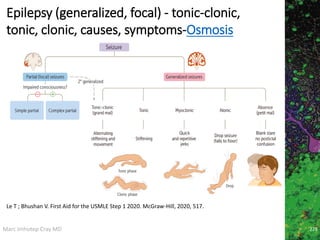
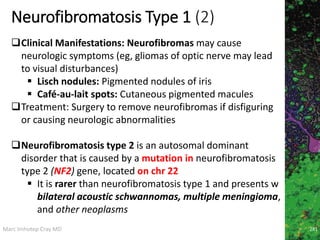
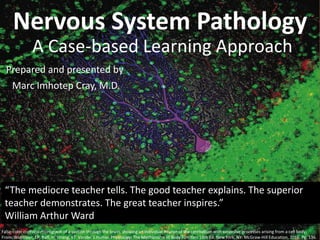
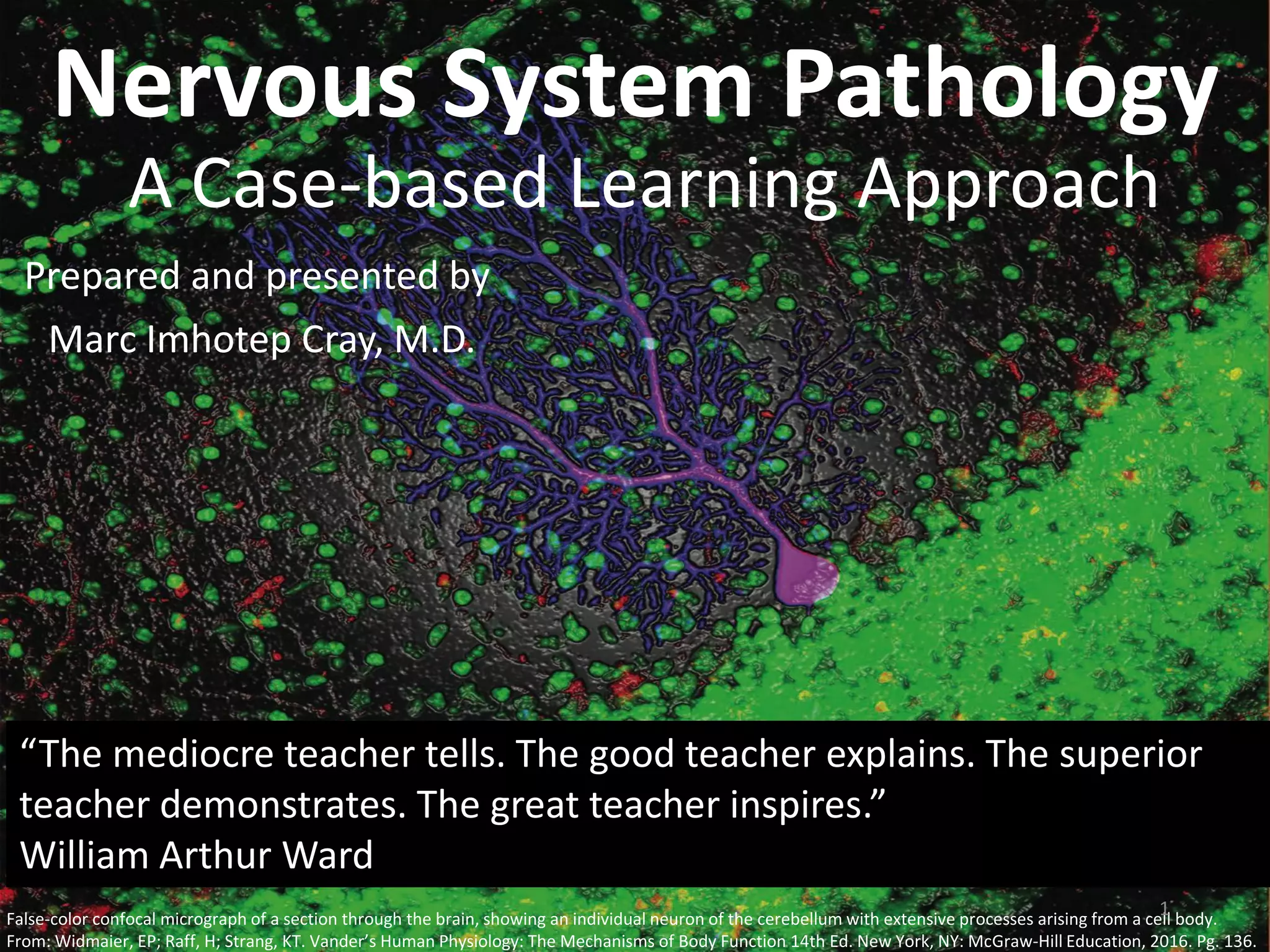
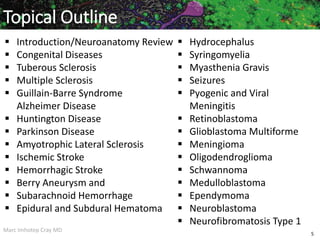
False-color confocal micrograph of a section through the brain, showing an individual neuron of the cerebellum with extensive processes arising from a cell body.
From: Widmaier, EP; Raff, H; Strang, KT. Vander’s Human Physiology: The Mechanisms of Body Function 14th Ed. New York, NY: McGraw-Hill Education, 2016. Pg. 136.
A Case-based Learning Approach
“The mediocre teacher tells. The good teacher explains. The superior
teacher demonstrates. The great teacher inspires.”
William Arthur Ward
1
Marc Imhotep Cray MD
Learning Outcomes
1. Describe the pathological characteristics of epidural,
subdural and subarachnoid hemorrhages
2. Describe CNS aneurysms. List their types, causes and
effects
3. Describe the morphology and pathogenesis of brain
infarction.
4. Give a list of demyelination diseases of the nervous system
5. Describe the etiology and pathological findings of multiple
sclerosis
6. List neurodegenerative diseases of the nervous system and
explain their pathogenesis
7. Describe the pathogenesis and pathological findings of
Alzheimer's disease
By the end of this series the learner should be able to:
2
Marc Imhotep Cray MD
Learning Outcomes cont’ed.
8. Classify CNS & PNS neoplasms
9. Describe the morphological features of the common
intracranial neoplasms
10. Describe the pathological effects of CNS & PNS tumors
11. Discuss the etiology of peripheral neuropathy
12. List the causes and effects of intracranial space occupying
lesions
13. Discuss the pathology of hydrocephalus
14. Describe the pathology of brain abscess
15. Describe the pathological features of encephalitides
By the end of this series the learner should be able to:
3
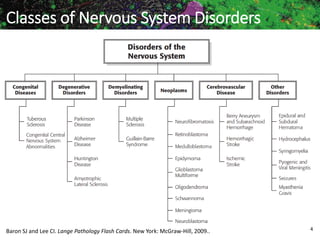
Marc Imhotep Cray MDBaron SJ and Lee CI. Lange Pathology Flash Cards. New York: McGraw-Hill, 2009.. 4
Classes of Nervous System Disorders
Marc Imhotep Cray MD
5
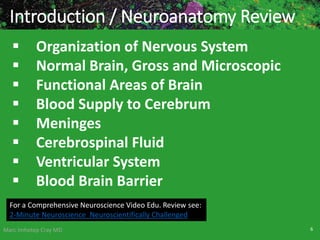
Topical Outline
 Introduction/Neuroanatomy Review
 Congenital Diseases
 Tuberous Sclerosis
 Multiple Sclerosis
 Guillain-Barre Syndrome
Alzheimer Disease
 Huntington Disease
 Parkinson Disease
 Amyotrophic Lateral Sclerosis
 Ischemic Stroke
 Hemorrhagic Stroke
 Berry Aneurysm and
 Subarachnoid Hemorrhage
 Epidural and Subdural Hematoma
 Hydrocephalus
 Syringomyelia
 Myasthenia Gravis
 Seizures
 Pyogenic and Viral
Meningitis
 Retinoblastoma
 Glioblastoma Multiforme
 Meningioma
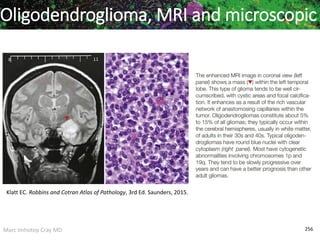
 Oligodendroglioma
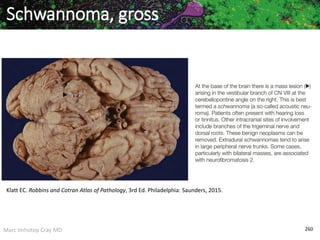
 Schwannoma
 Medulloblastoma
 Ependymoma
 Neuroblastoma
 Neurofibromatosis Type 1
Marc Imhotep Cray MD 6
Introduction / Neuroanatomy Review
 Organization of Nervous System
 Normal Brain, Gross and Microscopic
 Functional Areas of Brain
 Blood Supply to Cerebrum
 Meninges
 Cerebrospinal Fluid
 Ventricular System
 Blood Brain Barrier
For a Comprehensive Neuroscience Video Edu. Review see:
2-Minute Neuroscience_Neuroscientifically Challenged
Marc Imhotep Cray MD 7
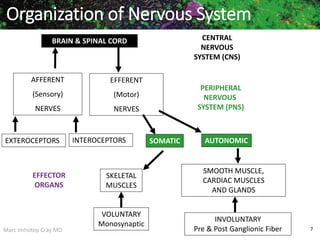
Organization of Nervous System
BRAIN & SPINAL CORD CENTRAL
NERVOUS
SYSTEM (CNS)
PERIPHERAL
NERVOUS
SYSTEM (PNS)
AFFERENT
(Sensory)
NERVES
EFFERENT
(Motor)
NERVES
INTEROCEPTORS SOMATIC AUTONOMIC
EFFECTOR
ORGANS
SKELETAL
MUSCLES
SMOOTH MUSCLE,
CARDIAC MUSCLES
AND GLANDS
VOLUNTARY
Monosynaptic
INVOLUNTARY
Pre & Post Ganglionic Fiber
EXTEROCEPTORS
Marc Imhotep Cray MD 8
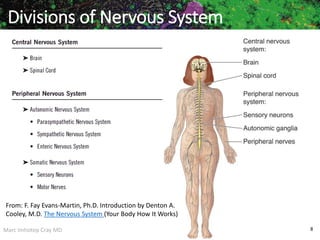
Divisions of Nervous System
From: F. Fay Evans-Martin, Ph.D. Introduction by Denton A.
Cooley, M.D. The Nervous System (Your Body How It Works)
Marc Imhotep Cray MD
Normal Brain,
Gross and Microscopic Follow
9
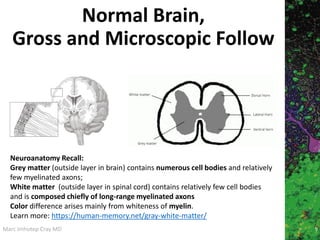
Neuroanatomy Recall:
Grey matter (outside layer in brain) contains numerous cell bodies and relatively
few myelinated axons;
White matter (outside layer in spinal cord) contains relatively few cell bodies
and is composed chiefly of long-range myelinated axons
Color difference arises mainly from whiteness of myelin.
Learn more: https://human-memory.net/gray-white-matter/
Marc Imhotep Cray MD 10
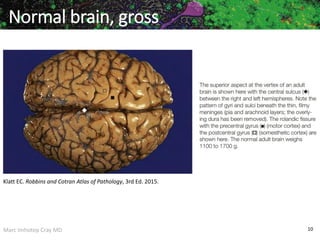
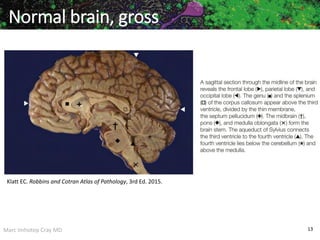
Normal brain, gross
Klatt EC. Robbins and Cotran Atlas of Pathology, 3rd Ed. 2015.
Marc Imhotep Cray MD 11
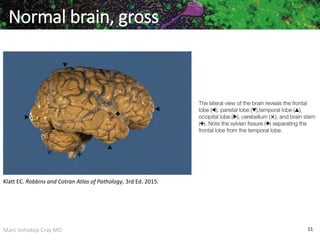
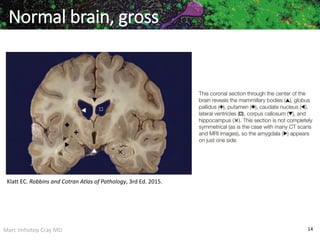
Normal brain, gross
Klatt EC. Robbins and Cotran Atlas of Pathology, 3rd Ed. 2015.
Marc Imhotep Cray MD 12
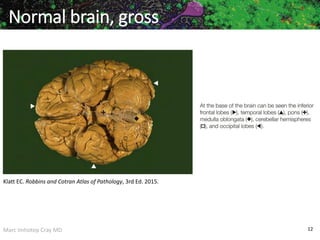
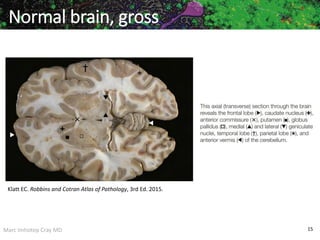
Normal brain, gross
Klatt EC. Robbins and Cotran Atlas of Pathology, 3rd Ed. 2015.
Marc Imhotep Cray MD 13
Normal brain, gross
Klatt EC. Robbins and Cotran Atlas of Pathology, 3rd Ed. 2015.
Marc Imhotep Cray MD 14
Normal brain, gross
Klatt EC. Robbins and Cotran Atlas of Pathology, 3rd Ed. 2015.
Marc Imhotep Cray MD 15
Normal brain, gross
Klatt EC. Robbins and Cotran Atlas of Pathology, 3rd Ed. 2015.
Marc Imhotep Cray MD 16
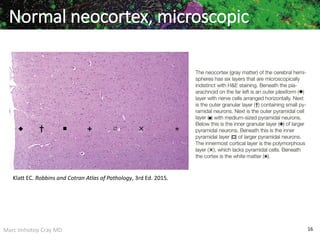
Normal neocortex, microscopic
Klatt EC. Robbins and Cotran Atlas of Pathology, 3rd Ed. 2015.
Marc Imhotep Cray MD 17
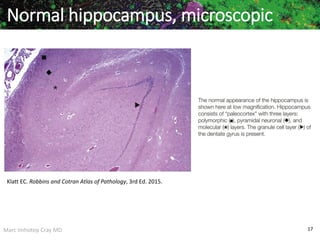
Normal hippocampus, microscopic
Klatt EC. Robbins and Cotran Atlas of Pathology, 3rd Ed. 2015.
Marc Imhotep Cray MD 18
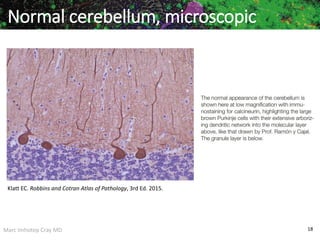
Normal cerebellum, microscopic
Klatt EC. Robbins and Cotran Atlas of Pathology, 3rd Ed. 2015.
Marc Imhotep Cray MD 19
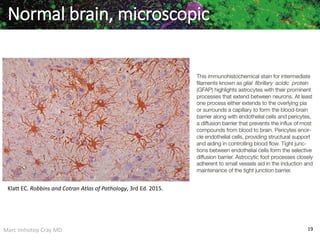
Normal brain, microscopic
Klatt EC. Robbins and Cotran Atlas of Pathology, 3rd Ed. 2015.
Marc Imhotep Cray MD 20
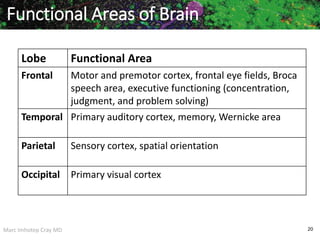
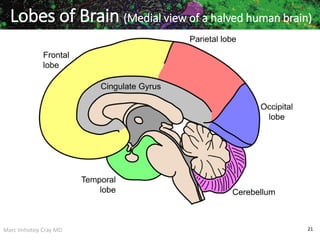
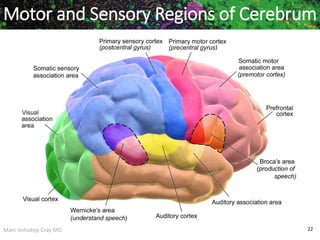
Functional Areas of Brain
Lobe Functional Area
Frontal Motor and premotor cortex, frontal eye fields, Broca
speech area, executive functioning (concentration,
judgment, and problem solving)
Temporal Primary auditory cortex, memory, Wernicke area
Parietal Sensory cortex, spatial orientation
Occipital Primary visual cortex
Marc Imhotep Cray MD 21
Lobes of Brain (Medial view of a halved human brain)
)
Marc Imhotep Cray MD 22
Motor and Sensory Regions of Cerebrum
Marc Imhotep Cray MD 23
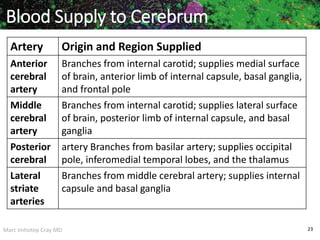
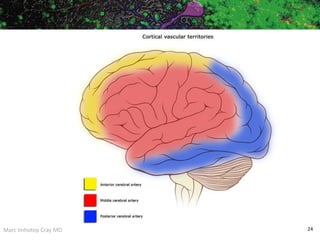
Blood Supply to Cerebrum
Artery Origin and Region Supplied
Anterior
cerebral
artery
Branches from internal carotid; supplies medial surface
of brain, anterior limb of internal capsule, basal ganglia,
and frontal pole
Middle
cerebral
artery
Branches from internal carotid; supplies lateral surface
of brain, posterior limb of internal capsule, and basal
ganglia
Posterior
cerebral
artery Branches from basilar artery; supplies occipital
pole, inferomedial temporal lobes, and the thalamus
Lateral
striate
arteries
Branches from middle cerebral artery; supplies internal
capsule and basal ganglia
Marc Imhotep Cray MD 24
Marc Imhotep Cray MD 25
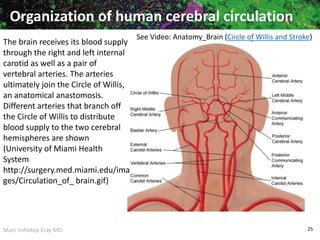
Organization of human cerebral circulation
The brain receives its blood supply
through the right and left internal
carotid as well as a pair of
vertebral arteries. The arteries
ultimately join the Circle of Willis,
an anatomical anastomosis.
Different arteries that branch off
the Circle of Willis to distribute
blood supply to the two cerebral
hemispheres are shown
(University of Miami Health
System
http://surgery.med.miami.edu/ima
ges/Circulation_of_ brain.gif)
See Video: Anatomy_Brain (Circle of Willis and Stroke)
Marc Imhotep Cray MD 26
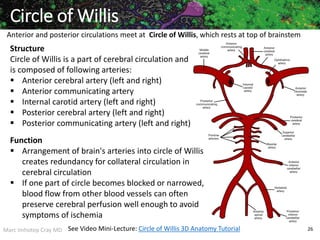
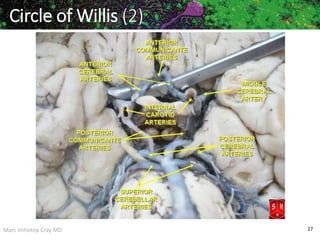
Anterior and posterior circulations meet at Circle of Willis, which rests at top of brainstem
Circle of Willis
Structure
Circle of Willis is a part of cerebral circulation and
is composed of following arteries:
 Anterior cerebral artery (left and right)
 Anterior communicating artery
 Internal carotid artery (left and right)
 Posterior cerebral artery (left and right)
 Posterior communicating artery (left and right)
Function
 Arrangement of brain's arteries into circle of Willis
creates redundancy for collateral circulation in
cerebral circulation
 If one part of circle becomes blocked or narrowed,
blood flow from other blood vessels can often
preserve cerebral perfusion well enough to avoid
symptoms of ischemia
See Video Mini-Lecture: Circle of Willis 3D Anatomy Tutorial
Marc Imhotep Cray MD 27
Circle of Willis (2)
Marc Imhotep Cray MD 28
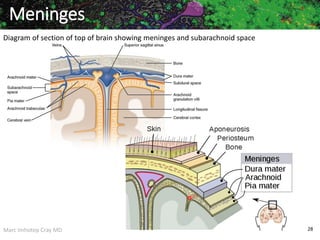
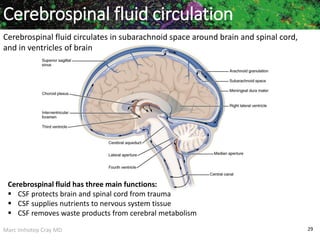
Diagram of section of top of brain showing meninges and subarachnoid space
Meninges
Marc Imhotep Cray MD 29
Cerebrospinal fluid circulates in subarachnoid space around brain and spinal cord,
and in ventricles of brain
Cerebrospinal fluid circulation
Cerebrospinal fluid has three main functions:
 CSF protects brain and spinal cord from trauma
 CSF supplies nutrients to nervous system tissue
 CSF removes waste products from cerebral metabolism
Marc Imhotep Cray MD 30
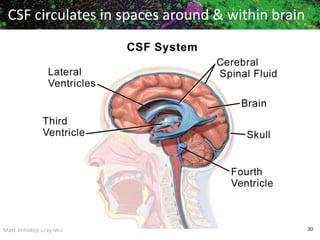
CSF circulates in spaces around & within brain
Marc Imhotep Cray MD 31
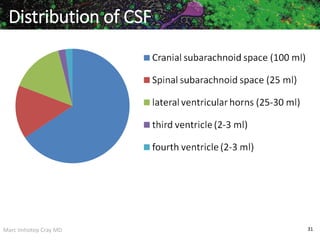
Distribution of CSF
Marc Imhotep Cray MD 32
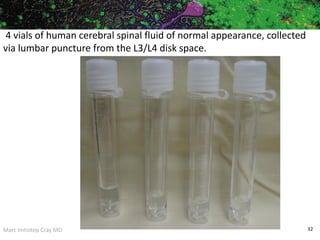
4 vials of human cerebral spinal fluid of normal appearance, collected
via lumbar puncture from the L3/L4 disk space.
Marc Imhotep Cray MD 33
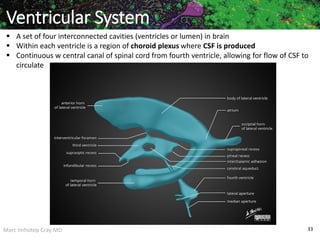
Ventricular System
 A set of four interconnected cavities (ventricles or lumen) in brain
 Within each ventricle is a region of choroid plexus where CSF is produced
 Continuous w central canal of spinal cord from fourth ventricle, allowing for flow of CSF to
circulate
Marc Imhotep Cray MD 34
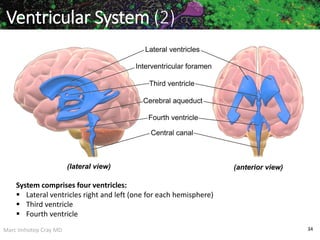
Ventricular System (2)
System comprises four ventricles:
 Lateral ventricles right and left (one for each hemisphere)
 Third ventricle
 Fourth ventricle
Marc Imhotep Cray MD 35
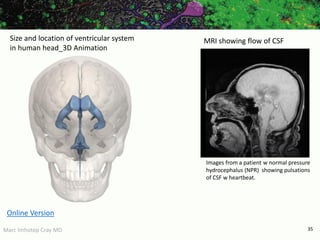
MRI showing flow of CSF
Images from a patient w normal pressure
hydrocephalus (NPR) showing pulsations
of CSF w heartbeat.
Size and location of ventricular system
in human head_3D Animation
Online Version
Marc Imhotep Cray MD 36
2-Minute Neuroscience: The Ventricles
Online Version
Marc Imhotep Cray MD 37
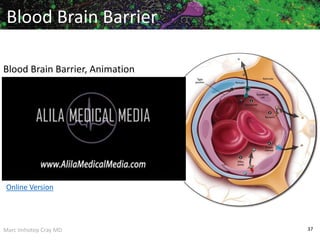
Blood Brain Barrier
Blood Brain Barrier, Animation
Online Version
Marc Imhotep Cray MD 38
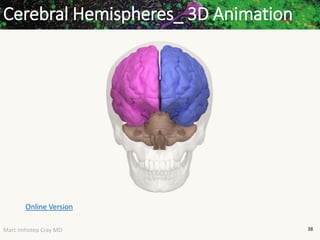
Cerebral Hemispheres_ 3D Animation
Online Version
Marc Imhotep Cray MD
Congenital Diseases
39
Marc Imhotep Cray MD
Vignette 1
40
A baby boy is born via an uncomplicated vaginal delivery. You
notice a large birthmark, associated with dimples and hairy
tufts, at the base of his back. Upon questioning his mother,
you learn that she did not take any prenatal vitamins or
receive prenatal care during her pregnancy. Although the
child initially appears normal, you suggest that the child be
evaluated for a disorder caused by a neural tube defect and
you fear that he may develop autonomic and motor deficits
later in life.
What is the Diagnosis?
Marc Imhotep Cray MD
Congenital CNS Abnormalities
41
Neural Tube Defects
 Etiology: Associated with folate deficiency during initial gestation and
elevated α-fetoprotein
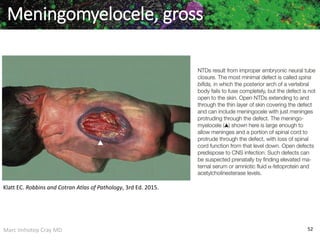
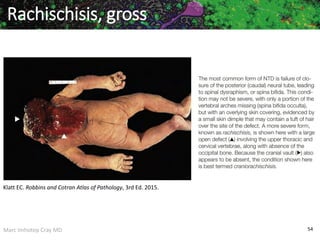
Spina bifida: Failure of posterior end of neural tube to close; results in
vertebral bony defect through which meninges can herniate
(meningocele) or meninges and spinal cord can herniate
(meningomyelocele) resulting in neurologic symptoms; bony defect
may also be asymptomatic until later in life, when neurologic symptoms
appear (spina bifida occulta)
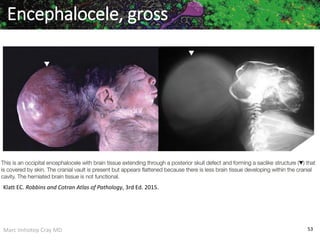
 Encephalocele: Defect in cranium allows for out-pouching of brain
through skull
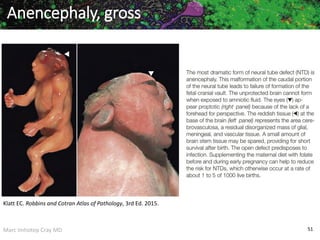
 Anencephaly: Failure of anterior end of neural tube to close; results in
absence of fetal brain and often absence of overlying skull
Marc Imhotep Cray MD
Congenital CNS Abnormalities (2)
42
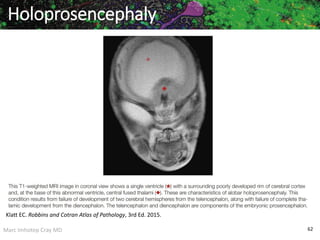
Holoprosencephaly
 Pathology: Failure of embryo’s forebrain to divide into bilateral
cerebral hemispheres, leading to incomplete separation of cerebral
hemispheres
 Clinical Manifestations: Facial and neurological defects
Arnold-Chiari Malformation
 Pathology: Characterized by a small posterior fossa, resulting in
displacement of cerebellum and medulla through foramen magnum
 Clinical manifestations: Hydrocephalus; associated strongly with
thoracolumbar meningomyelocele and syringomyelia
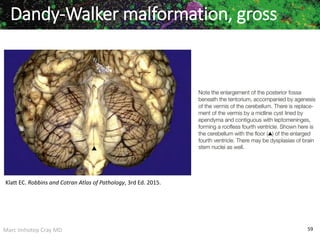
Dandy-Walker Malformation
 Pathology: Characterized by large posterior fossa with replacement
of cerebellar vermis with large cyst; associated with brainstem
nuclei dysplasias
 Clinical Manifestations: Seizures and cerebellar dysfunction
Marc Imhotep Cray MD 43
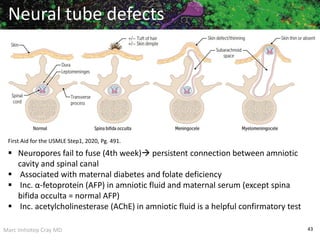
First Aid for the USMLE Step1, 2020, Pg. 491.
Neural tube defects
 Neuropores fail to fuse (4th week) persistent connection between amniotic
cavity and spinal canal
 Associated with maternal diabetes and folate deficiency
 Inc. α-fetoprotein (AFP) in amniotic fluid and maternal serum (except spina
bifida occulta = normal AFP)
 Inc. acetylcholinesterase (AChE) in amniotic fluid is a helpful confirmatory test
Marc Imhotep Cray MD 44
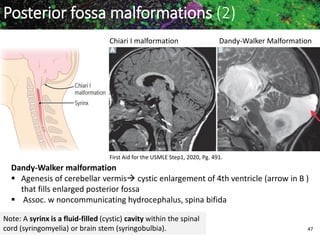
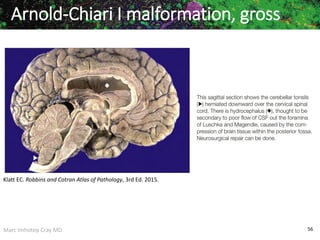
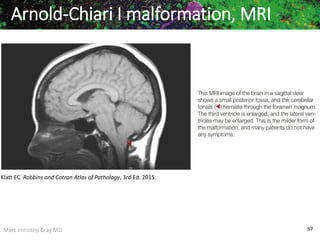
Chiari I malformation
 Ectopia of cerebellar tonsils inferior to foramen magnum (1
structure)
 Congenital, usually asymptomatic in childhood, manifests in
adulthood w headaches and cerebellar symptoms
 Associated w spinal cavitations (eg, syringomyelia)
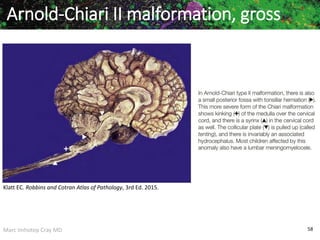
Chiari II malformation
 Herniation of cerebellar vermis and tonsils (2 structures) through
foramen magnum w aqueductal stenosis noncommunicating
hydrocephalus
 Usually assoc. w lumbosacral myelomeningocele (may present as
paralysis/sensory loss at and below level of lesion)
o More severe than Chiari I, usually presents early in life
Posterior fossa malformations
Marc Imhotep Cray MD
Vignette 2
45
A 25-year-old woman presents to your office complaining of
diminished sensation in both arms. Further neurologic
evaluation of her arms reveals that she has diminished pain
and temperature sensation, but that her touch sensation and
proprioception are intact. She demonstrates no other
neurologic deficits. When a MRI reveals cystic dilation in the
center of the cervical spinal cord, you refer her to a
neurosurgeon for treatment of her condition.
What is the Diagnosis?
Marc Imhotep Cray MD
Syringomyelia
46
Etiology: Often assoc. w Arnold-Chiari malformation; also
caused by intraspinal neoplasms or trauma
Pathology:
Spinal cord: Formation of fluid-filled cavity often extending
from central canal usually in cervical region of cord (most
commonly C7-T1) results in destruction of adjacent gray
and white matter (crossing fibers of spinothalamic tract) with
resultant reactive gliosis
Clinical Manifestations: Loss of pain and temperature
sensation of upper extremities usually w preservation of
touch and proprioception; may eventually progress to
involve motor and other sensory tracts
Treatment: Surgical drainage of cavity
Marc Imhotep Cray MD 47
Chiari I malformation Dandy-Walker Malformation
Dandy-Walker malformation
 Agenesis of cerebellar vermis cystic enlargement of 4th ventricle (arrow in B )
that fills enlarged posterior fossa
 Assoc. w noncommunicating hydrocephalus, spina bifida
First Aid for the USMLE Step1, 2020, Pg. 491.
Note: A syrinx is a fluid-filled (cystic) cavity within the spinal
cord (syringomyelia) or brain stem (syringobulbia).
Posterior fossa malformations (2)
Marc Imhotep Cray MD 48
Syringomyelia
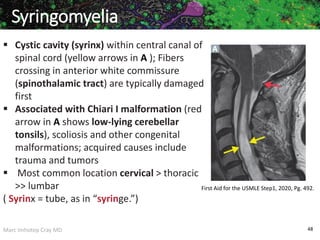
 Cystic cavity (syrinx) within central canal of
spinal cord (yellow arrows in A ); Fibers
crossing in anterior white commissure
(spinothalamic tract) are typically damaged
first
 Associated with Chiari I malformation (red
arrow in A shows low-lying cerebellar
tonsils), scoliosis and other congenital
malformations; acquired causes include
trauma and tumors
 Most common location cervical > thoracic
>> lumbar
( Syrinx = tube, as in “syringe.”)
First Aid for the USMLE Step1, 2020, Pg. 492.
Marc Imhotep Cray MD 49
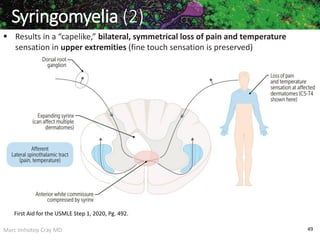
 Results in a “capelike,” bilateral, symmetrical loss of pain and temperature
sensation in upper extremities (fine touch sensation is preserved)
Syringomyelia (2)
First Aid for the USMLE Step 1, 2020, Pg. 492.
Marc Imhotep Cray MD 50
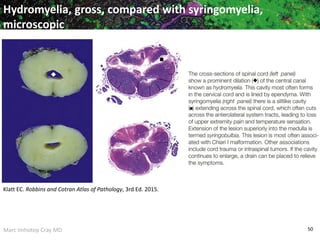
Hydromyelia, gross, compared with syringomyelia,
microscopic
Klatt EC. Robbins and Cotran Atlas of Pathology, 3rd Ed. 2015.
Marc Imhotep Cray MD 51
Klatt EC. Robbins and Cotran Atlas of Pathology, 3rd Ed. 2015.
Anencephaly, gross
Marc Imhotep Cray MD 52
Meningomyelocele, gross
Klatt EC. Robbins and Cotran Atlas of Pathology, 3rd Ed. 2015.
Marc Imhotep Cray MD 53
Encephalocele, gross
Klatt EC. Robbins and Cotran Atlas of Pathology, 3rd Ed. 2015.
Marc Imhotep Cray MD 54
Rachischisis, gross
Klatt EC. Robbins and Cotran Atlas of Pathology, 3rd Ed. 2015.
Marc Imhotep Cray MD 55
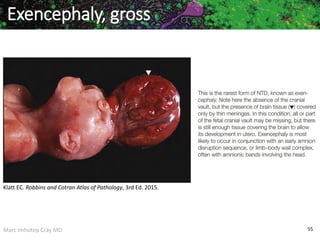
Exencephaly, gross
Klatt EC. Robbins and Cotran Atlas of Pathology, 3rd Ed. 2015.
Marc Imhotep Cray MD 56
Arnold-Chiari I malformation, gross
Klatt EC. Robbins and Cotran Atlas of Pathology, 3rd Ed. 2015.
Marc Imhotep Cray MD 57
Arnold-Chiari I malformation, MRI
Klatt EC. Robbins and Cotran Atlas of Pathology, 3rd Ed. 2015.
Marc Imhotep Cray MD 58
Arnold-Chiari II malformation, gross
Klatt EC. Robbins and Cotran Atlas of Pathology, 3rd Ed. 2015.
Marc Imhotep Cray MD 59
Dandy-Walker malformation, gross
Klatt EC. Robbins and Cotran Atlas of Pathology, 3rd Ed. 2015.
Marc Imhotep Cray MD 60
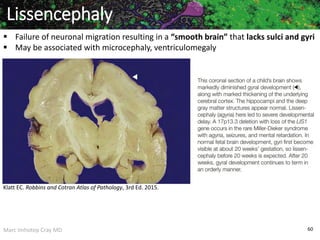
 Failure of neuronal migration resulting in a “smooth brain” that lacks sulci and gyri
 May be associated with microcephaly, ventriculomegaly
Lissencephaly
Klatt EC. Robbins and Cotran Atlas of Pathology, 3rd Ed. 2015.
Marc Imhotep Cray MD 61
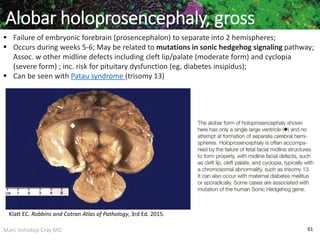
Alobar holoprosencephaly, gross
 Failure of embryonic forebrain (prosencephalon) to separate into 2 hemispheres;
 Occurs during weeks 5-6; May be related to mutations in sonic hedgehog signaling pathway;
Assoc. w other midline defects including cleft lip/palate (moderate form) and cyclopia
(severe form) ; inc. risk for pituitary dysfunction (eg, diabetes insipidus);
 Can be seen with Patau syndrome (trisomy 13)
Klatt EC. Robbins and Cotran Atlas of Pathology, 3rd Ed. 2015.
Marc Imhotep Cray MD 62
Holoprosencephaly
Klatt EC. Robbins and Cotran Atlas of Pathology, 3rd Ed. 2015.
Marc Imhotep Cray MD
Vignette 3
63
A 6-year-old boy presents to your office complaining of red
nodules that have appeared on his face. He is mentally
retarded and has a seizure disorder. His mother suffers from
similar symptoms and has recently been diagnosed with a
rhabdomyoma of the heart and renal angiomyolipomas.
You begin to suspect that this boy is suffering from an
autosomal dominant genetic disorder.
What is the Diagnosis?
Marc Imhotep Cray MD
Tuberous Sclerosis
64
 Etiology: Autosomal dominant disorder resulting from a
mutation in one of several different genes
 Tumor suppressor genes TSC1 on chromosome 9 (hamartin), TSC2
on chromosome 16 (tuberin)
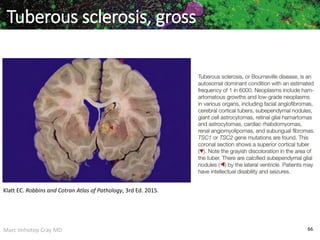
 Pathology: Brain hamartoma (cortical tuber): Firm nodule
located in cerebral cortex composed of disorganized array
of neurons with large vesicular nuclei and eosinophilic
cytoplasm
 Also assoc. w neoplasms occurring outside CNS, including
cardiac rhabdomyomas, adenoma sebaceum of face
(lesion consisting of malformed blood vessels), renal
angiomyolipomas (lesion consisting of malformed blood
vessels, adipocytes, and smooth muscle), and cysts of
bone and lung
Marc Imhotep Cray MD
Tuberous Sclerosis (2)
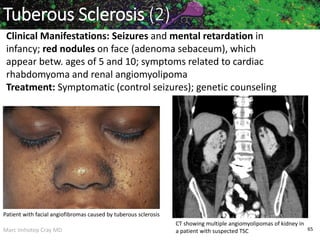
Clinical Manifestations: Seizures and mental retardation in
infancy; red nodules on face (adenoma sebaceum), which
appear betw. ages of 5 and 10; symptoms related to cardiac
rhabdomyoma and renal angiomyolipoma
Treatment: Symptomatic (control seizures); genetic counseling
Patient with facial angiofibromas caused by tuberous sclerosis
CT showing multiple angiomyolipomas of kidney in
a patient with suspected TSC 65
Marc Imhotep Cray MD 66
Klatt EC. Robbins and Cotran Atlas of Pathology, 3rd Ed. 2015.
Tuberous sclerosis, gross
Marc Imhotep Cray MD 67
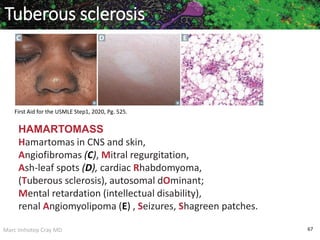
HAMARTOMASS
Hamartomas in CNS and skin,
Angiofibromas (C), Mitral regurgitation,
Ash-leaf spots (D), cardiac Rhabdomyoma,
(Tuberous sclerosis), autosomal dOminant;
Mental retardation (intellectual disability),
renal Angiomyolipoma (E) , Seizures, Shagreen patches.
Tuberous sclerosis
First Aid for the USMLE Step1, 2020, Pg. 525.
Marc Imhotep Cray MD 68
A 1-year-old girl develops seizures, ash-leaf pigmented lesions on
the trunk, sebaceous adenomas, and a shagreen patch (flesh-
colored soft plaque) on her lumbosacral region.
What is the diagnosis?
Check Up
A 40-year-old woman complains of occipital headaches,
weakness/numbness in her hands and feet, and has downbeat
nystagmus on physical examination. An MRI shows tonsillar
herniation below the foramen magnum.
What is the diagnosis?
Marc Imhotep Cray MD
Degenerative Disorders
69
Marc Imhotep Cray MD
CNS Neurodegenerative diseases
70
Neurodegenerative diseases of CNS include:
 Parkinson’s disease
 Huntington disease
 Alzheimer’s disease
 Multiple Sclerosis (MS)
 Amyotrophic Lateral Sclerosis (ALS)
These devastating illnesses are characterized by
progressive loss of selected neurons in discrete brain
areas, resulting in characteristic disorders of movement,
cognition, or both
Marc Imhotep Cray MD
Basal Nuclei (Ganglia)
71
Components
 Caudate nucleus
 Putamen
 Globus pallidus
Grouping of the Basal Nuclei (Ganglia)
 The striatum consists of caudate nucleus and putamen
 The lentiform nucleus consists of globus pallidus and
putamen
 The corpus striatum consists of lentiform nucleus and
caudate nucleus
NB: Basal Nuclei The term basal ganglia is a misnomer. The cells forming
these structures are not “ganglia”—a term reserved to describe aggregations
of neuronal cell bodies[somata] (groups of nerve cell bodies ) in the peripheral
nervous system—but “nuclei” in the central nervous system.
Marc Imhotep Cray MD
Vignette 4
72
A 78-year-old woman is brought to your clinic by her son and
daughter. They tell you that she has been very forgetful lately
and has twice wandered out of her house and gotten lost,
requiring the police to bring her back. Upon speaking with the
woman, you note that her short-term memory is compromised
and that she has trouble finding the words to express what she
wants to say. An MRI of the brain does not reveal any evidence
of a stroke. You suspect that a biopsy of this woman’s brain
would reveal neuritic plaques and neurofibrillary tangles.
What is the Diagnosis?
Marc Imhotep Cray MD
Dementia
Dementia is a progressive global decline in
intellectual capacity that occurs with increasing
frequency with advancing age
Two most commonly encountered forms are
 Alzheimer’s disease (AD) (sometimes familial)
and
 Vascular (multi-infarct) dementia (VaD)
 Less common dementias are Huntington’s
disease (an inherited condition) and Pick’s disease
73
Marc Imhotep Cray MD
Alzheimer disease
74
Etiology and Epidemiology: Etiology unknown, but theories
involve abnormal expression of amyloid gene resulting in
increased amyloid beta (Aβ protein), deficiency of choline
acetyltransferase leading to decreased acetylcholine
levels, or atrophy of nucleus basalis of Meynert
 Familial Alzheimer disease involves
o mutations in amyloid precursor protein (APP) gene
on chr 21,
o mutations in presenilin genes (chr 1,14), and
o Ɛ 4 allele of apolipoprotein E (chr 19)
 Affects 50% of people > 85 years old
NB: Lewy body dementia, also known as dementia w Lewy bodies, is
second most common type of progressive dementia after AD dementia.
Protein deposits, called Lewy bodies, develop in nerve cells in brain
regions involved in thinking, memory and movement (motor control).
Marc Imhotep Cray MD
Alzheimer disease (2)
75
 Pathology
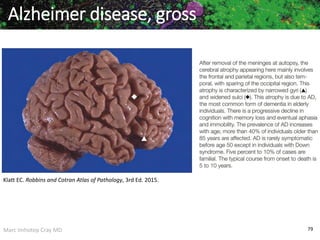
 Gross: Cortical atrophy of brain with widening of sulci
and ventricles
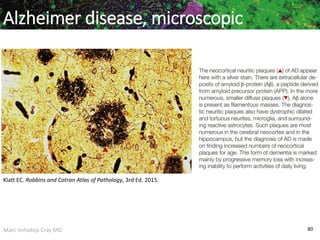
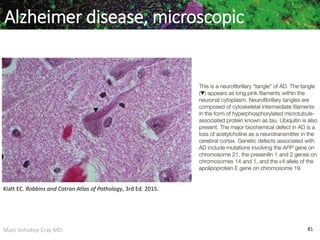
 Microscopic: Neurofibrillary tangles composed of tau
protein within cytoplasm that displace nucleus; neuritic
plaques (spherical cluster with Aβ protein core and
peripheral astrocytes); amyloid angiopathy; Hirano
bodies (eosinophilic bodies in hippocampal cells);
granulovacuolar degeneration (cytoplasmic vacuoles in
hippocampal cells)
NB: The hippocampus is area of brain demonstrating greatest
degree of atrophy in Alzheimer's disease Hippocampal
atrophy on MRI is highly suggestive of the diagnosis
Marc Imhotep Cray MD 76
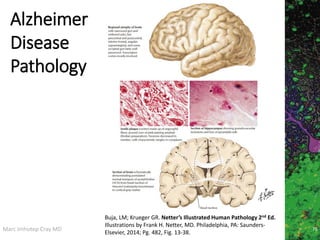
Alzheimer
Disease
Pathology
Buja, LM; Krueger GR. Netter’s Illustrated Human Pathology 2nd Ed.
Illustrations by Frank H. Netter, MD. Philadelphia, PA: Saunders-
Elsevier, 2014; Pg. 482, Fig. 13-38.
Marc Imhotep Cray MD
Alzheimer disease (3)
77
Clinical Manifestations: Dementia presenting with
progressive memory disturbances, disorientation, aphasias,
visuospatial deficits, loss of motor skills or incontinence
 Initial symptoms: Impairments involving recent memory
 Treatment and Prognosis
 Donepezil (acetylcholinesterase inhibitor) to slow
progression
 Progressive disease with no cure
Note: Pick disease also causes dementia, but tends to affect
women more than men
 Histopathologically, characterized by cortical atrophy of
frontotemporal lobes and Pick bodies (cytoplasmic inclusion bodies
made of neurofilaments)
 Initial symptoms: personality & behavioral changes (apathy, socially
inappropriate behavior)
Marc Imhotep Cray MD 78
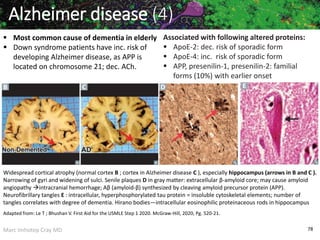
Widespread cortical atrophy (normal cortex B ; cortex in Alzheimer disease C ), especially hippocampus (arrows in B and C ).
Narrowing of gyri and widening of sulci. Senile plaques D in gray matter: extracellular β-amyloid core; may cause amyloid
angiopathy intracranial hemorrhage; Aβ (amyloid-β) synthesized by cleaving amyloid precursor protein (APP).
Neurofibrillary tangles E : intracellular, hyperphosphorylated tau protein = insoluble cytoskeletal elements; number of
tangles correlates with degree of dementia. Hirano bodies—intracellular eosinophilic proteinaceous rods in hippocampus
 Most common cause of dementia in elderly
 Down syndrome patients have inc. risk of
developing Alzheimer disease, as APP is
located on chromosome 21; dec. ACh.
Alzheimer disease (4)
Associated with following altered proteins:
 ApoE-2: dec. risk of sporadic form
 ApoE-4: inc. risk of sporadic form
 APP, presenilin-1, presenilin-2: familial
forms (10%) with earlier onset
Adapted from: Le T ; Bhushan V. First Aid for the USMLE Step 1 2020. McGraw-Hill, 2020, Pg. 520-21.
Marc Imhotep Cray MD 79
Alzheimer disease, gross
Klatt EC. Robbins and Cotran Atlas of Pathology, 3rd Ed. 2015.
Marc Imhotep Cray MD 80
Alzheimer disease, microscopic
Klatt EC. Robbins and Cotran Atlas of Pathology, 3rd Ed. 2015.
Marc Imhotep Cray MD 81
Alzheimer disease, microscopic
Klatt EC. Robbins and Cotran Atlas of Pathology, 3rd Ed. 2015.
Marc Imhotep Cray MD 82
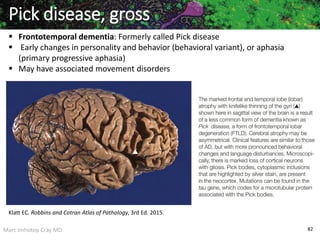
Pick disease, gross
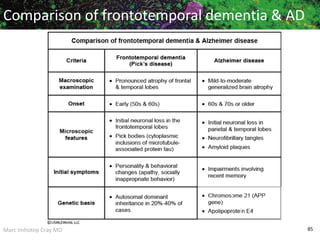
 Frontotemporal dementia: Formerly called Pick disease
 Early changes in personality and behavior (behavioral variant), or aphasia
(primary progressive aphasia)
 May have associated movement disorders
Klatt EC. Robbins and Cotran Atlas of Pathology, 3rd Ed. 2015.
Marc Imhotep Cray MD 83
Q&A Check-Up
A 54-year-old man is brought to the physician by his daughter. She says that her
father has been acting strangely over the past 2 years. He makes inappropriate
sexual jokes, has little regard for social rules, is often irritable, and is borderline
aggressive at times. The patient denies that his personality is any different from
normal. When speaking with the patient, the physician notices that he has minimal
verbal output and repeats "it is what it is" when asked questions about his strange
behavior. On physical examination, he appears unkempt but otherwise has no
significant findings. This patient most likely has a condition involving which of the
following?
A. Caudate nucleus
B. Frontal cortex
C. Hippocampus
D. Parietal cortex
E. Substantia nigra
F. Subthalamic nucleus
Marc Imhotep Cray MD 84
Answer
Important structures in the frontal lobe include the motor cortex, Broca's speech
area, frontal eye fields, and the prefrontal cortex. Lesions involving the prefrontal
cortex cause inappropriate behavior, impaired judgment, and poor problem-solving
skills (executive dysfunction). Incontinence and gait disturbances may also be seen.
Frontotemporal dementia (Pick's disease) is characterized by degeneration of the
frontal lobes that eventually progresses to include the temporal lobes.
Characteristic symptoms include early personality and behavioral changes (eg,
disinhibition, apathy, social inappropriateness, compulsive behaviors) and altered
speech patterns (eg, paucity of speech, repeated phrases). Neurocognitive deficits
occur later in the course of the illness.
When evaluating a patient with dementia, frontotemporal dementia should be
differentiated from the more common Alzheimer disease, which presents initially
with impairment involving recent memory.
Source: UWorld Step 1, 2015. Neurology/Pathology Q#40
Marc Imhotep Cray MD 85
Comparison of frontotemporal dementia & AD
Marc Imhotep Cray MD
Vignette 5
86
A 48-year-old man presents to your clinic complaining of
involuntary movements of his arms and legs. He tells you that
his mother had similar symptoms, which eventually
progressed to dementia. Physical examination and history
reveal involuntary jerky movements, flattened affect, and
poor concentration. When an MRI of the brain demonstrates
atrophy of the caudate nucleus and putamen as well as
dilatation of the ventricles, you fear that this patient will
eventually succumb to the same dementia as his mother.
What is the Diagnosis?
Marc Imhotep Cray MD
Huntington Disease
87
Etiology: Autosomal dominant disorder associated with
increased number of CAG repeats in Huntington disease
gene on chr 4
Pathology
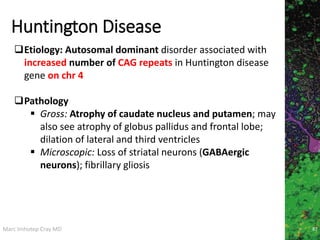
 Gross: Atrophy of caudate nucleus and putamen; may
also see atrophy of globus pallidus and frontal lobe;
dilation of lateral and third ventricles
 Microscopic: Loss of striatal neurons (GABAergic
neurons); fibrillary gliosis
Marc Imhotep Cray MD
Huntington Disease (2)
88
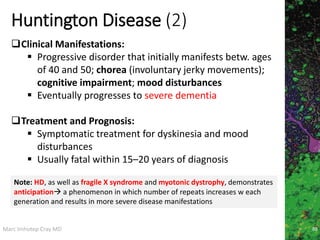
Clinical Manifestations:
 Progressive disorder that initially manifests betw. ages
of 40 and 50; chorea (involuntary jerky movements);
cognitive impairment; mood disturbances
 Eventually progresses to severe dementia
Treatment and Prognosis:
 Symptomatic treatment for dyskinesia and mood
disturbances
 Usually fatal within 15–20 years of diagnosis
Note: HD, as well as fragile X syndrome and myotonic dystrophy, demonstrates
anticipation a phenomenon in which number of repeats increases w each
generation and results in more severe disease manifestations
Marc Imhotep Cray MD 89
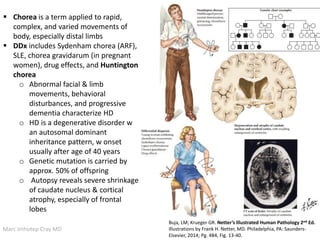
Buja, LM; Krueger GR. Netter’s Illustrated Human Pathology 2nd Ed.
Illustrations by Frank H. Netter, MD. Philadelphia, PA: Saunders-
Elsevier, 2014; Pg. 484, Fig. 13-40.
 Chorea is a term applied to rapid,
complex, and varied movements of
body, especially distal limbs
 DDx includes Sydenham chorea (ARF),
SLE, chorea gravidarum (in pregnant
women), drug effects, and Huntington
chorea
o Abnormal facial & limb
movements, behavioral
disturbances, and progressive
dementia characterize HD
o HD is a degenerative disorder w
an autosomal dominant
inheritance pattern, w onset
usually after age of 40 years
o Genetic mutation is carried by
approx. 50% of offspring
o Autopsy reveals severe shrinkage
of caudate nucleus & cortical
atrophy, especially of frontal
lobes
Marc Imhotep Cray MD 90
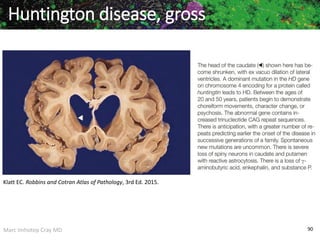
Huntington disease, gross
Klatt EC. Robbins and Cotran Atlas of Pathology, 3rd Ed. 2015.
Marc Imhotep Cray MD
Vignette 6
91
A 64-year-old man presents to your neurology clinic
complaining of unsteadiness. As you obtain a history from
this patient, you notice that he has expressionless facies
and a pill-rolling tremor at rest. Physical examination reveals
a shuffling gait, rigidity in response to passive movement,
and bradykinesia. You suspect that the neurons of his
substantia nigra may contain Lewy bodies and you prescribe
levodopa to treat his symptoms.
What is the Diagnosis?
Marc Imhotep Cray MD
Parkinson Disease
92
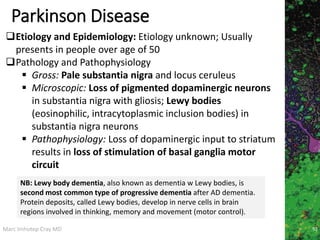
Etiology and Epidemiology: Etiology unknown; Usually
presents in people over age of 50
Pathology and Pathophysiology
 Gross: Pale substantia nigra and locus ceruleus
 Microscopic: Loss of pigmented dopaminergic neurons
in substantia nigra with gliosis; Lewy bodies
(eosinophilic, intracytoplasmic inclusion bodies) in
substantia nigra neurons
 Pathophysiology: Loss of dopaminergic input to striatum
results in loss of stimulation of basal ganglia motor
circuit
NB: Lewy body dementia, also known as dementia w Lewy bodies, is
second most common type of progressive dementia after AD dementia.
Protein deposits, called Lewy bodies, develop in nerve cells in brain
regions involved in thinking, memory and movement (motor control).
Marc Imhotep Cray MD 93
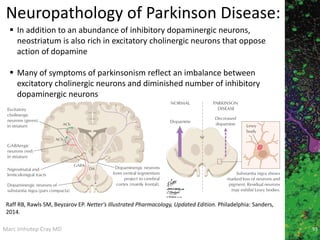
Neuropathology of Parkinson Disease:
 In addition to an abundance of inhibitory dopaminergic neurons,
neostriatum is also rich in excitatory cholinergic neurons that oppose
action of dopamine
 Many of symptoms of parkinsonism reflect an imbalance between
excitatory cholinergic neurons and diminished number of inhibitory
dopaminergic neurons
Raff RB, Rawls SM, Beyzarov EP. Netter's Illustrated Pharmacology, Updated Edition. Philadelphia: Sanders,
2014.
Marc Imhotep Cray MD
Parkinson Disease
94
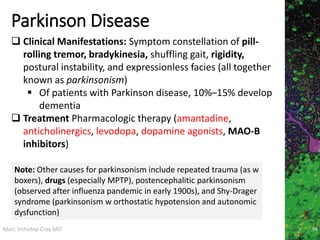
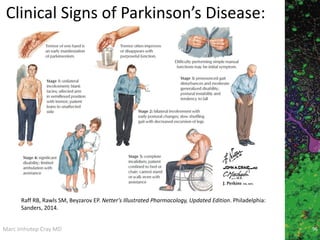
 Clinical Manifestations: Symptom constellation of pill-
rolling tremor, bradykinesia, shuffling gait, rigidity,
postural instability, and expressionless facies (all together
known as parkinsonism)
 Of patients with Parkinson disease, 10%–15% develop
dementia
 Treatment Pharmacologic therapy (amantadine,
anticholinergics, levodopa, dopamine agonists, MAO-B
inhibitors)
Note: Other causes for parkinsonism include repeated trauma (as w
boxers), drugs (especially MPTP), postencephalitic parkinsonism
(observed after influenza pandemic in early 1900s), and Shy-Drager
syndrome (parkinsonism w orthostatic hypotension and autonomic
dysfunction)
Marc Imhotep Cray MD
Parkinsonism: Symptoms and Defect
95
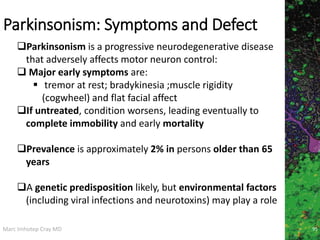
Parkinsonism is a progressive neurodegenerative disease
that adversely affects motor neuron control:
 Major early symptoms are:
 tremor at rest; bradykinesia ;muscle rigidity
(cogwheel) and flat facial affect
If untreated, condition worsens, leading eventually to
complete immobility and early mortality
Prevalence is approximately 2% in persons older than 65
years
A genetic predisposition likely, but environmental factors
(including viral infections and neurotoxins) may play a role
Marc Imhotep Cray MD 96
Clinical Signs of Parkinson’s Disease:
Raff RB, Rawls SM, Beyzarov EP. Netter's Illustrated Pharmacology, Updated Edition. Philadelphia:
Sanders, 2014.
Marc Imhotep Cray MD 97
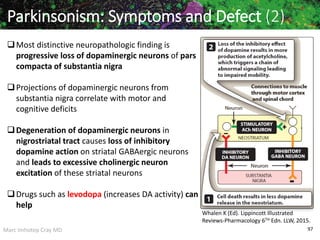
Parkinsonism: Symptoms and Defect (2)
Most distinctive neuropathologic finding is
progressive loss of dopaminergic neurons of pars
compacta of substantia nigra
Projections of dopaminergic neurons from
substantia nigra correlate with motor and
cognitive deficits
Degeneration of dopaminergic neurons in
nigrostriatal tract causes loss of inhibitory
dopamine action on striatal GABAergic neurons
and leads to excessive cholinergic neuron
excitation of these striatal neurons
Drugs such as levodopa (increases DA activity) can
help
Whalen K (Ed). Lippincott Illustrated
Reviews-Pharmacology 6TH Edn. LLW, 2015.
Marc Imhotep Cray MD
Vignette 7
98
A 47-year-old man presents to your clinic complaining of
weakness in his hands. He states that he has been frequently
dropping objects and is unable to perform fine motor tasks.
Physical examination reveals a positive Babinski sign,
hyperreflexia, atrophy, diminished strength in the muscles of
the hands and calves, and fasciculations. You fear that this
patient has a progressive condition, which will ultimately
result in his death from respiratory failure in the near future.
What is the Diagnosis?
Marc Imhotep Cray MD
Amyotrophic Lateral Sclerosis
99
 Etiology and Epidemiology: Etiology of sporadic ALS
unknown; 5%–10% of cases are familial with autosomal
dominant inheritance of a defect on chr 21 or w a defect in
SOD-1 (gene product involved in scavenging free radicals);
Most commonly affects men over age of 40
 Pathology: Progressive disease assoc. w loss of both upper
and lower motor neurons
 Spinal cord: Reduced number of anterior horn neurons
w reactive gliosis; degeneration of corticospinal tract
neurons
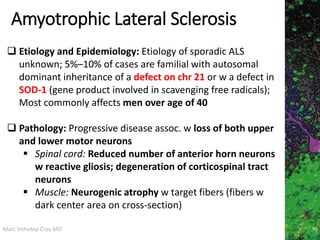
 Muscle: Neurogenic atrophy w target fibers (fibers w
dark center area on cross-section)
Marc Imhotep Cray MD
ALS (2)
100
Clinical Manifestations:
 Lower motor neuron signs: Atrophy of muscles; fasciculations
 Upper motor neuron signs: Hyperreflexia; positive Babinski sign;
spasticity
 Lower and upper motor neuron degeneration tends to present
initially with weakness of hands or cramping and spasticity of arms
and legs
 Involvement of respiratory muscles leads to lung infections and
eventually death
 Treatment and Prognosis:
 Supportive care
 Death from respiratory failure usually occurs within 5 years of
diagnosis
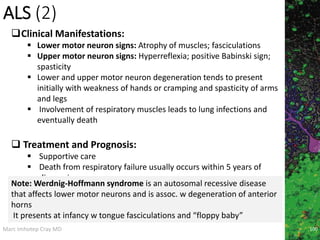
Note: Werdnig-Hoffmann syndrome is an autosomal recessive disease
that affects lower motor neurons and is assoc. w degeneration of anterior
horns
It presents at infancy w tongue fasciculations and “floppy baby”
Marc Imhotep Cray MD 101
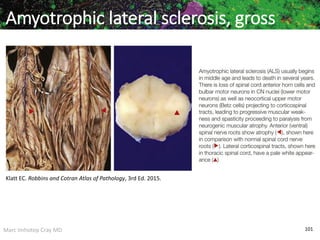
Amyotrophic lateral sclerosis, gross
Klatt EC. Robbins and Cotran Atlas of Pathology, 3rd Ed. 2015.
Marc Imhotep Cray MD 102
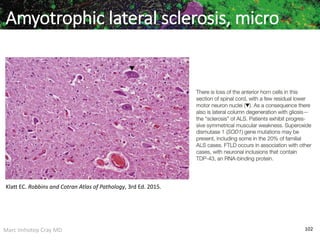
Amyotrophic lateral sclerosis, micro
Klatt EC. Robbins and Cotran Atlas of Pathology, 3rd Ed. 2015.
Marc Imhotep Cray MD
Demyelinating Disorders
103
Marc Imhotep Cray MD
Vignette 8
104
A 27-year-old Caucasian woman presents to your office
complaining of visual disturbances. During physical
examination, you note that on lateral gaze, one eye does not
adduct and the other eye has nystagmus on abduction.
Testing of cerebellar function reveals an intention tremor and
you also note decreased sensation on both legs. You obtain
CSF fluid via a lumbar puncture and find multiple oligoclonal
bands of IgG on electrophoresis. You order an MRI of the
brain and refer the patient to a neurologist for further care of
her condition.
What is the Diagnosis?
Marc Imhotep Cray MD
Multiple Sclerosis
105
Etiology and Epidemiology: Etiology unknown, although
autoimmune, genetic, and environmental factors have been
implicated;
 Incidence increases proportionally with distance from equator and
incidence is more common in HLA-DR2 individuals;
 Most often presents in Caucasian women betw. ages of 20 and 30
Pathology:
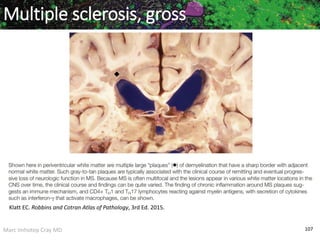
 CNS: Multiple firm plaques representing demyelination within
white matter of CNS, especially in optic nerve, brainstem, and
periventricular areas
 Microscopic plaque: Depletion of oligodendrocytes; monocytes,
lymphocytes, and lipid-laden macrophages around vessels; gliosis
and astrocyte proliferation
Marc Imhotep Cray MD
Multiple Sclerosis (2)
106
Clinical Manifestations: Relapsing and remitting course,
but eventually remissions become incomplete;
 classic Charcot triad: nystagmus, scanning speech, and intention
tremor;
 motor and sensory impairment of trunk and extremities
(hemiparesis, ataxia);
 visual impairment (optic neuritis, retrobulbar neuritis,
internuclear ophthalmoplegia [on lateral gaze, one eye does not
adduct and abducting eye has nystagmus caused by demyelination
of MLF]); urinary/bowel incontinence owing to loss of sphincter
control
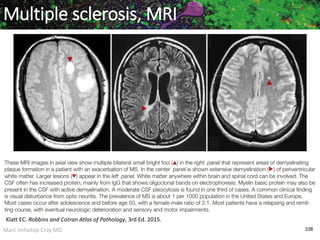
 Lab findings: Lumbar puncture shows mild lymphocytosis and
elevated IgG, manifested as multiple oligoclonal bands on
electrophoresis
Treatment: Corticosteroids and other immunosuppressants
Marc Imhotep Cray MD 107
Multiple sclerosis, gross
Klatt EC. Robbins and Cotran Atlas of Pathology, 3rd Ed. 2015.
Marc Imhotep Cray MD 108
Multiple sclerosis, MRI
Klatt EC. Robbins and Cotran Atlas of Pathology, 3rd Ed. 2015.
Marc Imhotep Cray MD 109
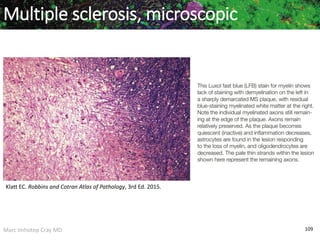
Multiple sclerosis, microscopic
Klatt EC. Robbins and Cotran Atlas of Pathology, 3rd Ed. 2015.
Marc Imhotep Cray MD
Vignette 9
110
A 29-year-old man presents to the emergency room
complaining of muscle weakness. He tells you that the
weakness began in his calves and has now ascended to
involve his thighs, hips, torso, and arms. Upon directed
history, you learn that he recently recovered from a flu-like
illness. Physical examination reveals symmetrical muscle
weakness in all limbs and absent deep tendon reflexes. A
lumbar puncture demonstrates an albumino-cytologic
dissociation of the CSF. You admit this patient to the intensive
care unit for observation as you fear that he may need
mechanical respiratory support for his condition.
What is the Diagnosis?
Marc Imhotep Cray MD
Guillain-Barre Syndrome
111
Etiology: Usually occurs after a flu-like viral illness (eg, EBV,
HSV, CMV), but has also been associated with surgical
procedures and bacterial infections (mycoplasma,
campylobacter)
Pathology and Pathophysiology:
 Pathophysiology: Viral illness causes a T-cell-mediated immune
reaction that results in demyelination of peripheral nerves
 Peripheral nerves: Endoneurial and perivenular infiltration by
lymphocytes and macrophages; segmental demyelination
Marc Imhotep Cray MD
Guillain-Barre Syndrome (2)
112
Clinical Manifestations: Ascending muscle weakness and
paralysis beginning in distal lower limbs; absent deep
tendon reflexes; sometimes sensory loss in extremities;
facial diplegia; abnormal autonomic function
(dysrhythmias, labile blood pressure)
 Can progress to respiratory failure or become chronic (chronic
inflammatory demyelinating polyradiculoneuropathy)
 Lab findings: Lumbar puncture shows albumino cytologic
dissociation of CSF (large protein content increase accompanied by
only a mild cell count increase)
Marc Imhotep Cray MD
Guillain-Barre Syndrome (3)
113
Treatment and Prognosis:
 Plasmapheresis;
 IV immunoglobulin;
 Supportive care (respiratory support until
recovery)
 Px Most pts recover after weeks to months, but
10%–20% are left w permanent disability
DDx: Postinfectious encephalitis can follow viral illnesses
(eg, chicken pox, rubella, measles, mumps) and is
characterized by transient, widespread demyelination.
Marc Imhotep Cray MD 114
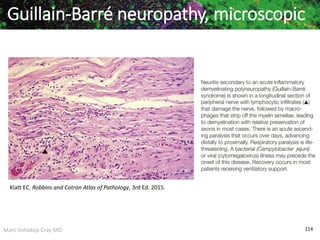
Guillain-Barré neuropathy, microscopic
Klatt EC. Robbins and Cotran Atlas of Pathology, 3rd Ed. 2015.
Marc Imhotep Cray MD 115
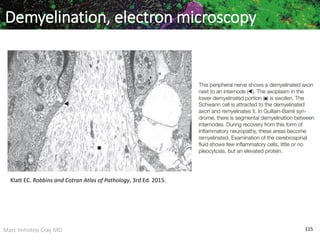
Demyelination, electron microscopy
Klatt EC. Robbins and Cotran Atlas of Pathology, 3rd Ed. 2015.
Marc Imhotep Cray MD
Cerebrovascular Disease
116
Marc Imhotep Cray MD
Vignette 10
117
A 74-year-old woman is brought to the emergency
department after developing left-sided paralysis 1 hour ago.
Further evaluation reveals left-sided sensory and motor
paralysis, left-sided hyperreflexia, left-sided Babinski reflex,
and bilateral symmetric loss of vision in half of her visual
fields. When you hear that she has a history of
atherosclerosis, you become even more certain of your
diagnosis. After obtaining a CT scan of the head to confirm
that she does not have a head bleed, you immediately begin
to administer thrombolytic therapy.
What is the Diagnosis?
Marc Imhotep Cray MD
Stroke (CVA) Capsule
CVA present clinically as sudden neurological
defects and may be caused by
 intracranial hemorrhage (hemorrhagic stroke) (e.g.
subarachnoid or intracranial hemorrhage) or
 cerebral infarction (usually secondary to thrombotic
[ischemic stroke] or embolic occlusion of a carotid or
intracranial artery) embolic stroke
Strokes may lead to death or permanent severe
neurological defects but modern therapies can
result in remarkable clinical recovery
118
Marc Imhotep Cray MD
Ischemic Stroke
119
Etiology: Causes include thrombosis, embolism,
dissection, vasculitis, or hypotension
Pathology:
i. Cerebral infarction: Associated with thrombosis or
embolism
 Ischemic neuronal change (nuclear pyknosis,
eosinophilic cytoplasm) within 12 hours;
 microglia and monocyte infiltration within 2 days;
 liquefactive necrosis leading to fluid-filled cavity
and reactive astrocytes by 1–3 weeks; gliosis (scar
formation) after several months
 may convert to hemorrhagic infarction, in which
blood seeps into infarction and is reabsorbed
Marc Imhotep Cray MD
Ischemic Stroke (2)
120
Pathology cont’ed:
ii. Watershed infarction: Assoc. w hypotension;
see wedge-shaped infarction occurring at
edge of area supplied by artery
 usually occurs in area betw. ACA and MCA
distribution
iii.Lacunar infarcts: Assoc. w hypertension and
thrombotic obstruction of small vessels
 see small cavitations with surrounding gliosis
Marc Imhotep Cray MD
Ischemic Stroke (3)
121
Clinical Manifestations: Depends on site of
ischemia and extent of collateral circulation
 ACA: Sensory loss and weakness in contralateral leg
 MCA: Contralateral paralysis and sensory loss;
homonymous hemianopia (bilateral symmetric loss of
vision in half of visual field); aphasias
 PCA: Contralateral sensory disturbance; macular-sparing
homonymous hemianopia
 Lateral striate arteries: Contralateral paralysis
Marc Imhotep Cray MD
Ischemic Stroke (4)
122
 Treatment:
 Thrombolytic therapy within 3 hours of onset;
 Antiplatelet therapy (aspirin, dipyridamole);
 Physical therapy;
 Statins for cholesterol-lowering effects
Note: Transient Ischemic Attack refers to neurologic deficits
caused by cerebral ischemia that resolves within 24 hours
suggests pt. is at high risk for having a stroke in near future
Marc Imhotep Cray MD 123
A 66-year-old Caucasian male with a history of atrial fibrillation
develops right-sided weakness and numbness, with his arm more
severely affected than his leg. He understands everything that is
said to him, but cannot speak. An embolus has most likely occluded
which of the following arteries?
A. Right middle cerebral artery
B. Left anterior cerebral artery
C. Left middle cerebral artery
D. Anterior inferior cerebellar artery
E. Posterior cerebellar artery
Check-Up Question
Source: USMLEWorld, 2015. Neurology/Pathology Q#23.
Marc Imhotep Cray MD 124
This patient displays the symptoms characteristic for a hemispheric stroke.
Hemiparesis, with more involvement of the arm than the leg, occurs due to the
occlusion of the middle cerebral artery (MCA). This artery supplies the face and arm
areas of the motor and sensory cortex, Broca's and Wernicke's speech areas, and
the frontal eye field.
The MCA also gives rise to the small, penetrating branches that perfuse the internal
capsule and basal ganglia. Along with hemiparesis, this patient has Broca's
(expressive) aphasia, which manifests with an inability to speak or write, but
preserved comprehension of the spoken and written word. Broca's area is located in
the inferior frontal gyrus in the dominant (left) hemisphere and is supplied by the
left middle cerebral artery. Contrary to popular belief, the left hemisphere of the
brain is most often dominant in both right-handed and left-handed people.
Educational Objective:
Hemiparesis with the arm affected more than the leg occurs due to occlusion of the
middle cerebral artery (MCA). If the occluded MCA is in the dominant hemisphere
(usually the left), aphasia may also occur.
Answer C: Left middle cerebral artery
Marc Imhotep Cray MD 125
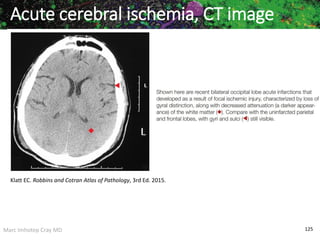
Acute cerebral ischemia, CT image
Klatt EC. Robbins and Cotran Atlas of Pathology, 3rd Ed. 2015.
Marc Imhotep Cray MD 126
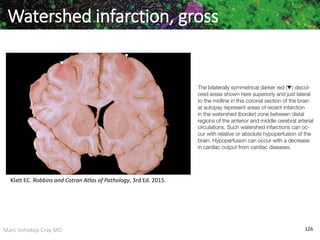
Watershed infarction, gross
Klatt EC. Robbins and Cotran Atlas of Pathology, 3rd Ed. 2015.
Marc Imhotep Cray MD 127
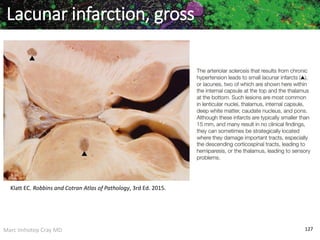
Lacunar infarction, gross
Klatt EC. Robbins and Cotran Atlas of Pathology, 3rd Ed. 2015.
Marc Imhotep Cray MD 128
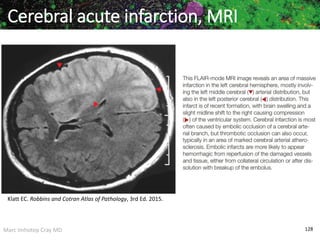
Cerebral acute infarction, MRI
Klatt EC. Robbins and Cotran Atlas of Pathology, 3rd Ed. 2015.
Marc Imhotep Cray MD 129
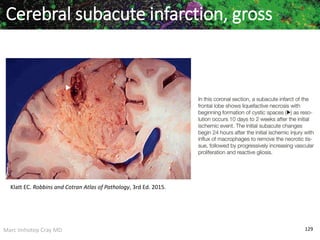
Cerebral subacute infarction, gross
Klatt EC. Robbins and Cotran Atlas of Pathology, 3rd Ed. 2015.
Marc Imhotep Cray MD 130
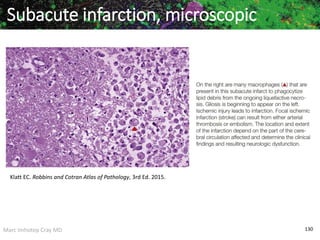
Subacute infarction, microscopic
Klatt EC. Robbins and Cotran Atlas of Pathology, 3rd Ed. 2015.
Marc Imhotep Cray MD 131
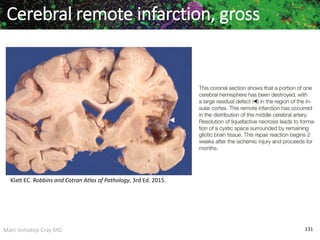
Cerebral remote infarction, gross
Klatt EC. Robbins and Cotran Atlas of Pathology, 3rd Ed. 2015.
Marc Imhotep Cray MD 132
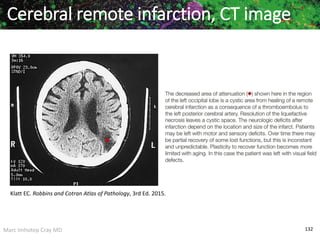
Cerebral remote infarction, CT image
Klatt EC. Robbins and Cotran Atlas of Pathology, 3rd Ed. 2015.
Marc Imhotep Cray MD
Vignette 11
133
A 67-year-old man presents to the emergency department
after passing out on the sidewalk. When he is revived, he
complains of a severe headache and nausea. Past medical
history is significant for long-standing hypertension. Physical
examination reveals right-sided hemiparesis. You think that
this man’s condition may be related to his high blood
pressure, which may have caused the formation of Charcot-
Bouchard microaneurysms. A CT scan of the head confirms
your suspicions.
What is the Diagnosis?
Marc Imhotep Cray MD
Hypertension
134
 Hypertension is common, often asymptomatic and has
many causes including
 Stress
 Obesity
 Renal artery stenosis and
 Hormonal defects such as Cushing’s syndrome and
Conn’s syndrome
 Chronic hypertension is characterized by an imbalance in
sodium and water homeostasis
 Untreated hypertension can lead to accelerated
atherosclerosis and to end-organ damage, including
hypertensive nephropathy, hypertensive heart disease
and intracerebral hemorrhage
Marc Imhotep Cray MD
Hemorrhagic Stroke
135
Etiology: Most commonly caused by hypertension; other
causes include bleeding disorders, arteriovenous
malformations, brain tumors, or amyloid angiopathy
Pathology and Pathophysiology:
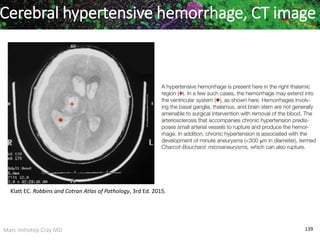
 Pathophysiology Chronic hypertension is associated with Charcot-
Bouchard microaneurysms are usually located within basal
ganglia
 Rupture of these aneurysms may be proximal cause of hemorrhage
 Brain: Hemorrhage usually located in basal ganglia or thalamus;
central area of blood surrounded by edematous brain tissue →
edema resolves and reactive astrocytes and macrophages appear
at edge of the injury → gliosis
Marc Imhotep Cray MD
Hemorrhagic Stroke (2)
136
Clinical Manifestations: Impairment of
consciousness; nausea and vomiting; headache;
neurologic deficits (especially hemiparesis and
sometimes hemisensory disturbance)
Treatment:
 Reverse any coagulopathies
 Strict blood pressure control
 surgical decompression if necessary for large
intracranial hemorrhage
Marc Imhotep Cray MD 137
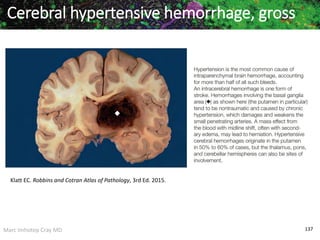
Cerebral hypertensive hemorrhage, gross
Klatt EC. Robbins and Cotran Atlas of Pathology, 3rd Ed. 2015.
Marc Imhotep Cray MD
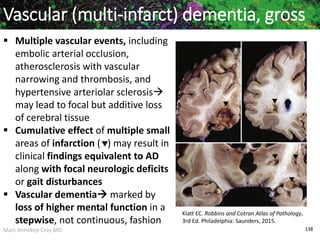
Vascular (multi-infarct) dementia, gross
 Multiple vascular events, including
embolic arterial occlusion,
atherosclerosis with vascular
narrowing and thrombosis, and
hypertensive arteriolar sclerosis
may lead to focal but additive loss
of cerebral tissue
 Cumulative effect of multiple small
areas of infarction ( ) may result in
clinical findings equivalent to AD
along with focal neurologic deficits
or gait disturbances
 Vascular dementia marked by
loss of higher mental function in a
stepwise, not continuous, fashion
Klatt EC. Robbins and Cotran Atlas of Pathology,
3rd Ed. Philadelphia: Saunders, 2015.
138
Marc Imhotep Cray MD 139
Cerebral hypertensive hemorrhage, CT image
Klatt EC. Robbins and Cotran Atlas of Pathology, 3rd Ed. 2015.
Marc Imhotep Cray MD
Vignette 12
140
A 44-year-old woman presents to the emergency department
complaining of nausea and the worst headache of her life.
Upon further questioning, you learn that she is a heavy
smoker and she has a history of poorly controlled
hypertension. You decide to perform a lumbar puncture,
which reveals blood in the CSF. A CT scan of the head
demonstrates blood in the basal cisterns. You immediately
admit her to the hospital for a cerebral angiography in order
to evaluate for the best treatment of her condition.
What is the Diagnosis?
Marc Imhotep Cray MD
Berry Aneurysm and Subarachnoid
Hemorrhage
141
Etiology and Epidemiology: Causes of subarachnoid
hemorrhage include rupture of berry aneurysm, trauma,
and arteriovenous malformation
 Most berry aneurysms occur sporadically, but risk factors
include hypertension, cigarette smoking, coarctation of aorta,
APKD, connective tissue disorders, and neurofibromatosis type 1
 Rupture of berry aneurysms occurs more frequently in women
and in those over the age of 40
Pathology:
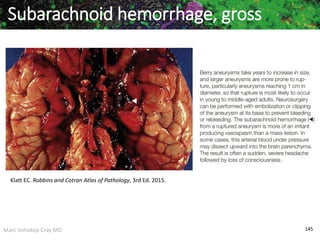
 Subarachnoid hemorrhage: Blood in subarachnoid space;
fibrosis, occurring after resolution, may lead to CSF obstruction
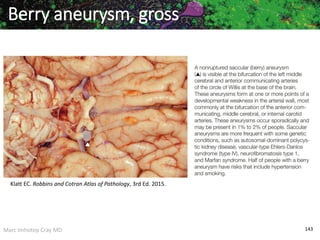
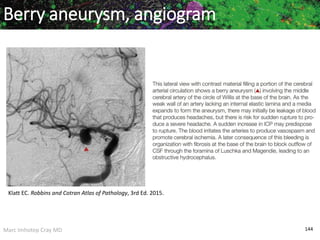
 Berry aneurysm: Often occur at arterial bifurcations of circle of
Willis; outpouching of arterial wall with intimal thickening and
media thinning at neck of aneurysm; media is absent in sac wall
Marc Imhotep Cray MD
Berry Aneurysm and Subarachnoid
Hemorrhage (2)
142
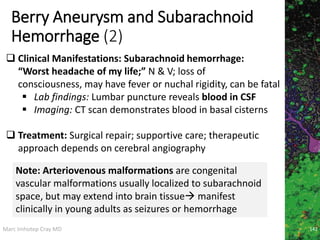
 Clinical Manifestations: Subarachnoid hemorrhage:
“Worst headache of my life;” N & V; loss of
consciousness, may have fever or nuchal rigidity, can be fatal
 Lab findings: Lumbar puncture reveals blood in CSF
 Imaging: CT scan demonstrates blood in basal cisterns
 Treatment: Surgical repair; supportive care; therapeutic
approach depends on cerebral angiography
Note: Arteriovenous malformations are congenital
vascular malformations usually localized to subarachnoid
space, but may extend into brain tissue manifest
clinically in young adults as seizures or hemorrhage
Marc Imhotep Cray MD 143
Berry aneurysm, gross
Klatt EC. Robbins and Cotran Atlas of Pathology, 3rd Ed. 2015.
Marc Imhotep Cray MD 144
Berry aneurysm, angiogram
Klatt EC. Robbins and Cotran Atlas of Pathology, 3rd Ed. 2015.
Marc Imhotep Cray MD 145
Subarachnoid hemorrhage, gross
Klatt EC. Robbins and Cotran Atlas of Pathology, 3rd Ed. 2015.
Marc Imhotep Cray MD 146
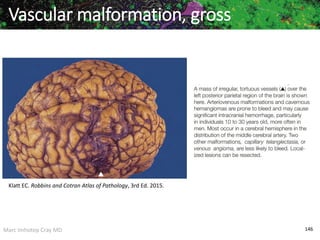
Vascular malformation, gross
Klatt EC. Robbins and Cotran Atlas of Pathology, 3rd Ed. 2015.
Marc Imhotep Cray MD
Vignette 13
147
A 78-year-old woman is brought to the emergency
department by her son because of headaches and altered
mental status. He tells you that the patient fell down the stairs
2 weeks ago, but that she appeared fine immediately after the
fall. Physical examination reveals bilateral papilledema.
When a CT scan of the head reveals a 3-cm crescent-shaped
collection of fluid on the right side of the head that crosses
suture lines with a 7-mm midline shift, you suspect that her
current condition is related to tearing of the bridging veins
between the cerebrum and venous sinuses in the dura and
you schedule her for immediate surgical drainage of the
blood.
What is the Diagnosis?
Marc Imhotep Cray MD
Epidural and Subdural Hematoma
148
Etiology:
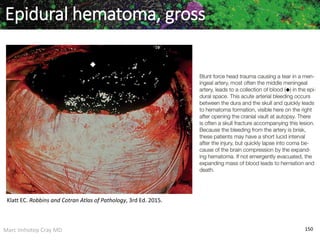
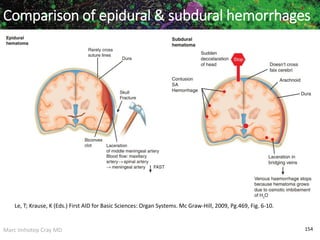
 Epidural hematoma: Caused by tearing of middle
meningeal artery, (middle meningeal vein, or dural
sinus) which is often caused by skull fracture
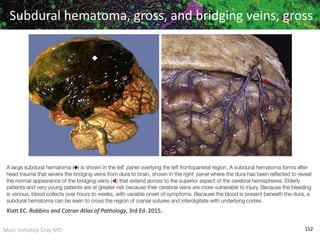
 Subdural hematoma: Caused by tearing of bridging
veins located betw. cerebrum and venous sinuses in
dura mater often owing to head injury
 Pathology:
 Epidural: Accumulation of blood betw. dura and skull
leading to cerebral compression
 Subdural: Accumulation of blood betw. dura and
arachnoid bleeding is self-limited, but hematoma can
grow owing to osmotic movement of water
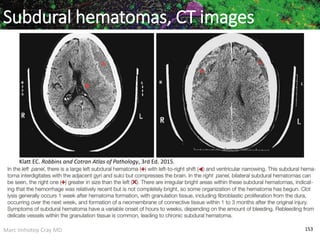
 resolution with granulation tissue can occur as well leading to a
chronic subdural hematoma
Marc Imhotep Cray MD
Epidural and Subdural Hematoma (2)
149
Clinical Manifestations:
 Epidural: Loss of consciousness (LOC) , followed by lucid
period, followed by headache, altered mental status,
seizures, focal neurologic deficits, and eventually coma
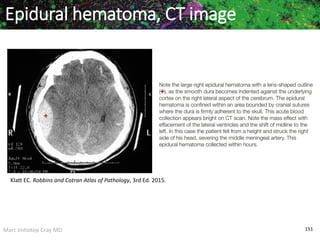
o Imaging: Head CT shows lens shaped /convex that
does not cross suture lines
 Subdural: Headache; altered mental status; other signs
of cerebral compression; clinical signs occur gradually,
appearing hours to weeks after injury
o Imaging: Head CT shows crescent-shaped/ concave
disk that crosses suture lines
Treatment:
 Surgical drainage of blood;
 reversal of coagulopathy
Marc Imhotep Cray MD 150
Epidural hematoma, gross
Klatt EC. Robbins and Cotran Atlas of Pathology, 3rd Ed. 2015.
Marc Imhotep Cray MD 151
Epidural hematoma, CT image
Klatt EC. Robbins and Cotran Atlas of Pathology, 3rd Ed. 2015.
Marc Imhotep Cray MD 152
Subdural hematoma, gross, and bridging veins, gross
Klatt EC. Robbins and Cotran Atlas of Pathology, 3rd Ed. 2015.
Marc Imhotep Cray MD 153
Subdural hematomas, CT images
Klatt EC. Robbins and Cotran Atlas of Pathology, 3rd Ed. 2015.
Marc Imhotep Cray MD 154
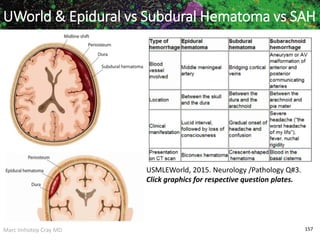
Comparison of epidural & subdural hemorrhages
Le, T; Krause, K (Eds.) First AID for Basic Sciences: Organ Systems. Mc Graw-Hill, 2009, Pg.469, Fig. 6-10.
Marc Imhotep Cray MD 155
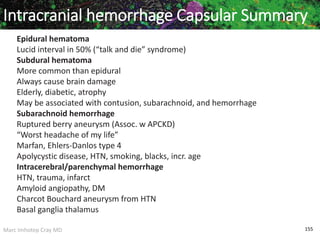
Epidural hematoma
Lucid interval in 50% (“talk and die” syndrome)
Subdural hematoma
More common than epidural
Always cause brain damage
Elderly, diabetic, atrophy
May be associated with contusion, subarachnoid, and hemorrhage
Subarachnoid hemorrhage
Ruptured berry aneurysm (Assoc. w APCKD)
“Worst headache of my life”
Marfan, Ehlers-Danlos type 4
Apolycystic disease, HTN, smoking, blacks, incr. age
Intracerebral/parenchymal hemorrhage
HTN, trauma, infarct
Amyloid angiopathy, DM
Charcot Bouchard aneurysm from HTN
Basal ganglia thalamus
Intracranial hemorrhage Capsular Summary
Marc Imhotep Cray MD 156
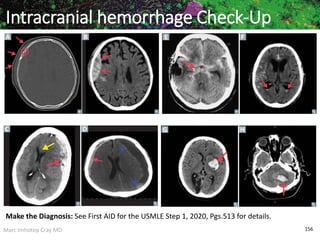
Intracranial hemorrhage Check-Up
Make the Diagnosis: See First AID for the USMLE Step 1, 2020, Pgs.513 for details.
Marc Imhotep Cray MD 157
USMLEWorld, 2015. Neurology /Pathology Q#3.
Click graphics for respective question plates.
UWorld & Epidural vs Subdural Hematoma vs SAH
Marc Imhotep Cray MD
Other Disorders
158
Marc Imhotep Cray MD
Vignette 14
159
A 43-year-old woman presents to the emergency room
complaining of episodic loss of vision. She also reports having
had severe headaches associated with nausea and vomiting
over the past month. Physical examination reveals bilateral
papilledema and a CT scan of the head demonstrates dilation of
the ventricular system of the brain. You suspect that she may
need placement of a ventriculoperitoneal shunt to treat her
condition and you admit her to the hospital to obtain
neurosurgical consultation.
What is the Diagnosis?
Marc Imhotep Cray MD
Hydrocephalus
160
 Etiology: Caused by accumulation of increased volume of
CSF within cranium can either result from obstruction to
CSF circulation (attributed to tumors or inflammation) or
from overproduction of CSF by tumors of choroid plexus
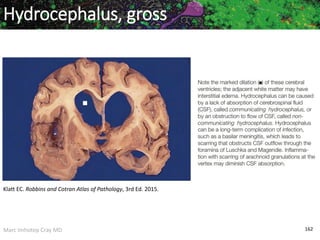
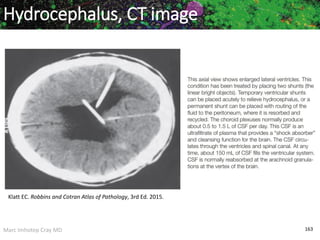
 Pathology Gross: Dilation of ventricles
 Four variants of hydrocephalus:
1. Internal: excessive CSF is present only in ventricular system
2. External: excessive CSF is present only in subarachnoid space
3. Communicating: CSF flows freely betw. ventricles and
subarachnoid space;
4. Noncommunicating: CSF flow betw. ventricles and subarachnoid
space is obstructed
Marc Imhotep Cray MD
Hydrocephalus (2)
161
Clinical Manifestations: May present w enlargement of
skull in adults, seizures, headaches, visual disturbances,
nausea and vomiting (N/V), and other signs of increased
intracranial pressure (ICP)
Treatment: Insertion of ventriculoperitoneal shunt;
removal of obstruction or choroid plexus tumor
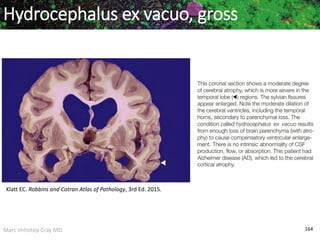
Note: Hydrocephalus ex vacuo refers to dilation of ventricles
w an increase in CSF volume resulting from a loss of brain
tissue (often by infarction or Alzheimer disease)
Marc Imhotep Cray MD 162
Hydrocephalus, gross
Klatt EC. Robbins and Cotran Atlas of Pathology, 3rd Ed. 2015.
Marc Imhotep Cray MD 163
Hydrocephalus, CT image
Klatt EC. Robbins and Cotran Atlas of Pathology, 3rd Ed. 2015.
Marc Imhotep Cray MD 164
Hydrocephalus ex vacuo, gross
Klatt EC. Robbins and Cotran Atlas of Pathology, 3rd Ed. 2015.
Marc Imhotep Cray MD
Vignette 15
165
A 25-year-old woman presents to your office complaining of
diminished sensation in both arms. Further neurologic
evaluation of her arms reveals that she has diminished pain
and temperature sensation, but that her touch sensation and
proprioception are intact. She demonstrates no other
neurologic deficits. When an MRI reveals cystic dilation in
the center of the cervical spinal cord, you refer her to a
neurosurgeon for treatment of her condition.
What is the Diagnosis?
Marc Imhotep Cray MD
Syringomyelia
166
Etiology: Often assoc. w Arnold-Chiari malformation; also
caused by intraspinal neoplasms or trauma
Pathology:
 Spinal cord: Formation of fluid-filled cavity often extending from
central canal usually in cervical region of cord (most commonly C7-
T1)results in destruction of adjacent gray and white matter
(crossing fibers of spinothalamic tract) w resultant reactive gliosis
Clinical Manifestations: Loss of pain and temp. of upper
extremities w preservation of touch and proprioception;
may progress to involve motor and other sensory tracts
Treatment: Surgical drainage of cavity
Marc Imhotep Cray MD
Vignette 16
167
A 32-year-old woman presents to your office complaining of
intermittent double vision. She tells you that this tends to
occur in the afternoons and evenings. Physical examination
reveals ptosis of both eyes that worsens when the patient is
asked to actively keep her eyelids elevated. When her
symptoms markedly improve after edrophonium
administration, you wonder if she may also have a thymoma.
What is the Diagnosis?
Marc Imhotep Cray MD
Myasthenia Gravis
168
 Etiology and Epidemiology: Caused by antibodies directed
against acetylcholine (ACh) receptors at neuromuscular
junction
 Presents most frequently in women under age of 40
 Pathology and Pathophysiology:
 Neuromuscular junction: Loss of ACh receptors;
infiltration of immune complexes and complement
factors
 Pathophysiology: Antibodies lead to Ach receptor
degradation causing a virtual block of synaptic
transmission
Marc Imhotep Cray MD
Myasthenia Gravis (2)
169
 Clinical Manifestations: Muscle weakness that worsens
with fatigue; common initial presentation is ptosis or
diplopia owing to extraocular (EOM) muscle involvement,
but also involves muscles of extremities and facial
muscles
 Diagnosis confirmed by improvement after
administration of a short-acting anticholinesterase
(edrophonium)
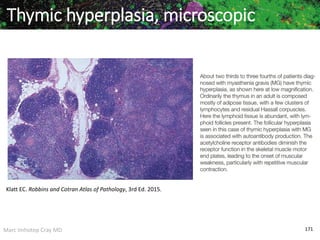
 Assoc. w thymoma or thymic hyperplasia
 Lab findings: Antibodies to ACh receptors
 Treatment: Anticholinesterase drugs (ie, pyridostigmine);
thymectomy; immunosuppression; plasmapheresis
if severe flare
Marc Imhotep Cray MD 170
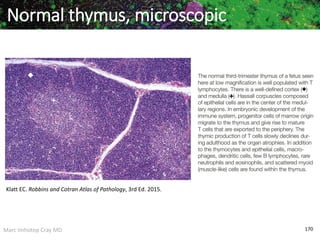
Normal thymus, microscopic
Klatt EC. Robbins and Cotran Atlas of Pathology, 3rd Ed. 2015.
Marc Imhotep Cray MD 171
Thymic hyperplasia, microscopic
Klatt EC. Robbins and Cotran Atlas of Pathology, 3rd Ed. 2015.
Marc Imhotep Cray MD
Vignette 17
A 21-year-old man presents to the emergency department
complaining of a severe headache. Physical examination
reveals a fever to 1020F, nuchal rigidity, and photophobia. You
perform a lumbar puncture, which initially reveals purulent
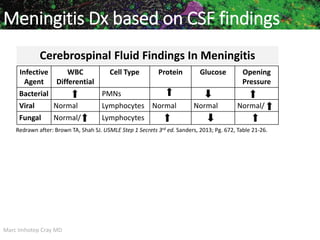
CSF infiltrated with neutrophils, increased protein content,
and decreased glucose content. While you await culture
results, you admit the patient to the hospital and begin
empiric broad spectrum antibiotics to treat his condition.
What is the Diagnosis?
172
Marc Imhotep Cray MD
Pyogenic and Viral Meningitis
Pyogenic
Etiology Pyogenic meningitis: Causes include group B
streptococci, E coli, Listeria in neonates and infants; H
influenzae and N meningitidis in children and young adults;
pneumococcus, Listeria, and gram-negative rods in older
adults
 Pathology Pyogenic meningitis: Purulent exudate within
leptomeninges; engorged meningeal vessels; neutrophils
within subarachnoid space
Viral
Viral meningitis: Causes include HSV virus, Coxsackie virus,
echoviruses, and arboviruses
Viral meningitis: There may be no abnormality or a mild
lymphocytic infiltrate in subarachnoid space; mild edema
may be present
173
Marc Imhotep Cray MD
Pyogenic and Viral Meningitis (2)
Clinical Manifestations
 Pyogenic meningitis: Headache; photophobia; neck
stiffness; fever; irritability.
 Lab findings: Lumbar puncture shows cloudy CSF with neutrophils,
increased protein, decreased glucose and increased opening
pressure
Viral meningitis: Headache; photophobia; neck stiffness;
fever; irritability.
 Lab findings: Lumbar puncture shows lymphocytosis, mildly
elevated protein, and normal glucose
 Treatment:
Pyogenic meningitis: Antibiotics and supportive care
Viral meningitis: Self-limiting; acyclovir for HSV meningitis
174
Marc Imhotep Cray MD 175
Aseptic meningitis
Aseptic meningitis can be caused by drugs and can also be a
manifestation of certain rheumatologic or other systemic disorders
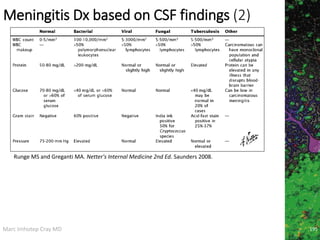
Runge MS and Greganti MA. Netter's Internal Medicine
2nd Ed. Saunders 2008.
A 45-year-old day care provider presents
in August with a fever of 38°C, headache,
photophobia, and neck stiffness. A clinical
diagnosis of meningitis is made. Based on
the epidemiology of meningitis in the
United States, what is the most likely
cause of her disease?
A. Cryptococcus neoformans
B. Haemophilus influenzae
C. Neisseria meningitidis
D. Streptococcus pneumoniae
E. Viral
Marc Imhotep Cray MD 176
Answer is E: Viral
 Overall viruses are most common cause of meningitis  Viral infection of
meninges is known as aseptic meningitis less severe than bacterial meningitis
 Whereas viral meningitis may not require hospitalization, bacterial meningitis is
a medical emergency requiring prompt Dx and admin. of empiric ABXs
 To avoid unnecessary hospitalization and admin. of ABXs essential to be able to
distinguish betw. septic (bacterial) and aseptic (viral) meningitis
o CSF findings help make this distinction Enteroviruses--specifically coxsackieviruses
and echoviruses-- cause greatest number of cases of aseptic meningitis common
infections of children and adults w close contact w children show a seasonal
occurrence, w most cases in summer and early fall
Related: AAP Updates Guidelines for Evaluating Simple Febrile Seizures in Children (American Family
Physician, Volume 83, Number 11 , June 1, 2011.); Febrile Seizures in Children (Osmosis)
 S. pneumoniae and N. meningitidis are important cause of meningitis in both
children and adults
o Vaccination has decr. occurrence of these two in U.S. and Western societies
 C. neoformans is a cause of meningitis in immune suppressed individuals
Marc Imhotep Cray MD
Meningitis (More discussion…)
A Vignette and Clinicopathologic Capsule
177
Marc Imhotep Cray MD
Vignette 18
An 18-year-old girl is brought to the college emergency room
by her roommate. The roommate 4 claimed that the patient
had been feeling fine the night before but this morning had
a high fever and was difficult to arouse. On physical
examination, the patient was found to have a temperature
of 102°F, to be very lethargic, and to have a petechial rash.
Examination of her cerebrospinal fluid revealed numerous
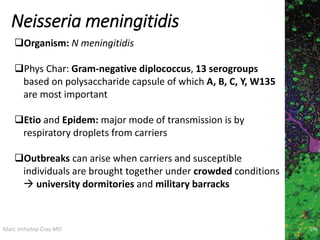
neutrophils and gram-negative diplococci. Her records
indicated that she had received the tetravalent meningitis
vaccine before graduating from high school.
178
Marc Imhotep Cray MD
Etiopathogenesis
 Pts w meningitis can present acutely or
chronically  a distinction that helps determine
likely etiologies
Most common acute presentations result from
bacterial and aseptic meningitis
 Aseptic meningitis may occur in pts. w viral infections
or in assoc. w an adverse drug reaction (ADR)
 A subacute picture--CSF pleocytosis persists for
longer than 4 weeks-- is more likely to be assoc. w
fungal or vasculitic meningitis
179
Marc Imhotep Cray MD 180
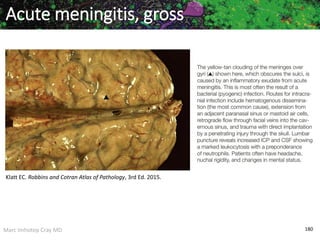
Acute meningitis, gross
Klatt EC. Robbins and Cotran Atlas of Pathology, 3rd Ed. 2015.
Marc Imhotep Cray MD 181
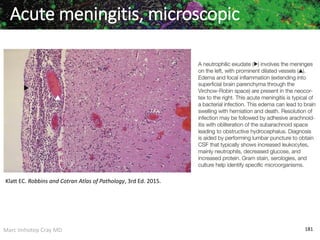
Acute meningitis, microscopic
Klatt EC. Robbins and Cotran Atlas of Pathology, 3rd Ed. 2015.
Marc Imhotep Cray MD 182
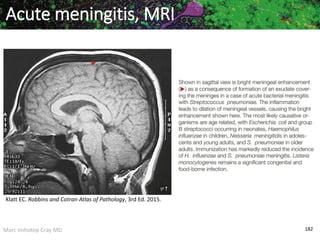
Acute meningitis, MRI
Klatt EC. Robbins and Cotran Atlas of Pathology, 3rd Ed. 2015.
Marc Imhotep Cray MD 183
Meningitis in a Ethiopian child w a very rigid neck
 Cerebral malaria should be
in DDx for this child
 Most bacterial meningitis in
children can now be
prevented by vaccines
frequently still not available
in developing countries Usatine RP, et al. The Color Atlas of Family Medicine. New
York: McGraw-Hill, 2013.
Marc Imhotep Cray MD
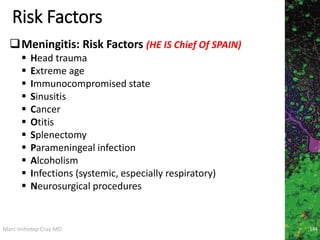
Risk Factors
Meningitis: Risk Factors (HE IS Chief Of SPAIN)
 Head trauma
 Extreme age
 Immunocompromised state
 Sinusitis
 Cancer
 Otitis
 Splenectomy
 Parameningeal infection
 Alcoholism
 Infections (systemic, especially respiratory)
 Neurosurgical procedures
184
Marc Imhotep Cray MD
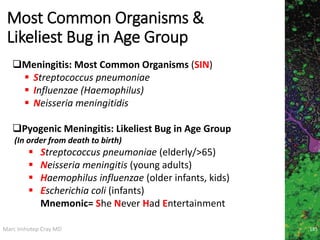
Most Common Organisms &
Likeliest Bug in Age Group
Meningitis: Most Common Organisms (SIN)
 Streptococcus pneumoniae
 Influenzae (Haemophilus)
 Neisseria meningitidis
Pyogenic Meningitis: Likeliest Bug in Age Group
(In order from death to birth)
 Streptococcus pneumoniae (elderly/>65)
 Neisseria meningitis (young adults)
 Haemophilus influenzae (older infants, kids)
 Escherichia coli (infants)
Mnemonic= She Never Had Entertainment
185
Marc Imhotep Cray MD
Most Common Organisms
186
 Haemophilus influenzae used to be most common cause
of meningitis in newborns but is now only rarely seen in
this age group. Why has this changed?
 Newborns are now given a vaccine to protect them against H.
influenzae type b however, vaccine is effective only for about
first 2 years of life
 In a patient w human immunodeficiency virus (HIV), what
infective agents may be more likely to cause meningitis
than in a patient who has a fully competent immune
system?
 In a pt. w HIV, opportunistic infections such as Toxoplasmosis,
Cryptococcus, and Human polyomavirus 2 (JC virus) must be
considered in differential diagnosis (DDx)
o Remember JC virus-induced Progressive Multifocal
Leukoencephalopathy (a demyelinating disease)
Marc Imhotep Cray MD
Clinical Manifestations
Signs and Symptoms:
Classic triad of bacteria meningitis consists of following:
 Fever
 Headache
 Neck stiffness
Other symptoms can include N/V, photophobia,
sleepiness, confusion, irritability, delirium, and coma
 Pts with viral meningitis may have a history of
preceding systemic symptoms (eg, myalgias, fatigue,
or anorexia)
187
Marc Imhotep Cray MD
Sn & Sx cont.
Ability to mount an immune responses must be kept in
mind when assessing severity of symptom
 Immunocompromised pts. may have a more subtle
presentation yet they are at very high risk for poor
outcome
 In bacterial meningitis, temp. usually exceeds 37.7º C
(99.9º F)
 Low-grade fever is more often present in viral meningitis
o Fever may be entirely absent in immunocompromised patients
Temp. conversion formulas:
°C x 9/5 + 32 = °F
(°F - 32) x 5/9 = °C
188
Marc Imhotep Cray MD
Sn & Sx cont.
189
 Mental status changes occur in bacterial meningitis in
44% of cases but are found in only 3% of viral meningitis
cases
 Seizures occur in range of 20% to 25% of pts w bacterial
meningitis focal findings such as CN deficits are even
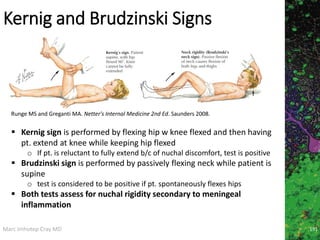
more common, occurring in 25% to 30% of these pts.
 Neck stiffness is a specific sign and has a sensitivity of
about 70%
Marc Imhotep Cray MD
Physical Examination
Meningeal signs, most commonly meningismus, are
present in about 88% of cases of bacterial meningitis
 A constellation of Sn & Sx (e.g., headache, neck stiffness)
suggestive of meningitis meningeal irritation without objective
findings
Other classic signs are Kernig and Brudzinski signs
 Kernig sign is pain in back upon passive extension of one leg at knee
and thigh
 Brudzinski sign is flexion of legs at thighs when patient’s neck is
flexed
 Jolt accentuation of headache is a very sensitive finding
for meningitis
 Elicited by having patient turn head rapidly horizontally a number of
times per second to assess for worsening of headache
190
Marc Imhotep Cray MD
Kernig and Brudzinski Signs
Runge MS and Greganti MA. Netter's Internal Medicine 2nd Ed. Saunders 2008.
191
 Kernig sign is performed by flexing hip w knee flexed and then having
pt. extend at knee while keeping hip flexed
o If pt. is reluctant to fully extend b/c of nuchal discomfort, test is positive
 Brudzinski sign is performed by passively flexing neck while patient is
supine
o test is considered to be positive if pt. spontaneously flexes hips
 Both tests assess for nuchal rigidity secondary to meningeal
inflammation
Marc Imhotep Cray MD
PE cont.
Thorough neurologic examination should be performed, w
attention given to accurate assessment of:
 level of consciousness
 presence or absence of cranial nerve deficits
 assessment for papilledema, and
 documentation of any focal motor or sensory defects
192
 Purpura strongly suggests meningococcal
disease
 Petechiae almost as frequently seen as
purpura in meningococcal meningitis
can also occur in rickettsial diseases and
sometimes in pneumococcal meningitis
Skin should be carefully examined for lesions
Marc Imhotep Cray MD
Diagnosis
193
Runge MS and Greganti MA. Netter's Internal Medicine 2nd Ed. Saunders 2008.
Marc Imhotep Cray MD 194
Meningitis Dx based on CSF findings
Redrawn after: Brown TA, Shah SJ. USMLE Step 1 Secrets 3rd ed. Sanders, 2013; Pg. 672, Table 21-26.
Cerebrospinal Fluid Findings In Meningitis
Infective
Agent
WBC
Differential
Cell Type Protein Glucose Opening
Pressure
Bacterial PMNs
Viral Normal Lymphocytes Normal Normal Normal/
Fungal Normal/ Lymphocytes
Marc Imhotep Cray MD
Runge MS and Greganti MA. Netter's Internal Medicine 2nd Ed. Saunders 2008.
Meningitis Dx based on CSF findings (2)
195
Marc Imhotep Cray MD
Neisseria meningitidis
196
Organism: N meningitidis
Phys Char: Gram-negative diplococcus, 13 serogroups
based on polysaccharide capsule of which A, B, C, Y, W135
are most important
Etio and Epidem: major mode of transmission is by
respiratory droplets from carriers
Outbreaks can arise when carriers and susceptible
individuals are brought together under crowded conditions
 university dormitories and military barracks
Marc Imhotep Cray MD
Neisseria meningitidis (To Osmosis Vid.)
197
Clinical Findings: Nasopharynx is portal of entry from
nasopharynx organisms may reach bloodstream
(meningococcemia)
 Meningitis is most common complication of
meningococcemia
o Widespread petechiae and ecchymoses are signs of
meningococcemia
o Severe cases can lead to disseminated intravascular coagulation
(DIC)
Marc Imhotep Cray MD
Neisseria meningitidis cont.
Pathogenesis: Major virulence factors is an antiphagocytic
polysaccharide capsule, endotoxin (lipooligosaccharide),
IgA1 protease, and pili
 As w N gonorrhoeae, complement system is important in immune
clearance through classical pathway
o Individuals with complement deficiencies are at higher risk for
dissemination
Laboratory: Latex agglutination tests used to Dx N
meningitidis in CSF, as are direct Gram stains
 Latex agglutination is more sensitive than Gram stain of CSF
however, it is not as sensitive as culture, and a negative test does
not rule out an infectious cause of patient’s symptoms
o N meningitidis can be grown on blood or chocolate agar
198
Marc Imhotep Cray MD
Neisseria meningitidis cont.
Treatment:
In general, penicillin or third-generation
cephalosporins are effective for treatment
 Often a combination of IV vancomycin and ceftriaxone
is used b/c of their central nervous system (CNS)
penetration and broad coverage
199
Appropriate time to initiate antibiotic therapy and what antimicrobial agent
could be used
 ATB Tx must be initiated immediately when bacterial meningitis is suspected
 Based on age of pt. and morphology on Gram stain an appropriate agent can
be chosen
AEs:
 IV vancomycin nephrotoxicity and ototoxicity, thrombophlebitis, Red man
syndrome (prevented by antihistamines)
 Ciprofloxacin or rifampin is used for high-risk individuals who have been in
close contact with an index case
Marc Imhotep Cray MD
Neisseria meningitidis cont.
200
Prevention
A vaccine against serogroups A, C, Y, & W135 is available
 B serogroup polysaccharide is a poor immunogen and is
therefore not in current vaccine
o A high percentage of cases involve serogroup B
 Chemoprophylaxis: A single dose of 500 mg of
ciprofloxacin is preferred regimen for prophylaxis of
adults against Neisseria meningitidis
 Rifampin can also be used
 Children can be protected using a single dose of ceftriaxone as
fluoroquinolones contraindicated in children  Damages
cartilage in young children
Marc Imhotep Cray MD
Question
 What adrenal disease
should be suspected in a
young patient with bacterial
meningitis due to Neisseria
meningitidis who also
becomes acutely
hypotensive?
 Sn & Sx:
 septicemia, hypotension
 disseminated intravascular
coagulation (DIC)
 adrenal hemorrhage, and
 petechial rash Raff RB, Rawls SM, Beyzarov EP. Netter's Illustrated
Pharmacology, Updated Edn. Saunders, 2014.
201
Marc Imhotep Cray MD 202
Waterhouse-Friderichsen syndrome, gross
Klatt EC. Robbins and Cotran Atlas of Pathology, 3rd Ed. Saunders, 2015.
Ans. Waterhouse-Friderichsen syndrome typically causes bilateral
adrenal hemorrhage, which can be rapidly fatal acute adrenal
cortical insufficiency syndrome
Responsible bacterium is Neisseria meningitidis
Marc Imhotep Cray MD
Vignette 19
203
A 10-year-old boy is brought to your pediatric neurology
clinic by his parents who have noticed that he has self-
limited periods of unresponsiveness, even though his eyes
are open. When questioned, the patient states that he sees
flashes or blinking lights at times and has momentary lapses
of “forgetfulness.” The parents report that their other child
had similar episodes, but the episodes subsided after
puberty. You inform the parents that you believe their child
may have a mild form of epilepsy. You order an EEG, which
you expect will demonstrate a classic 3-Hz spike-and-wave
EEG pattern.
What is the Diagnosis?
Marc Imhotep Cray MD
Seizures Disorders Capsule
204
 Etiology: Causes for seizures include
 toxins (ie, drugs, alcohol withdrawal),
 intracranial pathology (stroke, bleed, tumor,
infection, degenerative disorders),
 metabolic abnormalities (hyponatremia,
hypoglycemia) or
 epilepsy (syndrome of recurrent seizures)
 Pathophysiology: Abnormal discharge of CNS neurons
results in neurological symptoms
Marc Imhotep Cray MD
Seizures Capsule cont.
205
Clinical Manifestations: Usually preceded by aura (odd
smell/vision), then followed by seizure; seizure
often followed by postictal period (mins. to hrs. of
resolving confusion and lethargy)
 Seizures may be either partial (involving discrete area
of brain) or generalized and include
(1) Simple partial: no impairment of consciousness; involves motor,
sensory, or autonomic brain;
(2) Complex partial: similar to simple partial except that
consciousness impaired;
(3) Tonic-clonic (grand mal): contraction of muscles alternating with
relaxation;
(4) Absence: lapse of consciousness without loss of postural tone;
(5) Myoclonic: sudden, brief contractions
Marc Imhotep Cray MD
Overview of Epilepsy
206
Approximately 10% of population will have at least one
seizure in their lifetime
 Epilepsy vs Seizures A seizure is a single occurrence, whereas
epilepsy is a neurological condition characterized by two or more
unprovoked seizures
Globally, epilepsy is third most common neurologic
disorder after Cerebrovascular Disease and Alzheimer’s
disease
 Epilepsy is not a single entity but an assortment of
different seizure types and syndromes  originating
from several mechanisms that have in common sudden,
excessive, and synchronous discharge of cerebral
neurons
Marc Imhotep Cray MD
Overview of Epilepsy (2)
207
Abnormal electrical activity may result in a variety of
events, including loss of consciousness (LOC), abnormal
movements, atypical or odd behavior, and distorted
perceptions that are of limited duration but recur if
untreated
Site of origin of abnormal neuronal firing determines
symptom produced
 For example, if motor cortex is involved, patient may experience
abnormal movements or a generalized convulsion
 Seizures originating in parietal or occipital lobe may include visual,
auditory, and olfactory hallucinations
Marc Imhotep Cray MD 208
Electroencephalography
EEG permits recording of
collective electrical
activity of cerebral
cortex as a summation of
activity measured as a
difference between two
recording electrodes
Recording electrodes
(leads) are placed on the
scalp on at least 16
standard sites, and
recordings of potential
differences between key
electrodes are obtained
Raff RB, Rawls SM, Beyzarov EP. Netter's Illustrated Pharmacology,
Updated Edition. Philadelphia: Sanders, 2014.
“The diagnosis of epilepsy is often not straightforward, and misdiagnosis is not rare. A detailed and reliable account of the event by an eyewitness is the most
important part of the diagnostic evaluation, but may not be available.
Electroencephalography (EEG) is an important diagnostic test in evaluating a patient with possible epilepsy. It can provide support for the diagnosis of
epilepsy and also assists in classifying the underlying epileptic syndrome. However, there are several reasons why EEG alone cannot be used to make or refute
a specific diagnosis of epilepsy:
●Most EEG patterns can be caused by a wide variety of different neurologic diseases.
●Many diseases can cause more than one type of EEG pattern.” (From https://www.uptodate.com/contents/electroencephalography-eeg-in-the-diagnosis-of-
seizures-and-epilepsy)
Marc Imhotep Cray MD 209
EEG (2)
Examples are provided of a
1. normal EEG taken when
client is awake with eyes
closed and
2. normal EEG sleeping
Abnormal patterns of
activity can be seen in
presence of
3. tumors and
4. seizures
Raff RB, Rawls SM, Beyzarov EP. Netter's Illustrated Pharmacology,
Updated Edition. Philadelphia: Sanders, 2014.
Marc Imhotep Cray MD 210
Etiology of Epilepsy and Seizures
In most cases, epilepsy has no identifiable cause
 Focal areas that are functionally abnormal may be triggered
into activity by changes in physiologic factors, such as
alteration in blood gases, pH, electrolytes, and blood glucose
and changes in environmental factors, such as sleep
deprivation, alcohol intake, flashing lights and stress
Neuronal discharge results from firing of a small population
of neurons in a specific area of brain referred to as the
“primary focus”
Neuroimaging techniques, such as magnetic resonance
imaging (MRI), positron emission tomography (PET) scans,
and single photon emission coherence tomography (SPECT)
may identify areas of concern
Marc Imhotep Cray MD 211
Etiology of Seizures (2)
Intracranial:
Raff RB, Rawls SM, Beyzarov EP. Netter's Illustrated Pharmacology, Updated Edition.
Philadelphia: Sanders, 2014.
Marc Imhotep Cray MD 212
Etiology of Seizures (3)
Extracranial:
Raff RB, Rawls SM, Beyzarov EP. Netter's Illustrated Pharmacology,
Updated Edition. Philadelphia: Sanders, 2014.
Marc Imhotep Cray MD 213
Classification of Seizures
It is important to correctly classify seizures
to determine appropriate treatment
 Seizures have been categorized by site of
origin, etiology, electrophysiologic
correlation, and clinical presentation
The nomenclature developed by
International League Against Epilepsy is
considered standard way to classify
seizures and epilepsy syndromes
Seizures have been classified into two
broad groups: focal and generalized
Marc Imhotep Cray MD
Framework for classification of epilepsies_ILAE
(International League Against Epilepsy)
214
Source: Scheffer, et.al. Epilepsia, 58(4):512–521, 2017 (It’s in the repository.)
Marc Imhotep Cray MD
A. Focal Seizures, Simple complex
215
 Involve only a portion of brain, part of one lobe of one
hemisphere impaired consciousness, automatisms
 Symptoms depend on site of neuronal discharge and on
extent to which electrical activity spreads to other
neurons in brain
 Focal seizures may progress to become generalized
tonic-clonic seizures
Marc Imhotep Cray MD
Focal Seizures, Simple partial
216
Caused by a group of hyperactive neurons exhibiting
abnormal electrical activity and confined to a single locus in
brain
Electrical discharge does not spread, and patient does not
lose consciousness or awareness
Pt. often exhibits abnormal activity of a single limb or
muscle group controlled by region of brain experiencing
disturbance
Pt. may also show sensory distortions
May occur at any age
Marc Imhotep Cray MD 217
Raff RB, Rawls SM, Beyzarov EP. Netter's Illustrated Pharmacology, Updated Edition. Philadelphia: Sanders, 2014.
Marc Imhotep Cray MD
Focal Seizures, Complex partial
218
Exhibit complex sensory hallucinations and mental
distortion
Motor dysfunction may involve chewing movements,
diarrhea, and/or urination
 Consciousness is altered
 Simple partial seizure activity may spread to become
complex and then spread to a secondarily generalized
convulsion
May occur at any age
Marc Imhotep Cray MD 219
Raff RB, Rawls SM, Beyzarov EP. Netter's Illustrated Pharmacology, Updated Edition. Philadelphia: Sanders, 2014.
Marc Imhotep Cray MD
B. Generalized Seizures
220
May begin locally and then progress to include
abnormal electrical discharges throughout both
hemispheres of brain
Primary generalized seizures may be convulsive
or nonconvulsive, and
Patient usually has an immediate LOC
Marc Imhotep Cray MD
Generalized Seizures, 1. Tonic-Clonic
221
These seizures result in LOC, followed by tonic
(continuous contraction) and clonic (rapid
contraction and relaxation) phases
 “Ictal phase”
May be followed by a period of confusion and
exhaustion due to depletion of glucose and energy
stores
 “Postictal phase”
(Grand Mal seizures)
Marc Imhotep Cray MD 222
Grand Mal seizures
Raff RB, Rawls SM, Beyzarov EP. Netter's Illustrated Pharmacology, Updated Edition. Philadelphia: Sanders, 2014.
Marc Imhotep Cray MD 223
Status Epilepticus An unbroken cycle of seizures
Raff RB, Rawls SM, Beyzarov EP. Netter's Illustrated Pharmacology, Updated Edition. Philadelphia: Sanders, 2014.
Status epilepticus is continuous tonic-clonic seizure for over 30 minutes
Complications include anoxic brain injury and lactic acidosis
Marc Imhotep Cray MD
Generalized Seizures, 2. Absence
224
These seizures involve a brief, abrupt, and self-limiting loss
of consciousness
Onset generally occurs in patients at 3 to 5 years of age and
lasts until puberty or beyond
Patient stares and exhibits rapid eye-blinking, which lasts 3
to 5 seconds
Has a very distinct three-per-second spike and wave
discharge seen on electroencephalogram
(Petit Mal seizures)
Marc Imhotep Cray MD 225
Petit Mal seizures (Absence Seizures)
Raff RB, Rawls SM, Beyzarov EP. Netter's Illustrated Pharmacology, Updated Edition. Philadelphia: Sanders, 2014.
3 Hz spike-and-wave discharges, no
postictal confusion, blank stare
Marc Imhotep Cray MD
Generalized Seizures, 3. Myoclonic
226
Consist of short episodes of muscle contractions that may
recur for several minutes
Exhibit as brief jerks of limbs (quick, repetitive jerks)
Occur at any age but usually begin around puberty or early
adulthood
Marc Imhotep Cray MD
Generalized Seizures cont.
227
4. Clonic: Consist of short episodes of muscle
contractions that may closely resemble myoclonic
seizures
 Consciousness is more impaired compared to myoclonic
5. Tonic: Involve increased tone in extension
muscles and are generally less than 60 seconds long
6. Atonic: Also known as drop attacks and are
characterized by a sudden loss of muscle tone
Marc Imhotep Cray MD 228
Le T ; Bhushan V. First Aid for the USMLE Step 1 2020. McGraw-Hill, 2020, 517.
Epilepsy (generalized, focal) - tonic-clonic,
tonic, clonic, causes, symptoms-Osmosis
Marc Imhotep Cray MD
Neoplasms
229
What are the common presenting features of patients with brain tumors?
Patients may present with a variety of symptoms including nausea, headache,
seizures, focal findings (eg, compression of a single cranial nerve), and/or
altered mental status/confusion.
What is the most common adult brain tumor?
Metastases (eg, lung, breast, melanoma)
Within the skull, where are adult brain tumors most often located?
Superior to the tentorium—“supratentorial”
Within the skull, where are pediatric brain tumors most often located?
Inferior to the tentorium—”infratentorial”
What is the most common primary brain tumor in adults?
Glioblastoma multiforme (GBM)
What is a “glioma”?
A glioma is a relatively nonspecific term applied to any brain tumor derived
from glial cells which include astrocytes, oligodendrocytes, and microglia.
Extracts from: Neuropathology Rapid Review_Q&A Arrangement
Marc Imhotep Cray MD 230
Cell Types in CNS: Neurons and Glia
The CNS is composed of two
predominant cell types, neurons
and glia, each of which has many
morphologically and functionally
diverse subclasses
Glial cells outnumber neurons
and contain many
neurotransmitter (NT) receptors
and transporters
 There are 4 main types of CNS
glial cells:
1. Astrocytes
2. Oligodendrocytes
3. Microglia
4. Ependymal cells
Wecker L, et al. Brody’s human pharmacology : molecular to
clinical 5th ed. Philadelphia, PA: Mosby, 2010.
NB: Read First AID for the USMLE Step 1, 2020.
Neurology /Anatomy and Physiology, Pgs. 493-495.
Marc Imhotep Cray MD 231
https://qbi.uq.edu.au/brain-basics/brain/brain-physiology/types-glia
Types of Neuroglia
Marc Imhotep Cray MD
Glia Cells Function, Astrocytes
232
Astrocytes physically separate neurons and
multineuronal pathways, assist in repairing nerve
injury, and modulate metabolic and ionic
microenvironment
Astrocytes express ion channels and
neurotransmitter (NT) transport proteins and play
an active role in modulating synapse function
 express a range of receptors and transporters, and
release a wide variety of mediators, including
Glutamate, D-serine, ATP, Lipid mediators, Growth
Factors etc…
Marc Imhotep Cray MD
Glia Cells Function, Oligodendrocytes
233
 Oligodendrocytes form myelin sheath (in CNS) around
axons and play a critical role in maintaining transmission
down axons
 Polymorphisms (e.g. SNP*) in genes encoding several
myelin proteins have been identified in tissues from
patients with both schizophrenia and bipolar disorder
and may contribute to underlying etiology of these
disorders
Note:*Developments in DNA sequencing now make it easy to look for allelic
versions of a gene by sequencing samples of the gene taken from different
members of a population (or from a heterozygous individual).
Alleles whose sequence reveals only a single changed nucleotide are called
single nucleotide polymorphisms or SNPs.
SNPs most commonly refer to single-base differences in DNA among
individuals useful for finding genes that contribute to disease.
Marc Imhotep Cray MD
Glia Cells Function, Microglia
234
 Microglia proliferate after injury or degeneration (gliosis),
move to sites of injury, and transform into large
macrophages (phagocytes) to remove cellular debris
 These antigen presenting cells (APC) w innate immune Fx
also appear to play a role in endocrine development
 Ciliated simple columnar glial cells line ventricles and
central canal of spinal cord
 Apical surfaces are covered in cilia (which circulate CSF) and
microvilli (which help w CSF absorption)
 Specialized ependymal cells (choroid plexus) produce CSF
Glia Cells Function, Ependymal cells
Marc Imhotep Cray MD 235
Cell Types in CNS: Neurons
 Neurons are major cells involved in
intercellular communication b/c of
their ability to conduct impulses and
transmit information
 They are structurally different from
other cells, w four distinct features:
 Dendrites
 A perikaryon (cell body or soma)
 An axon
 A nerve (or axon) terminal
Wecker L, et al. Brody’s human pharmacology : molecular
to clinical 5th ed. Philadelphia, PA: Mosby, 2010.
Structural components of nerve cells.
Marc Imhotep Cray MD
Vignette 20
236
A 5-year-old boy presents to your office complaining of
diminished vision and eye pain in his left eye. Physical
examination reveals strabismus and a cat’s eye pupillary
reflex. Funduscopic examination suggests an intraocular
mass. When you hear that the boy’s father has had eye
neoplasms, you order an MRI of the orbits and also refer this
patient to both an oncologist and a medical genetics clinic.
You fear that this boy may develop other cancers later in life.
Wat is the Diagnosis?
Marc Imhotep Cray MD
Retinoblastoma
237
 Etiology: Caused by homozygous deletion in both alleles of
RB gene, a tumor-suppressor gene located on chr 13, which
results in a tumor arising from neuroepithelial cells in
retina; most common intraocular neoplasm of childhood
 Can be either familial or sporadic
o Familial form is transmitted as autosomal dominant trait even
though homozygosity is necessary for disease
o Over 90% of heterozygous carriers end up developing disease
 Pathology Retina: Round cells w hyperchromatic nuclei &
little cytoplasm arranged in Flexner Wintersteiner rosettes
(cuboidal cells positioned around central lumen)
 May metastasize to brain, spinal cord, bone, or lymph nodes
DDx of Flexner rosettes:
Neuroblastomas have Homer-Wright rosettes tumor cells surrounding neuropil
Ependymal rosettes, found in Ependymoma tumor cells w an empty lumen
Marc Imhotep Cray MD
Retinoblastoma (2)
238
Clinical Manifestations: Classically occurs in young children
(familial form) who present w diminished visual acuity, eye
pain, strabismus, intraocular mass on funduscopic exam, and
white cat’s eye pupillary reflex
 Pts w familial disease develop bilateral retinoblastoma
and are at an increased risk for developing other cancers
(eg, osteosarcoma)
Treatment and Prognosis:
 Surgery (removal of tumor or eye ) & radiation
 Tumor is fatal once it has spread beyond eye
OF NOTE: Prototype of Knudson two-hit hypothesis:
 Two mutations are required for disease One deletion is
either inherited (familial) or occurs sporadically
 Second mutation results from a sporadic mutation in
both familial and sporadic cases
Marc Imhotep Cray MD 239
Retinoblastoma, funduscopy
Klatt EC. Robbins and Cotran Atlas of Pathology, 3rd Ed. Saunders, 2015.
Marc Imhotep Cray MD 240
Retinoblastoma, gross
Klatt EC. Robbins and Cotran Atlas of Pathology, 3rd Ed. Saunders, 2015.
Marc Imhotep Cray MD 241
Retinoblastoma, microscopic
Klatt EC. Robbins and Cotran Atlas of Pathology, 3rd Ed. Saunders, 2015.
Marc Imhotep Cray MD
Vignette 21
242
A 59-year-old man presents to your office complaining of
severe headaches for the last week. He tells you that his
headaches are often associated with projectile vomiting.
Physical examination reveals bilateral papilledema and a CT
scan of the head demonstrates an irregular mass in the left
cerebral hemisphere. When a CT-guided brain biopsy
demonstrates pseudopalisading malignant cells around areas
of necrosis, you realize that this patient’s prognosis is very
poor.
What is the Diagnosis?
Marc Imhotep Cray MD
Glioblastoma Multiforme
243
Etiology and Epidemiology: Assoc. w genetic mutations in
several oncogenes and tumor-suppressor genes, including
TP53 (p53), RB gene (Learn them, First AID 2020, Pg. 224.)
 Most common primary brain neoplasm
 Occurs most frequently betw. ages 40 and 60
Pathology (GBM is a Grade IV astrocytoma)
 Gross: Variable, noncircumscribed lesion found in
cerebral hemisphere
 Microscopic: High-grade astrocytoma (arises from
astrocytes); central areas of necrosis and hemorrhage
surrounded by multiple tumor cells, arranged in a
pseudopalisading fashion; high degree of anaplasia
Marc Imhotep Cray MD
Glioblastoma Multiforme (2)
244
Clinical Manifestations: Seizures; headaches; nausea and
vomiting; other signs of increased intracranial pressure
 Imaging: Mass effect, cerebral edema (discussed in
Lectures. to follow.)
Treatment and Prognosis:
 Surgical resection w chemotherapy and radiation
 Px is very poor w most pts. dying within a year of Dx
Note:
 Low-grade astrocytomas, especially pilocytic
astrocytomas, are benign, slow-growing tumors occurring
in cerebellum of children
 On histology, Rosenthal fibers (eosinophilic, corkscrew
fibers) are present
Marc Imhotep Cray MD 245
Glioblastoma, gross
Klatt EC. Robbins and Cotran Atlas of Pathology, 3rd Ed. Saunders, 2015.
Marc Imhotep Cray MD 246
Glioblastoma, MRI
Klatt EC. Robbins and Cotran Atlas of Pathology, 3rd Ed. Saunders, 2015.
Marc Imhotep Cray MD 247
Glioblastoma, microscopic
Klatt EC. Robbins and Cotran Atlas of Pathology, 3rd Ed. Saunders, 2015.
Marc Imhotep Cray MD
Vignette 22
248
A 42-year-old woman presents to your office complaining of
headaches and vomiting over the past 4 months. Upon
further questioning, you learn that she also feels as if she
trips more than usual when she is walking and she has
recently had more trouble remembering things. A physical
examination reveals bilateral papilledema and reduced
strength and hyperreflexia in both of her legs. A CT scan
reveals a parasagittal mass compressing the brain and a CT-
guided brain biopsy demonstrates a whorled pattern of
tumor cells with psammoma bodies. You tell the patient that
she will most likely need surgery to remove the tumor.
What is the Diagnosis?
Marc Imhotep Cray MD
Meningioma
249
Etiology and Epidemiology: Benign, slow-growing tumor
arising from meningothelial cells of arachnoid;
therefore external to brain
 Multiple meningiomas can be present in pts w
neurofibromatosis type 2
 Occurs most often in women after age 30
Pathology:
 Gross: Usually round encapsulated mass w dural
base; usually occurs in convexities of cerebral
hemispheres or parasagittal region; usually does not
infiltrate brain
 Microscopic: Whorled pattern of tightly packed tumor
cells; psammoma bodies (laminated calcifications)
Marc Imhotep Cray MD
Meningioma (2)
250
Clinical Manifestations: Sx are assoc. w compression of
underlying brain including seizures, headaches, N/V and
other signs of increased ICP
Treatment and Prognosis:
 Surgical removal of tumor
 Prognosis is good
Of Note: Meningiomas are second most common primary
brain tumors
Marc Imhotep Cray MD 251
Meningioma, MRI
Klatt EC. Robbins and Cotran Atlas of Pathology, 3rd Ed. Saunders, 2015.
Marc Imhotep Cray MD 252
Meningioma, gross
Klatt EC. Robbins and Cotran Atlas of Pathology, 3rd Ed. Saunders, 2015.
Marc Imhotep Cray MD 253
Meningioma, microscopic
Klatt EC. Robbins and Cotran Atlas of Pathology, 3rd Ed. Saunders, 2015.
Marc Imhotep Cray MD
Vignette 23
254
A 49-year-old man presents to the emergency department
with a seizure. When he has been stabilized, he tells you
that he has had several severe headaches over the past
couple of months. A CT scan of his head reveals a large mass
in the frontal lobe of his brain that demonstrates areas
of calcification. You admit him to the neurology service and
you suspect that he will need surgery to treat his condition.
What is the Diagnosis?
Marc Imhotep Cray MD 255
Oligodendroglioma
Etiology and Epidemiology: Relatively rare benign tumor derived
from oligodendrocytes; Commonly affects middle-aged people
Pathology:
 Gross: Circumscribed, slow-growing gray mass often w cysts; usually occurs
in white matter of cerebral hemispheres (especially frontal lobe)
 Microscopic: Sheets of uniform cells with round nuclei with clear cytoplasm
(fried egg appearance); often calcification is present; increased vascularity
(“Chicken-wire” capillary pattern)
Clinical Manifestations: Seizures; headaches; papilledema; other
signs of increased intracranial pressure (ICP)
 Imaging: Calcification of tumor is detected on CT scan
 Treatment and Prognosis: Surgical resection, followed by
radiotherapy and chemotherapy
 Average survival time is 5–10 years after diagnosis
Marc Imhotep Cray MD 256
Oligodendroglioma, MRI and microscopic
Klatt EC. Robbins and Cotran Atlas of Pathology, 3rd Ed. Saunders, 2015.
Marc Imhotep Cray MD
Vignette 24
257
A 58-year-old woman presents to your clinic complaining of
hearing loss and a ringing in her left ear. The Weber and
Rinne hearing tests help you to determine that the hearing
loss is caused by a sensory disturbance and not a conduction
deficit. You send the patient for an MRI of her head, which
reveals a mass at the left cerebellopontine angle, impinging
on cranial nerve VIII. You refer this patient to a neurosurgeon
for a biopsy and likely removal of the mass.
What is the Diagnosis?
Marc Imhotep Cray MD
Schwannoma (an acoustic neuroma)
258
Etiology: Usually benign tumors arising from Schwann cells
 Bilateral acoustic schwannomas are assoc. w
neurofibromatosis type 2
Pathology:
 Gross: Encapsulated masses, often with cystic areas;
usually occur in cerebellopontine angle where it can
compress cranial nerve VIII (acoustic schwannoma)
Microscopic: Two growth patterns:
(1) Antoni A: tightly packed elongated cells with palisading nuclei
(2) Antoni B: loose arrangement of cells w microcysts
Marc Imhotep Cray MD
Schwannoma (2)
259
Clinical Manifestations: Presents w Sx assoc. w
compression of involved nerve (cranial nerve VIII
compression leads to pts. presenting w ipsilateral
hearing loss, tinnitus, and vertigo), seizures, headaches,
N/V, and other signs of increased ICP
Treatment and Prognosis:
 Surgical resection of tumor
 Prognosis is good
Note: Pineal tumors usually occur in young men betw. ages of 10 and 40
 Presents w Parinaud syndrome (paralysis of upward gaze caused
by pre-tectal and superior colliculus damage,
 Obstructive hydrocephalus [owing to compression of aqueduct of
Sylvius], and
 Endocrine abnormalities [owing to compression of hypothalamus])
Marc Imhotep Cray MD 260
Schwannoma, gross
Klatt EC. Robbins and Cotran Atlas of Pathology, 3rd Ed. Philadelphia: Saunders, 2015.
Marc Imhotep Cray MD 261
Schwannoma, microscopic
Klatt EC. Robbins and Cotran Atlas of Pathology, 3rd Ed. Philadelphia: Saunders, 2015.
Marc Imhotep Cray MD
Vignette 25
262
A 6-year-old boy presents to his pediatrician’s office
complaining of frequent falls. Upon further questioning, you
learn that the boy has also been suffering from nausea and
vomiting, which is usually associated with headaches. During
physical examination, you note that the boy has an
ataxic gait and bilateral papilledema. You send the boy for a
CT scan, which reveals a mass in the cerebellum and dilated
third and lateral ventricles. You immediately refer the patient
to a neurosurgeon.
What is the Diagnosis?
Marc Imhotep Cray MD
Medulloblastoma
263
Etiology and Epidemiology: Highly malignant tumor arising
in cerebellum; assoc. w deletion on short arm of chr 17
(17p-)
 Occurs mostly in children and accounts for 20% of all
brain tumors in children
Pathology
 Gross: Gray, well-circumscribed tumor located at
midline of cerebellum
 Microscopic: Hypercellular sheets of anaplastic cells,
demonstrating many mitoses, scant cytoplasm, and
hyperchromatic nuclei; cells are often arranged in a
rosette or perivascular pseudorosette formation (called
Homer Wright rosettes)
Marc Imhotep Cray MD
Medulloblastoma (2)
264
 Clinical Manifestations: Unsteady gait; obstructive
hydrocephalus (tumor may obstruct flow of CSF by
compressing fourth ventricle); seizures, headaches;
N/V; other signs of increased ICP
 Treatment and Prognosis:
 Surgery w radiation and ChemoTx
 With total excision and radiation, 5-year survival
rate is 75%
Marc Imhotep Cray MD 265
Medulloblastoma, gross
Klatt EC. Robbins and Cotran Atlas of Pathology, 3rd Ed. Philadelphia: Saunders, 2015.
Marc Imhotep Cray MD 266
Medulloblastoma, MRI
Klatt EC. Robbins and Cotran Atlas of Pathology, 3rd Ed. Philadelphia: Saunders, 2015.
Marc Imhotep Cray MD 267
Medulloblastoma, microscopic
Klatt EC. Robbins and Cotran Atlas of Pathology, 3rd Ed. Philadelphia: Saunders, 2015.
Marc Imhotep Cray MD
Vignette 26
268
An 8-year-old girl presents to your clinic complaining of blurry
vision. During physical examination, you note bilateral
papilledema. A CT scan of the head demonstrates a mass
extending from the floor of the fourth ventricle and dilated
lateral and third ventricles. You suspect that a biopsy of the
mass would demonstrate cells with blepharoplasts in a
perivascular pseudorosette arrangement.
What is the Diagnosis?
Marc Imhotep Cray MD
Ependymoma
269
 Etiology and Epidemiology: Tumor arising from ependyma
of ventricular system
 Most commonly occur in children (usually in fourth
ventricle), but can occur in spinal cord of adults
 Pathology:
 Gross: Solid, papillary masses extending from floor of
fourth ventricle
 Microscopic: Uniform cells w round nuclei set in a
fibrillary stroma and arranged in a perivascular
pseudorosette formation; tumor cells often have
blepharoplasts (rod near nucleus, which represents
basal ciliary bodies)
Marc Imhotep Cray MD
Ependymoma (2)
270
 Clinical Manifestations: Obstructive hydrocephalus
(tumor may obstruct flow of CSF through compression of
fourth ventricle); seizures; headaches; N/V; other signs of
increased ICP
 Treatment and Prognosis: Surgical excision (difficult
owing to proximity of brainstem nuclei)
 Px is poor w average survival time of 4 years
Marc Imhotep Cray MD 271
Ependymoma, CT image
Klatt EC. Robbins and Cotran Atlas of Pathology, 3rd Ed. Philadelphia: Saunders, 2015.
Marc Imhotep Cray MD 272
Ependymoma, gross
Klatt EC. Robbins and Cotran Atlas of Pathology, 3rd Ed. Philadelphia: Saunders, 2015.
Marc Imhotep Cray MD 273
Ependymoma, microscopic
Klatt EC. Robbins and Cotran Atlas of Pathology, 3rd Ed. Philadelphia: Saunders, 2015.
Marc Imhotep Cray MD
Vignette 27
274
A 2-year-old boy is brought to your office after his parents
noticed a large abdominal mass while dressing him. They also
remark that he seems to have lost weight over the past
month. During physical examination, you note ecchymoses
over his trunk, a large palpable abdominal mass, and a blood
pressure of 160/100. Laboratory tests reveal an elevation of
urinary VMA and catecholamines and a CT scan of the
abdomen demonstrates a large mass arising from the right
adrenal gland. When a biopsy of the mass reveals Homer-
Wright pseudorosettes, you suspect that the amplification of
a specific oncogene may be responsible for his condition.
What is the Diagnosis?
Marc Imhotep Cray MD
Neuroblastoma
275
Etiology and Epidemiology: Tumor arising from neural
precursor cells; assoc. w amplification of N-myc
oncogene and deletions in short arm of chr 1 (1p-)
 Most commonly seen in young children, but does
rarely occur in adults
Pathology:
 Gross: Classically arises in adrenal medulla but
can arise in sympathetic chain, pelvis, neck, or brain;
variable in size; may be circumscribed; may show
cyst formation or necrosis
 Microscopic: Sheets of small cells w dark nuclei and
scant cytoplasm often arranged in Homer Wright
pseudorosettes; neurosecretory granules containing
catecholamines
Marc Imhotep Cray MD
Neuroblastoma (2)
276
Clinical Manifestations: Classic presentation is young child
(< 2 years old) w large abdominal mass, hypertension, and
weight loss
 Other Sx include ecchymosis and proptosis (protrusion of eyes)
 Older children may present w symptoms of metastases to bone,
liver, or lungs (manifesting as bone pain, respiratory, or GI
symptoms)
 Lab findings: Increased 24-hour urinary VMA and metanephrine
levels, increased plasma and urinary catecholamine levels
Treatment and Prognosis:
 Surgical resection with chemotherapy
 Px is variable; younger age of pt. and lower stage of cancer at Dx
has a better prognosis
Marc Imhotep Cray MD 277
Adrenal neuroblastoma, gross
Klatt EC. Robbins and Cotran Atlas of Pathology, 3rd Ed. Philadelphia: Saunders, 2015.
Marc Imhotep Cray MD 278
Adrenal neuroblastoma, microscopic
Klatt EC. Robbins and Cotran Atlas of Pathology, 3rd Ed. Philadelphia: Saunders, 2015.
Marc Imhotep Cray MD
Vignette 28
279
A 14-year-old girl presents to your clinic complaining of
multiple nodules on her skin. She tells you that her mother
suffers from a similar condition. Upon further examination,
you find multiple coffee-colored macules on her torso and
limbs and pigmented nodules on her irises. You suspect that
her condition is caused by an autosomal dominant genetic
disorder and you refer her to a medical genetics clinic.
What is the Diagnosis?
Marc Imhotep Cray MD
Neurofibromatosis Type 1
280
Etiology: Autosomal dominant disorder that is caused
by a mutation in neurofibromatosis type 1 (NF1)
gene a tumor suppressor gene located on chr 17
Pathology:
 Neurofibroma: Unencapsulated, well-circumscribed
masses of spindle cells, which occur in dermis
(cutaneous), in peripheral nerve (solitary), or in a
large nerve trunk (plexiform);
 cutaneous neurofibromas are visible as skin nodules
and may cause hyperpigmentation of overlying skin
Marc Imhotep Cray MD
Neurofibromatosis Type 1 (2)
281
Clinical Manifestations: Neurofibromas may cause
neurologic symptoms (eg, gliomas of optic nerve may lead
to visual disturbances)
 Lisch nodules: Pigmented nodules of iris
 Café-au-lait spots: Cutaneous pigmented macules
Treatment: Surgery to remove neurofibromas if disfiguring
or causing neurologic abnormalities
Neurofibromatosis type 2 is an autosomal dominant
disorder that is caused by a mutation in neurofibromatosis
type 2 (NF2) gene, located on chr 22
 It is rarer than neurofibromatosis type 1 and presents w
bilateral acoustic schwannomas, multiple meningioma,
and other neoplasms
Marc Imhotep Cray MD 282
Neurofibromatosis, gross
Klatt EC. Robbins and Cotran Atlas of Pathology, 3rd Ed. Philadelphia: Saunders, 2015.
Marc Imhotep Cray MD 283
Neurofibroma, microscopic
Klatt EC. Robbins and Cotran Atlas of Pathology, 3rd Ed. Philadelphia: Saunders, 2015.
Marc Imhotep Cray MD
Increased Intracranial Pressure (ICP)
Raised ICP may occur secondary to intracranial
hemorrhage (usually acute onset) or as a result of a
space-occupying lesion such as a neoplasm
(usually gradual onset)
 Early effects include cranial nerve compression (e.g.
third nerve compression leading to pupillary dilatation)
 One of main dangers of increased ICP is it can cause
brain ischemia by decreasing cerebral perfusion pressure
(CPP)
 Later effects include herniation of brain tissue through
an anatomical aperture (e.g. the foramen magnum),
which when severe may lead to brainstem
compression and death
284
Marc Imhotep Cray MD 285
CPP, pressure of blood flowing to brain, is normally fairly constant due to autoregulation, but for abnormal MAP or
abnormal ICP, cerebral perfusion pressure is calculated by subtracting intracranial pressure from mean arterial pressure:
CPP = MAP − ICP . One of main dangers of increased ICP is that it can cause ischemia by decreasing CPP. Once ICP
approaches level mean systemic pressure, cerebral perfusion falls. The body's response to a fall in CPP is to raise systemic
blood pressure and dilate cerebral blood vessels. This results in increased cerebral blood volume, which increases ICP,
lowering CPP further and causing a vicious cycle.
Pathophysiology of Increase ICP
Marc Imhotep Cray MD 286
Lobar hemorrhage, gross
Klatt EC. Robbins and Cotran Atlas of Pathology, 3rd Ed. Philadelphia: Saunders, 2015.
Marc Imhotep Cray MD
Klatt EC. Robbins and Cotran Atlas of Pathology, 3rd Ed. Philadelphia: Saunders, 2015.
287
Cerebral edema, gross
Marc Imhotep Cray MD 288
Klatt EC. Robbins and Cotran Atlas of Pathology, 3rd Ed. Philadelphia: Saunders, 2015.
Cerebral edema, gross
Marc Imhotep Cray MD 289
Klatt EC. Robbins and Cotran Atlas of Pathology, 3rd Ed. Philadelphia: Saunders, 2015.
Cerebral edema, MRI
Marc Imhotep Cray MD 290
1. Uncal
• Blown pupil (3rd nerve palsy, compression from uncus into tentorium cerebelli
• Hemiparesis/ Babinski (75% contralateral)
2. Central Transtentorial
• Pinpoint → nonresponsive midpoint pupils
• Motor weakness → increased tone → flexor, then extensor posturing
3. Cerebellotonsilar (posterior fossa pressure)
• Pinpoint pupils
• Sudden respiratory and cardiovascular collapse
• Flaccid quadriplegia
4. Upward Transtentorial
• Pinpoint pupils
• Downward conjugate gaze
5. Subfalcine herniation (cerebral mass lesion causes medial surface of affected
hemisphere to push against rigid falx cerebri, then herniate underneath)
• Cingulate gyrus most commonly affected
• Often clinically silent
Brain Herniation Syndromes|Types
The Global Emergency Medicine Wiki
https://wikem.org/wiki/Brain_herniation_syndromes
Marc Imhotep Cray MD 291
Brain Herniation Syndromes Illustrated
The Global Emergency Medicine Wiki
https://wikem.org/wiki/Brain_herniation_syndromes
Marc Imhotep Cray MD
Le T and Bhushan V. First Aid for the USMLE Step 1 2020. M-H, 2020, Pg. 529.
292
Marc Imhotep Cray MD 293
A 55-year-old right-handed woman complained of acute onset headache and
difficulty with vision. She quickly becomes unconscious en route to the hospital.
She has a past medical history of hypertension. Her medications include aspirin
and lisinopril at home. Her blood pressure is 150/90 mm Hg and pulse is 90/min
and regular. A stat head CT scan without contrast demonstrates an acute
hemorrhage in the left temporal lobe and compression of the anterior medial
temporal lobe against the free margin of the tentorium cerebelli. Which of the
following cranial nerves is most likely to be compromised in this patient?
A. Optic
B. Oculomotor
C. Trochlear
D. Trigeminal
E. Abducens
F. Facial
G. Vagus
UWorld Question Check Up
Marc Imhotep Cray MD 294
Answer, B. Oculomotor
Major herniations of the brainEducational objective:
Transtentorial (i.e., uncal) herniation is a
complication of an ipsilateral mass lesion,
such as a hemorrhage or brain tumor. The
first sign of uncal herniation is a fixed and
dilated pupil on the side of the lesion.
lpsilateral paralysis of oculomotor muscles,
contralateral or ipsilateral hemiparesis, and
contralateral homonymous hemianopsia
with macular sparing may also occur.
Source: UWorld Step 1, 2015. Neurology/Pathology Q#40
Marc Imhotep Cray MD 295
Herniation, gross
Klatt EC. Robbins and Cotran Atlas of Pathology, 3rd Ed. Philadelphia: Saunders, 2015.
Marc Imhotep Cray MD 296
Herniation with Duret hemorrhages, gross
Klatt EC. Robbins and Cotran Atlas of Pathology, 3rd Ed. Philadelphia: Saunders, 2015.
Marc Imhotep Cray MD 297
Cerebellar tonsillar herniation, gross
Klatt EC. Robbins and Cotran Atlas of Pathology, 3rd Ed. Philadelphia: Saunders, 2015.
Marc Imhotep Cray MD 298
Brain herniation - causes, symptoms, diagnosis, treatment,
pathology_Osmosis
Marc Imhotep Cray MD
THE END
See next slide for sources and links to tools for further study.
299
Marc Imhotep Cray MD
Sources and tools for further study
Presentation Sources:
Baron SJ; Lee, CI. Lange Pathology Flash Cards, 2nd Ed. Mc Graw-Hill, 2009.
Brown TA, Shah SJ. USMLE Step 1 Secrets 3rd ed. Sanders, 2013.
Klatt EC. Robbins and Cotran Atlas of Pathology 3rd Ed. Saunders, 2015.
Kumar V and Abbas AK. Robbins and Cotran Pathologic Basis of Disease, 9th
ed. Saunders, 2015.
Le, T; Bhushan, V. (Eds.) First AID for the USMLE Step 1 2020. Mc Graw-Hill,
2020.
Le, T; Krause, K (Eds.) First AID for Basic Sciences: Organ Systems. Mc Graw-
Hill, 2009.
Textbooks:
Kumar V and Abbas AK. Robbins and Cotran Pathologic Basis of Disease 8th
ed. Saunders, 2014.
Rubin R and Strayer DS Eds. Baltimore: Lippincott Williams & Wilkins, 2012.
Companion Study Tools:
Nervous System Pathology Notes
Neuropathology Rapid Review Notes_Q&A Arrangement
Nervous System Pathology Practice Questions
300

Nervous System Pathology_A Case-based Learning Approach

  • 1.
    Nervous System Pathology Preparedand presented by Marc Imhotep Cray, M.D. False-color confocal micrograph of a section through the brain, showing an individual neuron of the cerebellum with extensive processes arising from a cell body. From: Widmaier, EP; Raff, H; Strang, KT. Vander’s Human Physiology: The Mechanisms of Body Function 14th Ed. New York, NY: McGraw-Hill Education, 2016. Pg. 136. A Case-based Learning Approach “The mediocre teacher tells. The good teacher explains. The superior teacher demonstrates. The great teacher inspires.” William Arthur Ward 1
  • 2.
    Marc Imhotep CrayMD Learning Outcomes 1. Describe the pathological characteristics of epidural, subdural and subarachnoid hemorrhages 2. Describe CNS aneurysms. List their types, causes and effects 3. Describe the morphology and pathogenesis of brain infarction. 4. Give a list of demyelination diseases of the nervous system 5. Describe the etiology and pathological findings of multiple sclerosis 6. List neurodegenerative diseases of the nervous system and explain their pathogenesis 7. Describe the pathogenesis and pathological findings of Alzheimer's disease By the end of this series the learner should be able to: 2
  • 3.
    Marc Imhotep CrayMD Learning Outcomes cont’ed. 8. Classify CNS & PNS neoplasms 9. Describe the morphological features of the common intracranial neoplasms 10. Describe the pathological effects of CNS & PNS tumors 11. Discuss the etiology of peripheral neuropathy 12. List the causes and effects of intracranial space occupying lesions 13. Discuss the pathology of hydrocephalus 14. Describe the pathology of brain abscess 15. Describe the pathological features of encephalitides By the end of this series the learner should be able to: 3
  • 4.
    Marc Imhotep CrayMDBaron SJ and Lee CI. Lange Pathology Flash Cards. New York: McGraw-Hill, 2009.. 4 Classes of Nervous System Disorders
  • 5.
    Marc Imhotep CrayMD 5 Topical Outline  Introduction/Neuroanatomy Review  Congenital Diseases  Tuberous Sclerosis  Multiple Sclerosis  Guillain-Barre Syndrome Alzheimer Disease  Huntington Disease  Parkinson Disease  Amyotrophic Lateral Sclerosis  Ischemic Stroke  Hemorrhagic Stroke  Berry Aneurysm and  Subarachnoid Hemorrhage  Epidural and Subdural Hematoma  Hydrocephalus  Syringomyelia  Myasthenia Gravis  Seizures  Pyogenic and Viral Meningitis  Retinoblastoma  Glioblastoma Multiforme  Meningioma  Oligodendroglioma  Schwannoma  Medulloblastoma  Ependymoma  Neuroblastoma  Neurofibromatosis Type 1
  • 6.
    Marc Imhotep CrayMD 6 Introduction / Neuroanatomy Review  Organization of Nervous System  Normal Brain, Gross and Microscopic  Functional Areas of Brain  Blood Supply to Cerebrum  Meninges  Cerebrospinal Fluid  Ventricular System  Blood Brain Barrier For a Comprehensive Neuroscience Video Edu. Review see: 2-Minute Neuroscience_Neuroscientifically Challenged
  • 7.
    Marc Imhotep CrayMD 7 Organization of Nervous System BRAIN & SPINAL CORD CENTRAL NERVOUS SYSTEM (CNS) PERIPHERAL NERVOUS SYSTEM (PNS) AFFERENT (Sensory) NERVES EFFERENT (Motor) NERVES INTEROCEPTORS SOMATIC AUTONOMIC EFFECTOR ORGANS SKELETAL MUSCLES SMOOTH MUSCLE, CARDIAC MUSCLES AND GLANDS VOLUNTARY Monosynaptic INVOLUNTARY Pre & Post Ganglionic Fiber EXTEROCEPTORS
  • 8.
    Marc Imhotep CrayMD 8 Divisions of Nervous System From: F. Fay Evans-Martin, Ph.D. Introduction by Denton A. Cooley, M.D. The Nervous System (Your Body How It Works)
  • 9.
    Marc Imhotep CrayMD Normal Brain, Gross and Microscopic Follow 9 Neuroanatomy Recall: Grey matter (outside layer in brain) contains numerous cell bodies and relatively few myelinated axons; White matter (outside layer in spinal cord) contains relatively few cell bodies and is composed chiefly of long-range myelinated axons Color difference arises mainly from whiteness of myelin. Learn more: https://human-memory.net/gray-white-matter/
  • 10.
    Marc Imhotep CrayMD 10 Normal brain, gross Klatt EC. Robbins and Cotran Atlas of Pathology, 3rd Ed. 2015.
  • 11.
    Marc Imhotep CrayMD 11 Normal brain, gross Klatt EC. Robbins and Cotran Atlas of Pathology, 3rd Ed. 2015.
  • 12.
    Marc Imhotep CrayMD 12 Normal brain, gross Klatt EC. Robbins and Cotran Atlas of Pathology, 3rd Ed. 2015.
  • 13.
    Marc Imhotep CrayMD 13 Normal brain, gross Klatt EC. Robbins and Cotran Atlas of Pathology, 3rd Ed. 2015.
  • 14.
    Marc Imhotep CrayMD 14 Normal brain, gross Klatt EC. Robbins and Cotran Atlas of Pathology, 3rd Ed. 2015.
  • 15.
    Marc Imhotep CrayMD 15 Normal brain, gross Klatt EC. Robbins and Cotran Atlas of Pathology, 3rd Ed. 2015.
  • 16.
    Marc Imhotep CrayMD 16 Normal neocortex, microscopic Klatt EC. Robbins and Cotran Atlas of Pathology, 3rd Ed. 2015.
  • 17.
    Marc Imhotep CrayMD 17 Normal hippocampus, microscopic Klatt EC. Robbins and Cotran Atlas of Pathology, 3rd Ed. 2015.
  • 18.
    Marc Imhotep CrayMD 18 Normal cerebellum, microscopic Klatt EC. Robbins and Cotran Atlas of Pathology, 3rd Ed. 2015.
  • 19.
    Marc Imhotep CrayMD 19 Normal brain, microscopic Klatt EC. Robbins and Cotran Atlas of Pathology, 3rd Ed. 2015.
  • 20.
    Marc Imhotep CrayMD 20 Functional Areas of Brain Lobe Functional Area Frontal Motor and premotor cortex, frontal eye fields, Broca speech area, executive functioning (concentration, judgment, and problem solving) Temporal Primary auditory cortex, memory, Wernicke area Parietal Sensory cortex, spatial orientation Occipital Primary visual cortex
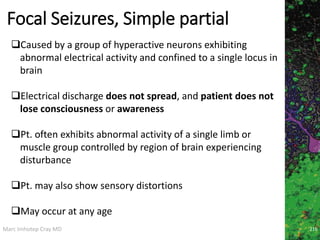
  • 21.
    Marc Imhotep CrayMD 21 Lobes of Brain (Medial view of a halved human brain) )
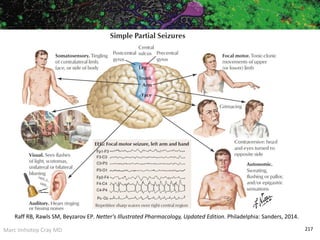
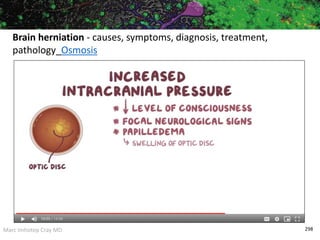
  • 22.
    Marc Imhotep CrayMD 22 Motor and Sensory Regions of Cerebrum
  • 23.
    Marc Imhotep CrayMD 23 Blood Supply to Cerebrum Artery Origin and Region Supplied Anterior cerebral artery Branches from internal carotid; supplies medial surface of brain, anterior limb of internal capsule, basal ganglia, and frontal pole Middle cerebral artery Branches from internal carotid; supplies lateral surface of brain, posterior limb of internal capsule, and basal ganglia Posterior cerebral artery Branches from basilar artery; supplies occipital pole, inferomedial temporal lobes, and the thalamus Lateral striate arteries Branches from middle cerebral artery; supplies internal capsule and basal ganglia
  • 24.
  • 25.
    Marc Imhotep CrayMD 25 Organization of human cerebral circulation The brain receives its blood supply through the right and left internal carotid as well as a pair of vertebral arteries. The arteries ultimately join the Circle of Willis, an anatomical anastomosis. Different arteries that branch off the Circle of Willis to distribute blood supply to the two cerebral hemispheres are shown (University of Miami Health System http://surgery.med.miami.edu/ima ges/Circulation_of_ brain.gif) See Video: Anatomy_Brain (Circle of Willis and Stroke)
  • 26.
    Marc Imhotep CrayMD 26 Anterior and posterior circulations meet at Circle of Willis, which rests at top of brainstem Circle of Willis Structure Circle of Willis is a part of cerebral circulation and is composed of following arteries:  Anterior cerebral artery (left and right)  Anterior communicating artery  Internal carotid artery (left and right)  Posterior cerebral artery (left and right)  Posterior communicating artery (left and right) Function  Arrangement of brain's arteries into circle of Willis creates redundancy for collateral circulation in cerebral circulation  If one part of circle becomes blocked or narrowed, blood flow from other blood vessels can often preserve cerebral perfusion well enough to avoid symptoms of ischemia See Video Mini-Lecture: Circle of Willis 3D Anatomy Tutorial
  • 27.
    Marc Imhotep CrayMD 27 Circle of Willis (2)
  • 28.
    Marc Imhotep CrayMD 28 Diagram of section of top of brain showing meninges and subarachnoid space Meninges
  • 29.
    Marc Imhotep CrayMD 29 Cerebrospinal fluid circulates in subarachnoid space around brain and spinal cord, and in ventricles of brain Cerebrospinal fluid circulation Cerebrospinal fluid has three main functions:  CSF protects brain and spinal cord from trauma  CSF supplies nutrients to nervous system tissue  CSF removes waste products from cerebral metabolism
  • 30.
    Marc Imhotep CrayMD 30 CSF circulates in spaces around & within brain
  • 31.
    Marc Imhotep CrayMD 31 Distribution of CSF
  • 32.
    Marc Imhotep CrayMD 32 4 vials of human cerebral spinal fluid of normal appearance, collected via lumbar puncture from the L3/L4 disk space.
  • 33.
    Marc Imhotep CrayMD 33 Ventricular System  A set of four interconnected cavities (ventricles or lumen) in brain  Within each ventricle is a region of choroid plexus where CSF is produced  Continuous w central canal of spinal cord from fourth ventricle, allowing for flow of CSF to circulate
  • 34.
    Marc Imhotep CrayMD 34 Ventricular System (2) System comprises four ventricles:  Lateral ventricles right and left (one for each hemisphere)  Third ventricle  Fourth ventricle
  • 35.
    Marc Imhotep CrayMD 35 MRI showing flow of CSF Images from a patient w normal pressure hydrocephalus (NPR) showing pulsations of CSF w heartbeat. Size and location of ventricular system in human head_3D Animation Online Version
  • 36.
    Marc Imhotep CrayMD 36 2-Minute Neuroscience: The Ventricles Online Version
  • 37.
    Marc Imhotep CrayMD 37 Blood Brain Barrier Blood Brain Barrier, Animation Online Version
  • 38.
    Marc Imhotep CrayMD 38 Cerebral Hemispheres_ 3D Animation Online Version
  • 39.
    Marc Imhotep CrayMD Congenital Diseases 39
  • 40.
    Marc Imhotep CrayMD Vignette 1 40 A baby boy is born via an uncomplicated vaginal delivery. You notice a large birthmark, associated with dimples and hairy tufts, at the base of his back. Upon questioning his mother, you learn that she did not take any prenatal vitamins or receive prenatal care during her pregnancy. Although the child initially appears normal, you suggest that the child be evaluated for a disorder caused by a neural tube defect and you fear that he may develop autonomic and motor deficits later in life. What is the Diagnosis?
  • 41.
    Marc Imhotep CrayMD Congenital CNS Abnormalities 41 Neural Tube Defects  Etiology: Associated with folate deficiency during initial gestation and elevated α-fetoprotein Spina bifida: Failure of posterior end of neural tube to close; results in vertebral bony defect through which meninges can herniate (meningocele) or meninges and spinal cord can herniate (meningomyelocele) resulting in neurologic symptoms; bony defect may also be asymptomatic until later in life, when neurologic symptoms appear (spina bifida occulta)  Encephalocele: Defect in cranium allows for out-pouching of brain through skull  Anencephaly: Failure of anterior end of neural tube to close; results in absence of fetal brain and often absence of overlying skull
  • 42.
    Marc Imhotep CrayMD Congenital CNS Abnormalities (2) 42 Holoprosencephaly  Pathology: Failure of embryo’s forebrain to divide into bilateral cerebral hemispheres, leading to incomplete separation of cerebral hemispheres  Clinical Manifestations: Facial and neurological defects Arnold-Chiari Malformation  Pathology: Characterized by a small posterior fossa, resulting in displacement of cerebellum and medulla through foramen magnum  Clinical manifestations: Hydrocephalus; associated strongly with thoracolumbar meningomyelocele and syringomyelia Dandy-Walker Malformation  Pathology: Characterized by large posterior fossa with replacement of cerebellar vermis with large cyst; associated with brainstem nuclei dysplasias  Clinical Manifestations: Seizures and cerebellar dysfunction
  • 43.
    Marc Imhotep CrayMD 43 First Aid for the USMLE Step1, 2020, Pg. 491. Neural tube defects  Neuropores fail to fuse (4th week) persistent connection between amniotic cavity and spinal canal  Associated with maternal diabetes and folate deficiency  Inc. α-fetoprotein (AFP) in amniotic fluid and maternal serum (except spina bifida occulta = normal AFP)  Inc. acetylcholinesterase (AChE) in amniotic fluid is a helpful confirmatory test
  • 44.
    Marc Imhotep CrayMD 44 Chiari I malformation  Ectopia of cerebellar tonsils inferior to foramen magnum (1 structure)  Congenital, usually asymptomatic in childhood, manifests in adulthood w headaches and cerebellar symptoms  Associated w spinal cavitations (eg, syringomyelia) Chiari II malformation  Herniation of cerebellar vermis and tonsils (2 structures) through foramen magnum w aqueductal stenosis noncommunicating hydrocephalus  Usually assoc. w lumbosacral myelomeningocele (may present as paralysis/sensory loss at and below level of lesion) o More severe than Chiari I, usually presents early in life Posterior fossa malformations
  • 45.
    Marc Imhotep CrayMD Vignette 2 45 A 25-year-old woman presents to your office complaining of diminished sensation in both arms. Further neurologic evaluation of her arms reveals that she has diminished pain and temperature sensation, but that her touch sensation and proprioception are intact. She demonstrates no other neurologic deficits. When a MRI reveals cystic dilation in the center of the cervical spinal cord, you refer her to a neurosurgeon for treatment of her condition. What is the Diagnosis?
  • 46.
    Marc Imhotep CrayMD Syringomyelia 46 Etiology: Often assoc. w Arnold-Chiari malformation; also caused by intraspinal neoplasms or trauma Pathology: Spinal cord: Formation of fluid-filled cavity often extending from central canal usually in cervical region of cord (most commonly C7-T1) results in destruction of adjacent gray and white matter (crossing fibers of spinothalamic tract) with resultant reactive gliosis Clinical Manifestations: Loss of pain and temperature sensation of upper extremities usually w preservation of touch and proprioception; may eventually progress to involve motor and other sensory tracts Treatment: Surgical drainage of cavity
  • 47.
    Marc Imhotep CrayMD 47 Chiari I malformation Dandy-Walker Malformation Dandy-Walker malformation  Agenesis of cerebellar vermis cystic enlargement of 4th ventricle (arrow in B ) that fills enlarged posterior fossa  Assoc. w noncommunicating hydrocephalus, spina bifida First Aid for the USMLE Step1, 2020, Pg. 491. Note: A syrinx is a fluid-filled (cystic) cavity within the spinal cord (syringomyelia) or brain stem (syringobulbia). Posterior fossa malformations (2)
  • 48.
    Marc Imhotep CrayMD 48 Syringomyelia  Cystic cavity (syrinx) within central canal of spinal cord (yellow arrows in A ); Fibers crossing in anterior white commissure (spinothalamic tract) are typically damaged first  Associated with Chiari I malformation (red arrow in A shows low-lying cerebellar tonsils), scoliosis and other congenital malformations; acquired causes include trauma and tumors  Most common location cervical > thoracic >> lumbar ( Syrinx = tube, as in “syringe.”) First Aid for the USMLE Step1, 2020, Pg. 492.
  • 49.
    Marc Imhotep CrayMD 49  Results in a “capelike,” bilateral, symmetrical loss of pain and temperature sensation in upper extremities (fine touch sensation is preserved) Syringomyelia (2) First Aid for the USMLE Step 1, 2020, Pg. 492.
  • 50.
    Marc Imhotep CrayMD 50 Hydromyelia, gross, compared with syringomyelia, microscopic Klatt EC. Robbins and Cotran Atlas of Pathology, 3rd Ed. 2015.
  • 51.
    Marc Imhotep CrayMD 51 Klatt EC. Robbins and Cotran Atlas of Pathology, 3rd Ed. 2015. Anencephaly, gross
  • 52.
    Marc Imhotep CrayMD 52 Meningomyelocele, gross Klatt EC. Robbins and Cotran Atlas of Pathology, 3rd Ed. 2015.
  • 53.
    Marc Imhotep CrayMD 53 Encephalocele, gross Klatt EC. Robbins and Cotran Atlas of Pathology, 3rd Ed. 2015.
  • 54.
    Marc Imhotep CrayMD 54 Rachischisis, gross Klatt EC. Robbins and Cotran Atlas of Pathology, 3rd Ed. 2015.
  • 55.
    Marc Imhotep CrayMD 55 Exencephaly, gross Klatt EC. Robbins and Cotran Atlas of Pathology, 3rd Ed. 2015.
  • 56.
    Marc Imhotep CrayMD 56 Arnold-Chiari I malformation, gross Klatt EC. Robbins and Cotran Atlas of Pathology, 3rd Ed. 2015.
  • 57.
    Marc Imhotep CrayMD 57 Arnold-Chiari I malformation, MRI Klatt EC. Robbins and Cotran Atlas of Pathology, 3rd Ed. 2015.
  • 58.
    Marc Imhotep CrayMD 58 Arnold-Chiari II malformation, gross Klatt EC. Robbins and Cotran Atlas of Pathology, 3rd Ed. 2015.
  • 59.
    Marc Imhotep CrayMD 59 Dandy-Walker malformation, gross Klatt EC. Robbins and Cotran Atlas of Pathology, 3rd Ed. 2015.
  • 60.
    Marc Imhotep CrayMD 60  Failure of neuronal migration resulting in a “smooth brain” that lacks sulci and gyri  May be associated with microcephaly, ventriculomegaly Lissencephaly Klatt EC. Robbins and Cotran Atlas of Pathology, 3rd Ed. 2015.
  • 61.
    Marc Imhotep CrayMD 61 Alobar holoprosencephaly, gross  Failure of embryonic forebrain (prosencephalon) to separate into 2 hemispheres;  Occurs during weeks 5-6; May be related to mutations in sonic hedgehog signaling pathway; Assoc. w other midline defects including cleft lip/palate (moderate form) and cyclopia (severe form) ; inc. risk for pituitary dysfunction (eg, diabetes insipidus);  Can be seen with Patau syndrome (trisomy 13) Klatt EC. Robbins and Cotran Atlas of Pathology, 3rd Ed. 2015.
  • 62.
    Marc Imhotep CrayMD 62 Holoprosencephaly Klatt EC. Robbins and Cotran Atlas of Pathology, 3rd Ed. 2015.
  • 63.
    Marc Imhotep CrayMD Vignette 3 63 A 6-year-old boy presents to your office complaining of red nodules that have appeared on his face. He is mentally retarded and has a seizure disorder. His mother suffers from similar symptoms and has recently been diagnosed with a rhabdomyoma of the heart and renal angiomyolipomas. You begin to suspect that this boy is suffering from an autosomal dominant genetic disorder. What is the Diagnosis?
  • 64.
    Marc Imhotep CrayMD Tuberous Sclerosis 64  Etiology: Autosomal dominant disorder resulting from a mutation in one of several different genes  Tumor suppressor genes TSC1 on chromosome 9 (hamartin), TSC2 on chromosome 16 (tuberin)  Pathology: Brain hamartoma (cortical tuber): Firm nodule located in cerebral cortex composed of disorganized array of neurons with large vesicular nuclei and eosinophilic cytoplasm  Also assoc. w neoplasms occurring outside CNS, including cardiac rhabdomyomas, adenoma sebaceum of face (lesion consisting of malformed blood vessels), renal angiomyolipomas (lesion consisting of malformed blood vessels, adipocytes, and smooth muscle), and cysts of bone and lung
  • 65.
    Marc Imhotep CrayMD Tuberous Sclerosis (2) Clinical Manifestations: Seizures and mental retardation in infancy; red nodules on face (adenoma sebaceum), which appear betw. ages of 5 and 10; symptoms related to cardiac rhabdomyoma and renal angiomyolipoma Treatment: Symptomatic (control seizures); genetic counseling Patient with facial angiofibromas caused by tuberous sclerosis CT showing multiple angiomyolipomas of kidney in a patient with suspected TSC 65
  • 66.
    Marc Imhotep CrayMD 66 Klatt EC. Robbins and Cotran Atlas of Pathology, 3rd Ed. 2015. Tuberous sclerosis, gross
  • 67.
    Marc Imhotep CrayMD 67 HAMARTOMASS Hamartomas in CNS and skin, Angiofibromas (C), Mitral regurgitation, Ash-leaf spots (D), cardiac Rhabdomyoma, (Tuberous sclerosis), autosomal dOminant; Mental retardation (intellectual disability), renal Angiomyolipoma (E) , Seizures, Shagreen patches. Tuberous sclerosis First Aid for the USMLE Step1, 2020, Pg. 525.
  • 68.
    Marc Imhotep CrayMD 68 A 1-year-old girl develops seizures, ash-leaf pigmented lesions on the trunk, sebaceous adenomas, and a shagreen patch (flesh- colored soft plaque) on her lumbosacral region. What is the diagnosis? Check Up A 40-year-old woman complains of occipital headaches, weakness/numbness in her hands and feet, and has downbeat nystagmus on physical examination. An MRI shows tonsillar herniation below the foramen magnum. What is the diagnosis?
  • 69.
    Marc Imhotep CrayMD Degenerative Disorders 69
  • 70.
    Marc Imhotep CrayMD CNS Neurodegenerative diseases 70 Neurodegenerative diseases of CNS include:  Parkinson’s disease  Huntington disease  Alzheimer’s disease  Multiple Sclerosis (MS)  Amyotrophic Lateral Sclerosis (ALS) These devastating illnesses are characterized by progressive loss of selected neurons in discrete brain areas, resulting in characteristic disorders of movement, cognition, or both
  • 71.
    Marc Imhotep CrayMD Basal Nuclei (Ganglia) 71 Components  Caudate nucleus  Putamen  Globus pallidus Grouping of the Basal Nuclei (Ganglia)  The striatum consists of caudate nucleus and putamen  The lentiform nucleus consists of globus pallidus and putamen  The corpus striatum consists of lentiform nucleus and caudate nucleus NB: Basal Nuclei The term basal ganglia is a misnomer. The cells forming these structures are not “ganglia”—a term reserved to describe aggregations of neuronal cell bodies[somata] (groups of nerve cell bodies ) in the peripheral nervous system—but “nuclei” in the central nervous system.
  • 72.
    Marc Imhotep CrayMD Vignette 4 72 A 78-year-old woman is brought to your clinic by her son and daughter. They tell you that she has been very forgetful lately and has twice wandered out of her house and gotten lost, requiring the police to bring her back. Upon speaking with the woman, you note that her short-term memory is compromised and that she has trouble finding the words to express what she wants to say. An MRI of the brain does not reveal any evidence of a stroke. You suspect that a biopsy of this woman’s brain would reveal neuritic plaques and neurofibrillary tangles. What is the Diagnosis?
  • 73.
    Marc Imhotep CrayMD Dementia Dementia is a progressive global decline in intellectual capacity that occurs with increasing frequency with advancing age Two most commonly encountered forms are  Alzheimer’s disease (AD) (sometimes familial) and  Vascular (multi-infarct) dementia (VaD)  Less common dementias are Huntington’s disease (an inherited condition) and Pick’s disease 73
  • 74.
    Marc Imhotep CrayMD Alzheimer disease 74 Etiology and Epidemiology: Etiology unknown, but theories involve abnormal expression of amyloid gene resulting in increased amyloid beta (Aβ protein), deficiency of choline acetyltransferase leading to decreased acetylcholine levels, or atrophy of nucleus basalis of Meynert  Familial Alzheimer disease involves o mutations in amyloid precursor protein (APP) gene on chr 21, o mutations in presenilin genes (chr 1,14), and o Ɛ 4 allele of apolipoprotein E (chr 19)  Affects 50% of people > 85 years old NB: Lewy body dementia, also known as dementia w Lewy bodies, is second most common type of progressive dementia after AD dementia. Protein deposits, called Lewy bodies, develop in nerve cells in brain regions involved in thinking, memory and movement (motor control).
  • 75.
    Marc Imhotep CrayMD Alzheimer disease (2) 75  Pathology  Gross: Cortical atrophy of brain with widening of sulci and ventricles  Microscopic: Neurofibrillary tangles composed of tau protein within cytoplasm that displace nucleus; neuritic plaques (spherical cluster with Aβ protein core and peripheral astrocytes); amyloid angiopathy; Hirano bodies (eosinophilic bodies in hippocampal cells); granulovacuolar degeneration (cytoplasmic vacuoles in hippocampal cells) NB: The hippocampus is area of brain demonstrating greatest degree of atrophy in Alzheimer's disease Hippocampal atrophy on MRI is highly suggestive of the diagnosis
  • 76.
    Marc Imhotep CrayMD 76 Alzheimer Disease Pathology Buja, LM; Krueger GR. Netter’s Illustrated Human Pathology 2nd Ed. Illustrations by Frank H. Netter, MD. Philadelphia, PA: Saunders- Elsevier, 2014; Pg. 482, Fig. 13-38.
  • 77.
    Marc Imhotep CrayMD Alzheimer disease (3) 77 Clinical Manifestations: Dementia presenting with progressive memory disturbances, disorientation, aphasias, visuospatial deficits, loss of motor skills or incontinence  Initial symptoms: Impairments involving recent memory  Treatment and Prognosis  Donepezil (acetylcholinesterase inhibitor) to slow progression  Progressive disease with no cure Note: Pick disease also causes dementia, but tends to affect women more than men  Histopathologically, characterized by cortical atrophy of frontotemporal lobes and Pick bodies (cytoplasmic inclusion bodies made of neurofilaments)  Initial symptoms: personality & behavioral changes (apathy, socially inappropriate behavior)
  • 78.
    Marc Imhotep CrayMD 78 Widespread cortical atrophy (normal cortex B ; cortex in Alzheimer disease C ), especially hippocampus (arrows in B and C ). Narrowing of gyri and widening of sulci. Senile plaques D in gray matter: extracellular β-amyloid core; may cause amyloid angiopathy intracranial hemorrhage; Aβ (amyloid-β) synthesized by cleaving amyloid precursor protein (APP). Neurofibrillary tangles E : intracellular, hyperphosphorylated tau protein = insoluble cytoskeletal elements; number of tangles correlates with degree of dementia. Hirano bodies—intracellular eosinophilic proteinaceous rods in hippocampus  Most common cause of dementia in elderly  Down syndrome patients have inc. risk of developing Alzheimer disease, as APP is located on chromosome 21; dec. ACh. Alzheimer disease (4) Associated with following altered proteins:  ApoE-2: dec. risk of sporadic form  ApoE-4: inc. risk of sporadic form  APP, presenilin-1, presenilin-2: familial forms (10%) with earlier onset Adapted from: Le T ; Bhushan V. First Aid for the USMLE Step 1 2020. McGraw-Hill, 2020, Pg. 520-21.
  • 79.
    Marc Imhotep CrayMD 79 Alzheimer disease, gross Klatt EC. Robbins and Cotran Atlas of Pathology, 3rd Ed. 2015.
  • 80.
    Marc Imhotep CrayMD 80 Alzheimer disease, microscopic Klatt EC. Robbins and Cotran Atlas of Pathology, 3rd Ed. 2015.
  • 81.
    Marc Imhotep CrayMD 81 Alzheimer disease, microscopic Klatt EC. Robbins and Cotran Atlas of Pathology, 3rd Ed. 2015.
  • 82.
    Marc Imhotep CrayMD 82 Pick disease, gross  Frontotemporal dementia: Formerly called Pick disease  Early changes in personality and behavior (behavioral variant), or aphasia (primary progressive aphasia)  May have associated movement disorders Klatt EC. Robbins and Cotran Atlas of Pathology, 3rd Ed. 2015.
  • 83.
    Marc Imhotep CrayMD 83 Q&A Check-Up A 54-year-old man is brought to the physician by his daughter. She says that her father has been acting strangely over the past 2 years. He makes inappropriate sexual jokes, has little regard for social rules, is often irritable, and is borderline aggressive at times. The patient denies that his personality is any different from normal. When speaking with the patient, the physician notices that he has minimal verbal output and repeats "it is what it is" when asked questions about his strange behavior. On physical examination, he appears unkempt but otherwise has no significant findings. This patient most likely has a condition involving which of the following? A. Caudate nucleus B. Frontal cortex C. Hippocampus D. Parietal cortex E. Substantia nigra F. Subthalamic nucleus
  • 84.
    Marc Imhotep CrayMD 84 Answer Important structures in the frontal lobe include the motor cortex, Broca's speech area, frontal eye fields, and the prefrontal cortex. Lesions involving the prefrontal cortex cause inappropriate behavior, impaired judgment, and poor problem-solving skills (executive dysfunction). Incontinence and gait disturbances may also be seen. Frontotemporal dementia (Pick's disease) is characterized by degeneration of the frontal lobes that eventually progresses to include the temporal lobes. Characteristic symptoms include early personality and behavioral changes (eg, disinhibition, apathy, social inappropriateness, compulsive behaviors) and altered speech patterns (eg, paucity of speech, repeated phrases). Neurocognitive deficits occur later in the course of the illness. When evaluating a patient with dementia, frontotemporal dementia should be differentiated from the more common Alzheimer disease, which presents initially with impairment involving recent memory. Source: UWorld Step 1, 2015. Neurology/Pathology Q#40
  • 85.
    Marc Imhotep CrayMD 85 Comparison of frontotemporal dementia & AD
  • 86.
    Marc Imhotep CrayMD Vignette 5 86 A 48-year-old man presents to your clinic complaining of involuntary movements of his arms and legs. He tells you that his mother had similar symptoms, which eventually progressed to dementia. Physical examination and history reveal involuntary jerky movements, flattened affect, and poor concentration. When an MRI of the brain demonstrates atrophy of the caudate nucleus and putamen as well as dilatation of the ventricles, you fear that this patient will eventually succumb to the same dementia as his mother. What is the Diagnosis?
  • 87.
    Marc Imhotep CrayMD Huntington Disease 87 Etiology: Autosomal dominant disorder associated with increased number of CAG repeats in Huntington disease gene on chr 4 Pathology  Gross: Atrophy of caudate nucleus and putamen; may also see atrophy of globus pallidus and frontal lobe; dilation of lateral and third ventricles  Microscopic: Loss of striatal neurons (GABAergic neurons); fibrillary gliosis
  • 88.
    Marc Imhotep CrayMD Huntington Disease (2) 88 Clinical Manifestations:  Progressive disorder that initially manifests betw. ages of 40 and 50; chorea (involuntary jerky movements); cognitive impairment; mood disturbances  Eventually progresses to severe dementia Treatment and Prognosis:  Symptomatic treatment for dyskinesia and mood disturbances  Usually fatal within 15–20 years of diagnosis Note: HD, as well as fragile X syndrome and myotonic dystrophy, demonstrates anticipation a phenomenon in which number of repeats increases w each generation and results in more severe disease manifestations
  • 89.
    Marc Imhotep CrayMD 89 Buja, LM; Krueger GR. Netter’s Illustrated Human Pathology 2nd Ed. Illustrations by Frank H. Netter, MD. Philadelphia, PA: Saunders- Elsevier, 2014; Pg. 484, Fig. 13-40.  Chorea is a term applied to rapid, complex, and varied movements of body, especially distal limbs  DDx includes Sydenham chorea (ARF), SLE, chorea gravidarum (in pregnant women), drug effects, and Huntington chorea o Abnormal facial & limb movements, behavioral disturbances, and progressive dementia characterize HD o HD is a degenerative disorder w an autosomal dominant inheritance pattern, w onset usually after age of 40 years o Genetic mutation is carried by approx. 50% of offspring o Autopsy reveals severe shrinkage of caudate nucleus & cortical atrophy, especially of frontal lobes
  • 90.
    Marc Imhotep CrayMD 90 Huntington disease, gross Klatt EC. Robbins and Cotran Atlas of Pathology, 3rd Ed. 2015.
  • 91.
    Marc Imhotep CrayMD Vignette 6 91 A 64-year-old man presents to your neurology clinic complaining of unsteadiness. As you obtain a history from this patient, you notice that he has expressionless facies and a pill-rolling tremor at rest. Physical examination reveals a shuffling gait, rigidity in response to passive movement, and bradykinesia. You suspect that the neurons of his substantia nigra may contain Lewy bodies and you prescribe levodopa to treat his symptoms. What is the Diagnosis?
  • 92.
    Marc Imhotep CrayMD Parkinson Disease 92 Etiology and Epidemiology: Etiology unknown; Usually presents in people over age of 50 Pathology and Pathophysiology  Gross: Pale substantia nigra and locus ceruleus  Microscopic: Loss of pigmented dopaminergic neurons in substantia nigra with gliosis; Lewy bodies (eosinophilic, intracytoplasmic inclusion bodies) in substantia nigra neurons  Pathophysiology: Loss of dopaminergic input to striatum results in loss of stimulation of basal ganglia motor circuit NB: Lewy body dementia, also known as dementia w Lewy bodies, is second most common type of progressive dementia after AD dementia. Protein deposits, called Lewy bodies, develop in nerve cells in brain regions involved in thinking, memory and movement (motor control).
  • 93.
    Marc Imhotep CrayMD 93 Neuropathology of Parkinson Disease:  In addition to an abundance of inhibitory dopaminergic neurons, neostriatum is also rich in excitatory cholinergic neurons that oppose action of dopamine  Many of symptoms of parkinsonism reflect an imbalance between excitatory cholinergic neurons and diminished number of inhibitory dopaminergic neurons Raff RB, Rawls SM, Beyzarov EP. Netter's Illustrated Pharmacology, Updated Edition. Philadelphia: Sanders, 2014.
  • 94.
    Marc Imhotep CrayMD Parkinson Disease 94  Clinical Manifestations: Symptom constellation of pill- rolling tremor, bradykinesia, shuffling gait, rigidity, postural instability, and expressionless facies (all together known as parkinsonism)  Of patients with Parkinson disease, 10%–15% develop dementia  Treatment Pharmacologic therapy (amantadine, anticholinergics, levodopa, dopamine agonists, MAO-B inhibitors) Note: Other causes for parkinsonism include repeated trauma (as w boxers), drugs (especially MPTP), postencephalitic parkinsonism (observed after influenza pandemic in early 1900s), and Shy-Drager syndrome (parkinsonism w orthostatic hypotension and autonomic dysfunction)
  • 95.
    Marc Imhotep CrayMD Parkinsonism: Symptoms and Defect 95 Parkinsonism is a progressive neurodegenerative disease that adversely affects motor neuron control:  Major early symptoms are:  tremor at rest; bradykinesia ;muscle rigidity (cogwheel) and flat facial affect If untreated, condition worsens, leading eventually to complete immobility and early mortality Prevalence is approximately 2% in persons older than 65 years A genetic predisposition likely, but environmental factors (including viral infections and neurotoxins) may play a role
  • 96.
    Marc Imhotep CrayMD 96 Clinical Signs of Parkinson’s Disease: Raff RB, Rawls SM, Beyzarov EP. Netter's Illustrated Pharmacology, Updated Edition. Philadelphia: Sanders, 2014.
  • 97.
    Marc Imhotep CrayMD 97 Parkinsonism: Symptoms and Defect (2) Most distinctive neuropathologic finding is progressive loss of dopaminergic neurons of pars compacta of substantia nigra Projections of dopaminergic neurons from substantia nigra correlate with motor and cognitive deficits Degeneration of dopaminergic neurons in nigrostriatal tract causes loss of inhibitory dopamine action on striatal GABAergic neurons and leads to excessive cholinergic neuron excitation of these striatal neurons Drugs such as levodopa (increases DA activity) can help Whalen K (Ed). Lippincott Illustrated Reviews-Pharmacology 6TH Edn. LLW, 2015.
  • 98.
    Marc Imhotep CrayMD Vignette 7 98 A 47-year-old man presents to your clinic complaining of weakness in his hands. He states that he has been frequently dropping objects and is unable to perform fine motor tasks. Physical examination reveals a positive Babinski sign, hyperreflexia, atrophy, diminished strength in the muscles of the hands and calves, and fasciculations. You fear that this patient has a progressive condition, which will ultimately result in his death from respiratory failure in the near future. What is the Diagnosis?
  • 99.
    Marc Imhotep CrayMD Amyotrophic Lateral Sclerosis 99  Etiology and Epidemiology: Etiology of sporadic ALS unknown; 5%–10% of cases are familial with autosomal dominant inheritance of a defect on chr 21 or w a defect in SOD-1 (gene product involved in scavenging free radicals); Most commonly affects men over age of 40  Pathology: Progressive disease assoc. w loss of both upper and lower motor neurons  Spinal cord: Reduced number of anterior horn neurons w reactive gliosis; degeneration of corticospinal tract neurons  Muscle: Neurogenic atrophy w target fibers (fibers w dark center area on cross-section)
  • 100.
    Marc Imhotep CrayMD ALS (2) 100 Clinical Manifestations:  Lower motor neuron signs: Atrophy of muscles; fasciculations  Upper motor neuron signs: Hyperreflexia; positive Babinski sign; spasticity  Lower and upper motor neuron degeneration tends to present initially with weakness of hands or cramping and spasticity of arms and legs  Involvement of respiratory muscles leads to lung infections and eventually death  Treatment and Prognosis:  Supportive care  Death from respiratory failure usually occurs within 5 years of diagnosis Note: Werdnig-Hoffmann syndrome is an autosomal recessive disease that affects lower motor neurons and is assoc. w degeneration of anterior horns It presents at infancy w tongue fasciculations and “floppy baby”
  • 101.
    Marc Imhotep CrayMD 101 Amyotrophic lateral sclerosis, gross Klatt EC. Robbins and Cotran Atlas of Pathology, 3rd Ed. 2015.
  • 102.
    Marc Imhotep CrayMD 102 Amyotrophic lateral sclerosis, micro Klatt EC. Robbins and Cotran Atlas of Pathology, 3rd Ed. 2015.
  • 103.
    Marc Imhotep CrayMD Demyelinating Disorders 103
  • 104.
    Marc Imhotep CrayMD Vignette 8 104 A 27-year-old Caucasian woman presents to your office complaining of visual disturbances. During physical examination, you note that on lateral gaze, one eye does not adduct and the other eye has nystagmus on abduction. Testing of cerebellar function reveals an intention tremor and you also note decreased sensation on both legs. You obtain CSF fluid via a lumbar puncture and find multiple oligoclonal bands of IgG on electrophoresis. You order an MRI of the brain and refer the patient to a neurologist for further care of her condition. What is the Diagnosis?
  • 105.
    Marc Imhotep CrayMD Multiple Sclerosis 105 Etiology and Epidemiology: Etiology unknown, although autoimmune, genetic, and environmental factors have been implicated;  Incidence increases proportionally with distance from equator and incidence is more common in HLA-DR2 individuals;  Most often presents in Caucasian women betw. ages of 20 and 30 Pathology:  CNS: Multiple firm plaques representing demyelination within white matter of CNS, especially in optic nerve, brainstem, and periventricular areas  Microscopic plaque: Depletion of oligodendrocytes; monocytes, lymphocytes, and lipid-laden macrophages around vessels; gliosis and astrocyte proliferation
  • 106.
    Marc Imhotep CrayMD Multiple Sclerosis (2) 106 Clinical Manifestations: Relapsing and remitting course, but eventually remissions become incomplete;  classic Charcot triad: nystagmus, scanning speech, and intention tremor;  motor and sensory impairment of trunk and extremities (hemiparesis, ataxia);  visual impairment (optic neuritis, retrobulbar neuritis, internuclear ophthalmoplegia [on lateral gaze, one eye does not adduct and abducting eye has nystagmus caused by demyelination of MLF]); urinary/bowel incontinence owing to loss of sphincter control  Lab findings: Lumbar puncture shows mild lymphocytosis and elevated IgG, manifested as multiple oligoclonal bands on electrophoresis Treatment: Corticosteroids and other immunosuppressants
  • 107.
    Marc Imhotep CrayMD 107 Multiple sclerosis, gross Klatt EC. Robbins and Cotran Atlas of Pathology, 3rd Ed. 2015.
  • 108.
    Marc Imhotep CrayMD 108 Multiple sclerosis, MRI Klatt EC. Robbins and Cotran Atlas of Pathology, 3rd Ed. 2015.
  • 109.
    Marc Imhotep CrayMD 109 Multiple sclerosis, microscopic Klatt EC. Robbins and Cotran Atlas of Pathology, 3rd Ed. 2015.
  • 110.
    Marc Imhotep CrayMD Vignette 9 110 A 29-year-old man presents to the emergency room complaining of muscle weakness. He tells you that the weakness began in his calves and has now ascended to involve his thighs, hips, torso, and arms. Upon directed history, you learn that he recently recovered from a flu-like illness. Physical examination reveals symmetrical muscle weakness in all limbs and absent deep tendon reflexes. A lumbar puncture demonstrates an albumino-cytologic dissociation of the CSF. You admit this patient to the intensive care unit for observation as you fear that he may need mechanical respiratory support for his condition. What is the Diagnosis?
  • 111.
    Marc Imhotep CrayMD Guillain-Barre Syndrome 111 Etiology: Usually occurs after a flu-like viral illness (eg, EBV, HSV, CMV), but has also been associated with surgical procedures and bacterial infections (mycoplasma, campylobacter) Pathology and Pathophysiology:  Pathophysiology: Viral illness causes a T-cell-mediated immune reaction that results in demyelination of peripheral nerves  Peripheral nerves: Endoneurial and perivenular infiltration by lymphocytes and macrophages; segmental demyelination
  • 112.
    Marc Imhotep CrayMD Guillain-Barre Syndrome (2) 112 Clinical Manifestations: Ascending muscle weakness and paralysis beginning in distal lower limbs; absent deep tendon reflexes; sometimes sensory loss in extremities; facial diplegia; abnormal autonomic function (dysrhythmias, labile blood pressure)  Can progress to respiratory failure or become chronic (chronic inflammatory demyelinating polyradiculoneuropathy)  Lab findings: Lumbar puncture shows albumino cytologic dissociation of CSF (large protein content increase accompanied by only a mild cell count increase)
  • 113.
    Marc Imhotep CrayMD Guillain-Barre Syndrome (3) 113 Treatment and Prognosis:  Plasmapheresis;  IV immunoglobulin;  Supportive care (respiratory support until recovery)  Px Most pts recover after weeks to months, but 10%–20% are left w permanent disability DDx: Postinfectious encephalitis can follow viral illnesses (eg, chicken pox, rubella, measles, mumps) and is characterized by transient, widespread demyelination.
  • 114.
    Marc Imhotep CrayMD 114 Guillain-Barré neuropathy, microscopic Klatt EC. Robbins and Cotran Atlas of Pathology, 3rd Ed. 2015.
  • 115.
    Marc Imhotep CrayMD 115 Demyelination, electron microscopy Klatt EC. Robbins and Cotran Atlas of Pathology, 3rd Ed. 2015.
  • 116.
    Marc Imhotep CrayMD Cerebrovascular Disease 116
  • 117.
    Marc Imhotep CrayMD Vignette 10 117 A 74-year-old woman is brought to the emergency department after developing left-sided paralysis 1 hour ago. Further evaluation reveals left-sided sensory and motor paralysis, left-sided hyperreflexia, left-sided Babinski reflex, and bilateral symmetric loss of vision in half of her visual fields. When you hear that she has a history of atherosclerosis, you become even more certain of your diagnosis. After obtaining a CT scan of the head to confirm that she does not have a head bleed, you immediately begin to administer thrombolytic therapy. What is the Diagnosis?
  • 118.
    Marc Imhotep CrayMD Stroke (CVA) Capsule CVA present clinically as sudden neurological defects and may be caused by  intracranial hemorrhage (hemorrhagic stroke) (e.g. subarachnoid or intracranial hemorrhage) or  cerebral infarction (usually secondary to thrombotic [ischemic stroke] or embolic occlusion of a carotid or intracranial artery) embolic stroke Strokes may lead to death or permanent severe neurological defects but modern therapies can result in remarkable clinical recovery 118
  • 119.
    Marc Imhotep CrayMD Ischemic Stroke 119 Etiology: Causes include thrombosis, embolism, dissection, vasculitis, or hypotension Pathology: i. Cerebral infarction: Associated with thrombosis or embolism  Ischemic neuronal change (nuclear pyknosis, eosinophilic cytoplasm) within 12 hours;  microglia and monocyte infiltration within 2 days;  liquefactive necrosis leading to fluid-filled cavity and reactive astrocytes by 1–3 weeks; gliosis (scar formation) after several months  may convert to hemorrhagic infarction, in which blood seeps into infarction and is reabsorbed
  • 120.
    Marc Imhotep CrayMD Ischemic Stroke (2) 120 Pathology cont’ed: ii. Watershed infarction: Assoc. w hypotension; see wedge-shaped infarction occurring at edge of area supplied by artery  usually occurs in area betw. ACA and MCA distribution iii.Lacunar infarcts: Assoc. w hypertension and thrombotic obstruction of small vessels  see small cavitations with surrounding gliosis
  • 121.
    Marc Imhotep CrayMD Ischemic Stroke (3) 121 Clinical Manifestations: Depends on site of ischemia and extent of collateral circulation  ACA: Sensory loss and weakness in contralateral leg  MCA: Contralateral paralysis and sensory loss; homonymous hemianopia (bilateral symmetric loss of vision in half of visual field); aphasias  PCA: Contralateral sensory disturbance; macular-sparing homonymous hemianopia  Lateral striate arteries: Contralateral paralysis
  • 122.
    Marc Imhotep CrayMD Ischemic Stroke (4) 122  Treatment:  Thrombolytic therapy within 3 hours of onset;  Antiplatelet therapy (aspirin, dipyridamole);  Physical therapy;  Statins for cholesterol-lowering effects Note: Transient Ischemic Attack refers to neurologic deficits caused by cerebral ischemia that resolves within 24 hours suggests pt. is at high risk for having a stroke in near future
  • 123.
    Marc Imhotep CrayMD 123 A 66-year-old Caucasian male with a history of atrial fibrillation develops right-sided weakness and numbness, with his arm more severely affected than his leg. He understands everything that is said to him, but cannot speak. An embolus has most likely occluded which of the following arteries? A. Right middle cerebral artery B. Left anterior cerebral artery C. Left middle cerebral artery D. Anterior inferior cerebellar artery E. Posterior cerebellar artery Check-Up Question Source: USMLEWorld, 2015. Neurology/Pathology Q#23.
  • 124.
    Marc Imhotep CrayMD 124 This patient displays the symptoms characteristic for a hemispheric stroke. Hemiparesis, with more involvement of the arm than the leg, occurs due to the occlusion of the middle cerebral artery (MCA). This artery supplies the face and arm areas of the motor and sensory cortex, Broca's and Wernicke's speech areas, and the frontal eye field. The MCA also gives rise to the small, penetrating branches that perfuse the internal capsule and basal ganglia. Along with hemiparesis, this patient has Broca's (expressive) aphasia, which manifests with an inability to speak or write, but preserved comprehension of the spoken and written word. Broca's area is located in the inferior frontal gyrus in the dominant (left) hemisphere and is supplied by the left middle cerebral artery. Contrary to popular belief, the left hemisphere of the brain is most often dominant in both right-handed and left-handed people. Educational Objective: Hemiparesis with the arm affected more than the leg occurs due to occlusion of the middle cerebral artery (MCA). If the occluded MCA is in the dominant hemisphere (usually the left), aphasia may also occur. Answer C: Left middle cerebral artery
  • 125.
    Marc Imhotep CrayMD 125 Acute cerebral ischemia, CT image Klatt EC. Robbins and Cotran Atlas of Pathology, 3rd Ed. 2015.
  • 126.
    Marc Imhotep CrayMD 126 Watershed infarction, gross Klatt EC. Robbins and Cotran Atlas of Pathology, 3rd Ed. 2015.
  • 127.
    Marc Imhotep CrayMD 127 Lacunar infarction, gross Klatt EC. Robbins and Cotran Atlas of Pathology, 3rd Ed. 2015.
  • 128.
    Marc Imhotep CrayMD 128 Cerebral acute infarction, MRI Klatt EC. Robbins and Cotran Atlas of Pathology, 3rd Ed. 2015.
  • 129.
    Marc Imhotep CrayMD 129 Cerebral subacute infarction, gross Klatt EC. Robbins and Cotran Atlas of Pathology, 3rd Ed. 2015.
  • 130.
    Marc Imhotep CrayMD 130 Subacute infarction, microscopic Klatt EC. Robbins and Cotran Atlas of Pathology, 3rd Ed. 2015.
  • 131.
    Marc Imhotep CrayMD 131 Cerebral remote infarction, gross Klatt EC. Robbins and Cotran Atlas of Pathology, 3rd Ed. 2015.
  • 132.
    Marc Imhotep CrayMD 132 Cerebral remote infarction, CT image Klatt EC. Robbins and Cotran Atlas of Pathology, 3rd Ed. 2015.
  • 133.
    Marc Imhotep CrayMD Vignette 11 133 A 67-year-old man presents to the emergency department after passing out on the sidewalk. When he is revived, he complains of a severe headache and nausea. Past medical history is significant for long-standing hypertension. Physical examination reveals right-sided hemiparesis. You think that this man’s condition may be related to his high blood pressure, which may have caused the formation of Charcot- Bouchard microaneurysms. A CT scan of the head confirms your suspicions. What is the Diagnosis?
  • 134.
    Marc Imhotep CrayMD Hypertension 134  Hypertension is common, often asymptomatic and has many causes including  Stress  Obesity  Renal artery stenosis and  Hormonal defects such as Cushing’s syndrome and Conn’s syndrome  Chronic hypertension is characterized by an imbalance in sodium and water homeostasis  Untreated hypertension can lead to accelerated atherosclerosis and to end-organ damage, including hypertensive nephropathy, hypertensive heart disease and intracerebral hemorrhage
  • 135.
    Marc Imhotep CrayMD Hemorrhagic Stroke 135 Etiology: Most commonly caused by hypertension; other causes include bleeding disorders, arteriovenous malformations, brain tumors, or amyloid angiopathy Pathology and Pathophysiology:  Pathophysiology Chronic hypertension is associated with Charcot- Bouchard microaneurysms are usually located within basal ganglia  Rupture of these aneurysms may be proximal cause of hemorrhage  Brain: Hemorrhage usually located in basal ganglia or thalamus; central area of blood surrounded by edematous brain tissue → edema resolves and reactive astrocytes and macrophages appear at edge of the injury → gliosis
  • 136.
    Marc Imhotep CrayMD Hemorrhagic Stroke (2) 136 Clinical Manifestations: Impairment of consciousness; nausea and vomiting; headache; neurologic deficits (especially hemiparesis and sometimes hemisensory disturbance) Treatment:  Reverse any coagulopathies  Strict blood pressure control  surgical decompression if necessary for large intracranial hemorrhage
  • 137.
    Marc Imhotep CrayMD 137 Cerebral hypertensive hemorrhage, gross Klatt EC. Robbins and Cotran Atlas of Pathology, 3rd Ed. 2015.
  • 138.
    Marc Imhotep CrayMD Vascular (multi-infarct) dementia, gross  Multiple vascular events, including embolic arterial occlusion, atherosclerosis with vascular narrowing and thrombosis, and hypertensive arteriolar sclerosis may lead to focal but additive loss of cerebral tissue  Cumulative effect of multiple small areas of infarction ( ) may result in clinical findings equivalent to AD along with focal neurologic deficits or gait disturbances  Vascular dementia marked by loss of higher mental function in a stepwise, not continuous, fashion Klatt EC. Robbins and Cotran Atlas of Pathology, 3rd Ed. Philadelphia: Saunders, 2015. 138
  • 139.
    Marc Imhotep CrayMD 139 Cerebral hypertensive hemorrhage, CT image Klatt EC. Robbins and Cotran Atlas of Pathology, 3rd Ed. 2015.
  • 140.
    Marc Imhotep CrayMD Vignette 12 140 A 44-year-old woman presents to the emergency department complaining of nausea and the worst headache of her life. Upon further questioning, you learn that she is a heavy smoker and she has a history of poorly controlled hypertension. You decide to perform a lumbar puncture, which reveals blood in the CSF. A CT scan of the head demonstrates blood in the basal cisterns. You immediately admit her to the hospital for a cerebral angiography in order to evaluate for the best treatment of her condition. What is the Diagnosis?
  • 141.
    Marc Imhotep CrayMD Berry Aneurysm and Subarachnoid Hemorrhage 141 Etiology and Epidemiology: Causes of subarachnoid hemorrhage include rupture of berry aneurysm, trauma, and arteriovenous malformation  Most berry aneurysms occur sporadically, but risk factors include hypertension, cigarette smoking, coarctation of aorta, APKD, connective tissue disorders, and neurofibromatosis type 1  Rupture of berry aneurysms occurs more frequently in women and in those over the age of 40 Pathology:  Subarachnoid hemorrhage: Blood in subarachnoid space; fibrosis, occurring after resolution, may lead to CSF obstruction  Berry aneurysm: Often occur at arterial bifurcations of circle of Willis; outpouching of arterial wall with intimal thickening and media thinning at neck of aneurysm; media is absent in sac wall
  • 142.
    Marc Imhotep CrayMD Berry Aneurysm and Subarachnoid Hemorrhage (2) 142  Clinical Manifestations: Subarachnoid hemorrhage: “Worst headache of my life;” N & V; loss of consciousness, may have fever or nuchal rigidity, can be fatal  Lab findings: Lumbar puncture reveals blood in CSF  Imaging: CT scan demonstrates blood in basal cisterns  Treatment: Surgical repair; supportive care; therapeutic approach depends on cerebral angiography Note: Arteriovenous malformations are congenital vascular malformations usually localized to subarachnoid space, but may extend into brain tissue manifest clinically in young adults as seizures or hemorrhage
  • 143.
    Marc Imhotep CrayMD 143 Berry aneurysm, gross Klatt EC. Robbins and Cotran Atlas of Pathology, 3rd Ed. 2015.
  • 144.
    Marc Imhotep CrayMD 144 Berry aneurysm, angiogram Klatt EC. Robbins and Cotran Atlas of Pathology, 3rd Ed. 2015.
  • 145.
    Marc Imhotep CrayMD 145 Subarachnoid hemorrhage, gross Klatt EC. Robbins and Cotran Atlas of Pathology, 3rd Ed. 2015.
  • 146.
    Marc Imhotep CrayMD 146 Vascular malformation, gross Klatt EC. Robbins and Cotran Atlas of Pathology, 3rd Ed. 2015.
  • 147.
    Marc Imhotep CrayMD Vignette 13 147 A 78-year-old woman is brought to the emergency department by her son because of headaches and altered mental status. He tells you that the patient fell down the stairs 2 weeks ago, but that she appeared fine immediately after the fall. Physical examination reveals bilateral papilledema. When a CT scan of the head reveals a 3-cm crescent-shaped collection of fluid on the right side of the head that crosses suture lines with a 7-mm midline shift, you suspect that her current condition is related to tearing of the bridging veins between the cerebrum and venous sinuses in the dura and you schedule her for immediate surgical drainage of the blood. What is the Diagnosis?
  • 148.
    Marc Imhotep CrayMD Epidural and Subdural Hematoma 148 Etiology:  Epidural hematoma: Caused by tearing of middle meningeal artery, (middle meningeal vein, or dural sinus) which is often caused by skull fracture  Subdural hematoma: Caused by tearing of bridging veins located betw. cerebrum and venous sinuses in dura mater often owing to head injury  Pathology:  Epidural: Accumulation of blood betw. dura and skull leading to cerebral compression  Subdural: Accumulation of blood betw. dura and arachnoid bleeding is self-limited, but hematoma can grow owing to osmotic movement of water  resolution with granulation tissue can occur as well leading to a chronic subdural hematoma
  • 149.
    Marc Imhotep CrayMD Epidural and Subdural Hematoma (2) 149 Clinical Manifestations:  Epidural: Loss of consciousness (LOC) , followed by lucid period, followed by headache, altered mental status, seizures, focal neurologic deficits, and eventually coma o Imaging: Head CT shows lens shaped /convex that does not cross suture lines  Subdural: Headache; altered mental status; other signs of cerebral compression; clinical signs occur gradually, appearing hours to weeks after injury o Imaging: Head CT shows crescent-shaped/ concave disk that crosses suture lines Treatment:  Surgical drainage of blood;  reversal of coagulopathy
  • 150.
    Marc Imhotep CrayMD 150 Epidural hematoma, gross Klatt EC. Robbins and Cotran Atlas of Pathology, 3rd Ed. 2015.
  • 151.
    Marc Imhotep CrayMD 151 Epidural hematoma, CT image Klatt EC. Robbins and Cotran Atlas of Pathology, 3rd Ed. 2015.
  • 152.
    Marc Imhotep CrayMD 152 Subdural hematoma, gross, and bridging veins, gross Klatt EC. Robbins and Cotran Atlas of Pathology, 3rd Ed. 2015.
  • 153.
    Marc Imhotep CrayMD 153 Subdural hematomas, CT images Klatt EC. Robbins and Cotran Atlas of Pathology, 3rd Ed. 2015.
  • 154.
    Marc Imhotep CrayMD 154 Comparison of epidural & subdural hemorrhages Le, T; Krause, K (Eds.) First AID for Basic Sciences: Organ Systems. Mc Graw-Hill, 2009, Pg.469, Fig. 6-10.
  • 155.
    Marc Imhotep CrayMD 155 Epidural hematoma Lucid interval in 50% (“talk and die” syndrome) Subdural hematoma More common than epidural Always cause brain damage Elderly, diabetic, atrophy May be associated with contusion, subarachnoid, and hemorrhage Subarachnoid hemorrhage Ruptured berry aneurysm (Assoc. w APCKD) “Worst headache of my life” Marfan, Ehlers-Danlos type 4 Apolycystic disease, HTN, smoking, blacks, incr. age Intracerebral/parenchymal hemorrhage HTN, trauma, infarct Amyloid angiopathy, DM Charcot Bouchard aneurysm from HTN Basal ganglia thalamus Intracranial hemorrhage Capsular Summary
  • 156.
    Marc Imhotep CrayMD 156 Intracranial hemorrhage Check-Up Make the Diagnosis: See First AID for the USMLE Step 1, 2020, Pgs.513 for details.
  • 157.
    Marc Imhotep CrayMD 157 USMLEWorld, 2015. Neurology /Pathology Q#3. Click graphics for respective question plates. UWorld & Epidural vs Subdural Hematoma vs SAH
  • 158.
    Marc Imhotep CrayMD Other Disorders 158
  • 159.
    Marc Imhotep CrayMD Vignette 14 159 A 43-year-old woman presents to the emergency room complaining of episodic loss of vision. She also reports having had severe headaches associated with nausea and vomiting over the past month. Physical examination reveals bilateral papilledema and a CT scan of the head demonstrates dilation of the ventricular system of the brain. You suspect that she may need placement of a ventriculoperitoneal shunt to treat her condition and you admit her to the hospital to obtain neurosurgical consultation. What is the Diagnosis?
  • 160.
    Marc Imhotep CrayMD Hydrocephalus 160  Etiology: Caused by accumulation of increased volume of CSF within cranium can either result from obstruction to CSF circulation (attributed to tumors or inflammation) or from overproduction of CSF by tumors of choroid plexus  Pathology Gross: Dilation of ventricles  Four variants of hydrocephalus: 1. Internal: excessive CSF is present only in ventricular system 2. External: excessive CSF is present only in subarachnoid space 3. Communicating: CSF flows freely betw. ventricles and subarachnoid space; 4. Noncommunicating: CSF flow betw. ventricles and subarachnoid space is obstructed
  • 161.
    Marc Imhotep CrayMD Hydrocephalus (2) 161 Clinical Manifestations: May present w enlargement of skull in adults, seizures, headaches, visual disturbances, nausea and vomiting (N/V), and other signs of increased intracranial pressure (ICP) Treatment: Insertion of ventriculoperitoneal shunt; removal of obstruction or choroid plexus tumor Note: Hydrocephalus ex vacuo refers to dilation of ventricles w an increase in CSF volume resulting from a loss of brain tissue (often by infarction or Alzheimer disease)
  • 162.
    Marc Imhotep CrayMD 162 Hydrocephalus, gross Klatt EC. Robbins and Cotran Atlas of Pathology, 3rd Ed. 2015.
  • 163.
    Marc Imhotep CrayMD 163 Hydrocephalus, CT image Klatt EC. Robbins and Cotran Atlas of Pathology, 3rd Ed. 2015.
  • 164.
    Marc Imhotep CrayMD 164 Hydrocephalus ex vacuo, gross Klatt EC. Robbins and Cotran Atlas of Pathology, 3rd Ed. 2015.
  • 165.
    Marc Imhotep CrayMD Vignette 15 165 A 25-year-old woman presents to your office complaining of diminished sensation in both arms. Further neurologic evaluation of her arms reveals that she has diminished pain and temperature sensation, but that her touch sensation and proprioception are intact. She demonstrates no other neurologic deficits. When an MRI reveals cystic dilation in the center of the cervical spinal cord, you refer her to a neurosurgeon for treatment of her condition. What is the Diagnosis?
  • 166.
    Marc Imhotep CrayMD Syringomyelia 166 Etiology: Often assoc. w Arnold-Chiari malformation; also caused by intraspinal neoplasms or trauma Pathology:  Spinal cord: Formation of fluid-filled cavity often extending from central canal usually in cervical region of cord (most commonly C7- T1)results in destruction of adjacent gray and white matter (crossing fibers of spinothalamic tract) w resultant reactive gliosis Clinical Manifestations: Loss of pain and temp. of upper extremities w preservation of touch and proprioception; may progress to involve motor and other sensory tracts Treatment: Surgical drainage of cavity
  • 167.
    Marc Imhotep CrayMD Vignette 16 167 A 32-year-old woman presents to your office complaining of intermittent double vision. She tells you that this tends to occur in the afternoons and evenings. Physical examination reveals ptosis of both eyes that worsens when the patient is asked to actively keep her eyelids elevated. When her symptoms markedly improve after edrophonium administration, you wonder if she may also have a thymoma. What is the Diagnosis?
  • 168.
    Marc Imhotep CrayMD Myasthenia Gravis 168  Etiology and Epidemiology: Caused by antibodies directed against acetylcholine (ACh) receptors at neuromuscular junction  Presents most frequently in women under age of 40  Pathology and Pathophysiology:  Neuromuscular junction: Loss of ACh receptors; infiltration of immune complexes and complement factors  Pathophysiology: Antibodies lead to Ach receptor degradation causing a virtual block of synaptic transmission
  • 169.
    Marc Imhotep CrayMD Myasthenia Gravis (2) 169  Clinical Manifestations: Muscle weakness that worsens with fatigue; common initial presentation is ptosis or diplopia owing to extraocular (EOM) muscle involvement, but also involves muscles of extremities and facial muscles  Diagnosis confirmed by improvement after administration of a short-acting anticholinesterase (edrophonium)  Assoc. w thymoma or thymic hyperplasia  Lab findings: Antibodies to ACh receptors  Treatment: Anticholinesterase drugs (ie, pyridostigmine); thymectomy; immunosuppression; plasmapheresis if severe flare
  • 170.
    Marc Imhotep CrayMD 170 Normal thymus, microscopic Klatt EC. Robbins and Cotran Atlas of Pathology, 3rd Ed. 2015.
  • 171.
    Marc Imhotep CrayMD 171 Thymic hyperplasia, microscopic Klatt EC. Robbins and Cotran Atlas of Pathology, 3rd Ed. 2015.
  • 172.
    Marc Imhotep CrayMD Vignette 17 A 21-year-old man presents to the emergency department complaining of a severe headache. Physical examination reveals a fever to 1020F, nuchal rigidity, and photophobia. You perform a lumbar puncture, which initially reveals purulent CSF infiltrated with neutrophils, increased protein content, and decreased glucose content. While you await culture results, you admit the patient to the hospital and begin empiric broad spectrum antibiotics to treat his condition. What is the Diagnosis? 172
  • 173.
    Marc Imhotep CrayMD Pyogenic and Viral Meningitis Pyogenic Etiology Pyogenic meningitis: Causes include group B streptococci, E coli, Listeria in neonates and infants; H influenzae and N meningitidis in children and young adults; pneumococcus, Listeria, and gram-negative rods in older adults  Pathology Pyogenic meningitis: Purulent exudate within leptomeninges; engorged meningeal vessels; neutrophils within subarachnoid space Viral Viral meningitis: Causes include HSV virus, Coxsackie virus, echoviruses, and arboviruses Viral meningitis: There may be no abnormality or a mild lymphocytic infiltrate in subarachnoid space; mild edema may be present 173
  • 174.
    Marc Imhotep CrayMD Pyogenic and Viral Meningitis (2) Clinical Manifestations  Pyogenic meningitis: Headache; photophobia; neck stiffness; fever; irritability.  Lab findings: Lumbar puncture shows cloudy CSF with neutrophils, increased protein, decreased glucose and increased opening pressure Viral meningitis: Headache; photophobia; neck stiffness; fever; irritability.  Lab findings: Lumbar puncture shows lymphocytosis, mildly elevated protein, and normal glucose  Treatment: Pyogenic meningitis: Antibiotics and supportive care Viral meningitis: Self-limiting; acyclovir for HSV meningitis 174
  • 175.
    Marc Imhotep CrayMD 175 Aseptic meningitis Aseptic meningitis can be caused by drugs and can also be a manifestation of certain rheumatologic or other systemic disorders Runge MS and Greganti MA. Netter's Internal Medicine 2nd Ed. Saunders 2008. A 45-year-old day care provider presents in August with a fever of 38°C, headache, photophobia, and neck stiffness. A clinical diagnosis of meningitis is made. Based on the epidemiology of meningitis in the United States, what is the most likely cause of her disease? A. Cryptococcus neoformans B. Haemophilus influenzae C. Neisseria meningitidis D. Streptococcus pneumoniae E. Viral
  • 176.
    Marc Imhotep CrayMD 176 Answer is E: Viral  Overall viruses are most common cause of meningitis  Viral infection of meninges is known as aseptic meningitis less severe than bacterial meningitis  Whereas viral meningitis may not require hospitalization, bacterial meningitis is a medical emergency requiring prompt Dx and admin. of empiric ABXs  To avoid unnecessary hospitalization and admin. of ABXs essential to be able to distinguish betw. septic (bacterial) and aseptic (viral) meningitis o CSF findings help make this distinction Enteroviruses--specifically coxsackieviruses and echoviruses-- cause greatest number of cases of aseptic meningitis common infections of children and adults w close contact w children show a seasonal occurrence, w most cases in summer and early fall Related: AAP Updates Guidelines for Evaluating Simple Febrile Seizures in Children (American Family Physician, Volume 83, Number 11 , June 1, 2011.); Febrile Seizures in Children (Osmosis)  S. pneumoniae and N. meningitidis are important cause of meningitis in both children and adults o Vaccination has decr. occurrence of these two in U.S. and Western societies  C. neoformans is a cause of meningitis in immune suppressed individuals
  • 177.
    Marc Imhotep CrayMD Meningitis (More discussion…) A Vignette and Clinicopathologic Capsule 177
  • 178.
    Marc Imhotep CrayMD Vignette 18 An 18-year-old girl is brought to the college emergency room by her roommate. The roommate 4 claimed that the patient had been feeling fine the night before but this morning had a high fever and was difficult to arouse. On physical examination, the patient was found to have a temperature of 102°F, to be very lethargic, and to have a petechial rash. Examination of her cerebrospinal fluid revealed numerous neutrophils and gram-negative diplococci. Her records indicated that she had received the tetravalent meningitis vaccine before graduating from high school. 178
  • 179.
    Marc Imhotep CrayMD Etiopathogenesis  Pts w meningitis can present acutely or chronically  a distinction that helps determine likely etiologies Most common acute presentations result from bacterial and aseptic meningitis  Aseptic meningitis may occur in pts. w viral infections or in assoc. w an adverse drug reaction (ADR)  A subacute picture--CSF pleocytosis persists for longer than 4 weeks-- is more likely to be assoc. w fungal or vasculitic meningitis 179
  • 180.
    Marc Imhotep CrayMD 180 Acute meningitis, gross Klatt EC. Robbins and Cotran Atlas of Pathology, 3rd Ed. 2015.
  • 181.
    Marc Imhotep CrayMD 181 Acute meningitis, microscopic Klatt EC. Robbins and Cotran Atlas of Pathology, 3rd Ed. 2015.
  • 182.
    Marc Imhotep CrayMD 182 Acute meningitis, MRI Klatt EC. Robbins and Cotran Atlas of Pathology, 3rd Ed. 2015.
  • 183.
    Marc Imhotep CrayMD 183 Meningitis in a Ethiopian child w a very rigid neck  Cerebral malaria should be in DDx for this child  Most bacterial meningitis in children can now be prevented by vaccines frequently still not available in developing countries Usatine RP, et al. The Color Atlas of Family Medicine. New York: McGraw-Hill, 2013.
  • 184.
    Marc Imhotep CrayMD Risk Factors Meningitis: Risk Factors (HE IS Chief Of SPAIN)  Head trauma  Extreme age  Immunocompromised state  Sinusitis  Cancer  Otitis  Splenectomy  Parameningeal infection  Alcoholism  Infections (systemic, especially respiratory)  Neurosurgical procedures 184
  • 185.
    Marc Imhotep CrayMD Most Common Organisms & Likeliest Bug in Age Group Meningitis: Most Common Organisms (SIN)  Streptococcus pneumoniae  Influenzae (Haemophilus)  Neisseria meningitidis Pyogenic Meningitis: Likeliest Bug in Age Group (In order from death to birth)  Streptococcus pneumoniae (elderly/>65)  Neisseria meningitis (young adults)  Haemophilus influenzae (older infants, kids)  Escherichia coli (infants) Mnemonic= She Never Had Entertainment 185
  • 186.
    Marc Imhotep CrayMD Most Common Organisms 186  Haemophilus influenzae used to be most common cause of meningitis in newborns but is now only rarely seen in this age group. Why has this changed?  Newborns are now given a vaccine to protect them against H. influenzae type b however, vaccine is effective only for about first 2 years of life  In a patient w human immunodeficiency virus (HIV), what infective agents may be more likely to cause meningitis than in a patient who has a fully competent immune system?  In a pt. w HIV, opportunistic infections such as Toxoplasmosis, Cryptococcus, and Human polyomavirus 2 (JC virus) must be considered in differential diagnosis (DDx) o Remember JC virus-induced Progressive Multifocal Leukoencephalopathy (a demyelinating disease)
  • 187.
    Marc Imhotep CrayMD Clinical Manifestations Signs and Symptoms: Classic triad of bacteria meningitis consists of following:  Fever  Headache  Neck stiffness Other symptoms can include N/V, photophobia, sleepiness, confusion, irritability, delirium, and coma  Pts with viral meningitis may have a history of preceding systemic symptoms (eg, myalgias, fatigue, or anorexia) 187
  • 188.
    Marc Imhotep CrayMD Sn & Sx cont. Ability to mount an immune responses must be kept in mind when assessing severity of symptom  Immunocompromised pts. may have a more subtle presentation yet they are at very high risk for poor outcome  In bacterial meningitis, temp. usually exceeds 37.7º C (99.9º F)  Low-grade fever is more often present in viral meningitis o Fever may be entirely absent in immunocompromised patients Temp. conversion formulas: °C x 9/5 + 32 = °F (°F - 32) x 5/9 = °C 188
  • 189.
    Marc Imhotep CrayMD Sn & Sx cont. 189  Mental status changes occur in bacterial meningitis in 44% of cases but are found in only 3% of viral meningitis cases  Seizures occur in range of 20% to 25% of pts w bacterial meningitis focal findings such as CN deficits are even more common, occurring in 25% to 30% of these pts.  Neck stiffness is a specific sign and has a sensitivity of about 70%
  • 190.
    Marc Imhotep CrayMD Physical Examination Meningeal signs, most commonly meningismus, are present in about 88% of cases of bacterial meningitis  A constellation of Sn & Sx (e.g., headache, neck stiffness) suggestive of meningitis meningeal irritation without objective findings Other classic signs are Kernig and Brudzinski signs  Kernig sign is pain in back upon passive extension of one leg at knee and thigh  Brudzinski sign is flexion of legs at thighs when patient’s neck is flexed  Jolt accentuation of headache is a very sensitive finding for meningitis  Elicited by having patient turn head rapidly horizontally a number of times per second to assess for worsening of headache 190
  • 191.
    Marc Imhotep CrayMD Kernig and Brudzinski Signs Runge MS and Greganti MA. Netter's Internal Medicine 2nd Ed. Saunders 2008. 191  Kernig sign is performed by flexing hip w knee flexed and then having pt. extend at knee while keeping hip flexed o If pt. is reluctant to fully extend b/c of nuchal discomfort, test is positive  Brudzinski sign is performed by passively flexing neck while patient is supine o test is considered to be positive if pt. spontaneously flexes hips  Both tests assess for nuchal rigidity secondary to meningeal inflammation
  • 192.
    Marc Imhotep CrayMD PE cont. Thorough neurologic examination should be performed, w attention given to accurate assessment of:  level of consciousness  presence or absence of cranial nerve deficits  assessment for papilledema, and  documentation of any focal motor or sensory defects 192  Purpura strongly suggests meningococcal disease  Petechiae almost as frequently seen as purpura in meningococcal meningitis can also occur in rickettsial diseases and sometimes in pneumococcal meningitis Skin should be carefully examined for lesions
  • 193.
    Marc Imhotep CrayMD Diagnosis 193 Runge MS and Greganti MA. Netter's Internal Medicine 2nd Ed. Saunders 2008.
  • 194.
    Marc Imhotep CrayMD 194 Meningitis Dx based on CSF findings Redrawn after: Brown TA, Shah SJ. USMLE Step 1 Secrets 3rd ed. Sanders, 2013; Pg. 672, Table 21-26. Cerebrospinal Fluid Findings In Meningitis Infective Agent WBC Differential Cell Type Protein Glucose Opening Pressure Bacterial PMNs Viral Normal Lymphocytes Normal Normal Normal/ Fungal Normal/ Lymphocytes
  • 195.
    Marc Imhotep CrayMD Runge MS and Greganti MA. Netter's Internal Medicine 2nd Ed. Saunders 2008. Meningitis Dx based on CSF findings (2) 195
  • 196.
    Marc Imhotep CrayMD Neisseria meningitidis 196 Organism: N meningitidis Phys Char: Gram-negative diplococcus, 13 serogroups based on polysaccharide capsule of which A, B, C, Y, W135 are most important Etio and Epidem: major mode of transmission is by respiratory droplets from carriers Outbreaks can arise when carriers and susceptible individuals are brought together under crowded conditions  university dormitories and military barracks
  • 197.
    Marc Imhotep CrayMD Neisseria meningitidis (To Osmosis Vid.) 197 Clinical Findings: Nasopharynx is portal of entry from nasopharynx organisms may reach bloodstream (meningococcemia)  Meningitis is most common complication of meningococcemia o Widespread petechiae and ecchymoses are signs of meningococcemia o Severe cases can lead to disseminated intravascular coagulation (DIC)
  • 198.
    Marc Imhotep CrayMD Neisseria meningitidis cont. Pathogenesis: Major virulence factors is an antiphagocytic polysaccharide capsule, endotoxin (lipooligosaccharide), IgA1 protease, and pili  As w N gonorrhoeae, complement system is important in immune clearance through classical pathway o Individuals with complement deficiencies are at higher risk for dissemination Laboratory: Latex agglutination tests used to Dx N meningitidis in CSF, as are direct Gram stains  Latex agglutination is more sensitive than Gram stain of CSF however, it is not as sensitive as culture, and a negative test does not rule out an infectious cause of patient’s symptoms o N meningitidis can be grown on blood or chocolate agar 198
  • 199.
    Marc Imhotep CrayMD Neisseria meningitidis cont. Treatment: In general, penicillin or third-generation cephalosporins are effective for treatment  Often a combination of IV vancomycin and ceftriaxone is used b/c of their central nervous system (CNS) penetration and broad coverage 199 Appropriate time to initiate antibiotic therapy and what antimicrobial agent could be used  ATB Tx must be initiated immediately when bacterial meningitis is suspected  Based on age of pt. and morphology on Gram stain an appropriate agent can be chosen AEs:  IV vancomycin nephrotoxicity and ototoxicity, thrombophlebitis, Red man syndrome (prevented by antihistamines)  Ciprofloxacin or rifampin is used for high-risk individuals who have been in close contact with an index case
  • 200.
    Marc Imhotep CrayMD Neisseria meningitidis cont. 200 Prevention A vaccine against serogroups A, C, Y, & W135 is available  B serogroup polysaccharide is a poor immunogen and is therefore not in current vaccine o A high percentage of cases involve serogroup B  Chemoprophylaxis: A single dose of 500 mg of ciprofloxacin is preferred regimen for prophylaxis of adults against Neisseria meningitidis  Rifampin can also be used  Children can be protected using a single dose of ceftriaxone as fluoroquinolones contraindicated in children  Damages cartilage in young children
  • 201.
    Marc Imhotep CrayMD Question  What adrenal disease should be suspected in a young patient with bacterial meningitis due to Neisseria meningitidis who also becomes acutely hypotensive?  Sn & Sx:  septicemia, hypotension  disseminated intravascular coagulation (DIC)  adrenal hemorrhage, and  petechial rash Raff RB, Rawls SM, Beyzarov EP. Netter's Illustrated Pharmacology, Updated Edn. Saunders, 2014. 201
  • 202.
    Marc Imhotep CrayMD 202 Waterhouse-Friderichsen syndrome, gross Klatt EC. Robbins and Cotran Atlas of Pathology, 3rd Ed. Saunders, 2015. Ans. Waterhouse-Friderichsen syndrome typically causes bilateral adrenal hemorrhage, which can be rapidly fatal acute adrenal cortical insufficiency syndrome Responsible bacterium is Neisseria meningitidis
  • 203.
    Marc Imhotep CrayMD Vignette 19 203 A 10-year-old boy is brought to your pediatric neurology clinic by his parents who have noticed that he has self- limited periods of unresponsiveness, even though his eyes are open. When questioned, the patient states that he sees flashes or blinking lights at times and has momentary lapses of “forgetfulness.” The parents report that their other child had similar episodes, but the episodes subsided after puberty. You inform the parents that you believe their child may have a mild form of epilepsy. You order an EEG, which you expect will demonstrate a classic 3-Hz spike-and-wave EEG pattern. What is the Diagnosis?
  • 204.
    Marc Imhotep CrayMD Seizures Disorders Capsule 204  Etiology: Causes for seizures include  toxins (ie, drugs, alcohol withdrawal),  intracranial pathology (stroke, bleed, tumor, infection, degenerative disorders),  metabolic abnormalities (hyponatremia, hypoglycemia) or  epilepsy (syndrome of recurrent seizures)  Pathophysiology: Abnormal discharge of CNS neurons results in neurological symptoms
  • 205.
    Marc Imhotep CrayMD Seizures Capsule cont. 205 Clinical Manifestations: Usually preceded by aura (odd smell/vision), then followed by seizure; seizure often followed by postictal period (mins. to hrs. of resolving confusion and lethargy)  Seizures may be either partial (involving discrete area of brain) or generalized and include (1) Simple partial: no impairment of consciousness; involves motor, sensory, or autonomic brain; (2) Complex partial: similar to simple partial except that consciousness impaired; (3) Tonic-clonic (grand mal): contraction of muscles alternating with relaxation; (4) Absence: lapse of consciousness without loss of postural tone; (5) Myoclonic: sudden, brief contractions
  • 206.
    Marc Imhotep CrayMD Overview of Epilepsy 206 Approximately 10% of population will have at least one seizure in their lifetime  Epilepsy vs Seizures A seizure is a single occurrence, whereas epilepsy is a neurological condition characterized by two or more unprovoked seizures Globally, epilepsy is third most common neurologic disorder after Cerebrovascular Disease and Alzheimer’s disease  Epilepsy is not a single entity but an assortment of different seizure types and syndromes  originating from several mechanisms that have in common sudden, excessive, and synchronous discharge of cerebral neurons
  • 207.
    Marc Imhotep CrayMD Overview of Epilepsy (2) 207 Abnormal electrical activity may result in a variety of events, including loss of consciousness (LOC), abnormal movements, atypical or odd behavior, and distorted perceptions that are of limited duration but recur if untreated Site of origin of abnormal neuronal firing determines symptom produced  For example, if motor cortex is involved, patient may experience abnormal movements or a generalized convulsion  Seizures originating in parietal or occipital lobe may include visual, auditory, and olfactory hallucinations
  • 208.
    Marc Imhotep CrayMD 208 Electroencephalography EEG permits recording of collective electrical activity of cerebral cortex as a summation of activity measured as a difference between two recording electrodes Recording electrodes (leads) are placed on the scalp on at least 16 standard sites, and recordings of potential differences between key electrodes are obtained Raff RB, Rawls SM, Beyzarov EP. Netter's Illustrated Pharmacology, Updated Edition. Philadelphia: Sanders, 2014. “The diagnosis of epilepsy is often not straightforward, and misdiagnosis is not rare. A detailed and reliable account of the event by an eyewitness is the most important part of the diagnostic evaluation, but may not be available. Electroencephalography (EEG) is an important diagnostic test in evaluating a patient with possible epilepsy. It can provide support for the diagnosis of epilepsy and also assists in classifying the underlying epileptic syndrome. However, there are several reasons why EEG alone cannot be used to make or refute a specific diagnosis of epilepsy: ●Most EEG patterns can be caused by a wide variety of different neurologic diseases. ●Many diseases can cause more than one type of EEG pattern.” (From https://www.uptodate.com/contents/electroencephalography-eeg-in-the-diagnosis-of- seizures-and-epilepsy)
  • 209.
    Marc Imhotep CrayMD 209 EEG (2) Examples are provided of a 1. normal EEG taken when client is awake with eyes closed and 2. normal EEG sleeping Abnormal patterns of activity can be seen in presence of 3. tumors and 4. seizures Raff RB, Rawls SM, Beyzarov EP. Netter's Illustrated Pharmacology, Updated Edition. Philadelphia: Sanders, 2014.
  • 210.
    Marc Imhotep CrayMD 210 Etiology of Epilepsy and Seizures In most cases, epilepsy has no identifiable cause  Focal areas that are functionally abnormal may be triggered into activity by changes in physiologic factors, such as alteration in blood gases, pH, electrolytes, and blood glucose and changes in environmental factors, such as sleep deprivation, alcohol intake, flashing lights and stress Neuronal discharge results from firing of a small population of neurons in a specific area of brain referred to as the “primary focus” Neuroimaging techniques, such as magnetic resonance imaging (MRI), positron emission tomography (PET) scans, and single photon emission coherence tomography (SPECT) may identify areas of concern
  • 211.
    Marc Imhotep CrayMD 211 Etiology of Seizures (2) Intracranial: Raff RB, Rawls SM, Beyzarov EP. Netter's Illustrated Pharmacology, Updated Edition. Philadelphia: Sanders, 2014.
  • 212.
    Marc Imhotep CrayMD 212 Etiology of Seizures (3) Extracranial: Raff RB, Rawls SM, Beyzarov EP. Netter's Illustrated Pharmacology, Updated Edition. Philadelphia: Sanders, 2014.
  • 213.
    Marc Imhotep CrayMD 213 Classification of Seizures It is important to correctly classify seizures to determine appropriate treatment  Seizures have been categorized by site of origin, etiology, electrophysiologic correlation, and clinical presentation The nomenclature developed by International League Against Epilepsy is considered standard way to classify seizures and epilepsy syndromes Seizures have been classified into two broad groups: focal and generalized
  • 214.
    Marc Imhotep CrayMD Framework for classification of epilepsies_ILAE (International League Against Epilepsy) 214 Source: Scheffer, et.al. Epilepsia, 58(4):512–521, 2017 (It’s in the repository.)
  • 215.
    Marc Imhotep CrayMD A. Focal Seizures, Simple complex 215  Involve only a portion of brain, part of one lobe of one hemisphere impaired consciousness, automatisms  Symptoms depend on site of neuronal discharge and on extent to which electrical activity spreads to other neurons in brain  Focal seizures may progress to become generalized tonic-clonic seizures
  • 216.
    Marc Imhotep CrayMD Focal Seizures, Simple partial 216 Caused by a group of hyperactive neurons exhibiting abnormal electrical activity and confined to a single locus in brain Electrical discharge does not spread, and patient does not lose consciousness or awareness Pt. often exhibits abnormal activity of a single limb or muscle group controlled by region of brain experiencing disturbance Pt. may also show sensory distortions May occur at any age
  • 217.
    Marc Imhotep CrayMD 217 Raff RB, Rawls SM, Beyzarov EP. Netter's Illustrated Pharmacology, Updated Edition. Philadelphia: Sanders, 2014.
  • 218.
    Marc Imhotep CrayMD Focal Seizures, Complex partial 218 Exhibit complex sensory hallucinations and mental distortion Motor dysfunction may involve chewing movements, diarrhea, and/or urination  Consciousness is altered  Simple partial seizure activity may spread to become complex and then spread to a secondarily generalized convulsion May occur at any age
  • 219.
    Marc Imhotep CrayMD 219 Raff RB, Rawls SM, Beyzarov EP. Netter's Illustrated Pharmacology, Updated Edition. Philadelphia: Sanders, 2014.
  • 220.
    Marc Imhotep CrayMD B. Generalized Seizures 220 May begin locally and then progress to include abnormal electrical discharges throughout both hemispheres of brain Primary generalized seizures may be convulsive or nonconvulsive, and Patient usually has an immediate LOC
  • 221.
    Marc Imhotep CrayMD Generalized Seizures, 1. Tonic-Clonic 221 These seizures result in LOC, followed by tonic (continuous contraction) and clonic (rapid contraction and relaxation) phases  “Ictal phase” May be followed by a period of confusion and exhaustion due to depletion of glucose and energy stores  “Postictal phase” (Grand Mal seizures)
  • 222.
    Marc Imhotep CrayMD 222 Grand Mal seizures Raff RB, Rawls SM, Beyzarov EP. Netter's Illustrated Pharmacology, Updated Edition. Philadelphia: Sanders, 2014.
  • 223.
    Marc Imhotep CrayMD 223 Status Epilepticus An unbroken cycle of seizures Raff RB, Rawls SM, Beyzarov EP. Netter's Illustrated Pharmacology, Updated Edition. Philadelphia: Sanders, 2014. Status epilepticus is continuous tonic-clonic seizure for over 30 minutes Complications include anoxic brain injury and lactic acidosis
  • 224.
    Marc Imhotep CrayMD Generalized Seizures, 2. Absence 224 These seizures involve a brief, abrupt, and self-limiting loss of consciousness Onset generally occurs in patients at 3 to 5 years of age and lasts until puberty or beyond Patient stares and exhibits rapid eye-blinking, which lasts 3 to 5 seconds Has a very distinct three-per-second spike and wave discharge seen on electroencephalogram (Petit Mal seizures)
  • 225.
    Marc Imhotep CrayMD 225 Petit Mal seizures (Absence Seizures) Raff RB, Rawls SM, Beyzarov EP. Netter's Illustrated Pharmacology, Updated Edition. Philadelphia: Sanders, 2014. 3 Hz spike-and-wave discharges, no postictal confusion, blank stare
  • 226.
    Marc Imhotep CrayMD Generalized Seizures, 3. Myoclonic 226 Consist of short episodes of muscle contractions that may recur for several minutes Exhibit as brief jerks of limbs (quick, repetitive jerks) Occur at any age but usually begin around puberty or early adulthood
  • 227.
    Marc Imhotep CrayMD Generalized Seizures cont. 227 4. Clonic: Consist of short episodes of muscle contractions that may closely resemble myoclonic seizures  Consciousness is more impaired compared to myoclonic 5. Tonic: Involve increased tone in extension muscles and are generally less than 60 seconds long 6. Atonic: Also known as drop attacks and are characterized by a sudden loss of muscle tone
  • 228.
    Marc Imhotep CrayMD 228 Le T ; Bhushan V. First Aid for the USMLE Step 1 2020. McGraw-Hill, 2020, 517. Epilepsy (generalized, focal) - tonic-clonic, tonic, clonic, causes, symptoms-Osmosis
  • 229.
    Marc Imhotep CrayMD Neoplasms 229 What are the common presenting features of patients with brain tumors? Patients may present with a variety of symptoms including nausea, headache, seizures, focal findings (eg, compression of a single cranial nerve), and/or altered mental status/confusion. What is the most common adult brain tumor? Metastases (eg, lung, breast, melanoma) Within the skull, where are adult brain tumors most often located? Superior to the tentorium—“supratentorial” Within the skull, where are pediatric brain tumors most often located? Inferior to the tentorium—”infratentorial” What is the most common primary brain tumor in adults? Glioblastoma multiforme (GBM) What is a “glioma”? A glioma is a relatively nonspecific term applied to any brain tumor derived from glial cells which include astrocytes, oligodendrocytes, and microglia. Extracts from: Neuropathology Rapid Review_Q&A Arrangement
  • 230.
    Marc Imhotep CrayMD 230 Cell Types in CNS: Neurons and Glia The CNS is composed of two predominant cell types, neurons and glia, each of which has many morphologically and functionally diverse subclasses Glial cells outnumber neurons and contain many neurotransmitter (NT) receptors and transporters  There are 4 main types of CNS glial cells: 1. Astrocytes 2. Oligodendrocytes 3. Microglia 4. Ependymal cells Wecker L, et al. Brody’s human pharmacology : molecular to clinical 5th ed. Philadelphia, PA: Mosby, 2010. NB: Read First AID for the USMLE Step 1, 2020. Neurology /Anatomy and Physiology, Pgs. 493-495.
  • 231.
    Marc Imhotep CrayMD 231 https://qbi.uq.edu.au/brain-basics/brain/brain-physiology/types-glia Types of Neuroglia
  • 232.
    Marc Imhotep CrayMD Glia Cells Function, Astrocytes 232 Astrocytes physically separate neurons and multineuronal pathways, assist in repairing nerve injury, and modulate metabolic and ionic microenvironment Astrocytes express ion channels and neurotransmitter (NT) transport proteins and play an active role in modulating synapse function  express a range of receptors and transporters, and release a wide variety of mediators, including Glutamate, D-serine, ATP, Lipid mediators, Growth Factors etc…
  • 233.
    Marc Imhotep CrayMD Glia Cells Function, Oligodendrocytes 233  Oligodendrocytes form myelin sheath (in CNS) around axons and play a critical role in maintaining transmission down axons  Polymorphisms (e.g. SNP*) in genes encoding several myelin proteins have been identified in tissues from patients with both schizophrenia and bipolar disorder and may contribute to underlying etiology of these disorders Note:*Developments in DNA sequencing now make it easy to look for allelic versions of a gene by sequencing samples of the gene taken from different members of a population (or from a heterozygous individual). Alleles whose sequence reveals only a single changed nucleotide are called single nucleotide polymorphisms or SNPs. SNPs most commonly refer to single-base differences in DNA among individuals useful for finding genes that contribute to disease.
  • 234.
    Marc Imhotep CrayMD Glia Cells Function, Microglia 234  Microglia proliferate after injury or degeneration (gliosis), move to sites of injury, and transform into large macrophages (phagocytes) to remove cellular debris  These antigen presenting cells (APC) w innate immune Fx also appear to play a role in endocrine development  Ciliated simple columnar glial cells line ventricles and central canal of spinal cord  Apical surfaces are covered in cilia (which circulate CSF) and microvilli (which help w CSF absorption)  Specialized ependymal cells (choroid plexus) produce CSF Glia Cells Function, Ependymal cells
  • 235.
    Marc Imhotep CrayMD 235 Cell Types in CNS: Neurons  Neurons are major cells involved in intercellular communication b/c of their ability to conduct impulses and transmit information  They are structurally different from other cells, w four distinct features:  Dendrites  A perikaryon (cell body or soma)  An axon  A nerve (or axon) terminal Wecker L, et al. Brody’s human pharmacology : molecular to clinical 5th ed. Philadelphia, PA: Mosby, 2010. Structural components of nerve cells.
  • 236.
    Marc Imhotep CrayMD Vignette 20 236 A 5-year-old boy presents to your office complaining of diminished vision and eye pain in his left eye. Physical examination reveals strabismus and a cat’s eye pupillary reflex. Funduscopic examination suggests an intraocular mass. When you hear that the boy’s father has had eye neoplasms, you order an MRI of the orbits and also refer this patient to both an oncologist and a medical genetics clinic. You fear that this boy may develop other cancers later in life. Wat is the Diagnosis?
  • 237.
    Marc Imhotep CrayMD Retinoblastoma 237  Etiology: Caused by homozygous deletion in both alleles of RB gene, a tumor-suppressor gene located on chr 13, which results in a tumor arising from neuroepithelial cells in retina; most common intraocular neoplasm of childhood  Can be either familial or sporadic o Familial form is transmitted as autosomal dominant trait even though homozygosity is necessary for disease o Over 90% of heterozygous carriers end up developing disease  Pathology Retina: Round cells w hyperchromatic nuclei & little cytoplasm arranged in Flexner Wintersteiner rosettes (cuboidal cells positioned around central lumen)  May metastasize to brain, spinal cord, bone, or lymph nodes DDx of Flexner rosettes: Neuroblastomas have Homer-Wright rosettes tumor cells surrounding neuropil Ependymal rosettes, found in Ependymoma tumor cells w an empty lumen
  • 238.
    Marc Imhotep CrayMD Retinoblastoma (2) 238 Clinical Manifestations: Classically occurs in young children (familial form) who present w diminished visual acuity, eye pain, strabismus, intraocular mass on funduscopic exam, and white cat’s eye pupillary reflex  Pts w familial disease develop bilateral retinoblastoma and are at an increased risk for developing other cancers (eg, osteosarcoma) Treatment and Prognosis:  Surgery (removal of tumor or eye ) & radiation  Tumor is fatal once it has spread beyond eye OF NOTE: Prototype of Knudson two-hit hypothesis:  Two mutations are required for disease One deletion is either inherited (familial) or occurs sporadically  Second mutation results from a sporadic mutation in both familial and sporadic cases
  • 239.
    Marc Imhotep CrayMD 239 Retinoblastoma, funduscopy Klatt EC. Robbins and Cotran Atlas of Pathology, 3rd Ed. Saunders, 2015.
  • 240.
    Marc Imhotep CrayMD 240 Retinoblastoma, gross Klatt EC. Robbins and Cotran Atlas of Pathology, 3rd Ed. Saunders, 2015.
  • 241.
    Marc Imhotep CrayMD 241 Retinoblastoma, microscopic Klatt EC. Robbins and Cotran Atlas of Pathology, 3rd Ed. Saunders, 2015.
  • 242.
    Marc Imhotep CrayMD Vignette 21 242 A 59-year-old man presents to your office complaining of severe headaches for the last week. He tells you that his headaches are often associated with projectile vomiting. Physical examination reveals bilateral papilledema and a CT scan of the head demonstrates an irregular mass in the left cerebral hemisphere. When a CT-guided brain biopsy demonstrates pseudopalisading malignant cells around areas of necrosis, you realize that this patient’s prognosis is very poor. What is the Diagnosis?
  • 243.
    Marc Imhotep CrayMD Glioblastoma Multiforme 243 Etiology and Epidemiology: Assoc. w genetic mutations in several oncogenes and tumor-suppressor genes, including TP53 (p53), RB gene (Learn them, First AID 2020, Pg. 224.)  Most common primary brain neoplasm  Occurs most frequently betw. ages 40 and 60 Pathology (GBM is a Grade IV astrocytoma)  Gross: Variable, noncircumscribed lesion found in cerebral hemisphere  Microscopic: High-grade astrocytoma (arises from astrocytes); central areas of necrosis and hemorrhage surrounded by multiple tumor cells, arranged in a pseudopalisading fashion; high degree of anaplasia
  • 244.
    Marc Imhotep CrayMD Glioblastoma Multiforme (2) 244 Clinical Manifestations: Seizures; headaches; nausea and vomiting; other signs of increased intracranial pressure  Imaging: Mass effect, cerebral edema (discussed in Lectures. to follow.) Treatment and Prognosis:  Surgical resection w chemotherapy and radiation  Px is very poor w most pts. dying within a year of Dx Note:  Low-grade astrocytomas, especially pilocytic astrocytomas, are benign, slow-growing tumors occurring in cerebellum of children  On histology, Rosenthal fibers (eosinophilic, corkscrew fibers) are present
  • 245.
    Marc Imhotep CrayMD 245 Glioblastoma, gross Klatt EC. Robbins and Cotran Atlas of Pathology, 3rd Ed. Saunders, 2015.
  • 246.
    Marc Imhotep CrayMD 246 Glioblastoma, MRI Klatt EC. Robbins and Cotran Atlas of Pathology, 3rd Ed. Saunders, 2015.
  • 247.
    Marc Imhotep CrayMD 247 Glioblastoma, microscopic Klatt EC. Robbins and Cotran Atlas of Pathology, 3rd Ed. Saunders, 2015.
  • 248.
    Marc Imhotep CrayMD Vignette 22 248 A 42-year-old woman presents to your office complaining of headaches and vomiting over the past 4 months. Upon further questioning, you learn that she also feels as if she trips more than usual when she is walking and she has recently had more trouble remembering things. A physical examination reveals bilateral papilledema and reduced strength and hyperreflexia in both of her legs. A CT scan reveals a parasagittal mass compressing the brain and a CT- guided brain biopsy demonstrates a whorled pattern of tumor cells with psammoma bodies. You tell the patient that she will most likely need surgery to remove the tumor. What is the Diagnosis?
  • 249.
    Marc Imhotep CrayMD Meningioma 249 Etiology and Epidemiology: Benign, slow-growing tumor arising from meningothelial cells of arachnoid; therefore external to brain  Multiple meningiomas can be present in pts w neurofibromatosis type 2  Occurs most often in women after age 30 Pathology:  Gross: Usually round encapsulated mass w dural base; usually occurs in convexities of cerebral hemispheres or parasagittal region; usually does not infiltrate brain  Microscopic: Whorled pattern of tightly packed tumor cells; psammoma bodies (laminated calcifications)
  • 250.
    Marc Imhotep CrayMD Meningioma (2) 250 Clinical Manifestations: Sx are assoc. w compression of underlying brain including seizures, headaches, N/V and other signs of increased ICP Treatment and Prognosis:  Surgical removal of tumor  Prognosis is good Of Note: Meningiomas are second most common primary brain tumors
  • 251.
    Marc Imhotep CrayMD 251 Meningioma, MRI Klatt EC. Robbins and Cotran Atlas of Pathology, 3rd Ed. Saunders, 2015.
  • 252.
    Marc Imhotep CrayMD 252 Meningioma, gross Klatt EC. Robbins and Cotran Atlas of Pathology, 3rd Ed. Saunders, 2015.
  • 253.
    Marc Imhotep CrayMD 253 Meningioma, microscopic Klatt EC. Robbins and Cotran Atlas of Pathology, 3rd Ed. Saunders, 2015.
  • 254.
    Marc Imhotep CrayMD Vignette 23 254 A 49-year-old man presents to the emergency department with a seizure. When he has been stabilized, he tells you that he has had several severe headaches over the past couple of months. A CT scan of his head reveals a large mass in the frontal lobe of his brain that demonstrates areas of calcification. You admit him to the neurology service and you suspect that he will need surgery to treat his condition. What is the Diagnosis?
  • 255.
    Marc Imhotep CrayMD 255 Oligodendroglioma Etiology and Epidemiology: Relatively rare benign tumor derived from oligodendrocytes; Commonly affects middle-aged people Pathology:  Gross: Circumscribed, slow-growing gray mass often w cysts; usually occurs in white matter of cerebral hemispheres (especially frontal lobe)  Microscopic: Sheets of uniform cells with round nuclei with clear cytoplasm (fried egg appearance); often calcification is present; increased vascularity (“Chicken-wire” capillary pattern) Clinical Manifestations: Seizures; headaches; papilledema; other signs of increased intracranial pressure (ICP)  Imaging: Calcification of tumor is detected on CT scan  Treatment and Prognosis: Surgical resection, followed by radiotherapy and chemotherapy  Average survival time is 5–10 years after diagnosis
  • 256.
    Marc Imhotep CrayMD 256 Oligodendroglioma, MRI and microscopic Klatt EC. Robbins and Cotran Atlas of Pathology, 3rd Ed. Saunders, 2015.
  • 257.
    Marc Imhotep CrayMD Vignette 24 257 A 58-year-old woman presents to your clinic complaining of hearing loss and a ringing in her left ear. The Weber and Rinne hearing tests help you to determine that the hearing loss is caused by a sensory disturbance and not a conduction deficit. You send the patient for an MRI of her head, which reveals a mass at the left cerebellopontine angle, impinging on cranial nerve VIII. You refer this patient to a neurosurgeon for a biopsy and likely removal of the mass. What is the Diagnosis?
  • 258.
    Marc Imhotep CrayMD Schwannoma (an acoustic neuroma) 258 Etiology: Usually benign tumors arising from Schwann cells  Bilateral acoustic schwannomas are assoc. w neurofibromatosis type 2 Pathology:  Gross: Encapsulated masses, often with cystic areas; usually occur in cerebellopontine angle where it can compress cranial nerve VIII (acoustic schwannoma) Microscopic: Two growth patterns: (1) Antoni A: tightly packed elongated cells with palisading nuclei (2) Antoni B: loose arrangement of cells w microcysts
  • 259.
    Marc Imhotep CrayMD Schwannoma (2) 259 Clinical Manifestations: Presents w Sx assoc. w compression of involved nerve (cranial nerve VIII compression leads to pts. presenting w ipsilateral hearing loss, tinnitus, and vertigo), seizures, headaches, N/V, and other signs of increased ICP Treatment and Prognosis:  Surgical resection of tumor  Prognosis is good Note: Pineal tumors usually occur in young men betw. ages of 10 and 40  Presents w Parinaud syndrome (paralysis of upward gaze caused by pre-tectal and superior colliculus damage,  Obstructive hydrocephalus [owing to compression of aqueduct of Sylvius], and  Endocrine abnormalities [owing to compression of hypothalamus])
  • 260.
    Marc Imhotep CrayMD 260 Schwannoma, gross Klatt EC. Robbins and Cotran Atlas of Pathology, 3rd Ed. Philadelphia: Saunders, 2015.
  • 261.
    Marc Imhotep CrayMD 261 Schwannoma, microscopic Klatt EC. Robbins and Cotran Atlas of Pathology, 3rd Ed. Philadelphia: Saunders, 2015.
  • 262.
    Marc Imhotep CrayMD Vignette 25 262 A 6-year-old boy presents to his pediatrician’s office complaining of frequent falls. Upon further questioning, you learn that the boy has also been suffering from nausea and vomiting, which is usually associated with headaches. During physical examination, you note that the boy has an ataxic gait and bilateral papilledema. You send the boy for a CT scan, which reveals a mass in the cerebellum and dilated third and lateral ventricles. You immediately refer the patient to a neurosurgeon. What is the Diagnosis?
  • 263.
    Marc Imhotep CrayMD Medulloblastoma 263 Etiology and Epidemiology: Highly malignant tumor arising in cerebellum; assoc. w deletion on short arm of chr 17 (17p-)  Occurs mostly in children and accounts for 20% of all brain tumors in children Pathology  Gross: Gray, well-circumscribed tumor located at midline of cerebellum  Microscopic: Hypercellular sheets of anaplastic cells, demonstrating many mitoses, scant cytoplasm, and hyperchromatic nuclei; cells are often arranged in a rosette or perivascular pseudorosette formation (called Homer Wright rosettes)
  • 264.
    Marc Imhotep CrayMD Medulloblastoma (2) 264  Clinical Manifestations: Unsteady gait; obstructive hydrocephalus (tumor may obstruct flow of CSF by compressing fourth ventricle); seizures, headaches; N/V; other signs of increased ICP  Treatment and Prognosis:  Surgery w radiation and ChemoTx  With total excision and radiation, 5-year survival rate is 75%
  • 265.
    Marc Imhotep CrayMD 265 Medulloblastoma, gross Klatt EC. Robbins and Cotran Atlas of Pathology, 3rd Ed. Philadelphia: Saunders, 2015.
  • 266.
    Marc Imhotep CrayMD 266 Medulloblastoma, MRI Klatt EC. Robbins and Cotran Atlas of Pathology, 3rd Ed. Philadelphia: Saunders, 2015.
  • 267.
    Marc Imhotep CrayMD 267 Medulloblastoma, microscopic Klatt EC. Robbins and Cotran Atlas of Pathology, 3rd Ed. Philadelphia: Saunders, 2015.
  • 268.
    Marc Imhotep CrayMD Vignette 26 268 An 8-year-old girl presents to your clinic complaining of blurry vision. During physical examination, you note bilateral papilledema. A CT scan of the head demonstrates a mass extending from the floor of the fourth ventricle and dilated lateral and third ventricles. You suspect that a biopsy of the mass would demonstrate cells with blepharoplasts in a perivascular pseudorosette arrangement. What is the Diagnosis?
  • 269.
    Marc Imhotep CrayMD Ependymoma 269  Etiology and Epidemiology: Tumor arising from ependyma of ventricular system  Most commonly occur in children (usually in fourth ventricle), but can occur in spinal cord of adults  Pathology:  Gross: Solid, papillary masses extending from floor of fourth ventricle  Microscopic: Uniform cells w round nuclei set in a fibrillary stroma and arranged in a perivascular pseudorosette formation; tumor cells often have blepharoplasts (rod near nucleus, which represents basal ciliary bodies)
  • 270.
    Marc Imhotep CrayMD Ependymoma (2) 270  Clinical Manifestations: Obstructive hydrocephalus (tumor may obstruct flow of CSF through compression of fourth ventricle); seizures; headaches; N/V; other signs of increased ICP  Treatment and Prognosis: Surgical excision (difficult owing to proximity of brainstem nuclei)  Px is poor w average survival time of 4 years
  • 271.
    Marc Imhotep CrayMD 271 Ependymoma, CT image Klatt EC. Robbins and Cotran Atlas of Pathology, 3rd Ed. Philadelphia: Saunders, 2015.
  • 272.
    Marc Imhotep CrayMD 272 Ependymoma, gross Klatt EC. Robbins and Cotran Atlas of Pathology, 3rd Ed. Philadelphia: Saunders, 2015.
  • 273.
    Marc Imhotep CrayMD 273 Ependymoma, microscopic Klatt EC. Robbins and Cotran Atlas of Pathology, 3rd Ed. Philadelphia: Saunders, 2015.
  • 274.
    Marc Imhotep CrayMD Vignette 27 274 A 2-year-old boy is brought to your office after his parents noticed a large abdominal mass while dressing him. They also remark that he seems to have lost weight over the past month. During physical examination, you note ecchymoses over his trunk, a large palpable abdominal mass, and a blood pressure of 160/100. Laboratory tests reveal an elevation of urinary VMA and catecholamines and a CT scan of the abdomen demonstrates a large mass arising from the right adrenal gland. When a biopsy of the mass reveals Homer- Wright pseudorosettes, you suspect that the amplification of a specific oncogene may be responsible for his condition. What is the Diagnosis?
  • 275.
    Marc Imhotep CrayMD Neuroblastoma 275 Etiology and Epidemiology: Tumor arising from neural precursor cells; assoc. w amplification of N-myc oncogene and deletions in short arm of chr 1 (1p-)  Most commonly seen in young children, but does rarely occur in adults Pathology:  Gross: Classically arises in adrenal medulla but can arise in sympathetic chain, pelvis, neck, or brain; variable in size; may be circumscribed; may show cyst formation or necrosis  Microscopic: Sheets of small cells w dark nuclei and scant cytoplasm often arranged in Homer Wright pseudorosettes; neurosecretory granules containing catecholamines
  • 276.
    Marc Imhotep CrayMD Neuroblastoma (2) 276 Clinical Manifestations: Classic presentation is young child (< 2 years old) w large abdominal mass, hypertension, and weight loss  Other Sx include ecchymosis and proptosis (protrusion of eyes)  Older children may present w symptoms of metastases to bone, liver, or lungs (manifesting as bone pain, respiratory, or GI symptoms)  Lab findings: Increased 24-hour urinary VMA and metanephrine levels, increased plasma and urinary catecholamine levels Treatment and Prognosis:  Surgical resection with chemotherapy  Px is variable; younger age of pt. and lower stage of cancer at Dx has a better prognosis
  • 277.
    Marc Imhotep CrayMD 277 Adrenal neuroblastoma, gross Klatt EC. Robbins and Cotran Atlas of Pathology, 3rd Ed. Philadelphia: Saunders, 2015.
  • 278.
    Marc Imhotep CrayMD 278 Adrenal neuroblastoma, microscopic Klatt EC. Robbins and Cotran Atlas of Pathology, 3rd Ed. Philadelphia: Saunders, 2015.
  • 279.
    Marc Imhotep CrayMD Vignette 28 279 A 14-year-old girl presents to your clinic complaining of multiple nodules on her skin. She tells you that her mother suffers from a similar condition. Upon further examination, you find multiple coffee-colored macules on her torso and limbs and pigmented nodules on her irises. You suspect that her condition is caused by an autosomal dominant genetic disorder and you refer her to a medical genetics clinic. What is the Diagnosis?
  • 280.
    Marc Imhotep CrayMD Neurofibromatosis Type 1 280 Etiology: Autosomal dominant disorder that is caused by a mutation in neurofibromatosis type 1 (NF1) gene a tumor suppressor gene located on chr 17 Pathology:  Neurofibroma: Unencapsulated, well-circumscribed masses of spindle cells, which occur in dermis (cutaneous), in peripheral nerve (solitary), or in a large nerve trunk (plexiform);  cutaneous neurofibromas are visible as skin nodules and may cause hyperpigmentation of overlying skin
  • 281.
    Marc Imhotep CrayMD Neurofibromatosis Type 1 (2) 281 Clinical Manifestations: Neurofibromas may cause neurologic symptoms (eg, gliomas of optic nerve may lead to visual disturbances)  Lisch nodules: Pigmented nodules of iris  Café-au-lait spots: Cutaneous pigmented macules Treatment: Surgery to remove neurofibromas if disfiguring or causing neurologic abnormalities Neurofibromatosis type 2 is an autosomal dominant disorder that is caused by a mutation in neurofibromatosis type 2 (NF2) gene, located on chr 22  It is rarer than neurofibromatosis type 1 and presents w bilateral acoustic schwannomas, multiple meningioma, and other neoplasms
  • 282.
    Marc Imhotep CrayMD 282 Neurofibromatosis, gross Klatt EC. Robbins and Cotran Atlas of Pathology, 3rd Ed. Philadelphia: Saunders, 2015.
  • 283.
    Marc Imhotep CrayMD 283 Neurofibroma, microscopic Klatt EC. Robbins and Cotran Atlas of Pathology, 3rd Ed. Philadelphia: Saunders, 2015.
  • 284.
    Marc Imhotep CrayMD Increased Intracranial Pressure (ICP) Raised ICP may occur secondary to intracranial hemorrhage (usually acute onset) or as a result of a space-occupying lesion such as a neoplasm (usually gradual onset)  Early effects include cranial nerve compression (e.g. third nerve compression leading to pupillary dilatation)  One of main dangers of increased ICP is it can cause brain ischemia by decreasing cerebral perfusion pressure (CPP)  Later effects include herniation of brain tissue through an anatomical aperture (e.g. the foramen magnum), which when severe may lead to brainstem compression and death 284
  • 285.
    Marc Imhotep CrayMD 285 CPP, pressure of blood flowing to brain, is normally fairly constant due to autoregulation, but for abnormal MAP or abnormal ICP, cerebral perfusion pressure is calculated by subtracting intracranial pressure from mean arterial pressure: CPP = MAP − ICP . One of main dangers of increased ICP is that it can cause ischemia by decreasing CPP. Once ICP approaches level mean systemic pressure, cerebral perfusion falls. The body's response to a fall in CPP is to raise systemic blood pressure and dilate cerebral blood vessels. This results in increased cerebral blood volume, which increases ICP, lowering CPP further and causing a vicious cycle. Pathophysiology of Increase ICP
  • 286.
    Marc Imhotep CrayMD 286 Lobar hemorrhage, gross Klatt EC. Robbins and Cotran Atlas of Pathology, 3rd Ed. Philadelphia: Saunders, 2015.
  • 287.
    Marc Imhotep CrayMD Klatt EC. Robbins and Cotran Atlas of Pathology, 3rd Ed. Philadelphia: Saunders, 2015. 287 Cerebral edema, gross
  • 288.
    Marc Imhotep CrayMD 288 Klatt EC. Robbins and Cotran Atlas of Pathology, 3rd Ed. Philadelphia: Saunders, 2015. Cerebral edema, gross
  • 289.
    Marc Imhotep CrayMD 289 Klatt EC. Robbins and Cotran Atlas of Pathology, 3rd Ed. Philadelphia: Saunders, 2015. Cerebral edema, MRI
  • 290.
    Marc Imhotep CrayMD 290 1. Uncal • Blown pupil (3rd nerve palsy, compression from uncus into tentorium cerebelli • Hemiparesis/ Babinski (75% contralateral) 2. Central Transtentorial • Pinpoint → nonresponsive midpoint pupils • Motor weakness → increased tone → flexor, then extensor posturing 3. Cerebellotonsilar (posterior fossa pressure) • Pinpoint pupils • Sudden respiratory and cardiovascular collapse • Flaccid quadriplegia 4. Upward Transtentorial • Pinpoint pupils • Downward conjugate gaze 5. Subfalcine herniation (cerebral mass lesion causes medial surface of affected hemisphere to push against rigid falx cerebri, then herniate underneath) • Cingulate gyrus most commonly affected • Often clinically silent Brain Herniation Syndromes|Types The Global Emergency Medicine Wiki https://wikem.org/wiki/Brain_herniation_syndromes
  • 291.
    Marc Imhotep CrayMD 291 Brain Herniation Syndromes Illustrated The Global Emergency Medicine Wiki https://wikem.org/wiki/Brain_herniation_syndromes
  • 292.
    Marc Imhotep CrayMD Le T and Bhushan V. First Aid for the USMLE Step 1 2020. M-H, 2020, Pg. 529. 292
  • 293.
    Marc Imhotep CrayMD 293 A 55-year-old right-handed woman complained of acute onset headache and difficulty with vision. She quickly becomes unconscious en route to the hospital. She has a past medical history of hypertension. Her medications include aspirin and lisinopril at home. Her blood pressure is 150/90 mm Hg and pulse is 90/min and regular. A stat head CT scan without contrast demonstrates an acute hemorrhage in the left temporal lobe and compression of the anterior medial temporal lobe against the free margin of the tentorium cerebelli. Which of the following cranial nerves is most likely to be compromised in this patient? A. Optic B. Oculomotor C. Trochlear D. Trigeminal E. Abducens F. Facial G. Vagus UWorld Question Check Up
  • 294.
    Marc Imhotep CrayMD 294 Answer, B. Oculomotor Major herniations of the brainEducational objective: Transtentorial (i.e., uncal) herniation is a complication of an ipsilateral mass lesion, such as a hemorrhage or brain tumor. The first sign of uncal herniation is a fixed and dilated pupil on the side of the lesion. lpsilateral paralysis of oculomotor muscles, contralateral or ipsilateral hemiparesis, and contralateral homonymous hemianopsia with macular sparing may also occur. Source: UWorld Step 1, 2015. Neurology/Pathology Q#40
  • 295.
    Marc Imhotep CrayMD 295 Herniation, gross Klatt EC. Robbins and Cotran Atlas of Pathology, 3rd Ed. Philadelphia: Saunders, 2015.
  • 296.
    Marc Imhotep CrayMD 296 Herniation with Duret hemorrhages, gross Klatt EC. Robbins and Cotran Atlas of Pathology, 3rd Ed. Philadelphia: Saunders, 2015.
  • 297.
    Marc Imhotep CrayMD 297 Cerebellar tonsillar herniation, gross Klatt EC. Robbins and Cotran Atlas of Pathology, 3rd Ed. Philadelphia: Saunders, 2015.
  • 298.
    Marc Imhotep CrayMD 298 Brain herniation - causes, symptoms, diagnosis, treatment, pathology_Osmosis
  • 299.
    Marc Imhotep CrayMD THE END See next slide for sources and links to tools for further study. 299
  • 300.
    Marc Imhotep CrayMD Sources and tools for further study Presentation Sources: Baron SJ; Lee, CI. Lange Pathology Flash Cards, 2nd Ed. Mc Graw-Hill, 2009. Brown TA, Shah SJ. USMLE Step 1 Secrets 3rd ed. Sanders, 2013. Klatt EC. Robbins and Cotran Atlas of Pathology 3rd Ed. Saunders, 2015. Kumar V and Abbas AK. Robbins and Cotran Pathologic Basis of Disease, 9th ed. Saunders, 2015. Le, T; Bhushan, V. (Eds.) First AID for the USMLE Step 1 2020. Mc Graw-Hill, 2020. Le, T; Krause, K (Eds.) First AID for Basic Sciences: Organ Systems. Mc Graw- Hill, 2009. Textbooks: Kumar V and Abbas AK. Robbins and Cotran Pathologic Basis of Disease 8th ed. Saunders, 2014. Rubin R and Strayer DS Eds. Baltimore: Lippincott Williams & Wilkins, 2012. Companion Study Tools: Nervous System Pathology Notes Neuropathology Rapid Review Notes_Q&A Arrangement Nervous System Pathology Practice Questions 300