LEARNING TARGETS
Chapter 2
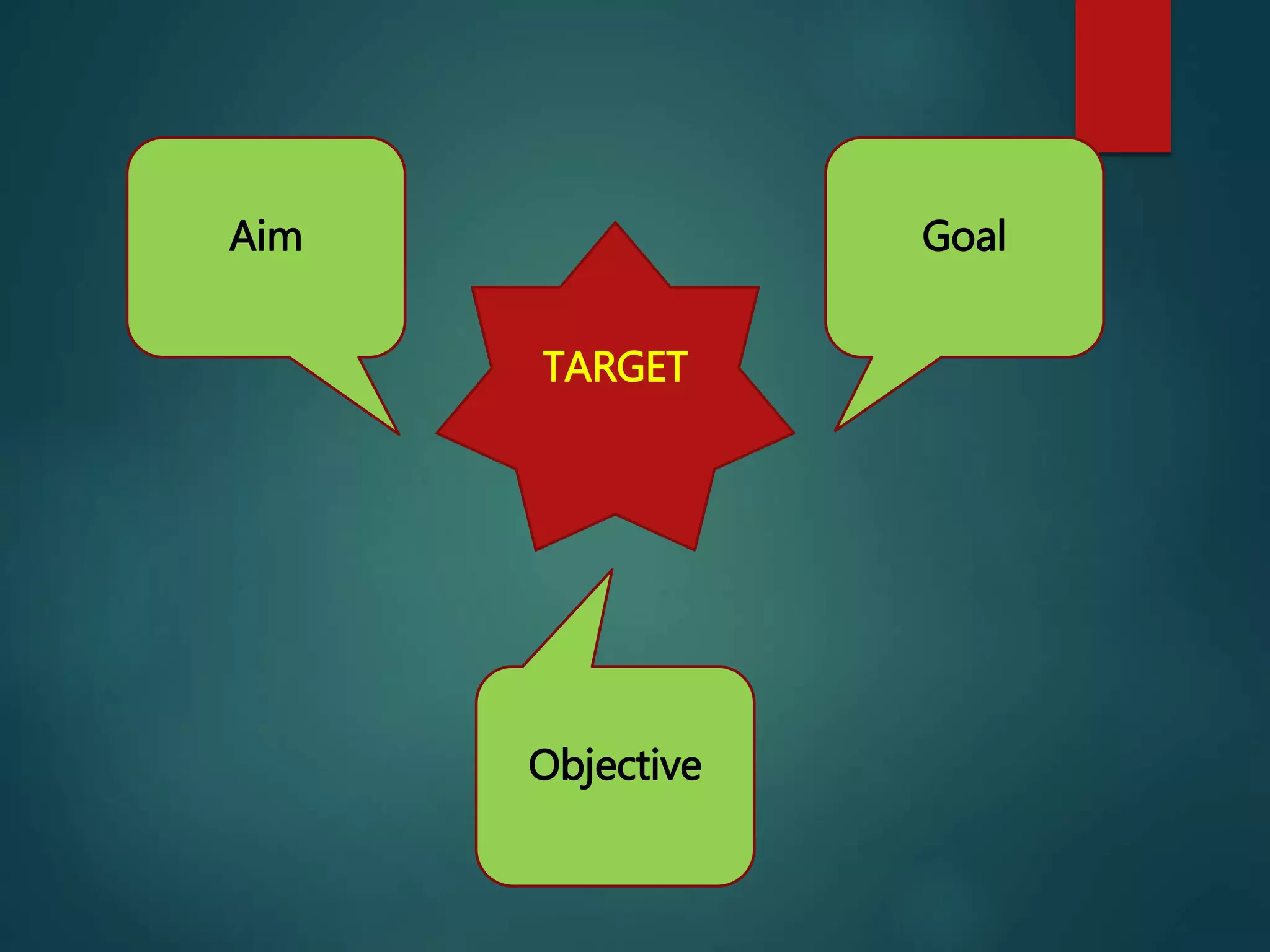
TARGET
Aim
Objective
Goal
 a statement of student performance that
includes both a description of what students
should know, understand, and be able to do
at the end of a unit of instruction
 something that can be observed through
the behavior of students
Learning Target
 Educational Goal
- a very general statement of what students
will know and be able to know
- typically written to cover a smaller block of
instructional time, such as an instructional unit
Learning Targets
 Educational Objective
- specific statements of student performance
that should be demonstrated at the end of the
instructional unit
- typically written to cover a smaller block of
instructional time, such as an instructional unit
Learning Targets
Elements of Highly Precise Performance
Objectives:
1. Performance
2. Criterion
3. Condition
4. Audience
Learning Targets
 Performance
a description of the behavior that
learners are expected to perform
describes what the learner will be doing
when demonstrating mastery of an
objective
Learning Targets
 Performance
Poor Examples:
• Be able to understand mathematics.
• Develop an appreciation of music.
• Be able to know the concept of diffusion.
• Be able to familiarize indefinite pronouns.
Learning Targets
 Performance
Good Examples:
• Be able to dance tinikling.
• Be able to interview licensed teachers.
• Be able to paint a picture of a mountain.
• Be able to write an application letter.
Learning Targets
 Condition
a description of the circumstances under
which the performance will be carried out
includes a description of what will be
available to learners when they perform
the desired behavior
Learning Targets
 Condition
Examples:
• Using a metric ruler...
• Given a set of whole numbers...
• Without the aid of class notes...
• Using only a screwdriver...
• Given a list of chemical elements...
Learning Targets
 Criterion
a description of the criteria for
acceptance of a performance as
sufficient, indicating mastery of the
objective
emphasizes time limits, accuracy, and
quality
Learning Targets
Objectives with the four components:
• Given the topic of the development of an
embryo, the BioSci students will be able to
write a short essay in no more than 30
sentences within 30 minutes.
• With the use of the different dried plants
collection, the 3rd year PhySci students will be
able to design a mini herbarium exhibit with
100% accuracy in no more than three hours.
Performance Objectives
Objectives with the four components:
• Provided with a list of trigonometric
functions, the students will be able to
prove identities within 30 minutes with at
least 90% accuracy.
Performance Objectives
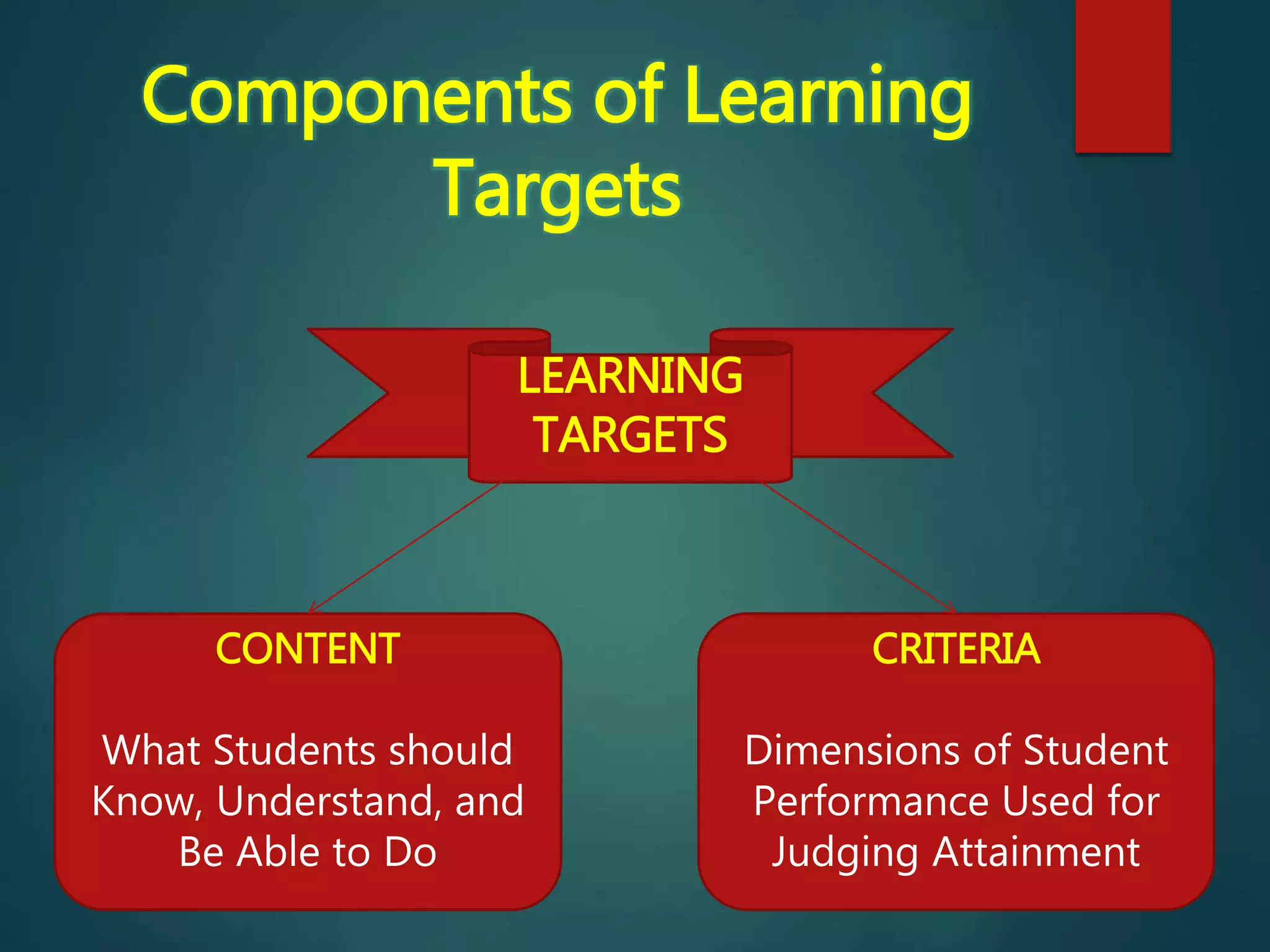
Components of Learning
Targets
CONTENT
What Students should
Know, Understand, and
Be Able to Do
CRITERIA
Dimensions of Student
Performance Used for
Judging Attainment
LEARNING
TARGETS
1. Knowledge
2. Reasoning
3. Skills
4. Products
5. Dispositions
Types of Learning Targets
Knowledge
 refers to the facts and concepts we want
students to know
 includes mastery of facts and information,
typically through recall
Types of Learning Targets
Knowledge
Content Standard Key Words
 explain, understand, describe, identify, tell,
name, list, define, label, match, choose, recall,
recognize, select, know
Types of Learning Targets
Knowledge
Examples:
 Recognizes and describes patterns of human
behaviour.
 Understands long-term physiological benefits
of regular participation in physical activity.
 Knows that energy can be transformed
between various forms.
Types of Learning Targets
Reasoning
 Students use what they know to reason and
solve problem
 includes problem solving, critical thinking,
synthesis, comparing, higher order thinking
skills, and judgment
Types of Learning Targets
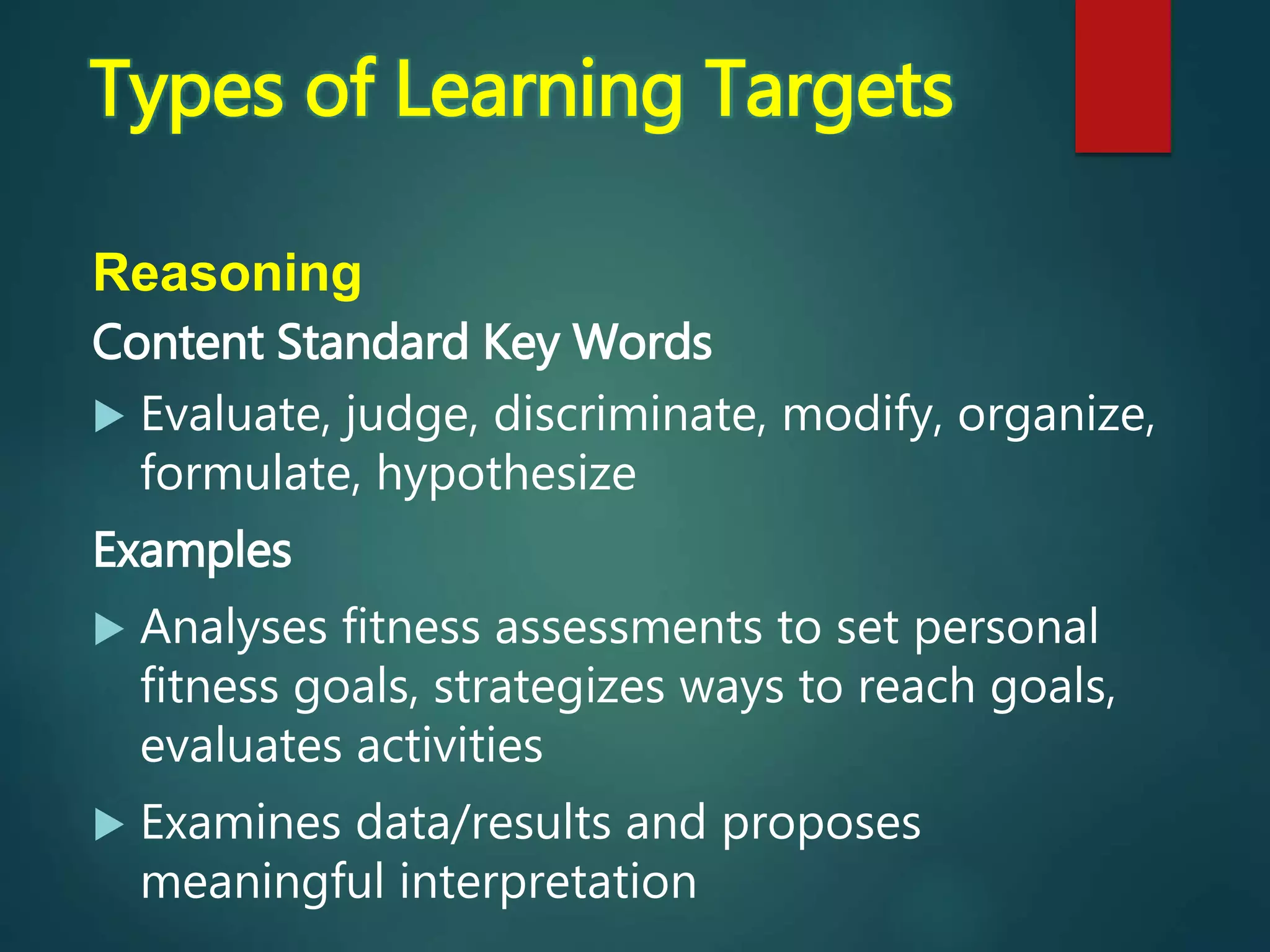
Reasoning
Content Standard Key Words
 Evaluate, judge, discriminate, modify, organize,
formulate, hypothesize
Examples
 Analyses fitness assessments to set personal
fitness goals, strategizes ways to reach goals,
evaluates activities
 Examines data/results and proposes
meaningful interpretation
Types of Learning Targets
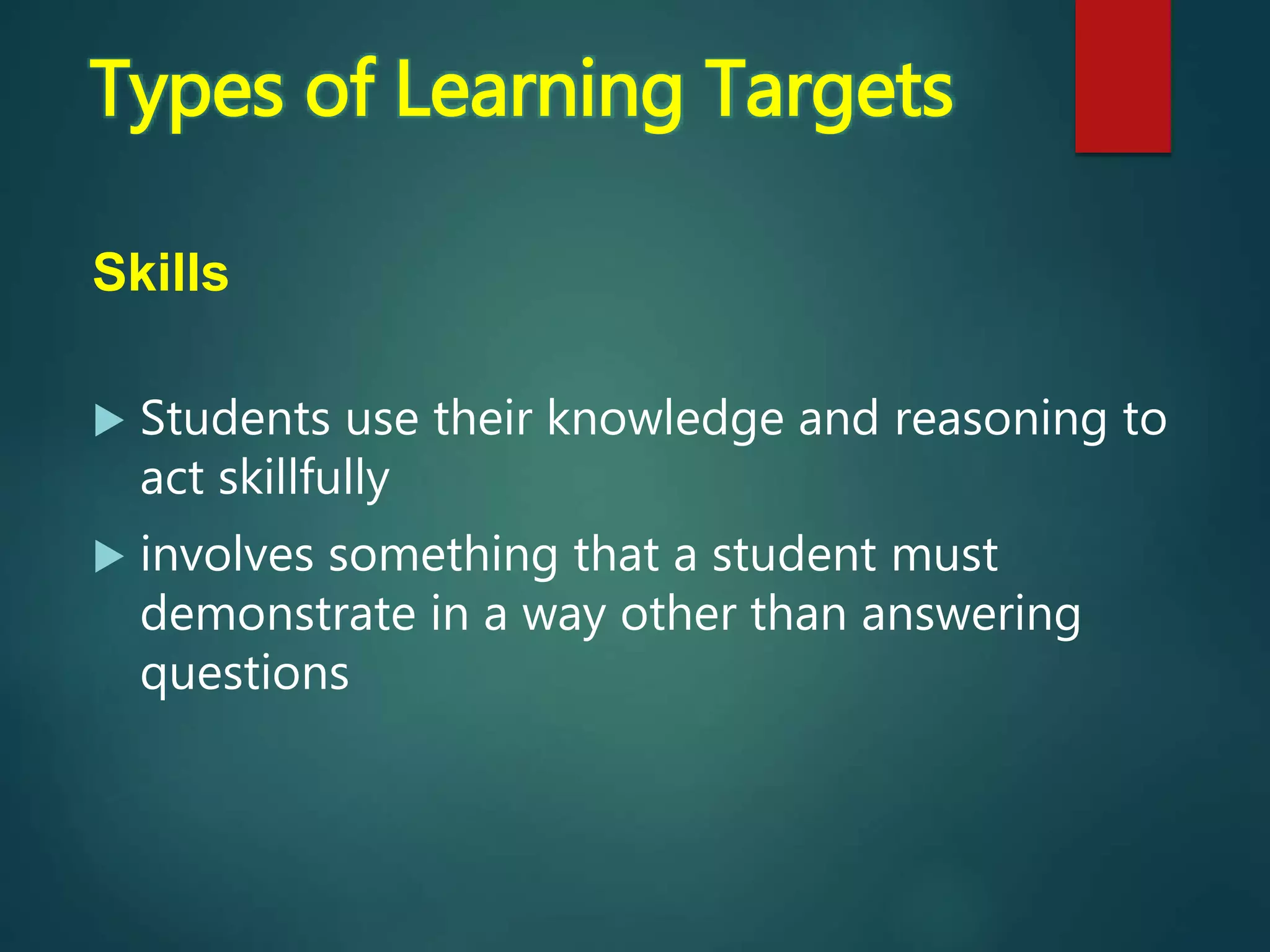
Skills
 Students use their knowledge and reasoning to
act skillfully
 involves something that a student must
demonstrate in a way other than answering
questions
Types of Learning Targets
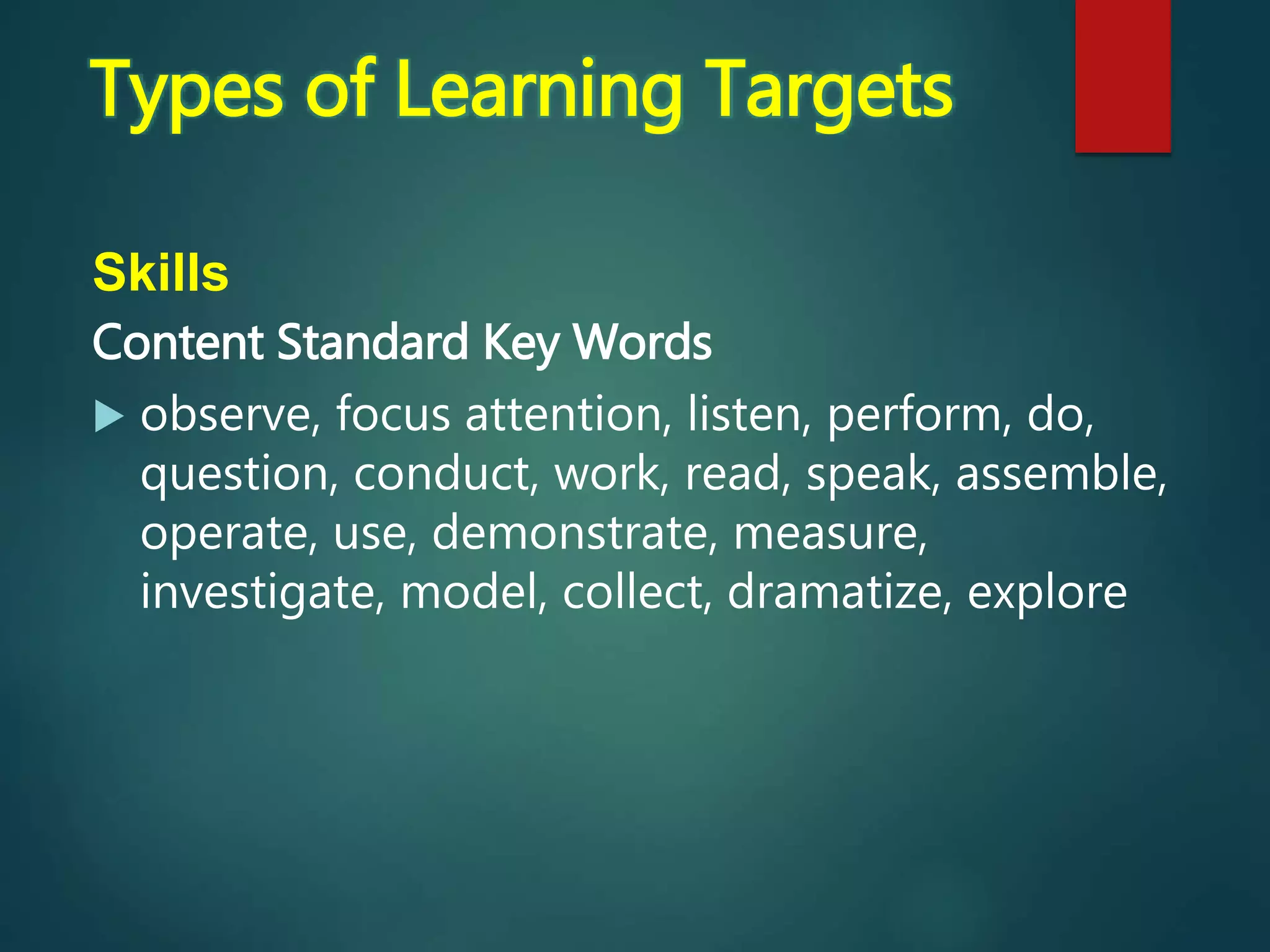
Skills
Content Standard Key Words
 observe, focus attention, listen, perform, do,
question, conduct, work, read, speak, assemble,
operate, use, demonstrate, measure,
investigate, model, collect, dramatize, explore
Types of Learning Targets
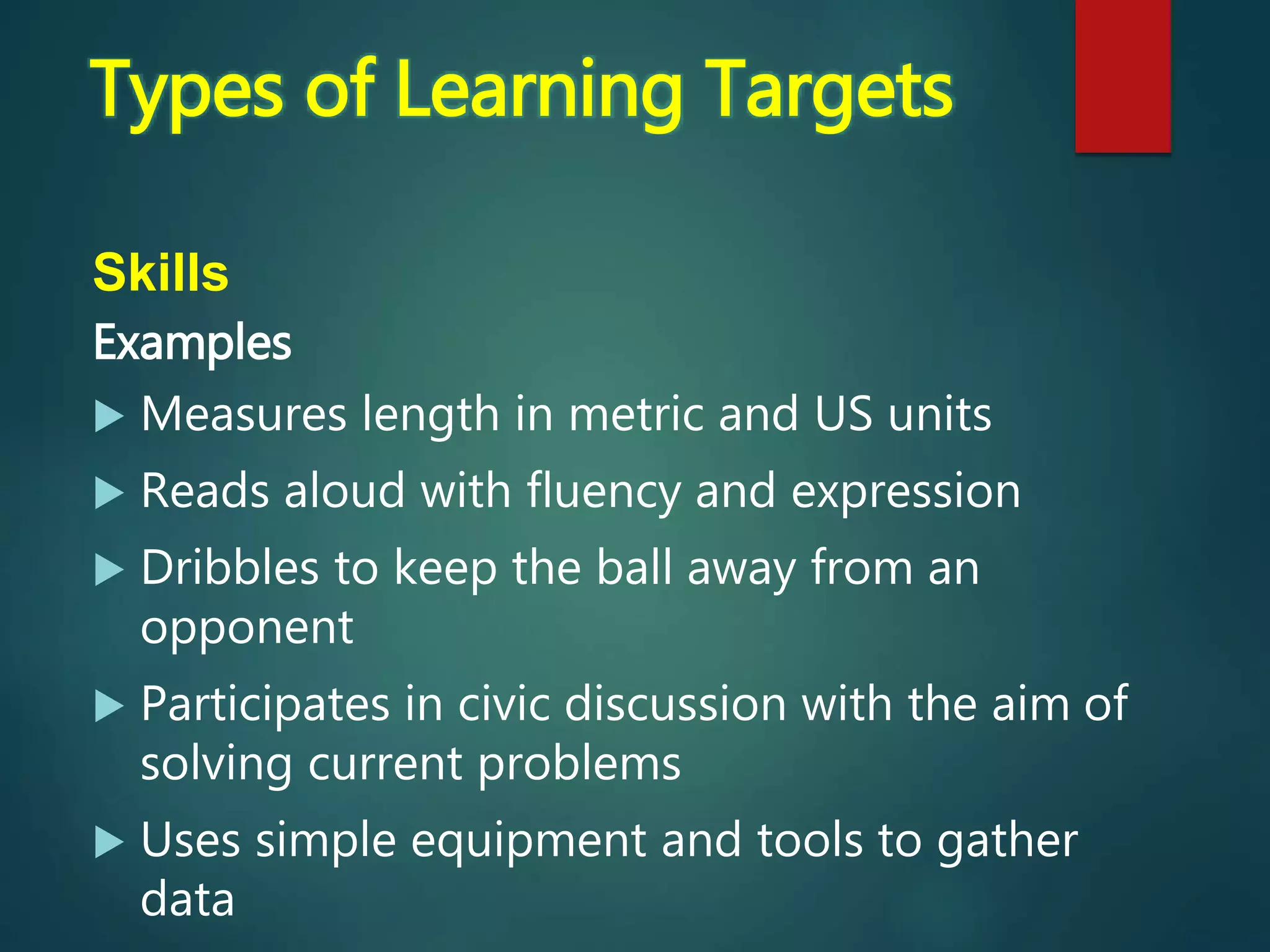
Skills
Examples
 Measures length in metric and US units
 Reads aloud with fluency and expression
 Dribbles to keep the ball away from an
opponent
 Participates in civic discussion with the aim of
solving current problems
 Uses simple equipment and tools to gather
data
Types of Learning Targets
Product
 Students use their knowledge, reasoning, and
skills to create a concrete product
 includes a sample of student work (i.e. paper,
report, artwork, or other project) that
demonstrates the ability knowledge,
understanding, reasoning, and skills
Types of Learning Targets
Product
Content Standard Key Words
 design, produce, create, develop, make, write,
draw, represent, display, model, construct
Types of Learning Targets
Product
Examples
 Constructs bar graphs
 Develops a personal health-related fitness plan
 Constructs physical models of familiar objects
 Creates a scripted scene based on improvised
work
Types of Learning Targets
Dispositions
 Students’ attitudes about school and learning
 includes attitudes, values, interests, feelings,
and beliefs
Types of Learning Targets
1. Bloom’s Taxonomy of Objectives
2. Professional Preparation
3. Textbooks
4. Existing Lists of Objectives
Sources of Learning Targets
and Standards
Bloom’s Taxonomy of Objectives
 Consists of 3 domains:
1. Cognitive
2. Affective
3. Psychomotor
Sources of Learning Targets
and Standards
Professional Preparation
 As you master each discipline you will be able
to identify what is most important for learning
 The more you understand, the better the
assessments
Sources of Learning Targets
and Standards
Textbooks
 Most textbooks are accompanied by an
instructor’s guide or a teacher’s edition
 Textbook objectives are neither the only nor
the best source for your learning targets
Sources of Learning Targets
and Standards
Existing List of Objectives
 A number of sources can be used to locate
these lists
 Yearbooks and handbooks in different
disciplines sometimes contain objectives
Sources of Learning Targets
and Standards

Chapter 2 Learning Targets

  • 1.
  • 2.
  • 3.
     a statementof student performance that includes both a description of what students should know, understand, and be able to do at the end of a unit of instruction  something that can be observed through the behavior of students Learning Target
  • 4.
     Educational Goal -a very general statement of what students will know and be able to know - typically written to cover a smaller block of instructional time, such as an instructional unit Learning Targets
  • 5.
     Educational Objective -specific statements of student performance that should be demonstrated at the end of the instructional unit - typically written to cover a smaller block of instructional time, such as an instructional unit Learning Targets
  • 6.
    Elements of HighlyPrecise Performance Objectives: 1. Performance 2. Criterion 3. Condition 4. Audience Learning Targets
  • 7.
     Performance a descriptionof the behavior that learners are expected to perform describes what the learner will be doing when demonstrating mastery of an objective Learning Targets
  • 8.
     Performance Poor Examples: •Be able to understand mathematics. • Develop an appreciation of music. • Be able to know the concept of diffusion. • Be able to familiarize indefinite pronouns. Learning Targets
  • 9.
     Performance Good Examples: •Be able to dance tinikling. • Be able to interview licensed teachers. • Be able to paint a picture of a mountain. • Be able to write an application letter. Learning Targets
  • 10.
     Condition a descriptionof the circumstances under which the performance will be carried out includes a description of what will be available to learners when they perform the desired behavior Learning Targets
  • 11.
     Condition Examples: • Usinga metric ruler... • Given a set of whole numbers... • Without the aid of class notes... • Using only a screwdriver... • Given a list of chemical elements... Learning Targets
  • 12.
     Criterion a descriptionof the criteria for acceptance of a performance as sufficient, indicating mastery of the objective emphasizes time limits, accuracy, and quality Learning Targets
  • 13.
    Objectives with thefour components: • Given the topic of the development of an embryo, the BioSci students will be able to write a short essay in no more than 30 sentences within 30 minutes. • With the use of the different dried plants collection, the 3rd year PhySci students will be able to design a mini herbarium exhibit with 100% accuracy in no more than three hours. Performance Objectives
  • 14.
    Objectives with thefour components: • Provided with a list of trigonometric functions, the students will be able to prove identities within 30 minutes with at least 90% accuracy. Performance Objectives
  • 15.
    Components of Learning Targets CONTENT WhatStudents should Know, Understand, and Be Able to Do CRITERIA Dimensions of Student Performance Used for Judging Attainment LEARNING TARGETS
  • 16.
    1. Knowledge 2. Reasoning 3.Skills 4. Products 5. Dispositions Types of Learning Targets
  • 17.
    Knowledge  refers tothe facts and concepts we want students to know  includes mastery of facts and information, typically through recall Types of Learning Targets
  • 18.
    Knowledge Content Standard KeyWords  explain, understand, describe, identify, tell, name, list, define, label, match, choose, recall, recognize, select, know Types of Learning Targets
  • 19.
    Knowledge Examples:  Recognizes anddescribes patterns of human behaviour.  Understands long-term physiological benefits of regular participation in physical activity.  Knows that energy can be transformed between various forms. Types of Learning Targets
  • 20.
    Reasoning  Students usewhat they know to reason and solve problem  includes problem solving, critical thinking, synthesis, comparing, higher order thinking skills, and judgment Types of Learning Targets
  • 21.
    Reasoning Content Standard KeyWords  Evaluate, judge, discriminate, modify, organize, formulate, hypothesize Examples  Analyses fitness assessments to set personal fitness goals, strategizes ways to reach goals, evaluates activities  Examines data/results and proposes meaningful interpretation Types of Learning Targets
  • 22.
    Skills  Students usetheir knowledge and reasoning to act skillfully  involves something that a student must demonstrate in a way other than answering questions Types of Learning Targets
  • 23.
    Skills Content Standard KeyWords  observe, focus attention, listen, perform, do, question, conduct, work, read, speak, assemble, operate, use, demonstrate, measure, investigate, model, collect, dramatize, explore Types of Learning Targets
  • 24.
    Skills Examples  Measures lengthin metric and US units  Reads aloud with fluency and expression  Dribbles to keep the ball away from an opponent  Participates in civic discussion with the aim of solving current problems  Uses simple equipment and tools to gather data Types of Learning Targets
  • 25.
    Product  Students usetheir knowledge, reasoning, and skills to create a concrete product  includes a sample of student work (i.e. paper, report, artwork, or other project) that demonstrates the ability knowledge, understanding, reasoning, and skills Types of Learning Targets
  • 26.
    Product Content Standard KeyWords  design, produce, create, develop, make, write, draw, represent, display, model, construct Types of Learning Targets
  • 27.
    Product Examples  Constructs bargraphs  Develops a personal health-related fitness plan  Constructs physical models of familiar objects  Creates a scripted scene based on improvised work Types of Learning Targets
  • 28.
    Dispositions  Students’ attitudesabout school and learning  includes attitudes, values, interests, feelings, and beliefs Types of Learning Targets
  • 29.
    1. Bloom’s Taxonomyof Objectives 2. Professional Preparation 3. Textbooks 4. Existing Lists of Objectives Sources of Learning Targets and Standards
  • 30.
    Bloom’s Taxonomy ofObjectives  Consists of 3 domains: 1. Cognitive 2. Affective 3. Psychomotor Sources of Learning Targets and Standards
  • 31.
    Professional Preparation  Asyou master each discipline you will be able to identify what is most important for learning  The more you understand, the better the assessments Sources of Learning Targets and Standards
  • 32.
    Textbooks  Most textbooksare accompanied by an instructor’s guide or a teacher’s edition  Textbook objectives are neither the only nor the best source for your learning targets Sources of Learning Targets and Standards
  • 33.
    Existing List ofObjectives  A number of sources can be used to locate these lists  Yearbooks and handbooks in different disciplines sometimes contain objectives Sources of Learning Targets and Standards