The document outlines the importance of writing effective learning outcomes that encompass performance, conditions, and criteria. It emphasizes their role in guiding both instructors and learners regarding expected knowledge, skills, and attitudes by the course's completion. Additionally, it highlights characteristics of effective learning outcomes and integrates Bloom's taxonomy to enhance outcome formulation.
Learning Outcomes
Youwill be able to…
Write SMART learning outcomes that include
descriptions of performance, conditions and
criteria (PCC).
3.
Learning Outcomes
Whatare learning outcomes?
Discussion (10 mins):
In groups, describe what are learning
outcomes and whether or not you use
them in your teaching
4.
Learning Outcomes
Describethe knowledge, skills and
attitude you want learners to acquire
by the end of the course.
5.
Learning Outcomes
Help instructors
Selectcontent
Develop instructional strategies or
learning activities
Develop and select instructional materials
Define the assessment plan
6.
Learning Outcomes
Help learners
Knowwhat they will be able to do at the
end of a learning experience
Know the requirements of the course
Organize their learning
Prepare for the assessment
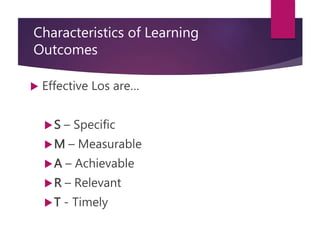
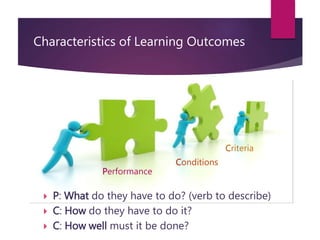
Characteristics of LearningOutcomes
Performance
Conditions
Criteria
P: What do they have to do? (verb to describe)
C: How do they have to do it?
C: How well must it be done?
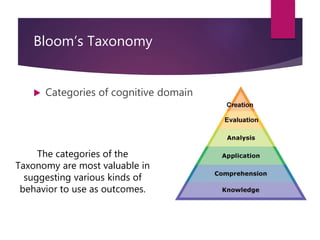
Bloom’s Taxonomy
The categoriesof the
Taxonomy are most valuable in
suggesting various kinds of
behavior to use as outcomes.
Categories of cognitive domain
13.
Learning Outcomes
Groupactivity (15 mins)
Write one effective learning outcome
Review and critique of learning outcomes.
Editor's Notes
#5 From what we have discussed, learning outcomes are one important course component. They describe ….. Learning objectives, learning intentions, learning goals…
Why we need to spend hours on defining learning outcomes?
Specify learning goals or your expectations to your students
Actually, they guide you on the development of your course.
..
… remember the principle of alignment? If you don’t have a clear idea about what your students need to achieve after the course, you will have difficulty in coming up with relevant and meaningful learning activities and assessment plan.
… organize your materials in a logical way.
For students, they act as a communication tool – so that they know … . Well defined LO indicates the focus of the course, so that students know how to organize their learning and what to expect for the assessment.
One of the teaching strategies is to go through the LOs with your students in the first class so that they know what they will learn and the your expectation on their learning results.
#6 From what we have discussed, learning outcomes are one important course component. They describe ….. Learning objectives, learning intentions, learning goals…
Why we need to spend hours on defining learning outcomes?
Specify learning goals or your expectations to your students
Actually, they guide you on the development of your course.
..
… remember the principle of alignment? If you don’t have a clear idea about what your students need to achieve after the course, you will have difficulty in coming up with relevant and meaningful learning activities and assessment plan.
… organize your materials in a logical way.
For students, they act as a communication tool – so that they know … . Well defined LO indicates the focus of the course, so that students know how to organize their learning and what to expect for the assessment.
One of the teaching strategies is to go through the LOs with your students in the first class so that they know what they will learn and the your expectation on their learning results.
#7 From what we have discussed, learning outcomes are one important course component. They describe ….. Learning objectives, learning intentions, learning goals…
Why we need to spend hours on defining learning outcomes?
Specify learning goals or your expectations to your students
Actually, they guide you on the development of your course.
..
… remember the principle of alignment? If you don’t have a clear idea about what your students need to achieve after the course, you will have difficulty in coming up with relevant and meaningful learning activities and assessment plan.
… organize your materials in a logical way.
For students, they act as a communication tool – so that they know … . Well defined LO indicates the focus of the course, so that students know how to organize their learning and what to expect for the assessment.
One of the teaching strategies is to go through the LOs with your students in the first class so that they know what they will learn and the your expectation on their learning results.
#8 Let us look at an example.
• S – specific
• M – measurable – mental process is invisible and hard to measure. But specific behaviors are measurable. Interpret mental process into measurable behavior change.
• A – achievable , students can achieve within your course
• R – Relevant, realistic, - motivation issue – learners loves LO that are relevant and realistic. So that they know how to apply in a real life situation.
• T – time-bound, typing 200 words in 1 min. after this course, you will be able to ….
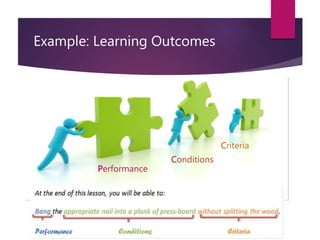
#9 A well written LO contains three components:
P- what? What types of K, S, A students need to acquire as a learning result. Use a verb to describe the desirable performance.
C – under which conditions,
C – how well
Let us look at some examples.
#10 A well written LO contains three components:
P- what? What types of K, S, A students need to acquire as a learning result. Use a verb to describe the desirable performance.
C – under which conditions,
C – how well
Let us look at some examples.
#11 when you write your outcome, on which part did you spend more time? Performance, conditions, criteria….
Performance – you spend time in figuring when verb is most suitable.
Here I would like to introduce you a job aid. You will need a bit theoretic background to use this job aid.
Educators and psychologists have given considerable thought to the various types of learning that take place in schools. Probably the most comprehensive and widely known analysis of objectives is the Bloom’s Taxonomy .
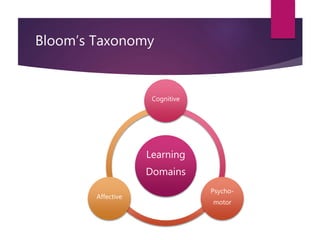
Bloom’s Taxonomy provides a consistent means of developing the single most powerful tool in instruction and the assessment of student learning outcomes - the learning or performance objective. The Taxonomy distinguishes between three major categories of
objectives termed the COGNITIVE DOMAIN, the PSYCHOMOTOR DOMAIN, and the AFFECTIVE DOMAIN. (See Section II for a more complete description of the Taxonomy.)
Affective learning of beliefs, attitudes, and values (growth in attitudes, emotion, and feelings).
Psychomotor learning of physical movements such as ballet steps, how to drive a car, how to drill out a cavity in a molar, etc.
Cognitive learning of information and the processes of dealing with that information.
#12 when you write your outcome, on which part did you spend more time? Performance, conditions, criteria….
Performance – you spend time in figuring when verb is most suitable.
Here I would like to introduce you a job aid. You will need a bit theoretic background to use this job aid.
Educators and psychologists have given considerable thought to the various types of learning that take place in schools. Probably the most comprehensive and widely known analysis of objectives is the Bloom’s Taxonomy .
Bloom’s Taxonomy provides a consistent means of developing the single most powerful tool in instruction and the assessment of student learning outcomes - the learning or performance objective. The Taxonomy distinguishes between three major categories of
objectives termed the COGNITIVE DOMAIN, the PSYCHOMOTOR DOMAIN, and the AFFECTIVE DOMAIN. (See Section II for a more complete description of the Taxonomy.)
Affective learning of beliefs, attitudes, and values (growth in attitudes, emotion, and feelings).
Psychomotor learning of physical movements such as ballet steps, how to drive a car, how to drill out a cavity in a molar, etc.
Cognitive learning of information and the processes of dealing with that information.
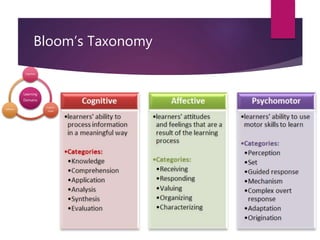
#13 Cognitive Learning Domain is of primary concern in higher education. If we are more concerned with process and problem solving activities, then the categories of the Taxonomy are most valuable in suggesting various kinds of behavior to use as outcomes.
P59
K – remembering/ recalling some factual K
C – Demonstrating understanding of facts and ideas by organizing, comparing, translating, interpreting, giving descriptions, and stating main ideas
A - Using new knowledge. Solve problems to new situations by applying acquired knowledge, facts, techniques and rules in a different way.
A – Examining and breaking information into parts by identifying motives or causes. Seeing relationships and how things work. Make inferences and find evidence to support generalizations.
E – appraise, judge, critique the outcomes of any of the other level
C- putting things together, building on what you have know to create something new. Seeing new relationships or making new connections.
It shows that thinking has higher or lower level thinking. As post-secondary instructors, we need to address higher level thinking skills in our courses.
You can find a verb list in the job aid. The verbs are categorized by the categories of different domains. You can use it as a reference. But those are example verbs you can use. It is not inclusive. You may have some verbs used in your field, which define the level of learning. Or you can use a verb in a lower level categories with some conditions to describe a higher level skills.
As long as the whole sentence indicates an outcome and SMART. The verb should be fine.
#14 Will you be able to tell three components of this LO?
Use a verb to describe the desirable performance.