WRITING LEARNING
OBJECTIVES
Darcy Turner
Instructional Designer
Learning objectives are the most important component of any course.
They lay the foundation for the design, delivery, and assessment of learning
and serve as an implied contract between instructor and student by
defining what is to be taught and what is to be learned.
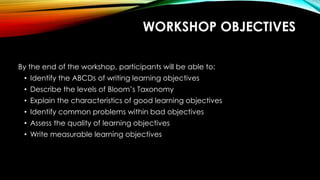
WORKSHOP OBJECTIVES
By the end of the workshop, participants will be able to:
• Identify the ABCDs of writing learning objectives
• Describe the levels of Bloom’s Taxonomy
• Explain the characteristics of good learning objectives
• Identify common problems within bad objectives
• Assess the quality of learning objectives
• Write measurable learning objectives
THE BASICS
General information about learning objectives
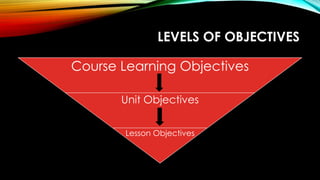
LEVELS OF OBJECTIVES
Course Learning Objectives
Unit Objectives
Lesson Objectives
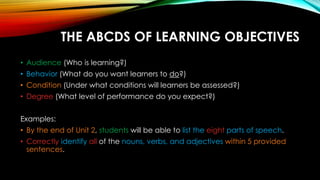
THE ABCDS OF LEARNING OBJECTIVES
• Audience (Who is learning?)
• Behavior (What do you want learners to do?)
• Condition (Under what conditions will learners be assessed?)
• Degree (What level of performance do you expect?)
Examples:
• By the end of Unit 2, students will be able to list the eight parts of speech.
• Correctly identify all of the nouns, verbs, and adjectives within 5 provided
sentences.
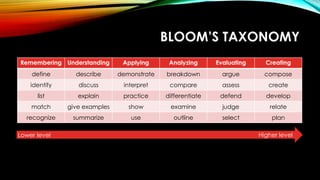
BLOOM’S TAXONOMY
Remembering Understanding Applying Analyzing Evaluating Creating
define describe demonstrate breakdown argue compose
identify discuss interpret compare assess create
list explain practice differentiate defend develop
match give examples show examine judge relate
recognize summarize use outline select plan
Lower level Higher level
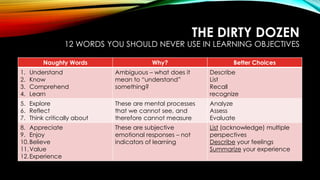
THE DIRTY DOZEN
12 WORDS YOU SHOULD NEVER USE IN LEARNING OBJECTIVES
Naughty Words Why? Better Choices
1. Understand
2. Know
3. Comprehend
4. Learn
Ambiguous – what does it
mean to “understand”
something?
Describe
List
Recall
recognize
5. Explore
6. Reflect
7. Think critically about
These are mental processes
that we cannot see, and
therefore cannot measure
Analyze
Assess
Evaluate
8. Appreciate
9. Enjoy
10.Believe
11.Value
12.Experience
These are subjective
emotional responses – not
indicators of learning
List (acknowledge) multiple
perspectives
Describe your feelings
Summarize your experience
GOOD VS. BAD OBJECTIVES
Characteristics and examples
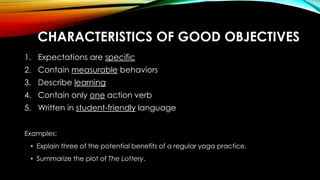
CHARACTERISTICS OF GOOD OBJECTIVES
1. Expectations are specific
2. Contain measurable behaviors
3. Describe learning
4. Contain only one action verb
5. Written in student-friendly language
Examples:
• Explain three of the potential benefits of a regular yoga practice.
• Summarize the plot of The Lottery.
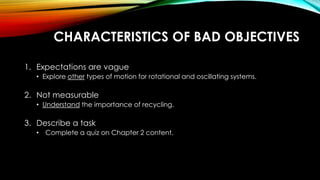
CHARACTERISTICS OF BAD OBJECTIVES
1. Expectations are vague
• Explore other types of motion for rotational and oscillating systems.
2. Not measurable
• Understand the importance of recycling.
3. Describe a task
• Complete a quiz on Chapter 2 content.
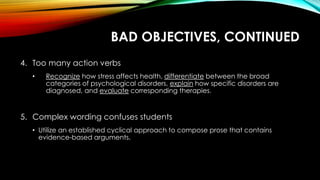
BAD OBJECTIVES, CONTINUED
4. Too many action verbs
• Recognize how stress affects health, differentiate between the broad
categories of psychological disorders, explain how specific disorders are
diagnosed, and evaluate corresponding therapies.
5. Complex wording confuses students
• Utilize an established cyclical approach to compose prose that contains
evidence-based arguments.
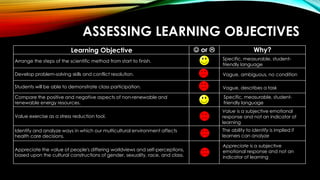
ASSESSING LEARNING OBJECTIVES
Can you spot the bad ones?
Learning Objective  or  Why?
Arrange the steps of the scientific method from start to finish.
Develop problem-solving skills and conflict resolution.
Students will be able to demonstrate class participation.
Compare the positive and negative aspects of non-renewable and
renewable energy resources.
Value exercise as a stress reduction tool.
Identify and analyze ways in which our multicultural environment affects
health care decisions.
Appreciate the value of people's differing worldviews and self-perceptions,
based upon the cultural constructions of gender, sexuality, race, and class.
ASSESSING LEARNING OBJECTIVES
Specific, measurable, student-
friendly language
Vague, ambiguous, no condition
Vague, describes a task
Specific, measurable, student-
friendly language
Value is a subjective emotional
response and not an indicator of
learning
The ability to identify is implied if
learners can analyze
Appreciate is a subjective
emotional response and not an
indicator of learning
PRACTICE WRITING OBJECTIVES
Let’s apply what you’ve learned!
PRACTICE WRITING OBJECTIVES
Scenario
• Making toast
• Replacing the toilet paper roll
• Using good manners
• Changing the oil in a vehicle
• Being a good student
• Changing a tire
• Changing a diaper
Questions to think about:
• What do you want students to
learn?
• What does achievement look like?
• What level of performance are you
expecting?
• How will you measure their
performance?
FINAL THOUGHTS
Tips and Contact Information
TIPS AND CONTACT INFORMATION
• Write learning objectives in multiple drafts.
• Get a second (or third) opinion.
• Write objectives with others.
• When you are stuck, start with understand. (Wait, what?!)
Darcy Turner, Instructional Designer
Saint Paul College
darcy.turner@saintpaul.edu
(651) 403-4471

Writing Learning Objectives

  • 1.
  • 2.
    Learning objectives arethe most important component of any course. They lay the foundation for the design, delivery, and assessment of learning and serve as an implied contract between instructor and student by defining what is to be taught and what is to be learned.
  • 3.
    WORKSHOP OBJECTIVES By theend of the workshop, participants will be able to: • Identify the ABCDs of writing learning objectives • Describe the levels of Bloom’s Taxonomy • Explain the characteristics of good learning objectives • Identify common problems within bad objectives • Assess the quality of learning objectives • Write measurable learning objectives
  • 4.
    THE BASICS General informationabout learning objectives
  • 5.
    LEVELS OF OBJECTIVES CourseLearning Objectives Unit Objectives Lesson Objectives
  • 6.
    THE ABCDS OFLEARNING OBJECTIVES • Audience (Who is learning?) • Behavior (What do you want learners to do?) • Condition (Under what conditions will learners be assessed?) • Degree (What level of performance do you expect?) Examples: • By the end of Unit 2, students will be able to list the eight parts of speech. • Correctly identify all of the nouns, verbs, and adjectives within 5 provided sentences.
  • 7.
    BLOOM’S TAXONOMY Remembering UnderstandingApplying Analyzing Evaluating Creating define describe demonstrate breakdown argue compose identify discuss interpret compare assess create list explain practice differentiate defend develop match give examples show examine judge relate recognize summarize use outline select plan Lower level Higher level
  • 8.
    THE DIRTY DOZEN 12WORDS YOU SHOULD NEVER USE IN LEARNING OBJECTIVES Naughty Words Why? Better Choices 1. Understand 2. Know 3. Comprehend 4. Learn Ambiguous – what does it mean to “understand” something? Describe List Recall recognize 5. Explore 6. Reflect 7. Think critically about These are mental processes that we cannot see, and therefore cannot measure Analyze Assess Evaluate 8. Appreciate 9. Enjoy 10.Believe 11.Value 12.Experience These are subjective emotional responses – not indicators of learning List (acknowledge) multiple perspectives Describe your feelings Summarize your experience
  • 9.
    GOOD VS. BADOBJECTIVES Characteristics and examples
  • 10.
    CHARACTERISTICS OF GOODOBJECTIVES 1. Expectations are specific 2. Contain measurable behaviors 3. Describe learning 4. Contain only one action verb 5. Written in student-friendly language Examples: • Explain three of the potential benefits of a regular yoga practice. • Summarize the plot of The Lottery.
  • 11.
    CHARACTERISTICS OF BADOBJECTIVES 1. Expectations are vague • Explore other types of motion for rotational and oscillating systems. 2. Not measurable • Understand the importance of recycling. 3. Describe a task • Complete a quiz on Chapter 2 content.
  • 12.
    BAD OBJECTIVES, CONTINUED 4.Too many action verbs • Recognize how stress affects health, differentiate between the broad categories of psychological disorders, explain how specific disorders are diagnosed, and evaluate corresponding therapies. 5. Complex wording confuses students • Utilize an established cyclical approach to compose prose that contains evidence-based arguments.
  • 13.
    ASSESSING LEARNING OBJECTIVES Canyou spot the bad ones?
  • 14.
    Learning Objective or  Why? Arrange the steps of the scientific method from start to finish. Develop problem-solving skills and conflict resolution. Students will be able to demonstrate class participation. Compare the positive and negative aspects of non-renewable and renewable energy resources. Value exercise as a stress reduction tool. Identify and analyze ways in which our multicultural environment affects health care decisions. Appreciate the value of people's differing worldviews and self-perceptions, based upon the cultural constructions of gender, sexuality, race, and class. ASSESSING LEARNING OBJECTIVES Specific, measurable, student- friendly language Vague, ambiguous, no condition Vague, describes a task Specific, measurable, student- friendly language Value is a subjective emotional response and not an indicator of learning The ability to identify is implied if learners can analyze Appreciate is a subjective emotional response and not an indicator of learning
  • 15.
    PRACTICE WRITING OBJECTIVES Let’sapply what you’ve learned!
  • 16.
    PRACTICE WRITING OBJECTIVES Scenario •Making toast • Replacing the toilet paper roll • Using good manners • Changing the oil in a vehicle • Being a good student • Changing a tire • Changing a diaper Questions to think about: • What do you want students to learn? • What does achievement look like? • What level of performance are you expecting? • How will you measure their performance?
  • 17.
    FINAL THOUGHTS Tips andContact Information
  • 18.
    TIPS AND CONTACTINFORMATION • Write learning objectives in multiple drafts. • Get a second (or third) opinion. • Write objectives with others. • When you are stuck, start with understand. (Wait, what?!) Darcy Turner, Instructional Designer Saint Paul College darcy.turner@saintpaul.edu (651) 403-4471