EDUCATIONAL
OBJECTIVES
Mr. Dani Paul
2nd yr PbBSc Nsg
SEMINAR OBJECTIVES:
• STUDENTS WILL BE ABLE TO
• Define educational objectives
• List the types of the educational objectives
• Identify behavioral terms and in writing
educational objectives
• Perform actively in differentiating the behavioral
terms of educational objectives and categorize
under each level
INTRODUCTION
• Educational objectives depict what students
should be able to do at the end of a learning
activity.
• As Educational objectives are more focussed
on the learner’s performance, it is also called
as “learning objective”.
DEFINITION
• “The result sought by the learner at the end
of the educational programme..i.e., what the
students should be able to do at the end of a
learning period, that they could not do
before hand”
• - JJ Guilbert
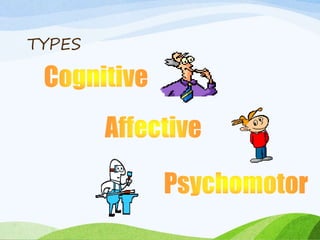
TYPES
LEVELS OF EDUCATIONAL
OBJECTIVES
• Cognitive:
• Level 1: knowledge: Remembering of previously
learned material.
• Verbs usage Eg: state the four steps in curriculum
development
• Level 2: comprehension: ability to grasp the
meaning of material.
• Verbs usage eg: student identifies the importance
of good nutrition during AN period.
• Level 3: application: ability to use learned
material in new situation
• Verbs usage eg: formulate diet plan for patients
with diabetes mellitus
• Level 4: analysis: ability to breakdown
material into its component parts
• Verb usage eg: distinguishes between marasmus
and kwashiorkor
• Level 5: synthesis: combines various parts
to form a new whole.
• Verb usage eg: derives a solution for the hospital
waste problem
• Level 6: evaluation: the ability to judge the
value of material for a given purpose
judgements are based on definite criteria
• Verb usage eg: compare and contrast any two
definitions of education
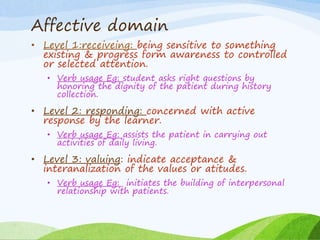
Affective domain
• Level 1:receiveing: being sensitive to something
existing & progress form awareness to controlled
or selected attention.
• Verb usage Eg: student asks right questions by
honoring the dignity of the patient during history
collection.
• Level 2: responding: concerned with active
response by the learner.
• Verb usage Eg: assists the patient in carrying out
activities of daily living.
• Level 3: valuing: indicate acceptance &
interanalization of the values or atitudes.
• Verb usage Eg: initiates the building of interpersonal
relationship with patients.
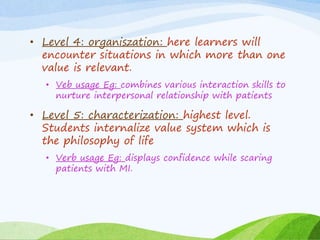
• Level 4: organiszation: here learners will
encounter situations in which more than one
value is relevant.
• Veb usage Eg: combines various interaction skills to
nurture interpersonal relationship with patients
• Level 5: characterization: highest level.
Students internalize value system which is
the philosophy of life
• Verb usage Eg: displays confidence while scaring
patients with MI.
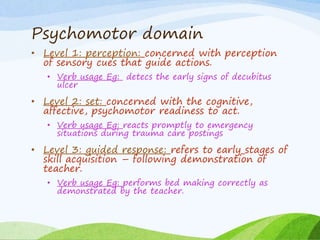
Psychomotor domain
• Level 1: perception: concerned with perception
of sensory cues that guide actions.
• Verb usage Eg: detecs the early signs of decubitus
ulcer
• Level 2: set: concerned with the cognitive,
affective, psychomotor readiness to act.
• Verb usage Eg: reacts promptly to emergency
situations during trauma care postings
• Level 3: guided response: refers to early stages of
skill acquisition – following demonstration of
teacher.
• Verb usage Eg: performs bed making correctly as
demonstrated by the teacher.
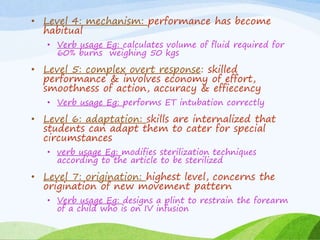
• Level 4: mechanism: performance has become
habitual
• Verb usage Eg: calculates volume of fluid required for
60% burns weighing 50 kgs
• Level 5: complex overt response: skilled
performance & involves economy of effort,
smoothness of action, accuracy & effiecency
• Verb usage Eg: performs ET intubation correctly
• Level 6: adaptation: skills are internalized that
students can adapt them to cater for special
circumstances
• verb usage Eg: modifies sterilization techniques
according to the article to be sterilized
• Level 7: origination: highest level, concerns the
origination of new movement pattern
• Verb usage Eg: designs a plint to restrain the forearm
of a child who is on IV infusion
BEHAVIOURAL TERMS IN
EDUCATIONAL OBJECTIVES
• ACTIVITY
CONCLUSION
• knowledge regarding the strengths and
weakness of behavioral objectives will assist
the nurse educator in framing objectives in a
realistic way suitable to the aims of nursing
education.
Assignment
• Write and submit educational objectives
using behavioral terms for taking class on
nursing care of patient with bronchial
asthma.
BIBLIOGRAPHY
1) SANKARANARAYAN B, “learning and
teaching nursing”, edition 3, Calicut,
Brainfill publication, 2003
2) NEERAJA KP, “text book of nursing
education”, 1st edition, New Delhi, Jaypee
brothers, 2004.

Educational objectives by bloom's taxonomy

  • 1.
  • 2.
    SEMINAR OBJECTIVES: • STUDENTSWILL BE ABLE TO • Define educational objectives • List the types of the educational objectives • Identify behavioral terms and in writing educational objectives • Perform actively in differentiating the behavioral terms of educational objectives and categorize under each level
  • 3.
    INTRODUCTION • Educational objectivesdepict what students should be able to do at the end of a learning activity. • As Educational objectives are more focussed on the learner’s performance, it is also called as “learning objective”.
  • 4.
    DEFINITION • “The resultsought by the learner at the end of the educational programme..i.e., what the students should be able to do at the end of a learning period, that they could not do before hand” • - JJ Guilbert
  • 5.
  • 6.
    LEVELS OF EDUCATIONAL OBJECTIVES •Cognitive: • Level 1: knowledge: Remembering of previously learned material. • Verbs usage Eg: state the four steps in curriculum development • Level 2: comprehension: ability to grasp the meaning of material. • Verbs usage eg: student identifies the importance of good nutrition during AN period. • Level 3: application: ability to use learned material in new situation • Verbs usage eg: formulate diet plan for patients with diabetes mellitus
  • 7.
    • Level 4:analysis: ability to breakdown material into its component parts • Verb usage eg: distinguishes between marasmus and kwashiorkor • Level 5: synthesis: combines various parts to form a new whole. • Verb usage eg: derives a solution for the hospital waste problem • Level 6: evaluation: the ability to judge the value of material for a given purpose judgements are based on definite criteria • Verb usage eg: compare and contrast any two definitions of education
  • 8.
    Affective domain • Level1:receiveing: being sensitive to something existing & progress form awareness to controlled or selected attention. • Verb usage Eg: student asks right questions by honoring the dignity of the patient during history collection. • Level 2: responding: concerned with active response by the learner. • Verb usage Eg: assists the patient in carrying out activities of daily living. • Level 3: valuing: indicate acceptance & interanalization of the values or atitudes. • Verb usage Eg: initiates the building of interpersonal relationship with patients.
  • 9.
    • Level 4:organiszation: here learners will encounter situations in which more than one value is relevant. • Veb usage Eg: combines various interaction skills to nurture interpersonal relationship with patients • Level 5: characterization: highest level. Students internalize value system which is the philosophy of life • Verb usage Eg: displays confidence while scaring patients with MI.
  • 10.
    Psychomotor domain • Level1: perception: concerned with perception of sensory cues that guide actions. • Verb usage Eg: detecs the early signs of decubitus ulcer • Level 2: set: concerned with the cognitive, affective, psychomotor readiness to act. • Verb usage Eg: reacts promptly to emergency situations during trauma care postings • Level 3: guided response: refers to early stages of skill acquisition – following demonstration of teacher. • Verb usage Eg: performs bed making correctly as demonstrated by the teacher.
  • 11.
    • Level 4:mechanism: performance has become habitual • Verb usage Eg: calculates volume of fluid required for 60% burns weighing 50 kgs • Level 5: complex overt response: skilled performance & involves economy of effort, smoothness of action, accuracy & effiecency • Verb usage Eg: performs ET intubation correctly • Level 6: adaptation: skills are internalized that students can adapt them to cater for special circumstances • verb usage Eg: modifies sterilization techniques according to the article to be sterilized • Level 7: origination: highest level, concerns the origination of new movement pattern • Verb usage Eg: designs a plint to restrain the forearm of a child who is on IV infusion
  • 12.
    BEHAVIOURAL TERMS IN EDUCATIONALOBJECTIVES • ACTIVITY
  • 13.
    CONCLUSION • knowledge regardingthe strengths and weakness of behavioral objectives will assist the nurse educator in framing objectives in a realistic way suitable to the aims of nursing education.
  • 14.
    Assignment • Write andsubmit educational objectives using behavioral terms for taking class on nursing care of patient with bronchial asthma.
  • 15.
    BIBLIOGRAPHY 1) SANKARANARAYAN B,“learning and teaching nursing”, edition 3, Calicut, Brainfill publication, 2003 2) NEERAJA KP, “text book of nursing education”, 1st edition, New Delhi, Jaypee brothers, 2004.