

Instructional Goals and Objectives 
Lesson 2
Lesson outcomes 
• Explain what a goal of instruction 
• Explain what an objective of instruction is 
• Differentiate between instructional goals and instructional 
objectives. 
• Explain what a learning outcome is 
• Describe the four domains of learning outcomes (cognitive, 
affective, psychomotor and social) 
• Discuss Bloom’s Taxonomy 
• Use Bloom’s taxonomy to state learning outcomes according to 
the levels taught in the subject. 
• State student focused learning objectives or learning outcomes 
using Mager’s format and the ABCD format
What is an objective? 
Objectives refer to expected or intended student outcomes 
Specific knowledge, skills, or attitudes that students are 
expected to achieve through their learning experience
Goals Objectives 
• General expectations of 
student outcomes 
• Can be broad and vague 
• Example: Students will 
understand the General 
Education requirements at 
UiTM 
• Statement of what students 
should be able to do, or how 
they should change 
developmentally, as a result 
of instruction or program 
• More specific; measurable 
• Example: Upon completion of 
Lesson 2, students will be able 
to list the four learning 
domains 
Goals vs. Objectives
Goals and Objectives 
Goals can be seen as the broad, general expectations for the program 
Objectives can be seen as the means by which those goals are met 
PROBLEM: Some objectives are written as broad and unmeasurable 
• “Understand Bloom’s taxonomy" 
• How do I know you “understand”?
Goals and Objectives: Example 
Goal: Understand the four 
domains of learning. 
• Objective 1: Upon completion 
of the lesson, students will be 
able to describe the goals and 
processes involved in the four 
domains (cognitive, affective, 
psychomotor and social). 
•Objective 2: Upon completion 
of the EDU 503 course, 
students will be able to state 
all the levels of Bloom’s 
cognitive learning.
Why do we need Objectives? 
• Provide 
focus/direction 
• Provide a means 
for assessing 
student 
• Guides choice of 
teaching 
methods 
/strategies
Using Objectives to Design Assessments 
• Objectives dictate the type of assessment to conduct 
• Looking at the action verb in the objective should indicate 
the appropriate means of measuring that objective 
• Example: “recognize”: may indicate matching, multiple choice, etc.– 
lower-level thinking 
• Example: “demonstrate”: may indicate a performance assessment, 
or higher-level demands
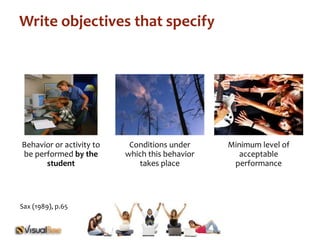
Write objectives that specify 
Behavior or activity to 
be performed by the 
student 
Conditions under 
which this behavior 
takes place 
Minimum level of 
acceptable 
performance 
Sax (1989), p.65
Assess ALL Objectives 
• EVERY objective MUST be measured 
• Data must be available to show evidence 
that each objective has been measured 
• Data can come from standardized objective 
measures, performance assessments, checklists, 
or other methods
Student-Focused Outcomes 
• Objectives should be worded to express what the student 
will learn, know, or do as a result of instruction or how the 
student will change developmentally 
• NOT what the instructor or program will do for the student 
• BAD Objective: Provide students with knowledge about 
how the library works. 
• BETTER Objective: After taking the Research Methods 
course, students will be able to demonstrate their 
knowledge of how the library works by finding ten sources 
for a research paper in the UiTM Library.
Observable, Measurable Objectives 
• Student learning and development should be 
assessed with an observable, measurable 
objective. Objectives such as “know” and 
“understand” are not observable. 
• BAD Objective: Students will know about 
photosynthesis. 
• BETTER Objective: Students will be able to 
describe photosynthesis.
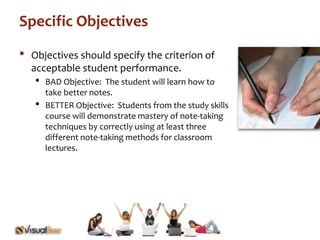
Specific Objectives 
• Objectives should specify the criterion of 
acceptable student performance. 
• BAD Objective: The student will learn how to 
take better notes. 
• BETTER Objective: Students from the study skills 
course will demonstrate mastery of note-taking 
techniques by correctly using at least three 
different note-taking methods for classroom 
lectures.
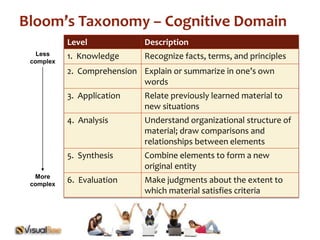
Bloom’s Taxonomy – Cognitive Domain 
Level Description 
1. Knowledge Recognize facts, terms, and principles 
2. Comprehension Explain or summarize in one’s own 
words 
3. Application Relate previously learned material to 
new situations 
4. Analysis Understand organizational structure of 
material; draw comparisons and 
relationships between elements 
5. Synthesis Combine elements to form a new 
original entity 
6. Evaluation Make judgments about the extent to 
which material satisfies criteria 
Less 
complex 
More 
complex
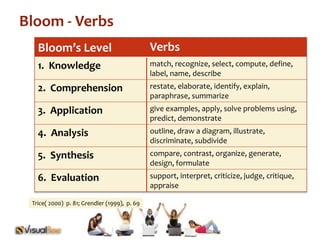
Bloom - Verbs 
Bloom’s Level Verbs 
1. Knowledge match, recognize, select, compute, define, 
label, name, describe 
2. Comprehension restate, elaborate, identify, explain, 
paraphrase, summarize 
3. Application give examples, apply, solve problems using, 
predict, demonstrate 
4. Analysis outline, draw a diagram, illustrate, 
discriminate, subdivide 
5. Synthesis compare, contrast, organize, generate, 
design, formulate 
6. Evaluation support, interpret, criticize, judge, critique, 
appraise 
Trice( 2000) p. 81; Grendler (1999), p. 69
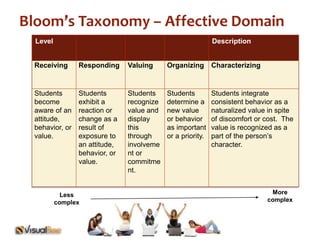
Bloom’s Taxonomy – Affective Domain 
Level Description 
Receiving Responding Valuing Organizing Characterizing 
Students 
become 
aware of an 
attitude, 
behavior, or 
value. 
Students 
exhibit a 
reaction or 
change as a 
result of 
exposure to 
an attitude, 
behavior, or 
value. 
Students 
recognize 
value and 
display 
this 
through 
involveme 
nt or 
commitme 
nt. 
Students 
determine a 
new value 
or behavior 
as important 
or a priority. 
Students integrate 
consistent behavior as a 
naturalized value in spite 
of discomfort or cost. The 
value is recognized as a 
part of the person’s 
character. 
Less 
complex 
More 
complex
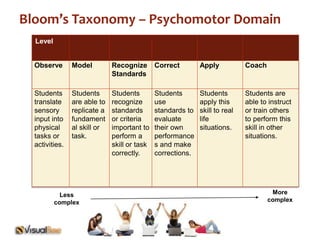
Bloom’s Taxonomy – Psychomotor Domain 
Level 
Observe Model Recognize 
Standards 
Correct Apply Coach 
Students 
translate 
sensory 
input into 
physical 
tasks or 
activities. 
Students 
are able to 
replicate a 
fundament 
al skill or 
task. 
Students 
recognize 
standards 
or criteria 
important to 
perform a 
skill or task 
correctly. 
Students 
use 
standards to 
evaluate 
their own 
performance 
s and make 
corrections. 
Students 
apply this 
skill to real 
life 
situations. 
Students are 
able to instruct 
or train others 
to perform this 
skill in other 
situations. 
Less 
complex 
More 
complex
Less 
complex 
More 
complex 
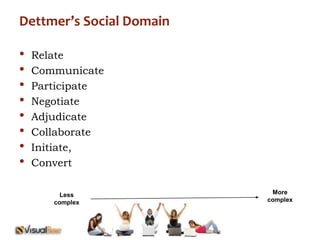
Dettmer’s Social Domain 
• Relate 
• Communicate 
• Participate 
• Negotiate 
• Adjudicate 
• Collaborate 
• Initiate, 
• Convert
Example from social domain 
It may take more than one objective 
to get at “a sense of social 
responsibility”. 
Example: Upon completion of service 
learning orientation, teacher trainees 
will show a ten-point increase on the 
Social Responsibility Index (SRI).
Stating Student focused Objectives -The 
ABCD Method 
• A = Audience 
From “How to Write Clear Objectives” 
• What population are you assessing? 
• B = Behavior 
• What is expected of the participant? 
• C = Conditions 
• Under what circumstances is the 
behavior to be performed? 
• D = Degree 
• How well must the behavior be 
performed? To what level?
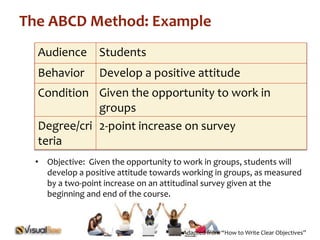
The ABCD Method: Example 
Audience Students 
Behavior Develop a positive attitude 
Condition Given the opportunity to work in 
groups 
Degree/cri 
teria 
2-point increase on survey 
• Objective: Given the opportunity to work in groups, students will 
develop a positive attitude towards working in groups, as measured 
by a two-point increase on an attitudinal survey given at the 
beginning and end of the course. 
Adapted from “How to Write Clear Objectives”
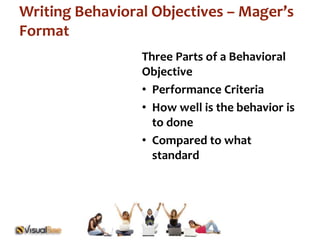
Writing Behavioral Objectives – Mager’s 
Format 
Three Parts of a Behavioral 
Objective 
• Performance Criteria 
• How well is the behavior is 
to done 
• Compared to what 
standard
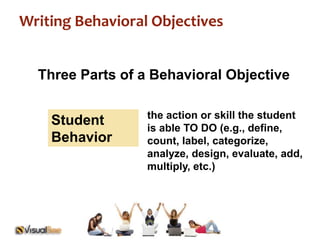
Writing Behavioral Objectives 
Three Parts of a Behavioral Objective 
Student 
Behavior 
the action or skill the student 
is able TO DO (e.g., define, 
count, label, categorize, 
analyze, design, evaluate, add, 
multiply, etc.)
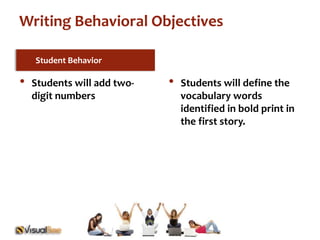
Writing Behavioral Objectives 
Student Behavior 
• Students will add two-digit 
numbers 
• Students will define the 
vocabulary words 
identified in bold print in 
the first story.
Writing Behavioral Objectives 
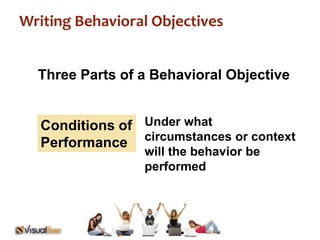
Three Parts of a Behavioral Objective 
Conditions of 
Performance 
Under what 
circumstances or context 
will the behavior be 
performed
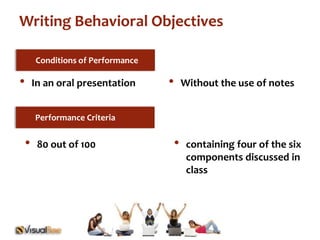
Writing Behavioral Objectives 
Conditions of Performance 
• In an oral presentation • Without the use of notes 
Performance Criteria 
• 80 out of 100 • containing four of the six 
components discussed in 
class
From “Mager’s Tips on Instructional Objectives” 
Common Mistakes 
• Vague behavior 
• Example: Have a thorough 
understanding of particle 
physics. 
• Gibberish 
• Example: Have a deep 
awareness and thorough 
humanizing grasp on… 
• Instructor behavior 
• Example: Train students on how 
and where to find information.
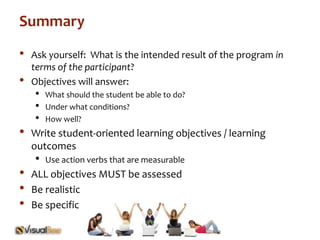
Summary 
• Ask yourself: What is the intended result of the program in 
terms of the participant? 
• Objectives will answer: 
• What should the student be able to do? 
• Under what conditions? 
• How well? 
• Write student-oriented learning objectives / learning 
outcomes 
• Use action verbs that are measurable 
• ALL objectives MUST be assessed 
• Be realistic 
• Be specific
Thank you.. 
Questions?

Week 2 - Instructional Objectives

  • 1.
    Instructional Goals andObjectives Lesson 2
  • 2.
    Lesson outcomes •Explain what a goal of instruction • Explain what an objective of instruction is • Differentiate between instructional goals and instructional objectives. • Explain what a learning outcome is • Describe the four domains of learning outcomes (cognitive, affective, psychomotor and social) • Discuss Bloom’s Taxonomy • Use Bloom’s taxonomy to state learning outcomes according to the levels taught in the subject. • State student focused learning objectives or learning outcomes using Mager’s format and the ABCD format
  • 3.
    What is anobjective? Objectives refer to expected or intended student outcomes Specific knowledge, skills, or attitudes that students are expected to achieve through their learning experience
  • 4.
    Goals Objectives •General expectations of student outcomes • Can be broad and vague • Example: Students will understand the General Education requirements at UiTM • Statement of what students should be able to do, or how they should change developmentally, as a result of instruction or program • More specific; measurable • Example: Upon completion of Lesson 2, students will be able to list the four learning domains Goals vs. Objectives
  • 5.
    Goals and Objectives Goals can be seen as the broad, general expectations for the program Objectives can be seen as the means by which those goals are met PROBLEM: Some objectives are written as broad and unmeasurable • “Understand Bloom’s taxonomy" • How do I know you “understand”?
  • 6.
    Goals and Objectives:Example Goal: Understand the four domains of learning. • Objective 1: Upon completion of the lesson, students will be able to describe the goals and processes involved in the four domains (cognitive, affective, psychomotor and social). •Objective 2: Upon completion of the EDU 503 course, students will be able to state all the levels of Bloom’s cognitive learning.
  • 7.
    Why do weneed Objectives? • Provide focus/direction • Provide a means for assessing student • Guides choice of teaching methods /strategies
  • 8.
    Using Objectives toDesign Assessments • Objectives dictate the type of assessment to conduct • Looking at the action verb in the objective should indicate the appropriate means of measuring that objective • Example: “recognize”: may indicate matching, multiple choice, etc.– lower-level thinking • Example: “demonstrate”: may indicate a performance assessment, or higher-level demands
  • 9.
    Write objectives thatspecify Behavior or activity to be performed by the student Conditions under which this behavior takes place Minimum level of acceptable performance Sax (1989), p.65
  • 10.
    Assess ALL Objectives • EVERY objective MUST be measured • Data must be available to show evidence that each objective has been measured • Data can come from standardized objective measures, performance assessments, checklists, or other methods
  • 11.
    Student-Focused Outcomes •Objectives should be worded to express what the student will learn, know, or do as a result of instruction or how the student will change developmentally • NOT what the instructor or program will do for the student • BAD Objective: Provide students with knowledge about how the library works. • BETTER Objective: After taking the Research Methods course, students will be able to demonstrate their knowledge of how the library works by finding ten sources for a research paper in the UiTM Library.
  • 12.
    Observable, Measurable Objectives • Student learning and development should be assessed with an observable, measurable objective. Objectives such as “know” and “understand” are not observable. • BAD Objective: Students will know about photosynthesis. • BETTER Objective: Students will be able to describe photosynthesis.
  • 13.
    Specific Objectives •Objectives should specify the criterion of acceptable student performance. • BAD Objective: The student will learn how to take better notes. • BETTER Objective: Students from the study skills course will demonstrate mastery of note-taking techniques by correctly using at least three different note-taking methods for classroom lectures.
  • 14.
    Bloom’s Taxonomy –Cognitive Domain Level Description 1. Knowledge Recognize facts, terms, and principles 2. Comprehension Explain or summarize in one’s own words 3. Application Relate previously learned material to new situations 4. Analysis Understand organizational structure of material; draw comparisons and relationships between elements 5. Synthesis Combine elements to form a new original entity 6. Evaluation Make judgments about the extent to which material satisfies criteria Less complex More complex
  • 15.
    Bloom - Verbs Bloom’s Level Verbs 1. Knowledge match, recognize, select, compute, define, label, name, describe 2. Comprehension restate, elaborate, identify, explain, paraphrase, summarize 3. Application give examples, apply, solve problems using, predict, demonstrate 4. Analysis outline, draw a diagram, illustrate, discriminate, subdivide 5. Synthesis compare, contrast, organize, generate, design, formulate 6. Evaluation support, interpret, criticize, judge, critique, appraise Trice( 2000) p. 81; Grendler (1999), p. 69
  • 16.
    Bloom’s Taxonomy –Affective Domain Level Description Receiving Responding Valuing Organizing Characterizing Students become aware of an attitude, behavior, or value. Students exhibit a reaction or change as a result of exposure to an attitude, behavior, or value. Students recognize value and display this through involveme nt or commitme nt. Students determine a new value or behavior as important or a priority. Students integrate consistent behavior as a naturalized value in spite of discomfort or cost. The value is recognized as a part of the person’s character. Less complex More complex
  • 17.
    Bloom’s Taxonomy –Psychomotor Domain Level Observe Model Recognize Standards Correct Apply Coach Students translate sensory input into physical tasks or activities. Students are able to replicate a fundament al skill or task. Students recognize standards or criteria important to perform a skill or task correctly. Students use standards to evaluate their own performance s and make corrections. Students apply this skill to real life situations. Students are able to instruct or train others to perform this skill in other situations. Less complex More complex
  • 18.
    Less complex More complex Dettmer’s Social Domain • Relate • Communicate • Participate • Negotiate • Adjudicate • Collaborate • Initiate, • Convert
  • 19.
    Example from socialdomain It may take more than one objective to get at “a sense of social responsibility”. Example: Upon completion of service learning orientation, teacher trainees will show a ten-point increase on the Social Responsibility Index (SRI).
  • 20.
    Stating Student focusedObjectives -The ABCD Method • A = Audience From “How to Write Clear Objectives” • What population are you assessing? • B = Behavior • What is expected of the participant? • C = Conditions • Under what circumstances is the behavior to be performed? • D = Degree • How well must the behavior be performed? To what level?
  • 21.
    The ABCD Method:Example Audience Students Behavior Develop a positive attitude Condition Given the opportunity to work in groups Degree/cri teria 2-point increase on survey • Objective: Given the opportunity to work in groups, students will develop a positive attitude towards working in groups, as measured by a two-point increase on an attitudinal survey given at the beginning and end of the course. Adapted from “How to Write Clear Objectives”
  • 22.
    Writing Behavioral Objectives– Mager’s Format Three Parts of a Behavioral Objective • Performance Criteria • How well is the behavior is to done • Compared to what standard
  • 23.
    Writing Behavioral Objectives Three Parts of a Behavioral Objective Student Behavior the action or skill the student is able TO DO (e.g., define, count, label, categorize, analyze, design, evaluate, add, multiply, etc.)
  • 24.
    Writing Behavioral Objectives Student Behavior • Students will add two-digit numbers • Students will define the vocabulary words identified in bold print in the first story.
  • 25.
    Writing Behavioral Objectives Three Parts of a Behavioral Objective Conditions of Performance Under what circumstances or context will the behavior be performed
  • 26.
    Writing Behavioral Objectives Conditions of Performance • In an oral presentation • Without the use of notes Performance Criteria • 80 out of 100 • containing four of the six components discussed in class
  • 27.
    From “Mager’s Tipson Instructional Objectives” Common Mistakes • Vague behavior • Example: Have a thorough understanding of particle physics. • Gibberish • Example: Have a deep awareness and thorough humanizing grasp on… • Instructor behavior • Example: Train students on how and where to find information.
  • 28.
    Summary • Askyourself: What is the intended result of the program in terms of the participant? • Objectives will answer: • What should the student be able to do? • Under what conditions? • How well? • Write student-oriented learning objectives / learning outcomes • Use action verbs that are measurable • ALL objectives MUST be assessed • Be realistic • Be specific
  • 29.

Editor's Notes

  • #5 Also, objectives are not the same as goals. General vs. specific.
  • #7 One possible way to correct this problem: make the original objective a course goal and add objectives that address the components of “understanding” Hilary’s up next with some rules for writing objectives. ABCD 1: A = students from IS 202 B = match C = upon completion of career and life planning course given a list of JMU majors and appropriate career choices D = 2: A = students from IS 202 B = state work personality C = upon completion of career and life planning course using the WAVI D =
  • #12 A = students from research methods course B = demonstrate; find C = after taking research methods course in Carrier library D = ten sources
  • #14 A = Students in the study skills course B = note-taking C = classroom lectures D = at least three different methods correctly used
  • #16 .
  • #22 Degree: What is the change you want to see to be satisfied that the program had the intended impact? You decide this!