WIRELESS POWER THEFT
     MONITORING


                SUBMITTED TO:
SUBMITTED BY:
                MR.RANJAN .K. JENA
RUPALI PATRA
                MR.ABHIMANYU MOHAPATR
0901106017
7TH SEM,EE      DEPARTMENT OF
                ELECTRICAL ENGINEER
CONTENTS:
  INTRODUCTION
    i.POWER THEFT :DEFINITION
   ii.HOW IT OCCURS ?
 DIFFERENT WAYS OF MONITORING POWER THEFT

 MICROCONTROLLER BASED POWER THEFT
MONITORING
    i.PROPOSED ARCHITECTURE
 BLOCK DIAGRAM DESCRIPTION

WORKING OF WIRELESS SENSOR NETWORK

ADVANTAGES

LIMITATIONS

CONCLUSION
INTRODUCTION-
POWER THEFT :DEFINITION


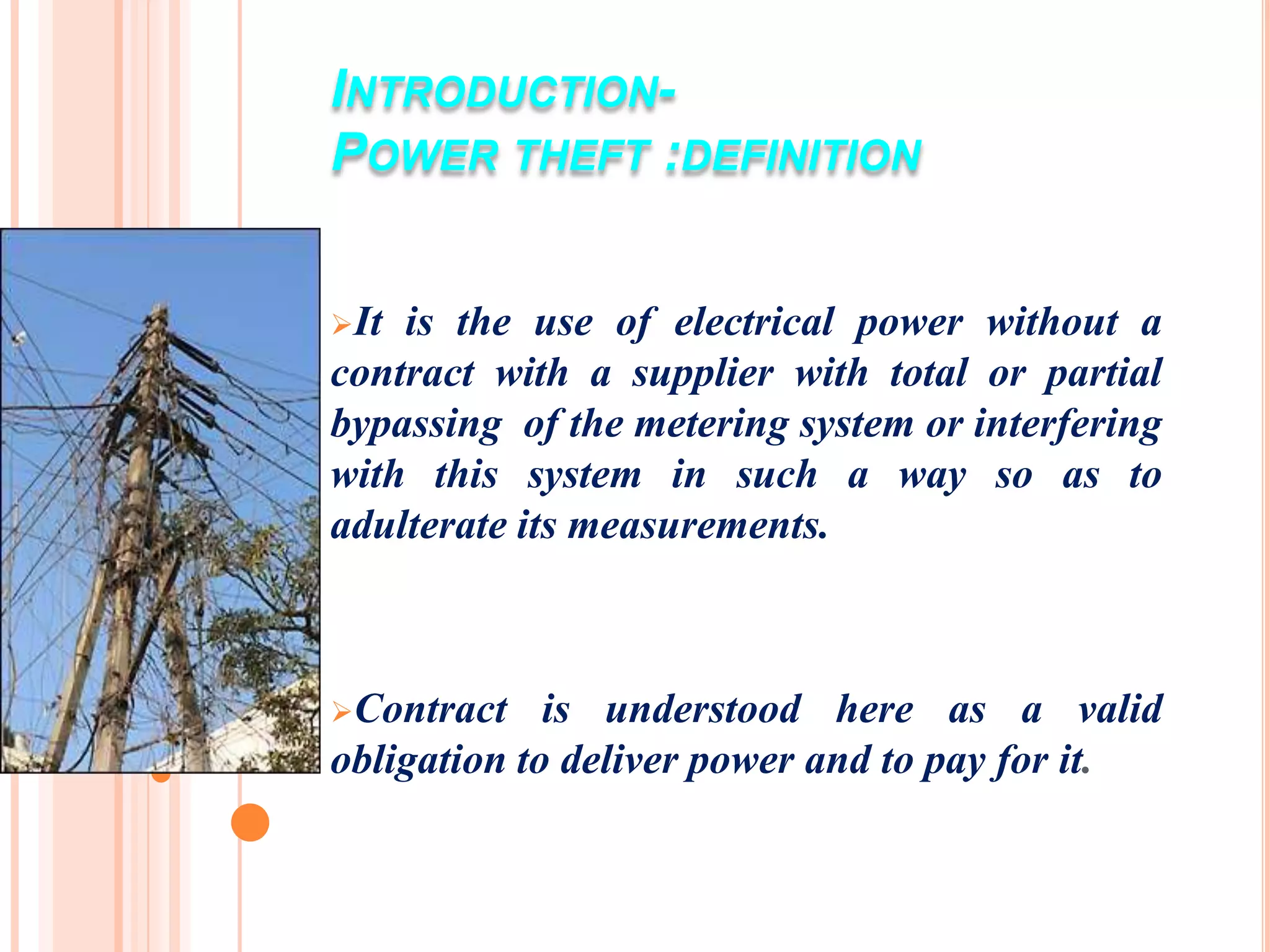
It is the use of electrical power without a
contract with a supplier with total or partial
bypassing of the metering system or interfering
with this system in such a way so as to
adulterate its measurements.


Contract    is understood here as a valid
obligation to deliver power and to pay for it.
HOW IT OCCURS?
   1.SLOWING DOWN THE
   METER:
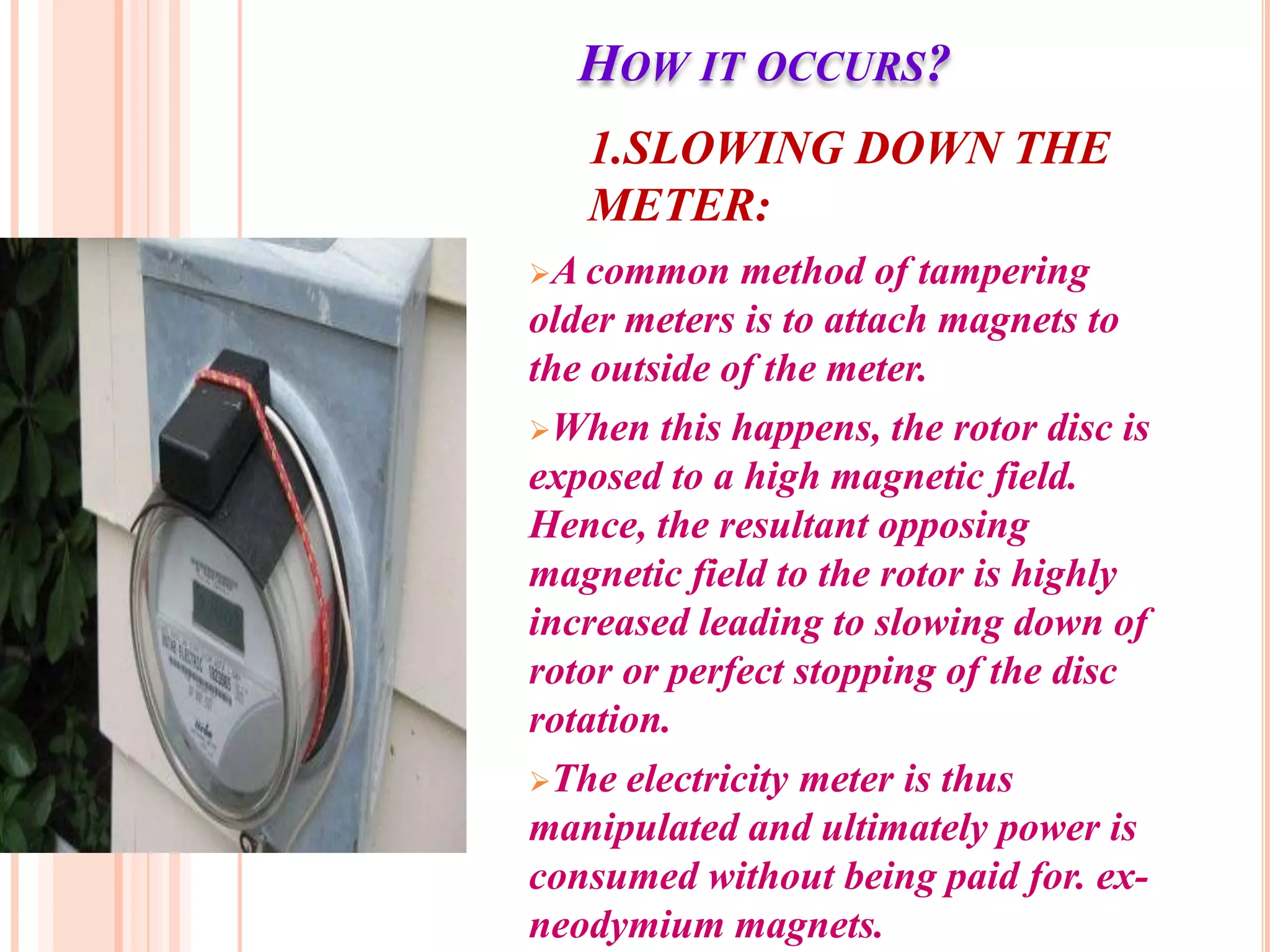
A common    method of tampering
older meters is to attach magnets to
the outside of the meter.
When this happens, the rotor disc is
exposed to a high magnetic field.
Hence, the resultant opposing
magnetic field to the rotor is highly
increased leading to slowing down of
rotor or perfect stopping of the disc
rotation.
The electricity meter is thus
manipulated and ultimately power is
consumed without being paid for. ex-
neodymium magnets.
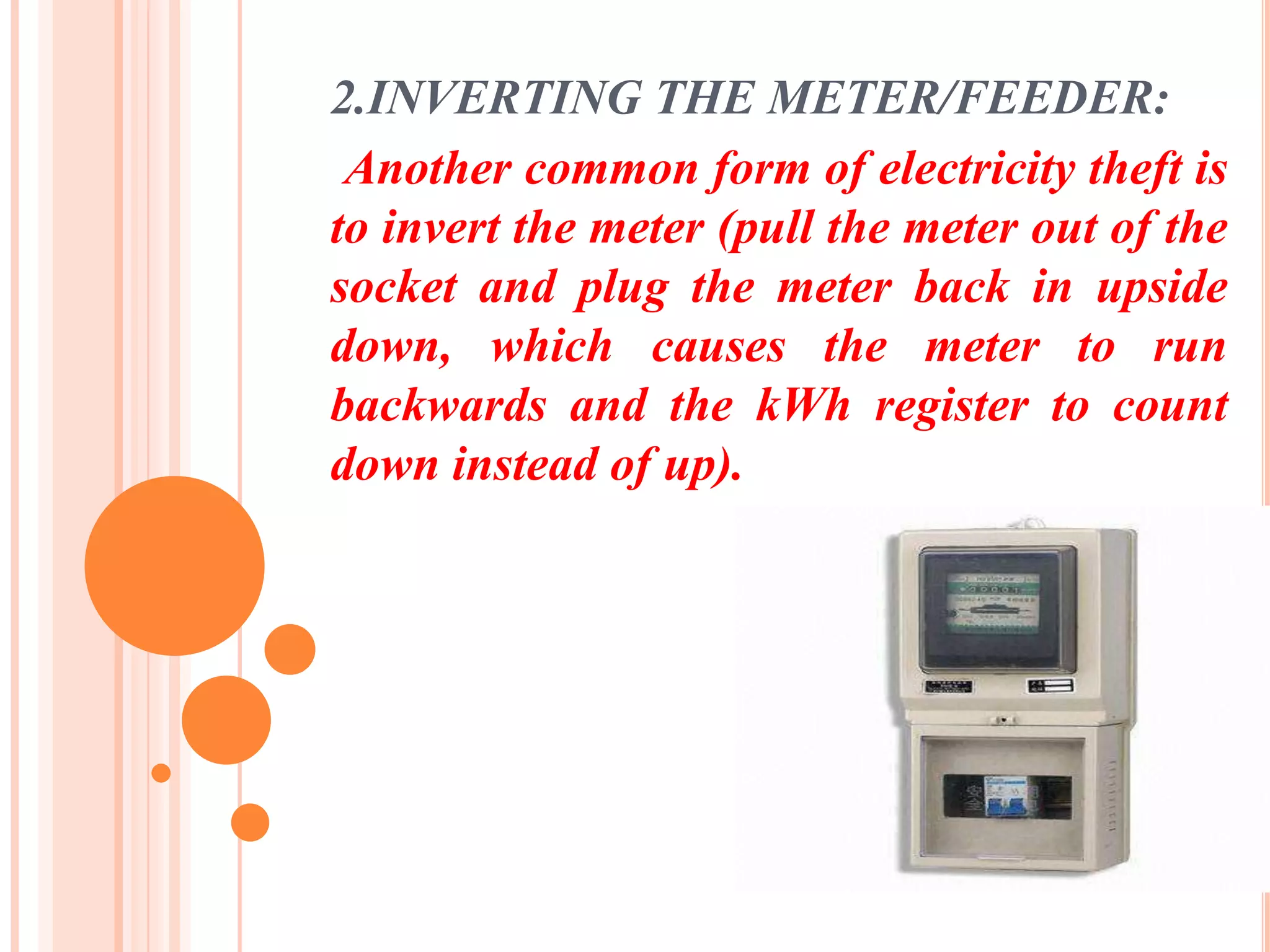
2.INVERTING THE METER/FEEDER:
 Another common form of electricity theft is
to invert the meter (pull the meter out of the
socket and plug the meter back in upside
down, which causes the meter to run
backwards and the kWh register to count
down instead of up).
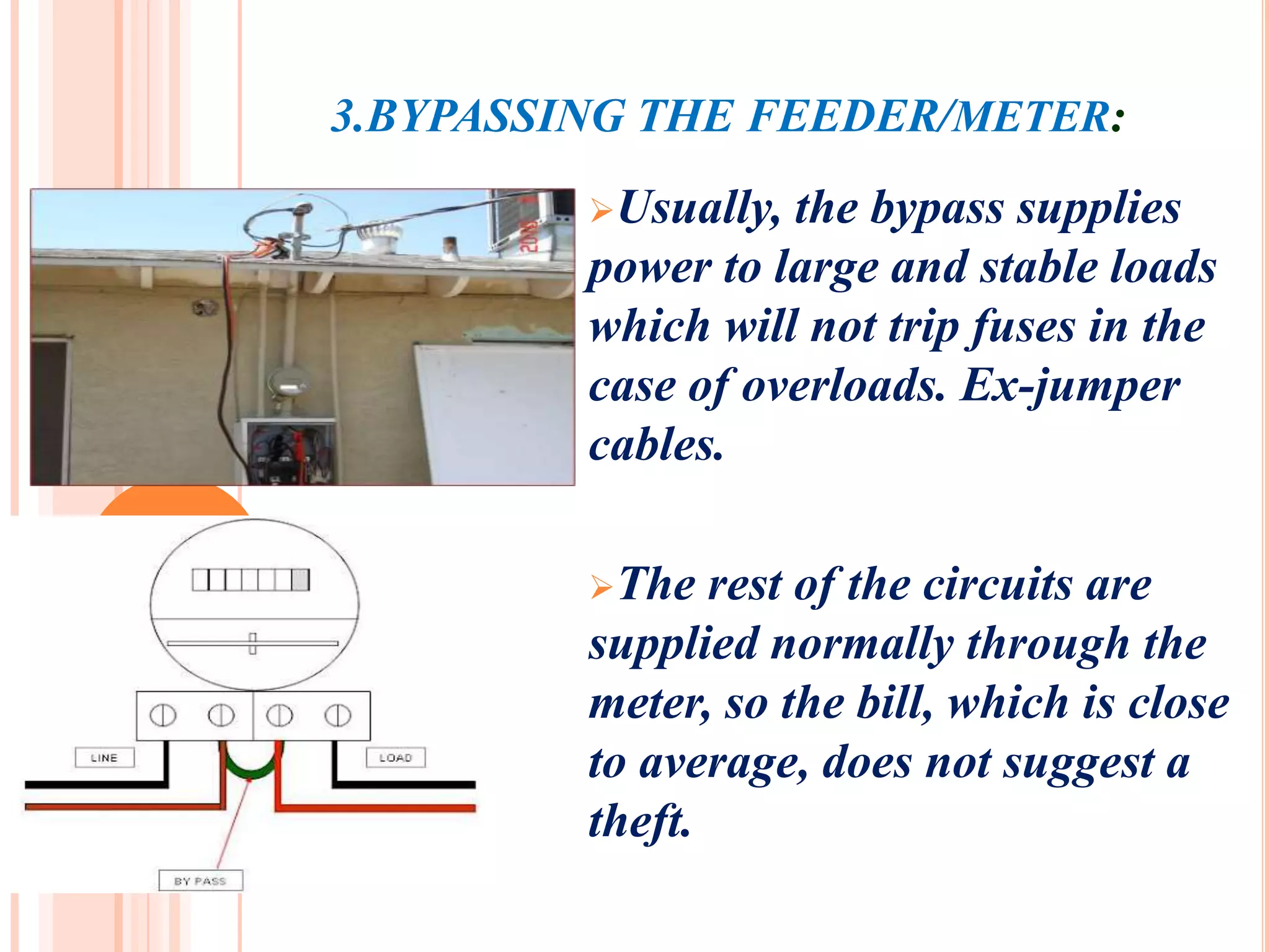
3.BYPASSING THE FEEDER/METER:
         Usually, the bypass supplies
         power to large and stable loads
         which will not trip fuses in the
         case of overloads. Ex-jumper
         cables.

         The   rest of the circuits are
         supplied normally through the
         meter, so the bill, which is close
         to average, does not suggest a
         theft.
DIFFERENT WAYS OF MONITORING POWER
THEFT:

GSM  based power theft
monitoring

Microcontroller   based power theft
monitoring

Power   theft monitoring using
PLC.
MICRO-CONTROLLER BASED
POWER THEFT MONITORING:

OVERVIEW:

The  whole system architecture is based on
integrating wireless network with existing
electrical grid.

The   proposed module also incorporates
different data aggregation algorithms and
 effective solutions needed for the different
pathways of the electricity distribution system.
THE PROPOSED ARCHITECTURE:

The Architecture Consists Of Four Modules
Namely:

Controlling   Station (CS)

   Wireless Transformer Sensor Node (WTSN)

Transmission   Line Sensor Node (TLSN)

Wireless   Consumer Sensor Node (WCSN)
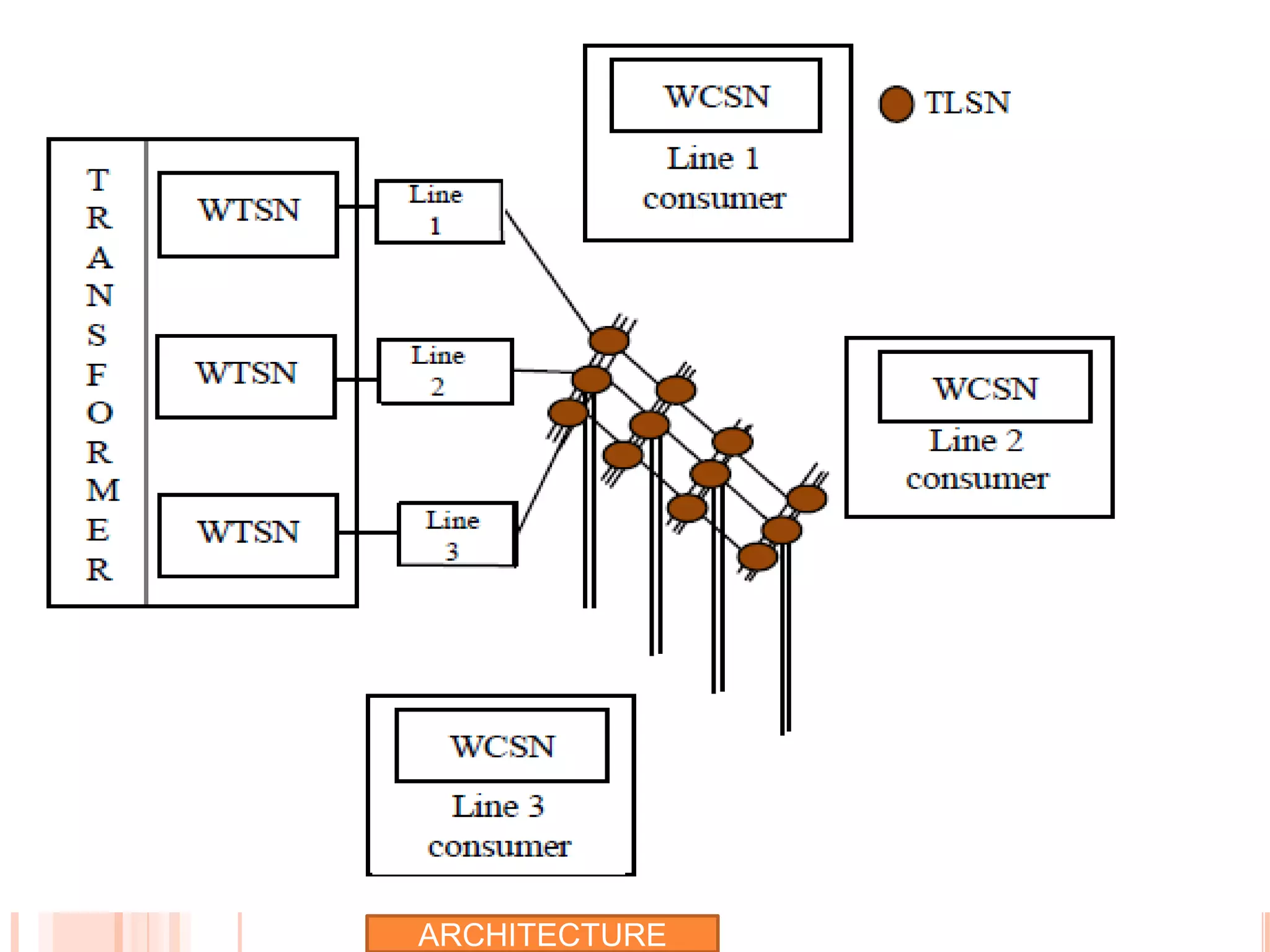
ARCHITECTURE
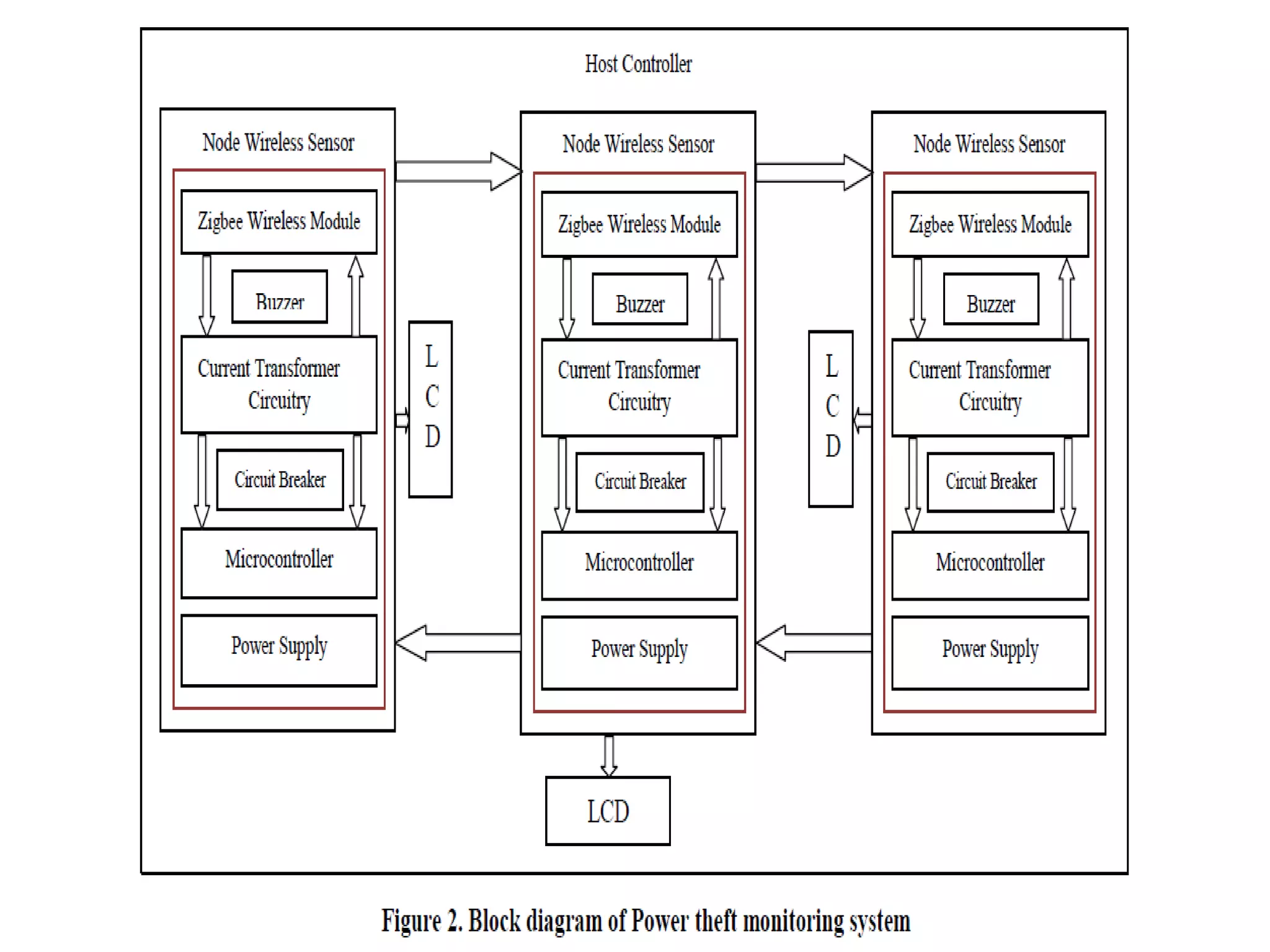
 WCSN is a module which acts as a consumer
power metering device that measures the power
consumed by the consumer and send the data
periodically to the WTSN.

Each   feeder of the transformer has a WTSN
which monitors power through each line and
collects data from WCSN ,aggregates it and sends
to the CS.

TLSN   is another module associated with
distribution line, mounted in each distribution line
posts .
DIFFERENT PARTS AND THEIR
            FUNCTIONS:
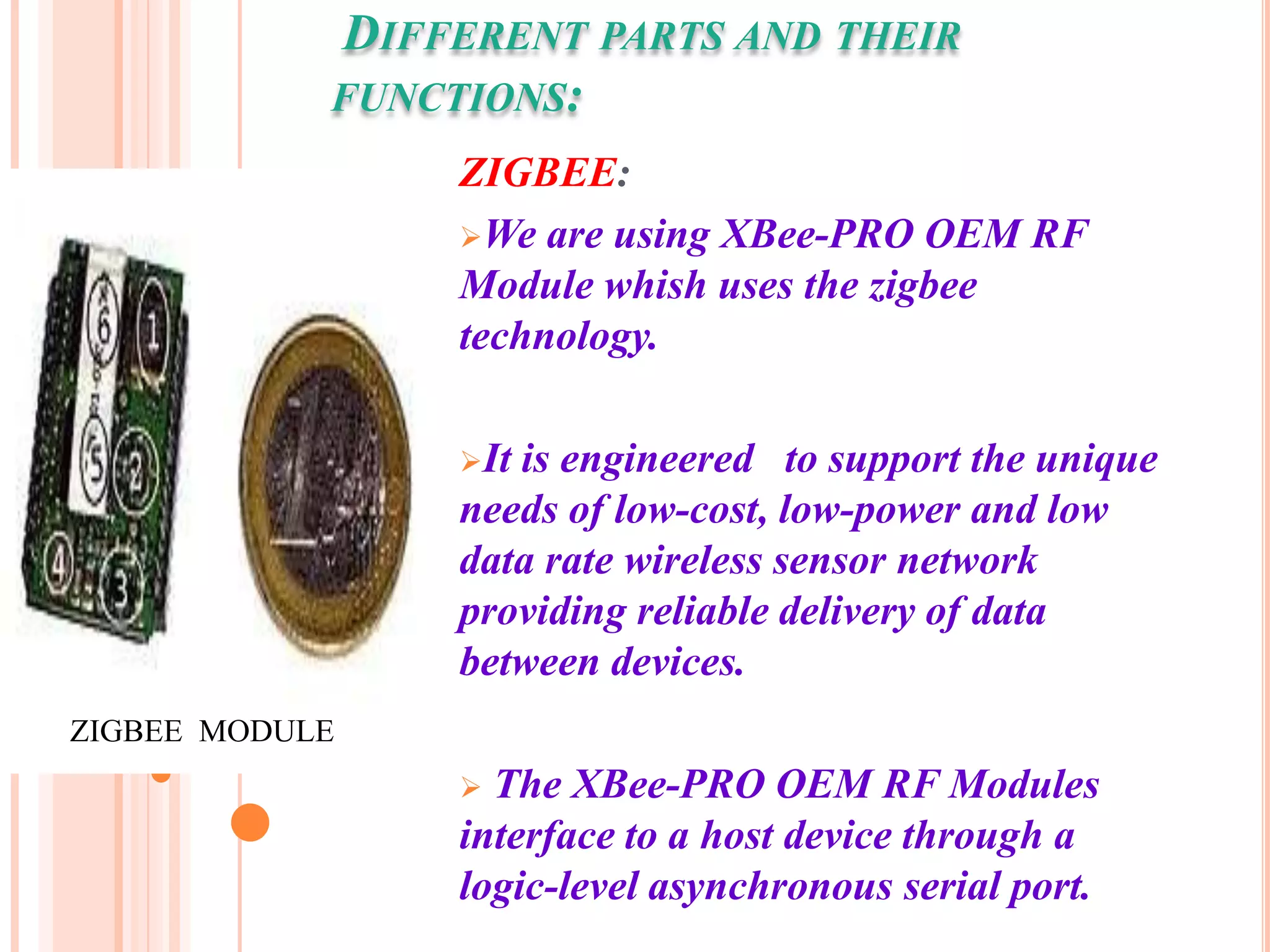
                 ZIGBEE:
                 We are using XBee-PRO OEM RF
                 Module whish uses the zigbee
                 technology.

                 Itis engineered to support the unique
                 needs of low-cost, low-power and low
                 data rate wireless sensor network
                 providing reliable delivery of data
                 between devices.
ZIGBEE MODULE
                  The XBee-PRO OEM RF Modules
                 interface to a host device through a
                 logic-level asynchronous serial port.
CURRENT TRANSFORMER CIRCUITRY:
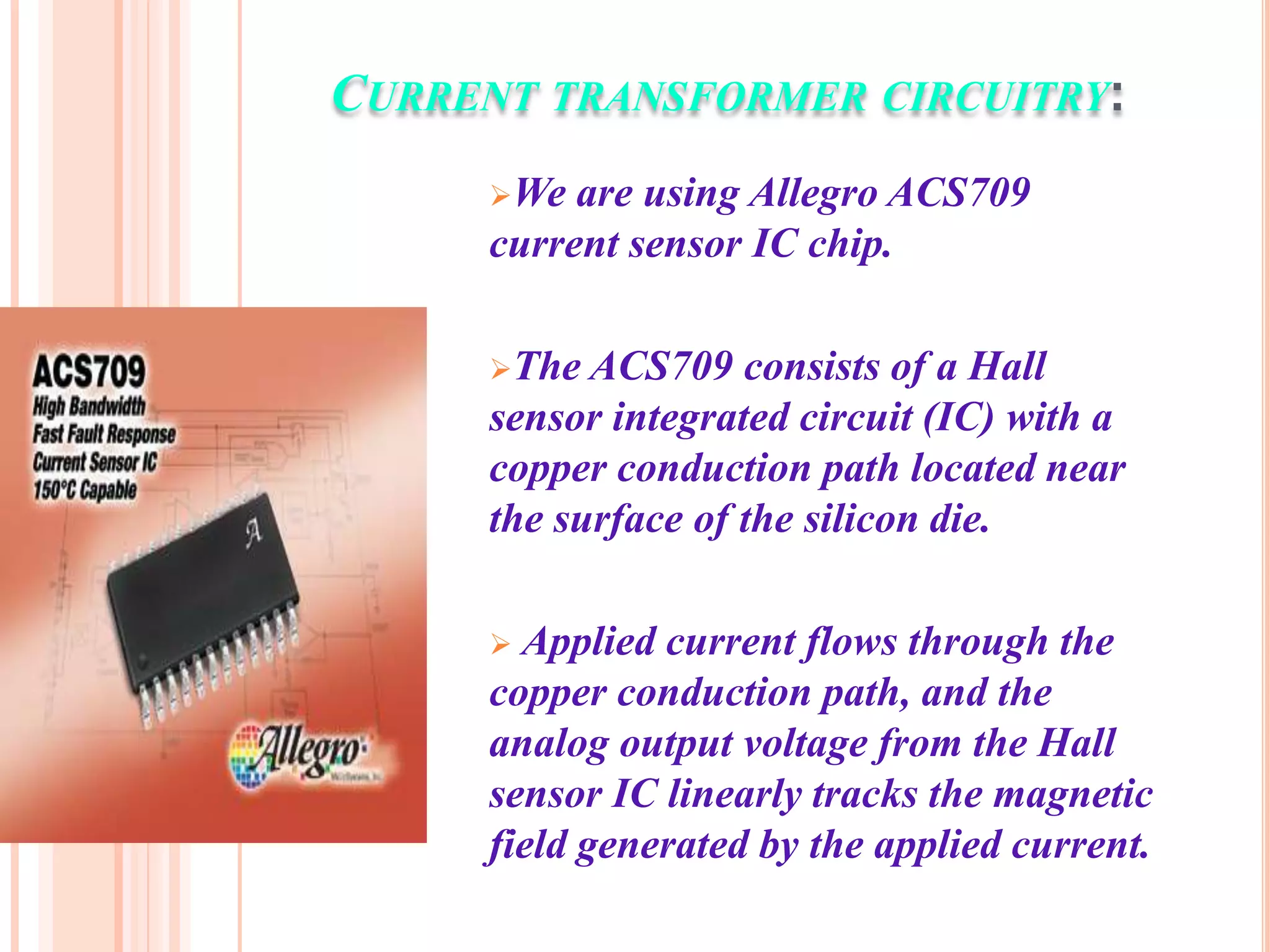
     We  are using Allegro ACS709
     current sensor IC chip.

     The ACS709    consists of a Hall
     sensor integrated circuit (IC) with a
     copper conduction path located near
     the surface of the silicon die.

      Applied current flows through the
     copper conduction path, and the
     analog output voltage from the Hall
     sensor IC linearly tracks the magnetic
     field generated by the applied current.
MICROCONTROLLER:
The LPC2148 microcontroller is based on a16-bit/32-bit
ARM7TDMI-S CPU with embedded high-speed flash memory
ranging from 32 kB to 512 kB.

 A 128-bitwide memory interface architecture enable 32-bit
code execution at the maximum clock rate.

Due   to their tiny size and low power consumption, LPC2148
is ideal for applications where miniaturization is a key
requirement.

Serial communication interfaces ranging from multiple
UARTs, on-chip SRAM of 8 kB up to 40 kB, make these
devices very well suited for communication gateways.
LCD:

LCD   stands for Liquid Crystal Display.

As  the output of the circuit should be
displayed in some form or the other, LCD
display is selected as it can display 16
characters at a time.

It is also easy to interface with the
microcontroller without any decoder. So it
is better than the seven segment display.
WORKING OF WIRELESS
    SENSOR NETWORK:
The  sensor network monitors the electrical grid for a specified
period of time, which may be daily, monthly or yearly.
 Thus the WTSN stores the maximum demand for each consumer
including the losses.
The measured data from each WCSN is send to the neighbouring
TLSN.
The  aggregated data is then sent to the next nearby WTSN. Thus
the data transfers from WCSN to the corresponding WTSN through
TLSN.
 The collected data is compared with the measured data by the
energy meter.
•Normally   these two data are almost same.


 If there is any difference (dmc) in the collected data and the
measured data, there may be a line fault or a power theft in that
segment.
 Large value of dmc indicates a line fault and small value of dmc
indicate a power theft .
ADVANTAGES:
The  proposed system provides the solution for some
of the main problems faced by the existing Indian
grid system, such as wastage of energy, power theft,
manual billing system, and transmission line fault.

 This method will reduce the energy wastage and
save a lot of energy for future use.

 We can detect the location from where the power is
being stolen which was not possible before.

   Optimized use of energy.
LIMITATIONS:
One  major disadvantage of this project is that it is
not capable of detecting the exact location from
where the power is being stolen giving only a
approximation to that place.


 Cannot determine who is stealing, but even no
other existing system is capable of doing this.


 If implemented on a large scale it may take a lot of
time and manual input.
CONCLUSION:
This  method reduces the heavy power and revenue losses
that occur due to power theft by the customers.

 By this design it can be concluded that power theft can be
effectively curbed by detecting where the power theft occurs
and informing the authorities.

Also  an automatic circuit breaker may be integrated to the
unit so as to remotely cut off the power supply to the house or
consumer who tries to indulge in power theft.

 The ability of the proposed system to inform or send data
digitally to a remote station using wireless radio link adds a
large amount of possibilities to the way the power supply is
controlled by the electricity board.

This  system will reduce the energy wastage and save a lot
for future use.
Wireless power theft monitoring

Wireless power theft monitoring

  • 1.
    WIRELESS POWER THEFT MONITORING SUBMITTED TO: SUBMITTED BY: MR.RANJAN .K. JENA RUPALI PATRA MR.ABHIMANYU MOHAPATR 0901106017 7TH SEM,EE DEPARTMENT OF ELECTRICAL ENGINEER
  • 2.
    CONTENTS:  INTRODUCTION i.POWER THEFT :DEFINITION ii.HOW IT OCCURS ?  DIFFERENT WAYS OF MONITORING POWER THEFT  MICROCONTROLLER BASED POWER THEFT MONITORING i.PROPOSED ARCHITECTURE  BLOCK DIAGRAM DESCRIPTION WORKING OF WIRELESS SENSOR NETWORK ADVANTAGES LIMITATIONS CONCLUSION
  • 3.
    INTRODUCTION- POWER THEFT :DEFINITION Itis the use of electrical power without a contract with a supplier with total or partial bypassing of the metering system or interfering with this system in such a way so as to adulterate its measurements. Contract is understood here as a valid obligation to deliver power and to pay for it.
  • 4.
    HOW IT OCCURS? 1.SLOWING DOWN THE METER: A common method of tampering older meters is to attach magnets to the outside of the meter. When this happens, the rotor disc is exposed to a high magnetic field. Hence, the resultant opposing magnetic field to the rotor is highly increased leading to slowing down of rotor or perfect stopping of the disc rotation. The electricity meter is thus manipulated and ultimately power is consumed without being paid for. ex- neodymium magnets.
  • 5.
    2.INVERTING THE METER/FEEDER: Another common form of electricity theft is to invert the meter (pull the meter out of the socket and plug the meter back in upside down, which causes the meter to run backwards and the kWh register to count down instead of up).
  • 6.
    3.BYPASSING THE FEEDER/METER: Usually, the bypass supplies power to large and stable loads which will not trip fuses in the case of overloads. Ex-jumper cables. The rest of the circuits are supplied normally through the meter, so the bill, which is close to average, does not suggest a theft.
  • 7.
    DIFFERENT WAYS OFMONITORING POWER THEFT: GSM based power theft monitoring Microcontroller based power theft monitoring Power theft monitoring using PLC.
  • 8.
    MICRO-CONTROLLER BASED POWER THEFTMONITORING: OVERVIEW: The whole system architecture is based on integrating wireless network with existing electrical grid. The proposed module also incorporates different data aggregation algorithms and effective solutions needed for the different pathways of the electricity distribution system.
  • 9.
    THE PROPOSED ARCHITECTURE: TheArchitecture Consists Of Four Modules Namely: Controlling Station (CS)  Wireless Transformer Sensor Node (WTSN) Transmission Line Sensor Node (TLSN) Wireless Consumer Sensor Node (WCSN)
  • 10.
  • 11.
     WCSN isa module which acts as a consumer power metering device that measures the power consumed by the consumer and send the data periodically to the WTSN. Each feeder of the transformer has a WTSN which monitors power through each line and collects data from WCSN ,aggregates it and sends to the CS. TLSN is another module associated with distribution line, mounted in each distribution line posts .
  • 12.
    DIFFERENT PARTS ANDTHEIR FUNCTIONS: ZIGBEE: We are using XBee-PRO OEM RF Module whish uses the zigbee technology. Itis engineered to support the unique needs of low-cost, low-power and low data rate wireless sensor network providing reliable delivery of data between devices. ZIGBEE MODULE  The XBee-PRO OEM RF Modules interface to a host device through a logic-level asynchronous serial port.
  • 13.
    CURRENT TRANSFORMER CIRCUITRY: We are using Allegro ACS709 current sensor IC chip. The ACS709 consists of a Hall sensor integrated circuit (IC) with a copper conduction path located near the surface of the silicon die.  Applied current flows through the copper conduction path, and the analog output voltage from the Hall sensor IC linearly tracks the magnetic field generated by the applied current.
  • 14.
    MICROCONTROLLER: The LPC2148 microcontrolleris based on a16-bit/32-bit ARM7TDMI-S CPU with embedded high-speed flash memory ranging from 32 kB to 512 kB.  A 128-bitwide memory interface architecture enable 32-bit code execution at the maximum clock rate. Due to their tiny size and low power consumption, LPC2148 is ideal for applications where miniaturization is a key requirement. Serial communication interfaces ranging from multiple UARTs, on-chip SRAM of 8 kB up to 40 kB, make these devices very well suited for communication gateways.
  • 15.
    LCD: LCD stands for Liquid Crystal Display. As the output of the circuit should be displayed in some form or the other, LCD display is selected as it can display 16 characters at a time. It is also easy to interface with the microcontroller without any decoder. So it is better than the seven segment display.
  • 17.
    WORKING OF WIRELESS SENSOR NETWORK: The sensor network monitors the electrical grid for a specified period of time, which may be daily, monthly or yearly.  Thus the WTSN stores the maximum demand for each consumer including the losses. The measured data from each WCSN is send to the neighbouring TLSN. The aggregated data is then sent to the next nearby WTSN. Thus the data transfers from WCSN to the corresponding WTSN through TLSN.  The collected data is compared with the measured data by the energy meter. •Normally these two data are almost same.  If there is any difference (dmc) in the collected data and the measured data, there may be a line fault or a power theft in that segment.  Large value of dmc indicates a line fault and small value of dmc indicate a power theft .
  • 18.
    ADVANTAGES: The proposedsystem provides the solution for some of the main problems faced by the existing Indian grid system, such as wastage of energy, power theft, manual billing system, and transmission line fault.  This method will reduce the energy wastage and save a lot of energy for future use.  We can detect the location from where the power is being stolen which was not possible before.  Optimized use of energy.
  • 19.
    LIMITATIONS: One majordisadvantage of this project is that it is not capable of detecting the exact location from where the power is being stolen giving only a approximation to that place.  Cannot determine who is stealing, but even no other existing system is capable of doing this.  If implemented on a large scale it may take a lot of time and manual input.
  • 20.
    CONCLUSION: This methodreduces the heavy power and revenue losses that occur due to power theft by the customers.  By this design it can be concluded that power theft can be effectively curbed by detecting where the power theft occurs and informing the authorities. Also an automatic circuit breaker may be integrated to the unit so as to remotely cut off the power supply to the house or consumer who tries to indulge in power theft.  The ability of the proposed system to inform or send data digitally to a remote station using wireless radio link adds a large amount of possibilities to the way the power supply is controlled by the electricity board. This system will reduce the energy wastage and save a lot for future use.