 Name: Bidusmita Sahoo

Regn no: 0901106016
Branch: Electrical Engineering
 Submitted to:

Mr. Abhimanyu Mohapatra
Mr. Ranjan Kumar Jena
CONTENTS
 Introduction
 What is cast resin process ?
 Why cast resin transformer ?

 Construction
 Types of tests on resin transformer
 Overload capability
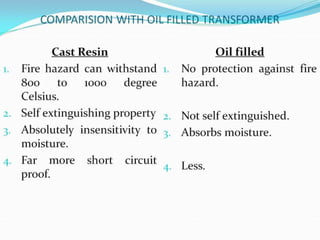
 Comparison with oil-filled transformer
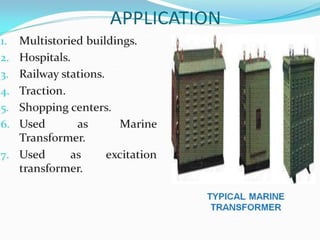
 Applications
 Manufacturers
 Conclusion
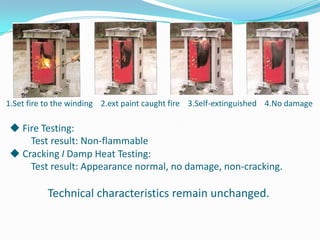
1.Set fire to the winding 2.ext paint caught fire 3.Self-extinguished 4.No damage

◆ Fire Testing:
Test result: Non-flammable
◆ Cracking I Damp Heat Testing:
Test result: Appearance normal, no damage, non-cracking.

Technical characteristics remain unchanged.
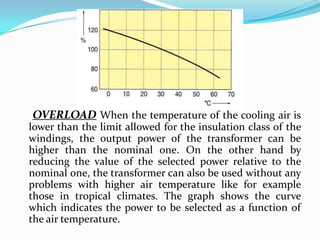
OVERLOAD When the temperature of the cooling air is
lower than the limit allowed for the insulation class of the
windings, the output power of the transformer can be
higher than the nominal one. On the other hand by
reducing the value of the selected power relative to the
nominal one, the transformer can also be used without any
problems with higher air temperature like for example
those in tropical climates. The graph shows the curve
which indicates the power to be selected as a function of
the air temperature.
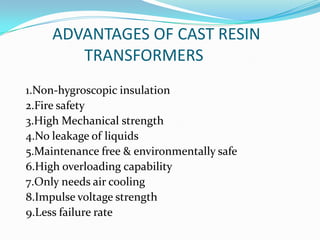
ADVANTAGES OF CAST RESIN
TRANSFORMERS
1.Non-hygroscopic insulation
2.Fire safety
3.High Mechanical strength
4.No leakage of liquids
5.Maintenance free & environmentally safe
6.High overloading capability
7.Only needs air cooling
8.Impulse voltage strength
9.Less failure rate
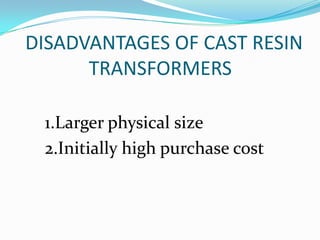
DISADVANTAGES OF CAST RESIN
TRANSFORMERS
1.Larger physical size
2.Initially high purchase cost
MANUFACTURERS
 ABB International Limited
 BHEL

 Siemens
 Alstom
CONCLUSION
Cast Resin transformer is used where
safety, pollution, size & economy matters a lot.
Now-a-days the use of Cast resin transformers has
been increased and they are widely used in power
houses, Apartments, as back-up supply, etc. These
are
very
commonly
used
in
China, Japan, USA, Switzerland, Netherland. But
these are very rarely used in India. According to
my view Energy Department of India should think
about the installation of these transformers in our
Power System.
Cast resin transformer

Cast resin transformer

  • 1.
     Name: BidusmitaSahoo Regn no: 0901106016 Branch: Electrical Engineering  Submitted to: Mr. Abhimanyu Mohapatra Mr. Ranjan Kumar Jena
  • 2.
    CONTENTS  Introduction  Whatis cast resin process ?  Why cast resin transformer ?  Construction  Types of tests on resin transformer  Overload capability  Comparison with oil-filled transformer  Applications  Manufacturers  Conclusion
  • 17.
    1.Set fire tothe winding 2.ext paint caught fire 3.Self-extinguished 4.No damage ◆ Fire Testing: Test result: Non-flammable ◆ Cracking I Damp Heat Testing: Test result: Appearance normal, no damage, non-cracking. Technical characteristics remain unchanged.
  • 20.
    OVERLOAD When thetemperature of the cooling air is lower than the limit allowed for the insulation class of the windings, the output power of the transformer can be higher than the nominal one. On the other hand by reducing the value of the selected power relative to the nominal one, the transformer can also be used without any problems with higher air temperature like for example those in tropical climates. The graph shows the curve which indicates the power to be selected as a function of the air temperature.
  • 22.
    ADVANTAGES OF CASTRESIN TRANSFORMERS 1.Non-hygroscopic insulation 2.Fire safety 3.High Mechanical strength 4.No leakage of liquids 5.Maintenance free & environmentally safe 6.High overloading capability 7.Only needs air cooling 8.Impulse voltage strength 9.Less failure rate
  • 23.
    DISADVANTAGES OF CASTRESIN TRANSFORMERS 1.Larger physical size 2.Initially high purchase cost
  • 26.
    MANUFACTURERS  ABB InternationalLimited  BHEL  Siemens  Alstom
  • 27.
    CONCLUSION Cast Resin transformeris used where safety, pollution, size & economy matters a lot. Now-a-days the use of Cast resin transformers has been increased and they are widely used in power houses, Apartments, as back-up supply, etc. These are very commonly used in China, Japan, USA, Switzerland, Netherland. But these are very rarely used in India. According to my view Energy Department of India should think about the installation of these transformers in our Power System.