COOLING OF POWER TRANSFORMER

Presented By :
Prasanta kumar Malik
7th Sem. Electrical engg
Roll No:1021106017
CONTENT
 Introduction
 Methods of Cooling
 Applications
 Conclusion
INTRODUCTION
Power transformers are key components for

electricity supply systems.
It convert energy at one voltage level to another
voltage level. During the process of energy
transfer ,losses occur in the winding of the
transformer. This losses appear as heat that may
burn the winding of the transformer.
So to make the transformer healthier cooling is
needed.
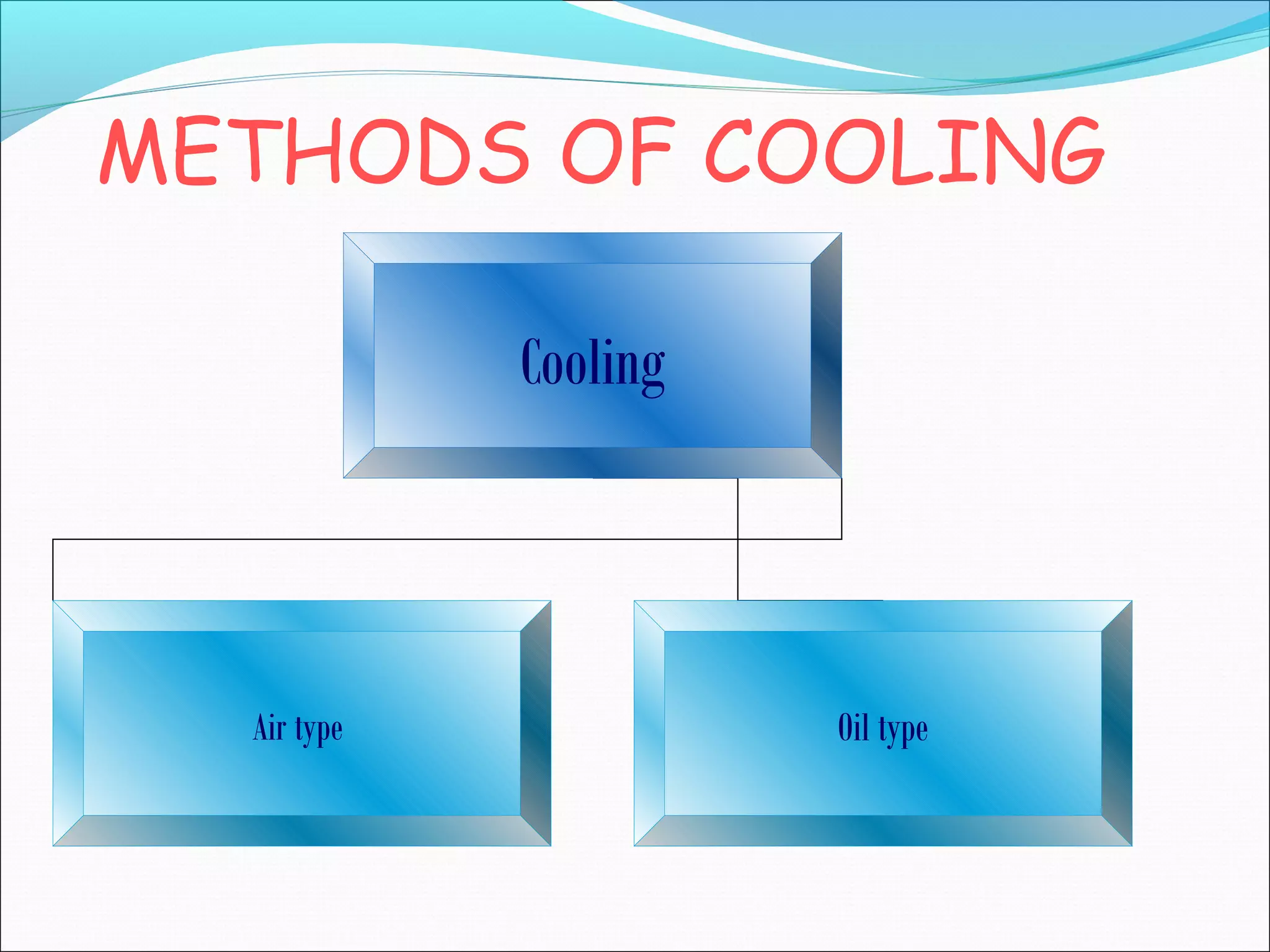
METHODS OF COOLING
Cooling

Air type

Oil type
AIR TYPE COOLING
Air natural (AN) Cooling
Air blast cooling
OIL IMMERSED TYPE
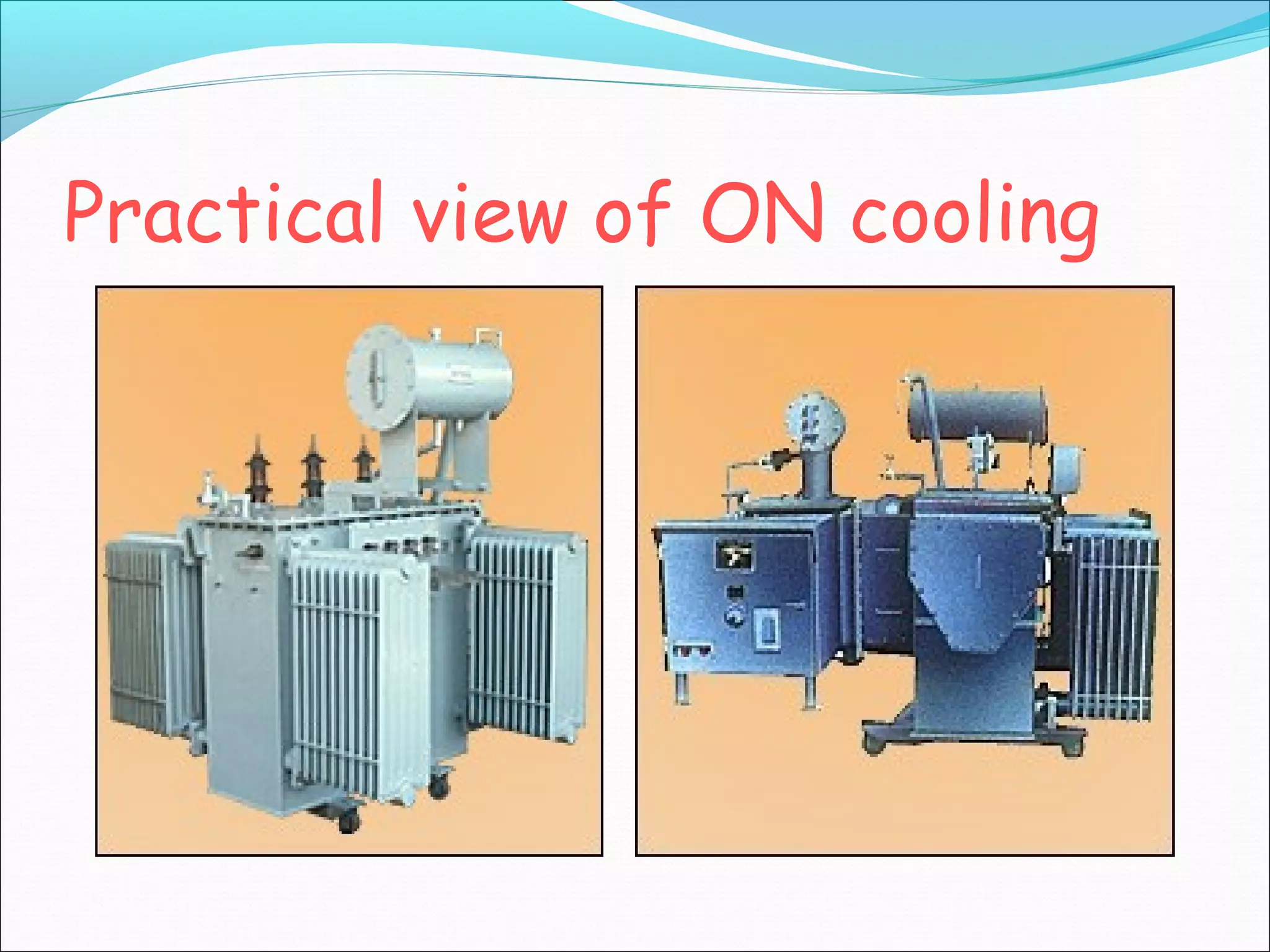
Oil natural (ON) cooling
Oil natural air forced (ONAF)cooling
Oil natural water forced (ONWF) Cooling
Oil forced air natural (OFAN) cooling
Oil forced air forced (OFAF) Cooling
Oil forced water forced (OFWF) Cooling
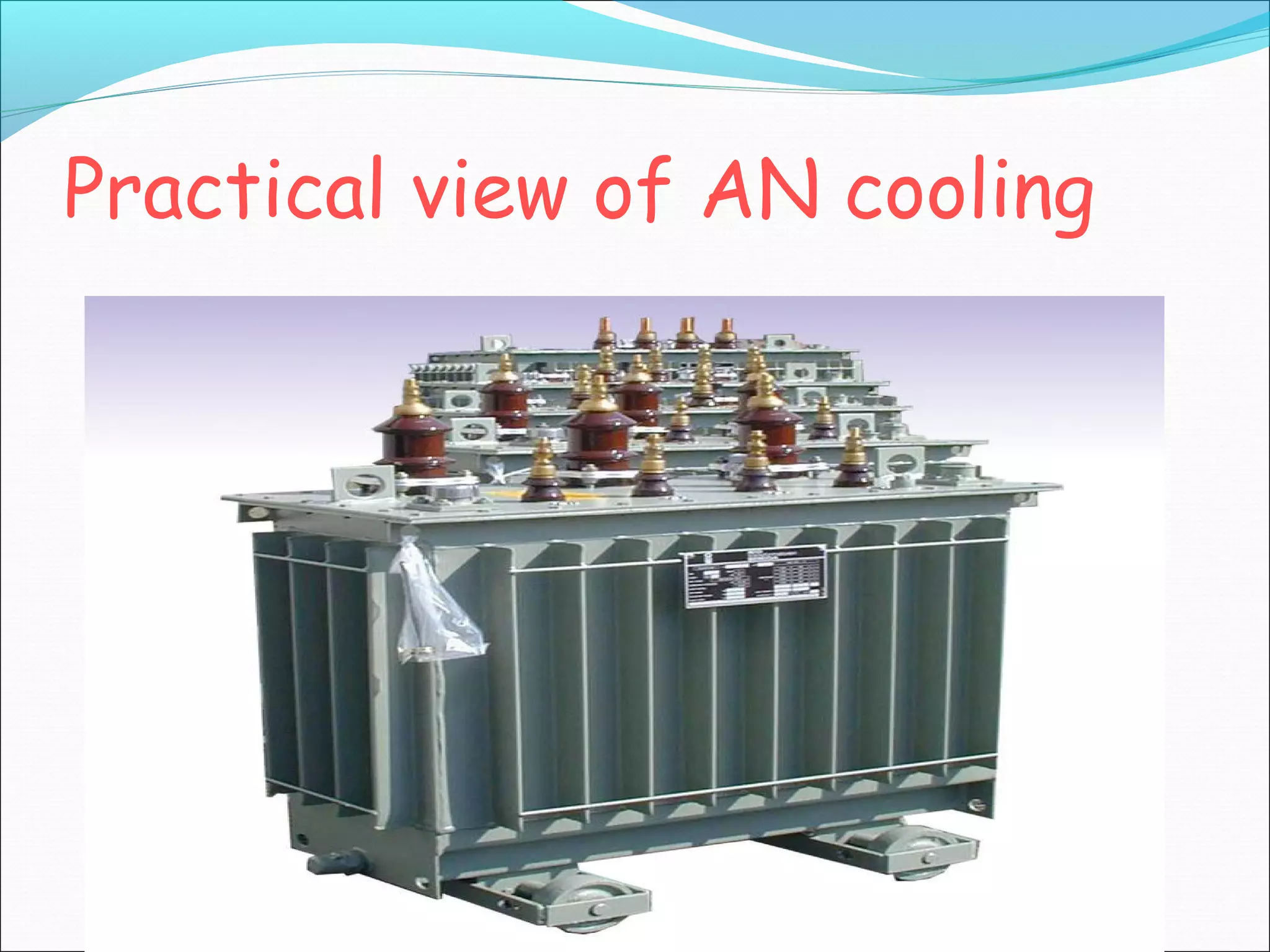
AIR NATURAL COOLING
 The transformers having smaller output(5-10KVA)

are cooled by this method.In this method the external
surface is sufficent to dissipate the heat produce by
the losses.
 Such transformers are cooled by the combination of
air convection currents within the enclose case and by
natural radiation from the case itself.
Practical view of AN cooling
AIR BLAST COOLNG
This type of cooling is used in dry type

transformers.
In this method ,heat dissipation is improved
by a continuous blast of air forced through the
core and windigs.
The air blast is produced by means of external
fans and blowers.
This type of cooling is limited to transformers
of voltage rating not exceeding 25kv.
DISADVANTAGES
In this process the increase in

insulation strength is not obtained due
to non-immersion in oil.
A regular maintenance is a must for
this kind of transformers.(i.e filter
maintenance)
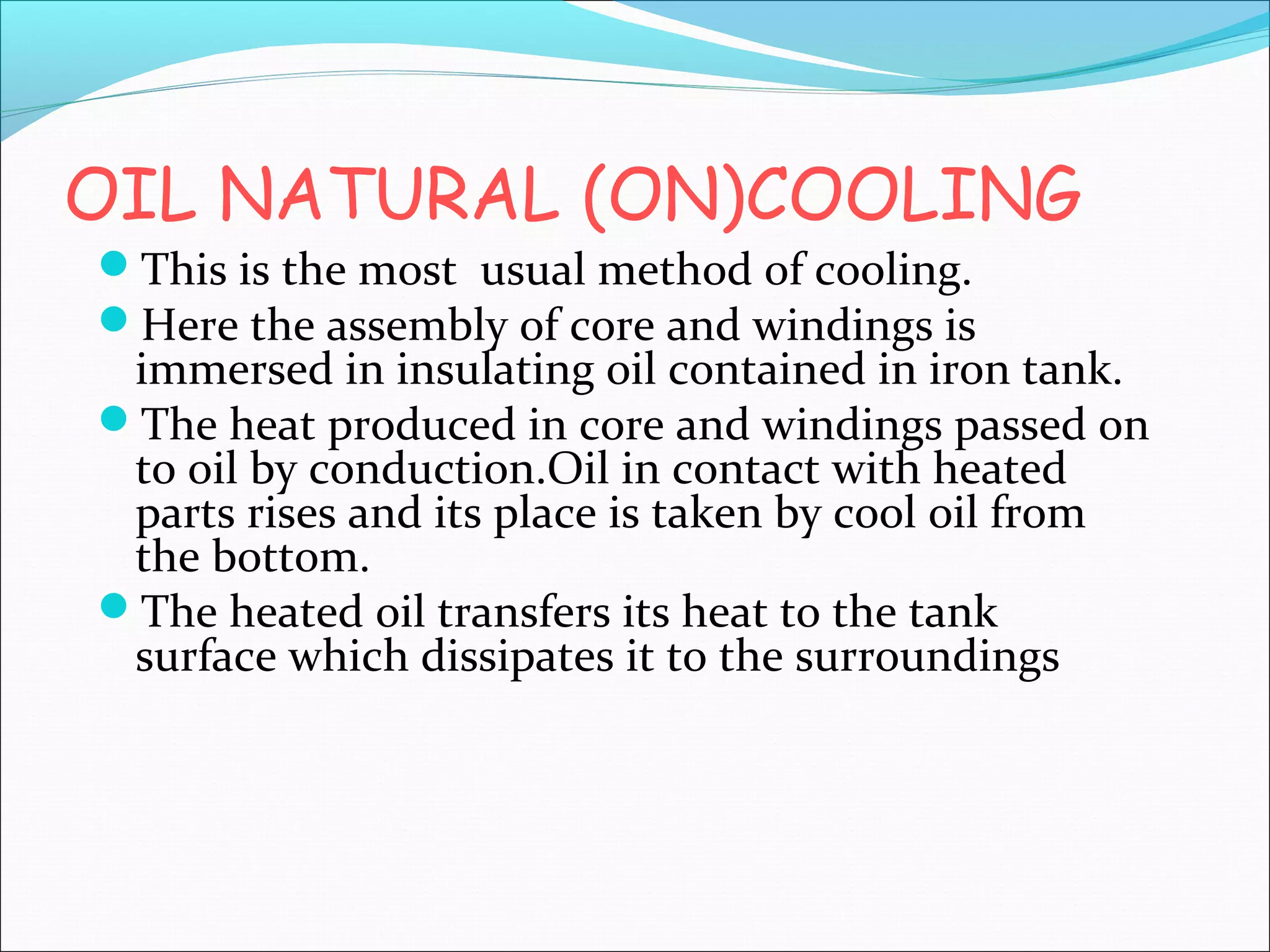
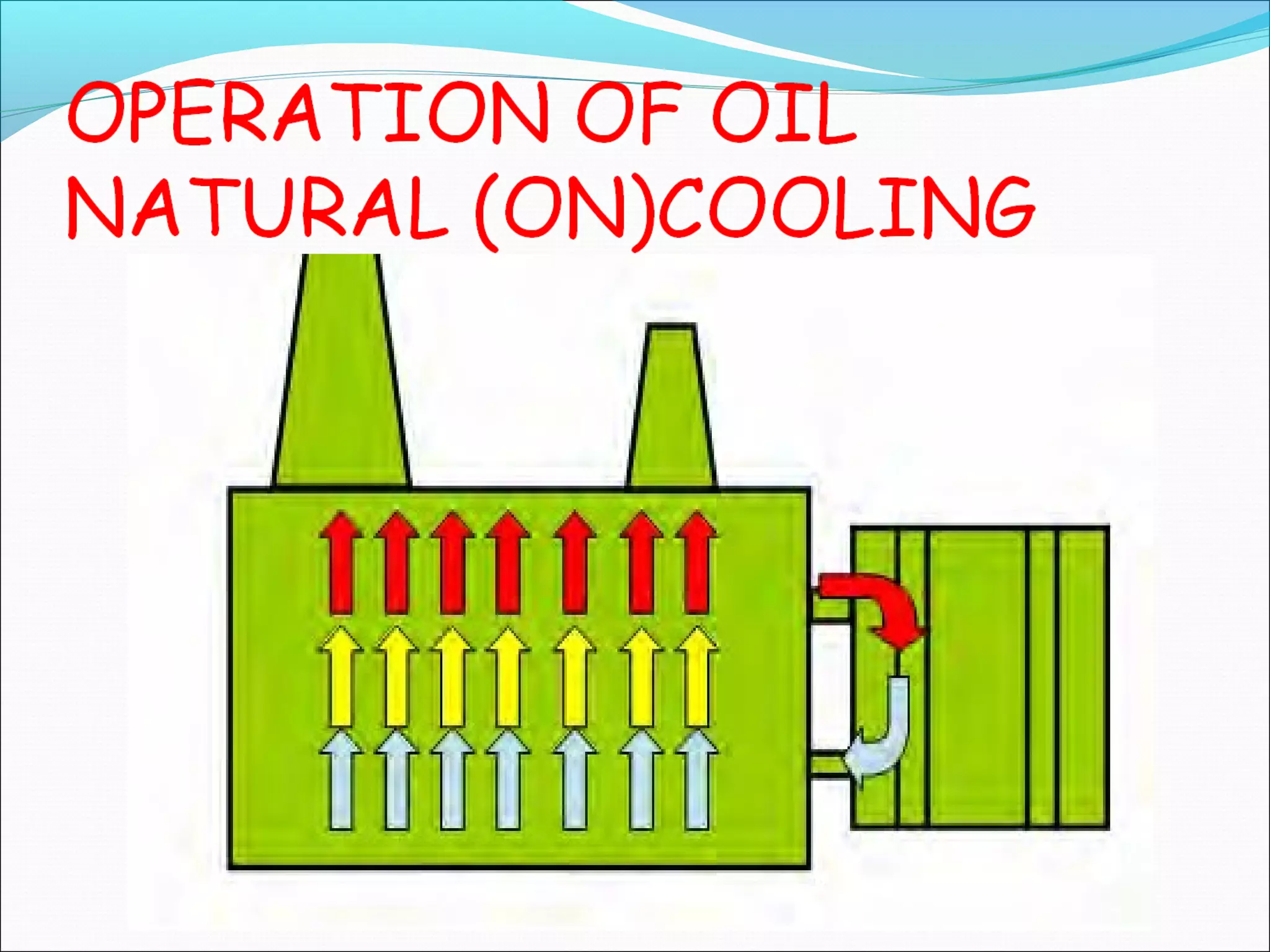
OIL NATURAL (ON)COOLING
This is the most usual method of cooling.
Here the assembly of core and windings is

immersed in insulating oil contained in iron tank.
The heat produced in core and windings passed on
to oil by conduction.Oil in contact with heated
parts rises and its place is taken by cool oil from
the bottom.
The heated oil transfers its heat to the tank
surface which dissipates it to the surroundings
Practical view of ON cooling
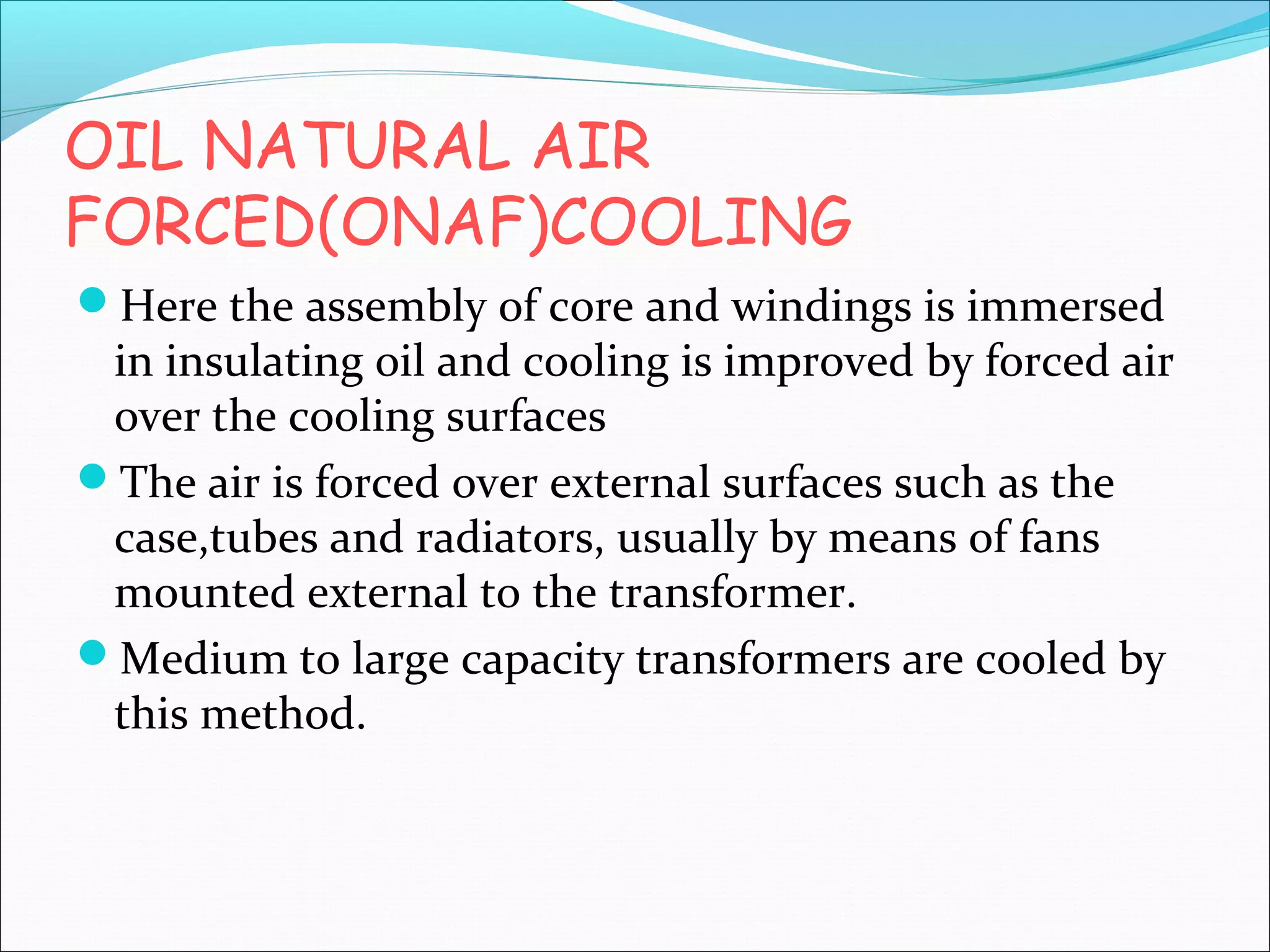
OIL NATURAL AIR
FORCED(ONAF)COOLING
Here the assembly of core and windings is immersed

in insulating oil and cooling is improved by forced air
over the cooling surfaces
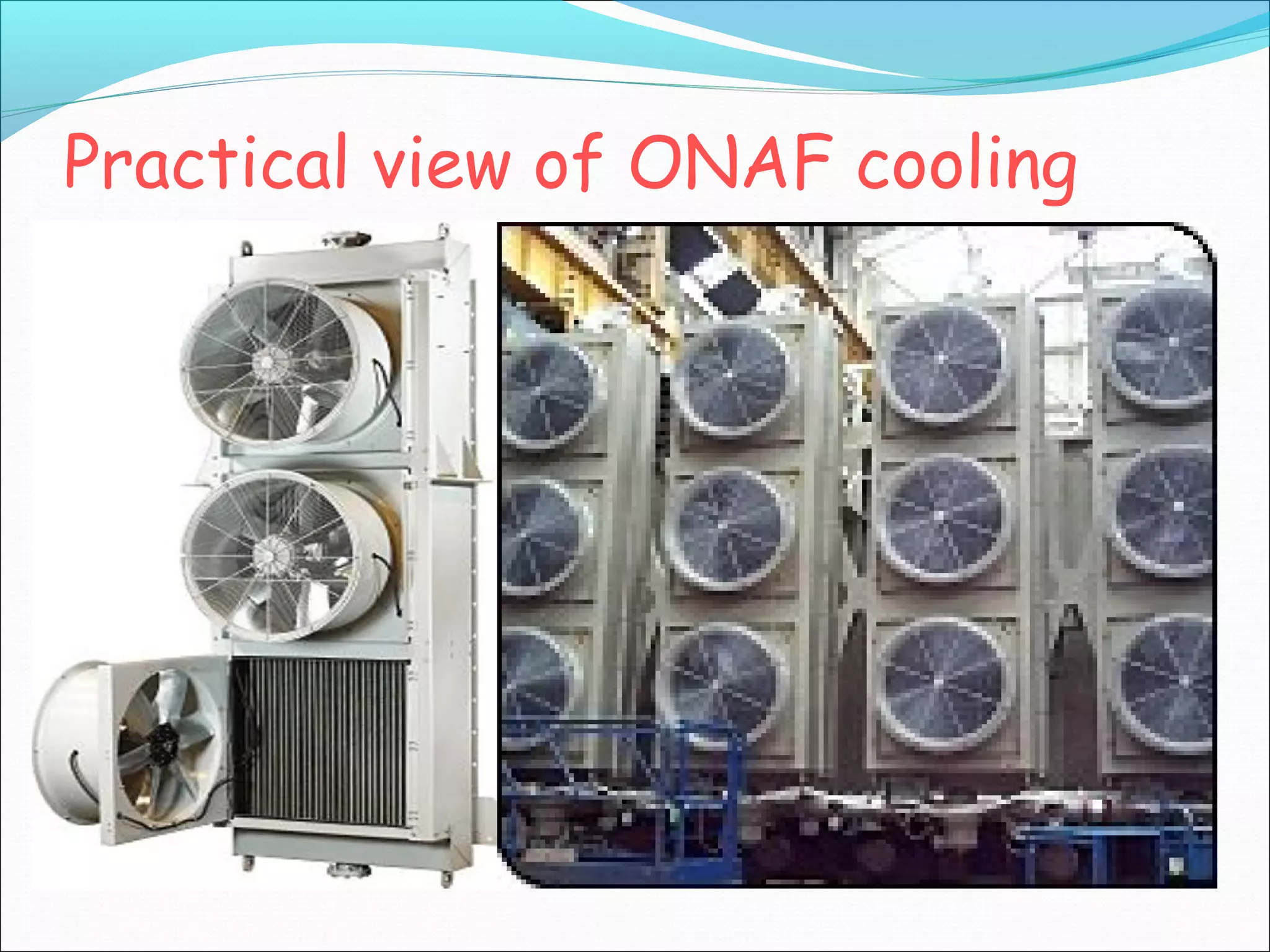
The air is forced over external surfaces such as the
case,tubes and radiators, usually by means of fans
mounted external to the transformer.
Medium to large capacity transformers are cooled by
this method.
Practical view of ONAF cooling
OIL NATURAL WATER
FORCED(ONWF)COOLING
In this type of cooling,the core and windings is

immersed in an insulating oil and cooling is
improved by circulation of water through copper
cooling coils mounted above the transformer core
but below oil surface.
The heated water is cooled in a spray pond or
cooling tower.
This method will be cheaper where a natural
water head is already available.
OIL FORCED AIR NATURAL
(OFAN)COOLING
In this method, oil is circulated through the

transformer with the help of pump and cooled in a
heat exchanger by natural circulation of air.
This method proves very useful where coolers have to
be well remove from the transformer.
This method is not very common.
OIL FORCED AIR
FORCED(OFAF)COOLING
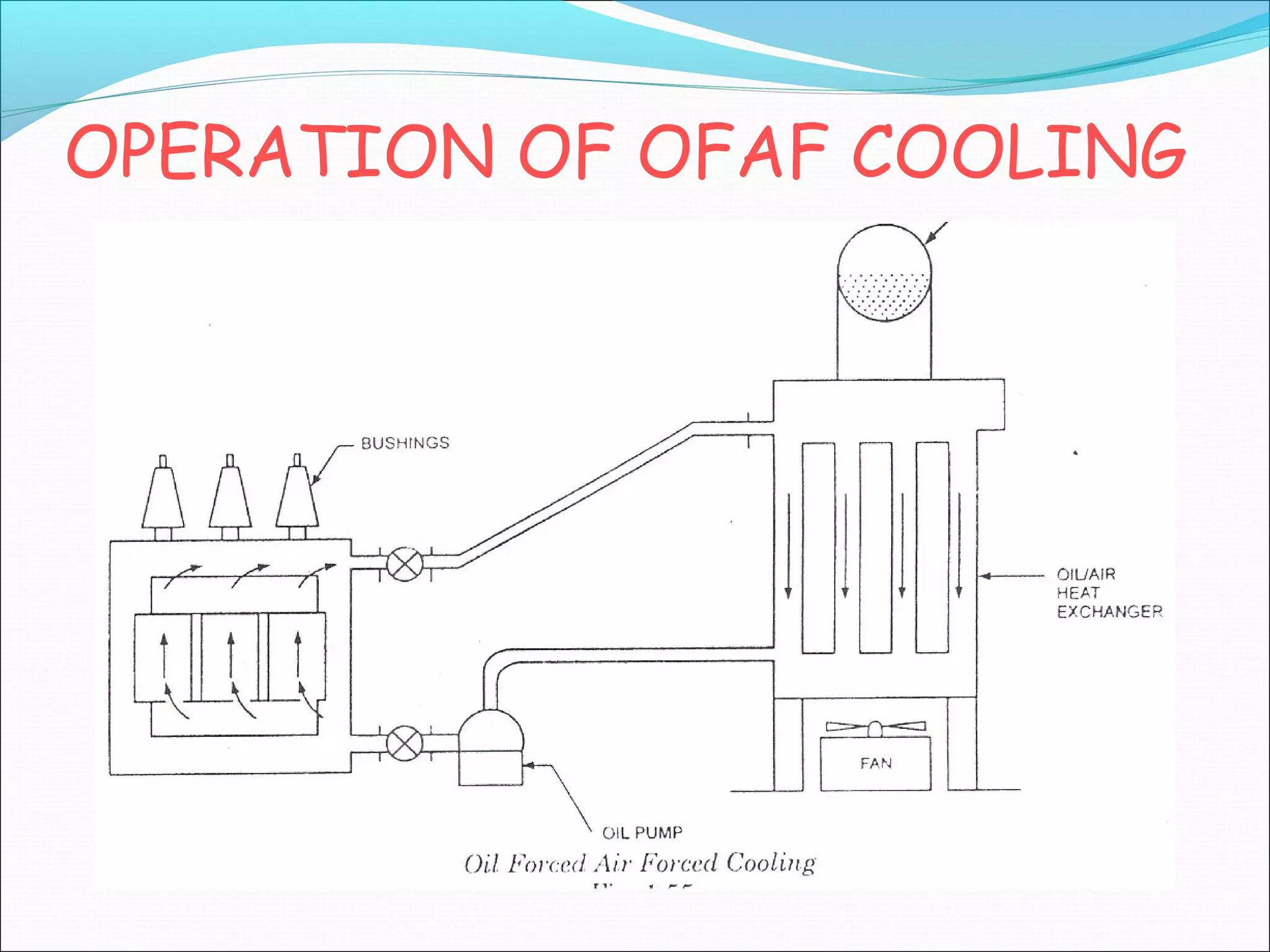
In this method,the oil is cooled in external heat

exchanger using air blast produced by fans.
At light load, say upto 50% of rated load,(when the
losses are small) natural circulation of air may be
sufficient to cool the transformer.
At higher loads,the pump and fans may be switch on
by temperature sensing elements.
This arrangement results in higher efficiency of the
system.
OPERATION OF OFAF COOLING
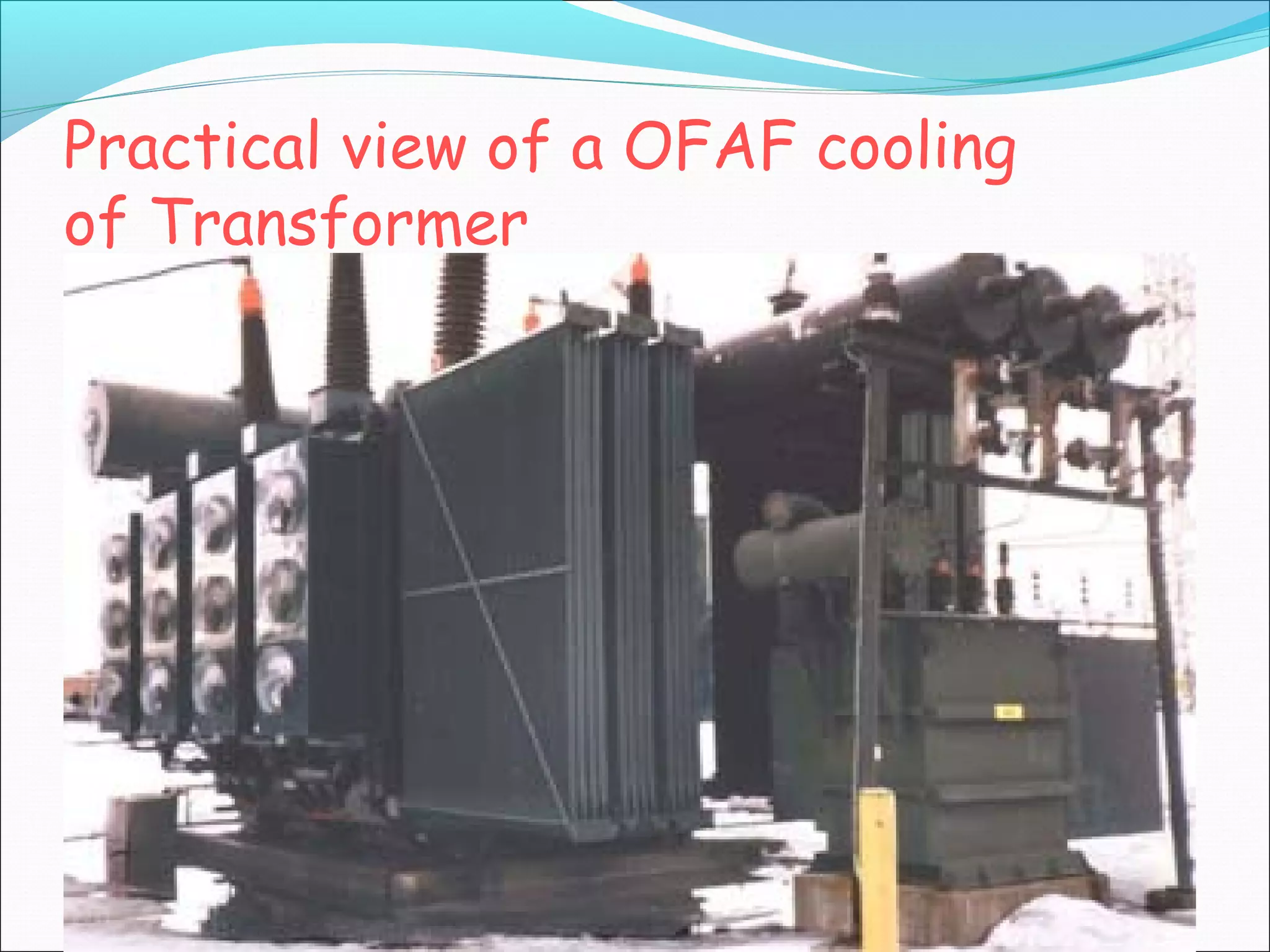
Practical view of a OFAF cooling
of Transformer
OIL FORCED WATER
FORCED(OFWF)COOLING
In this method,the heat oil pumped out from the

main tank to the radiator where the oil is cooled by
the water passing through copper tubes.
The pressure of oil is kept higher than that of water
therefore,any leakage that occurs is from oil to water.
There is no condensation problem.
NITROGEN COOLING
Heat transfer analysis on a cryogenic cooling system

is performed for HTS transformers to be operated at
63–66 K.
 HTS windings are immersed in a liquid nitrogen bath
where the liquid is cooled simply by colder copper
sheets vertically extended from the coldhead of a
cryocooler.
Liquid nitrogen in the gap between the windings and
the copper sheets develops a circulating flow by
buoyancy force in subcooled state close to the normal
freezing point.
Nitrogen functions as a heat transfer medium and an
electrical insulating fluid at the same time.
CONTINUED…….
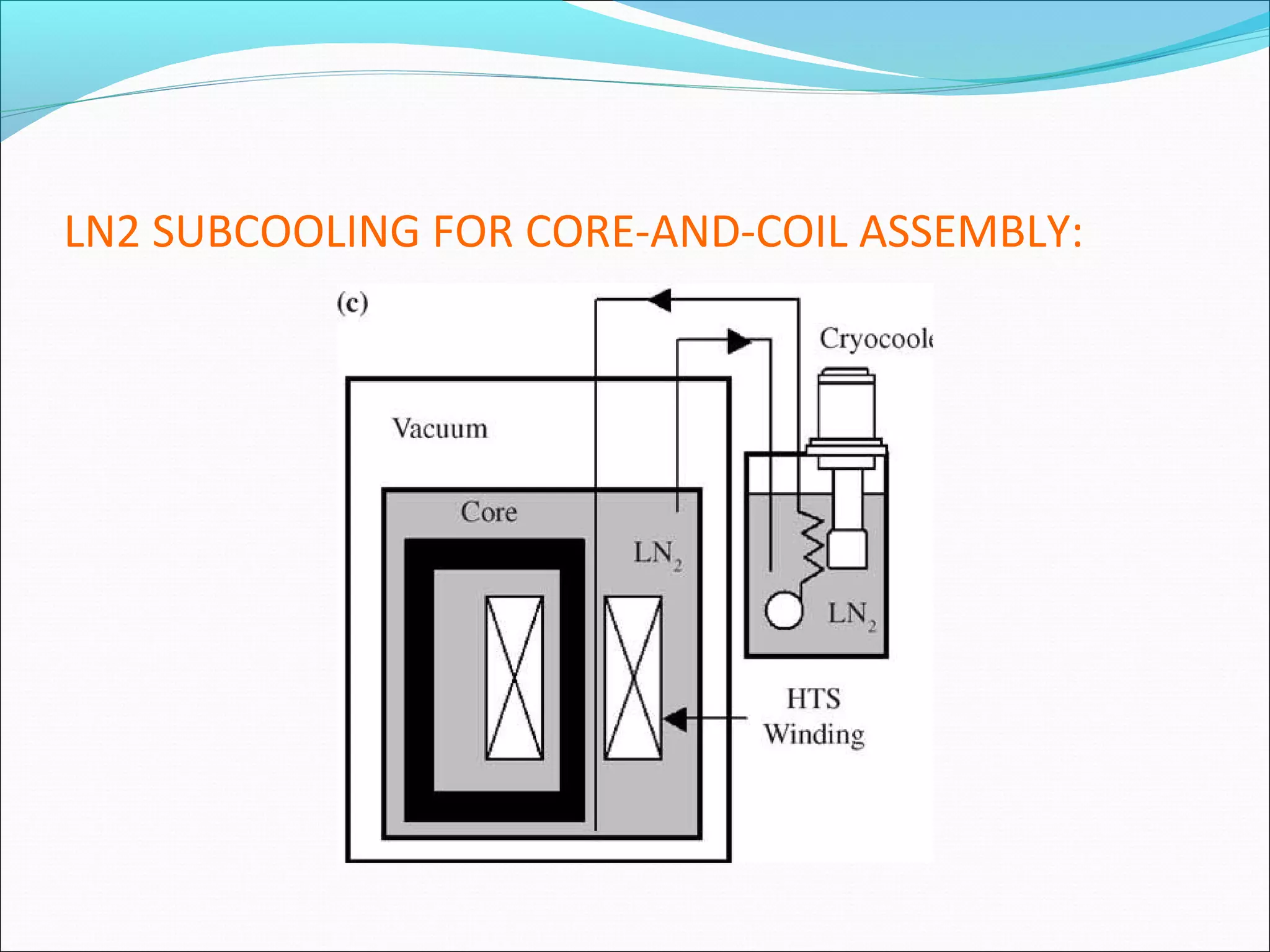
HTS windings in a main cryostat filled with subcooled
liquid nitrogen at around 65 K, and located an iron
core through room-temperature bore of the cryostat.
The subcooled liquid is continuously chilled by
two sets of cryocoolers in a secondary cryostat and
circulated through transfer lines to the main cryostat
by a pump.
LN2 SUBCOOLING FOR CORE-AND-COIL ASSEMBLY:
ADVANTAGES
 Faster Thermal Cycles
Lower Temperature Limits
Minimal Maintenance Costs
 Smaller Equipment
 Lower Electricity Usage
APPLICATION

Air natural (AN) cooling is used for smaller output

transformer having rating 5-10kva.
Air blast cooling is used for dry type transformer.
The voltage rating should not be exceed 25kv.
The oil forced air forced (OFAF) cooling is usually
used for power transformer of rating 30mva and
higher.
Continued..
CONTINUED…
Oil forced water forced (OFWF) cooling is used

for transformers designed for hydro-electric
power plant.
Cooling radiator system with natural cooling is
used for power transformers with a capacity of
10Mva
CONCLUSION
Not only the transformer but also all electrical

equipment requires cooling system.
By providing cooling system the efficiency of the
transformer will increase.
In case of rotating electrical machine due to
rotating parts air natural cooling is provided. But
in case of transformer there no is rotating part, so
these types of cooling must required for
transformer.
Cooling of power transformer

Cooling of power transformer

  • 1.
    COOLING OF POWERTRANSFORMER Presented By : Prasanta kumar Malik 7th Sem. Electrical engg Roll No:1021106017
  • 2.
    CONTENT  Introduction  Methodsof Cooling  Applications  Conclusion
  • 3.
    INTRODUCTION Power transformers arekey components for electricity supply systems. It convert energy at one voltage level to another voltage level. During the process of energy transfer ,losses occur in the winding of the transformer. This losses appear as heat that may burn the winding of the transformer. So to make the transformer healthier cooling is needed.
  • 4.
  • 5.
    AIR TYPE COOLING Airnatural (AN) Cooling Air blast cooling
  • 6.
    OIL IMMERSED TYPE Oilnatural (ON) cooling Oil natural air forced (ONAF)cooling Oil natural water forced (ONWF) Cooling Oil forced air natural (OFAN) cooling Oil forced air forced (OFAF) Cooling Oil forced water forced (OFWF) Cooling
  • 7.
    AIR NATURAL COOLING The transformers having smaller output(5-10KVA) are cooled by this method.In this method the external surface is sufficent to dissipate the heat produce by the losses.  Such transformers are cooled by the combination of air convection currents within the enclose case and by natural radiation from the case itself.
  • 8.
  • 9.
    AIR BLAST COOLNG Thistype of cooling is used in dry type transformers. In this method ,heat dissipation is improved by a continuous blast of air forced through the core and windigs. The air blast is produced by means of external fans and blowers. This type of cooling is limited to transformers of voltage rating not exceeding 25kv.
  • 10.
    DISADVANTAGES In this processthe increase in insulation strength is not obtained due to non-immersion in oil. A regular maintenance is a must for this kind of transformers.(i.e filter maintenance)
  • 11.
    OIL NATURAL (ON)COOLING Thisis the most usual method of cooling. Here the assembly of core and windings is immersed in insulating oil contained in iron tank. The heat produced in core and windings passed on to oil by conduction.Oil in contact with heated parts rises and its place is taken by cool oil from the bottom. The heated oil transfers its heat to the tank surface which dissipates it to the surroundings
  • 13.
  • 14.
    OIL NATURAL AIR FORCED(ONAF)COOLING Herethe assembly of core and windings is immersed in insulating oil and cooling is improved by forced air over the cooling surfaces The air is forced over external surfaces such as the case,tubes and radiators, usually by means of fans mounted external to the transformer. Medium to large capacity transformers are cooled by this method.
  • 15.
    Practical view ofONAF cooling
  • 16.
    OIL NATURAL WATER FORCED(ONWF)COOLING Inthis type of cooling,the core and windings is immersed in an insulating oil and cooling is improved by circulation of water through copper cooling coils mounted above the transformer core but below oil surface. The heated water is cooled in a spray pond or cooling tower. This method will be cheaper where a natural water head is already available.
  • 17.
    OIL FORCED AIRNATURAL (OFAN)COOLING In this method, oil is circulated through the transformer with the help of pump and cooled in a heat exchanger by natural circulation of air. This method proves very useful where coolers have to be well remove from the transformer. This method is not very common.
  • 18.
    OIL FORCED AIR FORCED(OFAF)COOLING Inthis method,the oil is cooled in external heat exchanger using air blast produced by fans. At light load, say upto 50% of rated load,(when the losses are small) natural circulation of air may be sufficient to cool the transformer. At higher loads,the pump and fans may be switch on by temperature sensing elements. This arrangement results in higher efficiency of the system.
  • 19.
  • 20.
    Practical view ofa OFAF cooling of Transformer
  • 21.
    OIL FORCED WATER FORCED(OFWF)COOLING Inthis method,the heat oil pumped out from the main tank to the radiator where the oil is cooled by the water passing through copper tubes. The pressure of oil is kept higher than that of water therefore,any leakage that occurs is from oil to water. There is no condensation problem.
  • 22.
    NITROGEN COOLING Heat transferanalysis on a cryogenic cooling system is performed for HTS transformers to be operated at 63–66 K.  HTS windings are immersed in a liquid nitrogen bath where the liquid is cooled simply by colder copper sheets vertically extended from the coldhead of a cryocooler. Liquid nitrogen in the gap between the windings and the copper sheets develops a circulating flow by buoyancy force in subcooled state close to the normal freezing point. Nitrogen functions as a heat transfer medium and an electrical insulating fluid at the same time.
  • 23.
    CONTINUED……. HTS windings ina main cryostat filled with subcooled liquid nitrogen at around 65 K, and located an iron core through room-temperature bore of the cryostat. The subcooled liquid is continuously chilled by two sets of cryocoolers in a secondary cryostat and circulated through transfer lines to the main cryostat by a pump.
  • 24.
    LN2 SUBCOOLING FORCORE-AND-COIL ASSEMBLY:
  • 25.
  • 26.
    APPLICATION Air natural (AN)cooling is used for smaller output transformer having rating 5-10kva. Air blast cooling is used for dry type transformer. The voltage rating should not be exceed 25kv. The oil forced air forced (OFAF) cooling is usually used for power transformer of rating 30mva and higher. Continued..
  • 27.
    CONTINUED… Oil forced waterforced (OFWF) cooling is used for transformers designed for hydro-electric power plant. Cooling radiator system with natural cooling is used for power transformers with a capacity of 10Mva
  • 28.
    CONCLUSION Not only thetransformer but also all electrical equipment requires cooling system. By providing cooling system the efficiency of the transformer will increase. In case of rotating electrical machine due to rotating parts air natural cooling is provided. But in case of transformer there no is rotating part, so these types of cooling must required for transformer.

Editor's Notes

  • #19 Advantages:greater capacity, Emergency self-cooled operation,smaller space requirements