WRITTEN-POLE
ELECTRIC MOTORS
Presented by:
Utkalika Sahoo (4th yr
Electrical Engg.)
CONTENTS
•INTRODUCTION
•DIFFERENCES
•LIMITATIONS OF CONVENTIONAL TECHNOLOGY
•WRITTEN-POLE TECHNOLOGY
•CONSTRUCTION
•OPERATION
•OPERATIONAL BENEFITS
•ADVANTAGES
•APPLICATIONS
•RECOGNITIONS
•CONCLUSION
•REFERENCES
WRITTEN POLE TECHNOLOGY

2
INTRODUCTION
• In the 1990’s, a new concept was developed in electric
motors called the Written Pole® electric motor
• This new motor type dramatically reduces starting
currents of single phase motors
• The motor uses an innovative approach of controlling
the magnetic field of the motor to reduce the starting
current requirements
• The result is a motor that has starting current
requirements of only about twice the normal running
current and, as an added benefit
• The motors have efficiencies of 90% or better
compared to conventional motors, which have
efficiencies of around 85%
WRITTEN POLE TECHNOLOGY

3
BASIC
DIFFERENCES….
• Rotating field is developed.
• In a convectional motor poles are fixed.
• In a written pole motors a magnet layer is
written at different places on motor’s poles
as the rotor turns.
• Written pole has much lower starting
current than traditional motors prevents
voltage dips etc….
• Slow start up speeds prevents water
hammering.
LIMITATIONS OF
CONVENTIONAL TECHNOLOGY
1.Dependence of speed on no. of poles of
rotor
Speed = 120 X frequency
no. of poles
2.The machine must have even no. of poles
and deviating from this condition will cause
unstability at its rated speed

WRITTEN POLE TECHNOLOGY

5
AN INNOVATIVE PATENTED
TECHNOLOGY

• In the 1990’s, with support from the
EPRI, the Precise Power Corporation of
Bradenton, Florida, developed a new
concept in electric motors called the
Written Pole® electric motor.

WRITTEN POLE TECHNOLOGY

6
WRITTEN-POLE
TECHNOLOGY
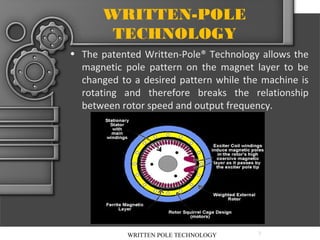
• The patented Written-Pole® Technology allows the
magnetic pole pattern on the magnet layer to be
changed to a desired pattern while the machine is
rotating and therefore breaks the relationship
between rotor speed and output frequency.

WRITTEN POLE TECHNOLOGY

7
CONSTRUCTION

WRITTEN POLE TECHNOLOGY

8

Contd…..
Contd……
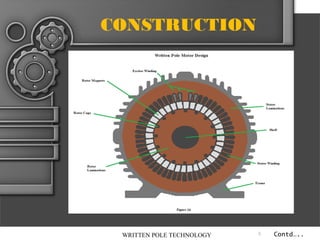
• Written Pole motors use similar construction
techniques found in conventional motors
• A continuous layer of ferrite magnets on the
surface of the rotor, along with a highdensity exciter winding contained within the
stator winding
• The basic platform consists of a conventional
steel shaft inserted into a lamination stack
containing a high resistance rotor cage
WRITTEN POLE TECHNOLOGY

8

Contd…
Contd……
• The high resistance cage is a key factor in
limiting the starting current of Written-Pole
motors
• The stator lamination stack is constructed
using low loss electrical steel laminations
• The concentrated excitation windings are
contained within the stator structure and are
located between the main stator windings
WRITTEN POLE TECHNOLOGY

9
Contd……
Contd…..

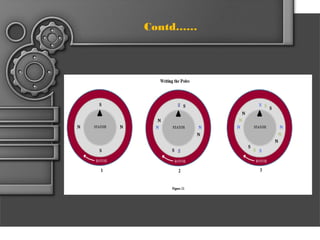
• The actual size and quantity of the poles
generated on the surface of the rotor
depends on the rotational speed of the
machine.
• Lower speeds result in a large number of
smaller poles with shorter spans while
higher speed results in a smaller number of
larger poles with longer spans.
Contd……

WRITTEN POLE TECHNOLOGY

13

Contd…
OPERATION
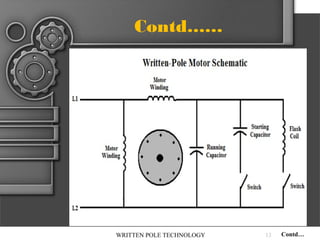
• A written-pole motor employs one of three
modes of operation based on the rotational
speed of the machine:
1. START MODE
2. TRANSITION MODE
3. RUN MODE

WRITTEN POLE TECHNOLOGY

14
Contd…….

Start mode
• In start mode a written pole produces a
large amount of hysteresis and induction
torque which helps to accelerate the motor
to its rated speed.
• W.P.T. technology is able to produce
synchronous torque over a wide range
providing gentler ramp which protects the
load from mechanical damage.
• Lower starting current so lower temp. rise
permitting high freq. starts and restarts.
Contd…….

tranSition mode
• As the written pole motor accelerates it
enters into transition mode during which the
excitation voltage begins to influence the
magnetic geometry of the rotor.
• Electrical synchronization is achieve before
mechanical synchronization .
• Ability to start high inertia loads.

run mode
• Excitation not reqd., motor in normal mode.
OPERATIONAL
BENEFITS
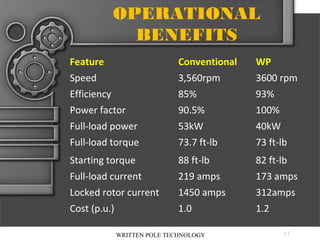
Feature

Conventional

WP

Speed

3,560rpm

3600 rpm

Efficiency

85%

93%

Power factor

90.5%

100%

Full-load power

53kW

40kW

Full-load torque

73.7 ft-lb

73 ft-lb

Starting torque

88 ft-lb

82 ft-lb

Full-load current

219 amps

173 amps

Locked rotor current

1450 amps

312amps

Cost (p.u.)

1.0

1.2

WRITTEN POLE TECHNOLOGY

17
ADVANTAGES
1. Low starting current requirements
2. Energy efficient operation
3. Unity power factor operation
4. Simple construction
5. Low temperature rise
6. High inertia starting
7. Instantaneous restart capability
8. Ride through characteristics
9. Three-phase applications
WRITTEN POLE TECHNOLOGY

18
Contd……
• The Written-Pole motor is designed to
operate in ambient temperatures ranging
from 32ºF to 104ºF
• However, test results show that Written-Pole
motors
have
reliably
operated
in
temperatures ranging from 42ºF to 122ºF
• They may be operated safely in the open air if
there is adequate protection from direct rain
• The motor base must be mounted on a raised
concrete pad or steel frame to avoid exposure
to standing water
WRITTEN POLE TECHNOLOGY

19
A WRITTEN POLE RIDE
THROUGH MOTOR USED IN A
FARM

WRITTEN POLE TECHNOLOGY

20
APPLICATIONS
• In a family of single and three-phase motive
power and power protection systems used by
many customers including the US Weather
Service, NASA, Federal Aviation Authority, US
Air Force and many commercial and industrial
customers.
• Agriculture purpose in rural areas.
• Conveyor belt applications.
• To run a 3-phase generator.
• At oil well beam pump.

WRITTEN POLE TECHNOLOGY

21
RECOGNTION
• A recipient of the R&D 100 Award in 1994,
Written-Pole technology was recognized by
R&D Magazine as one of that year's most
technologically significant innovations
• The technology has also been recognized by
numerous technical organizations including
the Professional Society of Engineers in the
United States

WRITTEN POLE TECHNOLOGY

22
CONCLUSION
• The written-pole motor also has
performance advantages over a
conventional induction motor including
low starting current, very high operating
efficiency, and excellent power factor.
This motor technology has the additional
benefit of being able to ride through brief
service interruptions on single-phase
power lines. When compared to the total
system costs, written pole motors are an
attractive alternative to convention threephase induction motors.
WRITTEN POLE TECHNOLOGY

23
REFERENCES
• S.Hoffman, B.Banerjee and S.Samotyj
“written-Pole-Revolution”. IEEE Power Eng.
6-9,1997
• A.Hannah,”Electrical field measurements on
an EPRI two pole,20-hp .written pole motor.

WRITTEN POLE TECHNOLOGY

24
THANK
YOU!

Written pole-technology

  • 1.
  • 2.
    CONTENTS •INTRODUCTION •DIFFERENCES •LIMITATIONS OF CONVENTIONALTECHNOLOGY •WRITTEN-POLE TECHNOLOGY •CONSTRUCTION •OPERATION •OPERATIONAL BENEFITS •ADVANTAGES •APPLICATIONS •RECOGNITIONS •CONCLUSION •REFERENCES WRITTEN POLE TECHNOLOGY 2
  • 3.
    INTRODUCTION • In the1990’s, a new concept was developed in electric motors called the Written Pole® electric motor • This new motor type dramatically reduces starting currents of single phase motors • The motor uses an innovative approach of controlling the magnetic field of the motor to reduce the starting current requirements • The result is a motor that has starting current requirements of only about twice the normal running current and, as an added benefit • The motors have efficiencies of 90% or better compared to conventional motors, which have efficiencies of around 85% WRITTEN POLE TECHNOLOGY 3
  • 4.
    BASIC DIFFERENCES…. • Rotating fieldis developed. • In a convectional motor poles are fixed. • In a written pole motors a magnet layer is written at different places on motor’s poles as the rotor turns. • Written pole has much lower starting current than traditional motors prevents voltage dips etc…. • Slow start up speeds prevents water hammering.
  • 5.
    LIMITATIONS OF CONVENTIONAL TECHNOLOGY 1.Dependenceof speed on no. of poles of rotor Speed = 120 X frequency no. of poles 2.The machine must have even no. of poles and deviating from this condition will cause unstability at its rated speed WRITTEN POLE TECHNOLOGY 5
  • 6.
    AN INNOVATIVE PATENTED TECHNOLOGY •In the 1990’s, with support from the EPRI, the Precise Power Corporation of Bradenton, Florida, developed a new concept in electric motors called the Written Pole® electric motor. WRITTEN POLE TECHNOLOGY 6
  • 7.
    WRITTEN-POLE TECHNOLOGY • The patentedWritten-Pole® Technology allows the magnetic pole pattern on the magnet layer to be changed to a desired pattern while the machine is rotating and therefore breaks the relationship between rotor speed and output frequency. WRITTEN POLE TECHNOLOGY 7
  • 8.
  • 9.
    Contd…… • Written Polemotors use similar construction techniques found in conventional motors • A continuous layer of ferrite magnets on the surface of the rotor, along with a highdensity exciter winding contained within the stator winding • The basic platform consists of a conventional steel shaft inserted into a lamination stack containing a high resistance rotor cage WRITTEN POLE TECHNOLOGY 8 Contd…
  • 10.
    Contd…… • The highresistance cage is a key factor in limiting the starting current of Written-Pole motors • The stator lamination stack is constructed using low loss electrical steel laminations • The concentrated excitation windings are contained within the stator structure and are located between the main stator windings WRITTEN POLE TECHNOLOGY 9
  • 11.
  • 12.
    Contd….. • The actualsize and quantity of the poles generated on the surface of the rotor depends on the rotational speed of the machine. • Lower speeds result in a large number of smaller poles with shorter spans while higher speed results in a smaller number of larger poles with longer spans.
  • 13.
  • 14.
    OPERATION • A written-polemotor employs one of three modes of operation based on the rotational speed of the machine: 1. START MODE 2. TRANSITION MODE 3. RUN MODE WRITTEN POLE TECHNOLOGY 14
  • 15.
    Contd……. Start mode • Instart mode a written pole produces a large amount of hysteresis and induction torque which helps to accelerate the motor to its rated speed. • W.P.T. technology is able to produce synchronous torque over a wide range providing gentler ramp which protects the load from mechanical damage. • Lower starting current so lower temp. rise permitting high freq. starts and restarts.
  • 16.
    Contd……. tranSition mode • Asthe written pole motor accelerates it enters into transition mode during which the excitation voltage begins to influence the magnetic geometry of the rotor. • Electrical synchronization is achieve before mechanical synchronization . • Ability to start high inertia loads. run mode • Excitation not reqd., motor in normal mode.
  • 17.
    OPERATIONAL BENEFITS Feature Conventional WP Speed 3,560rpm 3600 rpm Efficiency 85% 93% Power factor 90.5% 100% Full-loadpower 53kW 40kW Full-load torque 73.7 ft-lb 73 ft-lb Starting torque 88 ft-lb 82 ft-lb Full-load current 219 amps 173 amps Locked rotor current 1450 amps 312amps Cost (p.u.) 1.0 1.2 WRITTEN POLE TECHNOLOGY 17
  • 18.
    ADVANTAGES 1. Low startingcurrent requirements 2. Energy efficient operation 3. Unity power factor operation 4. Simple construction 5. Low temperature rise 6. High inertia starting 7. Instantaneous restart capability 8. Ride through characteristics 9. Three-phase applications WRITTEN POLE TECHNOLOGY 18
  • 19.
    Contd…… • The Written-Polemotor is designed to operate in ambient temperatures ranging from 32ºF to 104ºF • However, test results show that Written-Pole motors have reliably operated in temperatures ranging from 42ºF to 122ºF • They may be operated safely in the open air if there is adequate protection from direct rain • The motor base must be mounted on a raised concrete pad or steel frame to avoid exposure to standing water WRITTEN POLE TECHNOLOGY 19
  • 20.
    A WRITTEN POLERIDE THROUGH MOTOR USED IN A FARM WRITTEN POLE TECHNOLOGY 20
  • 21.
    APPLICATIONS • In afamily of single and three-phase motive power and power protection systems used by many customers including the US Weather Service, NASA, Federal Aviation Authority, US Air Force and many commercial and industrial customers. • Agriculture purpose in rural areas. • Conveyor belt applications. • To run a 3-phase generator. • At oil well beam pump. WRITTEN POLE TECHNOLOGY 21
  • 22.
    RECOGNTION • A recipientof the R&D 100 Award in 1994, Written-Pole technology was recognized by R&D Magazine as one of that year's most technologically significant innovations • The technology has also been recognized by numerous technical organizations including the Professional Society of Engineers in the United States WRITTEN POLE TECHNOLOGY 22
  • 23.
    CONCLUSION • The written-polemotor also has performance advantages over a conventional induction motor including low starting current, very high operating efficiency, and excellent power factor. This motor technology has the additional benefit of being able to ride through brief service interruptions on single-phase power lines. When compared to the total system costs, written pole motors are an attractive alternative to convention threephase induction motors. WRITTEN POLE TECHNOLOGY 23
  • 24.
    REFERENCES • S.Hoffman, B.Banerjeeand S.Samotyj “written-Pole-Revolution”. IEEE Power Eng. 6-9,1997 • A.Hannah,”Electrical field measurements on an EPRI two pole,20-hp .written pole motor. WRITTEN POLE TECHNOLOGY 24
  • 25.