8085 Microprocessor
Based Auto Synchronizer
PRESENTED BY : BIJU G
REG NO : 16030514
ROLL NO : 15
Contents
• Introduction
• Synchronization of alternator
• Existing method of synchronization
• Block diagram
• Hardware details
• Frequency control
• Voltage control
• Conclusion
• Reference
2
Introduction
• It is known that electrical load on a power system or an industrial establishment ,
never constant But it varies.
• To meet the requirement of variable load , economically and also for assuring
continuity of supply the number of generating units connected to a system busbar
are varied suitably .
• The connection of an incoming alternator to system bus, ie , synchronization
requires fulfillment of the condition like the same phase sequence equality of
voltages and frequency between the incoming machine and frequency between
the in coming machine and busbar.
3
Synchronization of alternator
• Synchronization of alternator means connecting an alternator into
grid in parallel with many other alternators .
1. Equal voltage. 2. Same frequency.
3. Similar phase sequence. 4. Similar phase angle
4
EXISTING METHODS OF SYNCHRONIZATION
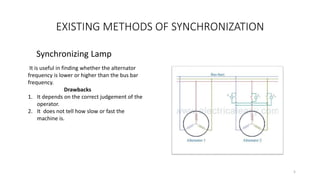
Synchronizing Lamp
It is useful in finding whether the alternator
frequency is lower or higher than the bus bar
frequency.
Drawbacks
1. It depends on the correct judgement of the
operator.
2. It does not tell how slow or fast the
machine is.
5
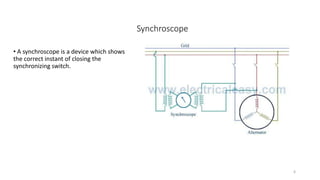
Synchroscope
• A synchroscope is a device which shows
the correct instant of closing the
synchronizing switch.
6
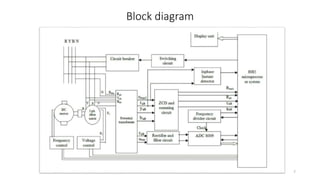
Block diagram
7
Hardware details
The hardware has been designed to fulfill all the requirements of the
synchronizing process.
Auto synchronizer setup consist of
1. Frequency control unit
2. Voltage control unit
3. Potential transformer unit
4. Signal conditioning card
5. Display card
6. Circuit breaker with the switching circuit.
8
FREQUENCY CONTROLLING UNIT
• The frequency of the alternator can be changed by varying the speed of
prime mover, DC shunt motor in this case, a rheostat is provided in the
field circuit of the motor.
• The frequency controlling unit is a lead screw arrangement driven by
stepper motor attached to variable point on the rheostat.
9
VOLTAGE CONTROLLING UNIT
• The frequency of alternator is adjusted, its voltage controlled by variation of
excitation current of alternator.
• The excitation current is varied by providing a rheostat in the field circuit.
• The automatic variation of excitation current is obtained by lead screw and
stepper motor arrangements.
10
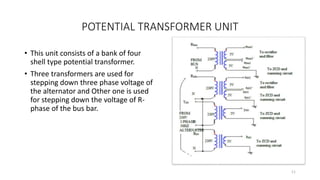
POTENTIAL TRANSFORMER UNIT
• This unit consists of a bank of four
shell type potential transformer.
• Three transformers are used for
stepping down three phase voltage of
the alternator and Other one is used
for stepping down the voltage of R-
phase of the bus bar.
11
Signal conditioning card
It is subdivided into two
1. Signal conditioning card
2. ADC subunit.
The signal conditioning subunit consists of four identical circuits each of
which comprises of a zero crossing detector (ZCD).
• For Ralt,Yalt,Balt and Rbus two rectifier and filter circuits.
• For Ralt and Rbus an inphase sequence detector and an inphase instant
detector .
12
ZCD OUTPUT WAVEFORM
13
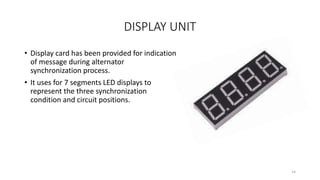
DISPLAY UNIT
• Display card has been provided for indication
of message during alternator
synchronization process.
• It uses for 7 segments LED displays to
represent the three synchronization
condition and circuit positions.
14
CIRCUIT BREAKER WITH SWITCHING CIRCUIT
• The circuit breaker used as a synchronizing switch is in the form of a DOL starter.
• In order to operate the circuit breaker, its operating coil is connected to a 230V
dc supply through electromagnetic relay.
• The relay is activated at proper instant by the microprocessor so that the circuit
breaker is closed at the correct inphase instant.
15
FREQUENCY CONTROL
• When the difference is less than the allowed difference , then FL is displayed .
• When the difference is greaterthan allowed difference either FH is displayed to
indicate Low or High frequency of alternator respectiely.
• The stepper motor is rotated in appropriate direction to bring the rated
frequency.
16
VOLTAGE CONTROL
• When the difference is less than the allowed difference , then VL is displayed .
• When the difference is greaterthan allowed difference either VH is displayed to
indicate Low or High voltage of alternator respectiely.
• The stepper motor is rotated in appropriate direction to bring the rated voltage.
17
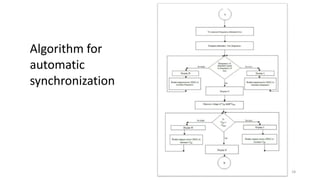
Algorithm for
automatic
synchronization
18
SYNCHRONIZING
• After satisfying all conditions, the time between the consecutive inphase instant
of Ralt and Rbus .
• The time interval where operating time of switching circuit, is obtained. The
closure of the circuit breaker is achieved by sensing next inphase instant with
delay of which will enable to switch ON the circuit the circuit breaker exactly at
the next inphase instant.
19
CONCLUSION
• The microprocessor based system of automatic synchronizer can be used more
effectively compared to conventional methods of synchronization such as
synchronizing lamp method and synchronization using sychroscope .
• This because of the fact that the conventional, method calls for of the operator
and accuracy is less and it depends on the sense of correct judgment of the
operator.
• Moreover the microprocessor based alternator synchronizer is user friendly and
requires less maintenance.
20
REFERENCES
• [1]. B. L. Theraja, “A Textbook of Electrical Technology” vol. 1, chapter 35, pp.
1492-1497, Oct. 2005
• [2]. L. Huber, Microprocessor based Alternator Synchronizer,” IEEE Trans.
Electrical Machines., vol.25, no.1,pp. 85-64, Jan. 2010.
• [3]. H. Endo, T. Yamashita, “Synchronizing Generators,” in Proc. IEEE computer
application, Jun.1999, pp. 171-176
• [4]. Ramesh S Gaonkar, “Microprocessor architecture, Programming and
application”, vol. 4, no.8, pp. 321-329, Oct. 1999.
21
Thank you…
22

microprocessor based automatic synchroniser (8085)

  • 1.
    8085 Microprocessor Based AutoSynchronizer PRESENTED BY : BIJU G REG NO : 16030514 ROLL NO : 15
  • 2.
    Contents • Introduction • Synchronizationof alternator • Existing method of synchronization • Block diagram • Hardware details • Frequency control • Voltage control • Conclusion • Reference 2
  • 3.
    Introduction • It isknown that electrical load on a power system or an industrial establishment , never constant But it varies. • To meet the requirement of variable load , economically and also for assuring continuity of supply the number of generating units connected to a system busbar are varied suitably . • The connection of an incoming alternator to system bus, ie , synchronization requires fulfillment of the condition like the same phase sequence equality of voltages and frequency between the incoming machine and frequency between the in coming machine and busbar. 3
  • 4.
    Synchronization of alternator •Synchronization of alternator means connecting an alternator into grid in parallel with many other alternators . 1. Equal voltage. 2. Same frequency. 3. Similar phase sequence. 4. Similar phase angle 4
  • 5.
    EXISTING METHODS OFSYNCHRONIZATION Synchronizing Lamp It is useful in finding whether the alternator frequency is lower or higher than the bus bar frequency. Drawbacks 1. It depends on the correct judgement of the operator. 2. It does not tell how slow or fast the machine is. 5
  • 6.
    Synchroscope • A synchroscopeis a device which shows the correct instant of closing the synchronizing switch. 6
  • 7.
  • 8.
    Hardware details The hardwarehas been designed to fulfill all the requirements of the synchronizing process. Auto synchronizer setup consist of 1. Frequency control unit 2. Voltage control unit 3. Potential transformer unit 4. Signal conditioning card 5. Display card 6. Circuit breaker with the switching circuit. 8
  • 9.
    FREQUENCY CONTROLLING UNIT •The frequency of the alternator can be changed by varying the speed of prime mover, DC shunt motor in this case, a rheostat is provided in the field circuit of the motor. • The frequency controlling unit is a lead screw arrangement driven by stepper motor attached to variable point on the rheostat. 9
  • 10.
    VOLTAGE CONTROLLING UNIT •The frequency of alternator is adjusted, its voltage controlled by variation of excitation current of alternator. • The excitation current is varied by providing a rheostat in the field circuit. • The automatic variation of excitation current is obtained by lead screw and stepper motor arrangements. 10
  • 11.
    POTENTIAL TRANSFORMER UNIT •This unit consists of a bank of four shell type potential transformer. • Three transformers are used for stepping down three phase voltage of the alternator and Other one is used for stepping down the voltage of R- phase of the bus bar. 11
  • 12.
    Signal conditioning card Itis subdivided into two 1. Signal conditioning card 2. ADC subunit. The signal conditioning subunit consists of four identical circuits each of which comprises of a zero crossing detector (ZCD). • For Ralt,Yalt,Balt and Rbus two rectifier and filter circuits. • For Ralt and Rbus an inphase sequence detector and an inphase instant detector . 12
  • 13.
  • 14.
    DISPLAY UNIT • Displaycard has been provided for indication of message during alternator synchronization process. • It uses for 7 segments LED displays to represent the three synchronization condition and circuit positions. 14
  • 15.
    CIRCUIT BREAKER WITHSWITCHING CIRCUIT • The circuit breaker used as a synchronizing switch is in the form of a DOL starter. • In order to operate the circuit breaker, its operating coil is connected to a 230V dc supply through electromagnetic relay. • The relay is activated at proper instant by the microprocessor so that the circuit breaker is closed at the correct inphase instant. 15
  • 16.
    FREQUENCY CONTROL • Whenthe difference is less than the allowed difference , then FL is displayed . • When the difference is greaterthan allowed difference either FH is displayed to indicate Low or High frequency of alternator respectiely. • The stepper motor is rotated in appropriate direction to bring the rated frequency. 16
  • 17.
    VOLTAGE CONTROL • Whenthe difference is less than the allowed difference , then VL is displayed . • When the difference is greaterthan allowed difference either VH is displayed to indicate Low or High voltage of alternator respectiely. • The stepper motor is rotated in appropriate direction to bring the rated voltage. 17
  • 18.
  • 19.
    SYNCHRONIZING • After satisfyingall conditions, the time between the consecutive inphase instant of Ralt and Rbus . • The time interval where operating time of switching circuit, is obtained. The closure of the circuit breaker is achieved by sensing next inphase instant with delay of which will enable to switch ON the circuit the circuit breaker exactly at the next inphase instant. 19
  • 20.
    CONCLUSION • The microprocessorbased system of automatic synchronizer can be used more effectively compared to conventional methods of synchronization such as synchronizing lamp method and synchronization using sychroscope . • This because of the fact that the conventional, method calls for of the operator and accuracy is less and it depends on the sense of correct judgment of the operator. • Moreover the microprocessor based alternator synchronizer is user friendly and requires less maintenance. 20
  • 21.
    REFERENCES • [1]. B.L. Theraja, “A Textbook of Electrical Technology” vol. 1, chapter 35, pp. 1492-1497, Oct. 2005 • [2]. L. Huber, Microprocessor based Alternator Synchronizer,” IEEE Trans. Electrical Machines., vol.25, no.1,pp. 85-64, Jan. 2010. • [3]. H. Endo, T. Yamashita, “Synchronizing Generators,” in Proc. IEEE computer application, Jun.1999, pp. 171-176 • [4]. Ramesh S Gaonkar, “Microprocessor architecture, Programming and application”, vol. 4, no.8, pp. 321-329, Oct. 1999. 21
  • 22.