Submitted by,
Soumya Ranjan Pradhan
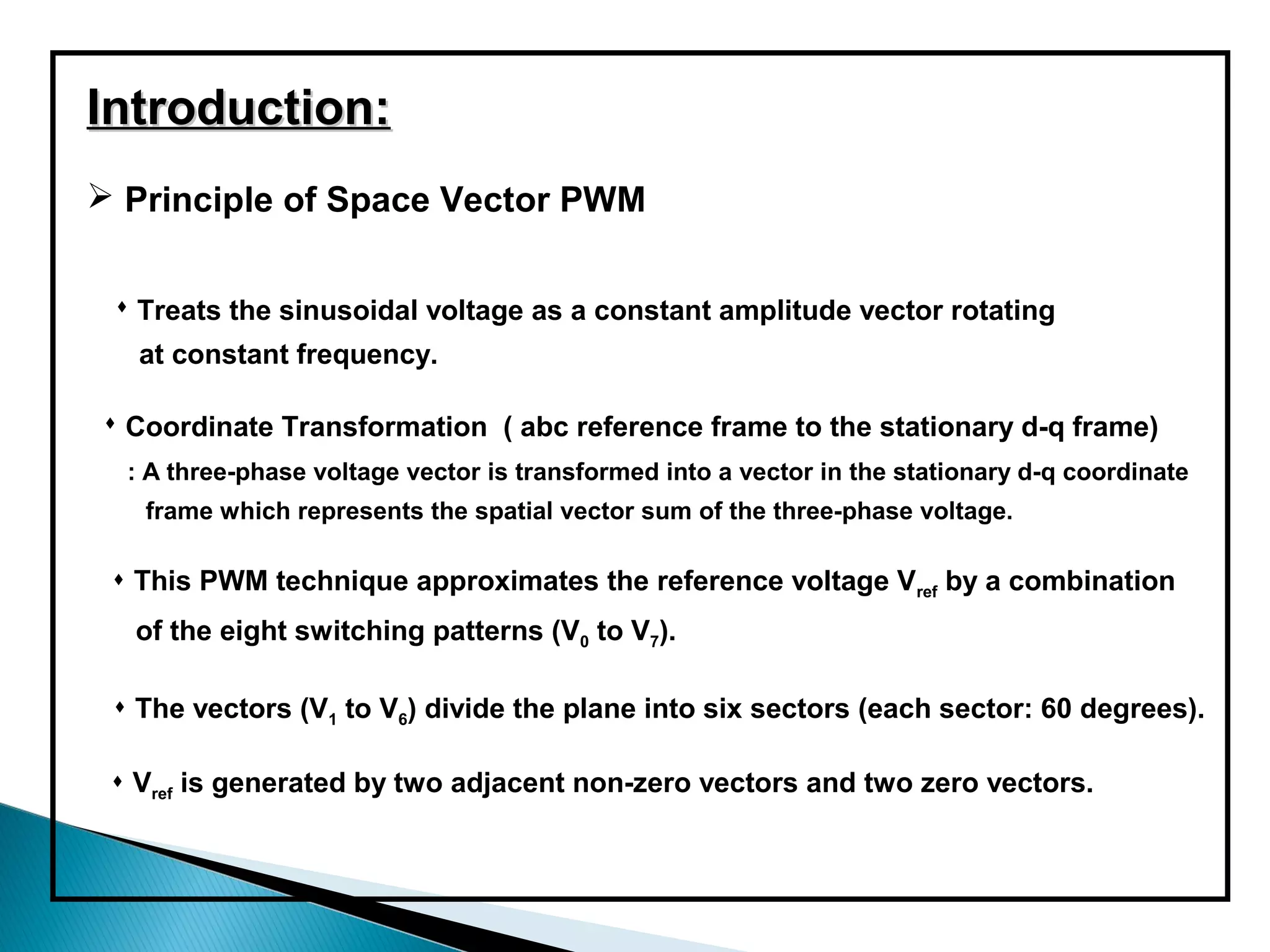
Introduction:
 Principle of Space Vector PWM


  Treats the sinusoidal voltage as a constant amplitude vector rotating
   at constant frequency.

 Coordinate Transformation ( abc reference frame to the stationary d-q frame)
  : A three-phase voltage vector is transformed into a vector in the stationary d-q coordinate
   frame which represents the spatial vector sum of the three-phase voltage.

  This PWM technique approximates the reference voltage Vref by a combination
  of the eight switching patterns (V0 to V7).

  The vectors (V1 to V6) divide the plane into six sectors (each sector: 60 degrees).

  Vref is generated by two adjacent non-zero vectors and two zero vectors.
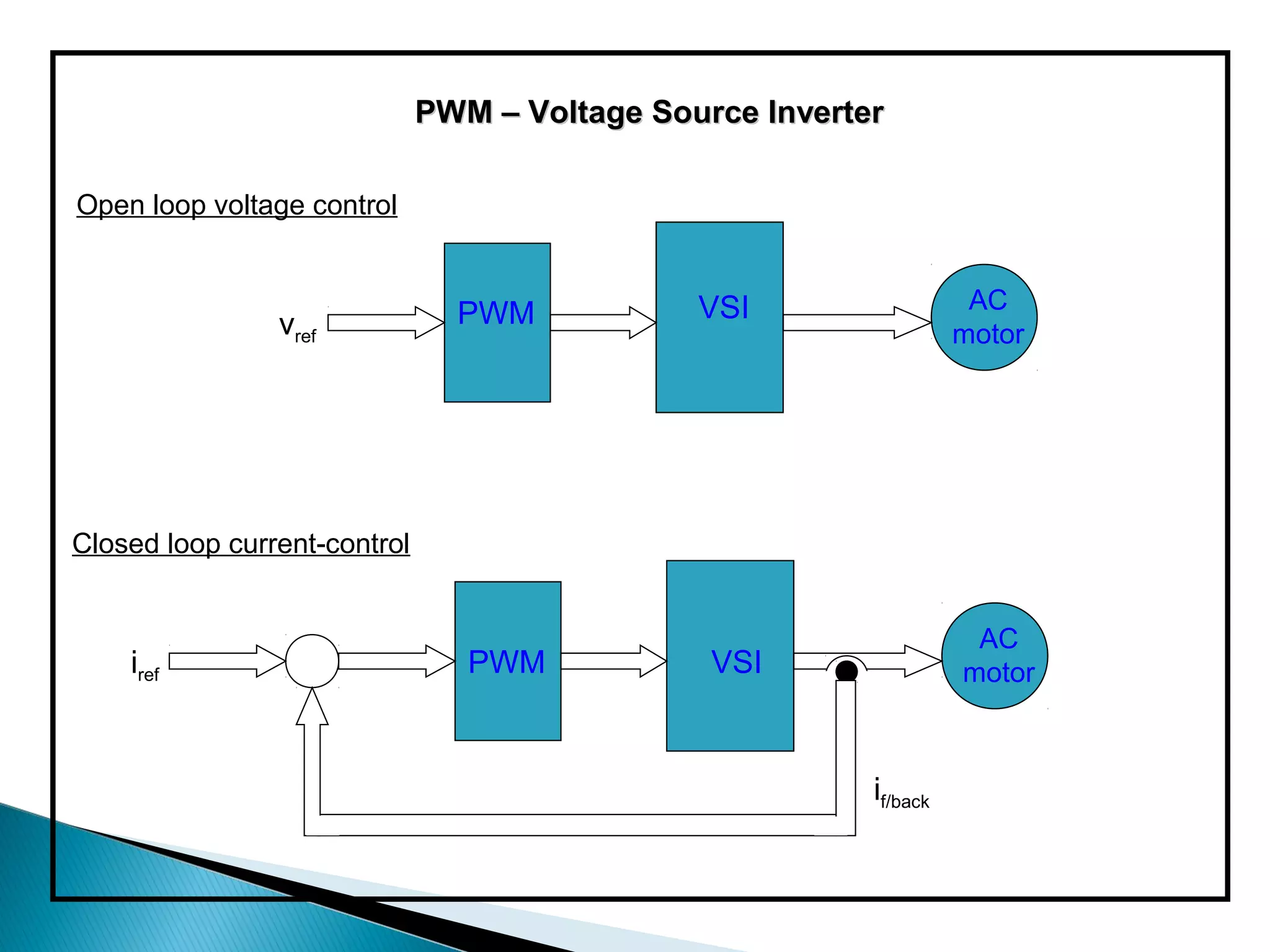
PWM – Voltage Source Inverter

Open loop voltage control


                                               VSI                   AC
                vref            PWM
                                                                    motor


Closed loop current-control


                                                                     AC
    iref                         PWM            VSI                 motor


                                                          if/back
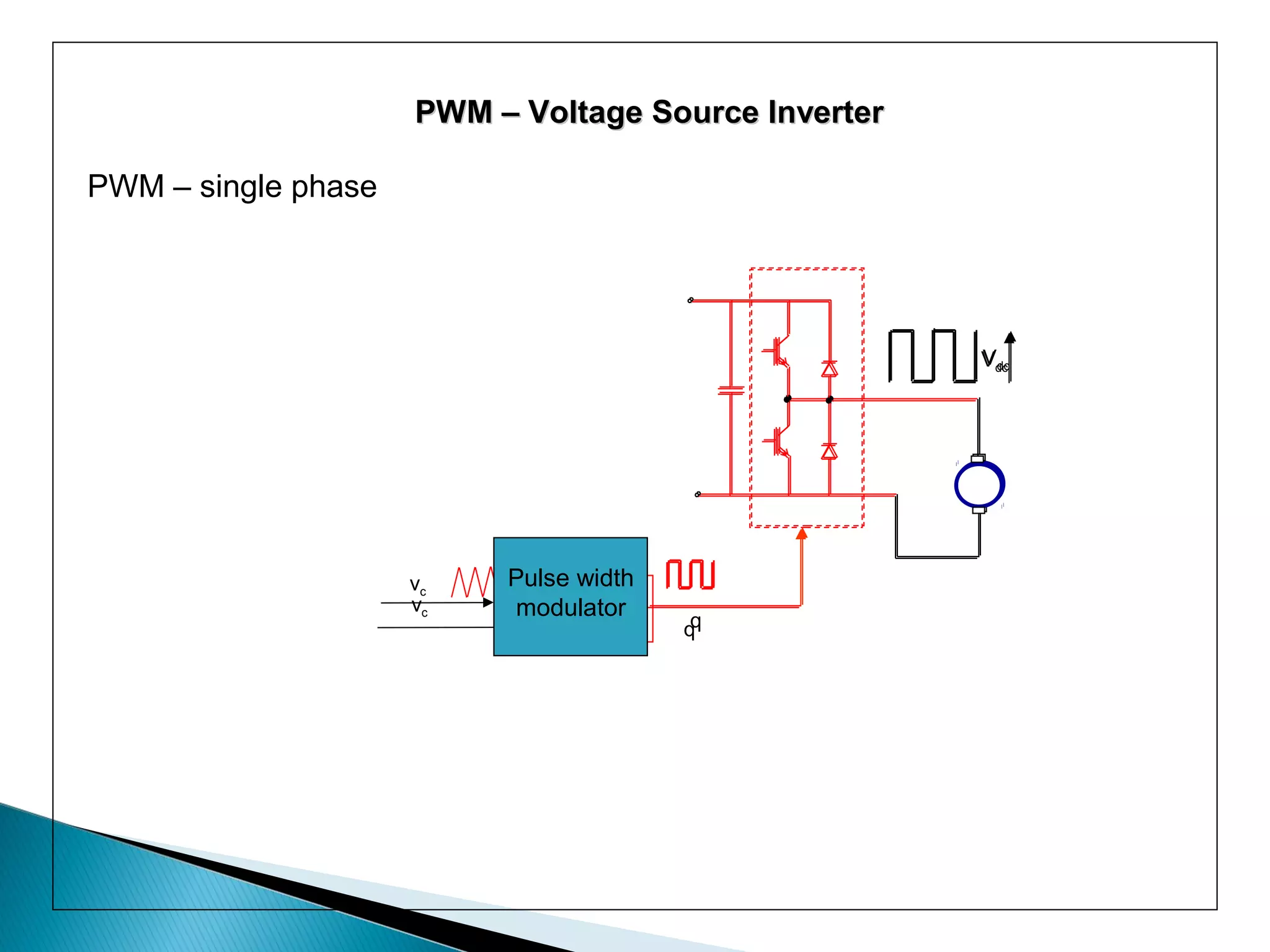
PWM – Voltage Source Inverter

PWM – single phase


                                                     Vdc
                                                      dc


                     vc   vPulse width
                           tri

                     vc    modulator
                                         qq
PWM – Voltage Source Inverter


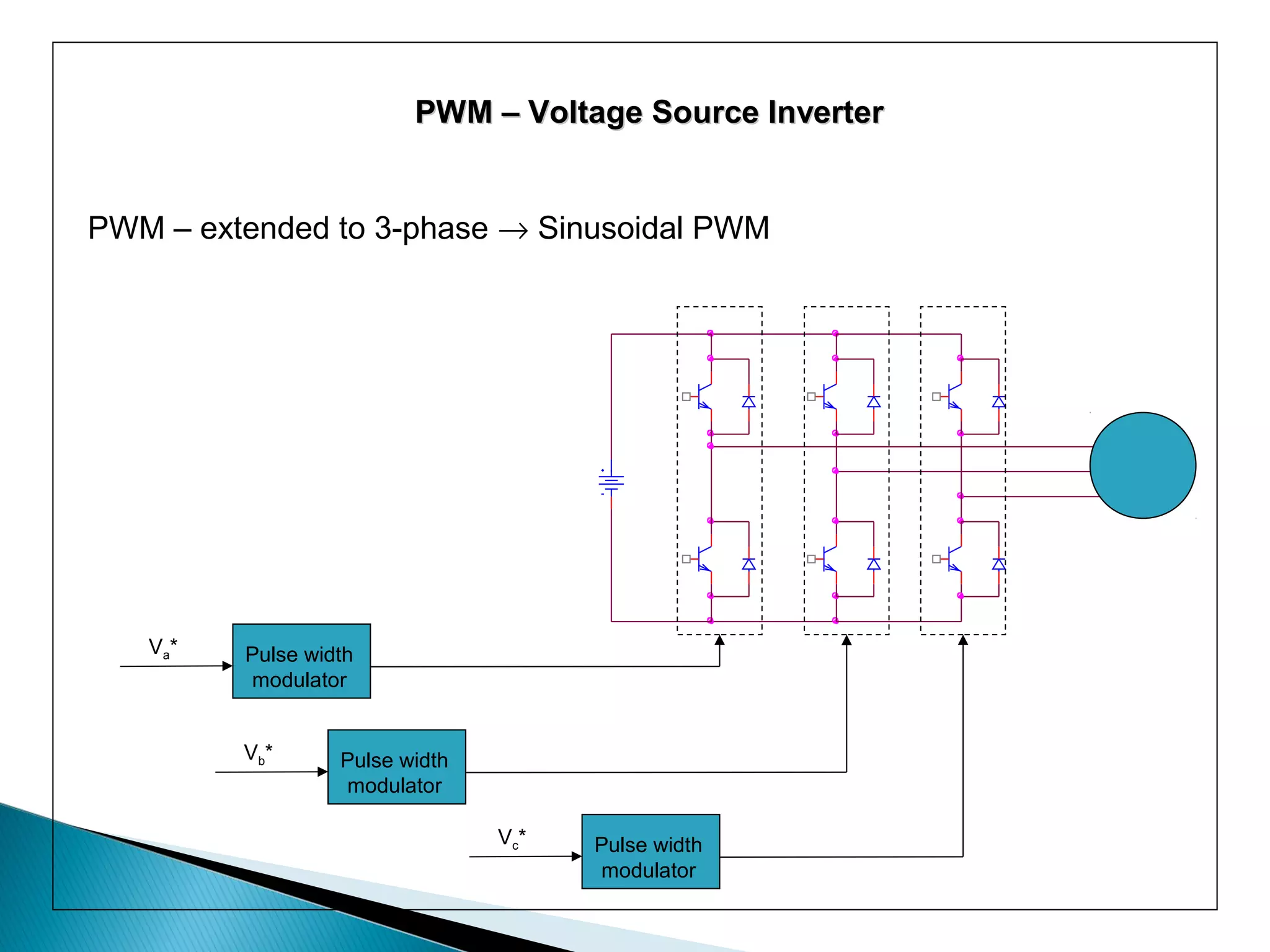
PWM – extended to 3-phase → Sinusoidal PWM


   Va*   Pulse width
         modulator


         Vb*      Pulse width
                  modulator

                                Vc*   Pulse width
                                      modulator
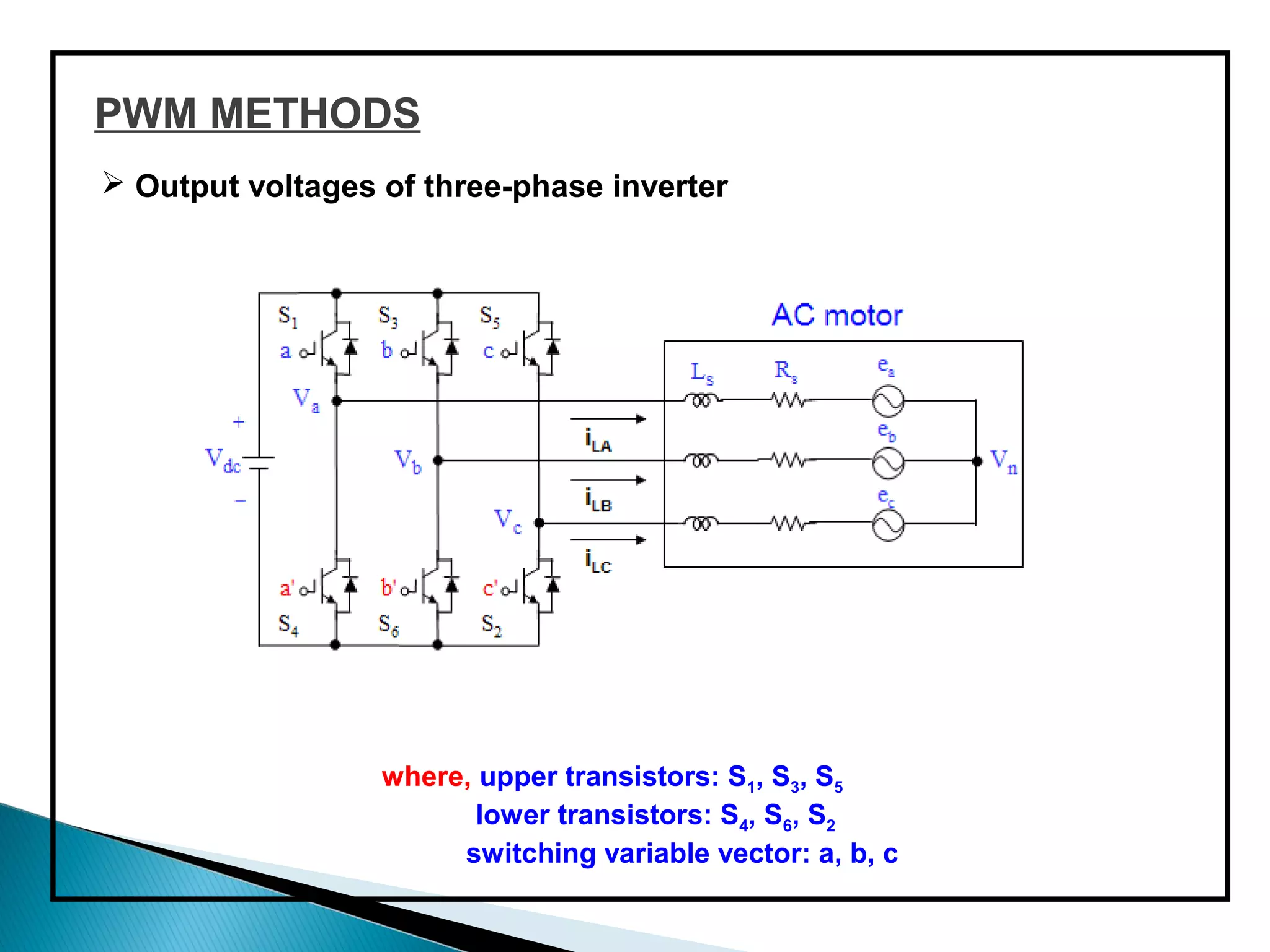
PWM METHODS
 Output voltages of three-phase inverter


                  where, upper transistors: S1, S3, S5
                         lower transistors: S4, S6, S2
                       switching variable vector: a, b, c
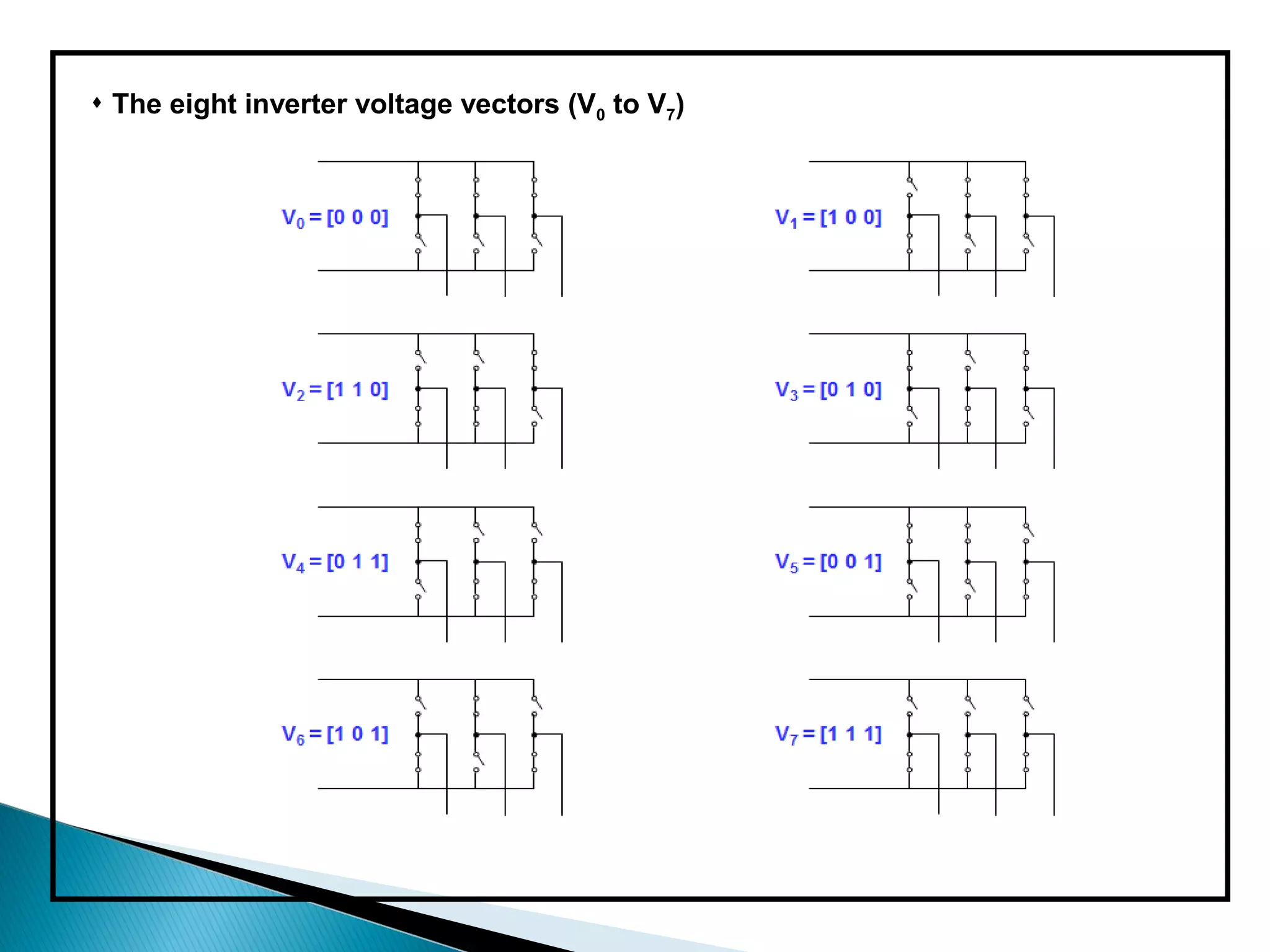
 The eight inverter voltage vectors (V0 to V7)
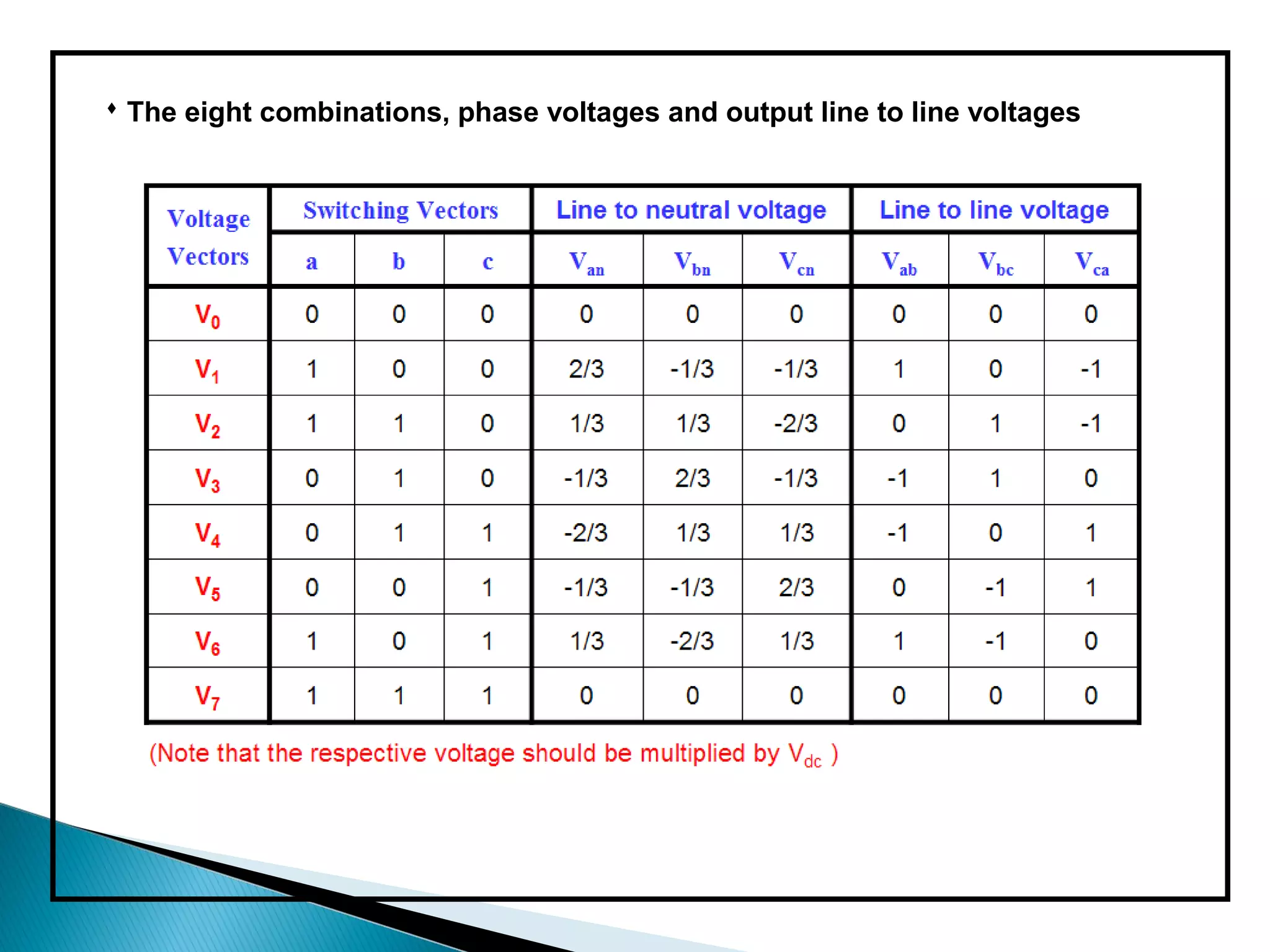
 The eight combinations, phase voltages and output line to line voltages
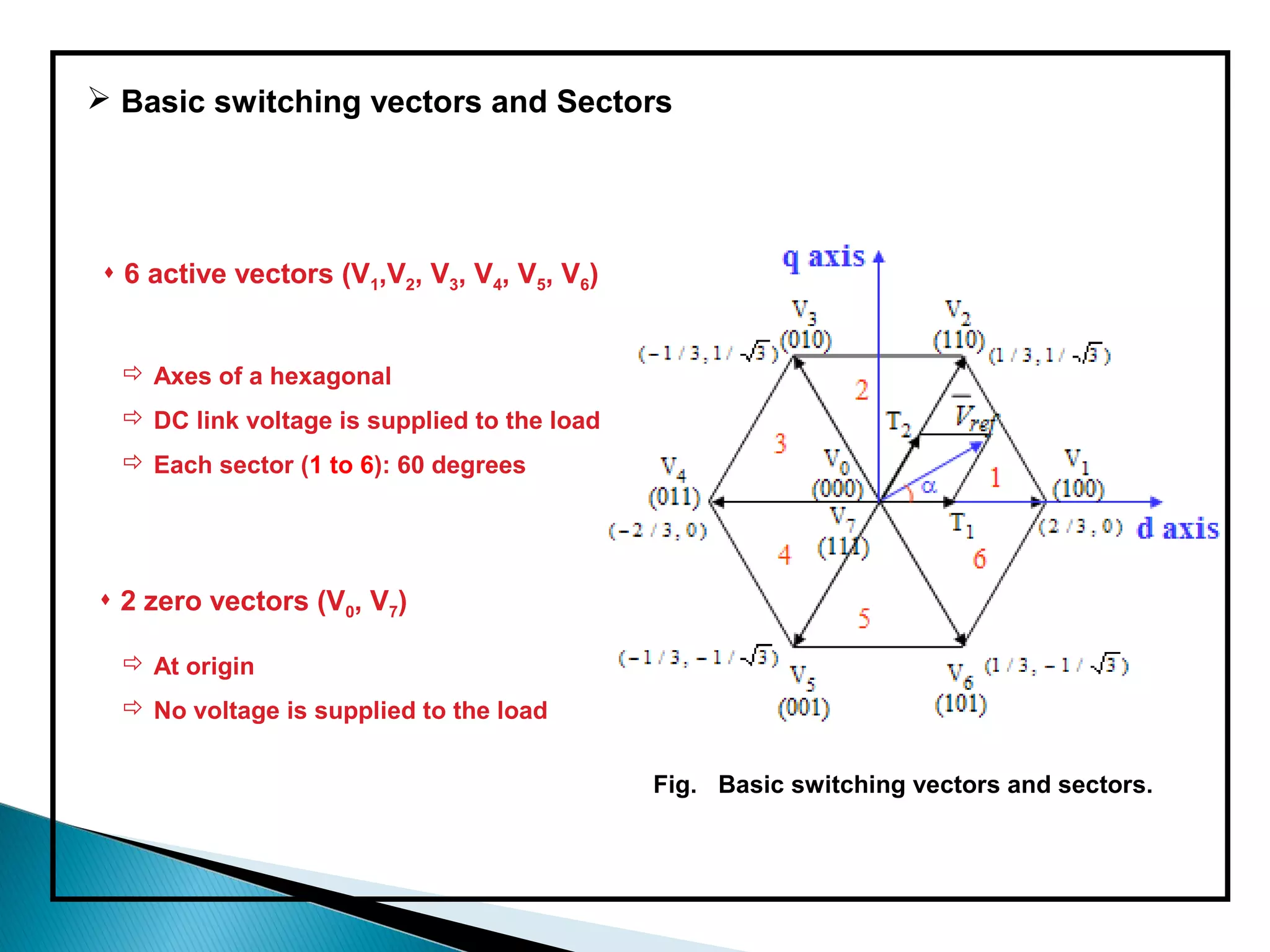
 Basic switching vectors and Sectors


  6 active vectors (V1,V2, V3, V4, V5, V6)


   Axes of a hexagonal
   DC link voltage is supplied to the load
   Each sector (1 to 6): 60 degrees


 2 zero vectors (V0, V7)

   At origin
   No voltage is supplied to the load


                                              Fig. Basic switching vectors and sectors.
Space Vector Modulation


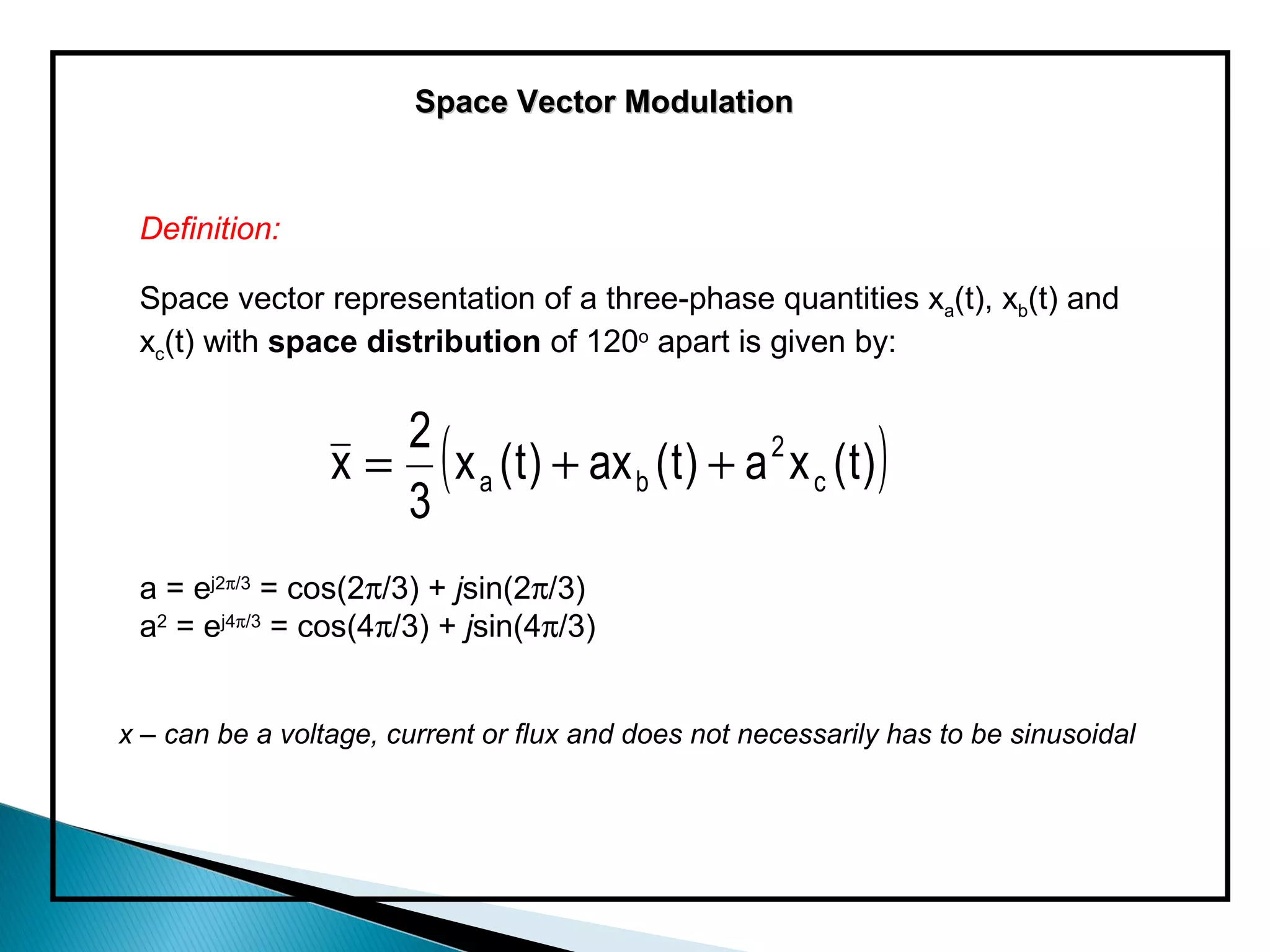
 Definition:

 Space vector representation of a three-phase quantities xa(t), xb(t) and
 xc(t) with space distribution of 120o apart is given by:


                 x = ( x a ( t ) + ax b ( t ) + a 2 x c ( t ) )
                    2
                    3
 a = ej2π/3 = cos(2π/3) + jsin(2π/3)
 a2 = ej4π/3 = cos(4π/3) + jsin(4π/3)


x – can be a voltage, current or flux and does not necessarily has to be sinusoidal
Space Vector Modulation


           v = ( v a ( t ) + av b ( t ) + a 2 v c ( t ) )
              2
           x     x           ax               x
              3

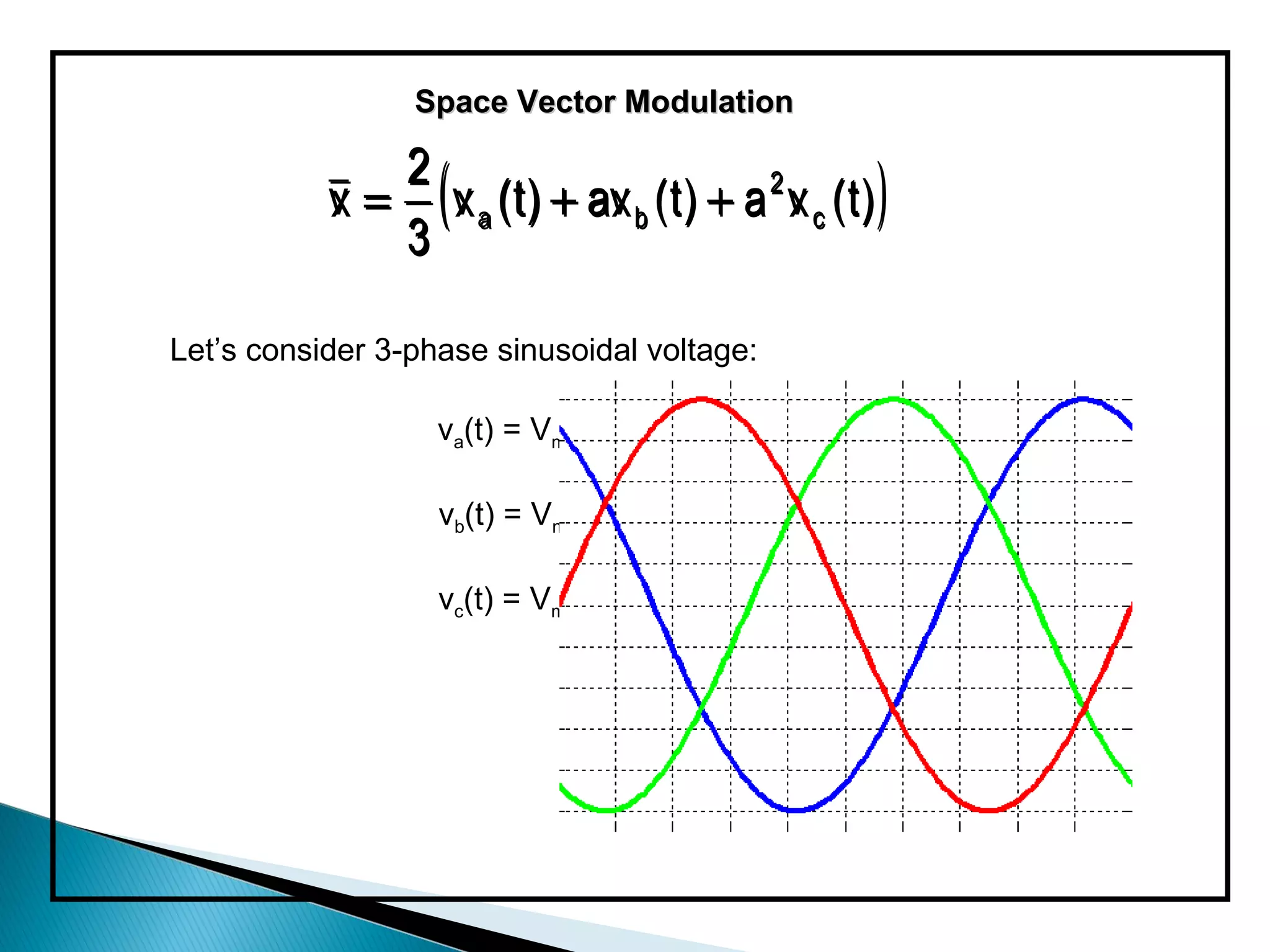
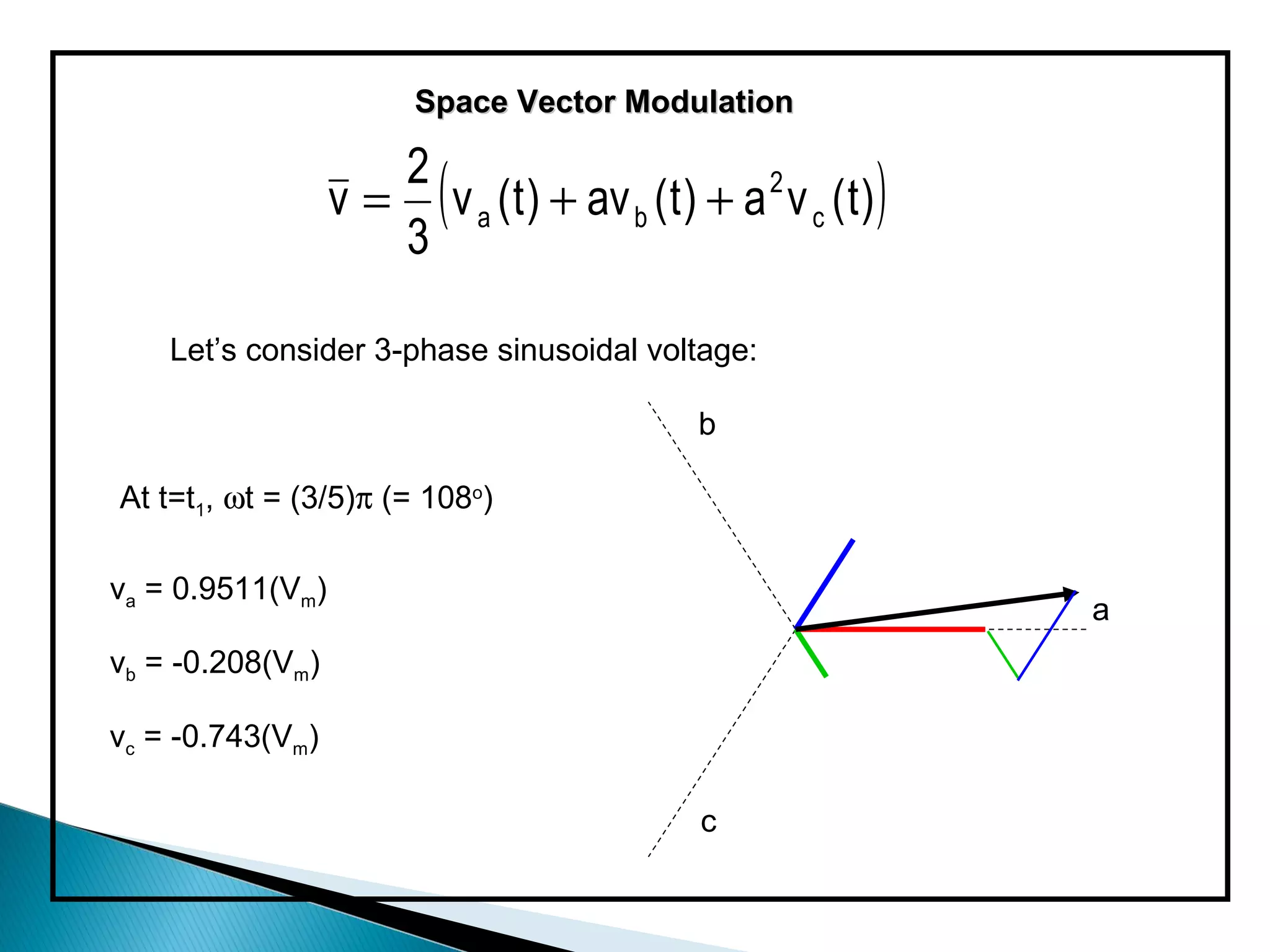
Let’s consider 3-phase sinusoidal voltage:

                   va(t) = Vmsin(ωt)

                    vb(t) = Vmsin(ωt - 120o)

                    vc(t) = Vmsin(ωt + 120o)
Space Vector Modulation


                  v = ( v a ( t ) + av b ( t ) + a 2 v c ( t ) )
                     2
                     3

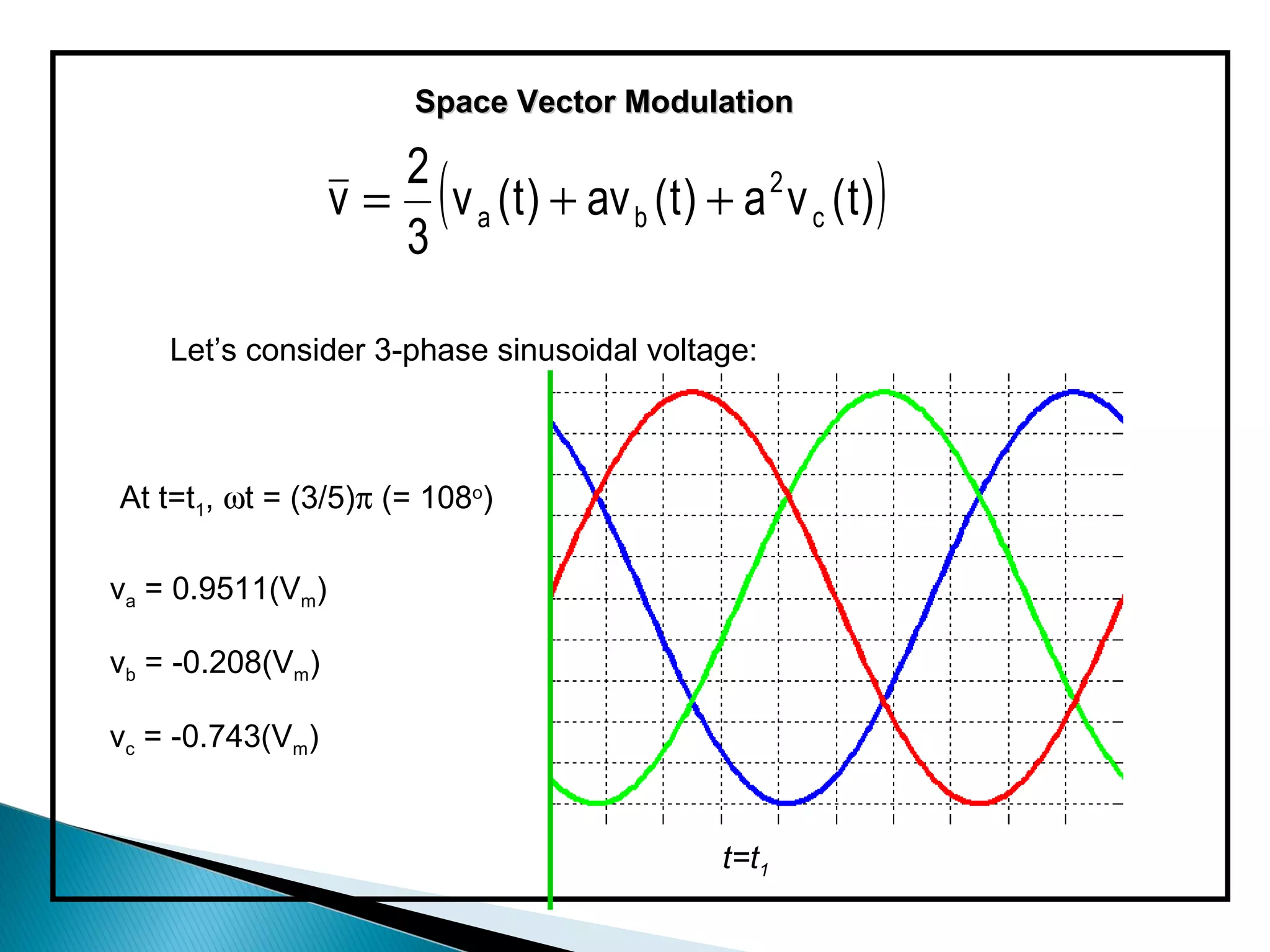
    Let’s consider 3-phase sinusoidal voltage:


At t=t1, ωt = (3/5)π (= 108o)

va = 0.9511(Vm)

vb = -0.208(Vm)

vc = -0.743(Vm)


                                                  t=t1
Space Vector Modulation


                  v = ( v a ( t ) + av b ( t ) + a 2 v c ( t ) )
                     2
                     3

    Let’s consider 3-phase sinusoidal voltage:

                                                b

At t=t1, ωt = (3/5)π (= 108o)

va = 0.9511(Vm)
                                                                   a
vb = -0.208(Vm)

vc = -0.743(Vm)

                                                c
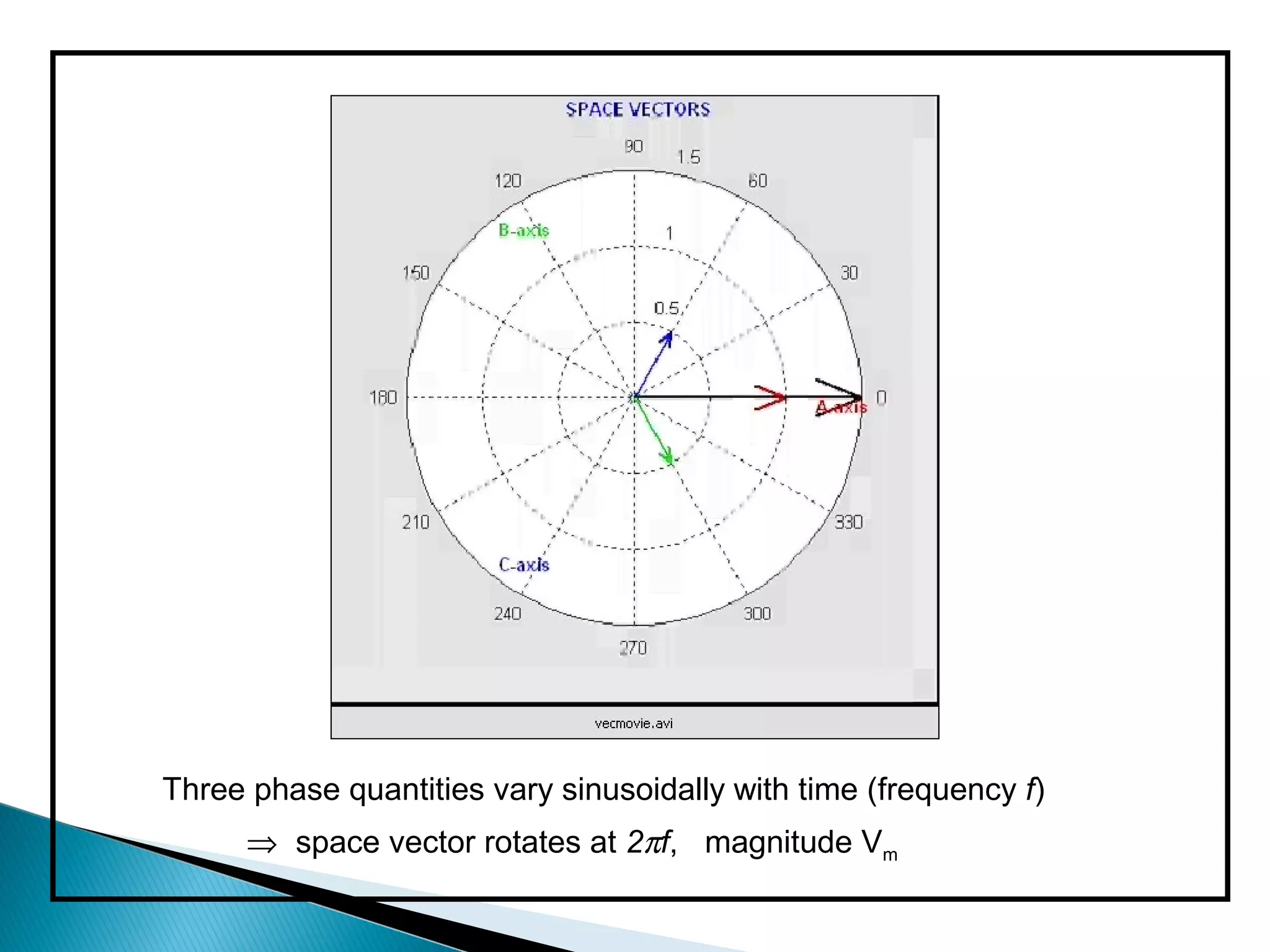
Three phase quantities vary sinusoidally with time (frequency f)
      ⇒ space vector rotates at 2πf, magnitude Vm
Space Vector Modulation


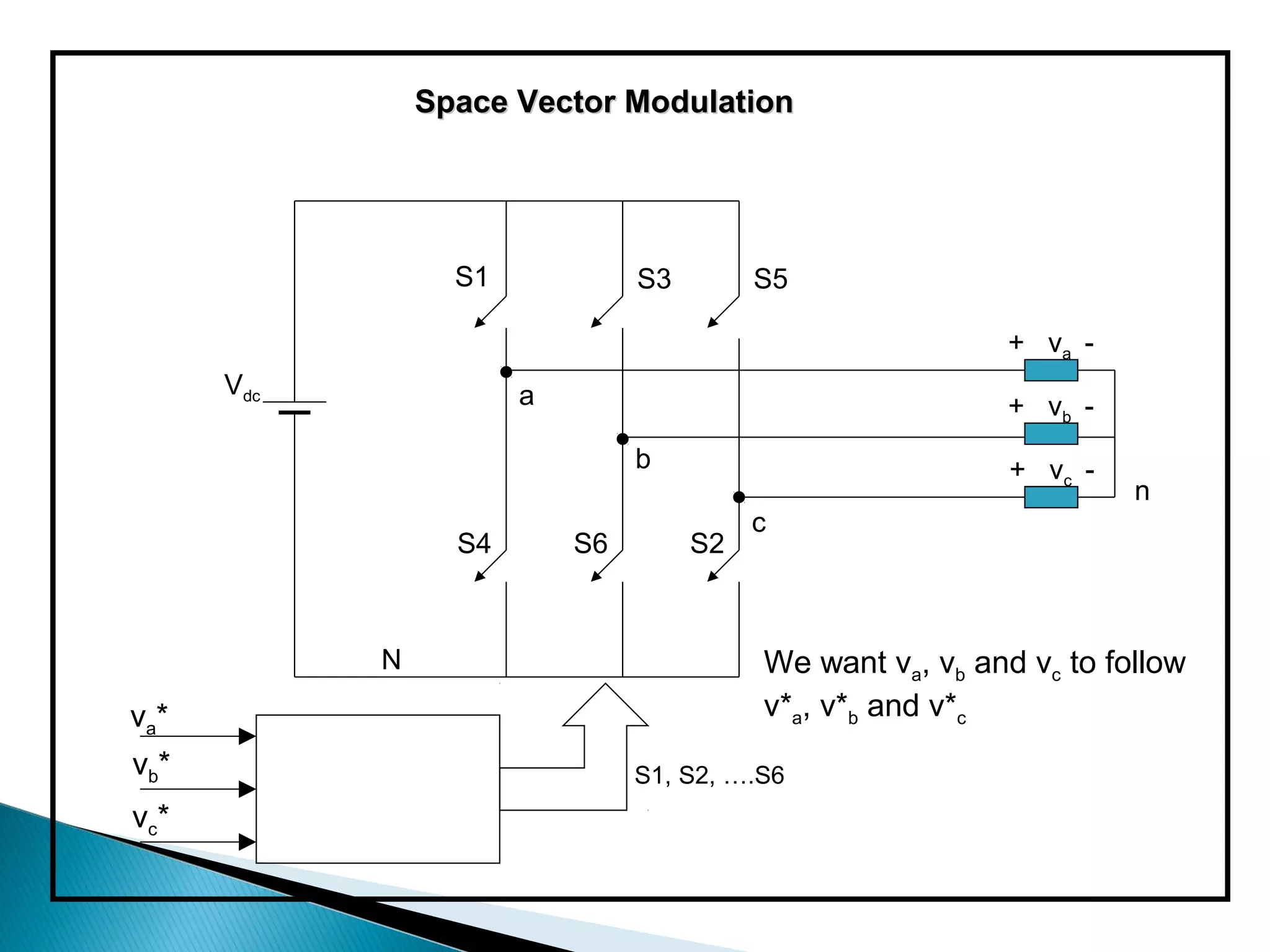
                  S1            S3        S5

                                                           + va -
      Vdc              a                                   + vb -
                                b                           + vc -
                                                                     n
                                          c
                  S4       S6        S2


            N                             We want va, vb and vc to follow
va*                                       v*a, v*b and v*c
vb*                             S1, S2, ….S6
vc*
Space Vector Modulation


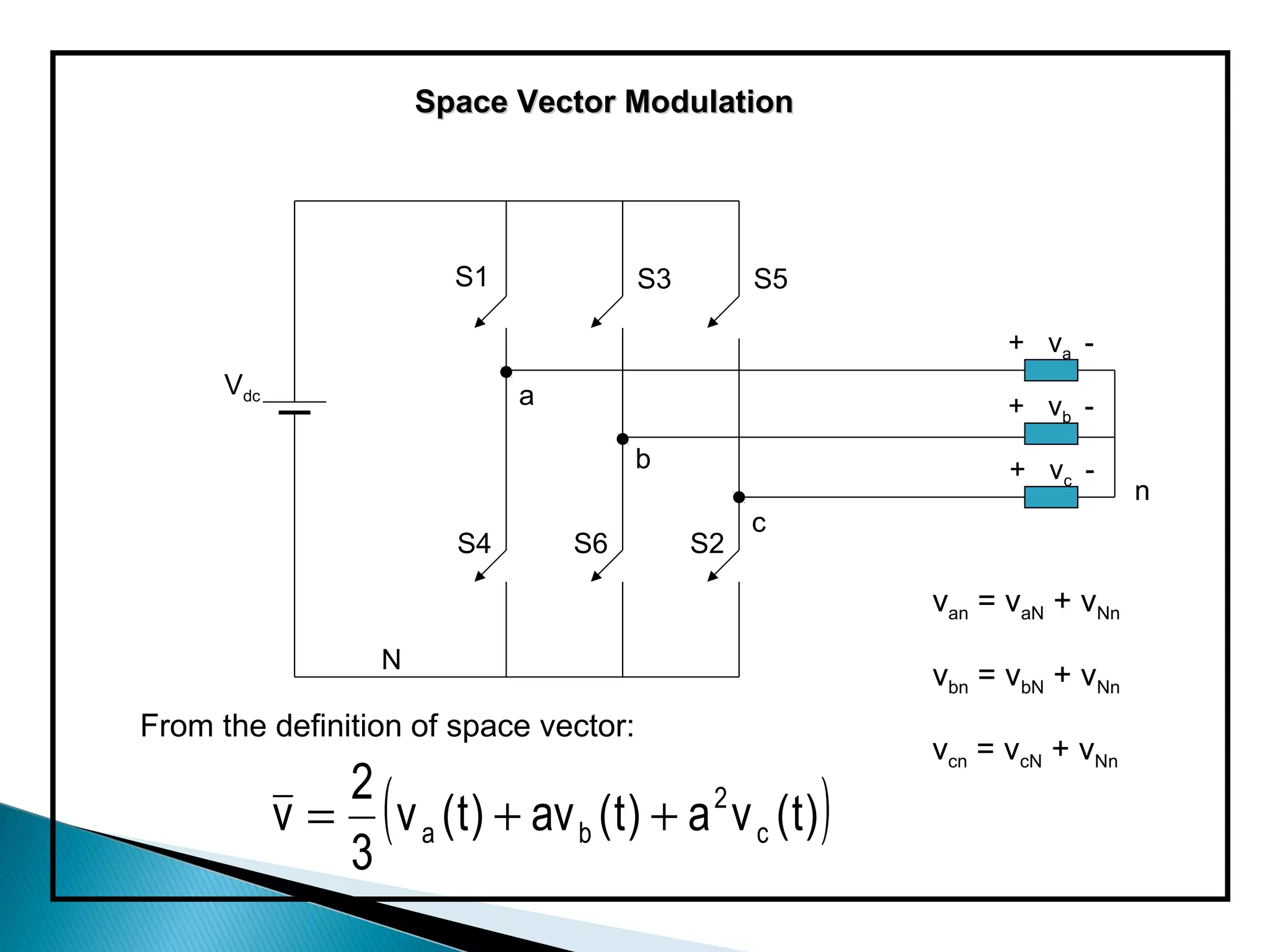
                           S1             S3        S5

                                                                   + va -
      Vdc                       a                                  + vb -
                                         b                         + vc -
                                                                               n
                                                    c
                           S4       S6         S2

                                                             van = vaN + vNn
                    N
                                                             vbn = vbN + vNn
From the definition of space vector:
                                                             vcn = vcN + vNn

            v = ( v a ( t ) + av b ( t ) + a 2 v c ( t ) )
               2
               3
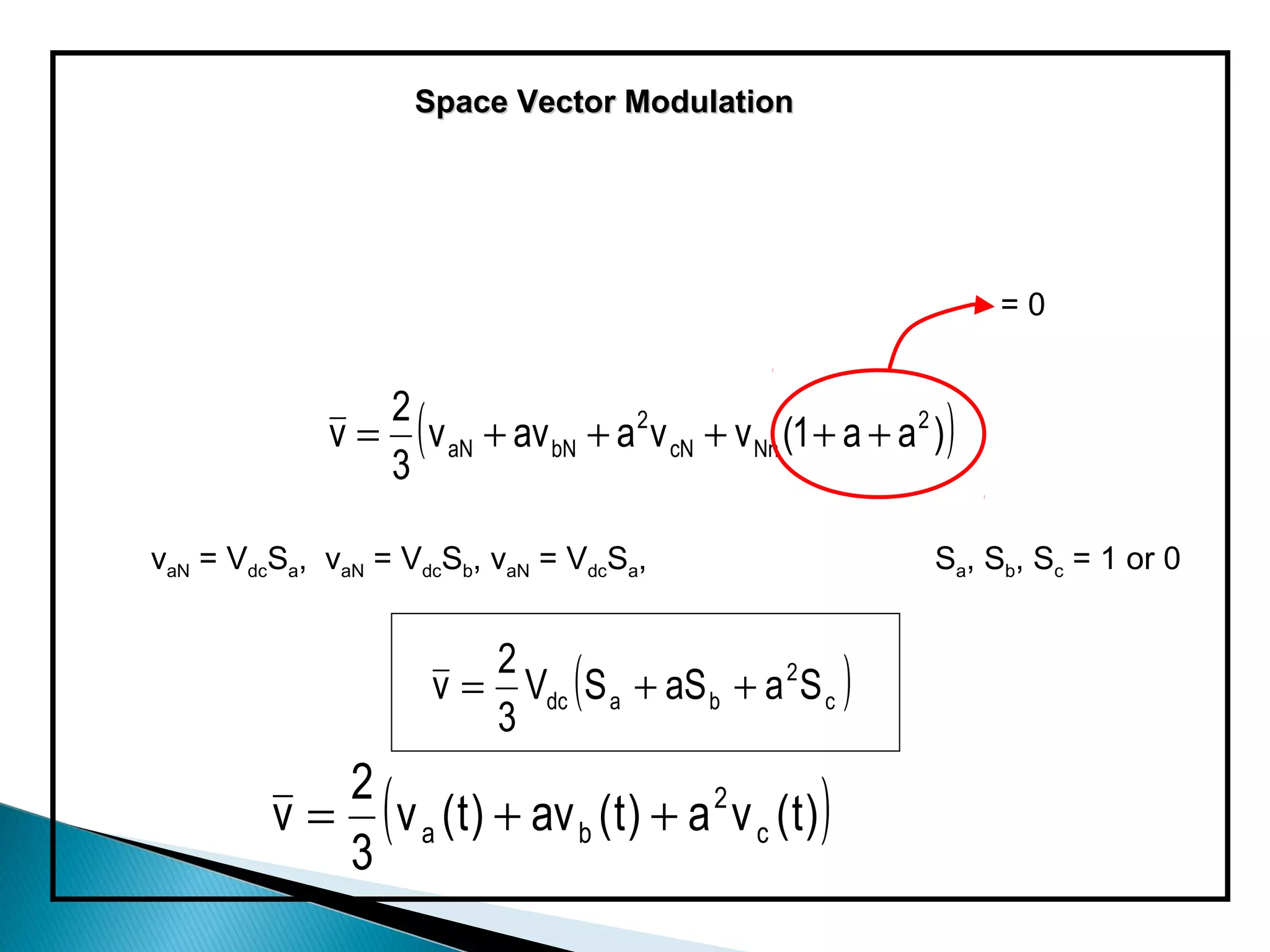
Space Vector Modulation


                                                                     =0


                2
                    (
             v = v aN + av bN + a 2 v cN + v Nn (1 + a + a 2 )
                3
                                                                 )
vaN = VdcSa, vaN = VdcSb, vaN = VdcSa,                        Sa, Sb, Sc = 1 or 0


                           2
                                 (
                        v = Vdc S a + aS b + a 2 S c
                           3
                                                          )
         v = ( v a ( t ) + av b ( t ) + a 2 v c ( t ) )
            2
            3
Space Vector Modulation


                                Sector 2
                   [010] V3                           [110] V2
                                          (1/√3)Vdc
    Sector 3                                                Sector 1


                                                                  [100] V1
[011] V4
                                                                 (2/3)Vdc

   Sector 4       2
                           (
               v = Vdc S a + aS b + a 2 S c
                  3
                                                       )     Sector 6


                [001] V5       Sector 5           [101] V6
Conversion from 3 phases to 2 phases :

 For Sector 1,

Three-phase line modulating signals (VC)abc = [VCaVCbVCc]T

can be represented by the represented by the complex vector
        VC = [VC]αβ = [VCaVCb]T

by means of the following transformation:
       VC α = 2/3 . [vCa - 0.5(vCb + vCc )]
       VC β = √3/3 . (vCb - vCc)
Space Vector Modulation


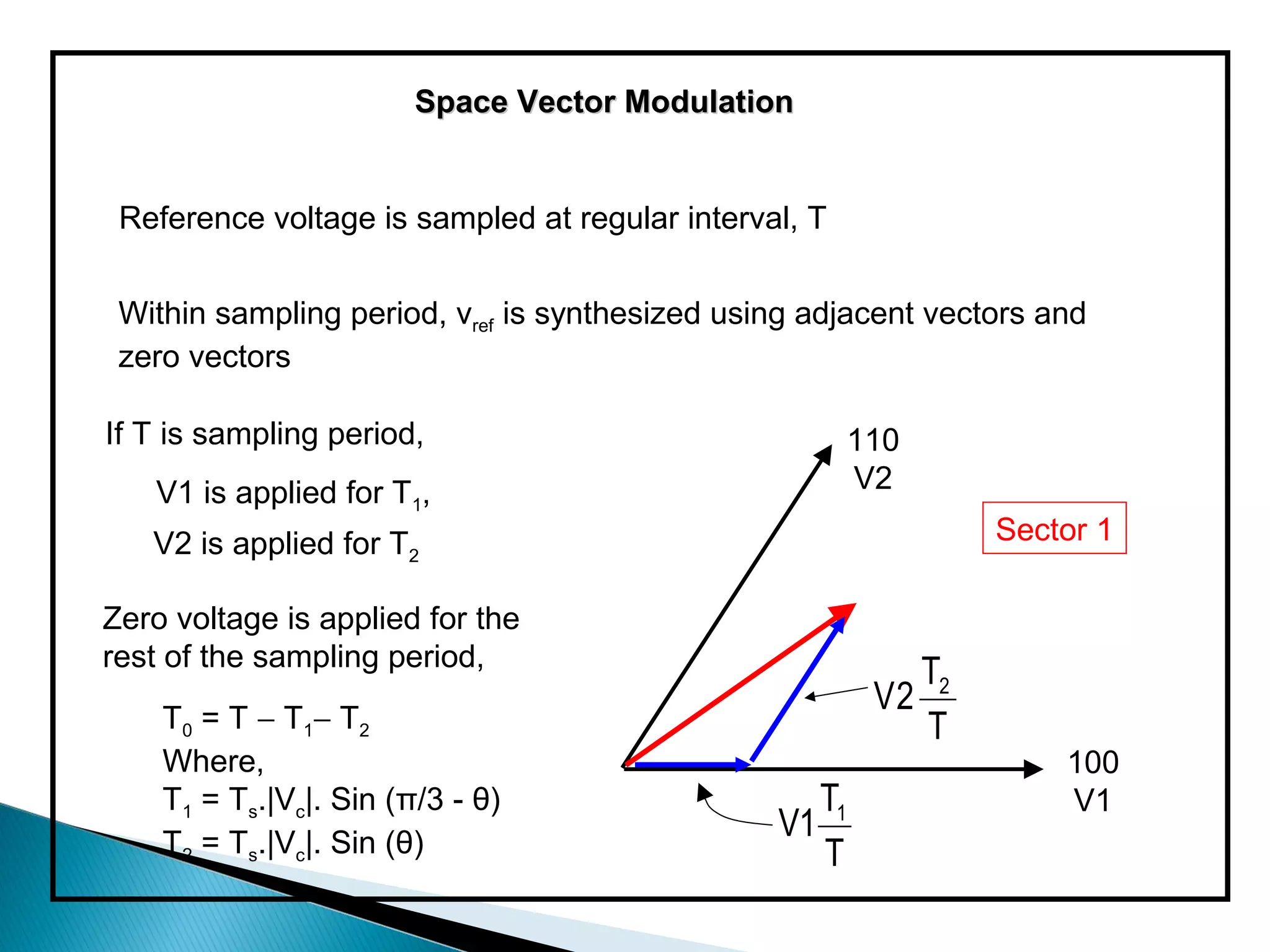
 Reference voltage is sampled at regular interval, T


 Within sampling period, vref is synthesized using adjacent vectors and
 zero vectors

If T is sampling period,                               110
   V1 is applied for T1,                               V2

   V2 is applied for T2                                             Sector 1

Zero voltage is applied for the
rest of the sampling period,
                                                               T2
                                                          V2
    T 0 = T − T 1− T 2                                         T
    Where,                                                              100
    T1 = Ts.|Vc|. Sin (π/3 - θ)                      T1                 V1
    T2 = Ts.|Vc|. Sin (θ)
                                                V1
                                                     T
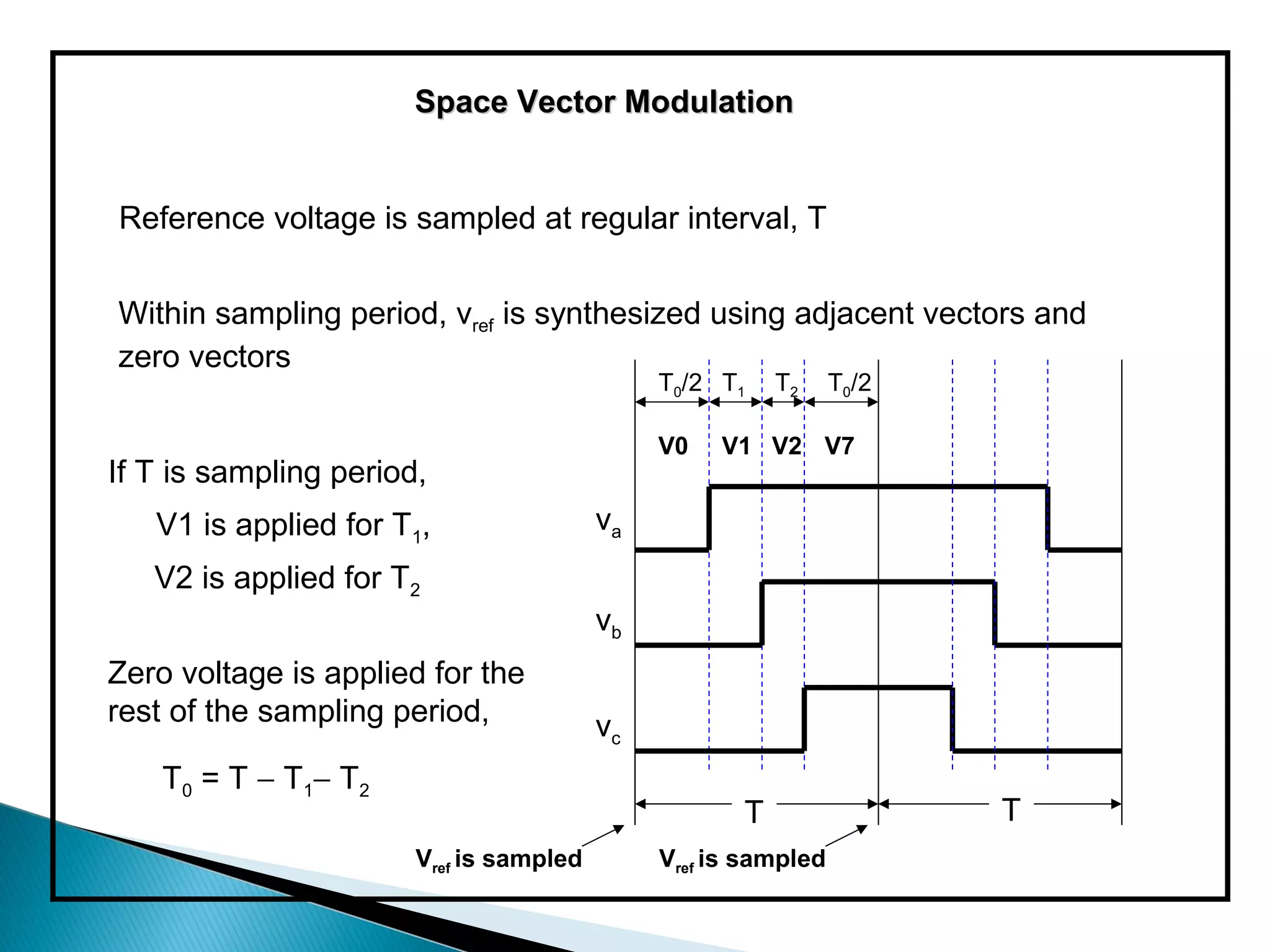
Space Vector Modulation


Reference voltage is sampled at regular interval, T


Within sampling period, vref is synthesized using adjacent vectors and
zero vectors
                                              T0/2 T1    T2     T0/2

                                              V0   V1 V2 V7
If T is sampling period,
   V1 is applied for T1,                 va
   V2 is applied for T2
                                         vb
Zero voltage is applied for the
rest of the sampling period,             vc
    T0 = T − T1− T2
                                                     T                 T
                       Vref is sampled        Vref is sampled
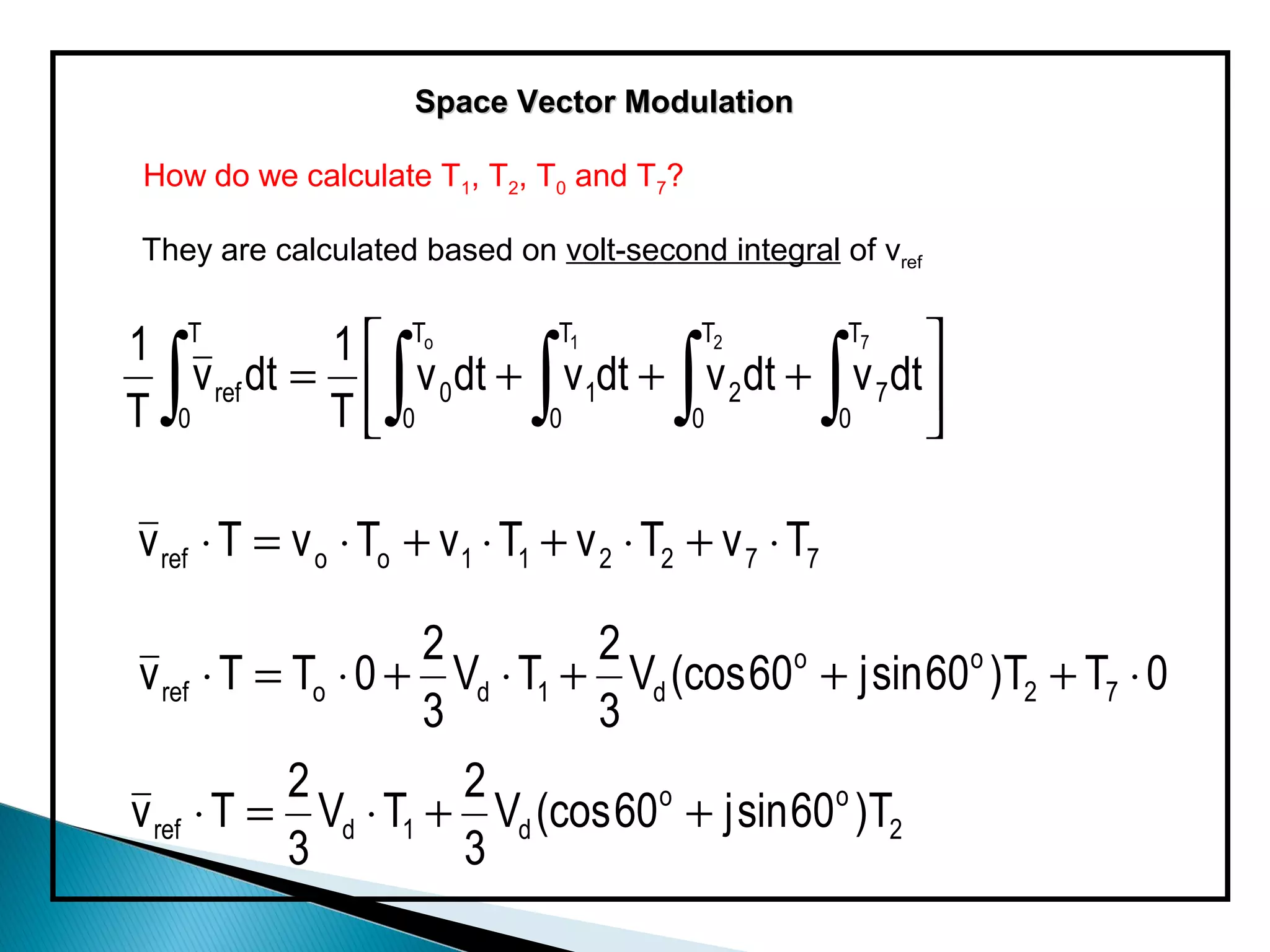
Space Vector Modulation

 How do we calculate T1, T2, T0 and T7?

They are calculated based on volt-second integral of vref


1 T           1  To       T1      T2       T7
                                                  
  ∫
T 0           T 0 ∫      0   ∫   0      ∫
    v ref dt =  v 0 dt + v 1dt + v 2 dt + v 7 dt 
                                           0           ∫
v ref ⋅ T = v o ⋅ To + v 1 ⋅ T1 + v 2 ⋅ T2 + v 7 ⋅ T7

                    2         2
v ref ⋅ T = To ⋅ 0 + Vd ⋅ T1 + Vd (cos 60o + j sin 60o )T2 + T7 ⋅ 0
                    3         3
            2         2
v ref ⋅ T = Vd ⋅ T1 + Vd (cos 60o + j sin 60o )T2
            3         3
Space Vector Modulation


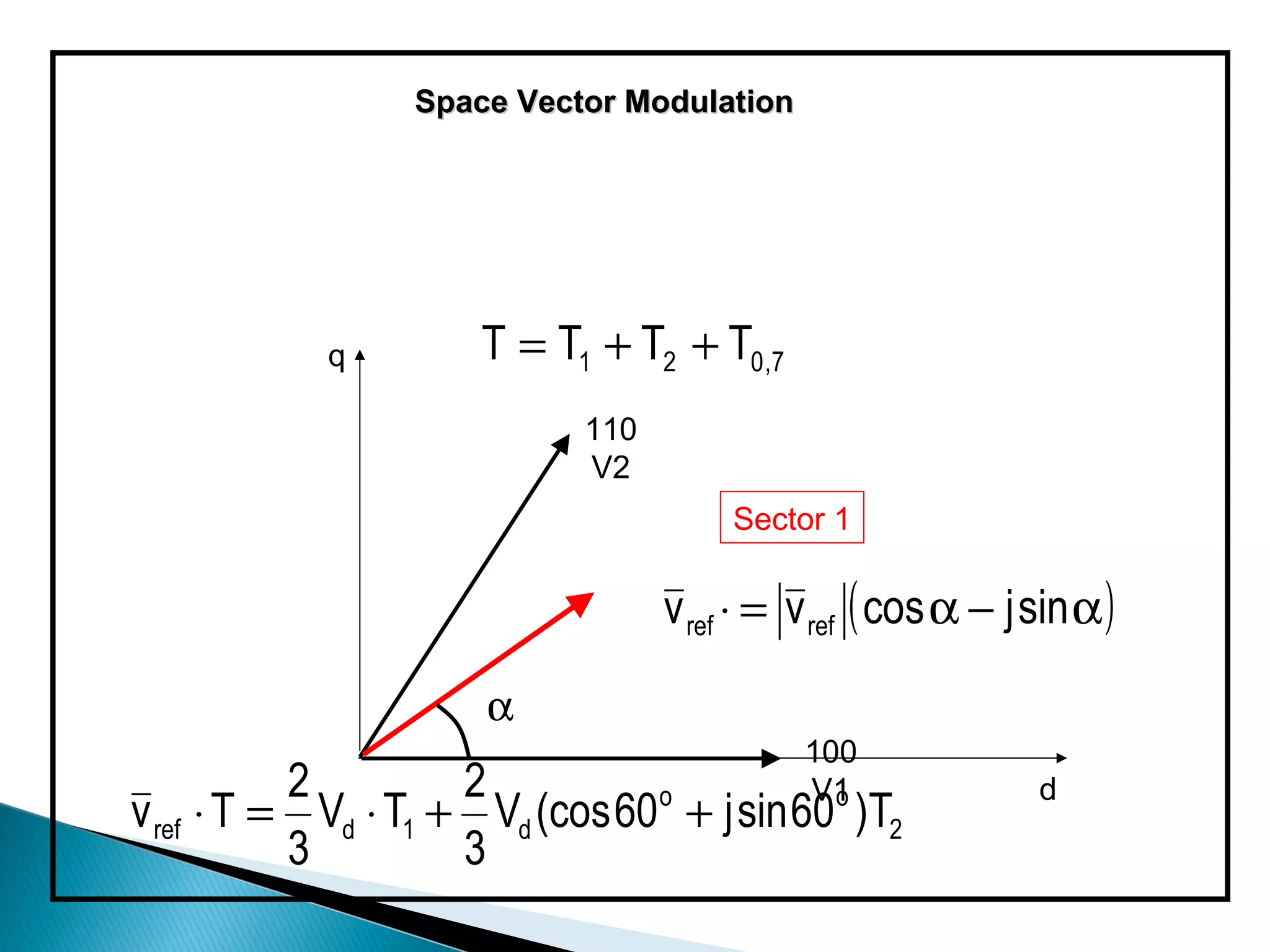
            q        T = T1 + T2 + T0,7
                            110
                            V2
                                       Sector 1

                                  v ref ⋅ = v ref ( cos α − j sin α )

                      α
                                            100
           2         2                      V1                 d
v ref ⋅ T = Vd ⋅ T1 + Vd (cos 60o + j sin 60 )T2
                                              o

           3         3
Space Vector Modulation


           2         2
v ref ⋅ T = Vd ⋅ T1 + Vd (cos 60o + j sin 60o )T2
           3         3
               2       1                                          1
T v ref cos α = Vd T1 + Vd T2                   T v ref   sin α =    Vd T2
               3       3                                           3

Solving for T1, T2 and T0,7 gives:
T1= 3/2 m[ (T/√3) cos α - (1/3)T sin α ]

T2= mT sin α
                                           where,
                                           M= Vref/ (Vd/ √3)
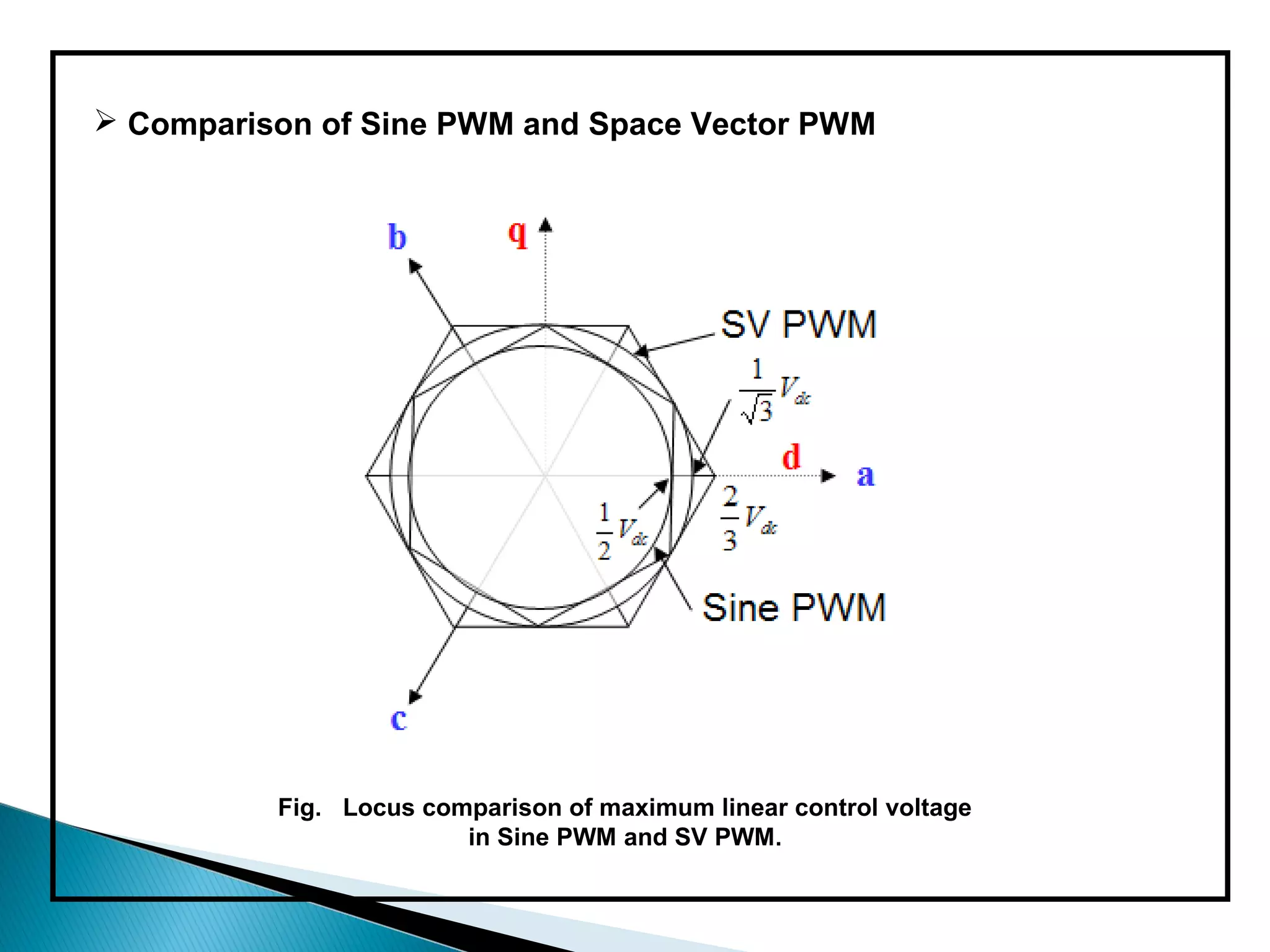
 Comparison of Sine PWM and Space Vector PWM


          Fig. Locus comparison of maximum linear control voltage
                        in Sine PWM and SV PWM.
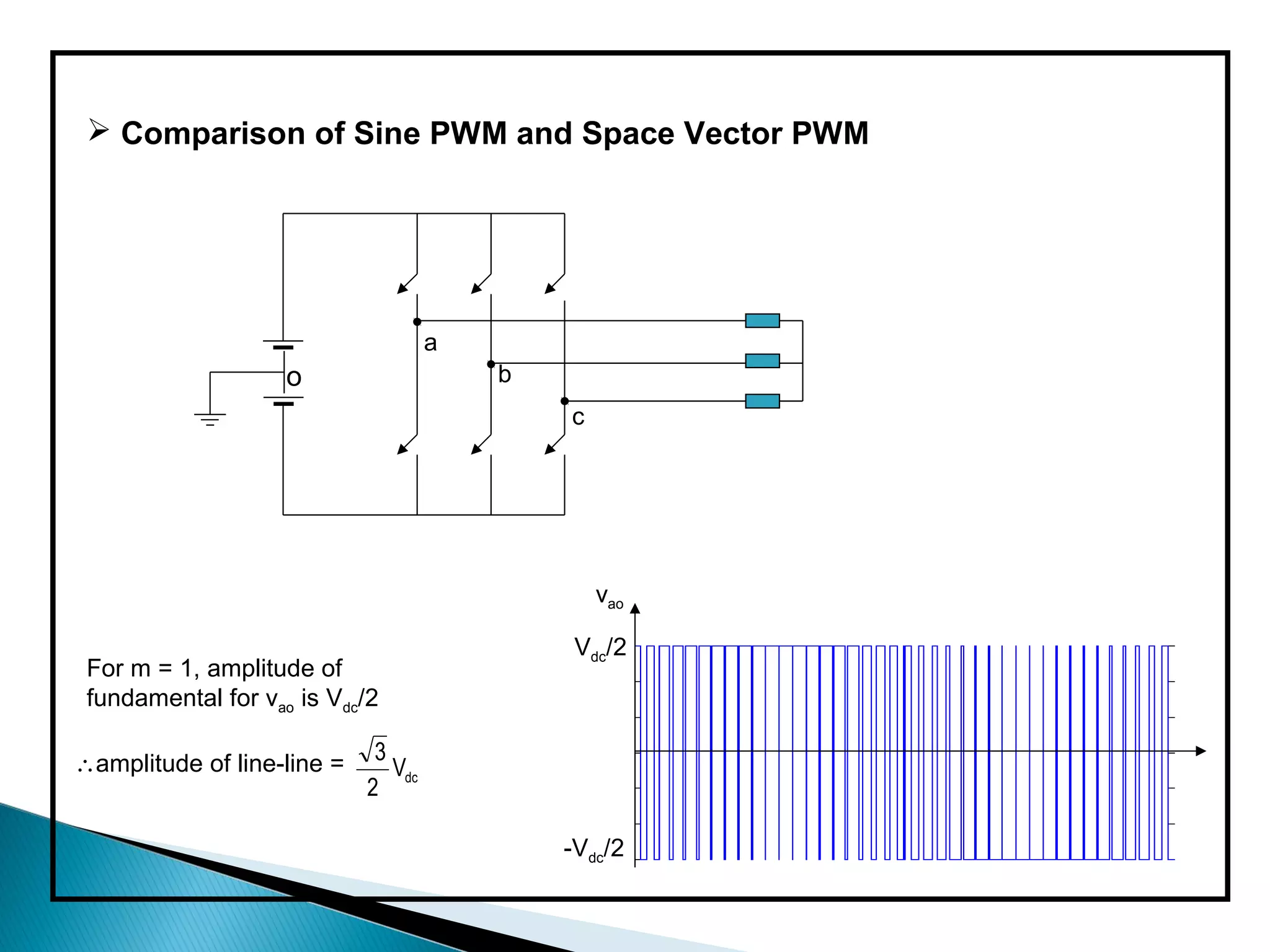
 Comparison of Sine PWM and Space Vector PWM


                                     a
                    o                    b
                                             c


                                                 vao

                                              Vdc/2
 For m = 1, amplitude of
 fundamental for vao is Vdc/2

∴amplitude of line-line =    3
                               Vdc
                            2

                                             -Vdc/2
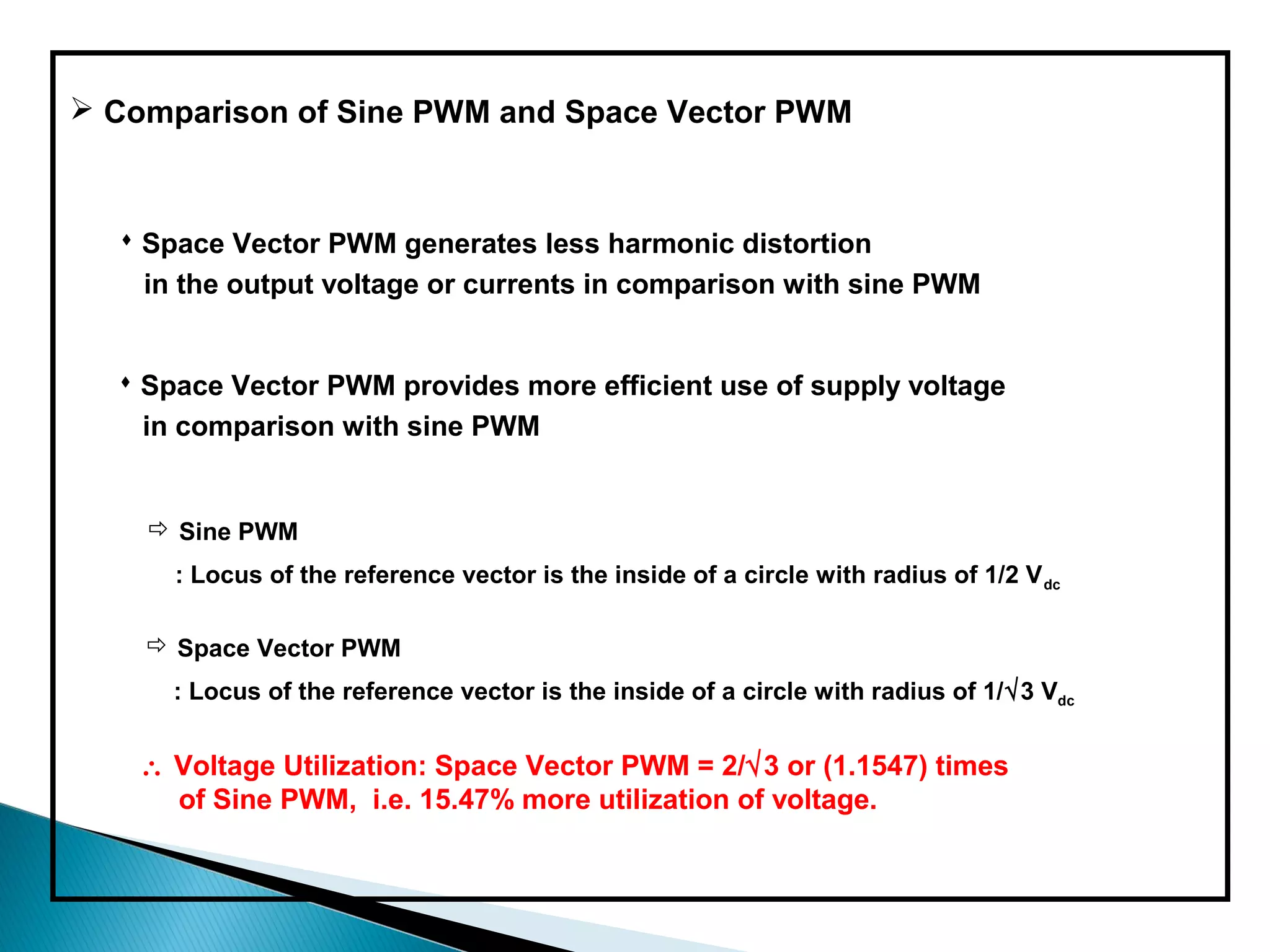
 Comparison of Sine PWM and Space Vector PWM


   Space Vector PWM generates less harmonic distortion
    in the output voltage or currents in comparison with sine PWM


   Space Vector PWM provides more efficient use of supply voltage
    in comparison with sine PWM


     Sine PWM
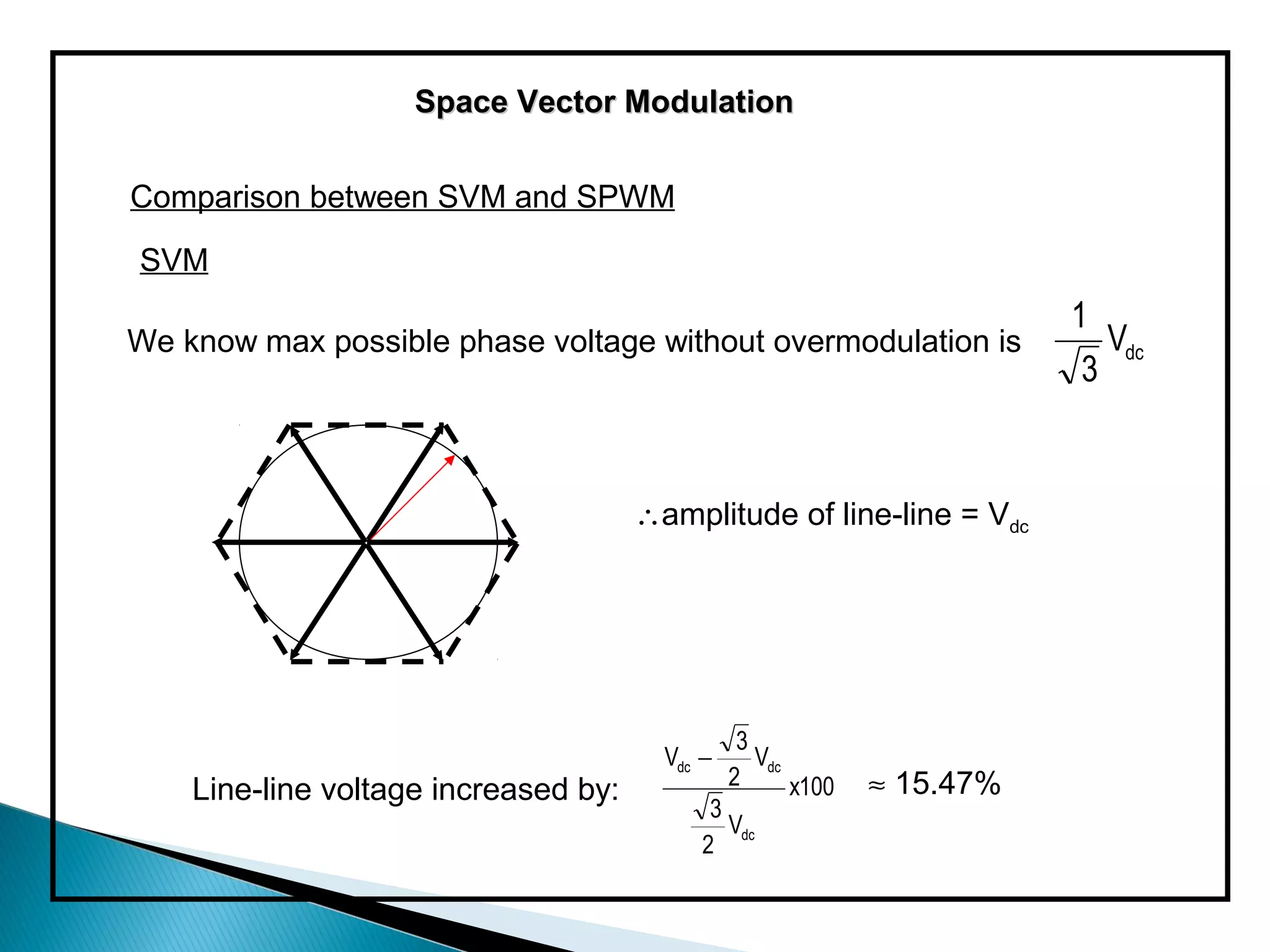
      : Locus of the reference vector is the inside of a circle with radius of 1/2 V dc

     Space Vector PWM
      : Locus of the reference vector is the inside of a circle with radius of 1/√3 Vdc


    ∴ Voltage Utilization: Space Vector PWM = 2/√3 or (1.1547) times
      of Sine PWM, i.e. 15.47% more utilization of voltage.
Space Vector Modulation


Comparison between SVM and SPWM

SVM
                                                                       1
We know max possible phase voltage without overmodulation is              Vdc
                                                                        3


                                      ∴amplitude of line-line = Vdc


                                               3
                                        Vdc −    Vdc
                                              2             ≈ 15.47%
    Line-line voltage increased by:                  x100
                                            3
                                              Vdc
                                           2
1. Power Electronics: Circuits, Devices and Applications by M. H. Rashid, 3rd edition,
Pearson
2. Power Electronics: Converters, Applications and Devices by Mohan, Undeland and
Robbins, Wiley student edition
3. Power Electronics Handbook: M.H. Rashid, Web edition
4. Modern Power Electronics And Ac Drives: B.K. Bose
5. Extended Report on AC drive control, IEEE : Issa Batarseh
6. Space vector modulation: Google, Wikipedia ; for figures.
Svpwm

Svpwm

  • 1.
  • 2.
    Introduction:  Principle ofSpace Vector PWM  Treats the sinusoidal voltage as a constant amplitude vector rotating at constant frequency.  Coordinate Transformation ( abc reference frame to the stationary d-q frame) : A three-phase voltage vector is transformed into a vector in the stationary d-q coordinate frame which represents the spatial vector sum of the three-phase voltage.  This PWM technique approximates the reference voltage Vref by a combination of the eight switching patterns (V0 to V7).  The vectors (V1 to V6) divide the plane into six sectors (each sector: 60 degrees).  Vref is generated by two adjacent non-zero vectors and two zero vectors.
  • 3.
    PWM – VoltageSource Inverter Open loop voltage control VSI AC vref PWM motor Closed loop current-control AC iref PWM VSI motor if/back
  • 4.
    PWM – VoltageSource Inverter PWM – single phase Vdc dc vc vPulse width tri vc modulator qq
  • 5.
    PWM – VoltageSource Inverter PWM – extended to 3-phase → Sinusoidal PWM Va* Pulse width modulator Vb* Pulse width modulator Vc* Pulse width modulator
  • 6.
    PWM METHODS  Outputvoltages of three-phase inverter where, upper transistors: S1, S3, S5 lower transistors: S4, S6, S2 switching variable vector: a, b, c
  • 7.
     The eightinverter voltage vectors (V0 to V7)
  • 8.
     The eightcombinations, phase voltages and output line to line voltages
  • 9.
     Basic switchingvectors and Sectors  6 active vectors (V1,V2, V3, V4, V5, V6)  Axes of a hexagonal  DC link voltage is supplied to the load  Each sector (1 to 6): 60 degrees  2 zero vectors (V0, V7)  At origin  No voltage is supplied to the load Fig. Basic switching vectors and sectors.
  • 10.
    Space Vector Modulation Definition: Space vector representation of a three-phase quantities xa(t), xb(t) and xc(t) with space distribution of 120o apart is given by: x = ( x a ( t ) + ax b ( t ) + a 2 x c ( t ) ) 2 3 a = ej2π/3 = cos(2π/3) + jsin(2π/3) a2 = ej4π/3 = cos(4π/3) + jsin(4π/3) x – can be a voltage, current or flux and does not necessarily has to be sinusoidal
  • 11.
    Space Vector Modulation v = ( v a ( t ) + av b ( t ) + a 2 v c ( t ) ) 2 x x ax x 3 Let’s consider 3-phase sinusoidal voltage: va(t) = Vmsin(ωt) vb(t) = Vmsin(ωt - 120o) vc(t) = Vmsin(ωt + 120o)
  • 12.
    Space Vector Modulation v = ( v a ( t ) + av b ( t ) + a 2 v c ( t ) ) 2 3 Let’s consider 3-phase sinusoidal voltage: At t=t1, ωt = (3/5)π (= 108o) va = 0.9511(Vm) vb = -0.208(Vm) vc = -0.743(Vm) t=t1
  • 13.
    Space Vector Modulation v = ( v a ( t ) + av b ( t ) + a 2 v c ( t ) ) 2 3 Let’s consider 3-phase sinusoidal voltage: b At t=t1, ωt = (3/5)π (= 108o) va = 0.9511(Vm) a vb = -0.208(Vm) vc = -0.743(Vm) c
  • 14.
    Three phase quantitiesvary sinusoidally with time (frequency f) ⇒ space vector rotates at 2πf, magnitude Vm
  • 15.
    Space Vector Modulation S1 S3 S5 + va - Vdc a + vb - b + vc - n c S4 S6 S2 N We want va, vb and vc to follow va* v*a, v*b and v*c vb* S1, S2, ….S6 vc*
  • 16.
    Space Vector Modulation S1 S3 S5 + va - Vdc a + vb - b + vc - n c S4 S6 S2 van = vaN + vNn N vbn = vbN + vNn From the definition of space vector: vcn = vcN + vNn v = ( v a ( t ) + av b ( t ) + a 2 v c ( t ) ) 2 3
  • 17.
    Space Vector Modulation =0 2 ( v = v aN + av bN + a 2 v cN + v Nn (1 + a + a 2 ) 3 ) vaN = VdcSa, vaN = VdcSb, vaN = VdcSa, Sa, Sb, Sc = 1 or 0 2 ( v = Vdc S a + aS b + a 2 S c 3 ) v = ( v a ( t ) + av b ( t ) + a 2 v c ( t ) ) 2 3
  • 18.
    Space Vector Modulation Sector 2 [010] V3 [110] V2 (1/√3)Vdc Sector 3 Sector 1 [100] V1 [011] V4 (2/3)Vdc Sector 4 2 ( v = Vdc S a + aS b + a 2 S c 3 ) Sector 6 [001] V5 Sector 5 [101] V6
  • 19.
    Conversion from 3phases to 2 phases : For Sector 1, Three-phase line modulating signals (VC)abc = [VCaVCbVCc]T can be represented by the represented by the complex vector VC = [VC]αβ = [VCaVCb]T by means of the following transformation: VC α = 2/3 . [vCa - 0.5(vCb + vCc )] VC β = √3/3 . (vCb - vCc)
  • 20.
    Space Vector Modulation Reference voltage is sampled at regular interval, T Within sampling period, vref is synthesized using adjacent vectors and zero vectors If T is sampling period, 110 V1 is applied for T1, V2 V2 is applied for T2 Sector 1 Zero voltage is applied for the rest of the sampling period, T2 V2 T 0 = T − T 1− T 2 T Where, 100 T1 = Ts.|Vc|. Sin (π/3 - θ) T1 V1 T2 = Ts.|Vc|. Sin (θ) V1 T
  • 21.
    Space Vector Modulation Referencevoltage is sampled at regular interval, T Within sampling period, vref is synthesized using adjacent vectors and zero vectors T0/2 T1 T2 T0/2 V0 V1 V2 V7 If T is sampling period, V1 is applied for T1, va V2 is applied for T2 vb Zero voltage is applied for the rest of the sampling period, vc T0 = T − T1− T2 T T Vref is sampled Vref is sampled
  • 22.
    Space Vector Modulation How do we calculate T1, T2, T0 and T7? They are calculated based on volt-second integral of vref 1 T 1  To T1 T2 T7  ∫ T 0 T 0 ∫ 0 ∫ 0 ∫ v ref dt =  v 0 dt + v 1dt + v 2 dt + v 7 dt  0  ∫ v ref ⋅ T = v o ⋅ To + v 1 ⋅ T1 + v 2 ⋅ T2 + v 7 ⋅ T7 2 2 v ref ⋅ T = To ⋅ 0 + Vd ⋅ T1 + Vd (cos 60o + j sin 60o )T2 + T7 ⋅ 0 3 3 2 2 v ref ⋅ T = Vd ⋅ T1 + Vd (cos 60o + j sin 60o )T2 3 3
  • 23.
    Space Vector Modulation q T = T1 + T2 + T0,7 110 V2 Sector 1 v ref ⋅ = v ref ( cos α − j sin α ) α 100 2 2 V1 d v ref ⋅ T = Vd ⋅ T1 + Vd (cos 60o + j sin 60 )T2 o 3 3
  • 24.
    Space Vector Modulation 2 2 v ref ⋅ T = Vd ⋅ T1 + Vd (cos 60o + j sin 60o )T2 3 3 2 1 1 T v ref cos α = Vd T1 + Vd T2 T v ref sin α = Vd T2 3 3 3 Solving for T1, T2 and T0,7 gives: T1= 3/2 m[ (T/√3) cos α - (1/3)T sin α ] T2= mT sin α where, M= Vref/ (Vd/ √3)
  • 25.
     Comparison ofSine PWM and Space Vector PWM Fig. Locus comparison of maximum linear control voltage in Sine PWM and SV PWM.
  • 26.
     Comparison ofSine PWM and Space Vector PWM a o b c vao Vdc/2 For m = 1, amplitude of fundamental for vao is Vdc/2 ∴amplitude of line-line = 3 Vdc 2 -Vdc/2
  • 27.
     Comparison ofSine PWM and Space Vector PWM  Space Vector PWM generates less harmonic distortion in the output voltage or currents in comparison with sine PWM  Space Vector PWM provides more efficient use of supply voltage in comparison with sine PWM  Sine PWM : Locus of the reference vector is the inside of a circle with radius of 1/2 V dc  Space Vector PWM : Locus of the reference vector is the inside of a circle with radius of 1/√3 Vdc ∴ Voltage Utilization: Space Vector PWM = 2/√3 or (1.1547) times of Sine PWM, i.e. 15.47% more utilization of voltage.
  • 28.
    Space Vector Modulation Comparisonbetween SVM and SPWM SVM 1 We know max possible phase voltage without overmodulation is Vdc 3 ∴amplitude of line-line = Vdc 3 Vdc − Vdc 2 ≈ 15.47% Line-line voltage increased by: x100 3 Vdc 2
  • 29.
    1. Power Electronics:Circuits, Devices and Applications by M. H. Rashid, 3rd edition, Pearson 2. Power Electronics: Converters, Applications and Devices by Mohan, Undeland and Robbins, Wiley student edition 3. Power Electronics Handbook: M.H. Rashid, Web edition 4. Modern Power Electronics And Ac Drives: B.K. Bose 5. Extended Report on AC drive control, IEEE : Issa Batarseh 6. Space vector modulation: Google, Wikipedia ; for figures.