PREPARED BY:-
           CHANDAN BEHERA
 ELECTRICAL ENGINEERING DEPARTMENT
    REGISTRATION NO:-0901106167
COLLEGE OF ENGINEERING & TECHNOLOGY
             BHUBANESWAR
CONTENTS
1.    INTRODUCTION
2.    ELECTROSTICTION NOTION
3.    POLING
4.    ULTRASONICMOTOR NOTION
5.    EQUATIONS
6.    BASIC PRINCIPLE
7.    CONSTRUCTION
8.    PARTS OF ULTASONIC MOTOR
9.    TYPES OF ULTRASONIC MOTOR
10.   DRIVER CIRCUIT OF ULTRASONIC MOTOR
11.   CONTROL TECHNIQUE OF ULTRASONIC MOTOR
12.   MAJOR APPLICATION
13.   ADVANTAGES & DISADVANTAGES
14.   CONLUSION
15.   REFERENCE
INTRODUCTION

 The first ultrasonic motor was developed by
  V.V lavrinko in 1965.
 Conversion of electric energy into motion by
  inverse piezoelectric effect.
 In this tpye of motor efficiency is
  insensitive to size,& these are superior in
  the mm-sized motor area.
ELECTROSTICTION NOTION

 Inverse piezoelectricity – generation of mechanical stress
    in response to electric voltage.
   The word is derived from the Greek piezein, which means
    to squeeze or press.
   This effect is also reversible.
   Deformation is only 0.1 % of the original dimension.
   Piezoelectric material- quartz(SiO2), barium titanate
    (BaTiO3),PZT(Lead-Zirconium-Titanium).
HOW IT OCCURS??
 When voltage is applied across the crystal, the atoms
  experience electrcal pressure.
 So they move to rebalance themselves, & thus
  deformation is produced.
 If the voltage is applied in the direction of poling voltage
  the material will elongate & its diameter reduces else
  length decreases & diameter increases.
 If AC is applied then the material will lengthen & shorten
  cyclically, at the frequency of applied voltage.
POLING
 It is process of polarization of the
  piezoelectric material.
EQUATIONS
   The relationships between an applied voltage & the
    corresponding increase or decrease in a piezoelectric
    ceramic element's thickness, length, or width are:
    Δh      = d33v
    S       = d33E
    Δl / l = d31E
    Δw / w = d31E
    where l: initial length of ceramic element
    w: initial width of ceramic element
    Δh: change in height (thickness) of ceramic element
    Δl: change in length of ceramic element
    Δw: change in width of ceramic element
    d31,d33: piezoelectric charge constants in different
    direction
    V: applied voltage
    S: strain (change in height / original height of element)
    E: electric field
ULTRASONICMOTOR NOTION


 It is named so ,as it uses voltage of frequency higher than
    20kHz.
   It is based on inverse piezoelectricty.
   It can be abbreviated as USM.
   It is driven by ultrasonic vibration of transducer.
   The ultrasonic vibration is transformed into output torque
    (in rotary USM) or thrust (in linear USM) by the friction
    between the stator and the rotor (in rotary USM) or the
    moving part (in linear USM).
BASIC PRINCIPLE

 Generation of gross mechanical motion through
  the amplification and repetition of micro-
  deformations of active material.
 The active material induces an orbital motion of
  the stator at the rotor contact points .
 Frictional interface between the rotor and stator
  rectifies the micro-motion to produce macro-
  motion of the ROTOR.
 Working frequency-20 KHz to 10 MHz
 Amplitude of the actuator motion – 20 to 200nm
CONSTRUCTION
PARTS OF ULTRASONIC MOTOR

 The Stator part transmits vibration.
 Stator consists of:
   The Piezo-Electric Ceramics which generate
   vibration.
   The Stator metal which makes vibration
   amplify.
   The Friction material which contacts with a
   rotor.
 The Rotor which is a rotation part.
 The Shaft which transmits rotation.
 The Bearing.
WORKING
•If voltage is made to apply to piezo-electric ceramics, the shape
of piezo-electric ceramics will be changed or distorted. The
modification amplifies and spreads with stator metal, and
generates a traveling wave on the surface of stator metal.
•Here, the stator metal touches the rotor only at each peak of a
traveling wave, and each of that peak carries out elliptical
movement. A rotor rotates in response to the influence of the
elliptical movement.
•The direction of movement of this ellipse is in accordance to the
direction which a traveling wave follows. And a rotor rotates in the
direction contrary to a traveling wave under the influence.
•So, When a traveling wave progresses in the clockwise direction
(CW) on the circumference of a stator, each peak of the traveling
wave in contact with a rotor carries out elliptical movement in the
clockwise direction (CW).And the rotor in contact with the peak of
the wave rotates in the counterclockwise direction (CCW).By
controlling the speed and direction of this traveling wave, control
of an Ultrasonic Motor is possible
TYPES OF ULTRASONIC MOTOR

                   ULTRASONIC
                     MOTOR


      STANDING                   TRAVELLING
      WAVE TYPE                   WAVE TYPE


 LINEAR       ROTARY        LINEAR        ROTARY
 MOTOR        MOTOR         MOTOR         MOTOR
STANDING WAVE USM

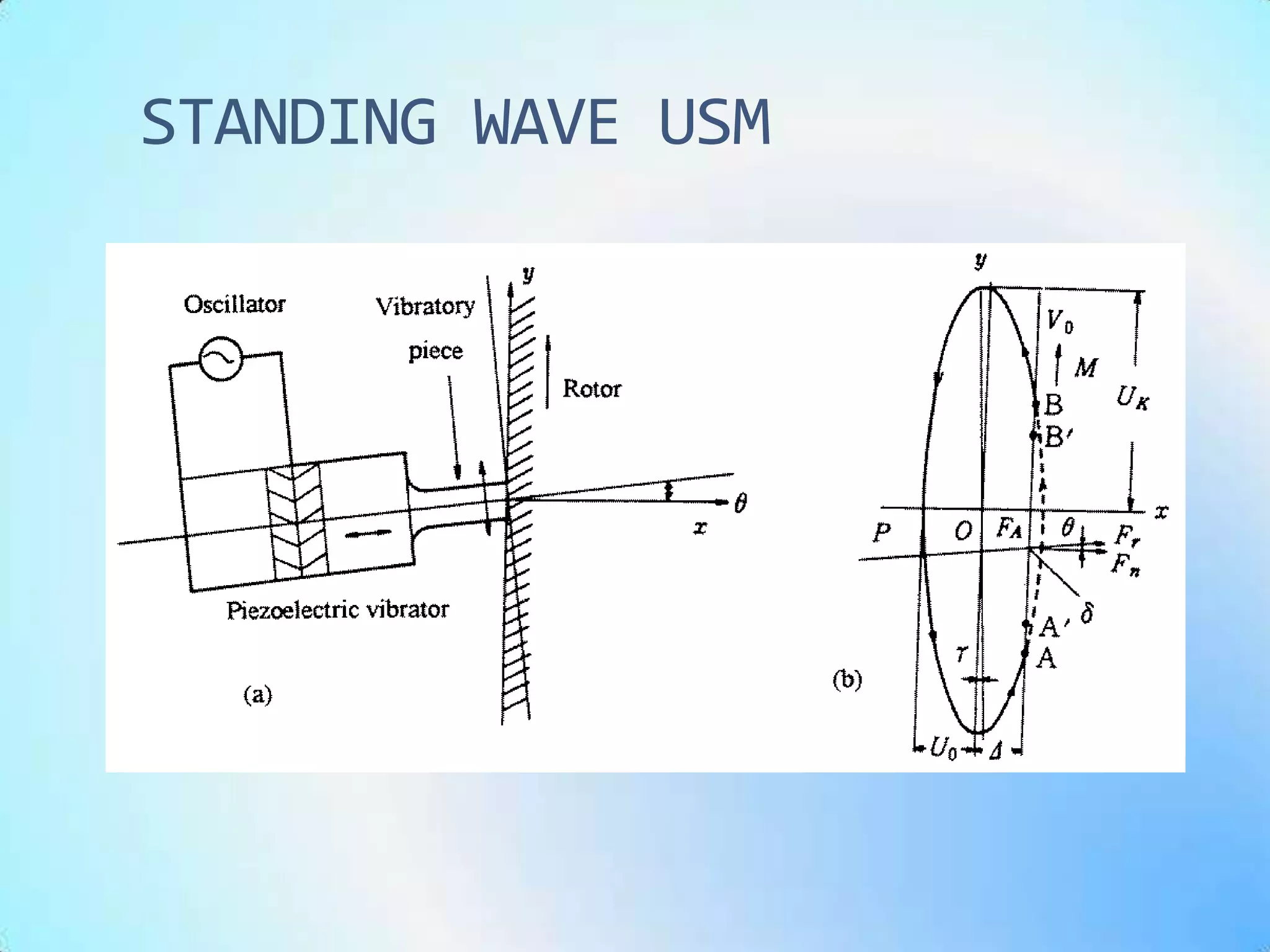
 Representation u( x, t) = A coskx coswt
 It is also referred as vibratory coupler type or
  wood pecker type.
 A vibrator is connected to the piezoelectric
  driver,it produces bending, so its tip produces
  flat elliptical motion to drive the rotor.
LINEAR TYPE STANDING WAVE USM

 Rectangular plate
  ultrasonic motor.
 Resonant frequency-
  98kHz.
 Efficiency-65%
 Applications-
card or paper senders.
ROTATING TYPE STANDING WAVE USM
 Torsional coupler
  ultrasonic motor.
 Provides high speed
  than linear motors
  because of high
  frequency (160kHz)&
  amplified vibration.
 Provides speed of
  1500 rpm, torque of
  0.08 Nm & efficiency
  of 80%.
STANDING WAVE USM

 Low cost
 one vibration source
 High efficiency
 Unidirectional
TRAVELING WAVE USM

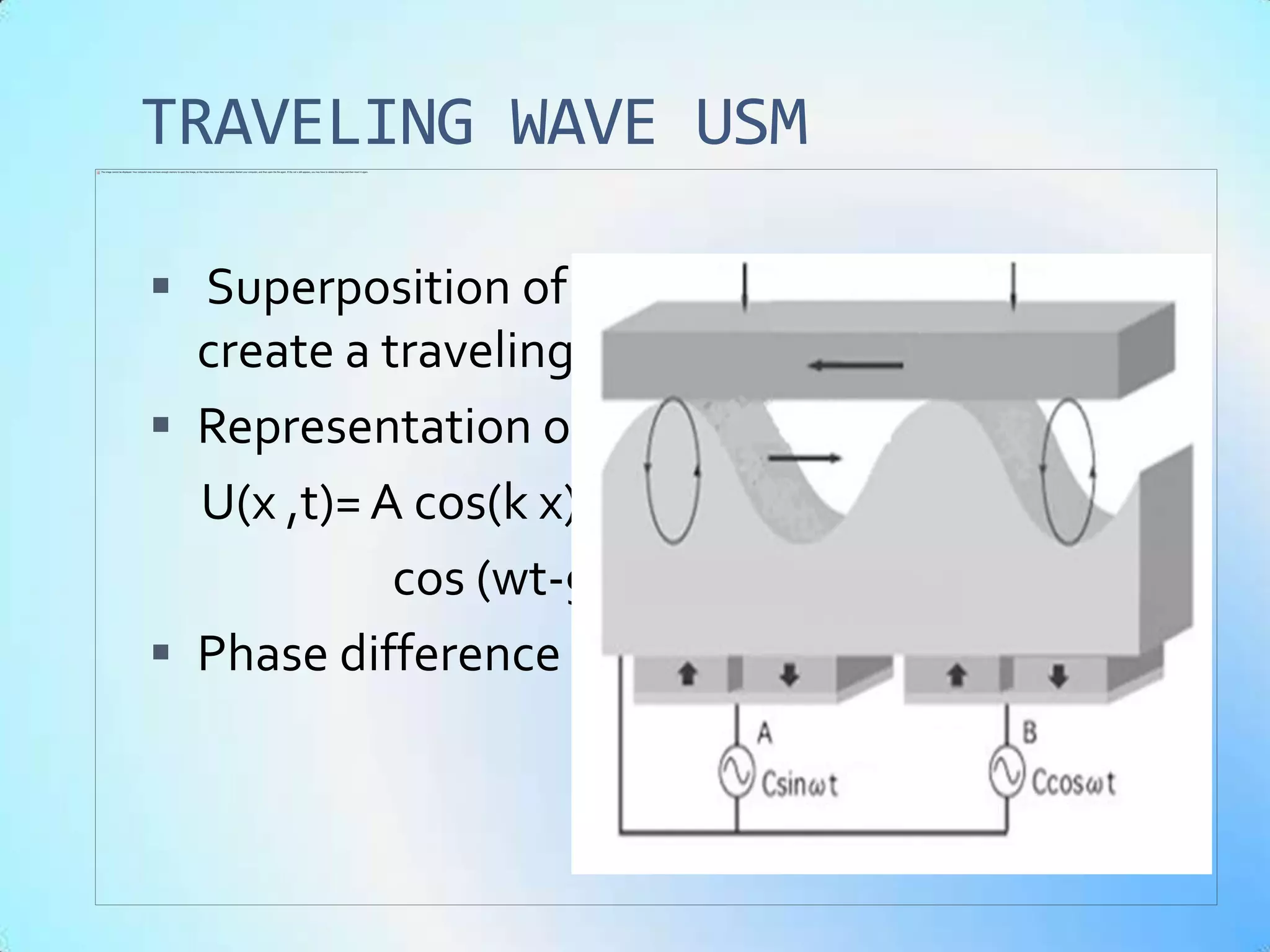
 Superposition of multiple standing wave
  create a traveling wave.
 Representation of travelling wave
  U(x ,t)= A cos(k x) cos(wt) + A cos(k x - 90)
            cos (wt-90).
 Phase difference is 90 degree
LINEAR TYPE TRAVELLING WAVE USM
 Linear motor using
  bending vibration.
 Consists of two
  piezoelectric vibrators
  installed at both the
  ends.
 Load resistance is
  adjusted for perfect
  travelling wave.
ROTARY TYPE TRAVELLING WAVE USM

 Two voltage sources are
  used to produce
  travelling wave.
 Vibrations of the
  piezoelectric material is
  amplified by the stator
  teeths.
 Due to frictional forces
  rotor rotates.
 Resonant frequency-
  46kHz.
TRAVELLING WAVE USM

 Requires two vibrating source.
 Controllable in both direction.
 Silent operation, so suitable to video cameras
  with microphone.
 Thinner design, leading to space saving.
 Low efficiency.
EQUIVALENT CIRCUIT OF USM
          STATOR
 Cd is the capacitance due to
  the dielectric property of
  piezo crystal i.e tank
  capacitance.
 Rm,Cm,Lm are the
  resistance ,capacitnce &
  inductance of stator.
 Their combined impedance
  is given by
( +1/             +      ).
DRIVER CIRCUIT OF USM
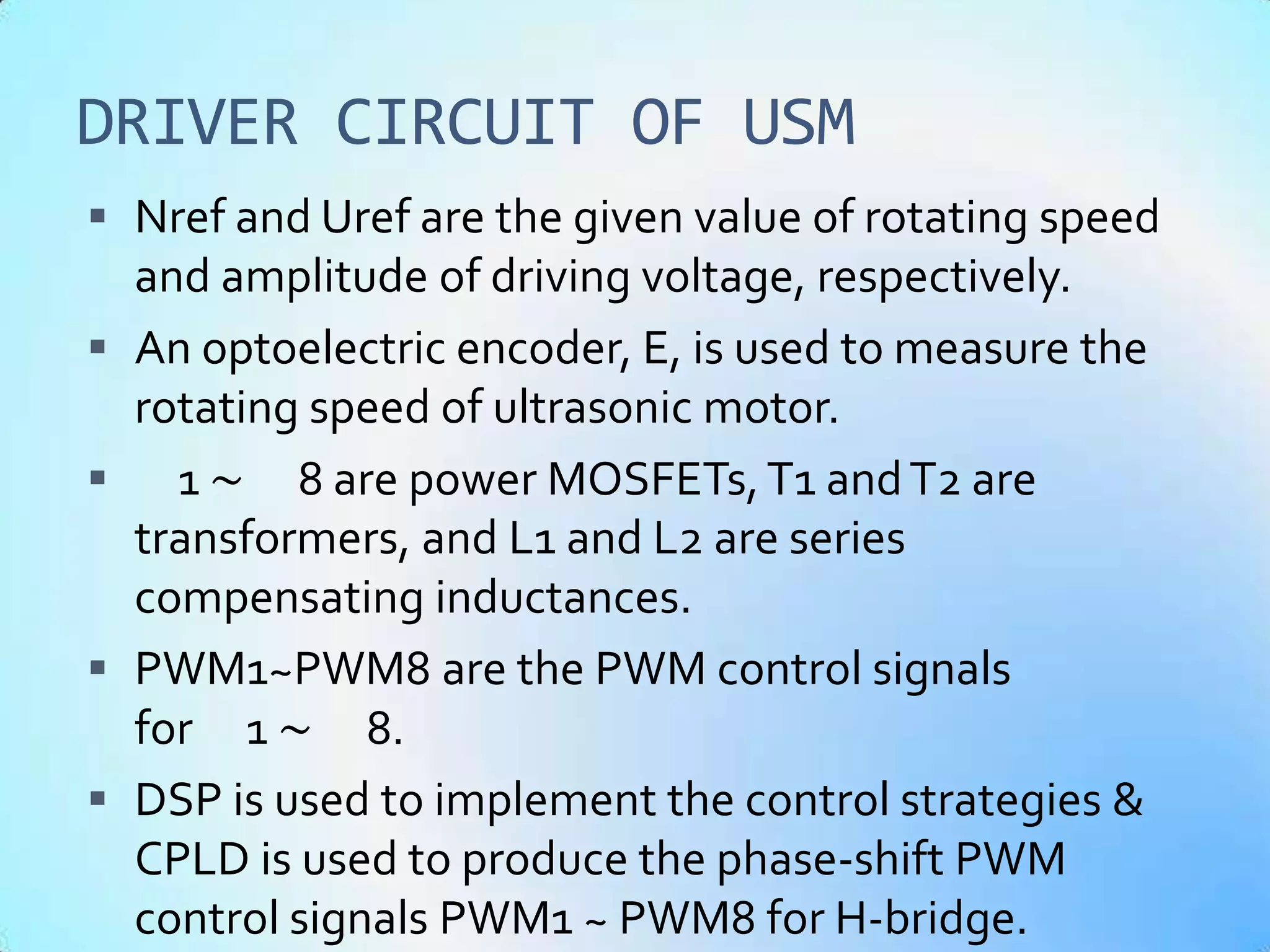
 Nref and Uref are the given value of rotating speed
  and amplitude of driving voltage, respectively.
 An optoelectric encoder, E, is used to measure the
  rotating speed of ultrasonic motor.
   1 ∼ 8 are power MOSFETs, T1 and T2 are
  transformers, and L1 and L2 are series
  compensating inductances.
 PWM1~PWM8 are the PWM control signals
  for 1 ∼ 8.
 DSP is used to implement the control strategies &
  CPLD is used to produce the phase-shift PWM
  control signals PWM1 ~ PWM8 for H-bridge.
CONTROL TECHNIQUE OF USM

 PWM control is used.
 Motor is operated at
  resonance
  frequency(low
  impedance) to reduce
  losses & to reduce
  pressure on
  piezoelectric material.
 Various control
  methods are :
MAJOR APPLICATION

 Camera auto focus lenses
 Watch motors and compact
  paper handling.
 Conveying machine parts
 In micro surgery and sensor
  scaning.
ADVANTAGES             DISADVANTAGES

 Low cost              Use of high frequency
 High efficiency        power supply
 No magnetic           Less constancy
  interference          Drooping torque
 Compact size           speed characteristic
 High torque/weight    Supppression of heat
  ratio                  is required
 Energy saving
CONCLUSION
 These motors are advantageous.
 Electromagnetic interference is not there.
 It is in great demand in the area of
  automation & miniaturiztion.
 Energy efficient.
 Light weight & compact size
ANY QUERIES??
REFERENCE

 www.google.com
 www.yahoo.com
 www.slideworld.com
 www.pdf-searchengine.com
 www.ask.com
 http://www.americanpiezo.com/piezo_theory
  /piezo_theory.pdf
THANK YOU ALL

Ultra sonic motor

  • 1.
    PREPARED BY:- CHANDAN BEHERA ELECTRICAL ENGINEERING DEPARTMENT REGISTRATION NO:-0901106167 COLLEGE OF ENGINEERING & TECHNOLOGY BHUBANESWAR
  • 2.
    CONTENTS 1. INTRODUCTION 2. ELECTROSTICTION NOTION 3. POLING 4. ULTRASONICMOTOR NOTION 5. EQUATIONS 6. BASIC PRINCIPLE 7. CONSTRUCTION 8. PARTS OF ULTASONIC MOTOR 9. TYPES OF ULTRASONIC MOTOR 10. DRIVER CIRCUIT OF ULTRASONIC MOTOR 11. CONTROL TECHNIQUE OF ULTRASONIC MOTOR 12. MAJOR APPLICATION 13. ADVANTAGES & DISADVANTAGES 14. CONLUSION 15. REFERENCE
  • 3.
    INTRODUCTION  The firstultrasonic motor was developed by V.V lavrinko in 1965.  Conversion of electric energy into motion by inverse piezoelectric effect.  In this tpye of motor efficiency is insensitive to size,& these are superior in the mm-sized motor area.
  • 4.
    ELECTROSTICTION NOTION  Inversepiezoelectricity – generation of mechanical stress in response to electric voltage.  The word is derived from the Greek piezein, which means to squeeze or press.  This effect is also reversible.  Deformation is only 0.1 % of the original dimension.  Piezoelectric material- quartz(SiO2), barium titanate (BaTiO3),PZT(Lead-Zirconium-Titanium).
  • 5.
    HOW IT OCCURS?? When voltage is applied across the crystal, the atoms experience electrcal pressure.  So they move to rebalance themselves, & thus deformation is produced.  If the voltage is applied in the direction of poling voltage the material will elongate & its diameter reduces else length decreases & diameter increases.  If AC is applied then the material will lengthen & shorten cyclically, at the frequency of applied voltage.
  • 6.
    POLING  It isprocess of polarization of the piezoelectric material.
  • 7.
    EQUATIONS  The relationships between an applied voltage & the corresponding increase or decrease in a piezoelectric ceramic element's thickness, length, or width are: Δh = d33v S = d33E Δl / l = d31E Δw / w = d31E where l: initial length of ceramic element w: initial width of ceramic element Δh: change in height (thickness) of ceramic element Δl: change in length of ceramic element Δw: change in width of ceramic element d31,d33: piezoelectric charge constants in different direction V: applied voltage S: strain (change in height / original height of element) E: electric field
  • 8.
    ULTRASONICMOTOR NOTION  Itis named so ,as it uses voltage of frequency higher than 20kHz.  It is based on inverse piezoelectricty.  It can be abbreviated as USM.  It is driven by ultrasonic vibration of transducer.  The ultrasonic vibration is transformed into output torque (in rotary USM) or thrust (in linear USM) by the friction between the stator and the rotor (in rotary USM) or the moving part (in linear USM).
  • 9.
    BASIC PRINCIPLE  Generationof gross mechanical motion through the amplification and repetition of micro- deformations of active material.  The active material induces an orbital motion of the stator at the rotor contact points .  Frictional interface between the rotor and stator rectifies the micro-motion to produce macro- motion of the ROTOR.  Working frequency-20 KHz to 10 MHz  Amplitude of the actuator motion – 20 to 200nm
  • 10.
  • 11.
    PARTS OF ULTRASONICMOTOR  The Stator part transmits vibration.  Stator consists of: The Piezo-Electric Ceramics which generate vibration. The Stator metal which makes vibration amplify. The Friction material which contacts with a rotor.  The Rotor which is a rotation part.  The Shaft which transmits rotation.  The Bearing.
  • 12.
    WORKING •If voltage ismade to apply to piezo-electric ceramics, the shape of piezo-electric ceramics will be changed or distorted. The modification amplifies and spreads with stator metal, and generates a traveling wave on the surface of stator metal. •Here, the stator metal touches the rotor only at each peak of a traveling wave, and each of that peak carries out elliptical movement. A rotor rotates in response to the influence of the elliptical movement. •The direction of movement of this ellipse is in accordance to the direction which a traveling wave follows. And a rotor rotates in the direction contrary to a traveling wave under the influence. •So, When a traveling wave progresses in the clockwise direction (CW) on the circumference of a stator, each peak of the traveling wave in contact with a rotor carries out elliptical movement in the clockwise direction (CW).And the rotor in contact with the peak of the wave rotates in the counterclockwise direction (CCW).By controlling the speed and direction of this traveling wave, control of an Ultrasonic Motor is possible
  • 13.
    TYPES OF ULTRASONICMOTOR ULTRASONIC MOTOR STANDING TRAVELLING WAVE TYPE WAVE TYPE LINEAR ROTARY LINEAR ROTARY MOTOR MOTOR MOTOR MOTOR
  • 14.
    STANDING WAVE USM Representation u( x, t) = A coskx coswt  It is also referred as vibratory coupler type or wood pecker type.  A vibrator is connected to the piezoelectric driver,it produces bending, so its tip produces flat elliptical motion to drive the rotor.
  • 15.
    LINEAR TYPE STANDINGWAVE USM  Rectangular plate ultrasonic motor.  Resonant frequency- 98kHz.  Efficiency-65%  Applications- card or paper senders.
  • 16.
    ROTATING TYPE STANDINGWAVE USM  Torsional coupler ultrasonic motor.  Provides high speed than linear motors because of high frequency (160kHz)& amplified vibration.  Provides speed of 1500 rpm, torque of 0.08 Nm & efficiency of 80%.
  • 17.
    STANDING WAVE USM Low cost  one vibration source  High efficiency  Unidirectional
  • 18.
    TRAVELING WAVE USM Superposition of multiple standing wave create a traveling wave.  Representation of travelling wave U(x ,t)= A cos(k x) cos(wt) + A cos(k x - 90) cos (wt-90).  Phase difference is 90 degree
  • 19.
    LINEAR TYPE TRAVELLINGWAVE USM  Linear motor using bending vibration.  Consists of two piezoelectric vibrators installed at both the ends.  Load resistance is adjusted for perfect travelling wave.
  • 20.
    ROTARY TYPE TRAVELLINGWAVE USM  Two voltage sources are used to produce travelling wave.  Vibrations of the piezoelectric material is amplified by the stator teeths.  Due to frictional forces rotor rotates.  Resonant frequency- 46kHz.
  • 21.
    TRAVELLING WAVE USM Requires two vibrating source.  Controllable in both direction.  Silent operation, so suitable to video cameras with microphone.  Thinner design, leading to space saving.  Low efficiency.
  • 22.
    EQUIVALENT CIRCUIT OFUSM STATOR  Cd is the capacitance due to the dielectric property of piezo crystal i.e tank capacitance.  Rm,Cm,Lm are the resistance ,capacitnce & inductance of stator.  Their combined impedance is given by ( +1/ + ).
  • 23.
  • 24.
    DRIVER CIRCUIT OFUSM  Nref and Uref are the given value of rotating speed and amplitude of driving voltage, respectively.  An optoelectric encoder, E, is used to measure the rotating speed of ultrasonic motor.  1 ∼ 8 are power MOSFETs, T1 and T2 are transformers, and L1 and L2 are series compensating inductances.  PWM1~PWM8 are the PWM control signals for 1 ∼ 8.  DSP is used to implement the control strategies & CPLD is used to produce the phase-shift PWM control signals PWM1 ~ PWM8 for H-bridge.
  • 25.
    CONTROL TECHNIQUE OFUSM  PWM control is used.  Motor is operated at resonance frequency(low impedance) to reduce losses & to reduce pressure on piezoelectric material.  Various control methods are :
  • 26.
    MAJOR APPLICATION  Cameraauto focus lenses  Watch motors and compact paper handling.  Conveying machine parts  In micro surgery and sensor scaning.
  • 27.
    ADVANTAGES DISADVANTAGES  Low cost  Use of high frequency  High efficiency power supply  No magnetic  Less constancy interference  Drooping torque  Compact size speed characteristic  High torque/weight  Supppression of heat ratio is required  Energy saving
  • 28.
    CONCLUSION  These motorsare advantageous.  Electromagnetic interference is not there.  It is in great demand in the area of automation & miniaturiztion.  Energy efficient.  Light weight & compact size
  • 29.
  • 30.
    REFERENCE  www.google.com  www.yahoo.com www.slideworld.com  www.pdf-searchengine.com  www.ask.com  http://www.americanpiezo.com/piezo_theory /piezo_theory.pdf
  • 31.