A
SEMINAR ON
“HVDC TRANSMISSION”
SUBMITTED
BY
Utkarsh J. Jambhule
(BE12FO3FO25)
UNDER THE SUPERVISION OF
Dr. Archana G. Thosar (H.O.D)
INTRODUCTION:
With the increasing of requirement of electrical power
supply the facilities have to be increased in that
transmission plays an important role.
Here HVDC (high voltage direct current) transmission
plays major role in power transmission.
First HVDC transmission linked between gotland and
mainland in sweden in 1954.
The HVDC transmission has many advantages over
HVAC transmission.
HVDC MEANS…..
HVDC stands for High Voltage Direct Current and is
today a well-proven technology all over the world.
 Two AC systems having different frequencies can be
linked up together by means of HVDC link.
 HVDC technology is used to transmit electricity over
long distances.
WHY DC TRANSMISSION ?
Losses are less in DC transmission while comparing to
AC transmission.
Only two conductors are required for DC with
positive and negative polarities.
DC overhead lines or cables are less
expensive.
DC lines are useful for long distances above
500km.
?
Comparison of HVAC and HVDC
 Conventionally power transmission is affected
through HVAC systems all over the world.
 HVAC transmission is having several limitations like,
line length , uncontrolled power flow, over/low voltages
during lightly / over loaded conditions, stability
problems, fault isolation etc…
 But HVDC have low transmission losses and it
requires only two conductors.
Comparison between the prices of AC & DC
Transmission
Wind
Power
AC
Transmission
Line
Converter
Station
Inverter
Station AC
Transmission
Line
Distribution
Line
HVDC
Transmission Line
HVDC transmission system
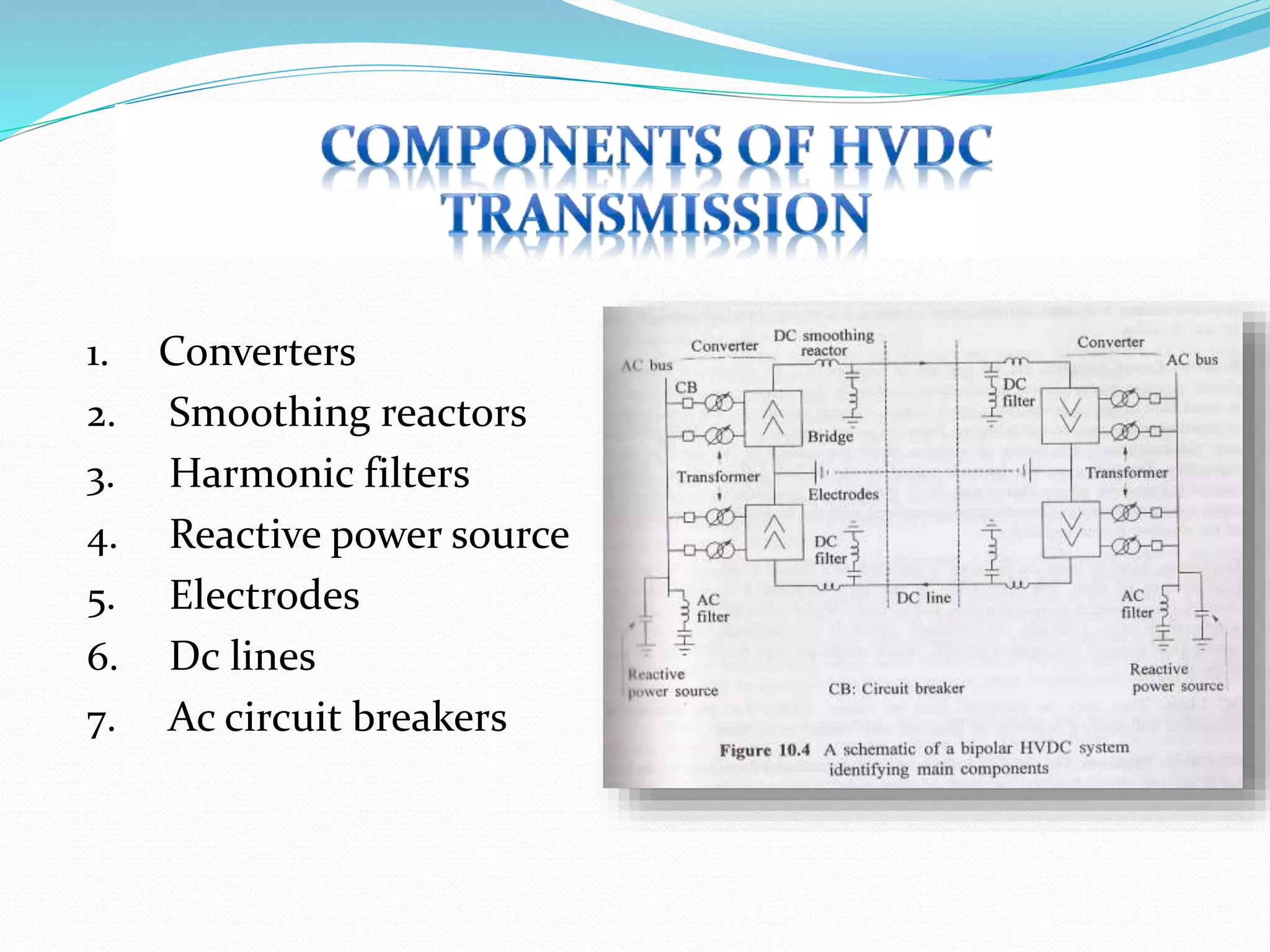
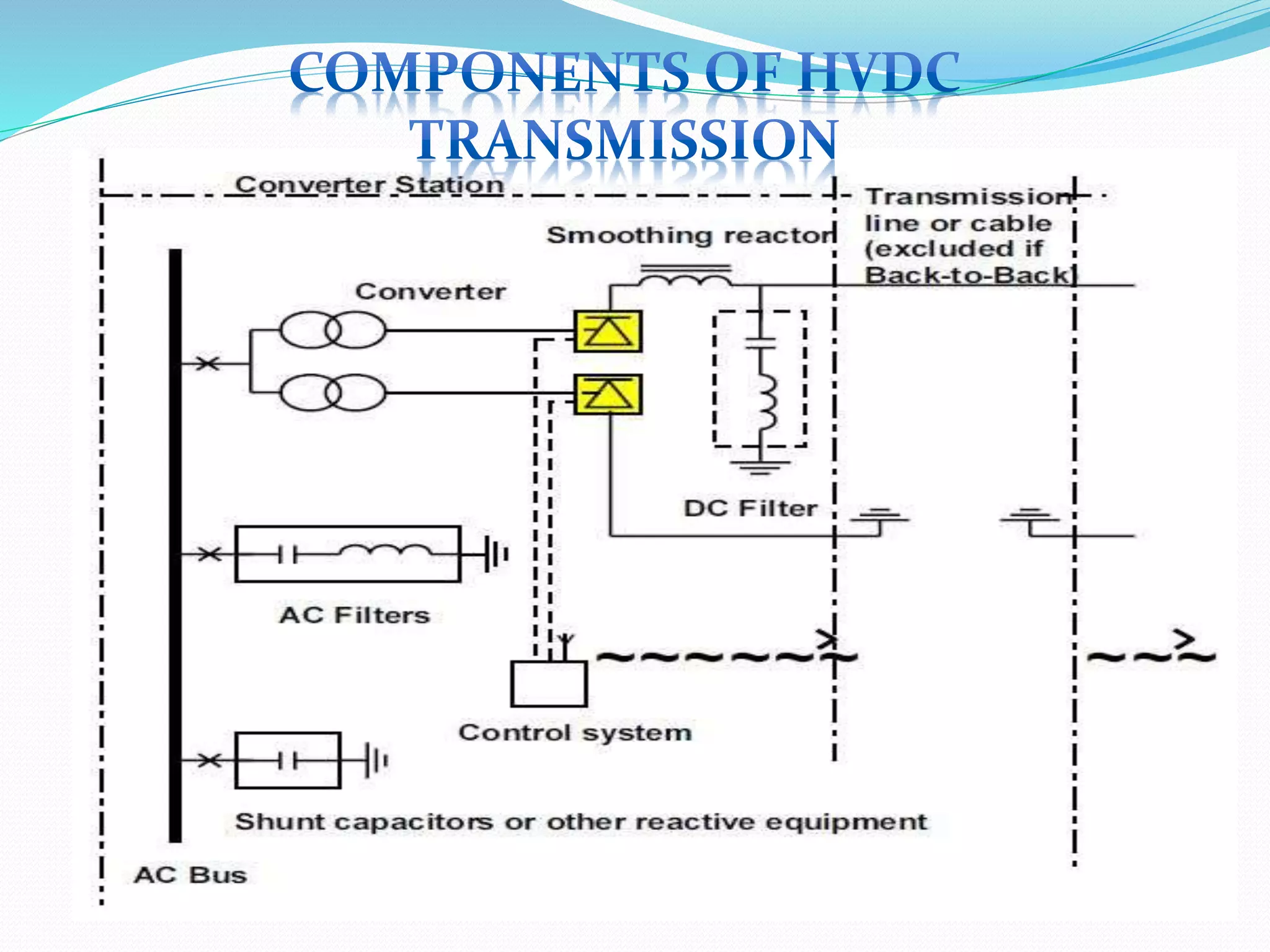
1. Converters
2. Smoothing reactors
3. Harmonic filters
4. Reactive power source
5. Electrodes
6. Dc lines
7. Ac circuit breakers
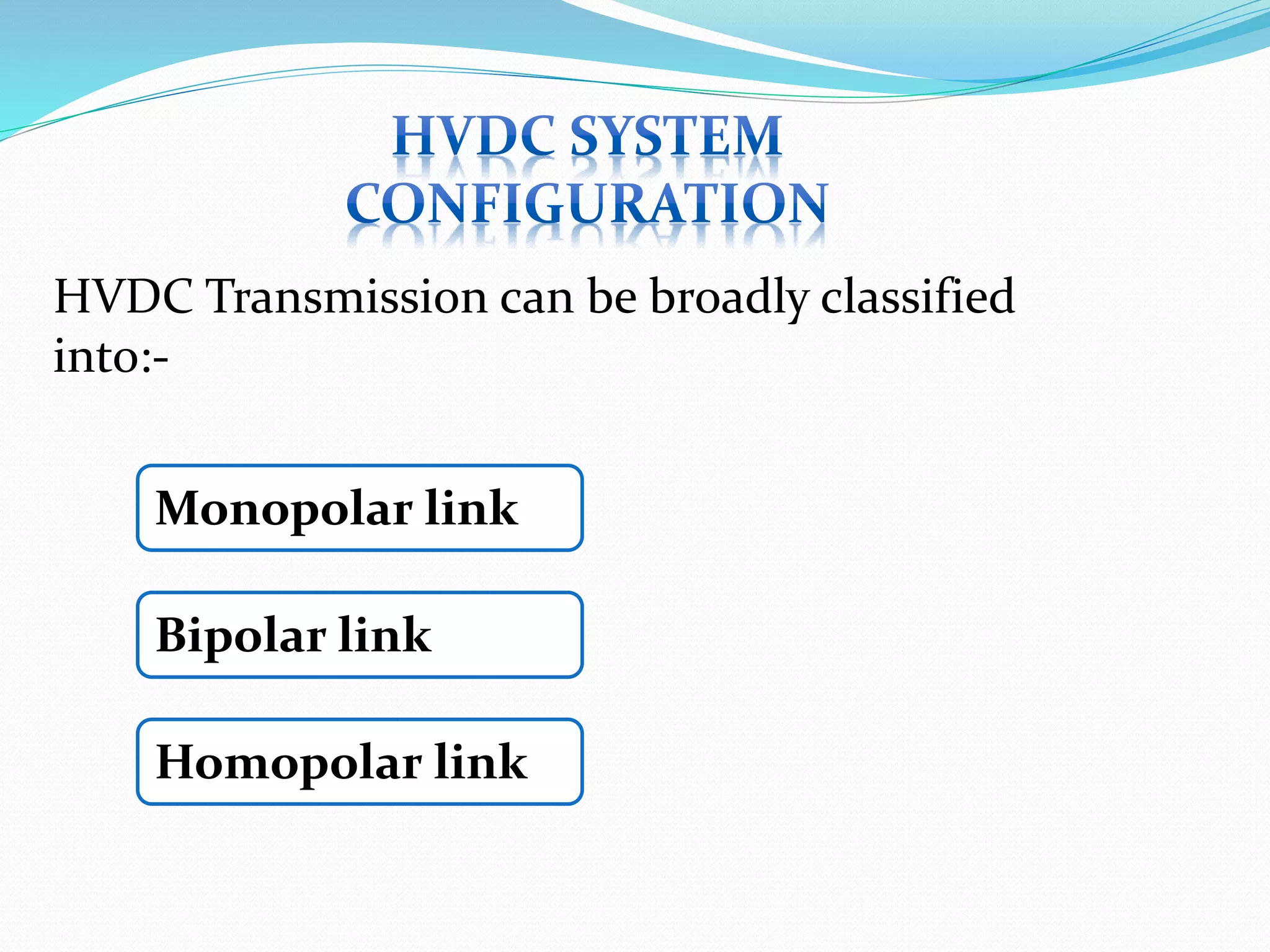
Homopolar link
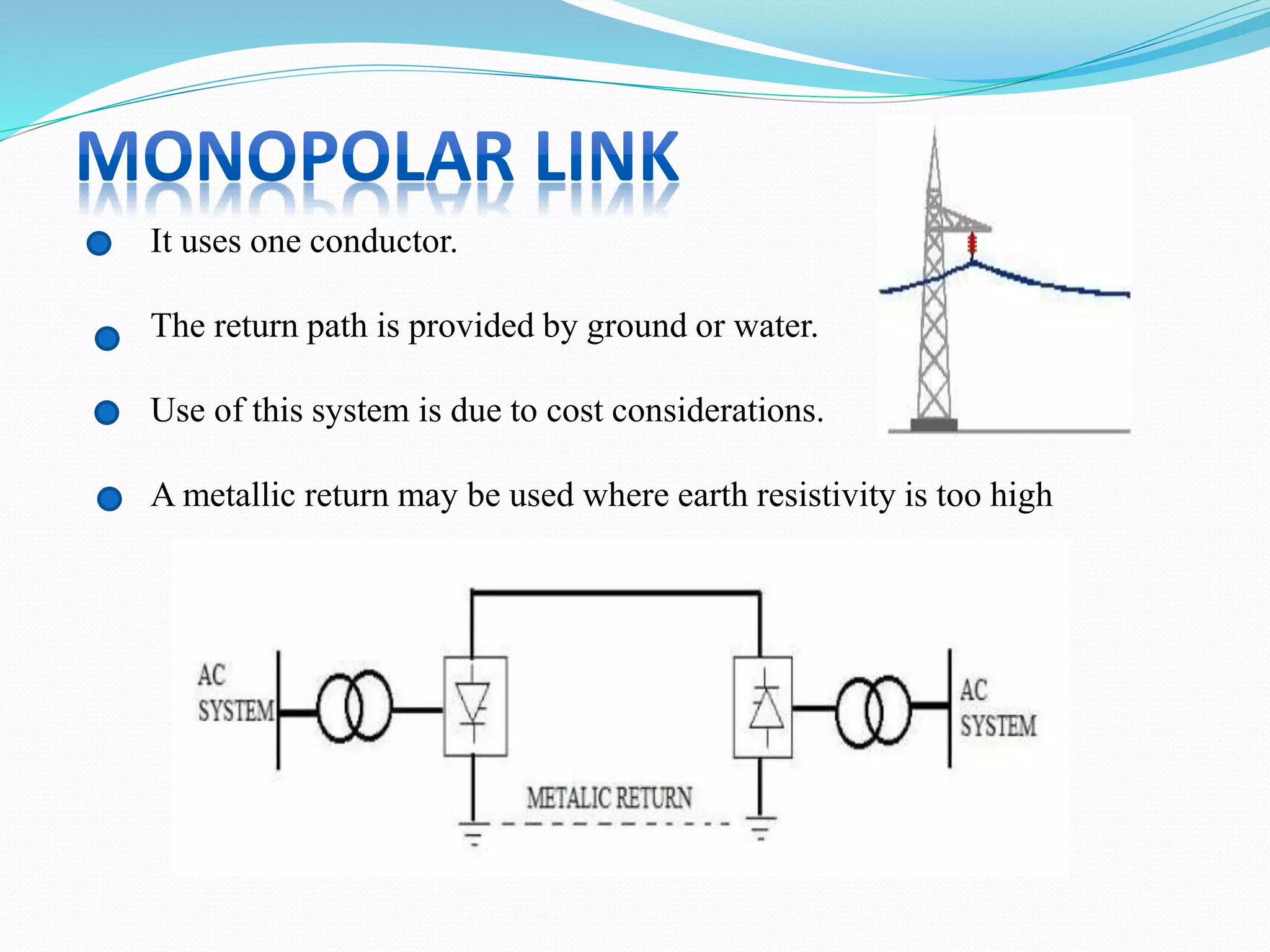
Monopolar link
Bipolar link
HVDC Transmission can be broadly classified
into:-
It uses one conductor.
The return path is provided by ground or water.
Use of this system is due to cost considerations.
A metallic return may be used where earth resistivity is too high
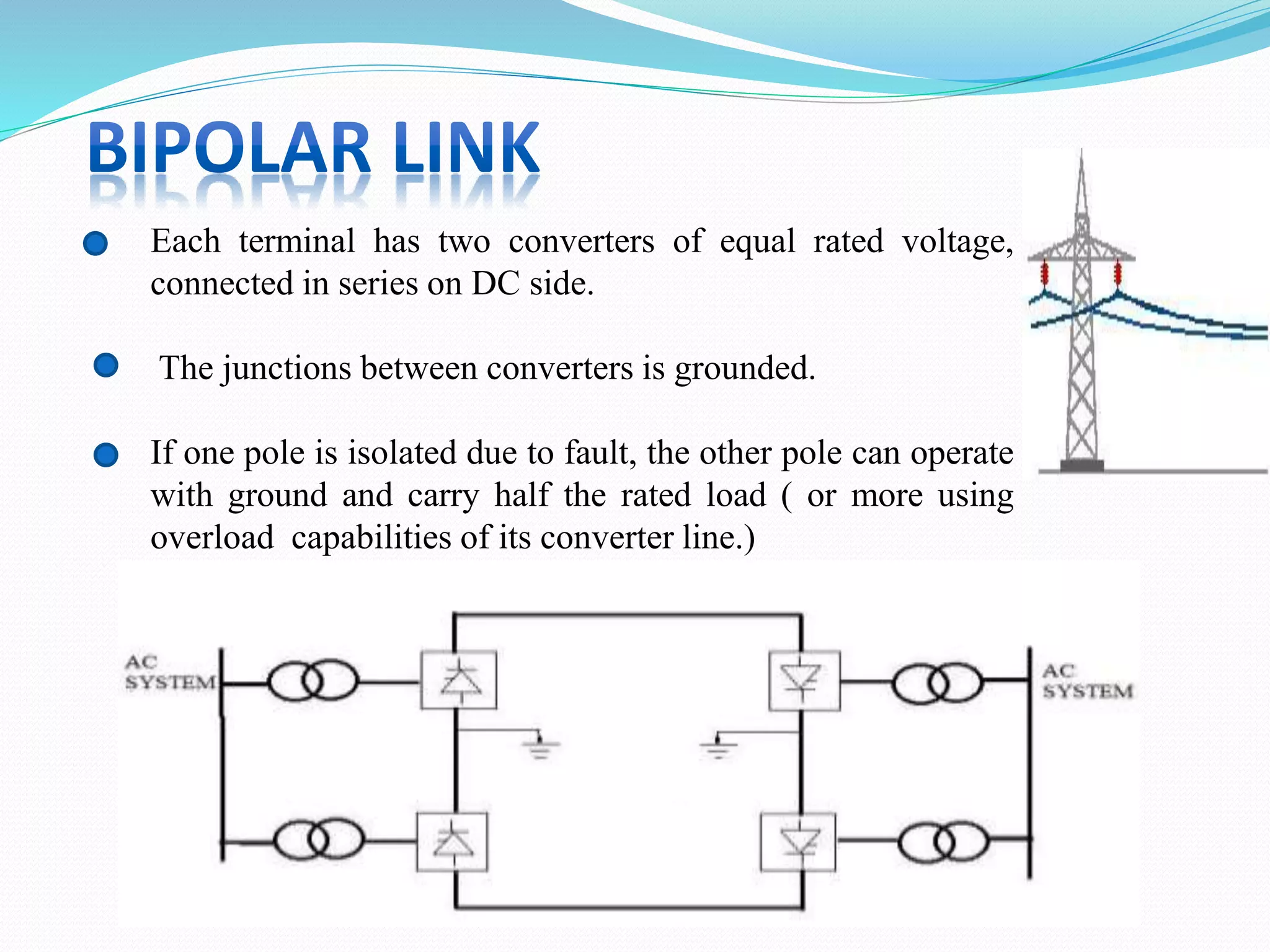
Each terminal has two converters of equal rated voltage,
connected in series on DC side.
The junctions between converters is grounded.
If one pole is isolated due to fault, the other pole can operate
with ground and carry half the rated load ( or more using
overload capabilities of its converter line.)
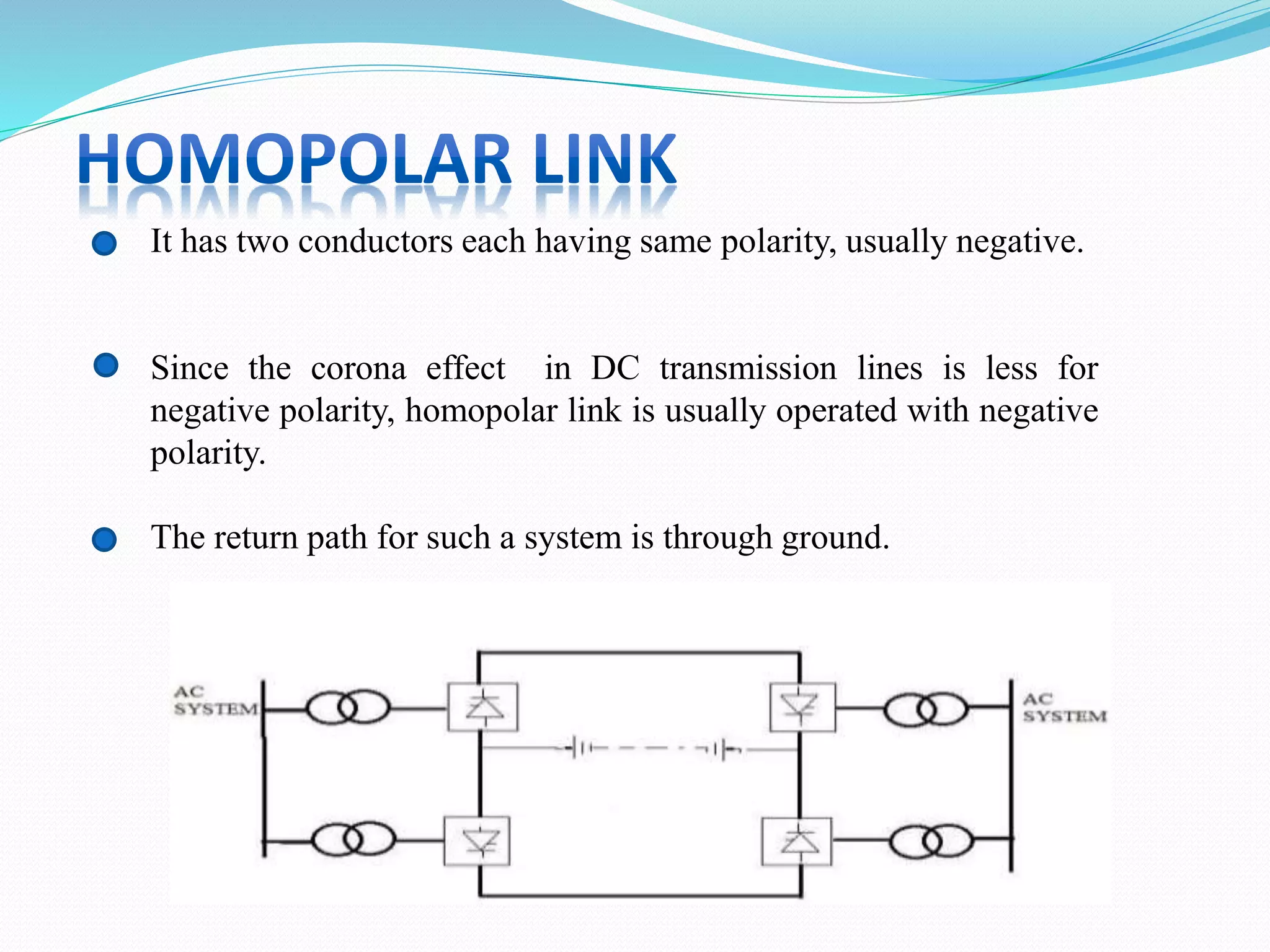
It has two conductors each having same polarity, usually negative.
Since the corona effect in DC transmission lines is less for
negative polarity, homopolar link is usually operated with negative
polarity.
The return path for such a system is through ground.
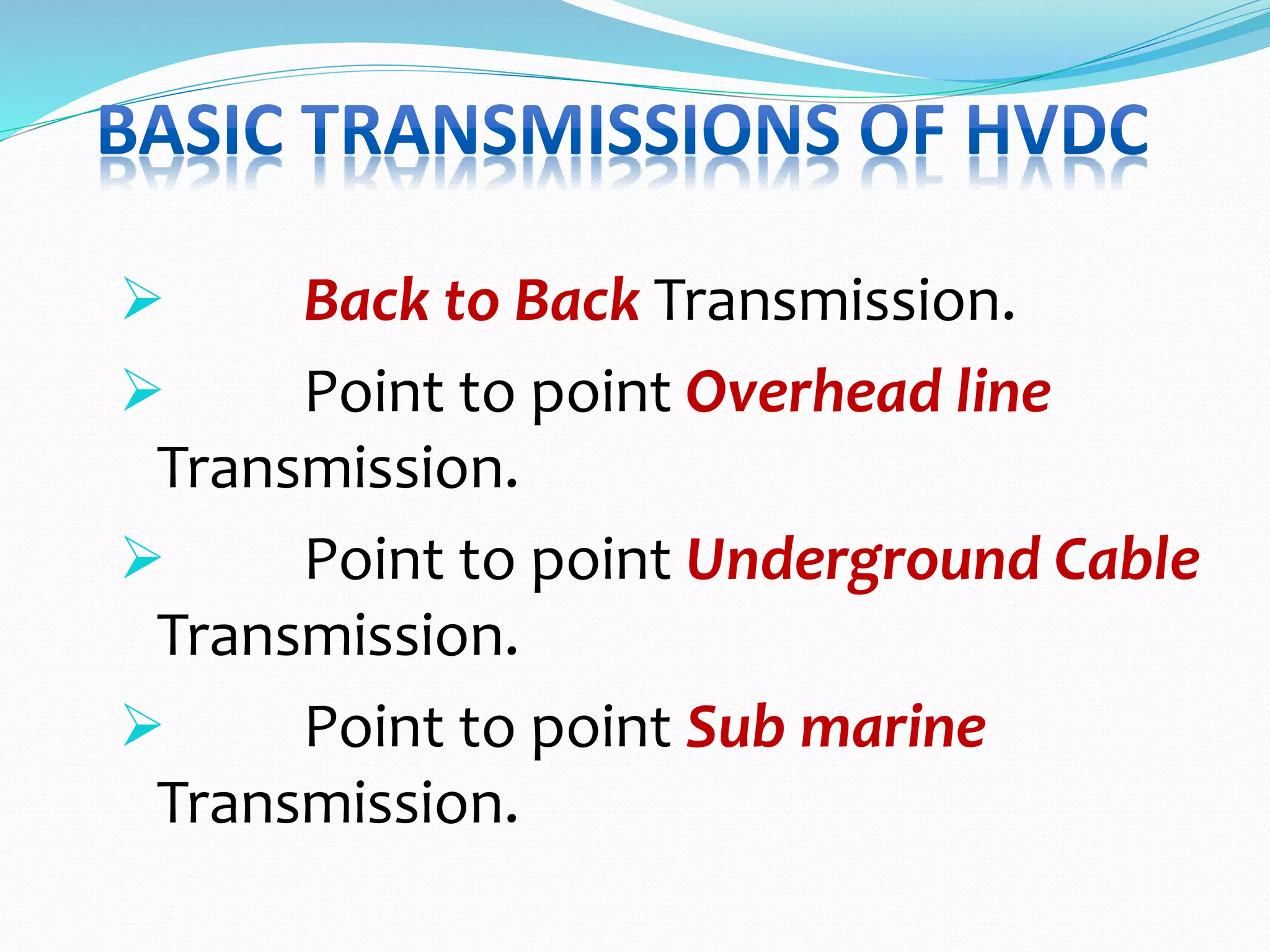
 Back to Back Transmission.
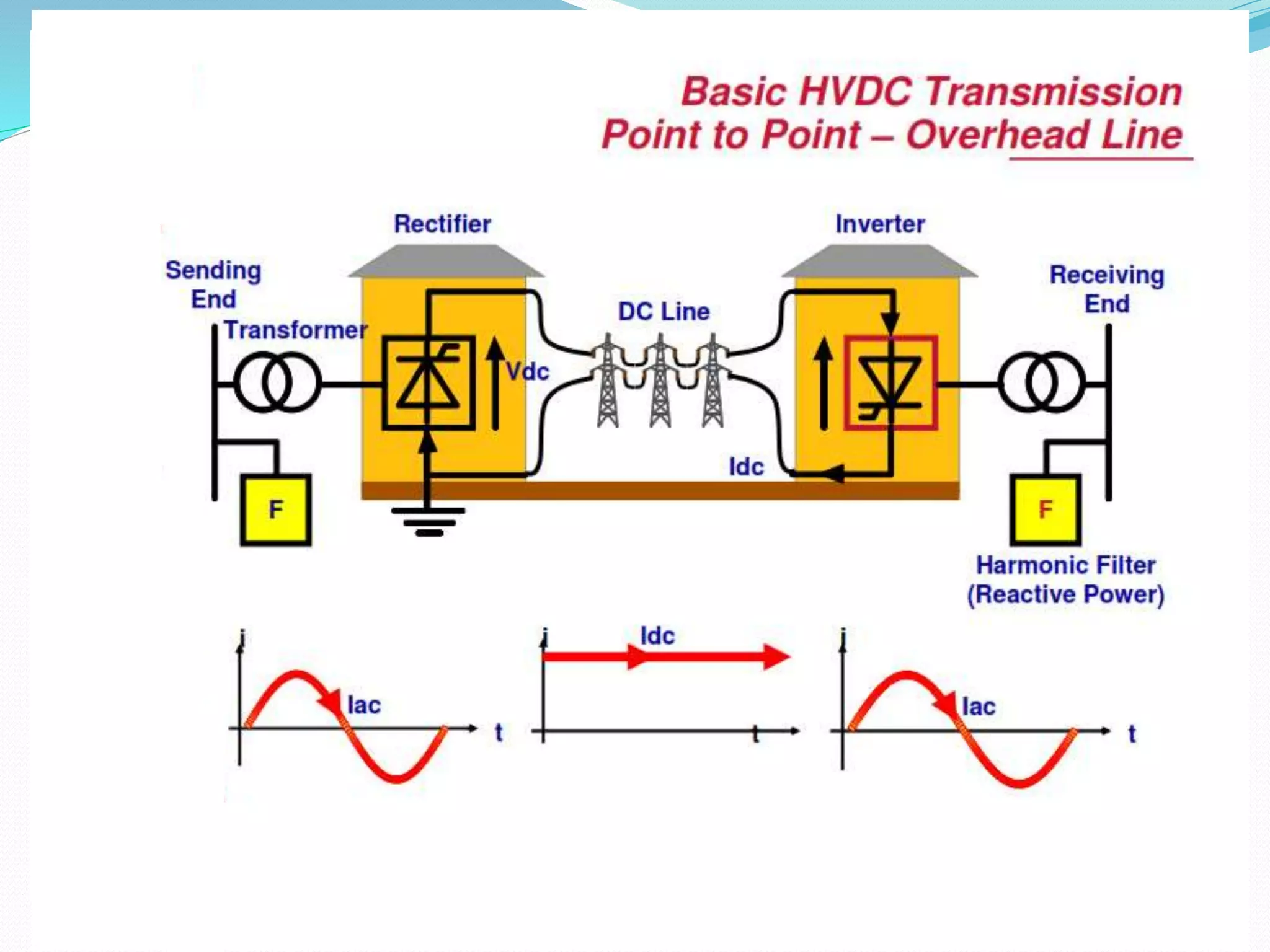
 Point to point Overhead line
Transmission.
 Point to point Underground Cable
Transmission.
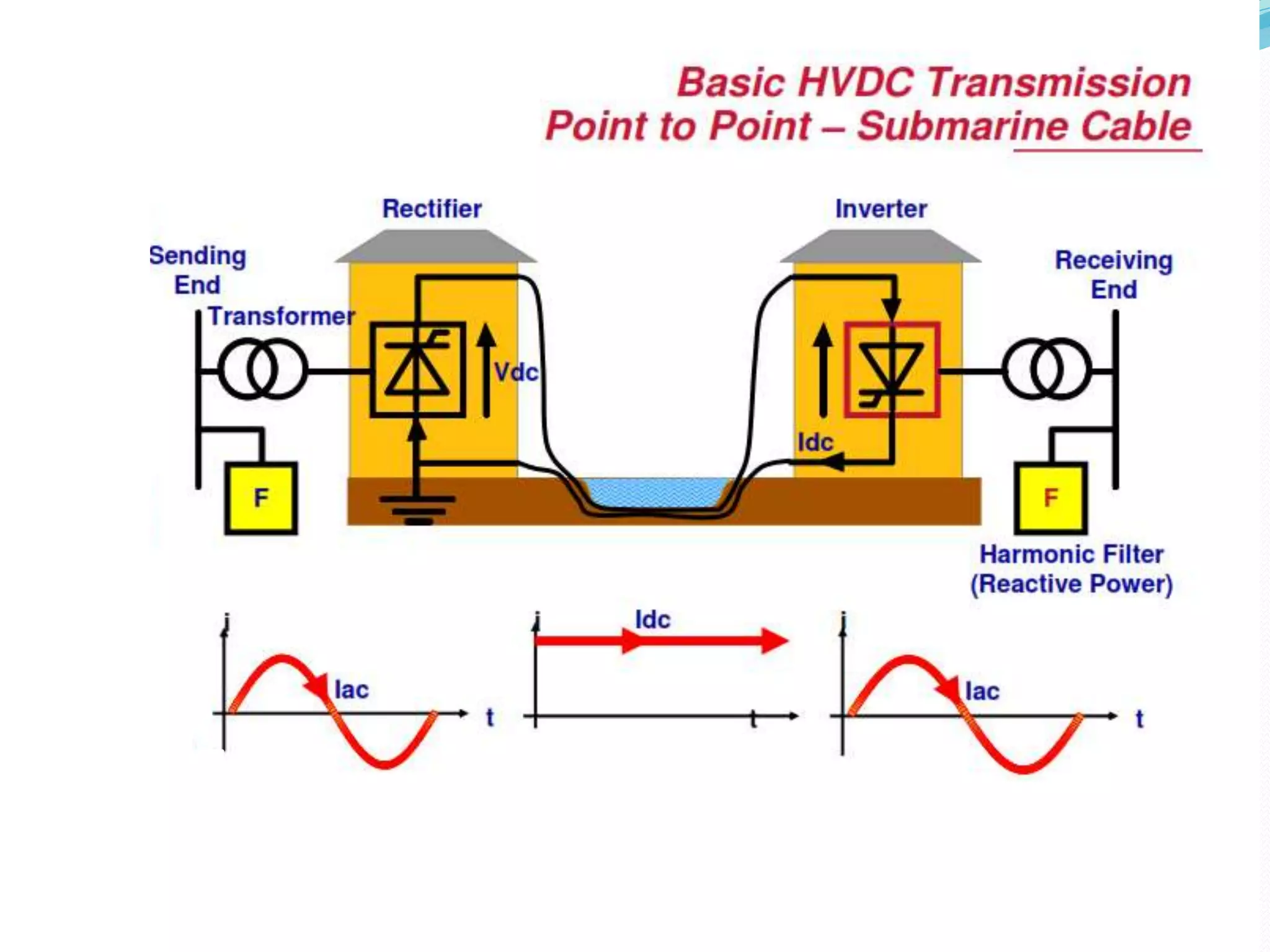
 Point to point Sub marine
Transmission.
 The losses which occurs in the
systems are comparatively low at all the
stages (i.e.) at generation , transmission
& distribution level.
 The losses at transmission level can
be highly reduced by HVDC
transmission.
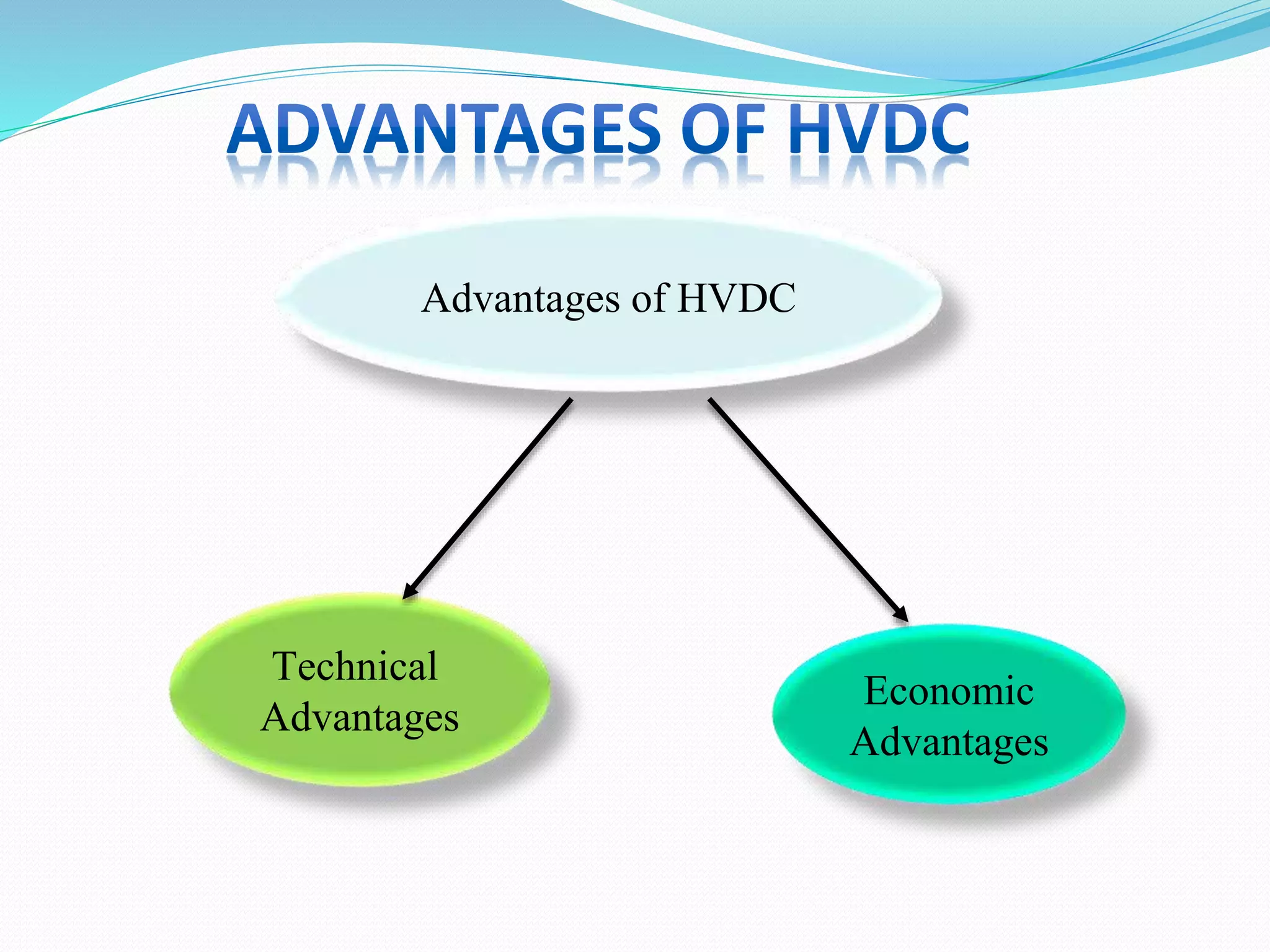
Advantages of HVDC
Technical
Advantages
Economic
Advantages
 Lesser Corona Loss and Radio interference.
 The voltage regulation problem is much less
serious for DC, since only the IR drop is
involved. For the same reason steady state
stability is no longer a major problem.
 No skin and proximity and Ferranti effect
 Asynchronous operation possible between
regions having different electrical parameters.
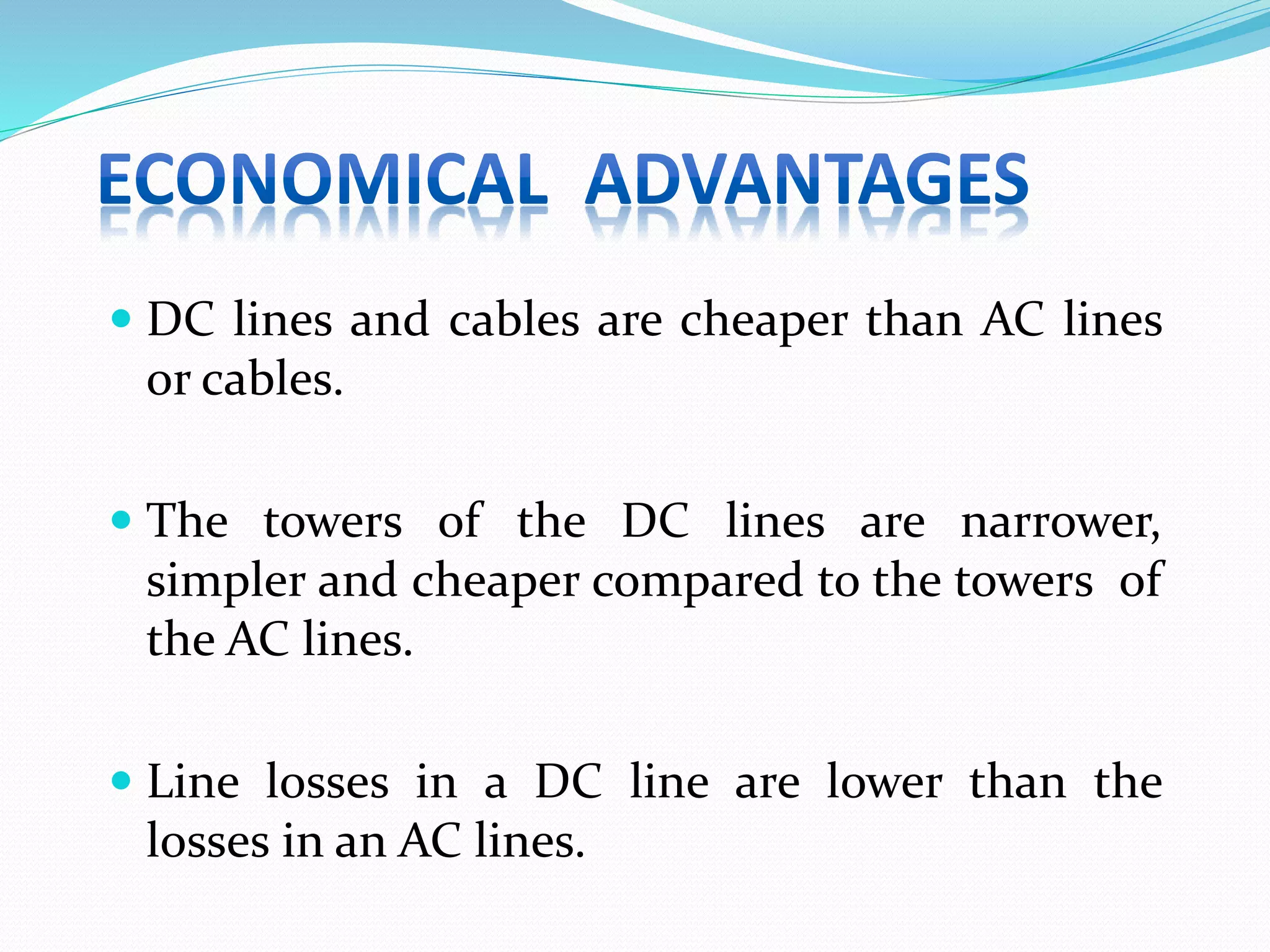
 DC lines and cables are cheaper than AC lines
or cables.
 The towers of the DC lines are narrower,
simpler and cheaper compared to the towers of
the AC lines.
 Line losses in a DC line are lower than the
losses in an AC lines.
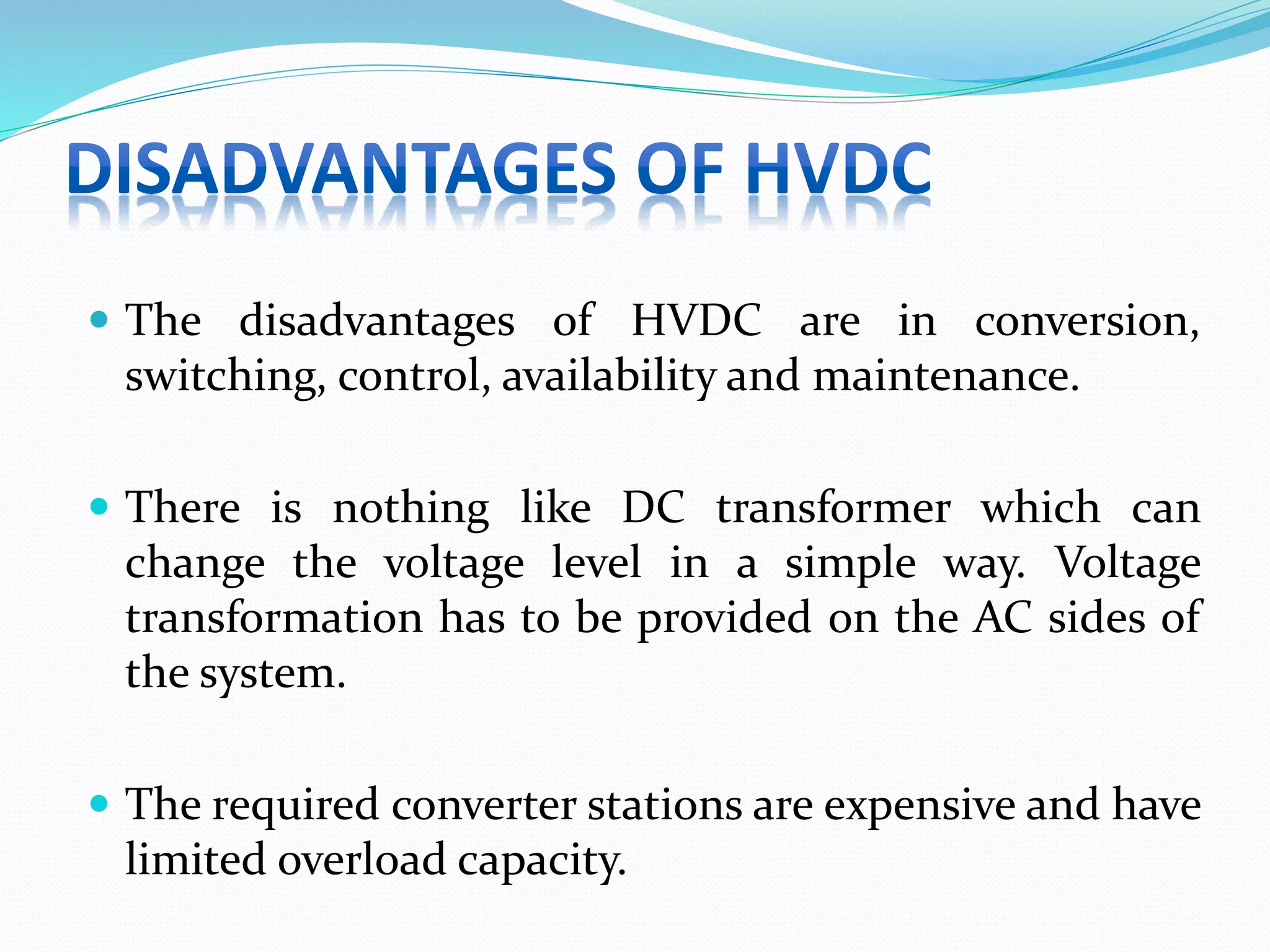
 The disadvantages of HVDC are in conversion,
switching, control, availability and maintenance.
 There is nothing like DC transformer which can
change the voltage level in a simple way. Voltage
transformation has to be provided on the AC sides of
the system.
 The required converter stations are expensive and have
limited overload capacity.
Rihand-delhi and chandrapur-padghe were the first long
distance hvdc projects in India.
 In 1990 ,rihand-delhi (singrauli) thermal power complex
with a combined power generation of Several thousand
MW was put in to service. it covers over a distance of 814
km.
The 1500 MW transmission chandrapur-padghe was put
in to service. it covers over distance of 736 km.
APPLICATIONS OF HVDC TRANSMISSION IN INDIA:
Conclusion
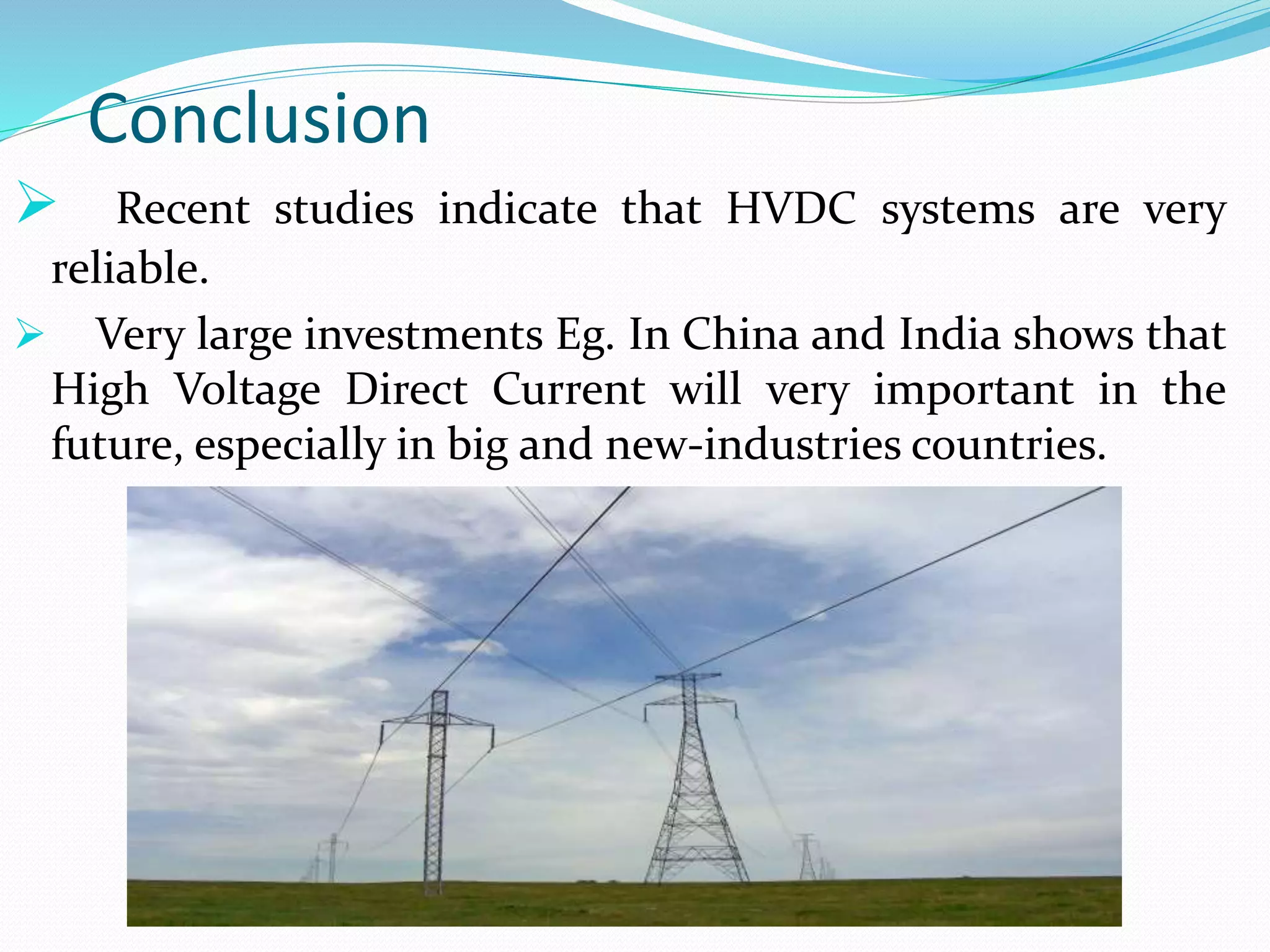
 Recent studies indicate that HVDC systems are very
reliable.
 Very large investments Eg. In China and India shows that
High Voltage Direct Current will very important in the
future, especially in big and new-industries countries.
1.C.L.wadhwa ‘electrical power systems'-third edition
2. I.J.nagrath and d.p.khotari 'power system engineering
3. S.S. vadhera 'power system analysis and stability
4. Soni gupta bhatnagar 'power system engineering
5. K.R.padiyar ‘hvdc power transmission systems'
BIBLIOGRAPHY:
Hvdc transmission seminar

Hvdc transmission seminar

  • 1.
    A SEMINAR ON “HVDC TRANSMISSION” SUBMITTED BY UtkarshJ. Jambhule (BE12FO3FO25) UNDER THE SUPERVISION OF Dr. Archana G. Thosar (H.O.D)
  • 2.
    INTRODUCTION: With the increasingof requirement of electrical power supply the facilities have to be increased in that transmission plays an important role. Here HVDC (high voltage direct current) transmission plays major role in power transmission. First HVDC transmission linked between gotland and mainland in sweden in 1954. The HVDC transmission has many advantages over HVAC transmission.
  • 3.
    HVDC MEANS….. HVDC standsfor High Voltage Direct Current and is today a well-proven technology all over the world.  Two AC systems having different frequencies can be linked up together by means of HVDC link.  HVDC technology is used to transmit electricity over long distances.
  • 4.
    WHY DC TRANSMISSION? Losses are less in DC transmission while comparing to AC transmission. Only two conductors are required for DC with positive and negative polarities. DC overhead lines or cables are less expensive. DC lines are useful for long distances above 500km. ?
  • 5.
    Comparison of HVACand HVDC  Conventionally power transmission is affected through HVAC systems all over the world.  HVAC transmission is having several limitations like, line length , uncontrolled power flow, over/low voltages during lightly / over loaded conditions, stability problems, fault isolation etc…  But HVDC have low transmission losses and it requires only two conductors.
  • 6.
    Comparison between theprices of AC & DC Transmission
  • 7.
  • 8.
    1. Converters 2. Smoothingreactors 3. Harmonic filters 4. Reactive power source 5. Electrodes 6. Dc lines 7. Ac circuit breakers
  • 10.
    Homopolar link Monopolar link Bipolarlink HVDC Transmission can be broadly classified into:-
  • 11.
    It uses oneconductor. The return path is provided by ground or water. Use of this system is due to cost considerations. A metallic return may be used where earth resistivity is too high
  • 12.
    Each terminal hastwo converters of equal rated voltage, connected in series on DC side. The junctions between converters is grounded. If one pole is isolated due to fault, the other pole can operate with ground and carry half the rated load ( or more using overload capabilities of its converter line.)
  • 13.
    It has twoconductors each having same polarity, usually negative. Since the corona effect in DC transmission lines is less for negative polarity, homopolar link is usually operated with negative polarity. The return path for such a system is through ground.
  • 14.
     Back toBack Transmission.  Point to point Overhead line Transmission.  Point to point Underground Cable Transmission.  Point to point Sub marine Transmission.
  • 19.
     The losseswhich occurs in the systems are comparatively low at all the stages (i.e.) at generation , transmission & distribution level.  The losses at transmission level can be highly reduced by HVDC transmission.
  • 20.
  • 21.
     Lesser CoronaLoss and Radio interference.  The voltage regulation problem is much less serious for DC, since only the IR drop is involved. For the same reason steady state stability is no longer a major problem.  No skin and proximity and Ferranti effect  Asynchronous operation possible between regions having different electrical parameters.
  • 22.
     DC linesand cables are cheaper than AC lines or cables.  The towers of the DC lines are narrower, simpler and cheaper compared to the towers of the AC lines.  Line losses in a DC line are lower than the losses in an AC lines.
  • 23.
     The disadvantagesof HVDC are in conversion, switching, control, availability and maintenance.  There is nothing like DC transformer which can change the voltage level in a simple way. Voltage transformation has to be provided on the AC sides of the system.  The required converter stations are expensive and have limited overload capacity.
  • 24.
    Rihand-delhi and chandrapur-padghewere the first long distance hvdc projects in India.  In 1990 ,rihand-delhi (singrauli) thermal power complex with a combined power generation of Several thousand MW was put in to service. it covers over a distance of 814 km. The 1500 MW transmission chandrapur-padghe was put in to service. it covers over distance of 736 km. APPLICATIONS OF HVDC TRANSMISSION IN INDIA:
  • 25.
    Conclusion  Recent studiesindicate that HVDC systems are very reliable.  Very large investments Eg. In China and India shows that High Voltage Direct Current will very important in the future, especially in big and new-industries countries.
  • 26.
    1.C.L.wadhwa ‘electrical powersystems'-third edition 2. I.J.nagrath and d.p.khotari 'power system engineering 3. S.S. vadhera 'power system analysis and stability 4. Soni gupta bhatnagar 'power system engineering 5. K.R.padiyar ‘hvdc power transmission systems' BIBLIOGRAPHY: