Smt. Indira Gandhi College of Engineering
Ghansoli,Navi Mumbai
Academic Year 2022-23
“Power Theft Detection using IOT”
Under guidance of
Prof. Ansari Mohd Mubashshir
By
Mr. Raj Ramesh Bomanwar (14)
Mr. Swapnil Dilip Chavan (15)
Mr. Vighnesh Pranay Chemburkar (16)
Mr. Sachin Popat Damale (17)
CONTENTS
• Introduction
• Abstract
• Literature review
• Block diagram of project
• Flow chart of project
• Circuit diagram
• Working
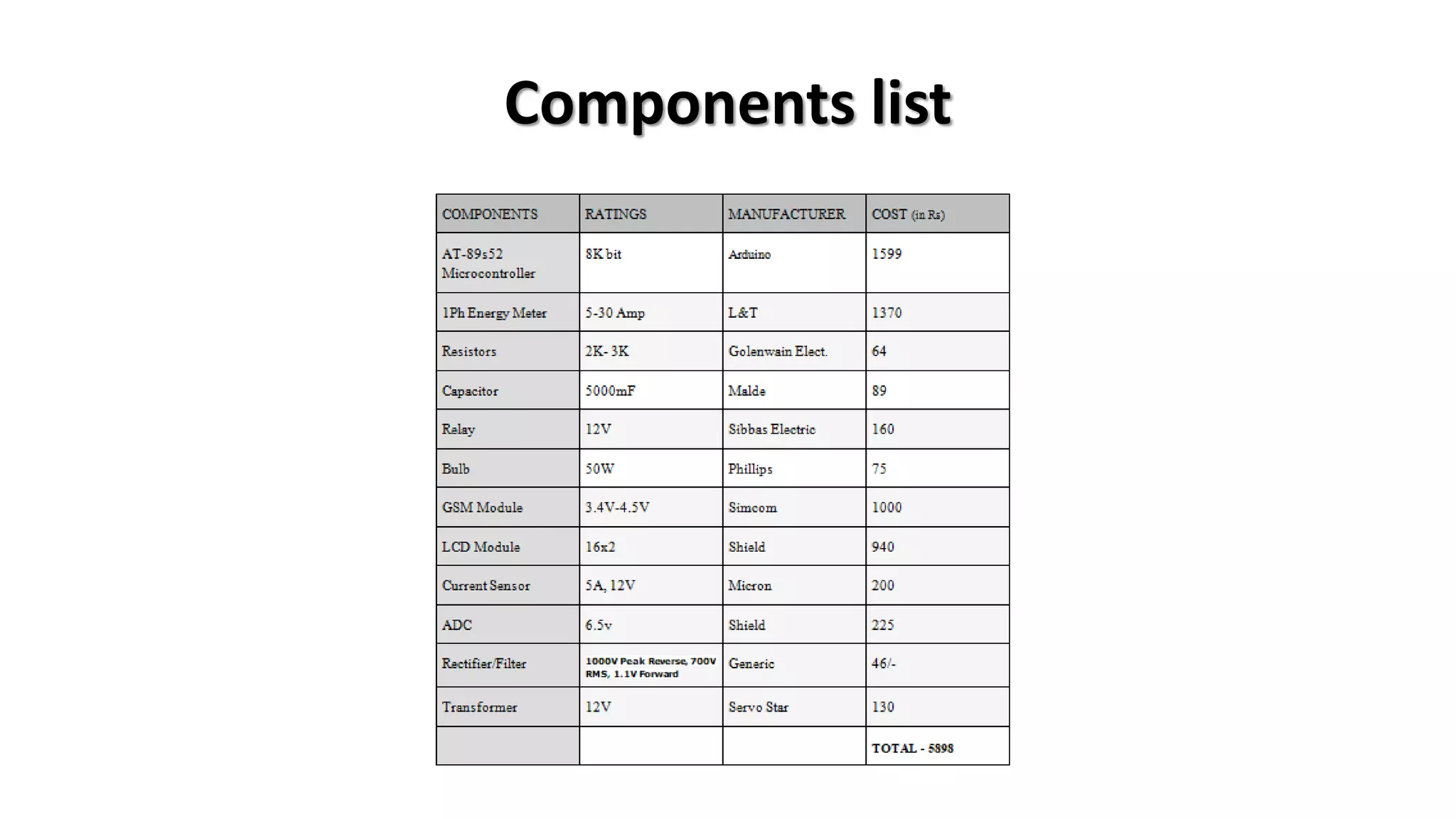
• List of component & specifications
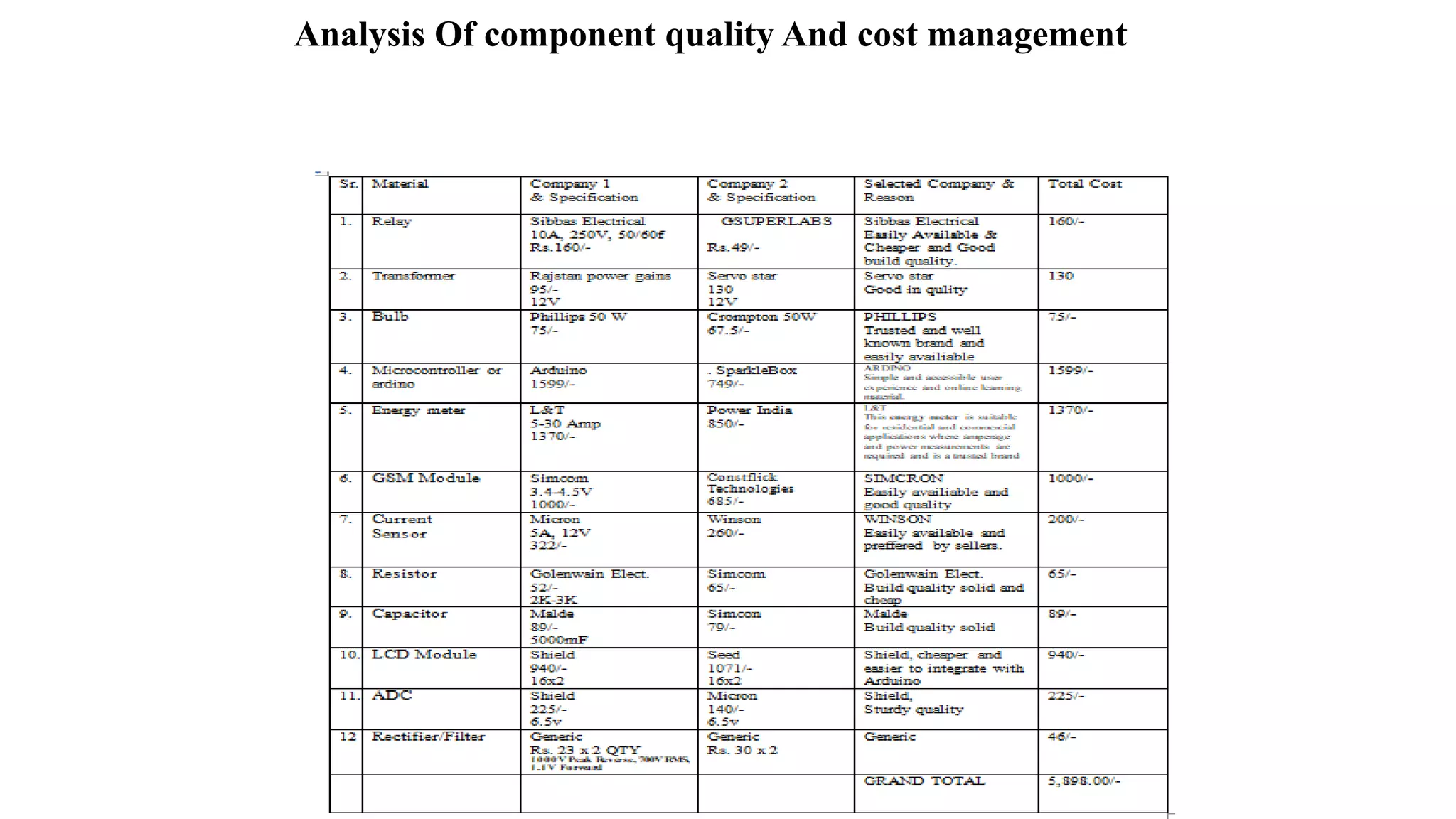
• Analysis of Component quality & cost management
• Advantages & Disadvantages of project
• Conclusion
• Future Scope of the project
• Reference
Introduction
Electricity theft is a very common problem, especially in our country. As our population is high so
the use of electricity is tremendously high. There are many operational losses involve in the
generation, transmission, and distribution of electrical energy. Whereas the losses implicated in
generation can be technically defined, but transmission and distribution losses cannot be precisely
quantified with the sending end information. In T&D the Technical losses are computed with the
information about total load and the total energy bill. Electricity theft is a social evil, so it has to be
eliminated completely. Power consumption and losses have to be closely monitored so that the
generated power is utilized in a mostefficient manner. The system prevents the illegal usage of
electricity.
ABSTRACT
Science, and technology with its miraculous advancements fascinated human life to an honest extent
that will imagine a world without these innovations is hardly possible. While technology is on the
raising slope, we should always also note increasing immoral activities. With a technical view, "Power
Theft" is also a non-ignorable crime that's highly prevalent, and at the same time, it directly affects
the economy of a nation. Detecting and eradicating such crimes with the help of the developing
scientific field is that the "Need of the Hour". With these views the was paper conceived and
designed. Our paper provides an entire and comprehensive tool to stop power theft which is
extremely simple to understand and easy to implement. It includes some sections -transmitting,
receiving, and processing sections. The most objective of this project is to point power theft to the
electricity board. It's carried over through embedded technology. Here a wireless metho.d is utilized
to hunt out electrical theft
LITERATURE REVIEW
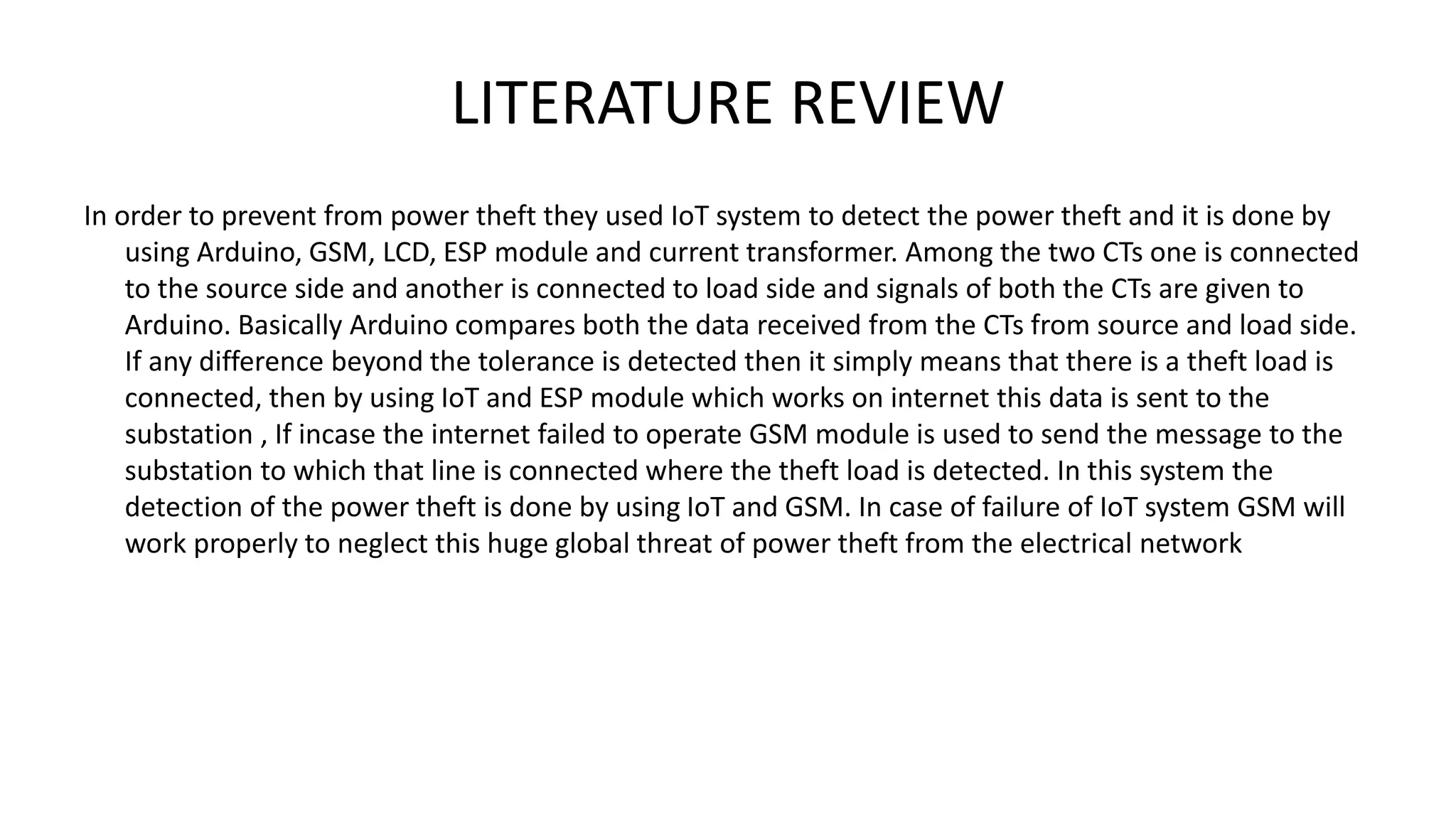
In order to prevent from power theft they used IoT system to detect the power theft and it is done by
using Arduino, GSM, LCD, ESP module and current transformer. Among the two CTs one is connected
to the source side and another is connected to load side and signals of both the CTs are given to
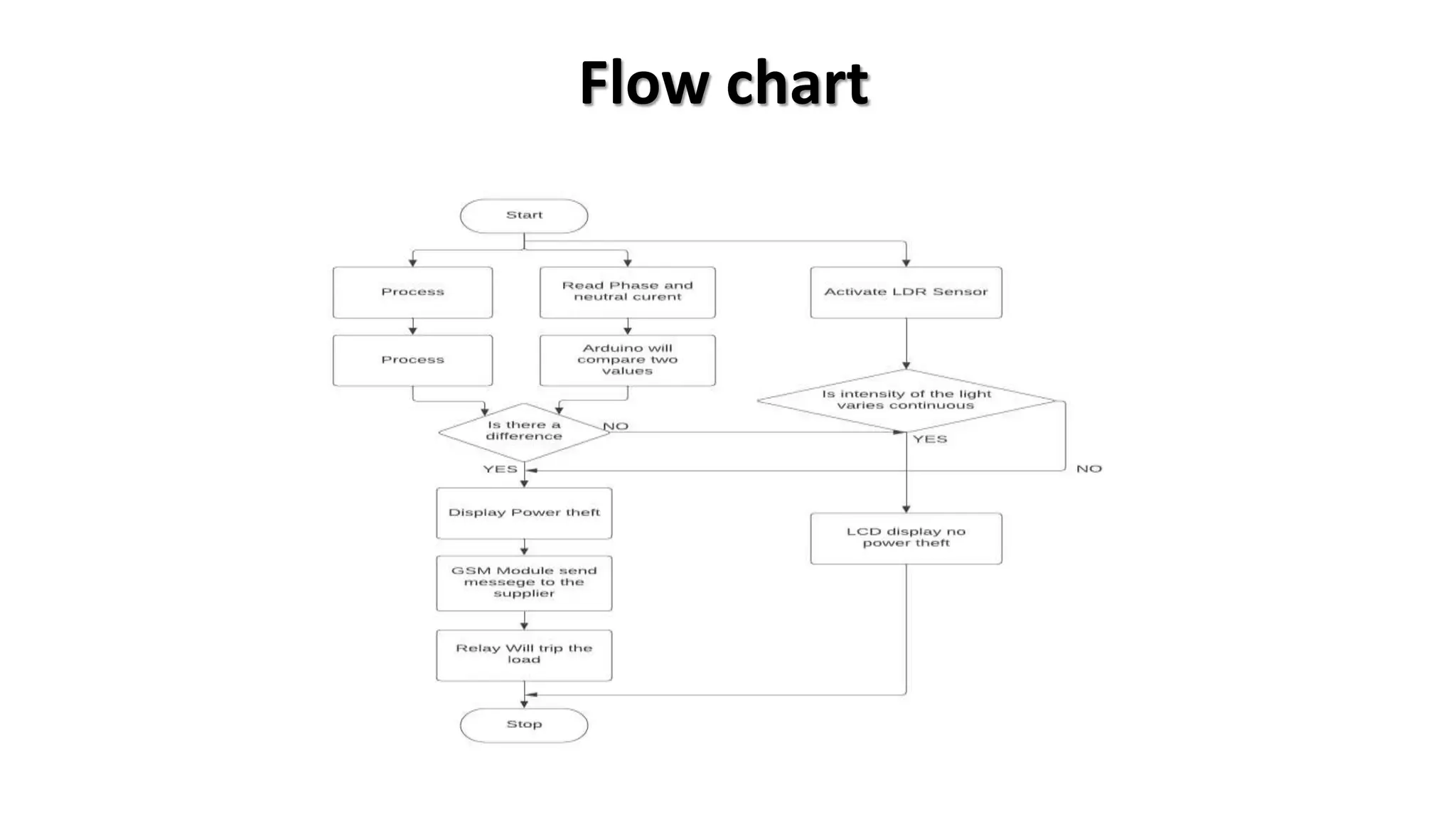
Arduino. Basically Arduino compares both the data received from the CTs from source and load side.
If any difference beyond the tolerance is detected then it simply means that there is a theft load is
connected, then by using IoT and ESP module which works on internet this data is sent to the
substation , If incase the internet failed to operate GSM module is used to send the message to the
substation to which that line is connected where the theft load is detected. In this system the
detection of the power theft is done by using IoT and GSM. In case of failure of IoT system GSM will
work properly to neglect this huge global threat of power theft from the electrical network
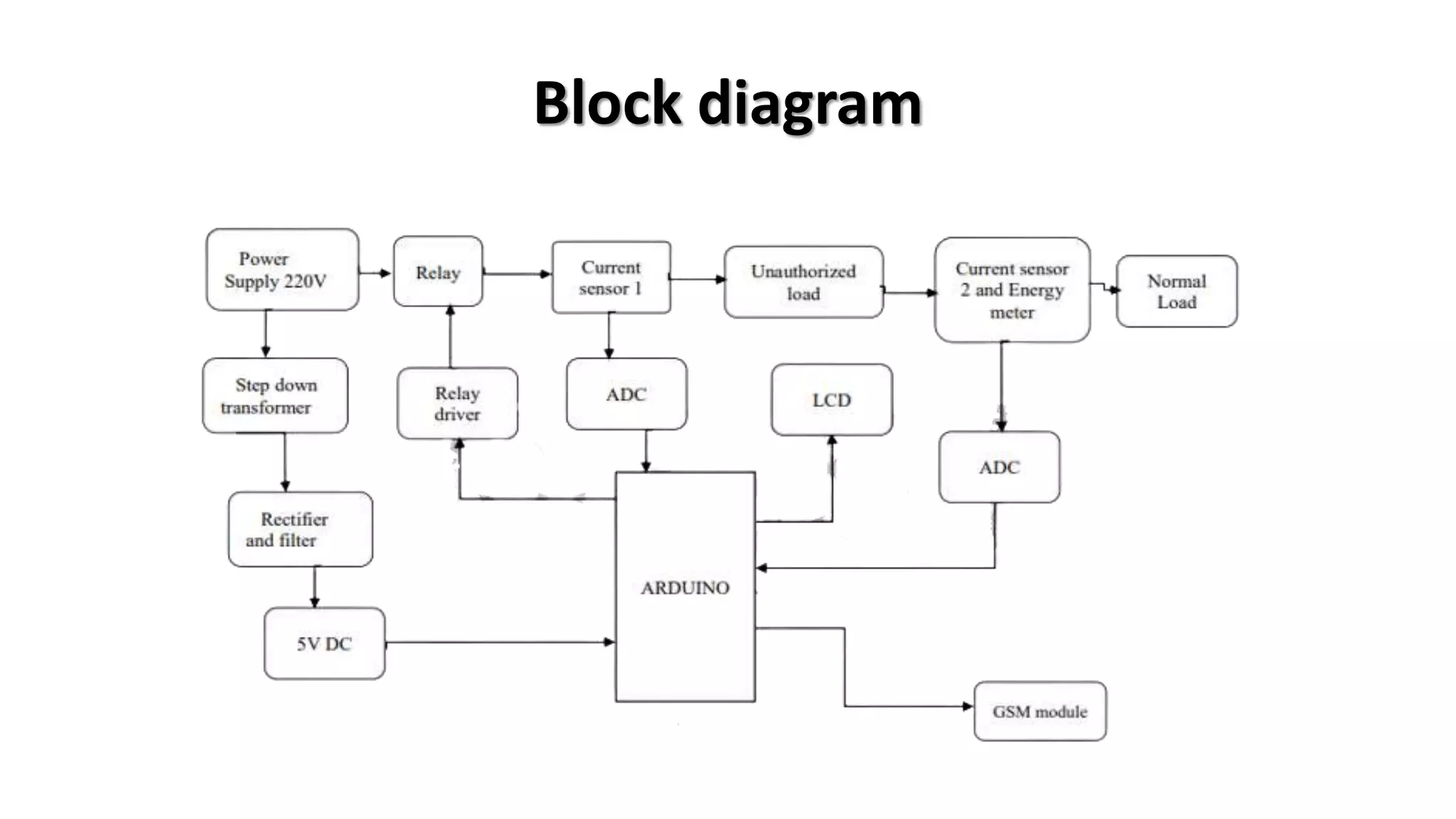
Block diagram
Flow chart
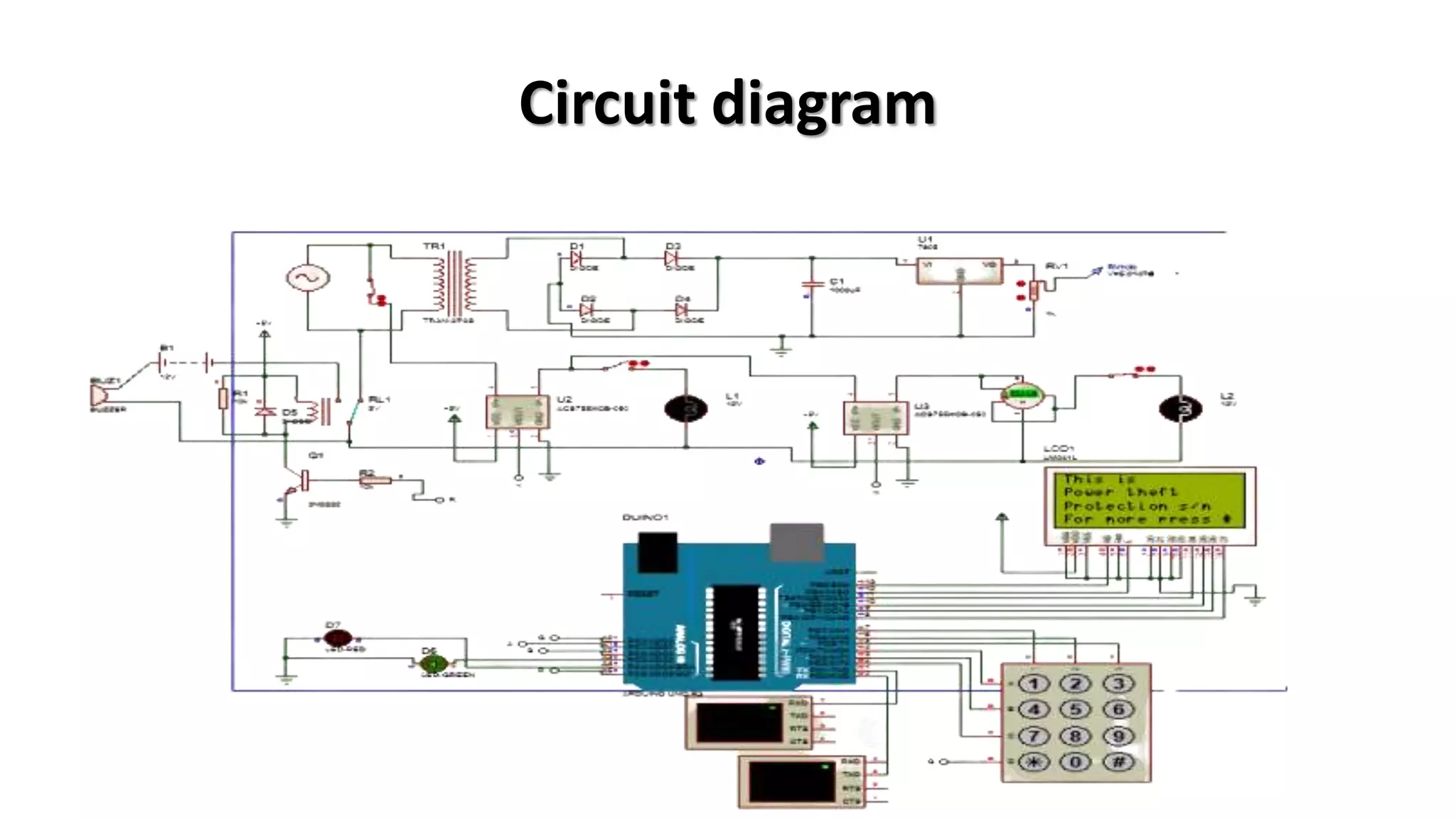
Circuit diagram
Analysis Of component quality And cost management
Components list
WORKING
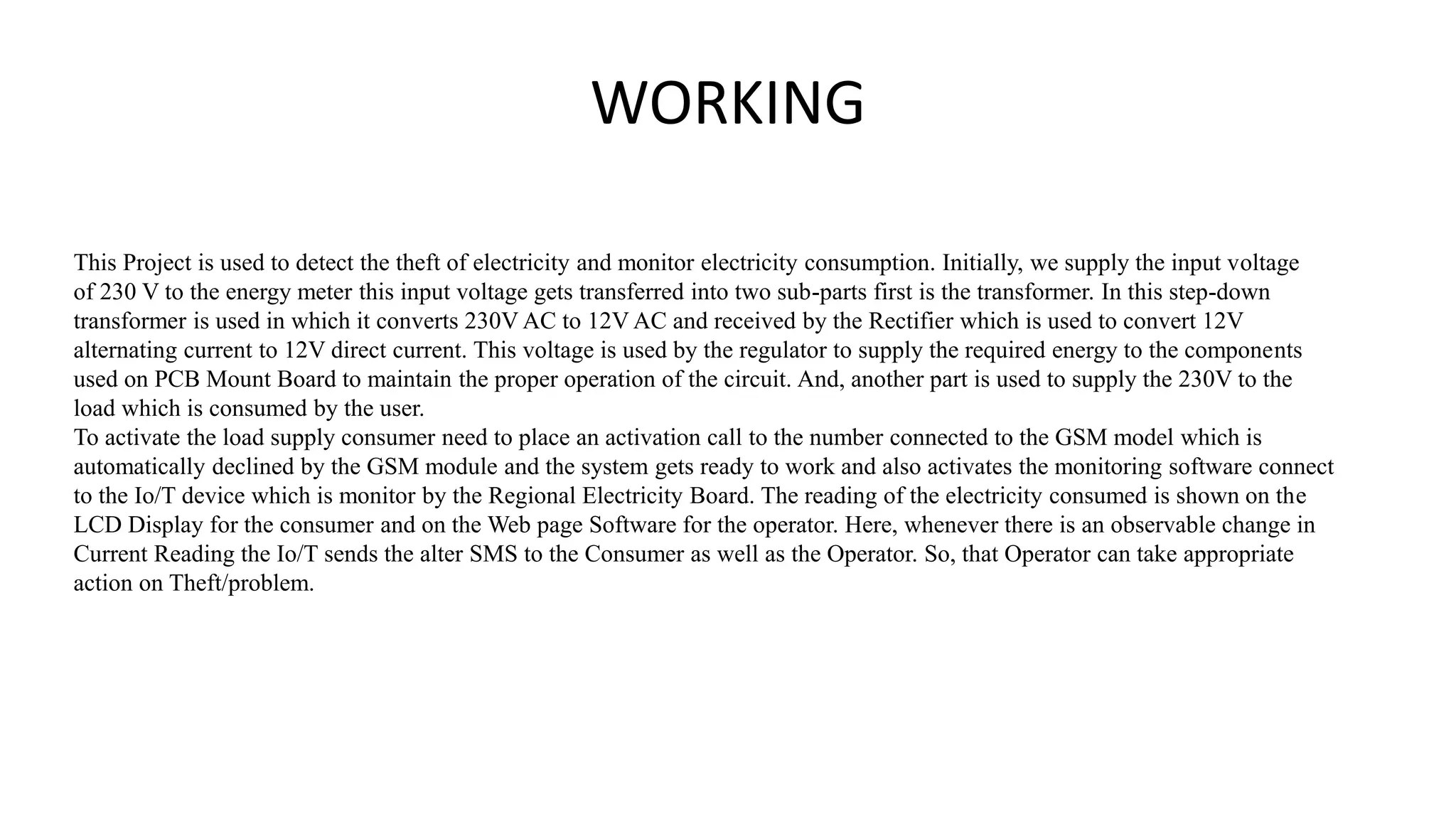
This Project is used to detect the theft of electricity and monitor electricity consumption. Initially, we supply the input voltage
of 230 V to the energy meter this input voltage gets transferred into two sub-parts first is the transformer. In this step-down
transformer is used in which it converts 230V AC to 12V AC and received by the Rectifier which is used to convert 12V
alternating current to 12V direct current. This voltage is used by the regulator to supply the required energy to the components
used on PCB Mount Board to maintain the proper operation of the circuit. And, another part is used to supply the 230V to the
load which is consumed by the user.
To activate the load supply consumer need to place an activation call to the number connected to the GSM model which is
automatically declined by the GSM module and the system gets ready to work and also activates the monitoring software connect
to the Io/T device which is monitor by the Regional Electricity Board. The reading of the electricity consumed is shown on the
LCD Display for the consumer and on the Web page Software for the operator. Here, whenever there is an observable change in
Current Reading the Io/T sends the alter SMS to the Consumer as well as the Operator. So, that Operator can take appropriate
action on Theft/problem.
ADVANTAGES
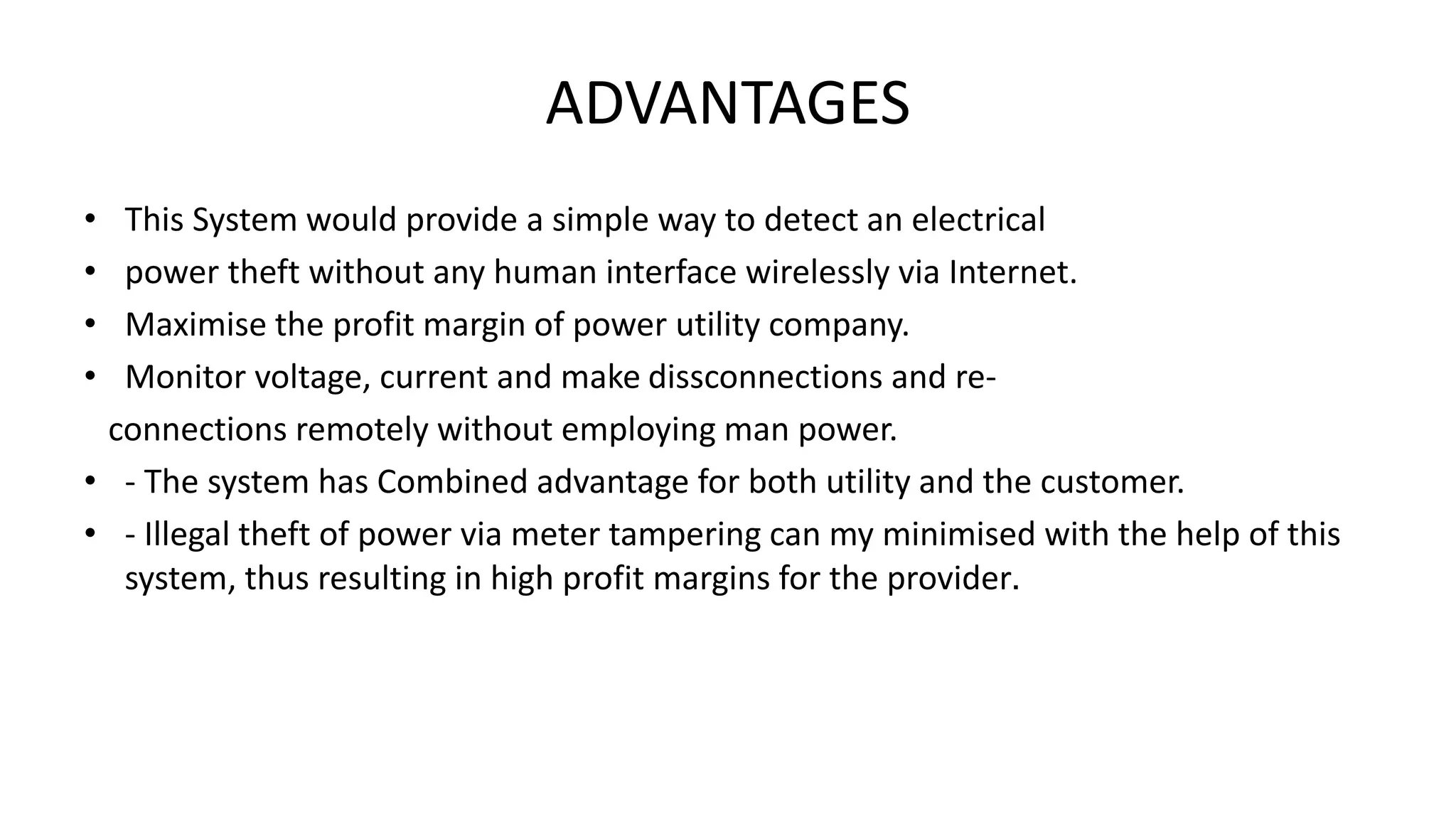
• This System would provide a simple way to detect an electrical
• power theft without any human interface wirelessly via Internet.
• Maximise the profit margin of power utility company.
• Monitor voltage, current and make dissconnections and re-
connections remotely without employing man power.
• - The system has Combined advantage for both utility and the customer.
• - Illegal theft of power via meter tampering can my minimised with the help of this
system, thus resulting in high profit margins for the provider.
LIMITATION
• Since the CT’s are connected across the each span of distribution
system, its installation as well as maintainance cost become higher.
• One major disadvantage of this project is that it is not capable of
detecting the exact location from where the power is being stolen,
giving only approximate location to that place.
• Cannot determine who is actually stealing, but even no other
existing system is capable of doing this.
• If implemented on a large scale, it may take a lot of time and
• manual input.
Conclusion
• In the era of smart city advancement, this project is targeting
the connectivity & networking factor of the IOT. during this
project, we are detecting the facility theft, identifying the fault
and also tracking the location of the fault area to require
necessary measures. The proposed system provides the
answer for a few of the most problems faced by the prevailing
Indian grid system, like wastage of energy, power theft, and
cable fault.
Future Scope
• 1. As mentioned above, we all know that electricity is low and at such time we can't afford power being theft. If this technique is
implemented then the sole the quantity of power required is going to be consumed and there'll be no wastage of power.
•
• 2.Moreover even the money spent is often saved. Hence it'll how of helping within the economic process of the country.
•
• 3.In the present system, IOT energy meter consumption is controlled by Wi-Fi and it helps consumers to avoid wastage use of
electricity. The performance of the system can be managed by connecting all household electrical appliances to IOT to consumepower.
•
• 4.So, in future following measures can be achieved to save power and avoid thefts.
•
• 5.We can make an IOT system where an owner can monitor energy consumption and can pay the bill online.
•
• 6.We can make a system where an owner can receive SMS when he/she crosses the threshold of electricity usage slab.
•
• 7.We can make a system that can send SMS to the preferred meter reading man of that area when theft detected at the consumer end.
Reference
• Lanedi C., Dipit. d.Inug.,delly inf. Secondaniv. di Npoli, Aversar Italy, Monrela, P.; lnilo G,, “ARM based energy
controlling system using smart meter and network server,", IEEE Instrumentation and Measurement Technology
conference Binjiang,, pp.1-6, May-2011.
• Darshan N, Dr. K A Radhakrishnan Rao, “IoT Based Energy Meter Reading, Theft Detection and connection and
Disconnection using PLC and Power optimization", International Journal of Advanced Research in Electrical,
Electronics and Instrumentation Engineering, Vol. 5, Issue 8, 2015
• ECI Telecom Ltd., Fighting Electricity Theft with Advanced Metering Infrastructure (March 2011) [Online]
Available:
• http://www.ecitele.com
• M. Golden, B. Min, “Theft and loss of electricity in an Indian Statetechnical report,” Int. Growth Centre 2012.
•

Power Theft Detection Using IOT

  • 1.
    Smt. Indira GandhiCollege of Engineering Ghansoli,Navi Mumbai Academic Year 2022-23 “Power Theft Detection using IOT” Under guidance of Prof. Ansari Mohd Mubashshir By Mr. Raj Ramesh Bomanwar (14) Mr. Swapnil Dilip Chavan (15) Mr. Vighnesh Pranay Chemburkar (16) Mr. Sachin Popat Damale (17)
  • 2.
    CONTENTS • Introduction • Abstract •Literature review • Block diagram of project • Flow chart of project • Circuit diagram • Working • List of component & specifications • Analysis of Component quality & cost management • Advantages & Disadvantages of project • Conclusion • Future Scope of the project • Reference
  • 3.
    Introduction Electricity theft isa very common problem, especially in our country. As our population is high so the use of electricity is tremendously high. There are many operational losses involve in the generation, transmission, and distribution of electrical energy. Whereas the losses implicated in generation can be technically defined, but transmission and distribution losses cannot be precisely quantified with the sending end information. In T&D the Technical losses are computed with the information about total load and the total energy bill. Electricity theft is a social evil, so it has to be eliminated completely. Power consumption and losses have to be closely monitored so that the generated power is utilized in a mostefficient manner. The system prevents the illegal usage of electricity.
  • 4.
    ABSTRACT Science, and technologywith its miraculous advancements fascinated human life to an honest extent that will imagine a world without these innovations is hardly possible. While technology is on the raising slope, we should always also note increasing immoral activities. With a technical view, "Power Theft" is also a non-ignorable crime that's highly prevalent, and at the same time, it directly affects the economy of a nation. Detecting and eradicating such crimes with the help of the developing scientific field is that the "Need of the Hour". With these views the was paper conceived and designed. Our paper provides an entire and comprehensive tool to stop power theft which is extremely simple to understand and easy to implement. It includes some sections -transmitting, receiving, and processing sections. The most objective of this project is to point power theft to the electricity board. It's carried over through embedded technology. Here a wireless metho.d is utilized to hunt out electrical theft
  • 5.
    LITERATURE REVIEW In orderto prevent from power theft they used IoT system to detect the power theft and it is done by using Arduino, GSM, LCD, ESP module and current transformer. Among the two CTs one is connected to the source side and another is connected to load side and signals of both the CTs are given to Arduino. Basically Arduino compares both the data received from the CTs from source and load side. If any difference beyond the tolerance is detected then it simply means that there is a theft load is connected, then by using IoT and ESP module which works on internet this data is sent to the substation , If incase the internet failed to operate GSM module is used to send the message to the substation to which that line is connected where the theft load is detected. In this system the detection of the power theft is done by using IoT and GSM. In case of failure of IoT system GSM will work properly to neglect this huge global threat of power theft from the electrical network
  • 6.
  • 7.
  • 8.
  • 9.
    Analysis Of componentquality And cost management
  • 10.
  • 11.
    WORKING This Project isused to detect the theft of electricity and monitor electricity consumption. Initially, we supply the input voltage of 230 V to the energy meter this input voltage gets transferred into two sub-parts first is the transformer. In this step-down transformer is used in which it converts 230V AC to 12V AC and received by the Rectifier which is used to convert 12V alternating current to 12V direct current. This voltage is used by the regulator to supply the required energy to the components used on PCB Mount Board to maintain the proper operation of the circuit. And, another part is used to supply the 230V to the load which is consumed by the user. To activate the load supply consumer need to place an activation call to the number connected to the GSM model which is automatically declined by the GSM module and the system gets ready to work and also activates the monitoring software connect to the Io/T device which is monitor by the Regional Electricity Board. The reading of the electricity consumed is shown on the LCD Display for the consumer and on the Web page Software for the operator. Here, whenever there is an observable change in Current Reading the Io/T sends the alter SMS to the Consumer as well as the Operator. So, that Operator can take appropriate action on Theft/problem.
  • 12.
    ADVANTAGES • This Systemwould provide a simple way to detect an electrical • power theft without any human interface wirelessly via Internet. • Maximise the profit margin of power utility company. • Monitor voltage, current and make dissconnections and re- connections remotely without employing man power. • - The system has Combined advantage for both utility and the customer. • - Illegal theft of power via meter tampering can my minimised with the help of this system, thus resulting in high profit margins for the provider.
  • 13.
    LIMITATION • Since theCT’s are connected across the each span of distribution system, its installation as well as maintainance cost become higher. • One major disadvantage of this project is that it is not capable of detecting the exact location from where the power is being stolen, giving only approximate location to that place. • Cannot determine who is actually stealing, but even no other existing system is capable of doing this. • If implemented on a large scale, it may take a lot of time and • manual input.
  • 14.
    Conclusion • In theera of smart city advancement, this project is targeting the connectivity & networking factor of the IOT. during this project, we are detecting the facility theft, identifying the fault and also tracking the location of the fault area to require necessary measures. The proposed system provides the answer for a few of the most problems faced by the prevailing Indian grid system, like wastage of energy, power theft, and cable fault.
  • 15.
    Future Scope • 1.As mentioned above, we all know that electricity is low and at such time we can't afford power being theft. If this technique is implemented then the sole the quantity of power required is going to be consumed and there'll be no wastage of power. • • 2.Moreover even the money spent is often saved. Hence it'll how of helping within the economic process of the country. • • 3.In the present system, IOT energy meter consumption is controlled by Wi-Fi and it helps consumers to avoid wastage use of electricity. The performance of the system can be managed by connecting all household electrical appliances to IOT to consumepower. • • 4.So, in future following measures can be achieved to save power and avoid thefts. • • 5.We can make an IOT system where an owner can monitor energy consumption and can pay the bill online. • • 6.We can make a system where an owner can receive SMS when he/she crosses the threshold of electricity usage slab. • • 7.We can make a system that can send SMS to the preferred meter reading man of that area when theft detected at the consumer end.
  • 16.
    Reference • Lanedi C.,Dipit. d.Inug.,delly inf. Secondaniv. di Npoli, Aversar Italy, Monrela, P.; lnilo G,, “ARM based energy controlling system using smart meter and network server,", IEEE Instrumentation and Measurement Technology conference Binjiang,, pp.1-6, May-2011. • Darshan N, Dr. K A Radhakrishnan Rao, “IoT Based Energy Meter Reading, Theft Detection and connection and Disconnection using PLC and Power optimization", International Journal of Advanced Research in Electrical, Electronics and Instrumentation Engineering, Vol. 5, Issue 8, 2015 • ECI Telecom Ltd., Fighting Electricity Theft with Advanced Metering Infrastructure (March 2011) [Online] Available: • http://www.ecitele.com • M. Golden, B. Min, “Theft and loss of electricity in an Indian Statetechnical report,” Int. Growth Centre 2012. •