Weather...
You can’t see me, but you feel me, you can’t touch
me, but I can touch you. I have been called the
“Breathe of the Gods”, or the killer and giver of life,
gentle and fierce, friendly and enemy, angry and
happy. The Native Americans called me Moriah,
and Snow Eater (Chinook). The Japanese call me
Kaze and in Russia I am called Veter. I can shatter
homes, or wake a child from a peaceful sleep or
bring relief in times of need. I can spread the most
dreaded diseases or bring a welcome freshness.
What am I?
Weather is....
 The current state of the
atmosphere...what is happening right
now
Main points to remember as we
learn about weather:
 The sun warms the earth’s surface and
therefore all the air above the surface
 The earth is warmed most at the equator and
least at the poles---why?
 The air above land is warmed more quickly
than air above water.
 Warm air expands and rises, creating an area
of low pressure; cold air is dense and sinks,
creating an area of high pressure
Weather Factors
 Weather: The state of the atmosphere
at a specific time and place
TEMPERATURE=
the average motion of molecules
↑ TEMP= ↑movement of molecules= feels hot
↓ TEMP= ↓movement of molecules= feels cold
Air Pressure
 Warm air= expanding or rising air=
leaves behind L pressure
 Cold Air=sinking air= leaves an area of
H pressure
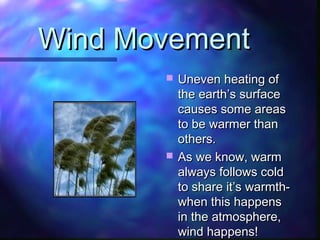
Wind MovementWind Movement
 Uneven heating ofUneven heating of
the earth’s surfacethe earth’s surface
causes some areascauses some areas
to be warmer thanto be warmer than
others.others.
 As we know, warmAs we know, warm
always follows coldalways follows cold
to share it’s warmth-to share it’s warmth-
when this happenswhen this happens
in the atmosphere,in the atmosphere,
wind happens!wind happens!
What causes winds?
 A wind is aA wind is a
horizontalhorizontal
movement of airmovement of air
from a area of highfrom a area of high
pressure to an areapressure to an area
of low pressureof low pressure
 It is this difference inIt is this difference in
pressure that makespressure that makes
the air move=windthe air move=wind
 Winds are
measured by
direction and speed
 The anemometer is
the tool we use to
measure this
 Wind chill=↑ cooling
the wind causes
Local WindsLocal Winds
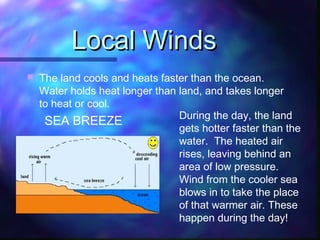
 The land cools and heats faster than the ocean.
Water holds heat longer than land, and takes longer
to heat or cool.
SEA BREEZE During the day, the land
gets hotter faster than the
water. The heated air
rises, leaving behind an
area of low pressure.
Wind from the cooler sea
blows in to take the place
of that warmer air. These
happen during the day!
Land BreezesLand Breezes
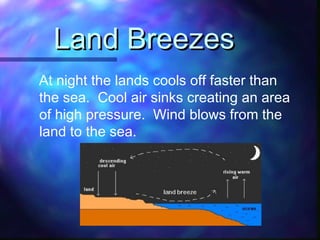
At night the lands cools off faster than
the sea. Cool air sinks creating an area
of high pressure. Wind blows from the
land to the sea.
Global Circulation and WindGlobal Circulation and Wind
SystemsSystems
Solar energy is at itsSolar energy is at its
greatest around thegreatest around the
equator---Why?equator---Why?
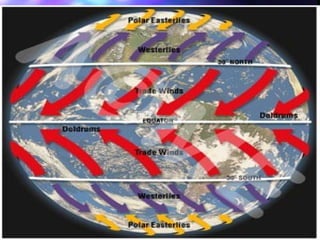
Global Winds:
 Wind belts:
Horse Latitudes= 30°N and S of
equator =calm winds= worlds
desert areas
Jet Streams= 10km above the
surface blow from the west to the east
Intense heat = Powerful
CONVECTION
 Warm, moist air rises and leaves behind anWarm, moist air rises and leaves behind an
area of low pressure. This is why most rainarea of low pressure. This is why most rain
forests are found along equatorial regions.forests are found along equatorial regions.
 That air rises until it reaches the top of theThat air rises until it reaches the top of the
troposphere, where it can’t rise any further.troposphere, where it can’t rise any further.
 It spreads out towards the polar regions HOTIt spreads out towards the polar regions HOT
follows COLD wanting to share its warmth.follows COLD wanting to share its warmth.
 As it spreads it begins to cool and sink-As it spreads it begins to cool and sink-
usually 30usually 30°N and S of the equator- sinking°N and S of the equator- sinking
air produces an area of H pressure with dryair produces an area of H pressure with dry
conditions= desert regions on earthconditions= desert regions on earth
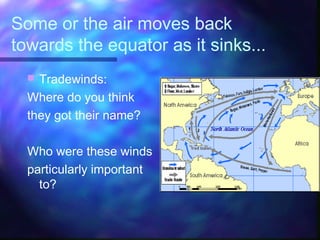
Some or the air moves back
towards the equator as it sinks...
 Tradewinds:
Where do you think
they got their name?
Who were these winds
particularly important
to?
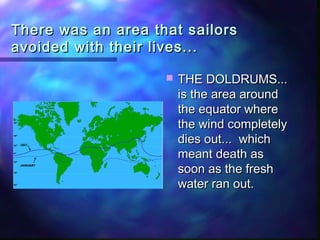
There was an area that sailorsThere was an area that sailors
avoided with their lives...avoided with their lives...
 THE DOLDRUMS...THE DOLDRUMS...
is the area aroundis the area around
the equator wherethe equator where
the wind completelythe wind completely
dies out... whichdies out... which
meant death asmeant death as
soon as the freshsoon as the fresh
water ran out.water ran out.
Water in the Atmosphere:Water in the Atmosphere:
HumidityHumidity
 HumidityHumidity: measure of the amount of water vapor: measure of the amount of water vapor
stuck between molecules in the air. The air’s abilitystuck between molecules in the air. The air’s ability
to hold water depends on the air tempto hold water depends on the air temp
 The hotter the air, the more water the air can holdThe hotter the air, the more water the air can hold
 Cold air: molecules move slower so droplets of waterCold air: molecules move slower so droplets of water
can start to stick together=can start to stick together=condensationcondensation
 Relative humidityRelative humidity: the amount of water vapor(%): the amount of water vapor(%)
compared to the amount the air can hold- tool used iscompared to the amount the air can hold- tool used is
aa psychrometer.psychrometer.
 100%=air is saturated100%=air is saturated
Cloud Formation
 Clouds form when water vapor
condenses on dust, salt particles in the
air
 The temperature in which condensation
begins is called the dew point
TYPES OF CLOUDS
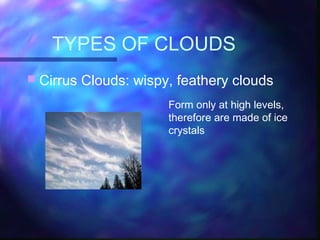
 Cirrus Clouds: wispy, feathery clouds
Form only at high levels,
therefore are made of ice
crystals
Types of Clouds
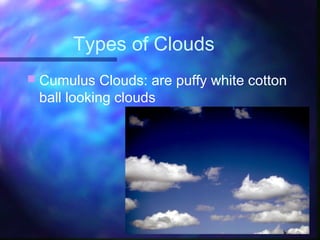
 Cumulus Clouds: are puffy white cotton
ball looking clouds
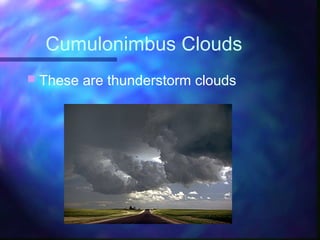
Cumulonimbus Clouds
 These are thunderstorm clouds
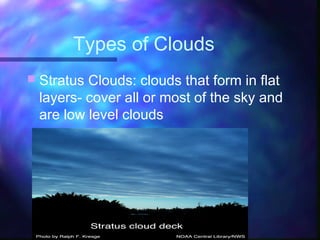
Types of Clouds
 Stratus Clouds: clouds that form in flat
layers- cover all or most of the sky and
are low level clouds
 Air masses are masses of air that have
the same characteristics of the surface
over which it develops
 Pressure Systems
descending (going down)=H pressure
ascending (going up)=L pressure
Air Masses
Weather Foldable
 Warm front
 Cold front
 Occluded front
 Stationary Front
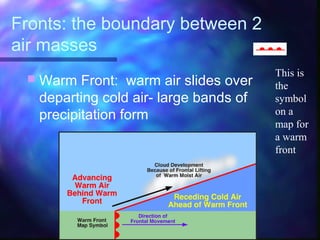
Fronts: the boundary between 2
air masses
 Warm Front: warm air slides over
departing cold air- large bands of
precipitation form
This is
the
symbol
on a
map for
a warm
front
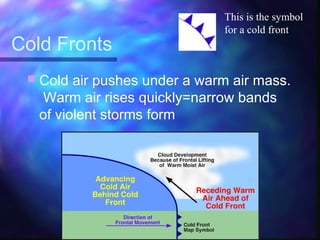
Cold Fronts
 Cold air pushes under a warm air mass.
Warm air rises quickly=narrow bands
of violent storms form
This is the symbol
for a cold front
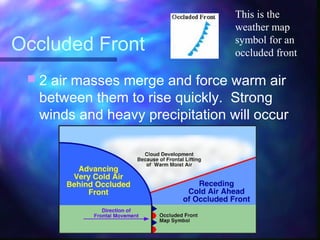
Occluded Front
 2 air masses merge and force warm air
between them to rise quickly. Strong
winds and heavy precipitation will occur
This is the
weather map
symbol for an
occluded front
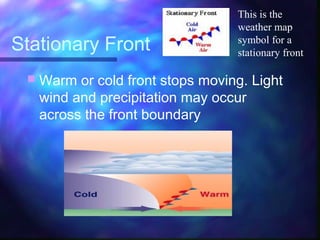
Stationary Front
 Warm or cold front stops moving. Light
wind and precipitation may occur
across the front boundary
This is the
weather map
symbol for a
stationary front
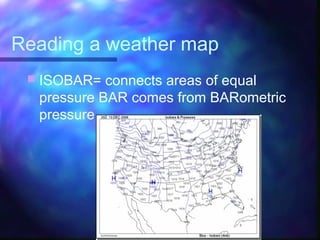
Reading a weather map
 ISOBAR= connects areas of equal
pressure BAR comes from BARometric
pressure
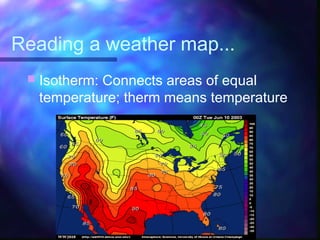
Reading a weather map...
 Isotherm: Connects areas of equal
temperature; therm means temperature
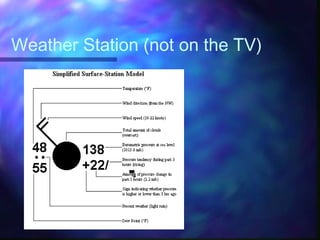
Weather Station (not on the TV)

Weather ms ppt 1997

  • 2.
    Weather... You can’t seeme, but you feel me, you can’t touch me, but I can touch you. I have been called the “Breathe of the Gods”, or the killer and giver of life, gentle and fierce, friendly and enemy, angry and happy. The Native Americans called me Moriah, and Snow Eater (Chinook). The Japanese call me Kaze and in Russia I am called Veter. I can shatter homes, or wake a child from a peaceful sleep or bring relief in times of need. I can spread the most dreaded diseases or bring a welcome freshness. What am I?
  • 3.
    Weather is....  Thecurrent state of the atmosphere...what is happening right now
  • 4.
    Main points toremember as we learn about weather:  The sun warms the earth’s surface and therefore all the air above the surface  The earth is warmed most at the equator and least at the poles---why?  The air above land is warmed more quickly than air above water.  Warm air expands and rises, creating an area of low pressure; cold air is dense and sinks, creating an area of high pressure
  • 5.
    Weather Factors  Weather:The state of the atmosphere at a specific time and place TEMPERATURE= the average motion of molecules ↑ TEMP= ↑movement of molecules= feels hot ↓ TEMP= ↓movement of molecules= feels cold
  • 6.
    Air Pressure  Warmair= expanding or rising air= leaves behind L pressure  Cold Air=sinking air= leaves an area of H pressure
  • 7.
    Wind MovementWind Movement Uneven heating ofUneven heating of the earth’s surfacethe earth’s surface causes some areascauses some areas to be warmer thanto be warmer than others.others.  As we know, warmAs we know, warm always follows coldalways follows cold to share it’s warmth-to share it’s warmth- when this happenswhen this happens in the atmosphere,in the atmosphere, wind happens!wind happens!
  • 8.
    What causes winds? A wind is aA wind is a horizontalhorizontal movement of airmovement of air from a area of highfrom a area of high pressure to an areapressure to an area of low pressureof low pressure  It is this difference inIt is this difference in pressure that makespressure that makes the air move=windthe air move=wind  Winds are measured by direction and speed  The anemometer is the tool we use to measure this  Wind chill=↑ cooling the wind causes
  • 9.
    Local WindsLocal Winds The land cools and heats faster than the ocean. Water holds heat longer than land, and takes longer to heat or cool. SEA BREEZE During the day, the land gets hotter faster than the water. The heated air rises, leaving behind an area of low pressure. Wind from the cooler sea blows in to take the place of that warmer air. These happen during the day!
  • 10.
    Land BreezesLand Breezes Atnight the lands cools off faster than the sea. Cool air sinks creating an area of high pressure. Wind blows from the land to the sea.
  • 11.
    Global Circulation andWindGlobal Circulation and Wind SystemsSystems Solar energy is at itsSolar energy is at its greatest around thegreatest around the equator---Why?equator---Why?
  • 13.
    Global Winds:  Windbelts: Horse Latitudes= 30°N and S of equator =calm winds= worlds desert areas Jet Streams= 10km above the surface blow from the west to the east
  • 14.
    Intense heat =Powerful CONVECTION  Warm, moist air rises and leaves behind anWarm, moist air rises and leaves behind an area of low pressure. This is why most rainarea of low pressure. This is why most rain forests are found along equatorial regions.forests are found along equatorial regions.  That air rises until it reaches the top of theThat air rises until it reaches the top of the troposphere, where it can’t rise any further.troposphere, where it can’t rise any further.  It spreads out towards the polar regions HOTIt spreads out towards the polar regions HOT follows COLD wanting to share its warmth.follows COLD wanting to share its warmth.  As it spreads it begins to cool and sink-As it spreads it begins to cool and sink- usually 30usually 30°N and S of the equator- sinking°N and S of the equator- sinking air produces an area of H pressure with dryair produces an area of H pressure with dry conditions= desert regions on earthconditions= desert regions on earth
  • 15.
    Some or theair moves back towards the equator as it sinks...  Tradewinds: Where do you think they got their name? Who were these winds particularly important to?
  • 16.
    There was anarea that sailorsThere was an area that sailors avoided with their lives...avoided with their lives...  THE DOLDRUMS...THE DOLDRUMS... is the area aroundis the area around the equator wherethe equator where the wind completelythe wind completely dies out... whichdies out... which meant death asmeant death as soon as the freshsoon as the fresh water ran out.water ran out.
  • 17.
    Water in theAtmosphere:Water in the Atmosphere: HumidityHumidity  HumidityHumidity: measure of the amount of water vapor: measure of the amount of water vapor stuck between molecules in the air. The air’s abilitystuck between molecules in the air. The air’s ability to hold water depends on the air tempto hold water depends on the air temp  The hotter the air, the more water the air can holdThe hotter the air, the more water the air can hold  Cold air: molecules move slower so droplets of waterCold air: molecules move slower so droplets of water can start to stick together=can start to stick together=condensationcondensation  Relative humidityRelative humidity: the amount of water vapor(%): the amount of water vapor(%) compared to the amount the air can hold- tool used iscompared to the amount the air can hold- tool used is aa psychrometer.psychrometer.  100%=air is saturated100%=air is saturated
  • 18.
    Cloud Formation  Cloudsform when water vapor condenses on dust, salt particles in the air  The temperature in which condensation begins is called the dew point
  • 19.
    TYPES OF CLOUDS Cirrus Clouds: wispy, feathery clouds Form only at high levels, therefore are made of ice crystals
  • 20.
    Types of Clouds Cumulus Clouds: are puffy white cotton ball looking clouds
  • 21.
    Cumulonimbus Clouds  Theseare thunderstorm clouds
  • 22.
    Types of Clouds Stratus Clouds: clouds that form in flat layers- cover all or most of the sky and are low level clouds
  • 23.
     Air massesare masses of air that have the same characteristics of the surface over which it develops  Pressure Systems descending (going down)=H pressure ascending (going up)=L pressure Air Masses
  • 25.
    Weather Foldable  Warmfront  Cold front  Occluded front  Stationary Front
  • 26.
    Fronts: the boundarybetween 2 air masses  Warm Front: warm air slides over departing cold air- large bands of precipitation form This is the symbol on a map for a warm front
  • 27.
    Cold Fronts  Coldair pushes under a warm air mass. Warm air rises quickly=narrow bands of violent storms form This is the symbol for a cold front
  • 28.
    Occluded Front  2air masses merge and force warm air between them to rise quickly. Strong winds and heavy precipitation will occur This is the weather map symbol for an occluded front
  • 29.
    Stationary Front  Warmor cold front stops moving. Light wind and precipitation may occur across the front boundary This is the weather map symbol for a stationary front
  • 30.
    Reading a weathermap  ISOBAR= connects areas of equal pressure BAR comes from BARometric pressure
  • 31.
    Reading a weathermap...  Isotherm: Connects areas of equal temperature; therm means temperature
  • 32.