What are clouds?
• Clouds are water
droplets or ice
crystals that are in
the Earths
troposphere (the
bottom part of the
Earth's atmosphere)
Dew Point and Condensation
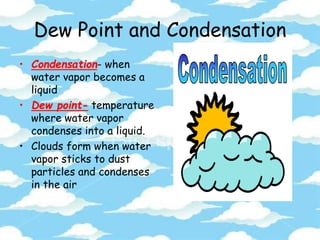
• Condensation- when
water vapor becomes a
liquid
• Dew point- temperature
where water vapor
condenses into a liquid.
• Clouds form when water
vapor sticks to dust
particles and condenses
in the air
How do clouds form?
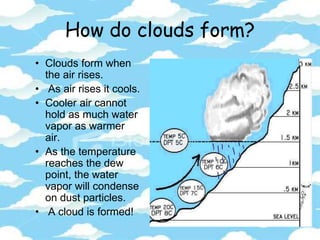
• Clouds form when
the air rises.
• As air rises it cools.
• Cooler air cannot
hold as much water
vapor as warmer
air.
• As the temperature
reaches the dew
point, the water
vapor will condense
on dust particles.
• A cloud is formed!
What are the different types of
clouds?
• Clouds are classified by
their altitude and
appearance
• Each type of cloud
forms in a different way
and brings its own type
of weather
• There are 3 main forms
of clouds
• The main forms are,
cirrus, stratus,
cumulus
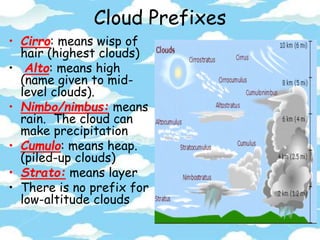
Cloud Prefixes
• Cirro: means wisp of
hair (highest clouds)
• Alto: means high
(name given to mid-
level clouds).
• Nimbo/nimbus: means
rain. The cloud can
make precipitation
• Cumulo: means heap.
(piled-up clouds)
• Strato: means layer
• There is no prefix for
low-altitude clouds
Cirrus
• Cirrus is Latin for
curl
• Cirrus clouds look
like curls of white
hair.
• Very high, made of
ice crystals
• Can indicate a
change in the
weather.
Stratus
• Stratus: Latin for
sheet or layer
• Stratus clouds look like
a gray, flat blanket
that covers the entire
sky.
• Look like fog that
does not reach the
ground.
• Usually no
precipitation, but
sometimes they may
drizzle.
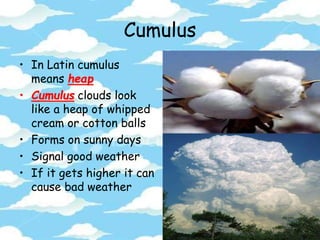
Cumulus
• In Latin cumulus
means heap
• Cumulus clouds look
like a heap of whipped
cream or cotton balls
• Forms on sunny days
• Signal good weather
• If it gets higher it can
cause bad weather
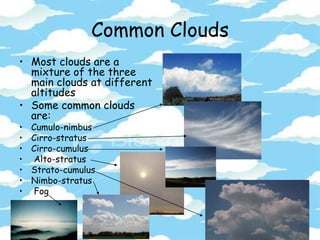
Common Clouds
• Most clouds are a
mixture of the three
main clouds at different
altitudes
• Some common clouds
are:
• Cumulo-nimbus
• Cirro-stratus
• Cirro-cumulus
• Alto-stratus
• Strato-cumulus
• Nimbo-stratus
• Fog
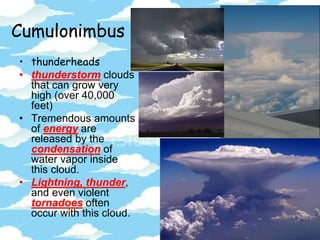
Cumulonimbus
• thunderheads
• thunderstorm clouds
that can grow very
high (over 40,000
feet)
• Tremendous amounts
of energy are
released by the
condensation of
water vapor inside
this cloud.
• Lightning, thunder,
and even violent
tornadoes often
occur with this cloud.
Cirrostratus
• Cirrostratus are sheet-
like, high-level clouds
made of ice crystals.
• Though cirrostratus can
cover the entire sky
and be up to several
thousand feet thick,
they are relatively
transparent, as the
sun or the moon can
often be seen through
them.
Cirrocumulus
• appear as small,
rounded white puffs.
• The small ripples in
these clouds
resemble the scales
of a fish.
• This sky is sometimes
referred to as a
"mackerel sky."
Altostratus
• Gray or blue-gray middle
level clouds composed of
ice crystals and water
droplets.
• Often cover the entire
sky.
• In the thinner areas of the
cloud, the sun may be
dimly visible as a round
disk.
• Altostratus clouds often
form ahead of storms
that will produce
continuous precipitation.
Stratocumulus
• Usually dark, heavy
looking clouds.
• Rain is likely.
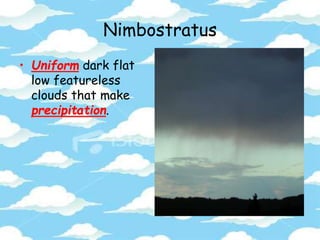
Nimbostratus
• Uniform dark flat
low featureless
clouds that make
precipitation.
Fog
• Very low stratus
cloud
• In contact with
ground
Bibliography
• http://www.enchantedlearning.com/subject
s/astronomy/planets/earth/clouds/
• http://wxdude.com/page9.html
• Prentice Hall Earth Science Teacher
Edition
• Our Textbook
•

Clouds

  • 2.
    What are clouds? •Clouds are water droplets or ice crystals that are in the Earths troposphere (the bottom part of the Earth's atmosphere)
  • 3.
    Dew Point andCondensation • Condensation- when water vapor becomes a liquid • Dew point- temperature where water vapor condenses into a liquid. • Clouds form when water vapor sticks to dust particles and condenses in the air
  • 4.
    How do cloudsform? • Clouds form when the air rises. • As air rises it cools. • Cooler air cannot hold as much water vapor as warmer air. • As the temperature reaches the dew point, the water vapor will condense on dust particles. • A cloud is formed!
  • 5.
    What are thedifferent types of clouds? • Clouds are classified by their altitude and appearance • Each type of cloud forms in a different way and brings its own type of weather • There are 3 main forms of clouds • The main forms are, cirrus, stratus, cumulus
  • 6.
    Cloud Prefixes • Cirro:means wisp of hair (highest clouds) • Alto: means high (name given to mid- level clouds). • Nimbo/nimbus: means rain. The cloud can make precipitation • Cumulo: means heap. (piled-up clouds) • Strato: means layer • There is no prefix for low-altitude clouds
  • 7.
    Cirrus • Cirrus isLatin for curl • Cirrus clouds look like curls of white hair. • Very high, made of ice crystals • Can indicate a change in the weather.
  • 8.
    Stratus • Stratus: Latinfor sheet or layer • Stratus clouds look like a gray, flat blanket that covers the entire sky. • Look like fog that does not reach the ground. • Usually no precipitation, but sometimes they may drizzle.
  • 9.
    Cumulus • In Latincumulus means heap • Cumulus clouds look like a heap of whipped cream or cotton balls • Forms on sunny days • Signal good weather • If it gets higher it can cause bad weather
  • 10.
    Common Clouds • Mostclouds are a mixture of the three main clouds at different altitudes • Some common clouds are: • Cumulo-nimbus • Cirro-stratus • Cirro-cumulus • Alto-stratus • Strato-cumulus • Nimbo-stratus • Fog
  • 12.
    Cumulonimbus • thunderheads • thunderstormclouds that can grow very high (over 40,000 feet) • Tremendous amounts of energy are released by the condensation of water vapor inside this cloud. • Lightning, thunder, and even violent tornadoes often occur with this cloud.
  • 13.
    Cirrostratus • Cirrostratus aresheet- like, high-level clouds made of ice crystals. • Though cirrostratus can cover the entire sky and be up to several thousand feet thick, they are relatively transparent, as the sun or the moon can often be seen through them.
  • 14.
    Cirrocumulus • appear assmall, rounded white puffs. • The small ripples in these clouds resemble the scales of a fish. • This sky is sometimes referred to as a "mackerel sky."
  • 15.
    Altostratus • Gray orblue-gray middle level clouds composed of ice crystals and water droplets. • Often cover the entire sky. • In the thinner areas of the cloud, the sun may be dimly visible as a round disk. • Altostratus clouds often form ahead of storms that will produce continuous precipitation.
  • 16.
    Stratocumulus • Usually dark,heavy looking clouds. • Rain is likely.
  • 17.
    Nimbostratus • Uniform darkflat low featureless clouds that make precipitation.
  • 18.
    Fog • Very lowstratus cloud • In contact with ground
  • 19.