ASSIGNMENT ON
Submitted by
Praveen.B
11AM/2017
What is wind?
 In meteorology – the horizontal movement of air relative to
the earth surface.
Air movements
 Horizontal & vertical
 Vertically moving air columns is known as currents.
what causes wind?
 Caused by a difference in air pressure due to unequal heating
of the atmosphere.
 Warm air rises, creating areas of low pressure. Cool air sinks,
creating areas of high pressure.
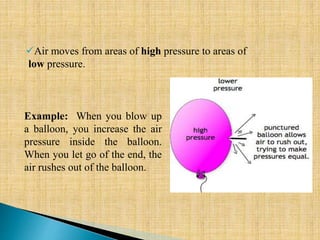
Air moves from areas of high pressure to areas of
low pressure.
Example: When you blow up
a balloon, you increase the air
pressure inside the balloon.
When you let go of the end, the
air rushes out of the balloon.
1.Primary circulation or prevailing wind
 It includes the planetary wind systems which are related to the
general arrangement of pressure belts on the earth’s surface.
 It consists of Trade winds, westerlies and polar easterlies.
2.Seondary circulation or periodic winds
 It consists of cyclones ,anti-cyclones ,monsoons.
3.Tertiary circulation
 It includes all the local winds .
Global winds
 These winds are named by the direction from which they
blow.
 Global winds are wind systems that occur at or near Earth’s
surface.
 Don’t travel North and South because of the Earth rotating on
its axis.
 It is also known as general circulation of the atmosphere.
ITCZ
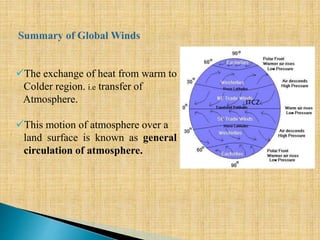
The exchange of heat from warm to
Colder region. i.e transfer of
Atmosphere.
This motion of atmosphere over a
land surface is known as general
circulation of atmosphere.
Types of Global Winds
 The globe is encircled by the following wind belts in each
hemisphere i.e from pole to equator.
A. Doldrums
B. trade wind belt
C. prevailing westerlies
D. polar easterlies
A. Doldrums:
 These are located at the equator, surface winds are calm and
weak with low pressure.
 Average location of the doldrums roughly between 50 S and 50N.
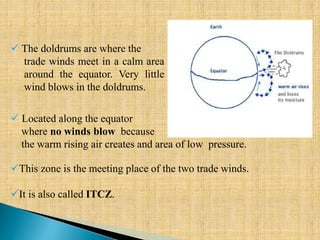
 The doldrums are where the
trade winds meet in a calm area
around the equator. Very little
wind blows in the doldrums.
 Located along the equator
where no winds blow because
the warm rising air creates and area of low pressure.
This zone is the meeting place of the two trade winds.
It is also called ITCZ.
B. Trade wind belt
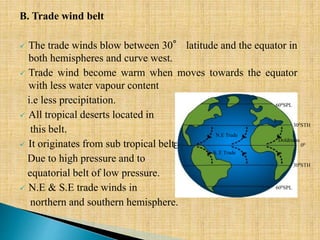
 The trade winds blow between 30° latitude and the equator in
both hemispheres and curve west.
 Trade wind become warm when moves towards the equator
with less water vapour content
i.e less precipitation.
 All tropical deserts located in
this belt.
 It originates from sub tropical belt
Due to high pressure and to
equatorial belt of low pressure.
 N.E & S.E trade winds in
northern and southern hemisphere.
E
N.E Trade
S. E Trade
Doldrums
300STH
300STH
600SPL
600SPL
00
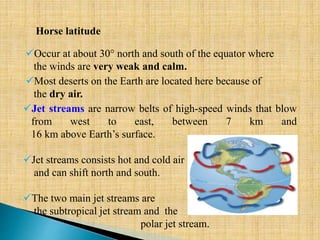
Most deserts on the Earth are located here because of
the dry air.
Horse latitude
Occur at about 30° north and south of the equator where
the winds are very weak and calm.
Jet streams are narrow belts of high-speed winds that blow
from west to east, between 7 km and
16 km above Earth’s surface.
Jet streams consists hot and cold air
and can shift north and south.
The two main jet streams are
the subtropical jet stream and the
polar jet stream.
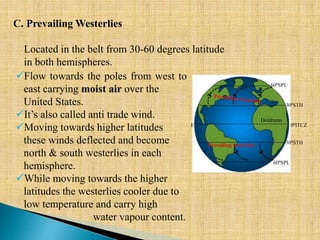
C. Prevailing Westerlies
Located in the belt from 30-60 degrees latitude
in both hemispheres.
Flow towards the poles from west to
east carrying moist air over the
United States.
It’s also called anti trade wind.
Moving towards higher latitudes
these winds deflected and become
north & south westerlies in each
hemisphere.
While moving towards the higher
latitudes the westerlies cooler due to
low temperature and carry high
water vapour content.
Doldrums
Prevailing westerlies
300STH
300STH
600SPL
600SPL
00ITCZE
 Highest precipitation zones seen in this belt.
 The moving cells of low and high pressures largely affect the
movement of westerlies.
 However the cyclones and anti cyclone occurs in the region and
moving towards the east.
 The flow of westerlies is obscured in northern hemisphere due to
larger land areas and high mountains ,changing seasonal pressure
systems.
 Roaring forties ,furious fifties and screaming sixties.
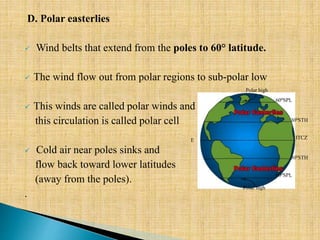
D. Polar easterlies
 Wind belts that extend from the poles to 60° latitude.
 The wind flow out from polar regions to sub-polar low
 This winds are called polar winds and
this circulation is called polar cell
 Cold air near poles sinks and
flow back toward lower latitudes
(away from the poles).
.
ITCZ
300STH
300STH
600SPL
600SPL
Polar high
Polar high
E
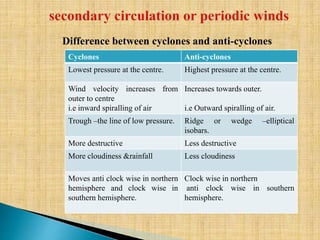
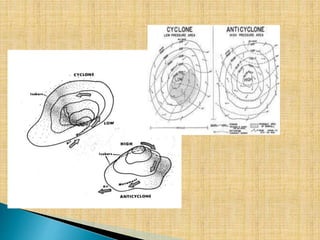
Difference between cyclones and anti-cyclones
Cyclones Anti-cyclones
Lowest pressure at the centre. Highest pressure at the centre.
Wind velocity increases from
outer to centre
i.e inward spiralling of air
Increases towards outer.
i.e Outward spiralling of air.
Trough –the line of low pressure. Ridge or wedge –elliptical
isobars.
More destructive Less destructive
More cloudiness &rainfall Less cloudiness
Moves anti clock wise in northern
hemisphere and clock wise in
southern hemisphere.
Clock wise in northern
anti clock wise in southern
hemisphere.
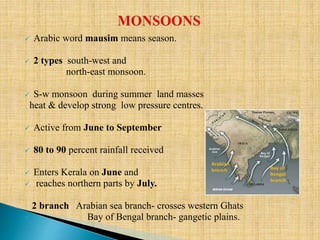
 Arabic word mausim means season.
 2 types south-west and
north-east monsoon.
 S-w monsoon during summer land masses
heat & develop strong low pressure centres.
 Active from June to September
 80 to 90 percent rainfall received
 Enters Kerala on June and
 reaches northern parts by July.
2 branch Arabian sea branch- crosses western Ghats
 Bay of Bengal branch- gangetic plains.
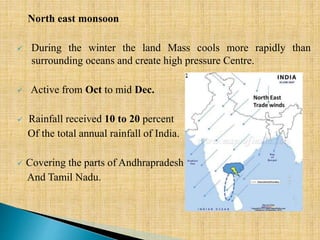
North east monsoon
 During the winter the land Mass cools more rapidly than
surrounding oceans and create high pressure Centre.
 Active from Oct to mid Dec.
 Rainfall received 10 to 20 percent
Of the total annual rainfall of India.
 Covering the parts of Andhrapradesh
And Tamil Nadu.
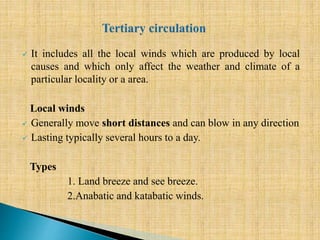
 It includes all the local winds which are produced by local
causes and which only affect the weather and climate of a
particular locality or a area.
Local winds
 Generally move short distances and can blow in any direction
 Lasting typically several hours to a day.
Types
1. Land breeze and see breeze.
2.Anabatic and katabatic winds.
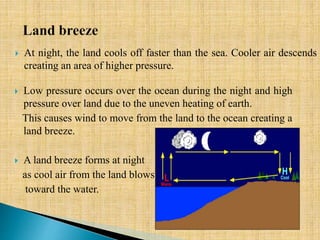
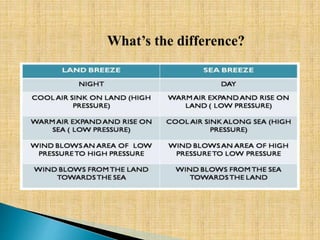
 Low pressure occurs over the ocean during the night and high
pressure over land due to the uneven heating of earth.
This causes wind to move from the land to the ocean creating a
land breeze.
 A land breeze forms at night
as cool air from the land blows
toward the water.
 At night, the land cools off faster than the sea. Cooler air descends
creating an area of higher pressure.
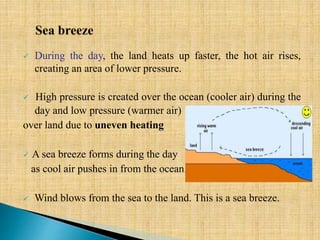
 During the day, the land heats up faster, the hot air rises,
creating an area of lower pressure.
 High pressure is created over the ocean (cooler air) during the
day and low pressure (warmer air)
over land due to uneven heating
 A sea breeze forms during the day
as cool air pushes in from the ocean.
 Wind blows from the sea to the land. This is a sea breeze.
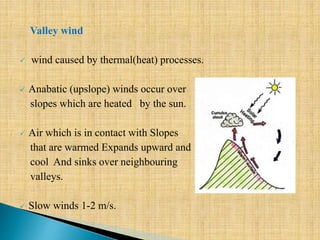
Valley wind
 wind caused by thermal(heat) processes.
 Anabatic (upslope) winds occur over
slopes which are heated by the sun.
 Air which is in contact with Slopes
that are warmed Expands upward and
cool And sinks over neighbouring
valleys.
 Slow winds 1-2 m/s.
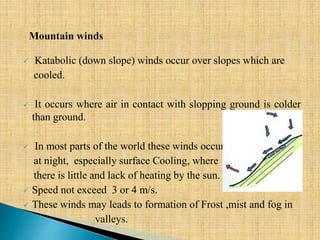
 Katabolic (down slope) winds occur over slopes which are
cooled.
 It occurs where air in contact with slopping ground is colder
than ground.
 In most parts of the world these winds occur
at night, especially surface Cooling, where
there is little and lack of heating by the sun.
 Speed not exceed 3 or 4 m/s.
 These winds may leads to formation of Frost ,mist and fog in
valleys.
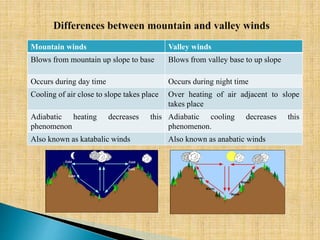
Mountain winds Valley winds
Blows from mountain up slope to base Blows from valley base to up slope
Occurs during day time Occurs during night time
Cooling of air close to slope takes place Over heating of air adjacent to slope
takes place
Adiabatic heating decreases this
phenomenon
Adiabatic cooling decreases this
phenomenon.
Also known as katabalic winds Also known as anabatic winds
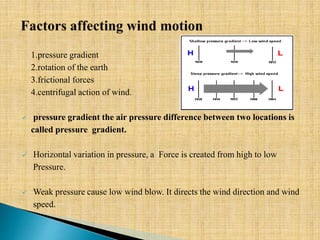
1.pressure gradient
2.rotation of the earth
3.frictional forces
4.centrifugal action of wind.
 pressure gradient the air pressure difference between two locations is
called pressure gradient.
 Horizontal variation in pressure, a Force is created from high to low
Pressure.
 Weak pressure cause low wind blow. It directs the wind direction and wind
speed.
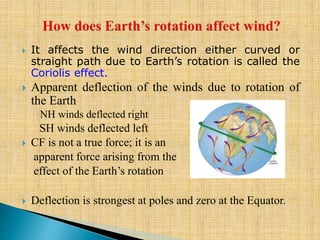
 It affects the wind direction either curved or
straight path due to Earth’s rotation is called the
Coriolis effect.
 Apparent deflection of the winds due to rotation of
the Earth
NH winds deflected right
SH winds deflected left
 CF is not a true force; it is an
apparent force arising from the
effect of the Earth’s rotation
 Deflection is strongest at poles and zero at the Equator.
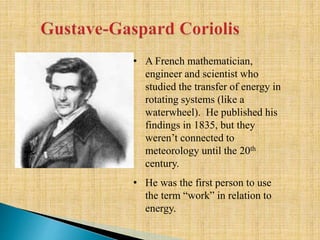
• A French mathematician,
engineer and scientist who
studied the transfer of energy in
rotating systems (like a
waterwheel). He published his
findings in 1835, but they
weren’t connected to
meteorology until the 20th
century.
• He was the first person to use
the term “work” in relation to
energy.
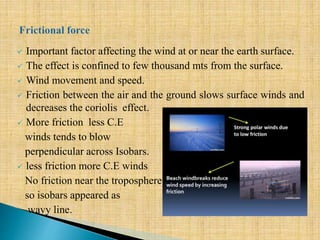
 Important factor affecting the wind at or near the earth surface.
 The effect is confined to few thousand mts from the surface.
 Wind movement and speed.
 Friction between the air and the ground slows surface winds and
decreases the coriolis effect.
 More friction less C.E
winds tends to blow
perpendicular across Isobars.
 less friction more C.E winds
No friction near the troposphere
so isobars appeared as
wavy line.
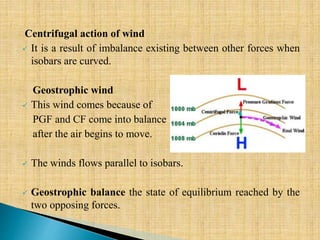
Centrifugal action of wind
 It is a result of imbalance existing between other forces when
isobars are curved.
Geostrophic wind
 This wind comes because of
PGF and CF come into balance
after the air begins to move.
 The winds flows parallel to isobars.
 Geostrophic balance the state of equilibrium reached by the
two opposing forces.
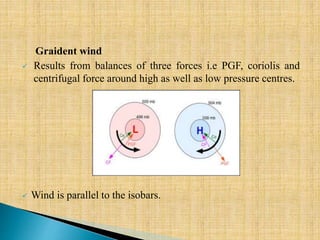
Graident wind
 Results from balances of three forces i.e PGF, coriolis and
centrifugal force around high as well as low pressure centres.
 Wind is parallel to the isobars.
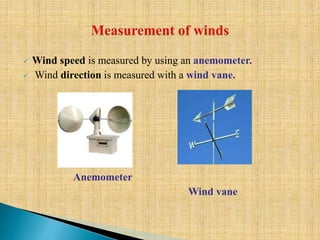
 Wind speed is measured by using an anemometer.
 Wind direction is measured with a wind vane.
Anemometer
Wind vane
 Lodging
 Transpiration and evaporation
 Soil erosion
 Pollination
 Disease spreading
 Insects spread and control
 Weed seed dissemination
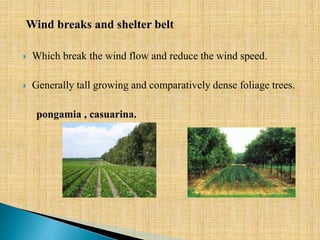
Wind breaks and shelter belt
 Which break the wind flow and reduce the wind speed.
 Generally tall growing and comparatively dense foliage trees.
pongamia , casuarina.
Thank you

Wind [autosaved]

  • 1.
  • 2.
    What is wind? In meteorology – the horizontal movement of air relative to the earth surface. Air movements  Horizontal & vertical  Vertically moving air columns is known as currents. what causes wind?  Caused by a difference in air pressure due to unequal heating of the atmosphere.  Warm air rises, creating areas of low pressure. Cool air sinks, creating areas of high pressure.
  • 3.
    Air moves fromareas of high pressure to areas of low pressure. Example: When you blow up a balloon, you increase the air pressure inside the balloon. When you let go of the end, the air rushes out of the balloon.
  • 4.
    1.Primary circulation orprevailing wind  It includes the planetary wind systems which are related to the general arrangement of pressure belts on the earth’s surface.  It consists of Trade winds, westerlies and polar easterlies. 2.Seondary circulation or periodic winds  It consists of cyclones ,anti-cyclones ,monsoons. 3.Tertiary circulation  It includes all the local winds .
  • 5.
    Global winds  Thesewinds are named by the direction from which they blow.  Global winds are wind systems that occur at or near Earth’s surface.  Don’t travel North and South because of the Earth rotating on its axis.  It is also known as general circulation of the atmosphere.
  • 6.
    ITCZ The exchange ofheat from warm to Colder region. i.e transfer of Atmosphere. This motion of atmosphere over a land surface is known as general circulation of atmosphere.
  • 7.
    Types of GlobalWinds  The globe is encircled by the following wind belts in each hemisphere i.e from pole to equator. A. Doldrums B. trade wind belt C. prevailing westerlies D. polar easterlies A. Doldrums:  These are located at the equator, surface winds are calm and weak with low pressure.  Average location of the doldrums roughly between 50 S and 50N.
  • 8.
     The doldrumsare where the trade winds meet in a calm area around the equator. Very little wind blows in the doldrums.  Located along the equator where no winds blow because the warm rising air creates and area of low pressure. This zone is the meeting place of the two trade winds. It is also called ITCZ.

  • 9.
    B. Trade windbelt  The trade winds blow between 30° latitude and the equator in both hemispheres and curve west.  Trade wind become warm when moves towards the equator with less water vapour content i.e less precipitation.  All tropical deserts located in this belt.  It originates from sub tropical belt Due to high pressure and to equatorial belt of low pressure.  N.E & S.E trade winds in northern and southern hemisphere. E N.E Trade S. E Trade Doldrums 300STH 300STH 600SPL 600SPL 00
  • 10.
    Most deserts onthe Earth are located here because of the dry air. Horse latitude Occur at about 30° north and south of the equator where the winds are very weak and calm. Jet streams are narrow belts of high-speed winds that blow from west to east, between 7 km and 16 km above Earth’s surface. Jet streams consists hot and cold air and can shift north and south. The two main jet streams are the subtropical jet stream and the polar jet stream.
  • 11.
    C. Prevailing Westerlies Locatedin the belt from 30-60 degrees latitude in both hemispheres. Flow towards the poles from west to east carrying moist air over the United States. It’s also called anti trade wind. Moving towards higher latitudes these winds deflected and become north & south westerlies in each hemisphere. While moving towards the higher latitudes the westerlies cooler due to low temperature and carry high water vapour content. Doldrums Prevailing westerlies 300STH 300STH 600SPL 600SPL 00ITCZE
  • 12.
     Highest precipitationzones seen in this belt.  The moving cells of low and high pressures largely affect the movement of westerlies.  However the cyclones and anti cyclone occurs in the region and moving towards the east.  The flow of westerlies is obscured in northern hemisphere due to larger land areas and high mountains ,changing seasonal pressure systems.  Roaring forties ,furious fifties and screaming sixties.
  • 13.
    D. Polar easterlies Wind belts that extend from the poles to 60° latitude.  The wind flow out from polar regions to sub-polar low  This winds are called polar winds and this circulation is called polar cell  Cold air near poles sinks and flow back toward lower latitudes (away from the poles). . ITCZ 300STH 300STH 600SPL 600SPL Polar high Polar high E
  • 14.
    Difference between cyclonesand anti-cyclones Cyclones Anti-cyclones Lowest pressure at the centre. Highest pressure at the centre. Wind velocity increases from outer to centre i.e inward spiralling of air Increases towards outer. i.e Outward spiralling of air. Trough –the line of low pressure. Ridge or wedge –elliptical isobars. More destructive Less destructive More cloudiness &rainfall Less cloudiness Moves anti clock wise in northern hemisphere and clock wise in southern hemisphere. Clock wise in northern anti clock wise in southern hemisphere.
  • 16.
     Arabic wordmausim means season.  2 types south-west and north-east monsoon.  S-w monsoon during summer land masses heat & develop strong low pressure centres.  Active from June to September  80 to 90 percent rainfall received  Enters Kerala on June and  reaches northern parts by July. 2 branch Arabian sea branch- crosses western Ghats  Bay of Bengal branch- gangetic plains.
  • 17.
    North east monsoon During the winter the land Mass cools more rapidly than surrounding oceans and create high pressure Centre.  Active from Oct to mid Dec.  Rainfall received 10 to 20 percent Of the total annual rainfall of India.  Covering the parts of Andhrapradesh And Tamil Nadu.
  • 18.
     It includesall the local winds which are produced by local causes and which only affect the weather and climate of a particular locality or a area. Local winds  Generally move short distances and can blow in any direction  Lasting typically several hours to a day. Types 1. Land breeze and see breeze. 2.Anabatic and katabatic winds.
  • 19.
     Low pressureoccurs over the ocean during the night and high pressure over land due to the uneven heating of earth. This causes wind to move from the land to the ocean creating a land breeze.  A land breeze forms at night as cool air from the land blows toward the water.  At night, the land cools off faster than the sea. Cooler air descends creating an area of higher pressure.
  • 20.
     During theday, the land heats up faster, the hot air rises, creating an area of lower pressure.  High pressure is created over the ocean (cooler air) during the day and low pressure (warmer air) over land due to uneven heating  A sea breeze forms during the day as cool air pushes in from the ocean.  Wind blows from the sea to the land. This is a sea breeze.
  • 22.
    Valley wind  windcaused by thermal(heat) processes.  Anabatic (upslope) winds occur over slopes which are heated by the sun.  Air which is in contact with Slopes that are warmed Expands upward and cool And sinks over neighbouring valleys.  Slow winds 1-2 m/s.
  • 23.
     Katabolic (downslope) winds occur over slopes which are cooled.  It occurs where air in contact with slopping ground is colder than ground.  In most parts of the world these winds occur at night, especially surface Cooling, where there is little and lack of heating by the sun.  Speed not exceed 3 or 4 m/s.  These winds may leads to formation of Frost ,mist and fog in valleys.
  • 24.
    Mountain winds Valleywinds Blows from mountain up slope to base Blows from valley base to up slope Occurs during day time Occurs during night time Cooling of air close to slope takes place Over heating of air adjacent to slope takes place Adiabatic heating decreases this phenomenon Adiabatic cooling decreases this phenomenon. Also known as katabalic winds Also known as anabatic winds
  • 26.
    1.pressure gradient 2.rotation ofthe earth 3.frictional forces 4.centrifugal action of wind.  pressure gradient the air pressure difference between two locations is called pressure gradient.  Horizontal variation in pressure, a Force is created from high to low Pressure.  Weak pressure cause low wind blow. It directs the wind direction and wind speed.
  • 27.
     It affectsthe wind direction either curved or straight path due to Earth’s rotation is called the Coriolis effect.  Apparent deflection of the winds due to rotation of the Earth NH winds deflected right SH winds deflected left  CF is not a true force; it is an apparent force arising from the effect of the Earth’s rotation  Deflection is strongest at poles and zero at the Equator.
  • 28.
    • A Frenchmathematician, engineer and scientist who studied the transfer of energy in rotating systems (like a waterwheel). He published his findings in 1835, but they weren’t connected to meteorology until the 20th century. • He was the first person to use the term “work” in relation to energy.
  • 29.
     Important factoraffecting the wind at or near the earth surface.  The effect is confined to few thousand mts from the surface.  Wind movement and speed.  Friction between the air and the ground slows surface winds and decreases the coriolis effect.  More friction less C.E winds tends to blow perpendicular across Isobars.  less friction more C.E winds No friction near the troposphere so isobars appeared as wavy line.
  • 30.
    Centrifugal action ofwind  It is a result of imbalance existing between other forces when isobars are curved. Geostrophic wind  This wind comes because of PGF and CF come into balance after the air begins to move.  The winds flows parallel to isobars.  Geostrophic balance the state of equilibrium reached by the two opposing forces.
  • 31.
    Graident wind  Resultsfrom balances of three forces i.e PGF, coriolis and centrifugal force around high as well as low pressure centres.  Wind is parallel to the isobars.
  • 32.
     Wind speedis measured by using an anemometer.  Wind direction is measured with a wind vane. Anemometer Wind vane
  • 33.
     Lodging  Transpirationand evaporation  Soil erosion  Pollination  Disease spreading  Insects spread and control  Weed seed dissemination
  • 34.
    Wind breaks andshelter belt  Which break the wind flow and reduce the wind speed.  Generally tall growing and comparatively dense foliage trees. pongamia , casuarina.
  • 35.