Structural Basis of Life
By Prof. Liwayway Memije-Cruz
Cell Physiology
All cells exhibit irritability, digest foods,
excrete waste, and are able to reproduce,
grow, move and metabolize. Concentrating
on cell environments developed cell
physiology. Physiologists found out that
human cells survive only in highly
specialized environments composed of
minerals, water, nutrients and other
constituents.
Principles of cell theory:
In 1838 and 1839, Matthias Jacob Schleiden, a
German botanist and Theodor Schwann, a
German zoologist published the so-called cell
theory. They stated the principle with particular
clarity, and later gained the general acceptance
of the scientists during their time. According to
them:
 All organisms are composed of one or more cells.
 The cell is the basic living unit of organization.
 All cells arise from pre- existing cells.
INTRODUCTION
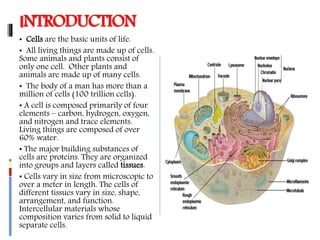
• Cells are the basic units of life.
• All living things are made up of cells.
Some animals and plants consist of
only one cell. Other plants and
animals are made up of many cells.
• The body of a man has more than a
million of cells (100 trillion cells).
• A cell is composed primarily of four
elements – carbon, hydrogen, oxygen,
and nitrogen and trace elements.
Living things are composed of over
60% water.
• The major building substances of
cells are proteins. They are organized
into groups and layers called tissues.
• Cells vary in size from microscopic to
over a meter in length. The cells of
different tissues vary in size, shape,
arrangement, and function.
Intercellular materials whose
composition varies from solid to liquid
separate cells.
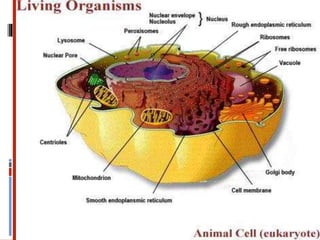
Major parts of a typical cell:
Nucleus
 governs the activities of the cell
 necessary for reproduction. The nucleus
contains genetic material called
deoxyribonucleic acid (DNA), which carries
hereditary instructions
 directs the production of proteins.
 is the structure, usually found near the center
of the cell that contains the cell’s hereditary
material.
Characteristic structures of the nucleus
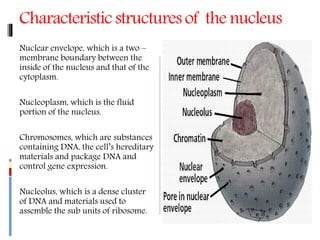
Nuclear envelope, which is a two –
membrane boundary between the
inside of the nucleus and that of the
cytoplasm.
Nucleoplasm, which is the fluid
portion of the nucleus.
Chromosomes, which are substances
containing DNA, the cell’s hereditary
materials and package DNA and
control gene expression.
Nucleolus, which is a dense cluster
of DNA and materials used to
assemble the sub units of ribosome.
Cytoplasm
• the part of the cell where
most cellular activities occur.
• its fluid substance called
cytosol contains inclusions,
stoned or inactive such as fat
globules, water vacuoles,
crystals in the cytoplasm and
specialized bodies known as
organelles.
• a site of metabolic reactions,
in which the cytoplasmic
organelles play specific roles.
The specialized organelles are:
 MITOCHONDRIA, WHICH ARE THE
CELL’S POWER PLANTS, WHICH
PRODUCE MOST OF THE ENERGY.
 GOLGI BODIES, WHICH TRANSPORT
PROTEINS AND OTHER MATERIALS.
 LYSOSOMES, WHICH ARE FOR
DEGRADATION AND RECYCLING OF
MATERIALS.
 ENDOPLASMIC RETICULUM, WHICH
IS A SYSTEM OF DEEP CHANNELS
THAT WINDS THROUGHOUT THE
CYTOPLASM. MANUFACTURES
PROTEINS, LIPID COMPONENTS OF
MEMBRANE AND MODIFIES
PROTEINS FOR SECRETION.
 PEROXISOMES, WHICH DISARM
DANGEROUS CHEMICAL IN THE
CELLS.
 RIBOSOMES, WHICH ARE TINY,
ROUND BODIES THAT BORDER THE
ENDOPLASMIC RETICULUM THAT
ARE RESPONSIBLE FOR PROTEIN
SYNTHESIS.
Plasma membrane
 The plasma membrane limits and encloses the
cytoplasm and acts as a selective barrier to
the movement of substances into and out of
the cell. It is composed of a bilipid layer
containing proteins. The water -
impermeable lipid portion forms the basic
fibers of the membranes. Proteins act as
enzymes or carriers in membrane transport,
form pores, provide reception sites for
hormones and other chemicals or play a role
in cellular replication and interactions during
development and immune reactions.

Structural Basis of Life

Structural Basis of Life

  • 1.
    Structural Basis ofLife By Prof. Liwayway Memije-Cruz
  • 3.
    Cell Physiology All cellsexhibit irritability, digest foods, excrete waste, and are able to reproduce, grow, move and metabolize. Concentrating on cell environments developed cell physiology. Physiologists found out that human cells survive only in highly specialized environments composed of minerals, water, nutrients and other constituents.
  • 4.
    Principles of celltheory: In 1838 and 1839, Matthias Jacob Schleiden, a German botanist and Theodor Schwann, a German zoologist published the so-called cell theory. They stated the principle with particular clarity, and later gained the general acceptance of the scientists during their time. According to them:  All organisms are composed of one or more cells.  The cell is the basic living unit of organization.  All cells arise from pre- existing cells.
  • 5.
    INTRODUCTION • Cells arethe basic units of life. • All living things are made up of cells. Some animals and plants consist of only one cell. Other plants and animals are made up of many cells. • The body of a man has more than a million of cells (100 trillion cells). • A cell is composed primarily of four elements – carbon, hydrogen, oxygen, and nitrogen and trace elements. Living things are composed of over 60% water. • The major building substances of cells are proteins. They are organized into groups and layers called tissues. • Cells vary in size from microscopic to over a meter in length. The cells of different tissues vary in size, shape, arrangement, and function. Intercellular materials whose composition varies from solid to liquid separate cells.
  • 6.
    Major parts ofa typical cell: Nucleus  governs the activities of the cell  necessary for reproduction. The nucleus contains genetic material called deoxyribonucleic acid (DNA), which carries hereditary instructions  directs the production of proteins.  is the structure, usually found near the center of the cell that contains the cell’s hereditary material.
  • 7.
    Characteristic structures ofthe nucleus Nuclear envelope, which is a two – membrane boundary between the inside of the nucleus and that of the cytoplasm. Nucleoplasm, which is the fluid portion of the nucleus. Chromosomes, which are substances containing DNA, the cell’s hereditary materials and package DNA and control gene expression. Nucleolus, which is a dense cluster of DNA and materials used to assemble the sub units of ribosome.
  • 8.
    Cytoplasm • the partof the cell where most cellular activities occur. • its fluid substance called cytosol contains inclusions, stoned or inactive such as fat globules, water vacuoles, crystals in the cytoplasm and specialized bodies known as organelles. • a site of metabolic reactions, in which the cytoplasmic organelles play specific roles. The specialized organelles are:  MITOCHONDRIA, WHICH ARE THE CELL’S POWER PLANTS, WHICH PRODUCE MOST OF THE ENERGY.  GOLGI BODIES, WHICH TRANSPORT PROTEINS AND OTHER MATERIALS.  LYSOSOMES, WHICH ARE FOR DEGRADATION AND RECYCLING OF MATERIALS.  ENDOPLASMIC RETICULUM, WHICH IS A SYSTEM OF DEEP CHANNELS THAT WINDS THROUGHOUT THE CYTOPLASM. MANUFACTURES PROTEINS, LIPID COMPONENTS OF MEMBRANE AND MODIFIES PROTEINS FOR SECRETION.  PEROXISOMES, WHICH DISARM DANGEROUS CHEMICAL IN THE CELLS.  RIBOSOMES, WHICH ARE TINY, ROUND BODIES THAT BORDER THE ENDOPLASMIC RETICULUM THAT ARE RESPONSIBLE FOR PROTEIN SYNTHESIS.
  • 9.
    Plasma membrane  Theplasma membrane limits and encloses the cytoplasm and acts as a selective barrier to the movement of substances into and out of the cell. It is composed of a bilipid layer containing proteins. The water - impermeable lipid portion forms the basic fibers of the membranes. Proteins act as enzymes or carriers in membrane transport, form pores, provide reception sites for hormones and other chemicals or play a role in cellular replication and interactions during development and immune reactions. 