Pressure and Winds
Today’s objectives:
-we will be able to define key terms
in Gateway 2
-we will be able to explain the
various causes of climate change
• Air pressure (atmospheric pressure): the
downward force exerted by the air’s weight per
unit area on the Earth’s surface
– about 1kg / cm2
• Relationship between pressure & altitude?
Negative relationship!
Low pressure occurs when altitude is higher.
Air molecules are far apart and air becomes thinner.
High pressure occurs when altitude is lower.
Air molecules are closely packed and air becomes
denser.
Pressure and winds
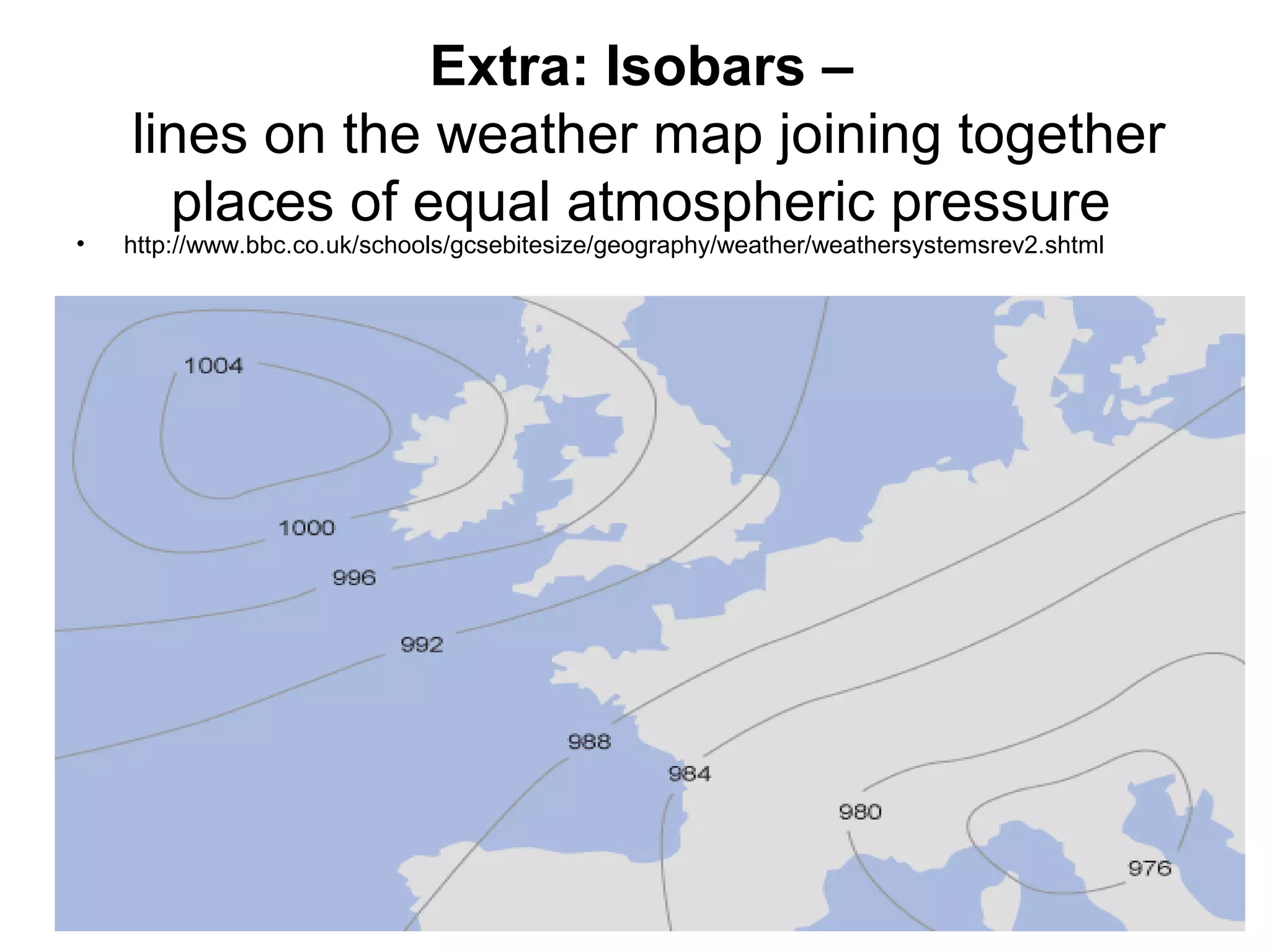
Extra: Isobars –
lines on the weather map joining together
places of equal atmospheric pressure
• http://www.bbc.co.uk/schools/gcsebitesize/geography/weather/weathersystemsrev2.shtml
6. Pressure and winds
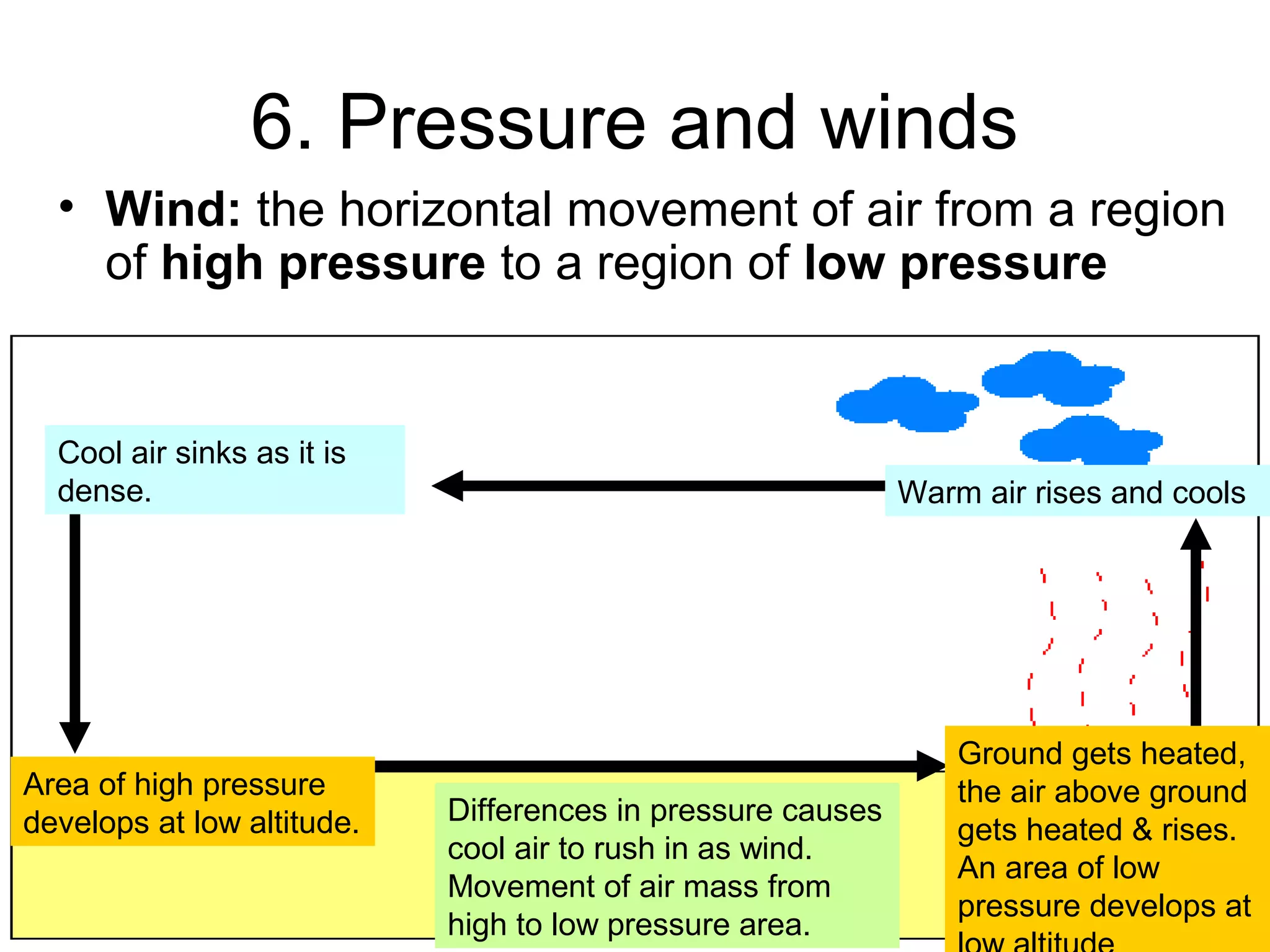
• Wind: the horizontal movement of air from a region
of high pressure to a region of low pressure
Area of high pressure
develops at low altitude. Differences in pressure causes
cool air to rush in as wind.
Movement of air mass from
high to low pressure area.
Ground gets heated,
the air above ground
gets heated & rises.
An area of low
pressure develops at
Warm air rises and cools
Cool air sinks as it is
dense.
6. Pressure and winds
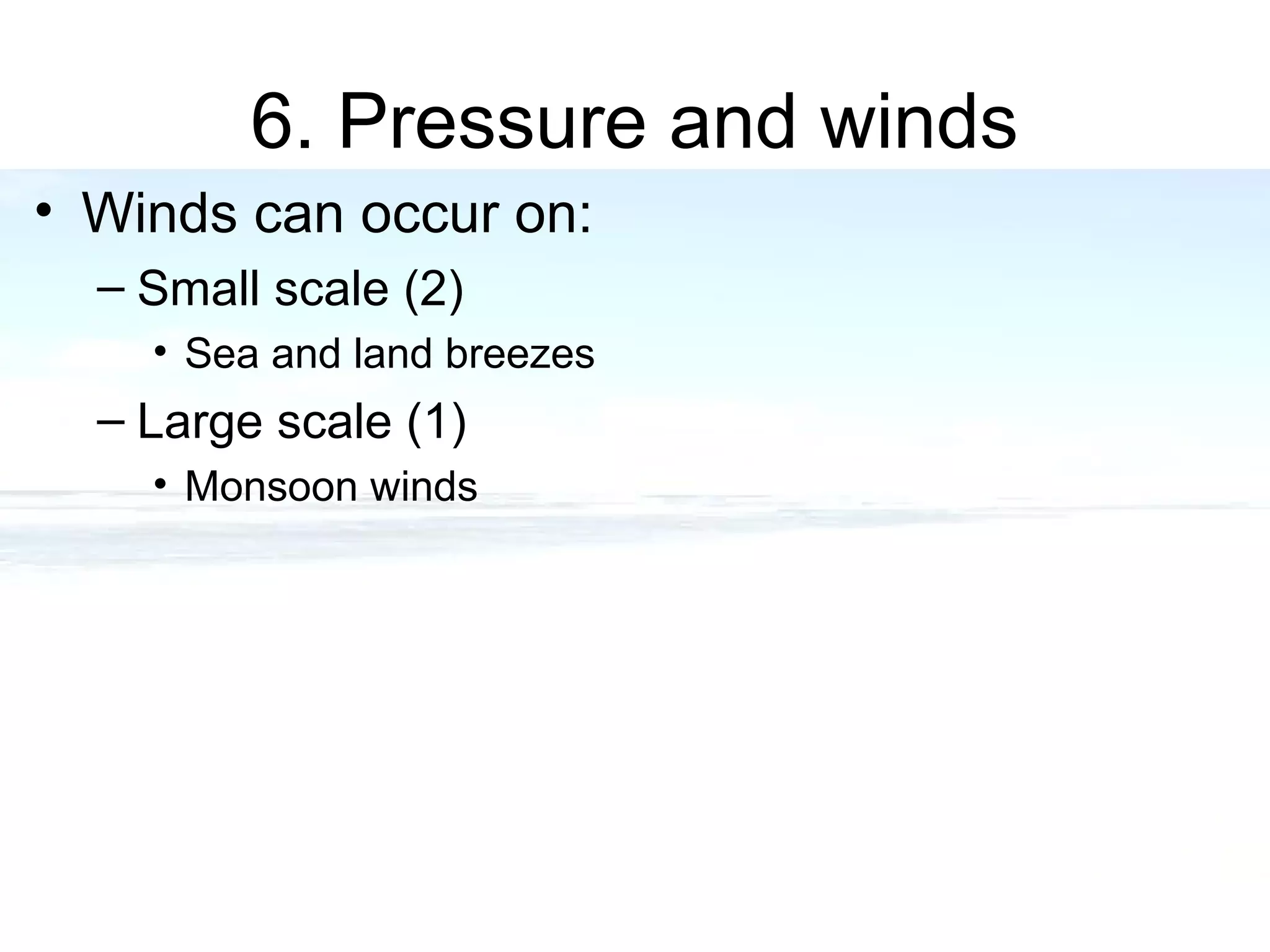
• Winds can occur on:
– Small scale (2)
• Sea and land breezes
– Large scale (1)
• Monsoon winds
6. Pressure and winds
• Sea and Land Breezes
– http://www.classzone.com/books/earth_science/terc/content/visualizations/es1903/es1903page01.cfm
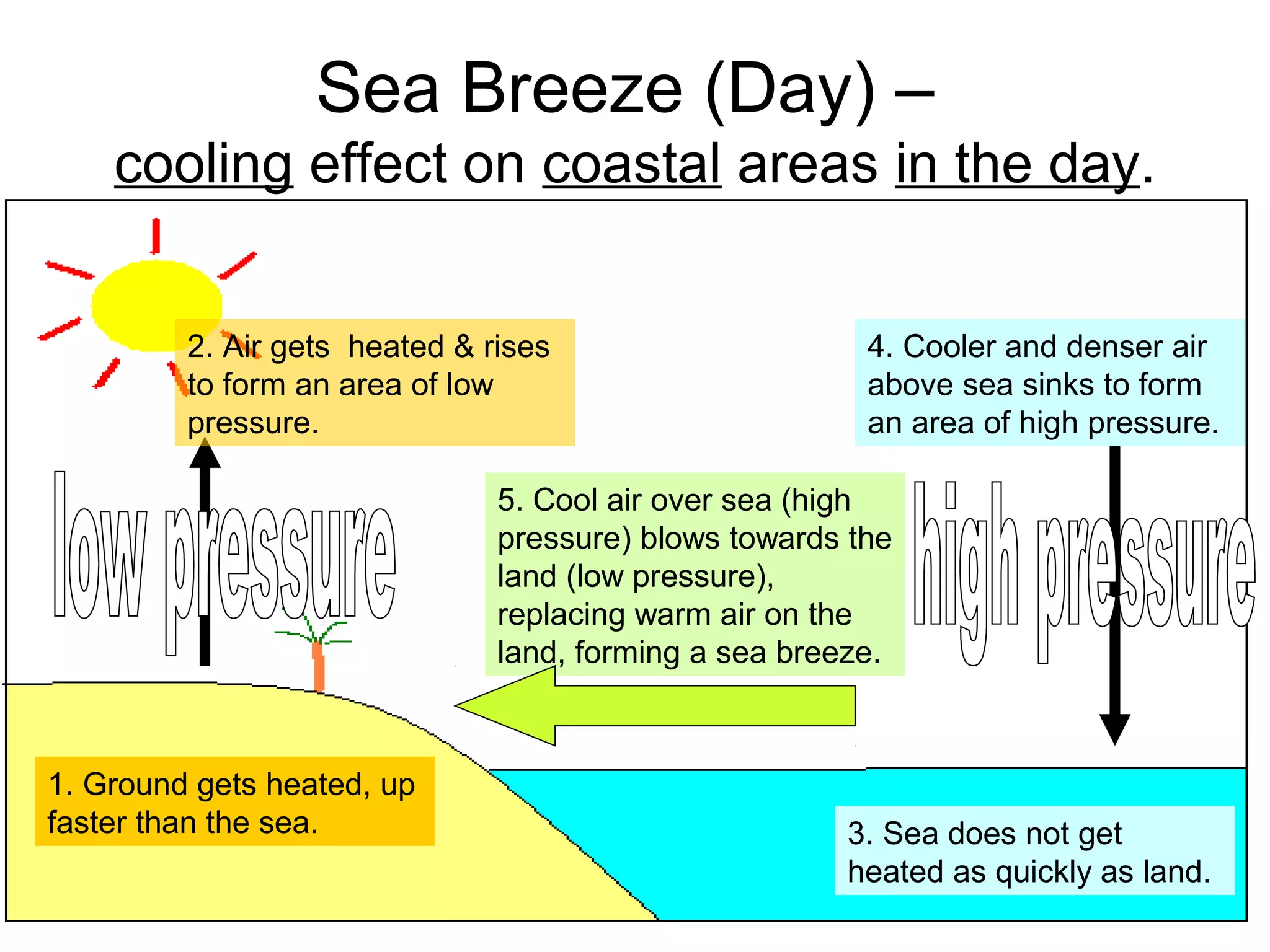
Sea Breeze (Day) –
cooling effect on coastal areas in the day.
1. Ground gets heated, up
faster than the sea. 3. Sea does not get
heated as quickly as land.
4. Cooler and denser air
above sea sinks to form
an area of high pressure.
2. Air gets heated & rises
to form an area of low
pressure.
5. Cool air over sea (high
pressure) blows towards the
land (low pressure),
replacing warm air on the
land, forming a sea breeze.
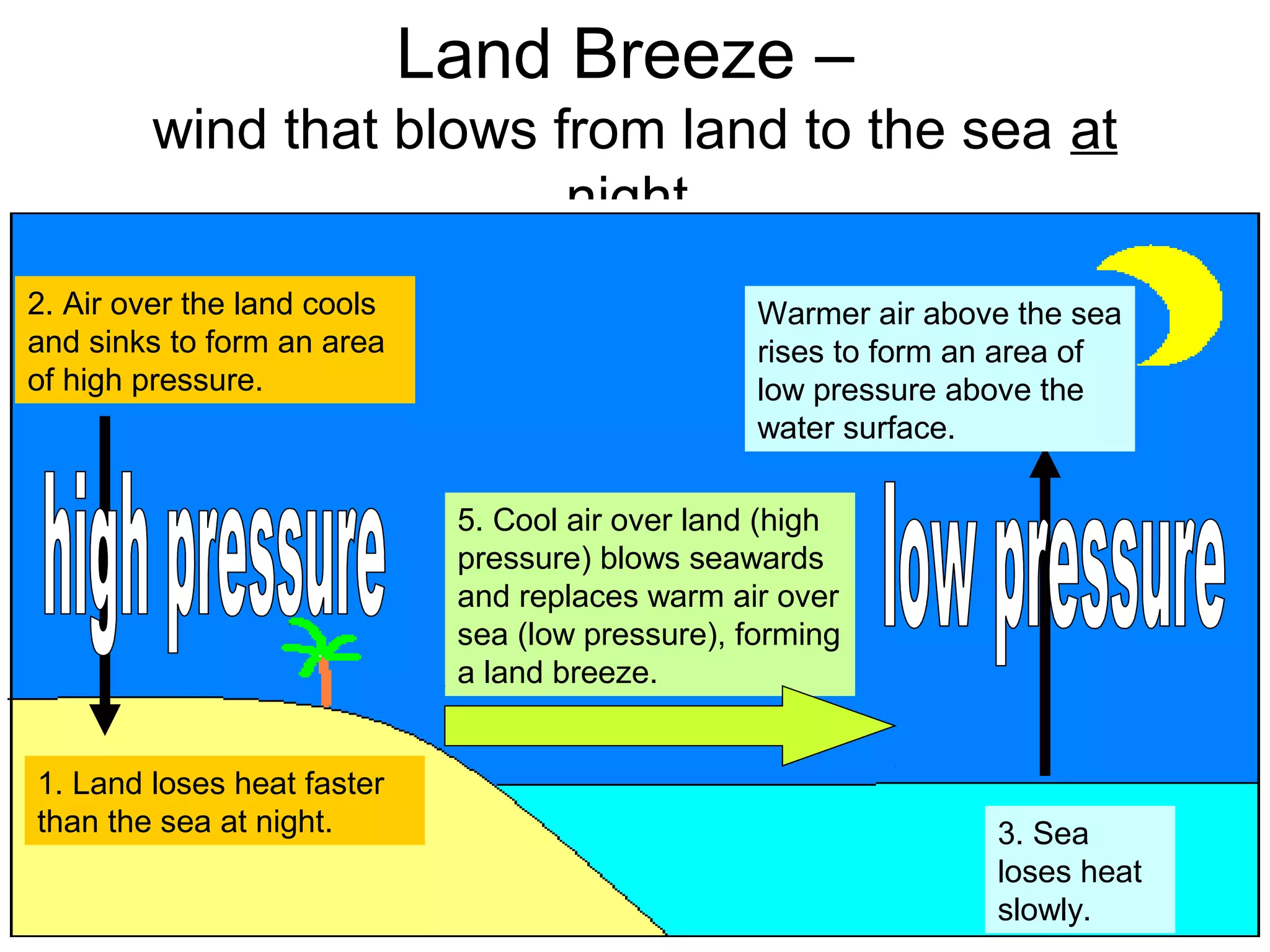
Land Breeze –
wind that blows from land to the sea at
night.
1. Land loses heat faster
than the sea at night. 3. Sea
loses heat
slowly.
Warmer air above the sea
rises to form an area of
low pressure above the
water surface.
2. Air over the land cools
and sinks to form an area
of high pressure.
5. Cool air over land (high
pressure) blows seawards
and replaces warm air over
sea (low pressure), forming
a land breeze.
6. Pressure and winds
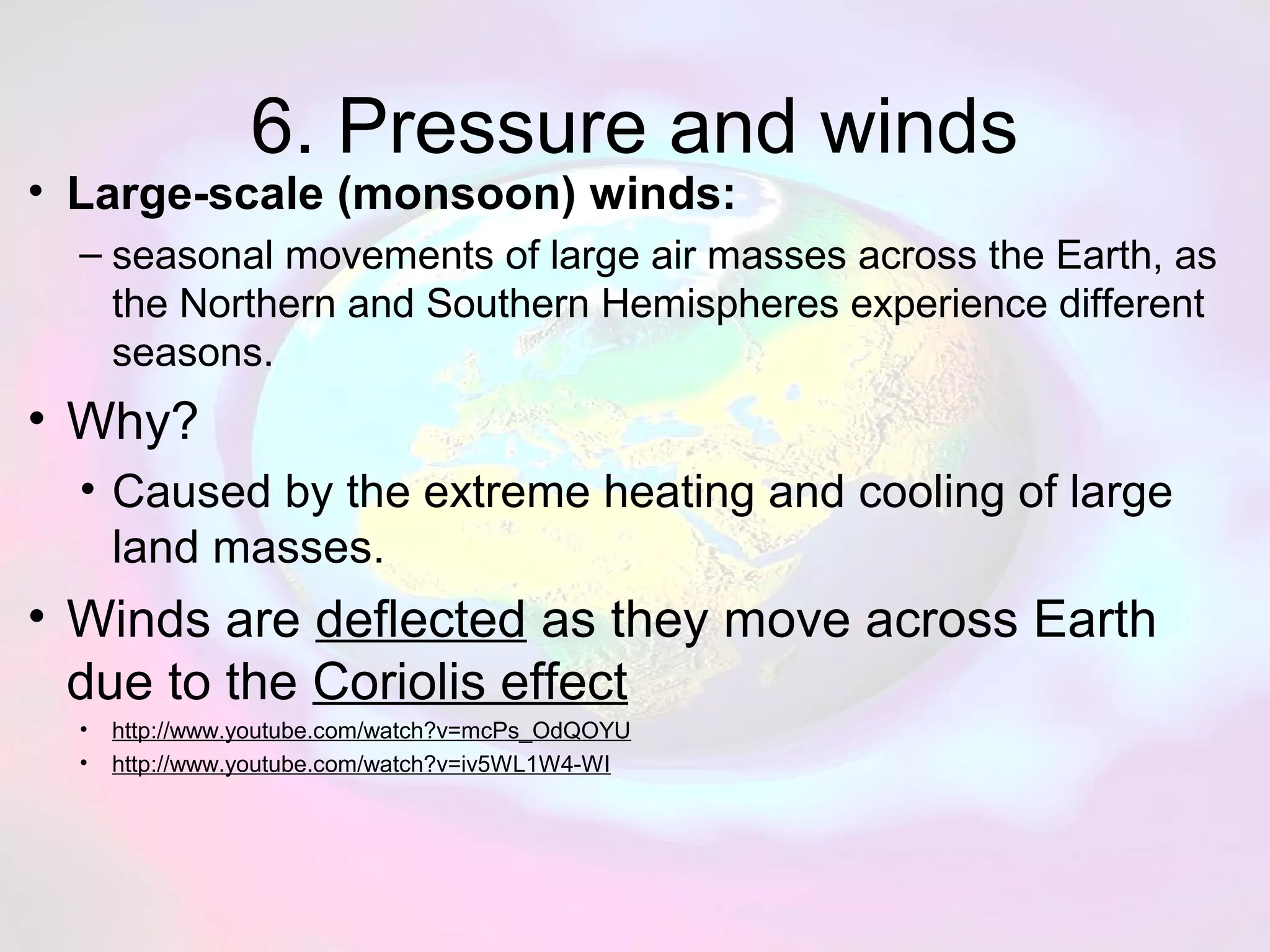
• Large-scale (monsoon) winds:
– seasonal movements of large air masses across the Earth, as
the Northern and Southern Hemispheres experience different
seasons.
• Why?
• Caused by the extreme heating and cooling of large
land masses.
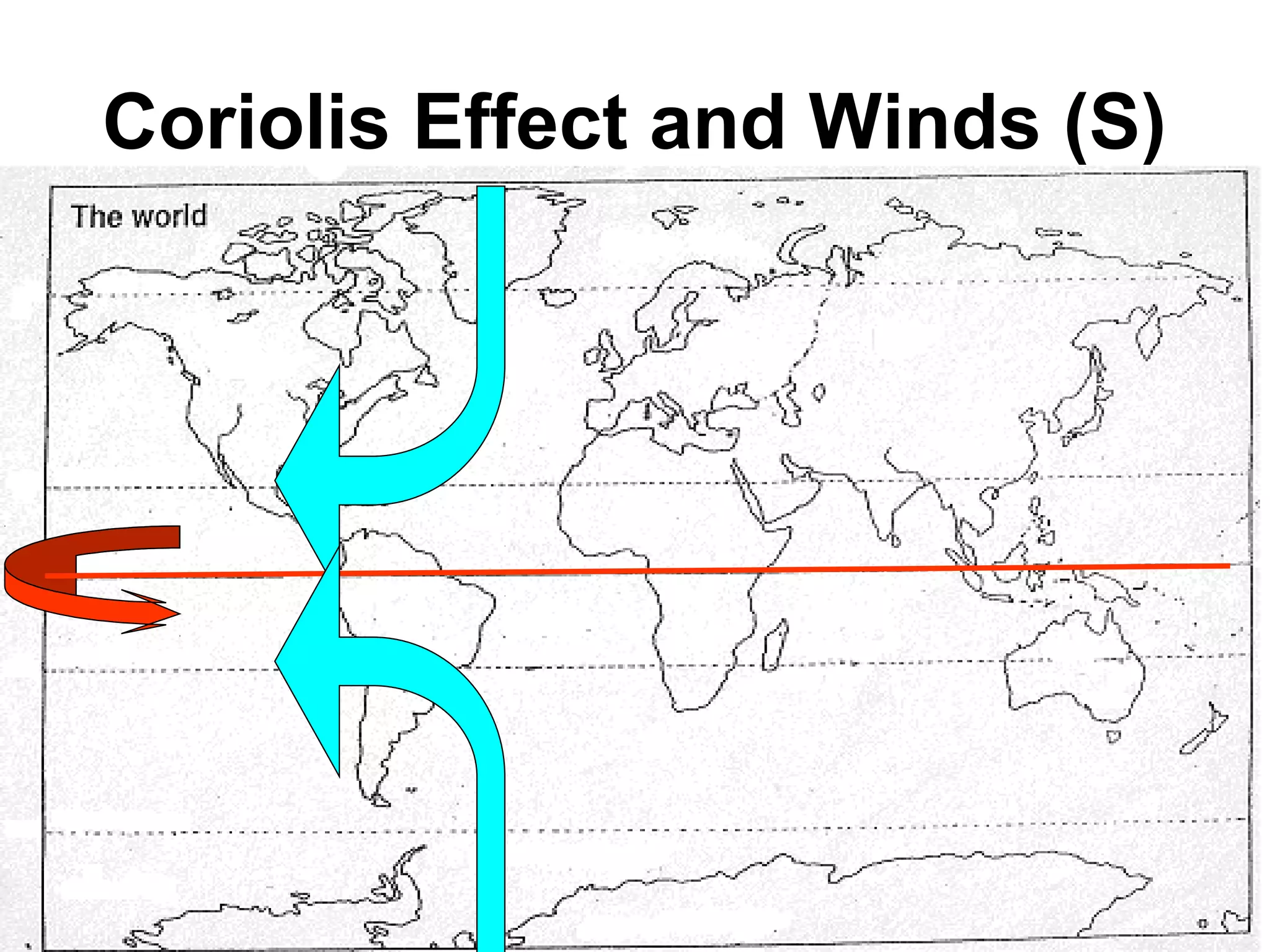
• Winds are deflected as they move across Earth
due to the Coriolis effect
• http://www.youtube.com/watch?v=mcPs_OdQOYU
• http://www.youtube.com/watch?v=iv5WL1W4-WI
Coriolis Effect and Winds (S)
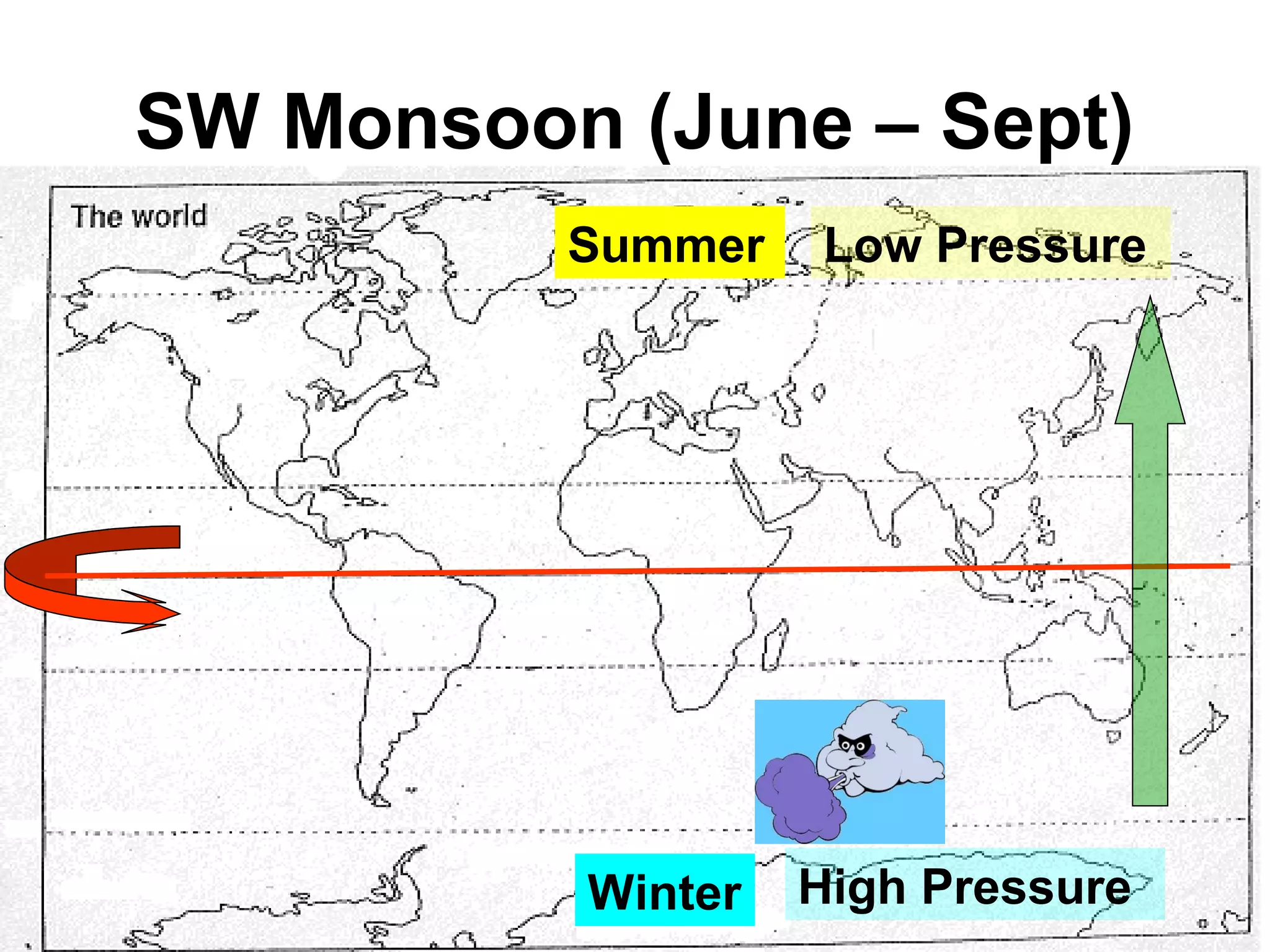
Summer
Winter
SW Monsoon (June – Sept)
High Pressure
Low Pressure
6. Pressure and winds
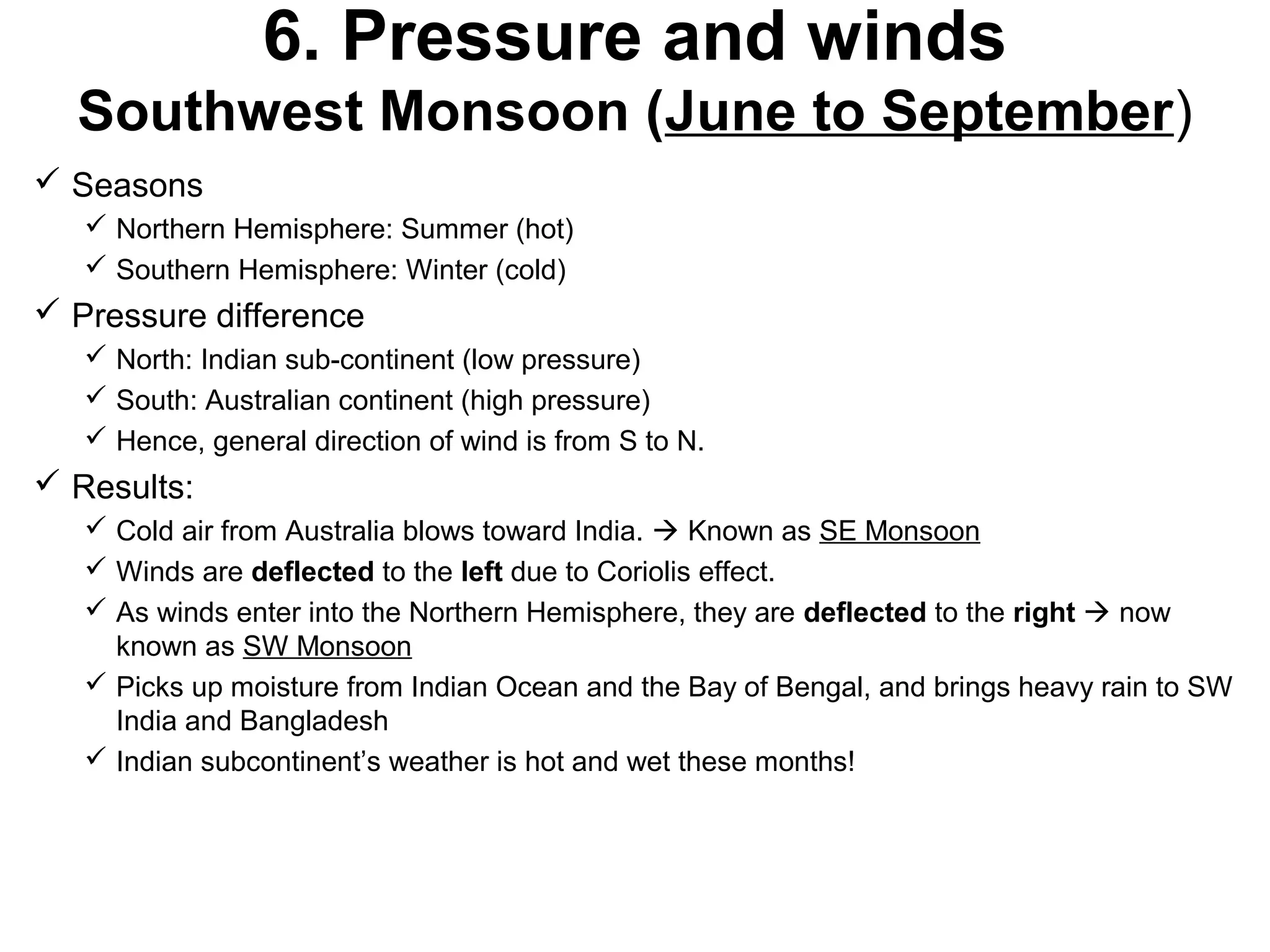
Southwest Monsoon (June to September)
 Seasons
 Northern Hemisphere: Summer (hot)
 Southern Hemisphere: Winter (cold)
 Pressure difference
 North: Indian sub-continent (low pressure)
 South: Australian continent (high pressure)
 Hence, general direction of wind is from S to N.
 Results:
 Cold air from Australia blows toward India.  Known as SE Monsoon
 Winds are deflected to the left due to Coriolis effect.
 As winds enter into the Northern Hemisphere, they are deflected to the right  now
known as SW Monsoon
 Picks up moisture from Indian Ocean and the Bay of Bengal, and brings heavy rain to SW
India and Bangladesh
 Indian subcontinent’s weather is hot and wet these months!
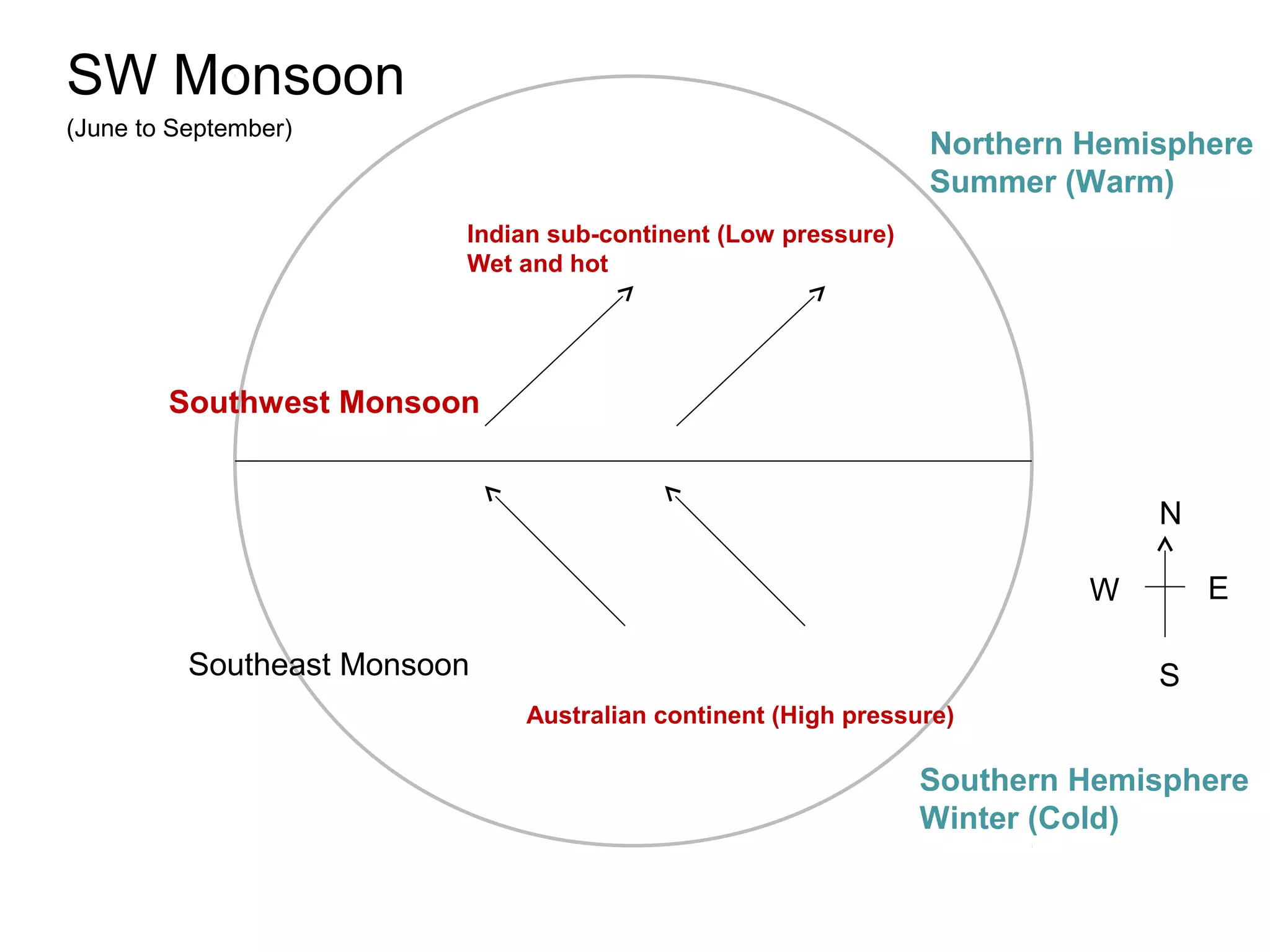
SW Monsoon
(June to September)
Southeast Monsoon
Southwest Monsoon
Northern Hemisphere
Summer (Warm)
Southern Hemisphere
Winter (Cold)
Indian sub-continent (Low pressure)
Wet and hot
Australian continent (High pressure)
N
W E
S
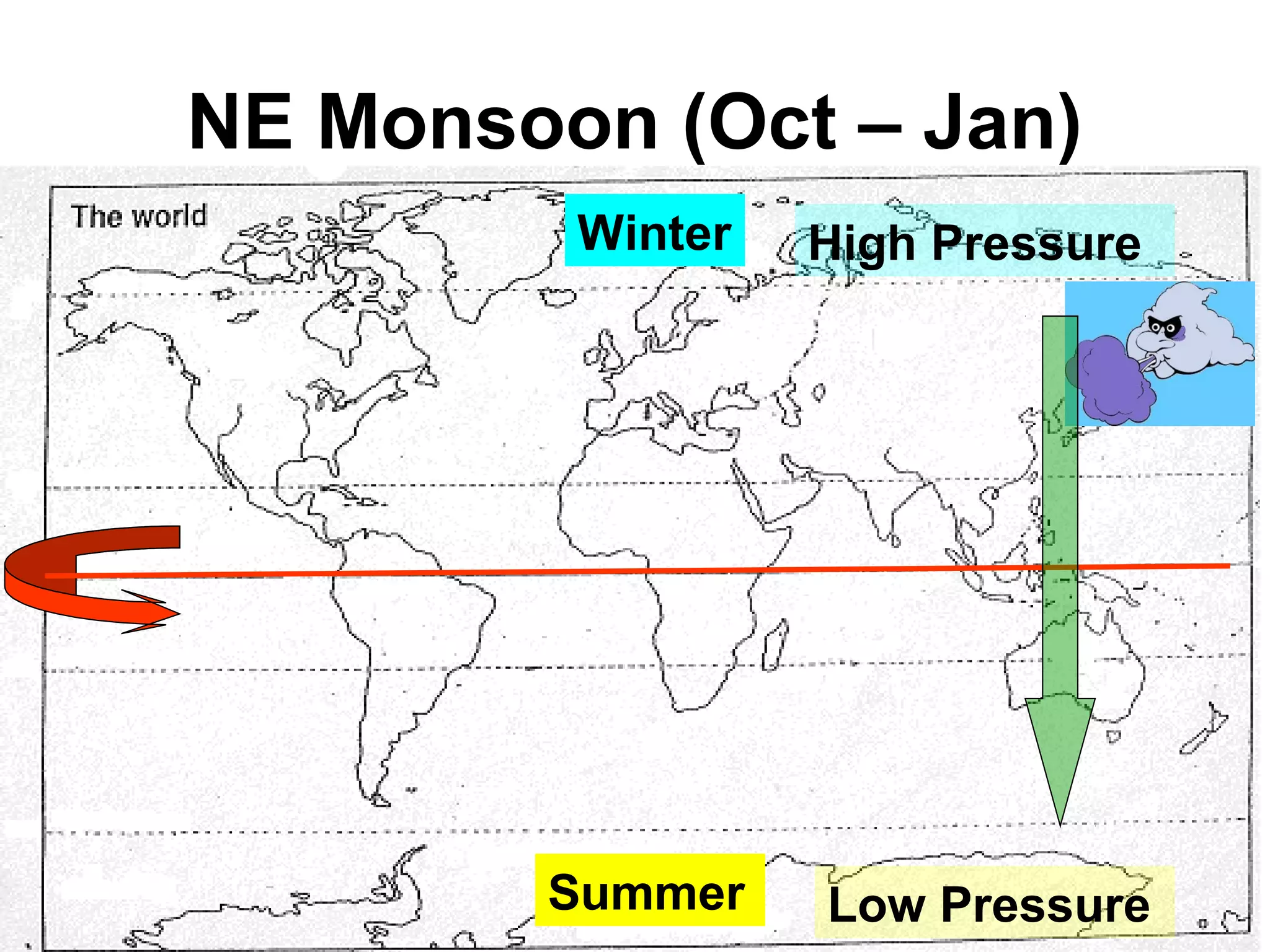
Summer
Winter
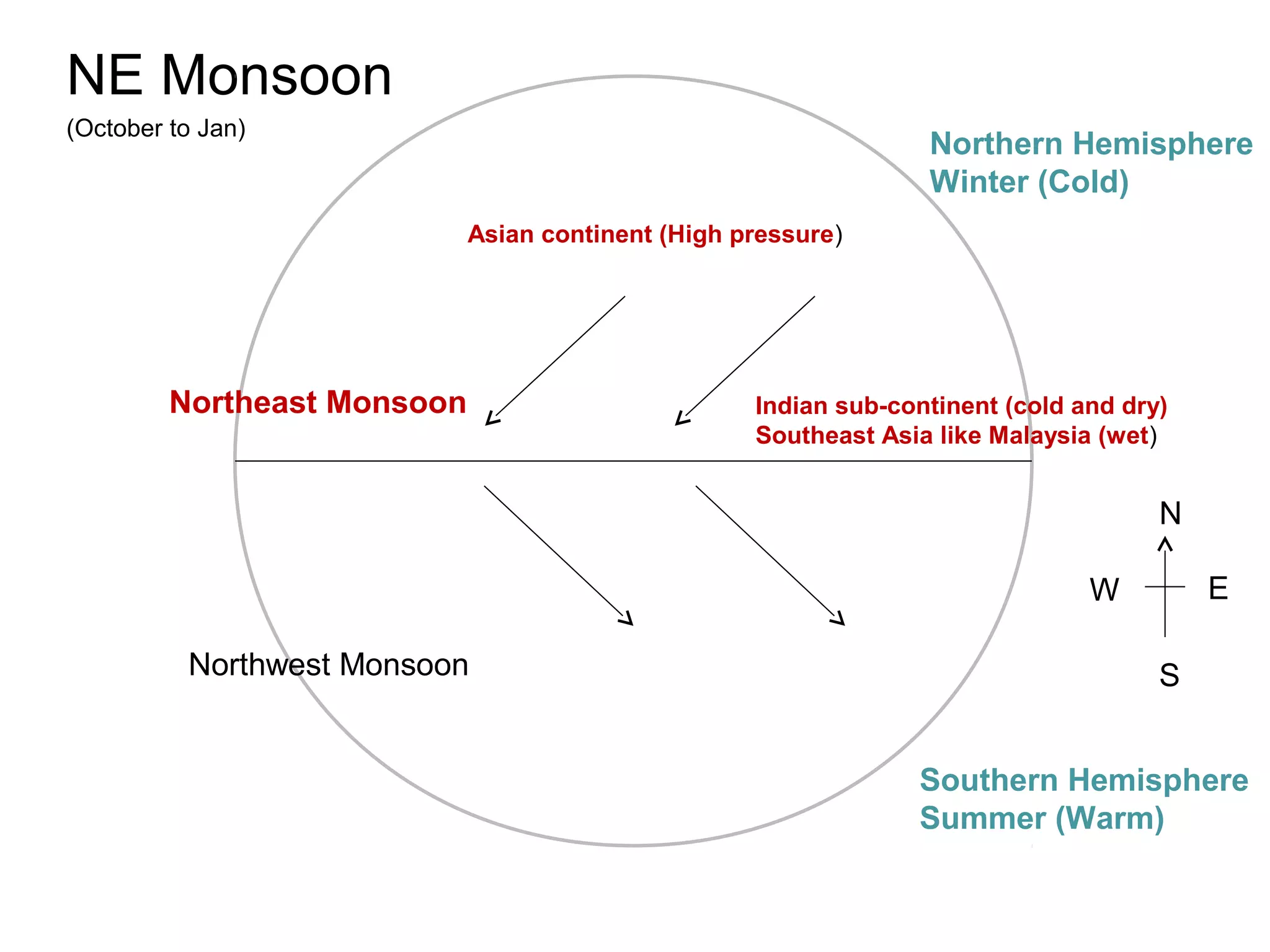
NE Monsoon (Oct – Jan)
High Pressure
Low Pressure
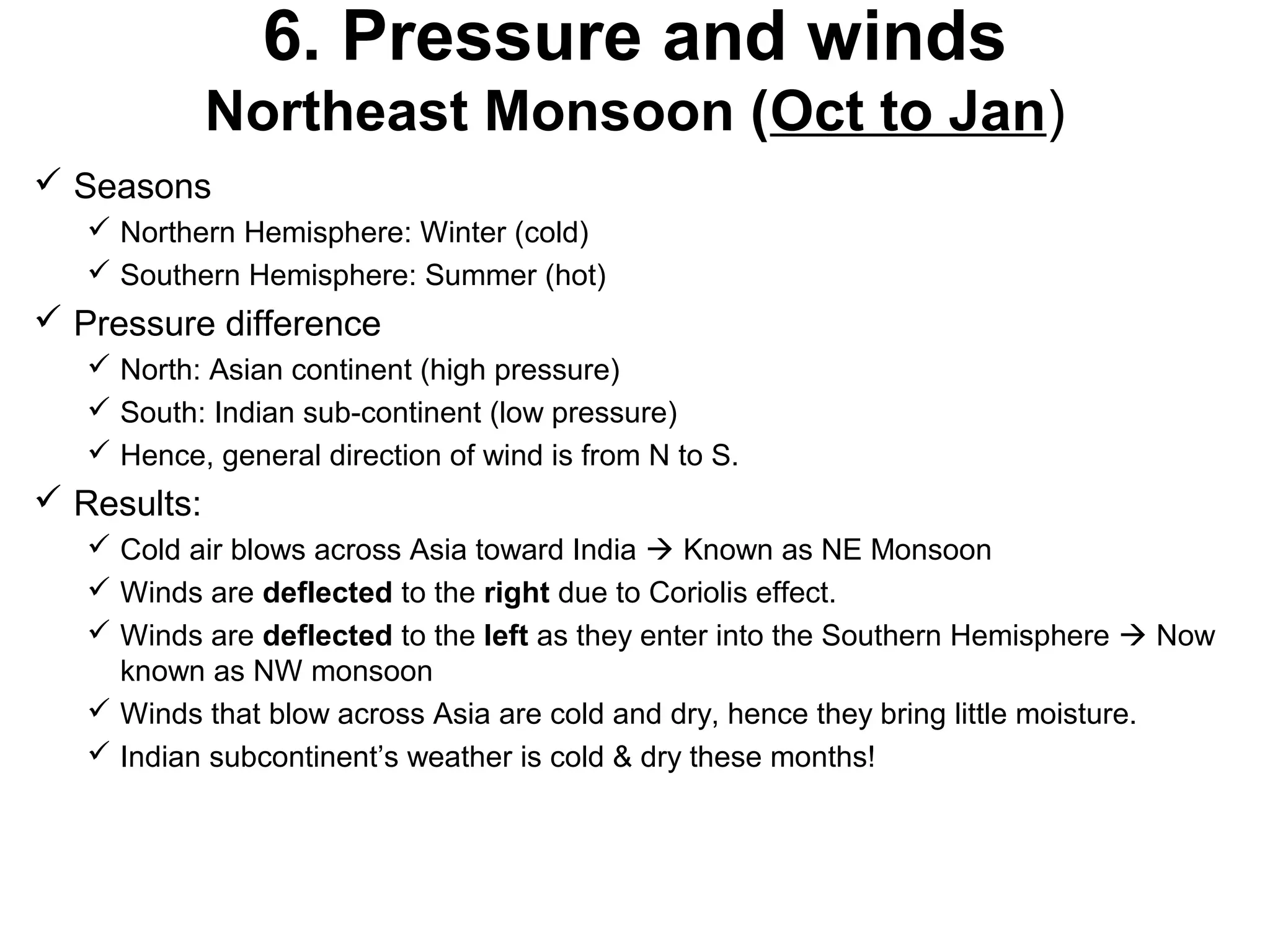
6. Pressure and winds
Northeast Monsoon (Oct to Jan)
 Seasons
 Northern Hemisphere: Winter (cold)
 Southern Hemisphere: Summer (hot)
 Pressure difference
 North: Asian continent (high pressure)
 South: Indian sub-continent (low pressure)
 Hence, general direction of wind is from N to S.
 Results:
 Cold air blows across Asia toward India  Known as NE Monsoon
 Winds are deflected to the right due to Coriolis effect.
 Winds are deflected to the left as they enter into the Southern Hemisphere  Now
known as NW monsoon
 Winds that blow across Asia are cold and dry, hence they bring little moisture.
 Indian subcontinent’s weather is cold & dry these months!
NE Monsoon
(October to Jan)
Northwest Monsoon
Northeast Monsoon
Northern Hemisphere
Winter (Cold)
Southern Hemisphere
Summer (Warm)
Asian continent (High pressure)
Indian sub-continent (cold and dry)
Southeast Asia like Malaysia (wet)
N
W E
S
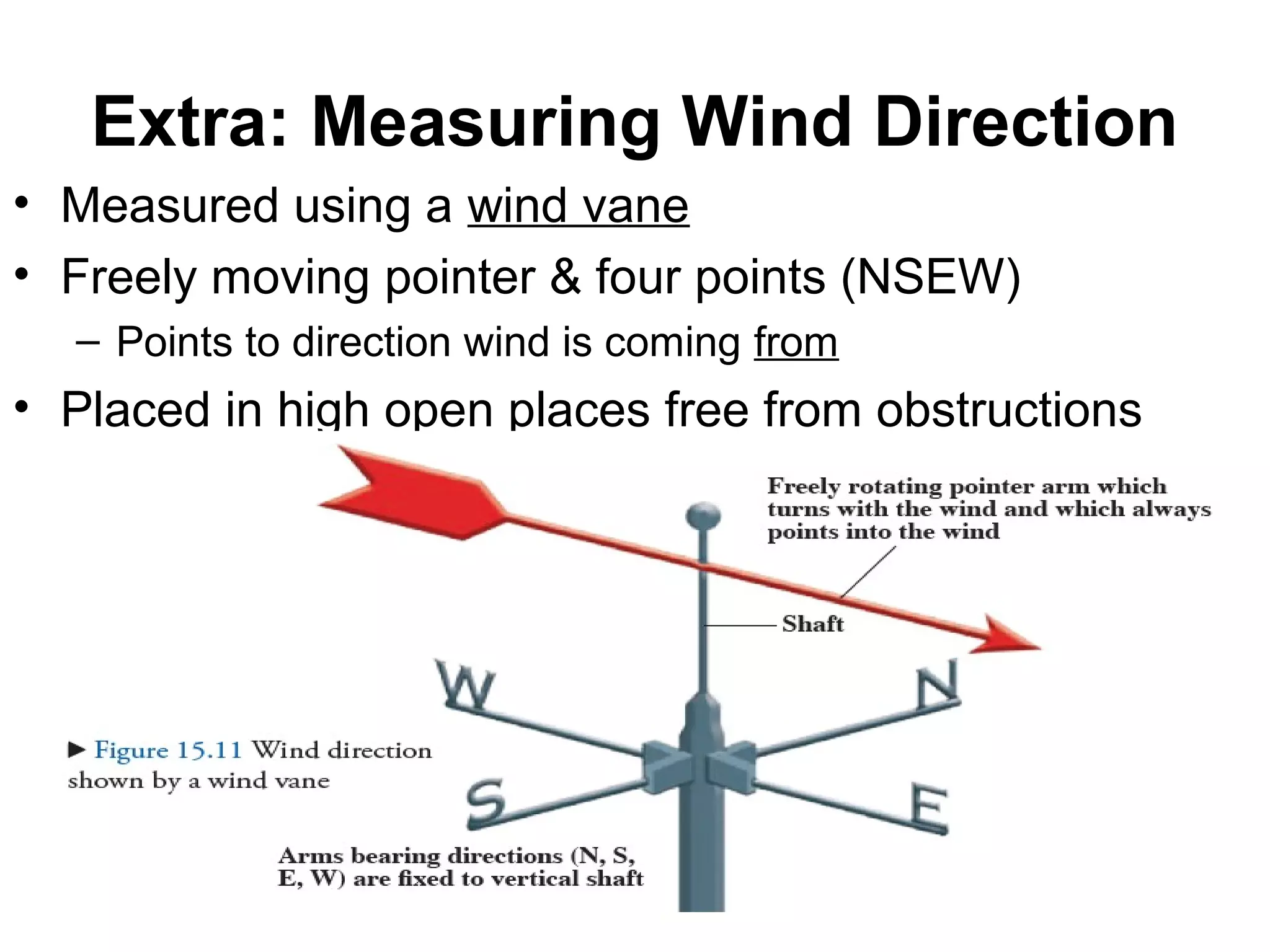
Extra: Measuring Wind Direction
• Measured using a wind vane
• Freely moving pointer & four points (NSEW)
– Points to direction wind is coming from
• Placed in high open places free from obstructions
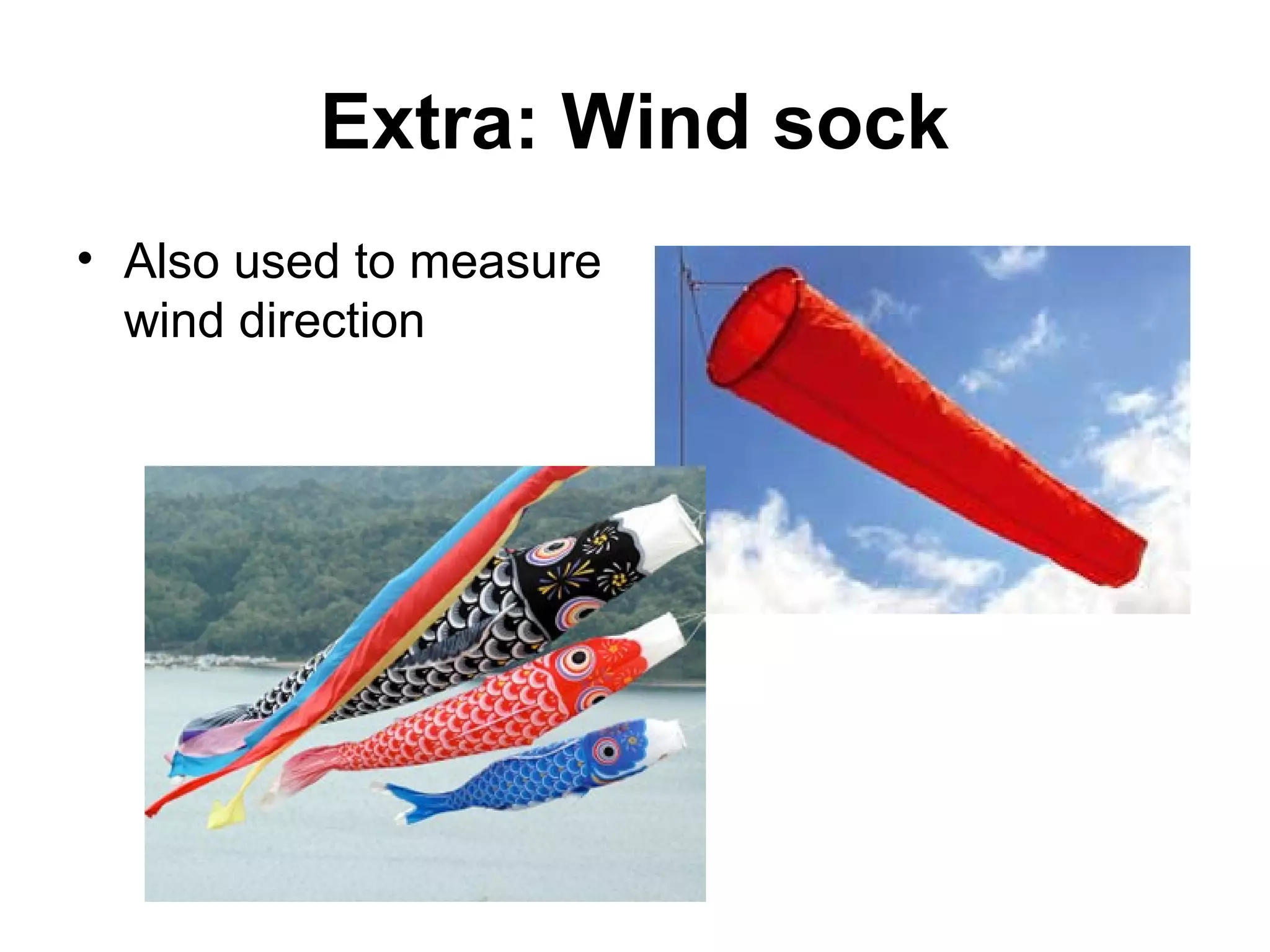
Extra: Wind sock
• Also used to measure
wind direction
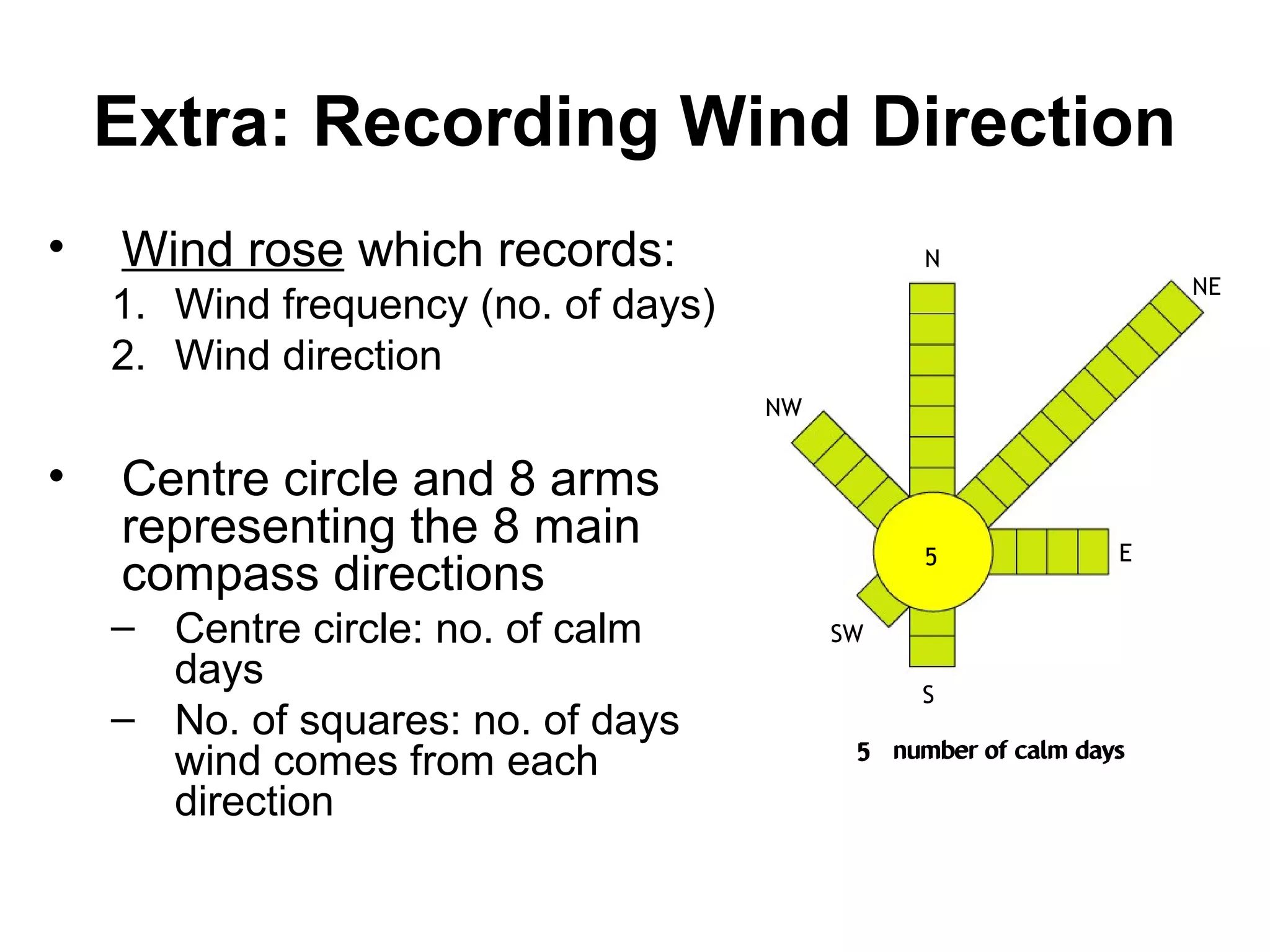
Extra: Recording Wind Direction
• Wind rose which records:
1. Wind frequency (no. of days)
2. Wind direction
• Centre circle and 8 arms
representing the 8 main
compass directions
– Centre circle: no. of calm
days
– No. of squares: no. of days
wind comes from each
direction
number of calm days5 number of calm days5
5 E
S
N
NW
SW
NE
Chapter 6: Understanding the
Elements of Weather
• Helps prepare for
whatever weather
conditions that may
occur.
• Allows the
classification of the
world’s regions
according to different
types of climate.

Secondary Three Geography: Elements-Winds and Pressure

  • 1.
  • 2.
    Today’s objectives: -we willbe able to define key terms in Gateway 2 -we will be able to explain the various causes of climate change
  • 3.
    • Air pressure(atmospheric pressure): the downward force exerted by the air’s weight per unit area on the Earth’s surface – about 1kg / cm2 • Relationship between pressure & altitude? Negative relationship! Low pressure occurs when altitude is higher. Air molecules are far apart and air becomes thinner. High pressure occurs when altitude is lower. Air molecules are closely packed and air becomes denser. Pressure and winds
  • 4.
    Extra: Isobars – lineson the weather map joining together places of equal atmospheric pressure • http://www.bbc.co.uk/schools/gcsebitesize/geography/weather/weathersystemsrev2.shtml
  • 5.
    6. Pressure andwinds • Wind: the horizontal movement of air from a region of high pressure to a region of low pressure Area of high pressure develops at low altitude. Differences in pressure causes cool air to rush in as wind. Movement of air mass from high to low pressure area. Ground gets heated, the air above ground gets heated & rises. An area of low pressure develops at Warm air rises and cools Cool air sinks as it is dense.
  • 6.
    6. Pressure andwinds • Winds can occur on: – Small scale (2) • Sea and land breezes – Large scale (1) • Monsoon winds
  • 7.
    6. Pressure andwinds • Sea and Land Breezes – http://www.classzone.com/books/earth_science/terc/content/visualizations/es1903/es1903page01.cfm
  • 8.
    Sea Breeze (Day)– cooling effect on coastal areas in the day. 1. Ground gets heated, up faster than the sea. 3. Sea does not get heated as quickly as land. 4. Cooler and denser air above sea sinks to form an area of high pressure. 2. Air gets heated & rises to form an area of low pressure. 5. Cool air over sea (high pressure) blows towards the land (low pressure), replacing warm air on the land, forming a sea breeze.
  • 9.
    Land Breeze – windthat blows from land to the sea at night. 1. Land loses heat faster than the sea at night. 3. Sea loses heat slowly. Warmer air above the sea rises to form an area of low pressure above the water surface. 2. Air over the land cools and sinks to form an area of high pressure. 5. Cool air over land (high pressure) blows seawards and replaces warm air over sea (low pressure), forming a land breeze.
  • 10.
    6. Pressure andwinds • Large-scale (monsoon) winds: – seasonal movements of large air masses across the Earth, as the Northern and Southern Hemispheres experience different seasons. • Why? • Caused by the extreme heating and cooling of large land masses. • Winds are deflected as they move across Earth due to the Coriolis effect • http://www.youtube.com/watch?v=mcPs_OdQOYU • http://www.youtube.com/watch?v=iv5WL1W4-WI
  • 11.
  • 12.
    Summer Winter SW Monsoon (June– Sept) High Pressure Low Pressure
  • 13.
    6. Pressure andwinds Southwest Monsoon (June to September)  Seasons  Northern Hemisphere: Summer (hot)  Southern Hemisphere: Winter (cold)  Pressure difference  North: Indian sub-continent (low pressure)  South: Australian continent (high pressure)  Hence, general direction of wind is from S to N.  Results:  Cold air from Australia blows toward India.  Known as SE Monsoon  Winds are deflected to the left due to Coriolis effect.  As winds enter into the Northern Hemisphere, they are deflected to the right  now known as SW Monsoon  Picks up moisture from Indian Ocean and the Bay of Bengal, and brings heavy rain to SW India and Bangladesh  Indian subcontinent’s weather is hot and wet these months!
  • 14.
    SW Monsoon (June toSeptember) Southeast Monsoon Southwest Monsoon Northern Hemisphere Summer (Warm) Southern Hemisphere Winter (Cold) Indian sub-continent (Low pressure) Wet and hot Australian continent (High pressure) N W E S
  • 15.
    Summer Winter NE Monsoon (Oct– Jan) High Pressure Low Pressure
  • 16.
    6. Pressure andwinds Northeast Monsoon (Oct to Jan)  Seasons  Northern Hemisphere: Winter (cold)  Southern Hemisphere: Summer (hot)  Pressure difference  North: Asian continent (high pressure)  South: Indian sub-continent (low pressure)  Hence, general direction of wind is from N to S.  Results:  Cold air blows across Asia toward India  Known as NE Monsoon  Winds are deflected to the right due to Coriolis effect.  Winds are deflected to the left as they enter into the Southern Hemisphere  Now known as NW monsoon  Winds that blow across Asia are cold and dry, hence they bring little moisture.  Indian subcontinent’s weather is cold & dry these months!
  • 17.
    NE Monsoon (October toJan) Northwest Monsoon Northeast Monsoon Northern Hemisphere Winter (Cold) Southern Hemisphere Summer (Warm) Asian continent (High pressure) Indian sub-continent (cold and dry) Southeast Asia like Malaysia (wet) N W E S
  • 18.
    Extra: Measuring WindDirection • Measured using a wind vane • Freely moving pointer & four points (NSEW) – Points to direction wind is coming from • Placed in high open places free from obstructions
  • 19.
    Extra: Wind sock •Also used to measure wind direction
  • 20.
    Extra: Recording WindDirection • Wind rose which records: 1. Wind frequency (no. of days) 2. Wind direction • Centre circle and 8 arms representing the 8 main compass directions – Centre circle: no. of calm days – No. of squares: no. of days wind comes from each direction number of calm days5 number of calm days5 5 E S N NW SW NE
  • 21.
    Chapter 6: Understandingthe Elements of Weather • Helps prepare for whatever weather conditions that may occur. • Allows the classification of the world’s regions according to different types of climate.

Editor's Notes

  • #5 The closer the isobars are together, the windier it is.
  • #11 N – Anti - Right S – Clockwise – Left