Cold air replaces the
rising warm air.
Such horizontal
movement of air is
called wind.
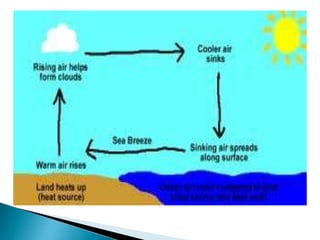
 The rising air caused by heating and the
sinking air caused by cooling forms
convection current
 During daytime, land heats faster than a body
of water; thus, hot air above the land rises
and the cold dense air from the body of water
replaces it. This is called sea breeze.
 During nighttime, land heat rises faster than
in a body of water; thus, hot air above the
body of water rises and the cold dense air
from the land replace it. This is called land
breeze.
 Isobars are lines connecting places of
equal air pressure.
 Pressure gradient is the spacing of the
isobars which indicates the pressure
changes occurring over a given
distance.
 the Coriolis effect result because of
the earth’s rotation. All free moving
objects, including the wind, are
deflected to the right of their path of
motion in the northern hemisphere
and to the left in the southern
hemisphere.
 The two general types of winds are :
local winds and prevailing winds. Local
winds are the winds we frequently
encounter and these blow in any
direction, prevailing winds are winds
that blow from the same direction and
most often travel long distances
 Winds belts are general patterns of air
circulation.
 Prevailing westerlies are winds
blowing from west while prevailing
easterlies blow from the east.
 The two factors affect the direction of
prevailing winds:
 1.local winds- we frequently
encounter and the blow in any
direction.
 Prevailing winds- that blow from the
same direction and most often travel
long distances.
 Two factors affect the direction of
prevailing winds
1.unequal heating of the earth’s
surface
2.earth’s rotation.
 Winds that blow during certain
season toward either the continent or
ocean due the differences in air
pressure and temperature are called
monsoons.
 Northeast monsoon is called Amihan
while southwest monsoon is called
Habagat.
 A pressure map uses isobars to
connect point that have the same
atmospheric pressure.

Atmospheric circulation

  • 2.
    Cold air replacesthe rising warm air. Such horizontal movement of air is called wind.
  • 3.
     The risingair caused by heating and the sinking air caused by cooling forms convection current  During daytime, land heats faster than a body of water; thus, hot air above the land rises and the cold dense air from the body of water replaces it. This is called sea breeze.  During nighttime, land heat rises faster than in a body of water; thus, hot air above the body of water rises and the cold dense air from the land replace it. This is called land breeze.
  • 6.
     Isobars arelines connecting places of equal air pressure.  Pressure gradient is the spacing of the isobars which indicates the pressure changes occurring over a given distance.  the Coriolis effect result because of the earth’s rotation. All free moving objects, including the wind, are deflected to the right of their path of motion in the northern hemisphere and to the left in the southern hemisphere.
  • 7.
     The twogeneral types of winds are : local winds and prevailing winds. Local winds are the winds we frequently encounter and these blow in any direction, prevailing winds are winds that blow from the same direction and most often travel long distances  Winds belts are general patterns of air circulation.
  • 8.
     Prevailing westerliesare winds blowing from west while prevailing easterlies blow from the east.  The two factors affect the direction of prevailing winds:  1.local winds- we frequently encounter and the blow in any direction.  Prevailing winds- that blow from the same direction and most often travel long distances.
  • 10.
     Two factorsaffect the direction of prevailing winds 1.unequal heating of the earth’s surface 2.earth’s rotation.  Winds that blow during certain season toward either the continent or ocean due the differences in air pressure and temperature are called monsoons.
  • 11.
     Northeast monsoonis called Amihan while southwest monsoon is called Habagat.  A pressure map uses isobars to connect point that have the same atmospheric pressure.