Pressure and Winds
Atmospheric Pressure
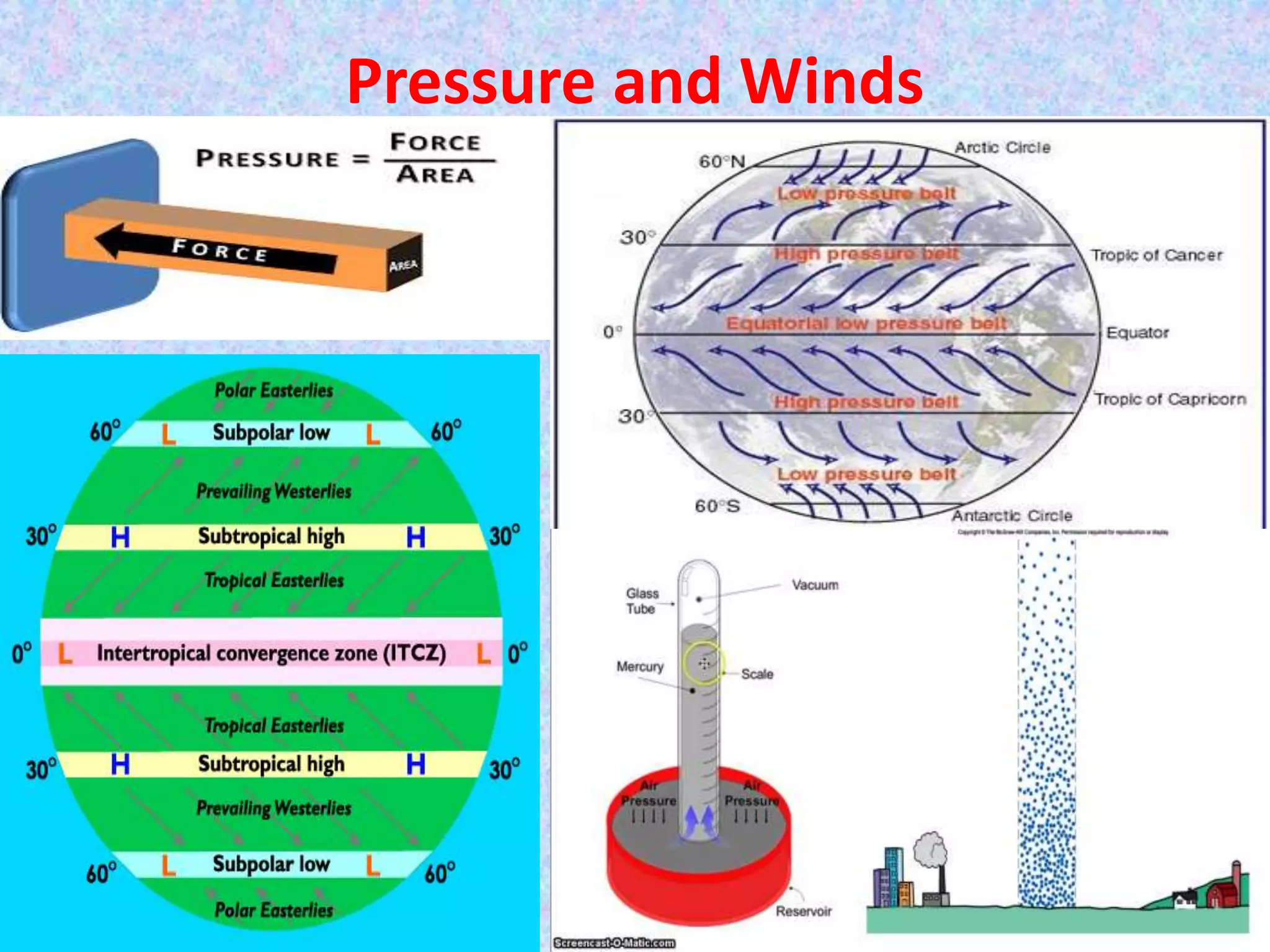
• The weight exerted by the
column of the air per unit
area on a fixed time is called
atmospheric pressure.
• It is measured with the help
of barometer.
• Its unit is millibars(mb).
• The normal atmospheric
pressure value is 1013.25
mb.
• An isobar is the line joining
places having equal air
pressure.
Importance of Atmospheric Pressure
• 1.Changes in temperature brings changes in
atmospheric pressure and causes air to blow to
balance the temperature. This horizontal
movement of air is called wind.(Winds move
from high pressure area(low temperature) to low
pressure area(high temperature) to balance)
• Winds transport from one area to another,
transfers heat and becomes the source of
precipitation in form of rain, snow.
• It is one of the significant factor in weather
forecasting.
Horizontal Distribution Of Atmospheric
Pressure.
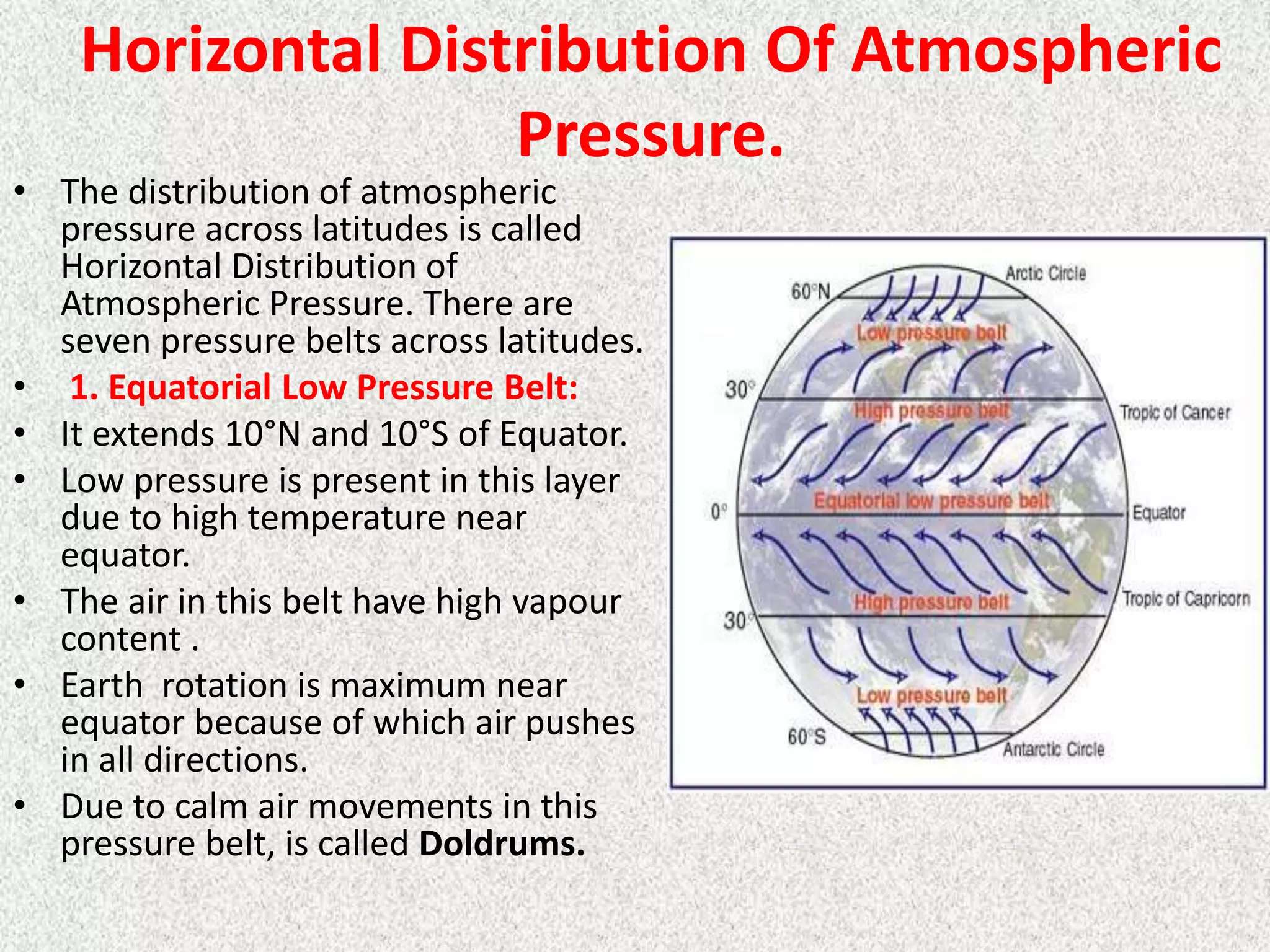
• The distribution of atmospheric
pressure across latitudes is called
Horizontal Distribution of
Atmospheric Pressure. There are
seven pressure belts across latitudes.
• 1. Equatorial Low Pressure Belt:
• It extends 10°N and 10°S of Equator.
• Low pressure is present in this layer
due to high temperature near
equator.
• The air in this belt have high vapour
content .
• Earth rotation is maximum near
equator because of which air pushes
in all directions.
• Due to calm air movements in this
pressure belt, is called Doldrums.
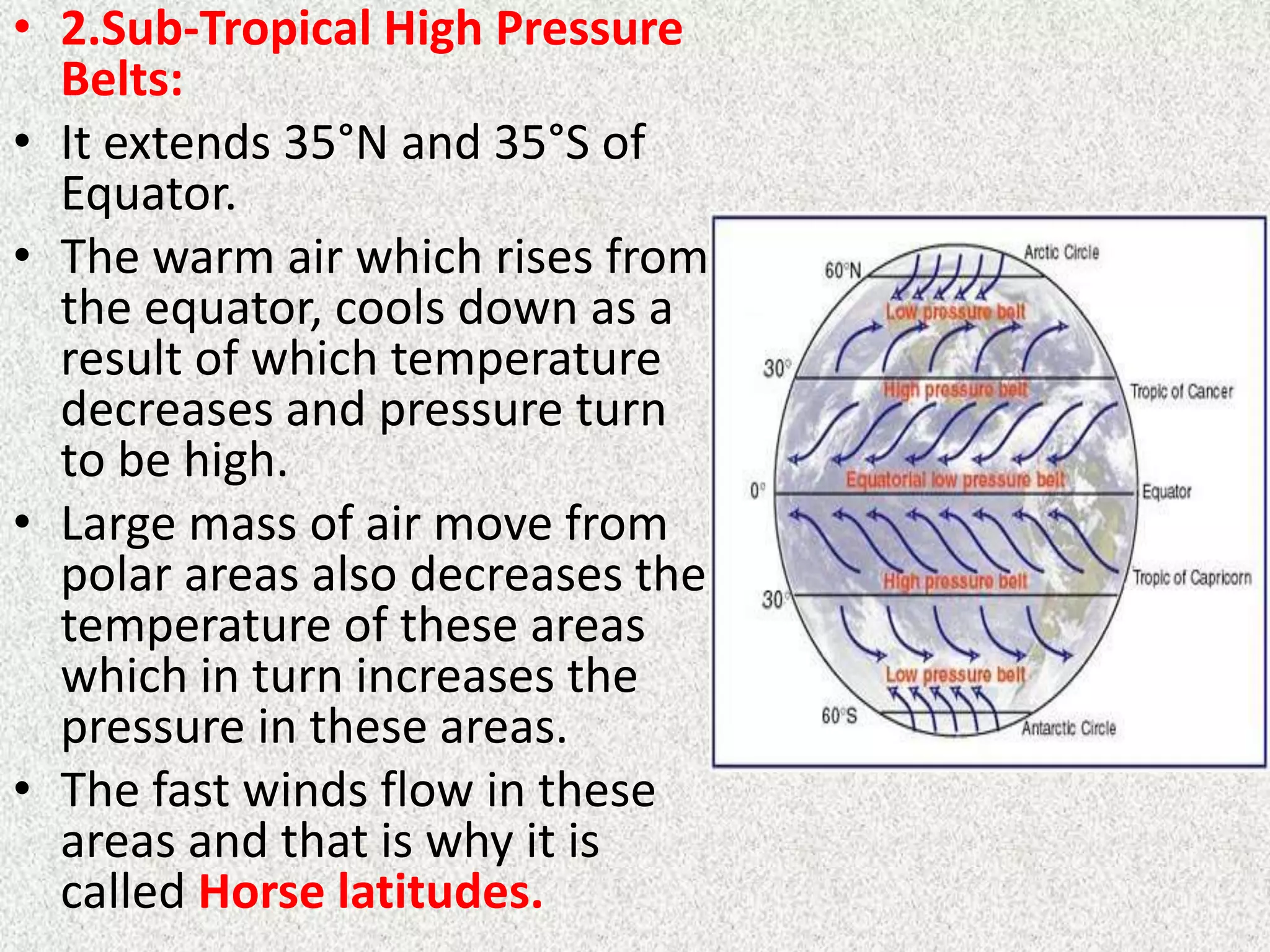
• 2.Sub-Tropical High Pressure
Belts:
• It extends 35°N and 35°S of
Equator.
• The warm air which rises from
the equator, cools down as a
result of which temperature
decreases and pressure turn
to be high.
• Large mass of air move from
polar areas also decreases the
temperature of these areas
which in turn increases the
pressure in these areas.
• The fast winds flow in these
areas and that is why it is
called Horse latitudes.
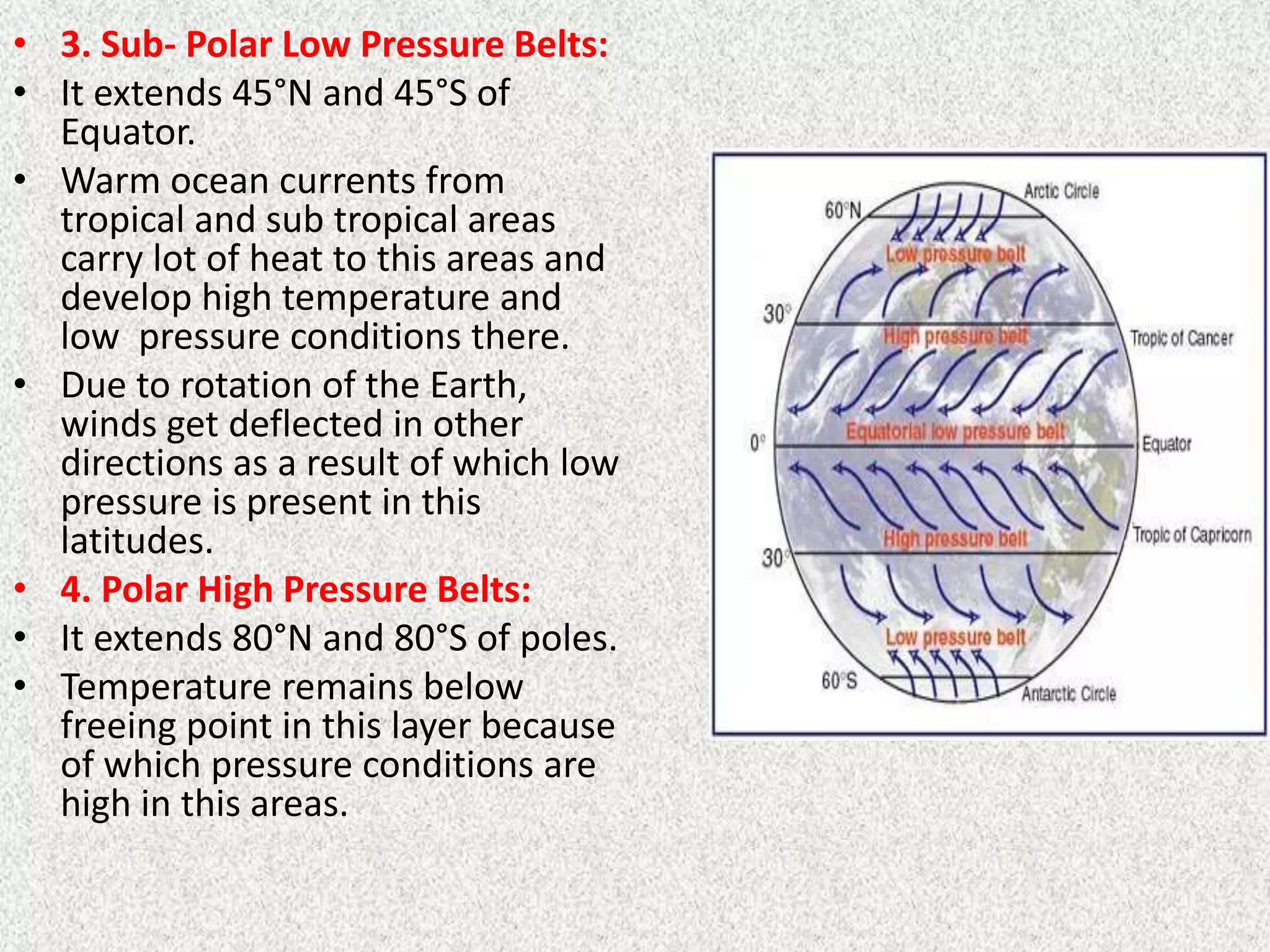
• 3. Sub- Polar Low Pressure Belts:
• It extends 45°N and 45°S of
Equator.
• Warm ocean currents from
tropical and sub tropical areas
carry lot of heat to this areas and
develop high temperature and
low pressure conditions there.
• Due to rotation of the Earth,
winds get deflected in other
directions as a result of which low
pressure is present in this
latitudes.
• 4. Polar High Pressure Belts:
• It extends 80°N and 80°S of poles.
• Temperature remains below
freeing point in this layer because
of which pressure conditions are
high in this areas.
Winds, its Types and Forces
determining it
• Air is present in the atmosphere but the
horizontal movement of air is called
wind.
• The direction and speed of wind is
controlled by various factors like:
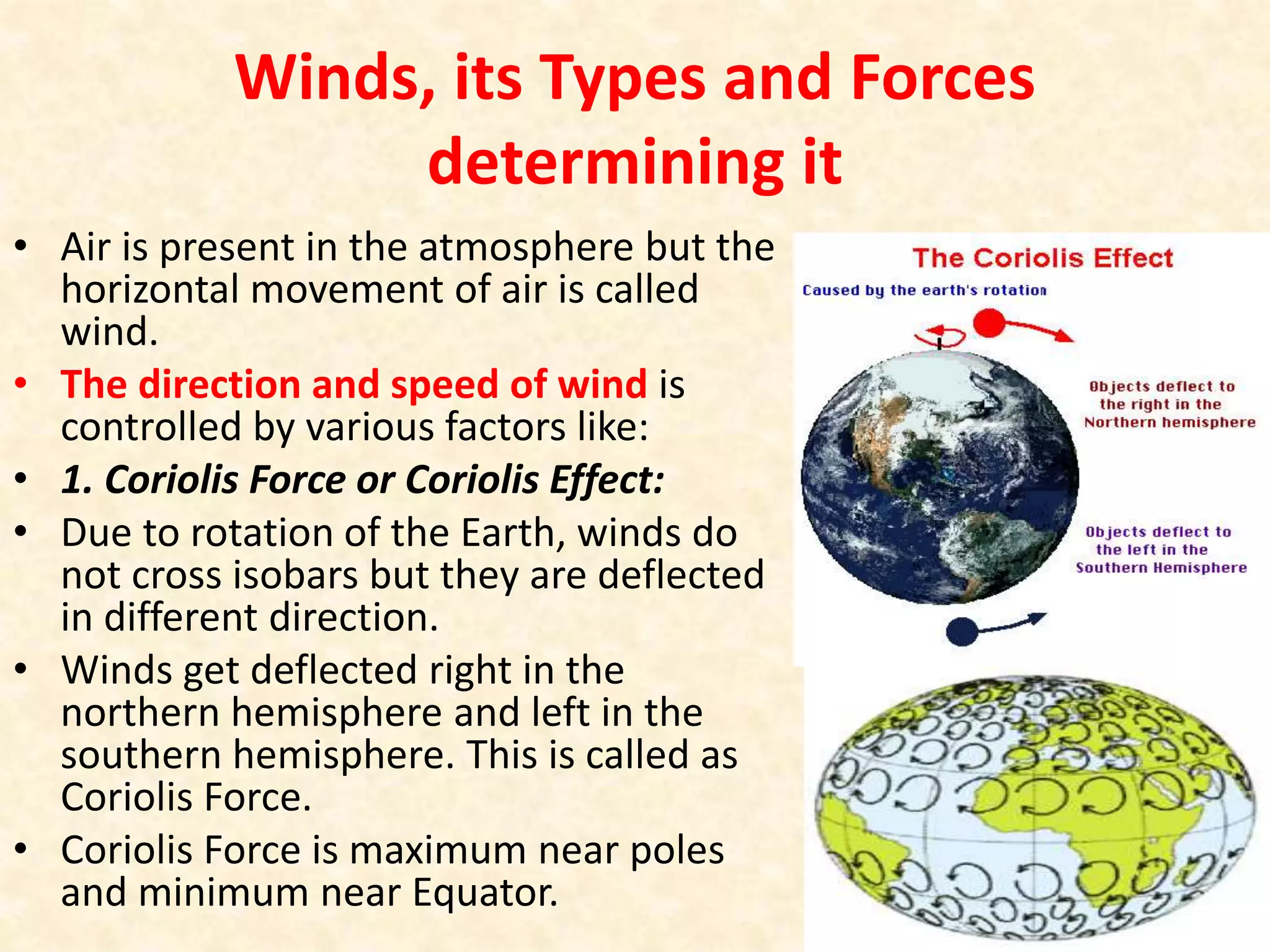
• 1. Coriolis Force or Coriolis Effect:
• Due to rotation of the Earth, winds do
not cross isobars but they are deflected
in different direction.
• Winds get deflected right in the
northern hemisphere and left in the
southern hemisphere. This is called as
Coriolis Force.
• Coriolis Force is maximum near poles
and minimum near Equator.
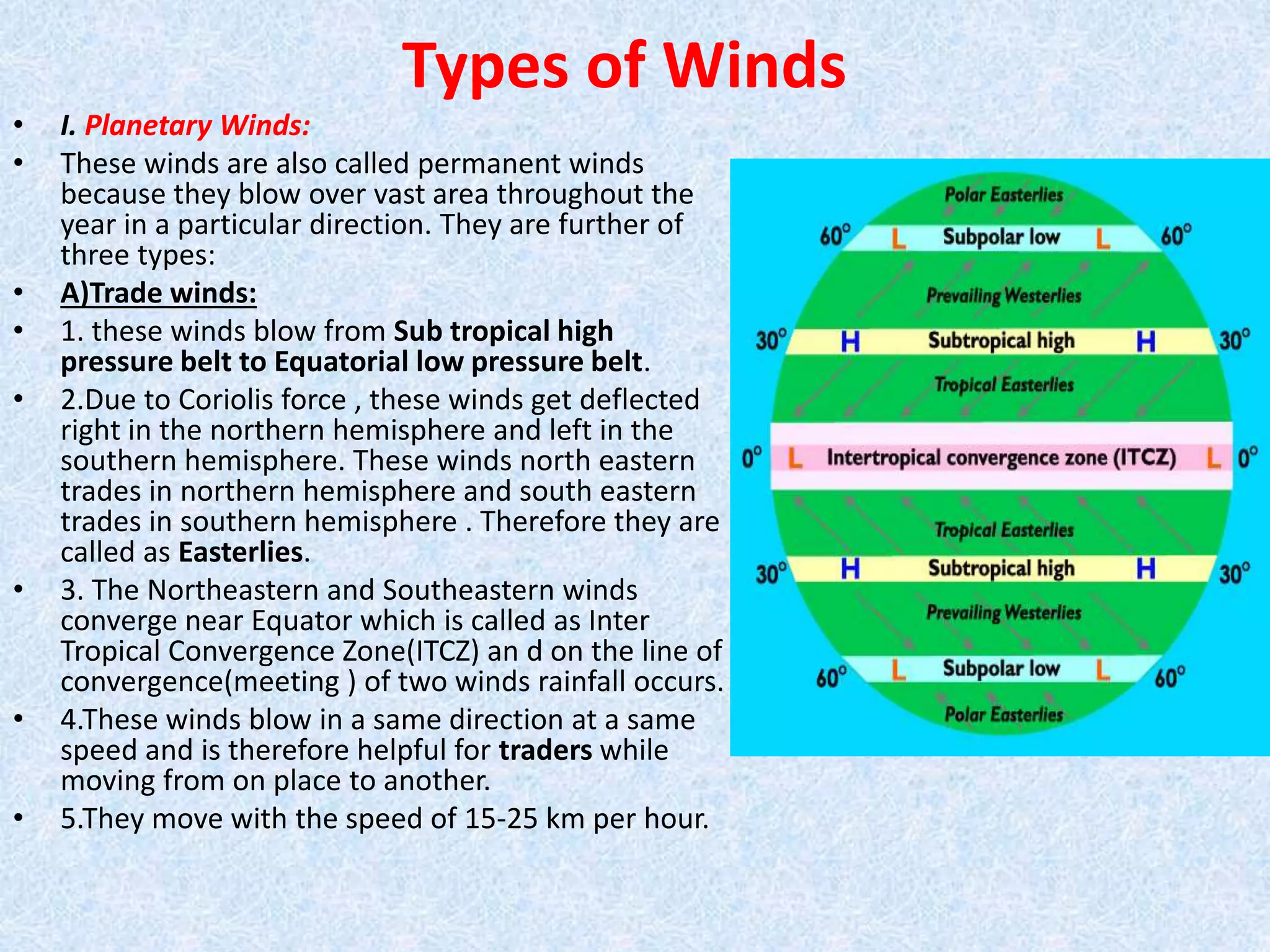
• 2. Pressure Gradient Force:
• The rate of change of pressure per unit
distance is called pressure gradient and
this force which moves the wind is called
pressure gradient force.
• Greater the pressure gradient force,
greater wil be the wind speed.
• 3.Land friction:
• Changes on the earth surface causes
changes in the speed and direction of
wind. Wind speed is smooth over ocean
surface where there is no obstruction.
• 4. Geostropic Wind: When there is no
friction over surface, Pressure Gradient
Force and Coriolis Force balances each
other and the wind blows parallel to
Isobars. This wind is called Geostropic
Wind.
Types of Winds
• I. Planetary Winds:
• These winds are also called permanent winds
because they blow over vast area throughout the
year in a particular direction. They are further of
three types:
• A)Trade winds:
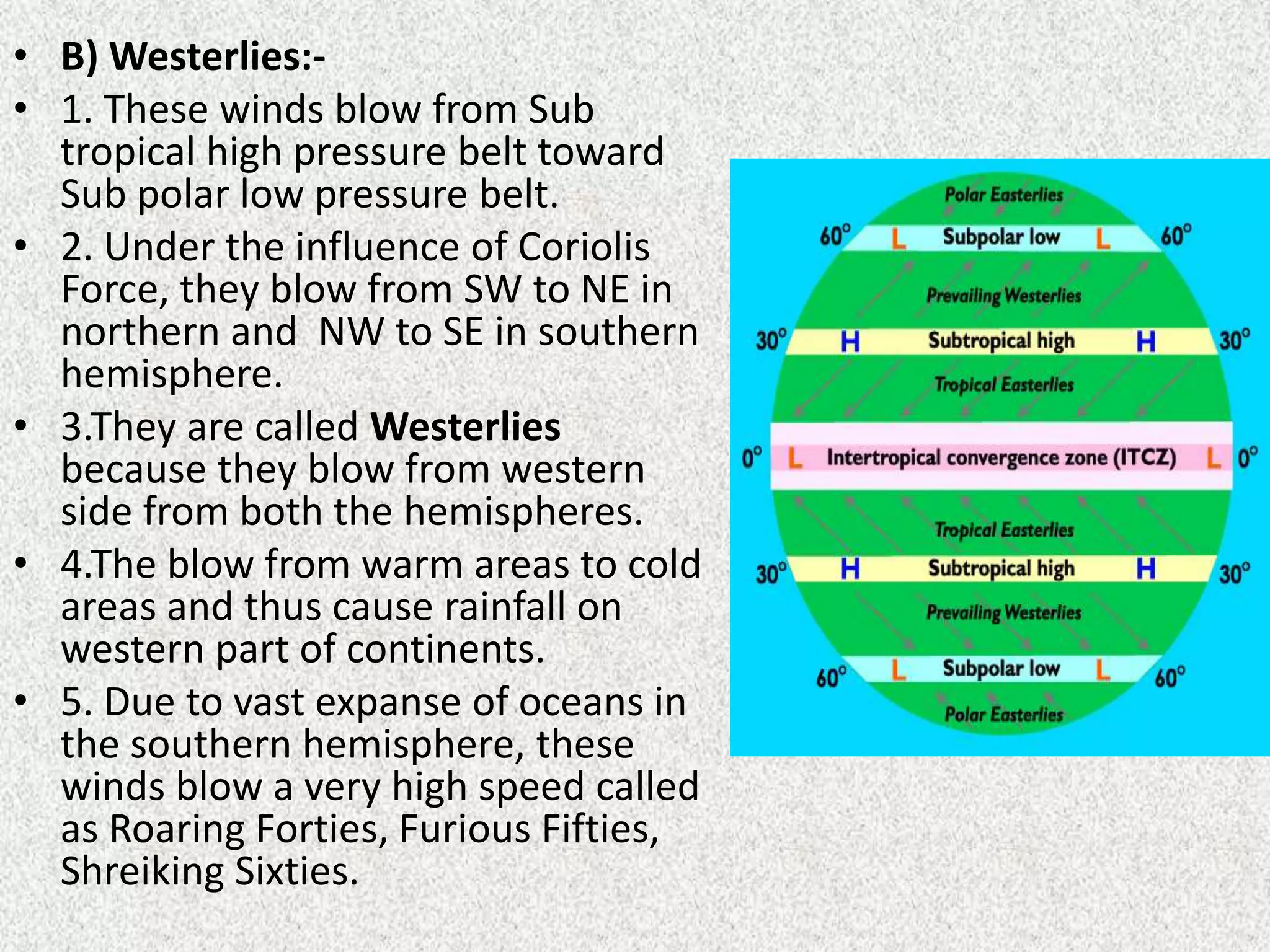
• 1. these winds blow from Sub tropical high
pressure belt to Equatorial low pressure belt.
• 2.Due to Coriolis force , these winds get deflected
right in the northern hemisphere and left in the
southern hemisphere. These winds north eastern
trades in northern hemisphere and south eastern
trades in southern hemisphere . Therefore they are
called as Easterlies.
• 3. The Northeastern and Southeastern winds
converge near Equator which is called as Inter
Tropical Convergence Zone(ITCZ) an d on the line of
convergence(meeting ) of two winds rainfall occurs.
• 4.These winds blow in a same direction at a same
speed and is therefore helpful for traders while
moving from on place to another.
• 5.They move with the speed of 15-25 km per hour.
• B) Westerlies:-
• 1. These winds blow from Sub
tropical high pressure belt toward
Sub polar low pressure belt.
• 2. Under the influence of Coriolis
Force, they blow from SW to NE in
northern and NW to SE in southern
hemisphere.
• 3.They are called Westerlies
because they blow from western
side from both the hemispheres.
• 4.The blow from warm areas to cold
areas and thus cause rainfall on
western part of continents.
• 5. Due to vast expanse of oceans in
the southern hemisphere, these
winds blow a very high speed called
as Roaring Forties, Furious Fifties,
Shreiking Sixties.
• C. Polar Winds:
• 1.They blow from Polar High
Pressure Belt to Sub-Polar Low
Pressure Belt and is called as
Polar Winds.
• 2.They blow from NE to SW in
northern hemisphere and SE
to NW in Southern
hemisphere due to Coriolis
Force.
• 3. They originate from cold
areas and are cold winds.
• 4. Since they originate from
cold areas, they do not cause
much rainfall.
II. LOCAL WINDS
• These winds blow due to difference in heating of land and sea. They are of
following types:
• A. LAND And SEA BREEZE:
• 1.During day time, land gets heated as a result of which temperature of
land becomes warm, air above that becomes light and rises and creates an
area of low pressure. Wind move from sea to land and is called as Sea
Breeze.
• 2.During night time, land which was heated during day gets cooled down
earlier as result of which low temperature and high pressure develops over
land .Winds move from land to sea to balance the temperature and
pressure conditions and is called as Land breeze.
• 2. Mountain and Valley Breeze
• During day mountain gets heated as a result of which high
temperature and low pressure conditions are present. To
balance this low pressure conditions, breeze moves from
valley to mountain which is called Valley Breeze.
• During night time, mountain slopes gets cooled down very
fast as a result of which high pressure conditions develop
over there. Breeze moves from mountain to valley to balance
the low pressure conditions in valley. It is called as Mountain
Breeze.
• 3. Loo: It is a hot and local wind of northern India. It can be
felt in the month of May and June when the temperature is
between 40-50° C
• 4.Foehn: it is a dry and warm wind which develops over the
leeward side of Alps mountain in Europe . This wind helps
in animal grazing and promoting ripening of grapes.
• 5.Chinook: it is a warm wind blowing in slopes of Rockies
Mountain in USA and Canada. It is also called as snow eater
as it helps in melting snow and keeping the grasslands clear.
• 6. Mistral: it is a cold wind which blows from Alps mountain
in France and move towards Mediterranean Sea.
Air
It is present in the
atmosphere and can
have different
temperature and
humidity.
It can start flowing
where there is
difference in
temperature and
pressure conditions.
It helps us in studying
variations of
atmosphere.
Air mass
It is large mass of air
with uniform
properties of
temperature and
humidity.
It starts flowing from
the source region.
It helps in studying
cyclones and
anticyclones.
FRONTS AND ITS TYPES
• The contact line between two different air masses of
different properties is called Front.
• It is of two types:
• 1.Warm front: When the warm airmass moves towards cold
airmass, it results in forming warm front.
• 2.Cold Front: When the cold airmass moves towards warm
airmass, it is called Cold front.
Cyclone and Anticyclone
• Cyclone:
• It is an area of low pressure
surrounded by high pressure.
• Wind moves from all sides to
centre.
• Wind moves anticlockwise in
northern and clockwise in the
southern hemisphere.
• Anticyclone:
• It is an area of high pressure
surrounded by low pressure.
• Wind moves from centre to all
sides.
• Wind moves clockwise in the
northern and anticlockwise in
the southern.
Type of Cyclone
Tropical Cyclone
They are
circular in
shape.
These cyclones
develop over
seas.
They affect the
smaller areas.
Wind velocity is
higher in
tropical cyclone
They are
prevalent in
summer season
Extra Tropical Cyclone
or Temperate Cyclone
They are V
shape.
These cyclones
develop over
land and seas.
They affect the
larger areas.
Wind velocity is
less in this
cyclone.
They are
prevalent in
winter sason.
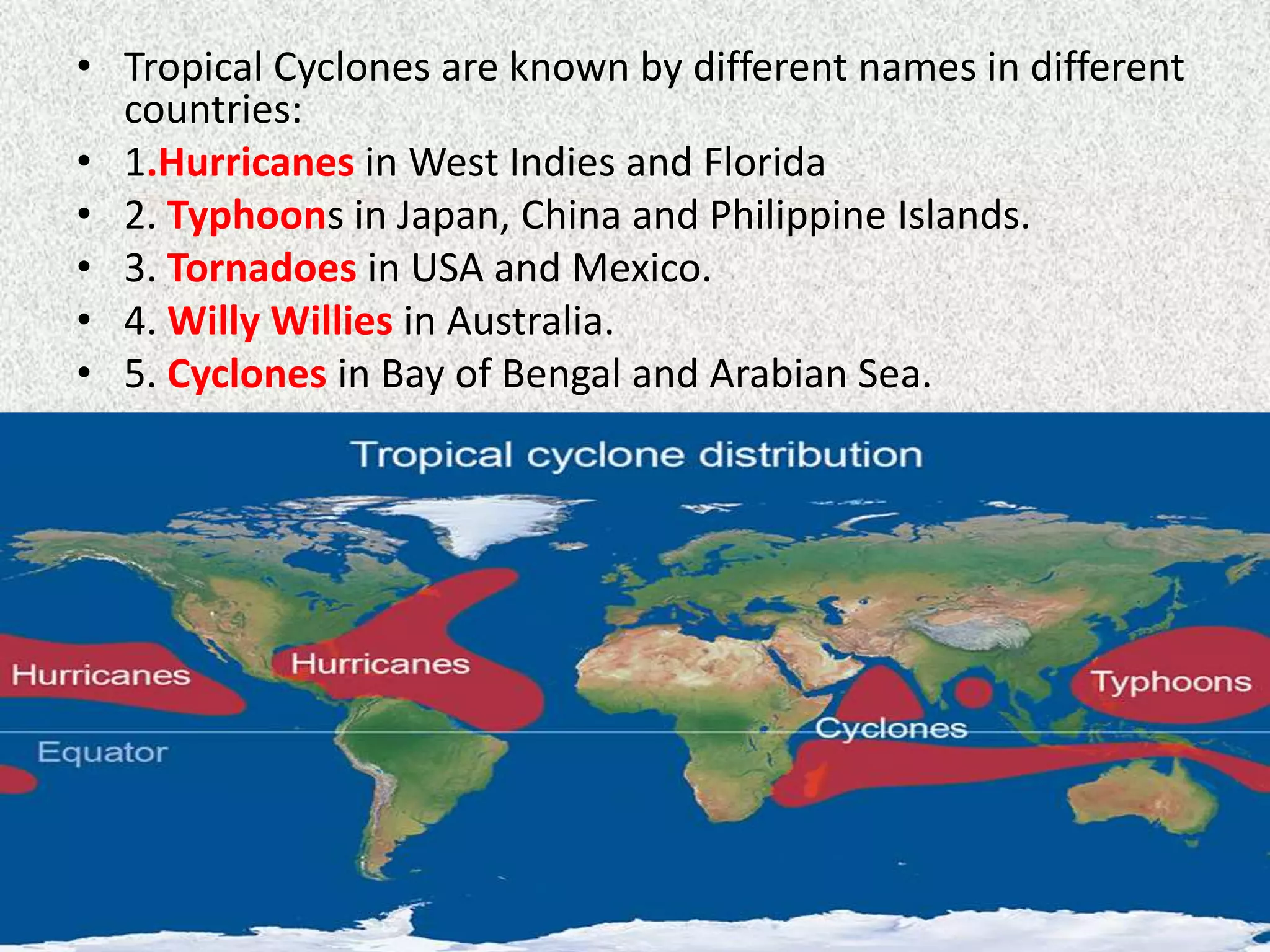
• Tropical Cyclones are known by different names in different
countries:
• 1.Hurricanes in West Indies and Florida
• 2. Typhoons in Japan, China and Philippine Islands.
• 3. Tornadoes in USA and Mexico.
• 4. Willy Willies in Australia.
• 5. Cyclones in Bay of Bengal and Arabian Sea.

PRESSURE AND WINDS 11 CLASS GEOGRAPHY

  • 1.
  • 2.
    Atmospheric Pressure • Theweight exerted by the column of the air per unit area on a fixed time is called atmospheric pressure. • It is measured with the help of barometer. • Its unit is millibars(mb). • The normal atmospheric pressure value is 1013.25 mb. • An isobar is the line joining places having equal air pressure.
  • 3.
    Importance of AtmosphericPressure • 1.Changes in temperature brings changes in atmospheric pressure and causes air to blow to balance the temperature. This horizontal movement of air is called wind.(Winds move from high pressure area(low temperature) to low pressure area(high temperature) to balance) • Winds transport from one area to another, transfers heat and becomes the source of precipitation in form of rain, snow. • It is one of the significant factor in weather forecasting.
  • 4.
    Horizontal Distribution OfAtmospheric Pressure. • The distribution of atmospheric pressure across latitudes is called Horizontal Distribution of Atmospheric Pressure. There are seven pressure belts across latitudes. • 1. Equatorial Low Pressure Belt: • It extends 10°N and 10°S of Equator. • Low pressure is present in this layer due to high temperature near equator. • The air in this belt have high vapour content . • Earth rotation is maximum near equator because of which air pushes in all directions. • Due to calm air movements in this pressure belt, is called Doldrums.
  • 5.
    • 2.Sub-Tropical HighPressure Belts: • It extends 35°N and 35°S of Equator. • The warm air which rises from the equator, cools down as a result of which temperature decreases and pressure turn to be high. • Large mass of air move from polar areas also decreases the temperature of these areas which in turn increases the pressure in these areas. • The fast winds flow in these areas and that is why it is called Horse latitudes.
  • 6.
    • 3. Sub-Polar Low Pressure Belts: • It extends 45°N and 45°S of Equator. • Warm ocean currents from tropical and sub tropical areas carry lot of heat to this areas and develop high temperature and low pressure conditions there. • Due to rotation of the Earth, winds get deflected in other directions as a result of which low pressure is present in this latitudes. • 4. Polar High Pressure Belts: • It extends 80°N and 80°S of poles. • Temperature remains below freeing point in this layer because of which pressure conditions are high in this areas.
  • 7.
    Winds, its Typesand Forces determining it • Air is present in the atmosphere but the horizontal movement of air is called wind. • The direction and speed of wind is controlled by various factors like: • 1. Coriolis Force or Coriolis Effect: • Due to rotation of the Earth, winds do not cross isobars but they are deflected in different direction. • Winds get deflected right in the northern hemisphere and left in the southern hemisphere. This is called as Coriolis Force. • Coriolis Force is maximum near poles and minimum near Equator.
  • 8.
    • 2. PressureGradient Force: • The rate of change of pressure per unit distance is called pressure gradient and this force which moves the wind is called pressure gradient force. • Greater the pressure gradient force, greater wil be the wind speed. • 3.Land friction: • Changes on the earth surface causes changes in the speed and direction of wind. Wind speed is smooth over ocean surface where there is no obstruction. • 4. Geostropic Wind: When there is no friction over surface, Pressure Gradient Force and Coriolis Force balances each other and the wind blows parallel to Isobars. This wind is called Geostropic Wind.
  • 9.
    Types of Winds •I. Planetary Winds: • These winds are also called permanent winds because they blow over vast area throughout the year in a particular direction. They are further of three types: • A)Trade winds: • 1. these winds blow from Sub tropical high pressure belt to Equatorial low pressure belt. • 2.Due to Coriolis force , these winds get deflected right in the northern hemisphere and left in the southern hemisphere. These winds north eastern trades in northern hemisphere and south eastern trades in southern hemisphere . Therefore they are called as Easterlies. • 3. The Northeastern and Southeastern winds converge near Equator which is called as Inter Tropical Convergence Zone(ITCZ) an d on the line of convergence(meeting ) of two winds rainfall occurs. • 4.These winds blow in a same direction at a same speed and is therefore helpful for traders while moving from on place to another. • 5.They move with the speed of 15-25 km per hour.
  • 10.
    • B) Westerlies:- •1. These winds blow from Sub tropical high pressure belt toward Sub polar low pressure belt. • 2. Under the influence of Coriolis Force, they blow from SW to NE in northern and NW to SE in southern hemisphere. • 3.They are called Westerlies because they blow from western side from both the hemispheres. • 4.The blow from warm areas to cold areas and thus cause rainfall on western part of continents. • 5. Due to vast expanse of oceans in the southern hemisphere, these winds blow a very high speed called as Roaring Forties, Furious Fifties, Shreiking Sixties.
  • 11.
    • C. PolarWinds: • 1.They blow from Polar High Pressure Belt to Sub-Polar Low Pressure Belt and is called as Polar Winds. • 2.They blow from NE to SW in northern hemisphere and SE to NW in Southern hemisphere due to Coriolis Force. • 3. They originate from cold areas and are cold winds. • 4. Since they originate from cold areas, they do not cause much rainfall.
  • 12.
    II. LOCAL WINDS •These winds blow due to difference in heating of land and sea. They are of following types: • A. LAND And SEA BREEZE: • 1.During day time, land gets heated as a result of which temperature of land becomes warm, air above that becomes light and rises and creates an area of low pressure. Wind move from sea to land and is called as Sea Breeze. • 2.During night time, land which was heated during day gets cooled down earlier as result of which low temperature and high pressure develops over land .Winds move from land to sea to balance the temperature and pressure conditions and is called as Land breeze.
  • 13.
    • 2. Mountainand Valley Breeze • During day mountain gets heated as a result of which high temperature and low pressure conditions are present. To balance this low pressure conditions, breeze moves from valley to mountain which is called Valley Breeze. • During night time, mountain slopes gets cooled down very fast as a result of which high pressure conditions develop over there. Breeze moves from mountain to valley to balance the low pressure conditions in valley. It is called as Mountain Breeze.
  • 14.
    • 3. Loo:It is a hot and local wind of northern India. It can be felt in the month of May and June when the temperature is between 40-50° C • 4.Foehn: it is a dry and warm wind which develops over the leeward side of Alps mountain in Europe . This wind helps in animal grazing and promoting ripening of grapes. • 5.Chinook: it is a warm wind blowing in slopes of Rockies Mountain in USA and Canada. It is also called as snow eater as it helps in melting snow and keeping the grasslands clear. • 6. Mistral: it is a cold wind which blows from Alps mountain in France and move towards Mediterranean Sea.
  • 15.
    Air It is presentin the atmosphere and can have different temperature and humidity. It can start flowing where there is difference in temperature and pressure conditions. It helps us in studying variations of atmosphere. Air mass It is large mass of air with uniform properties of temperature and humidity. It starts flowing from the source region. It helps in studying cyclones and anticyclones.
  • 16.
    FRONTS AND ITSTYPES • The contact line between two different air masses of different properties is called Front. • It is of two types: • 1.Warm front: When the warm airmass moves towards cold airmass, it results in forming warm front. • 2.Cold Front: When the cold airmass moves towards warm airmass, it is called Cold front.
  • 17.
    Cyclone and Anticyclone •Cyclone: • It is an area of low pressure surrounded by high pressure. • Wind moves from all sides to centre. • Wind moves anticlockwise in northern and clockwise in the southern hemisphere. • Anticyclone: • It is an area of high pressure surrounded by low pressure. • Wind moves from centre to all sides. • Wind moves clockwise in the northern and anticlockwise in the southern.
  • 18.
    Type of Cyclone TropicalCyclone They are circular in shape. These cyclones develop over seas. They affect the smaller areas. Wind velocity is higher in tropical cyclone They are prevalent in summer season Extra Tropical Cyclone or Temperate Cyclone They are V shape. These cyclones develop over land and seas. They affect the larger areas. Wind velocity is less in this cyclone. They are prevalent in winter sason.
  • 19.
    • Tropical Cyclonesare known by different names in different countries: • 1.Hurricanes in West Indies and Florida • 2. Typhoons in Japan, China and Philippine Islands. • 3. Tornadoes in USA and Mexico. • 4. Willy Willies in Australia. • 5. Cyclones in Bay of Bengal and Arabian Sea.