Geography
WIND
Group
• Prof. Mudassar
Shahzad Wahla
• I n t r o d u c t i o n
• Ty p e s & i t s
M e c h a n i s m
• 05
Group Members:
Mr. Shafeeq Ur Rehman (29)
Saud Ameer (11)
Misbah Hassan (49)
Taibah Najib (35)
Areej Iqbal (03)
Class:
BS URDU 4th (Evening)
Department:
Urdu & Oriental Languages
University of Sargodha,Sargodha
Wind
Content
Next
Content
Introductio
to Wind
Types of
Winds
Mechanism
of Wind
Wind
Circulation
on World
Map
Introduction of Wind
&
Types of Wind
Wind
Next
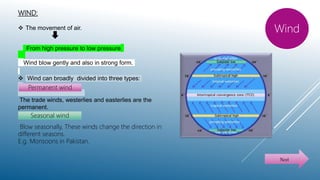
WIND:
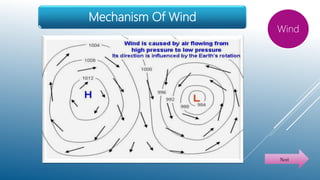
 The movement of air.
From high pressure to low pressure.
Wind blow gently and also in strong form.
 Wind can broadly divided into three types:
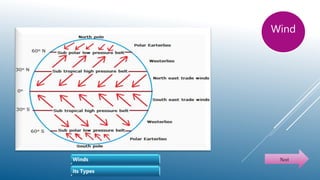
The trade winds, westerlies and easterlies are the
permanent.
Blow seasonally, These winds change the direction in
different seasons.
E.g. Monsoons in Pakistan.
Permanent wind
Seasonal wind
Wind
Next
WIND:
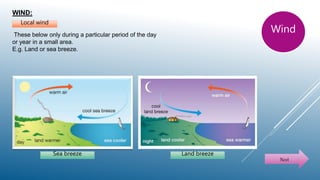
These below only during a particular period of the day
or year in a small area.
E.g. Land or sea breeze.
Local wind
Next
Wind
Sea breeze Land breeze
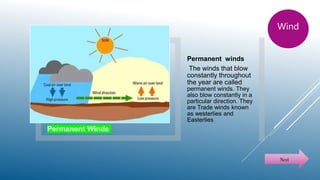
Permanent Winds
Permanent winds
The winds that blow
constantly throughout
the year are called
permanent winds. They
also blow constantly in a
particular direction. They
are Trade winds known
as westerlies and
Easterlies.
Next
Wind
Wind
Next
Winds
its Types
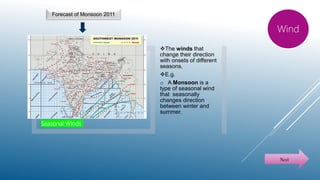
Seasonal Winds
The winds that
change their direction
with onsets of different
seasons.
E.g.
o A Monsoon is a
type of seasonal wind
that seasonally
changes direction
between winter and
summer.
Wind
Next
Forecast of Monsoon 2011
Monsoon
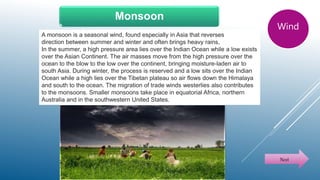
A monsoon is a seasonal wind, found especially in Asia that reverses
direction between summer and winter and often brings heavy rains,
In the summer, a high pressure area lies over the Indian Ocean while a low exists
over the Asian Continent. The air masses move from the high pressure over the
ocean to the blow to the low over the continent, bringing moisture-laden air to
south Asia. During winter, the process is reserved and a low sits over the Indian
Ocean while a high lies over the Tibetan plateau so air flows down the Himalaya
and south to the ocean. The migration of trade winds westerlies also contributes
to the monsoons. Smaller monsoons take place in equatorial Africa, northern
Australia and in the southwestern United States.
Wind
Next
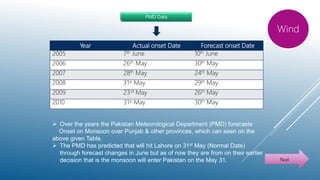
Year Actual onset Date Forecast onset Date
2005 7th June 10th June
2006 26th May 30th May
2007 28th May 24th May
2008 31st May 29th May
2009 23rd May 26th May
2010 31st May 30th May
PMD Data
 Over the years the Pakistan Meteorological Department (PMD) forecasts
Onset on Monsoon over Punjab & other provinces, which can seen on the
above given Table.
 The PMD has predicted that will hit Lahore on 31st May (Normal Date)
through forecast changes in June but as of now they are from on their earlier
decision that is the monsoon will enter Pakistan on the May 31.
Wind
Next
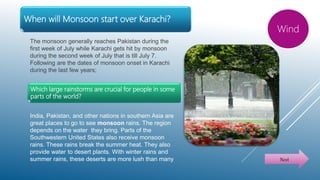
When will Monsoon start over Karachi?
The monsoon generally reaches Pakistan during the
first week of July while Karachi gets hit by monsoon
during the second week of July that is till July 7.
Following are the dates of monsoon onset in Karachi
during the last few years;
Wind
Next
Which large rainstorms are crucial for people in some
parts of the world?
India, Pakistan, and other nations in southern Asia are
great places to go to see monsoon rains. The region
depends on the water they bring. Parts of the
Southwestern United States also receive monsoon
rains. These rains break the summer heat. They also
provide water to desert plants. With winter rains and
summer rains, these deserts are more lush than many
Locall Winds
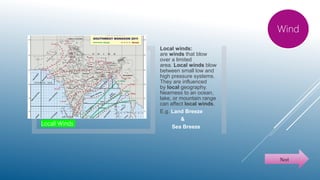
Local winds:
are winds that blow
over a limited
area. Local winds blow
between small low and
high pressure systems.
They are influenced
by local geography.
Nearness to an ocean,
lake, or mountain range
can affect local winds.
E.g. Land Breeze
&
Sea Breeze
Wind
Next
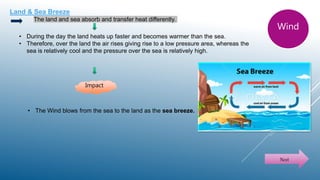
Land & Sea Breeze
The land and sea absorb and transfer heat differently.
• During the day the land heats up faster and becomes warmer than the sea.
• Therefore, over the land the air rises giving rise to a low pressure area, whereas the
sea is relatively cool and the pressure over the sea is relatively high.
Impact
• The Wind blows from the sea to the land as the sea breeze.
Wind
Next
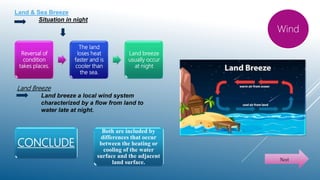
Land & Sea Breeze
Situation in night
Reversal of
condition
takes places.
The land
loses heat
faster and is
cooler than
the sea.
Land breeze
usually occur
at night
Wind
Next
Land Breeze
Land breeze a local wind system
characterized by a flow from land to
water late at night.
CONCLUDE
Both are included by
differences that occur
between the heating or
cooling of the water
surface and the adjacent
land surface.
WIND MECHANISM
Wind
Next
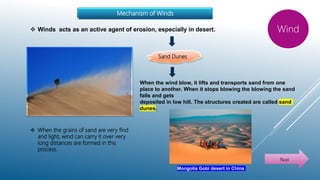
Mechanism of Winds
 Winds acts as an active agent of erosion, especially in desert.
Sand Dunes
When the wind blow, it lifts and transports sand from one
place to another. When it stops blowing the blowing the sand
falls and gets
deposited in low hill. The structures created are called sand
dunes.
 When the grains of sand are very find
and light, wind can carry it over very
long distances are formed in this
process.
Mongolia Gobi desert in China
Wind
Next
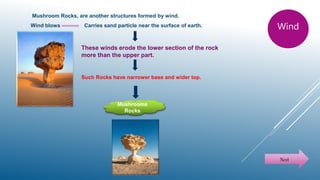
• Mushroom Rocks, are another structures formed by wind.
• Wind blows Carries sand particle near the surface of earth.
These winds erode the lower section of the rock
more than the upper part.
Such Rocks have narrower base and wider top.
Mushrooms
Rocks
Wind
Next
Mechanism Of Wind
Wind
Next
WIND CIRCULAION ON
WORLD MAP
Wind
Next
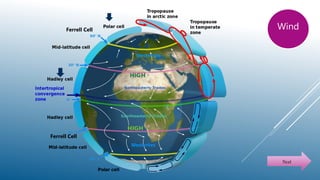
The Wind circulation
Over the major parts of the Earth's
surface there are large-scale wind
circulations present. The Wind
circulation can be described as the
world-wide system of winds by
which the necessary transport of
heat from tropical to polar latitudes
is accomplished.
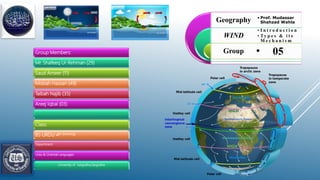
Wind Circulation on the World Map
Hadley
cell,
Ferrell cell Polar cell
In each hemisphere there are three cells:
Wind
Next
Wind
Next
Ferrell Cell
Ferrell Cell
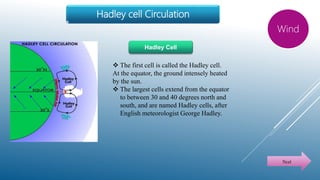
 The first cell is called the Hadley cell.
At the equator, the ground intensely heated
by the sun.
 The largest cells extend from the equator
to between 30 and 40 degrees north and
south, and are named Hadley cells, after
English meteorologist George Hadley.
Hadley cell Circulation
Wind
Next
Hadley Cell
Ferrell cell Circulation
Ferrell
Cell
Ferrell
Cell
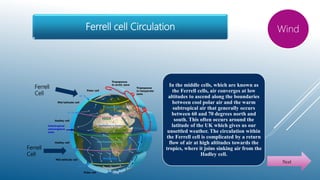
In the middle cells, which are known as
the Ferrell cells, air converges at low
altitudes to ascend along the boundaries
between cool polar air and the warm
subtropical air that generally occurs
between 60 and 70 degrees north and
south. This often occurs around the
latitude of the UK which gives us our
unsettled weather. The circulation within
the Ferrell cell is complicated by a return
flow of air at high altitudes towards the
tropics, where it joins sinking air from the
Hadley cell.
Wind
Next
Polar
cell
The smallest and weakest cells are the Polar cells, which extend
from between 60 and 70 degrees north and south, to the poles.
Air in these cells sinks over the highest latitudes and flows out
towards the lower latitudes at the surface.
.
At the poles, air is cooled and sinks towards the ground forming
high pressure, this known as the Polar high
The boundary between the warm and cold air is called the
Polar front
Wind
Next
Wind
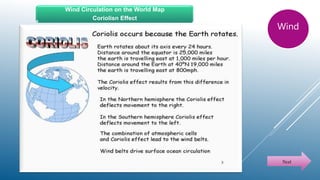
Wind Circulation on the World Map
Coriolisn Effect
Next
Do you
have any
Questions .
Friendly
may ask?
Wind
next
Wind
The End

Winds & it's types

  • 1.
    Geography WIND Group • Prof. Mudassar ShahzadWahla • I n t r o d u c t i o n • Ty p e s & i t s M e c h a n i s m • 05 Group Members: Mr. Shafeeq Ur Rehman (29) Saud Ameer (11) Misbah Hassan (49) Taibah Najib (35) Areej Iqbal (03) Class: BS URDU 4th (Evening) Department: Urdu & Oriental Languages University of Sargodha,Sargodha
  • 2.
  • 3.
  • 4.
    WIND:  The movementof air. From high pressure to low pressure. Wind blow gently and also in strong form.  Wind can broadly divided into three types: The trade winds, westerlies and easterlies are the permanent. Blow seasonally, These winds change the direction in different seasons. E.g. Monsoons in Pakistan. Permanent wind Seasonal wind Wind Next
  • 5.
    WIND: These below onlyduring a particular period of the day or year in a small area. E.g. Land or sea breeze. Local wind Next Wind Sea breeze Land breeze
  • 6.
    Permanent Winds Permanent winds Thewinds that blow constantly throughout the year are called permanent winds. They also blow constantly in a particular direction. They are Trade winds known as westerlies and Easterlies. Next Wind
  • 7.
  • 8.
    Seasonal Winds The windsthat change their direction with onsets of different seasons. E.g. o A Monsoon is a type of seasonal wind that seasonally changes direction between winter and summer. Wind Next Forecast of Monsoon 2011
  • 9.
    Monsoon A monsoon isa seasonal wind, found especially in Asia that reverses direction between summer and winter and often brings heavy rains, In the summer, a high pressure area lies over the Indian Ocean while a low exists over the Asian Continent. The air masses move from the high pressure over the ocean to the blow to the low over the continent, bringing moisture-laden air to south Asia. During winter, the process is reserved and a low sits over the Indian Ocean while a high lies over the Tibetan plateau so air flows down the Himalaya and south to the ocean. The migration of trade winds westerlies also contributes to the monsoons. Smaller monsoons take place in equatorial Africa, northern Australia and in the southwestern United States. Wind Next
  • 10.
    Year Actual onsetDate Forecast onset Date 2005 7th June 10th June 2006 26th May 30th May 2007 28th May 24th May 2008 31st May 29th May 2009 23rd May 26th May 2010 31st May 30th May PMD Data  Over the years the Pakistan Meteorological Department (PMD) forecasts Onset on Monsoon over Punjab & other provinces, which can seen on the above given Table.  The PMD has predicted that will hit Lahore on 31st May (Normal Date) through forecast changes in June but as of now they are from on their earlier decision that is the monsoon will enter Pakistan on the May 31. Wind Next
  • 11.
    When will Monsoonstart over Karachi? The monsoon generally reaches Pakistan during the first week of July while Karachi gets hit by monsoon during the second week of July that is till July 7. Following are the dates of monsoon onset in Karachi during the last few years; Wind Next Which large rainstorms are crucial for people in some parts of the world? India, Pakistan, and other nations in southern Asia are great places to go to see monsoon rains. The region depends on the water they bring. Parts of the Southwestern United States also receive monsoon rains. These rains break the summer heat. They also provide water to desert plants. With winter rains and summer rains, these deserts are more lush than many
  • 12.
    Locall Winds Local winds: arewinds that blow over a limited area. Local winds blow between small low and high pressure systems. They are influenced by local geography. Nearness to an ocean, lake, or mountain range can affect local winds. E.g. Land Breeze & Sea Breeze Wind Next
  • 13.
    Land & SeaBreeze The land and sea absorb and transfer heat differently. • During the day the land heats up faster and becomes warmer than the sea. • Therefore, over the land the air rises giving rise to a low pressure area, whereas the sea is relatively cool and the pressure over the sea is relatively high. Impact • The Wind blows from the sea to the land as the sea breeze. Wind Next
  • 14.
    Land & SeaBreeze Situation in night Reversal of condition takes places. The land loses heat faster and is cooler than the sea. Land breeze usually occur at night Wind Next Land Breeze Land breeze a local wind system characterized by a flow from land to water late at night. CONCLUDE Both are included by differences that occur between the heating or cooling of the water surface and the adjacent land surface.
  • 15.
  • 16.
    Mechanism of Winds Winds acts as an active agent of erosion, especially in desert. Sand Dunes When the wind blow, it lifts and transports sand from one place to another. When it stops blowing the blowing the sand falls and gets deposited in low hill. The structures created are called sand dunes.  When the grains of sand are very find and light, wind can carry it over very long distances are formed in this process. Mongolia Gobi desert in China Wind Next
  • 17.
    • Mushroom Rocks,are another structures formed by wind. • Wind blows Carries sand particle near the surface of earth. These winds erode the lower section of the rock more than the upper part. Such Rocks have narrower base and wider top. Mushrooms Rocks Wind Next
  • 18.
  • 19.
  • 20.
    The Wind circulation Overthe major parts of the Earth's surface there are large-scale wind circulations present. The Wind circulation can be described as the world-wide system of winds by which the necessary transport of heat from tropical to polar latitudes is accomplished. Wind Circulation on the World Map Hadley cell, Ferrell cell Polar cell In each hemisphere there are three cells: Wind Next
  • 21.
  • 22.
     The firstcell is called the Hadley cell. At the equator, the ground intensely heated by the sun.  The largest cells extend from the equator to between 30 and 40 degrees north and south, and are named Hadley cells, after English meteorologist George Hadley. Hadley cell Circulation Wind Next Hadley Cell
  • 23.
    Ferrell cell Circulation Ferrell Cell Ferrell Cell Inthe middle cells, which are known as the Ferrell cells, air converges at low altitudes to ascend along the boundaries between cool polar air and the warm subtropical air that generally occurs between 60 and 70 degrees north and south. This often occurs around the latitude of the UK which gives us our unsettled weather. The circulation within the Ferrell cell is complicated by a return flow of air at high altitudes towards the tropics, where it joins sinking air from the Hadley cell. Wind Next
  • 24.
    Polar cell The smallest andweakest cells are the Polar cells, which extend from between 60 and 70 degrees north and south, to the poles. Air in these cells sinks over the highest latitudes and flows out towards the lower latitudes at the surface. . At the poles, air is cooled and sinks towards the ground forming high pressure, this known as the Polar high The boundary between the warm and cold air is called the Polar front Wind Next
  • 25.
    Wind Wind Circulation onthe World Map Coriolisn Effect Next
  • 26.
    Do you have any Questions. Friendly may ask? Wind next
  • 27.