EDU555 CURRICULUM AND INSTRUCTION
WEEK 9
INSTRUCTIONAL OBJECTIVES
Instructional Objectives
0 To start teaching: teacher must be guided by
instructional objective, followed by strategies and
tools to accomplish the task, and then evaluate the
outcomes
Instructional Objectives
0 Objectives: desired outcomes of learning
0 Purpose:
Defining the intents of an educational plan
Helping teachers to plan steps necessary to achieve
plan
Helping students to know what is expected of them at
the end of the program
Instructional Objectives
Helping teachers, administrators and society to
assess the products of the system
Statement that described the teacher’s intent about
how students should change
Mager format of instructional
objectives
0 Robert Mager (1962) ‘Preparing Instructional
Objectives’
0 Objectives must be OBSERVABLE and MEASURABLE
0 ‘BEHAVIORAL OBJECTIVES’
Mager format of instructional
objectives
0 Robert Mager (1962) suggested that objectives of
learning need to be specific in term of:
1) Student behaviour
- What the learner will be able to do when he has
mastered the objectives
Mager format of instructional
objectives
- What learner will be doing or behavior the teacher
will accept as evidence that the ‘objectives’ have been
achieved
- using verbs that denote observable action
- “at the end of the lesson, the students should be able
to identify….”
Mager format of instructional
objectives
2) Testing situation
- Under what conditions he will be able to do it
- The condition under which the behaviour will be
observed
- ‘given the blank world map students should be
able to locate the 5 active volcanoes’
Mager format of instructional
objectives
3) Performance criteria
- To what standard he will be able to do it
- The standard of the performance level defined as
acceptable
- indicating correctness, speed, rate of response
- ‘given the blank world map students should be able to
locate the 5 active volcanoes’
Mager format of instructional
objectives
0 use precise words – that are not open to many
interpretations
0 Link the 3 parts together when writing the behavioral
objectives
0 Start by stating students behaviours, condition and
performance
Less precise words
- To know
- To understand
- To appreciate
- To enjoy
- To feel
- To appreciate
- To thank
Precise words
Examples :
- state
- list down
- identify
- compare
- calculate
- draw
- name the…
- colour the..
- measure
- solve
- match the..
Mager format of instructional
objectives
Criticisms:
1) Not practical  difficult to write
2) Difficult to accomplish the kind of specificity
3) Becomes unmanageable for teachers to write
because too many objectives and specificity
Instructional Objectives
0 Grondlund (1970) suggested there are 2 levels of
objectives:
1) General objectives
2) Specific objectives
Instructional Objectives
0 General instructional objectives must be followed by a
sample of specific behavioral outcomes
0 Teaching may be directed towards achievement of the
general objectives
Instructional Objectives
0 Specific objectives may form the basis for testing and
assessment
Bloom’s Instructional Objectives
0 There are different types of behaviours can be
specified in writing the instructional objectives
0 Y??
0 Learning outcomes are varied and may be classified
into different categories
Bloom’s Instructional Objectives
0 Benjamin Bloom (1956) proposed the most helpful
guides for the behaviour classification
0 He created a scheme that classifies instructional
objectives in a systematic way
Bloom’s Instructional Objectives
0 He divided the objectives into 3 domains:
1)Cognitive domain : knowing fact and information
2)Psychomotor domain: performing physical skills
3)Affective domain: exhibiting personal attitudes
Bloom’s Instructional Objectives
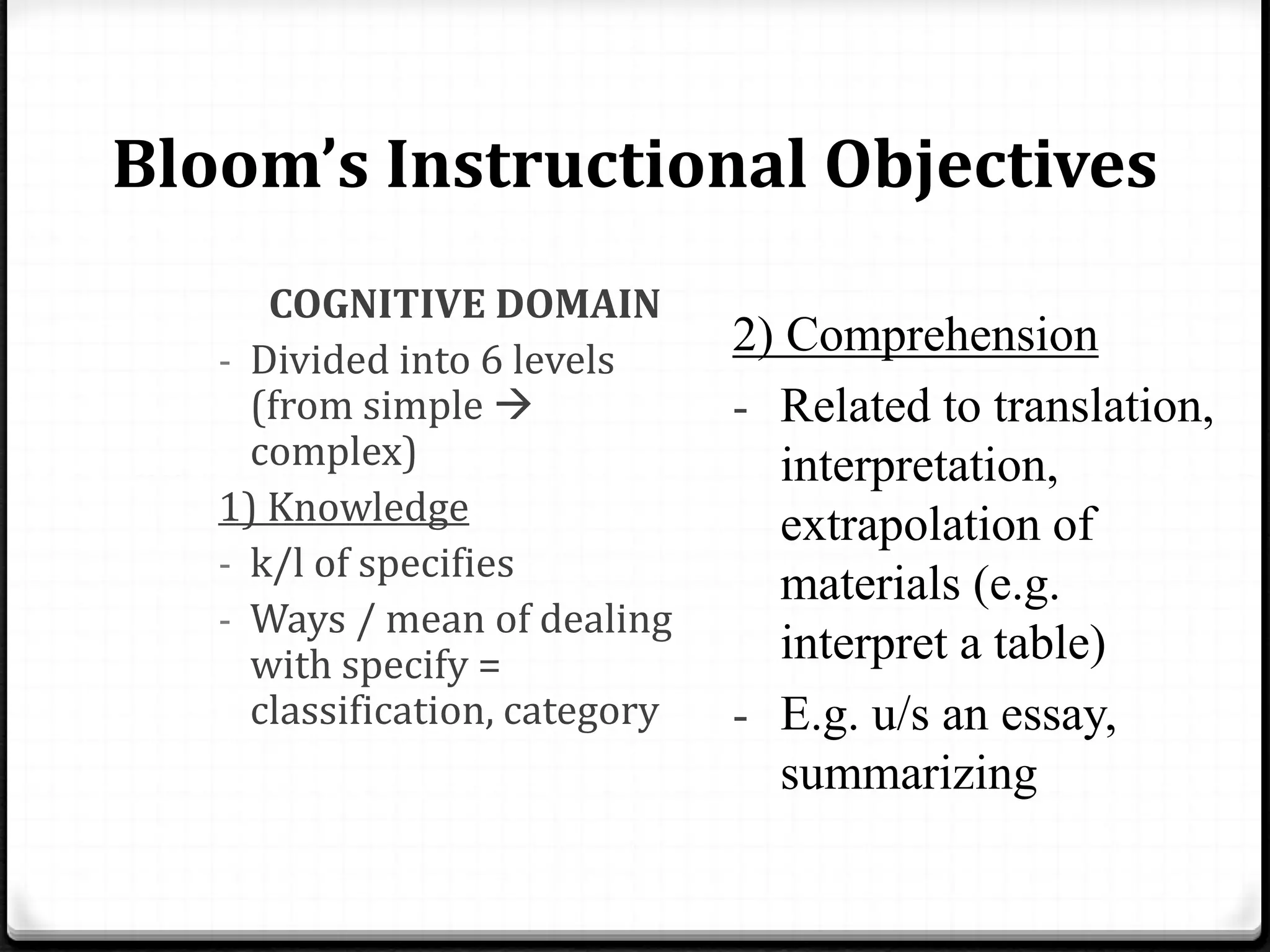
COGNITIVE DOMAIN
- Divided into 6 levels
(from simple 
complex)
1) Knowledge
- k/l of specifies
- Ways / mean of dealing
with specify =
classification, category
2) Comprehension
- Related to translation,
interpretation,
extrapolation of
materials (e.g.
interpret a table)
- E.g. u/s an essay,
summarizing
Bloom’s Instructional Objectives
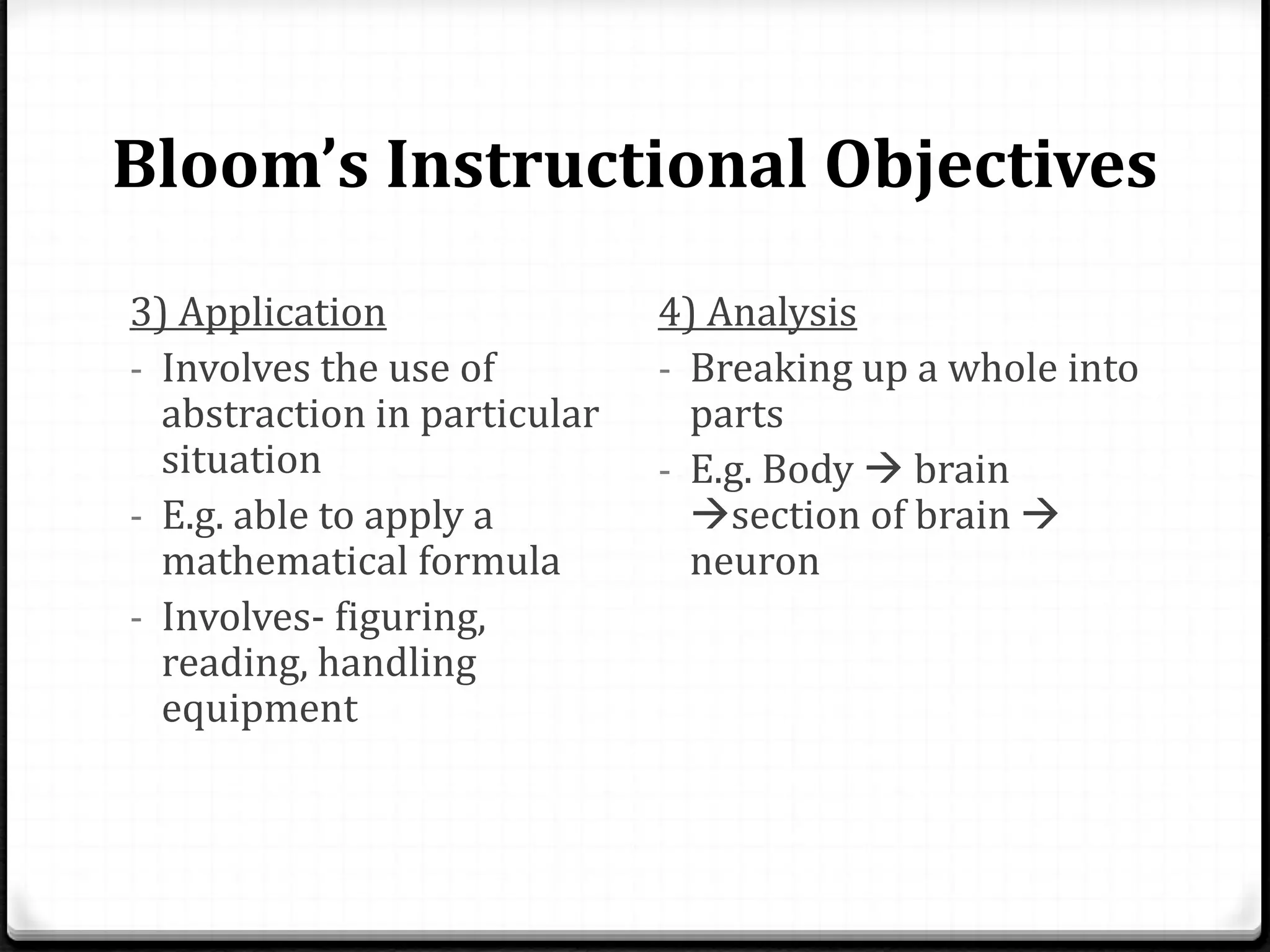
3) Application
- Involves the use of
abstraction in particular
situation
- E.g. able to apply a
mathematical formula
- Involves- figuring,
reading, handling
equipment
4) Analysis
- Breaking up a whole into
parts
- E.g. Body  brain
section of brain 
neuron
Bloom’s Instructional Objectives
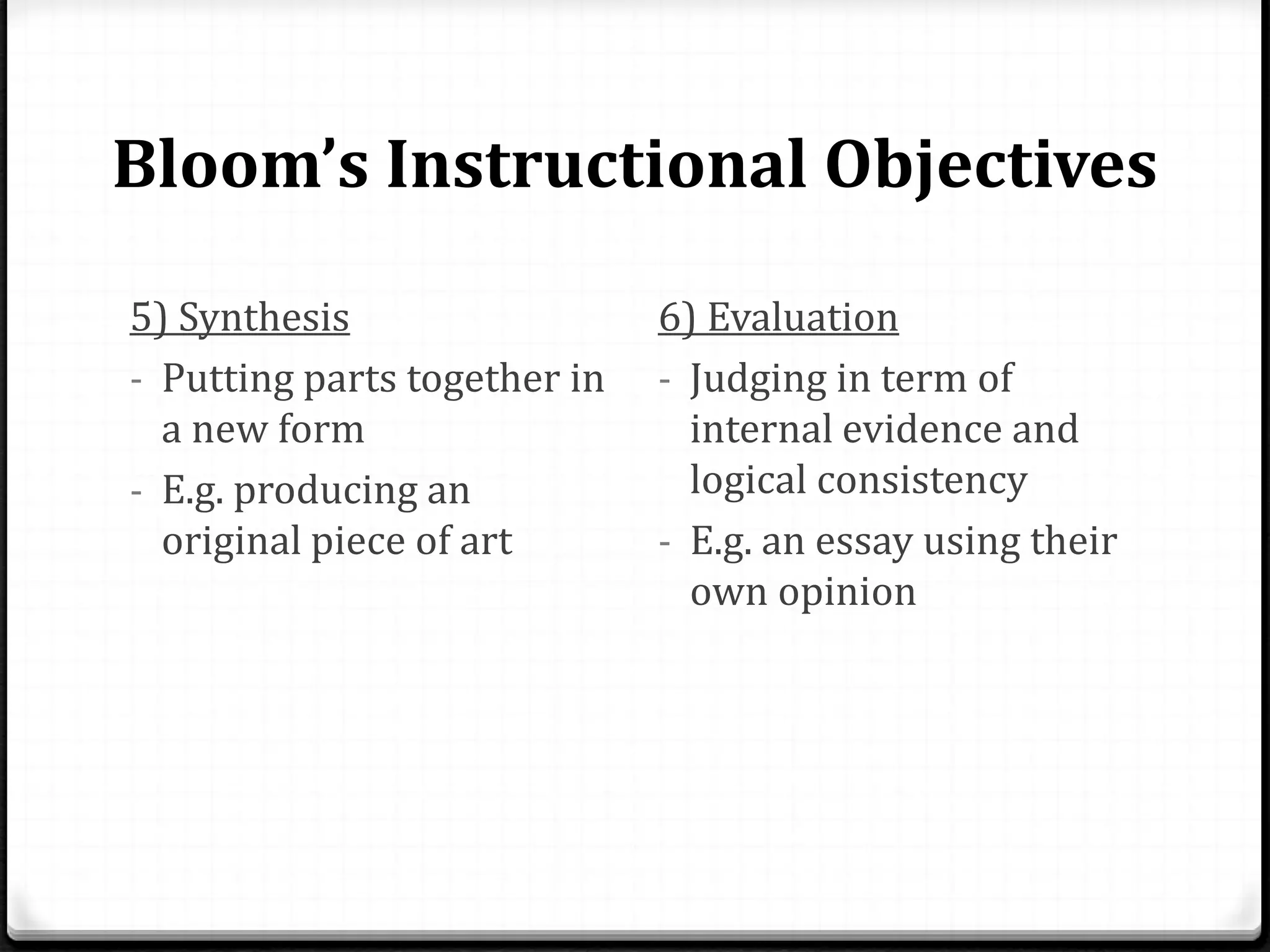
5) Synthesis
- Putting parts together in
a new form
- E.g. producing an
original piece of art
6) Evaluation
- Judging in term of
internal evidence and
logical consistency
- E.g. an essay using their
own opinion
Bloom’s Instructional Objectives
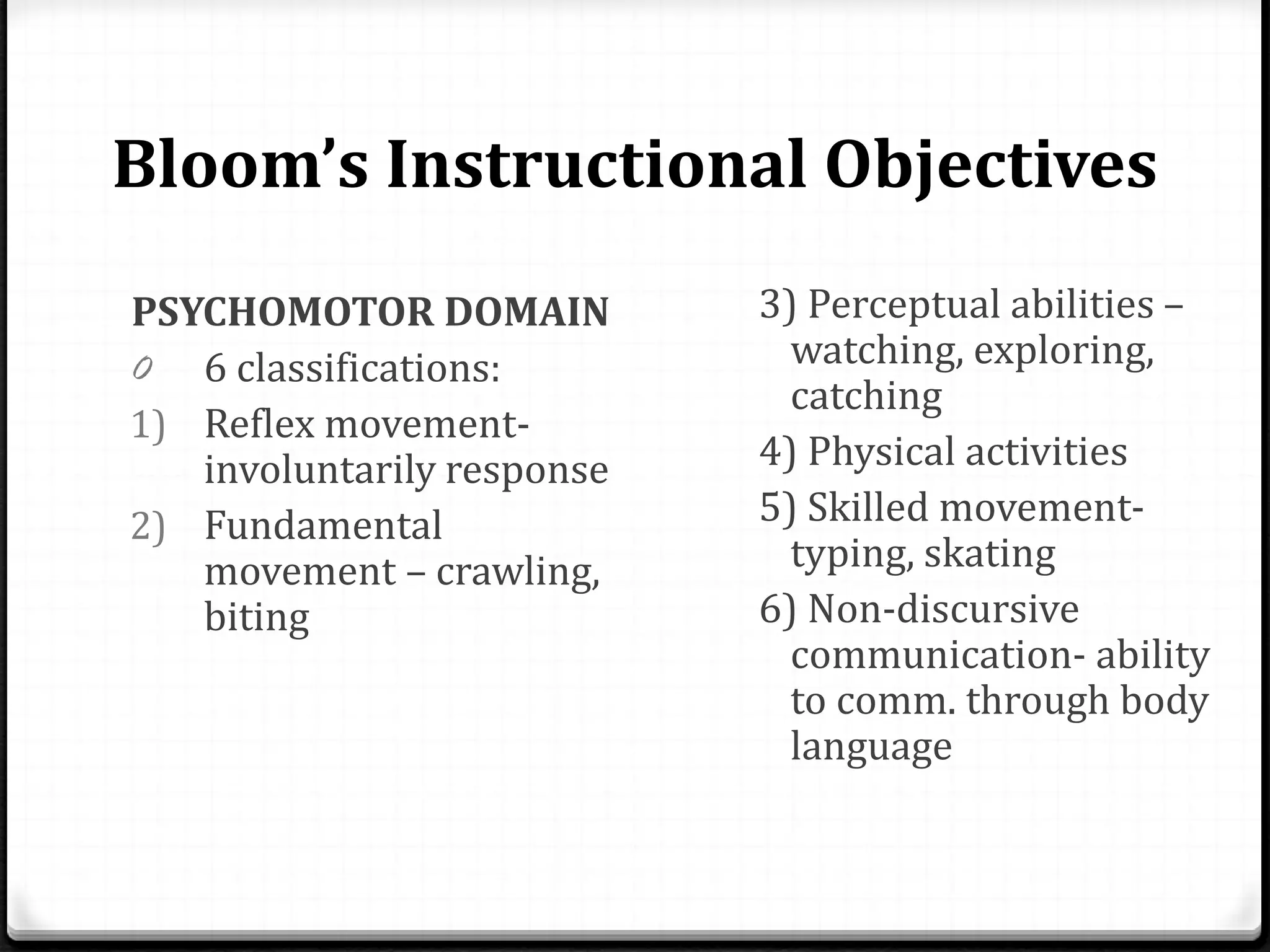
PSYCHOMOTOR DOMAIN
0 6 classifications:
1) Reflex movement-
involuntarily response
2) Fundamental
movement – crawling,
biting
3) Perceptual abilities –
watching, exploring,
catching
4) Physical activities
5) Skilled movement-
typing, skating
6) Non-discursive
communication- ability
to comm. through body
language
Bloom’s Instructional Objectives
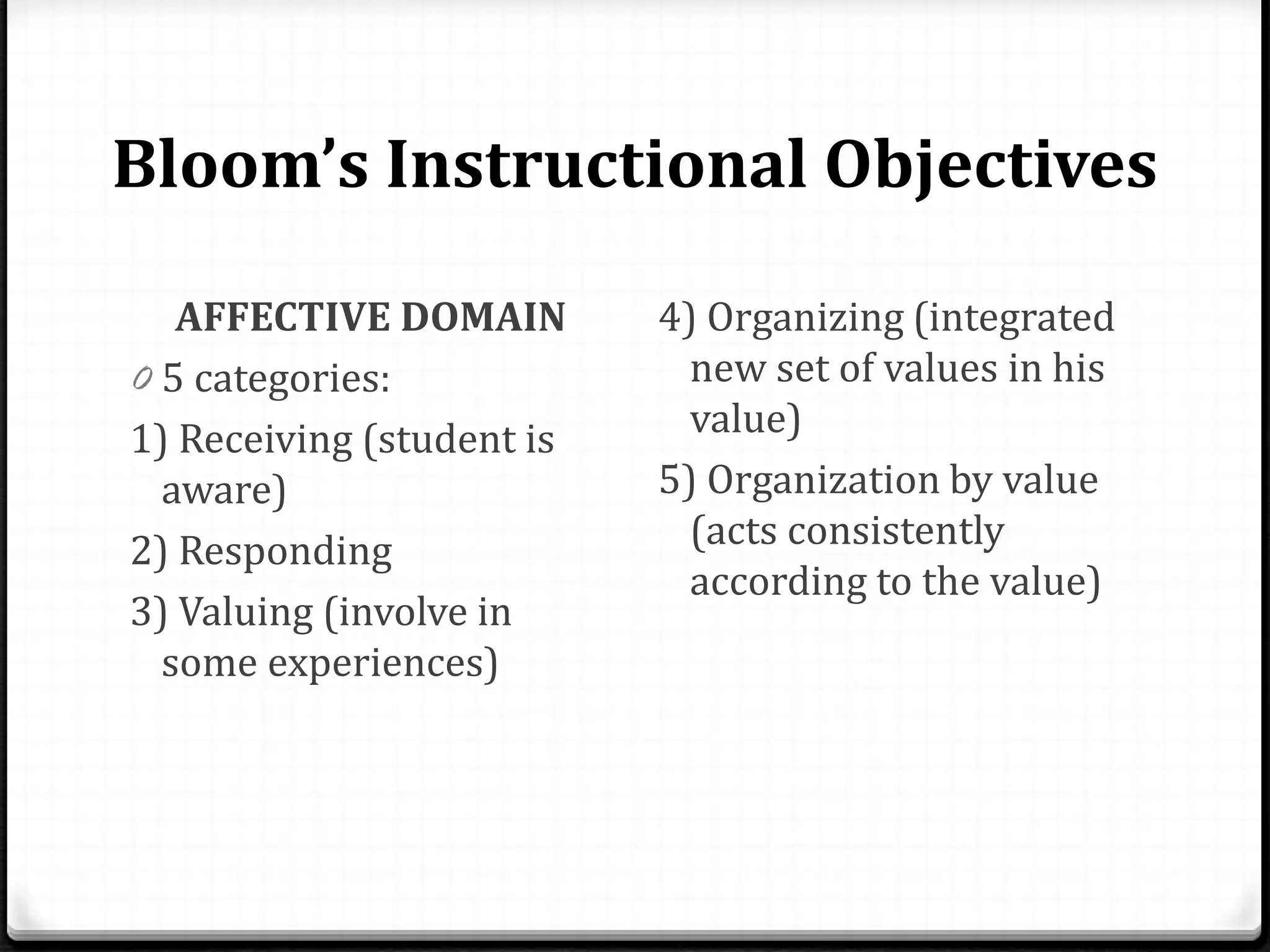
AFFECTIVE DOMAIN
0 5 categories:
1) Receiving (student is
aware)
2) Responding
3) Valuing (involve in
some experiences)
4) Organizing (integrated
new set of values in his
value)
5) Organization by value
(acts consistently
according to the value)
Bloom’s Instructional Objectives
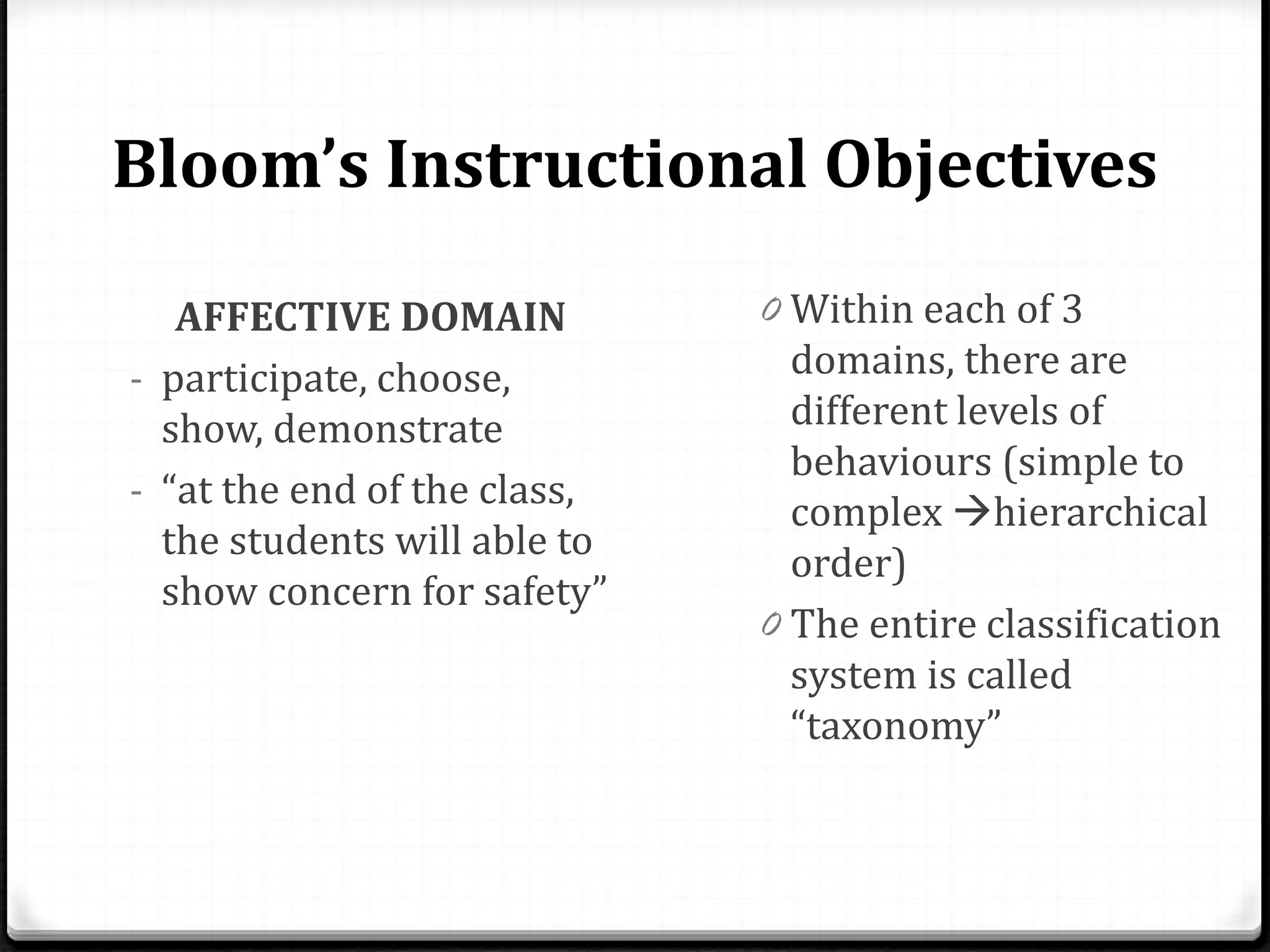
AFFECTIVE DOMAIN
- participate, choose,
show, demonstrate
- “at the end of the class,
the students will able to
show concern for safety”
0 Within each of 3
domains, there are
different levels of
behaviours (simple to
complex hierarchical
order)
0 The entire classification
system is called
“taxonomy”
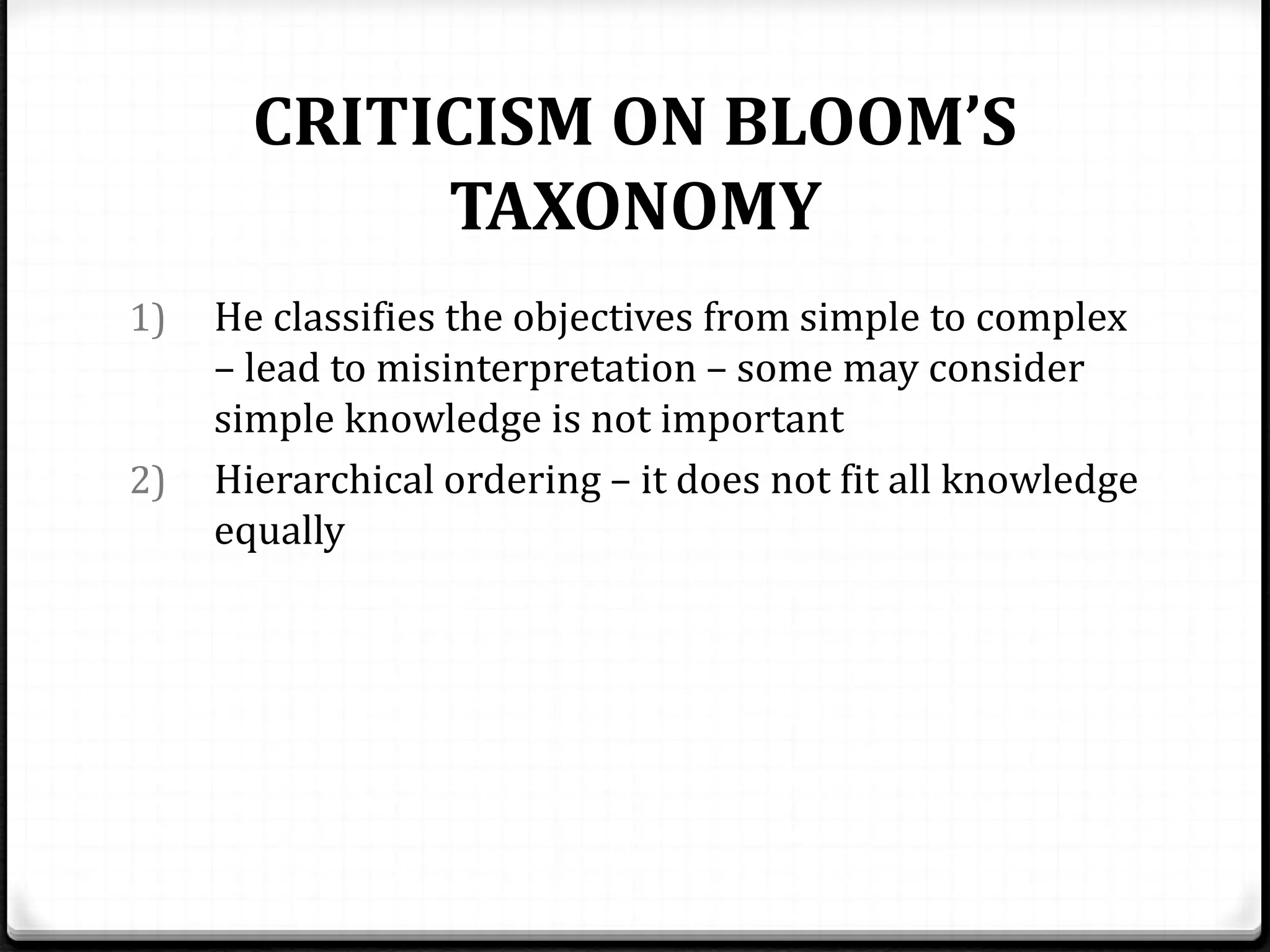
CRITICISM ON BLOOM’S
TAXONOMY
1) He classifies the objectives from simple to complex
– lead to misinterpretation – some may consider
simple knowledge is not important
2) Hierarchical ordering – it does not fit all knowledge
equally

Week 9 instructional objectives

  • 1.
    EDU555 CURRICULUM ANDINSTRUCTION WEEK 9
  • 2.
  • 3.
    Instructional Objectives 0 Tostart teaching: teacher must be guided by instructional objective, followed by strategies and tools to accomplish the task, and then evaluate the outcomes
  • 4.
    Instructional Objectives 0 Objectives:desired outcomes of learning 0 Purpose: Defining the intents of an educational plan Helping teachers to plan steps necessary to achieve plan Helping students to know what is expected of them at the end of the program
  • 5.
    Instructional Objectives Helping teachers,administrators and society to assess the products of the system Statement that described the teacher’s intent about how students should change
  • 6.
    Mager format ofinstructional objectives 0 Robert Mager (1962) ‘Preparing Instructional Objectives’ 0 Objectives must be OBSERVABLE and MEASURABLE 0 ‘BEHAVIORAL OBJECTIVES’
  • 7.
    Mager format ofinstructional objectives 0 Robert Mager (1962) suggested that objectives of learning need to be specific in term of: 1) Student behaviour - What the learner will be able to do when he has mastered the objectives
  • 8.
    Mager format ofinstructional objectives - What learner will be doing or behavior the teacher will accept as evidence that the ‘objectives’ have been achieved - using verbs that denote observable action - “at the end of the lesson, the students should be able to identify….”
  • 9.
    Mager format ofinstructional objectives 2) Testing situation - Under what conditions he will be able to do it - The condition under which the behaviour will be observed - ‘given the blank world map students should be able to locate the 5 active volcanoes’
  • 10.
    Mager format ofinstructional objectives 3) Performance criteria - To what standard he will be able to do it - The standard of the performance level defined as acceptable - indicating correctness, speed, rate of response - ‘given the blank world map students should be able to locate the 5 active volcanoes’
  • 11.
    Mager format ofinstructional objectives 0 use precise words – that are not open to many interpretations 0 Link the 3 parts together when writing the behavioral objectives 0 Start by stating students behaviours, condition and performance
  • 12.
    Less precise words -To know - To understand - To appreciate - To enjoy - To feel - To appreciate - To thank
  • 13.
    Precise words Examples : -state - list down - identify - compare - calculate - draw - name the… - colour the.. - measure - solve - match the..
  • 14.
    Mager format ofinstructional objectives Criticisms: 1) Not practical  difficult to write 2) Difficult to accomplish the kind of specificity 3) Becomes unmanageable for teachers to write because too many objectives and specificity
  • 15.
    Instructional Objectives 0 Grondlund(1970) suggested there are 2 levels of objectives: 1) General objectives 2) Specific objectives
  • 16.
    Instructional Objectives 0 Generalinstructional objectives must be followed by a sample of specific behavioral outcomes 0 Teaching may be directed towards achievement of the general objectives
  • 17.
    Instructional Objectives 0 Specificobjectives may form the basis for testing and assessment
  • 18.
    Bloom’s Instructional Objectives 0There are different types of behaviours can be specified in writing the instructional objectives 0 Y?? 0 Learning outcomes are varied and may be classified into different categories
  • 19.
    Bloom’s Instructional Objectives 0Benjamin Bloom (1956) proposed the most helpful guides for the behaviour classification 0 He created a scheme that classifies instructional objectives in a systematic way
  • 20.
    Bloom’s Instructional Objectives 0He divided the objectives into 3 domains: 1)Cognitive domain : knowing fact and information 2)Psychomotor domain: performing physical skills 3)Affective domain: exhibiting personal attitudes
  • 21.
    Bloom’s Instructional Objectives COGNITIVEDOMAIN - Divided into 6 levels (from simple  complex) 1) Knowledge - k/l of specifies - Ways / mean of dealing with specify = classification, category 2) Comprehension - Related to translation, interpretation, extrapolation of materials (e.g. interpret a table) - E.g. u/s an essay, summarizing
  • 22.
    Bloom’s Instructional Objectives 3)Application - Involves the use of abstraction in particular situation - E.g. able to apply a mathematical formula - Involves- figuring, reading, handling equipment 4) Analysis - Breaking up a whole into parts - E.g. Body  brain section of brain  neuron
  • 23.
    Bloom’s Instructional Objectives 5)Synthesis - Putting parts together in a new form - E.g. producing an original piece of art 6) Evaluation - Judging in term of internal evidence and logical consistency - E.g. an essay using their own opinion
  • 24.
    Bloom’s Instructional Objectives PSYCHOMOTORDOMAIN 0 6 classifications: 1) Reflex movement- involuntarily response 2) Fundamental movement – crawling, biting 3) Perceptual abilities – watching, exploring, catching 4) Physical activities 5) Skilled movement- typing, skating 6) Non-discursive communication- ability to comm. through body language
  • 25.
    Bloom’s Instructional Objectives AFFECTIVEDOMAIN 0 5 categories: 1) Receiving (student is aware) 2) Responding 3) Valuing (involve in some experiences) 4) Organizing (integrated new set of values in his value) 5) Organization by value (acts consistently according to the value)
  • 26.
    Bloom’s Instructional Objectives AFFECTIVEDOMAIN - participate, choose, show, demonstrate - “at the end of the class, the students will able to show concern for safety” 0 Within each of 3 domains, there are different levels of behaviours (simple to complex hierarchical order) 0 The entire classification system is called “taxonomy”
  • 27.
    CRITICISM ON BLOOM’S TAXONOMY 1)He classifies the objectives from simple to complex – lead to misinterpretation – some may consider simple knowledge is not important 2) Hierarchical ordering – it does not fit all knowledge equally