EDU555 CURRICULUM AND INSTRUCTION
WEEK 4
Introduction
0 This lecture will consist of the following:
1. Curriculum Evaluation:
Types, Purposes, Procedures
2. CIPP Model
Definition of Curriculum
Evaluation
0 Making judgments about the desirability of certain
changes in students + using info to change teaching
and the curriculum
Definition
Various definitions:
1. Tyler (1950): the process of determining to what extend
educational objectives are being attained
2. Borg & Gall (1983): the process of making judgment abt
the merit, value or worth of educational prog, projects,
materials and techniques
Definition
3. Smith & Glass (1987): the process of establishing value
judgments based on evidence abt a program / product
4. Stufflebeam et al. (1971): .. The process of delineating,
obtaining & providing useful info for judging decision
alternatives
Definition
0 Provus (1971): the comparison of performance to
some standards to determine whether discrepancies
existed
Types of Evaluation
0 Scriven (1967)
1) Formative evaluation
0 on-going program
0 program improvement
0 provide data abt educational program
 to assist developer in improving the program
Types of Evaluation
2) Summative evaluation
0 done at the completion of a program
0 concerned with overall effectiveness of the
program
0 Provide data to determine the worth of the
program
Evaluation in curriculum
development
0 Evaluation – part of the curriculum development
process
0 Enables curriculum makers reviewing and
modifying – to cater the current and future needs
Evaluation in curriculum
development
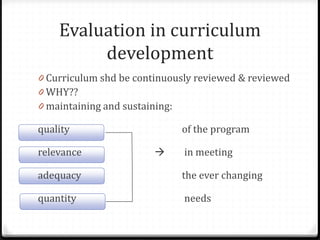
0 Curriculum shd be continuously reviewed & reviewed
0 WHY??
0 maintaining and sustaining:
quality of the program
relevance  in meeting
adequacy the ever changing
quantity needs
Evaluation in curriculum
development
0 QUESTIONS SHOULD BE ASKED:
1) Are the program (curriculum) meeting existing or
expected needs?
2) Does the program contain extraneous and outdated
materials?
3) Are the students able to perform adequately once they
finish their study?
Evaluation in curriculum
development
0 Wentling (1980): EVALUATION MUST DO MORE
THAN :
0 just analyse the extend to which a program had
adhered to an original plan
0 OR attained its primary goals and objectives
Evaluation in curriculum
development
0 So, based on Wentling’s (1980) suggestion..
0 Curriculum evaluation needs to go beyond the
assessment of student behaviour
0 It should include the overall effect on students,
teachers and society
Evaluation in curriculum
development
0 The task of evaluating the curriculum involves a
COMPLEX PROCESS
0 A comprehensive evaluation framework or model is
necessary to achieve a systematic, effective and
efficient evaluation
CIPP Model For Evaluation
0 Introduced by Daniel Stufflebeam in 1966.
0 A comprehensive framework for guiding
formative and summative evaluation of
 Programs (Curriculum, course design, etc.)
 Projects
 Personnel
 Products
 Institutions
 Systems
CIPP Model For Evaluation
0 The model has been widely applied by:
 Government officials
 Foundation officers
 Program and project staffs
 International assistance personnel
 School administrators
 Evaluators, etc.
Model (framework) for
Curriculum Evaluation
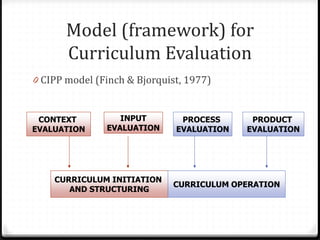
0 CIPP model (Finch & Bjorquist, 1977)
CONTEXT
EVALUATION
INPUT
EVALUATION
PROCESS
EVALUATION
PRODUCT
EVALUATION
CURRICULUM INITIATION
AND STRUCTURING
CURRICULUM OPERATION
Context Evaluation
0 Involves analysis of goals and needs in a specific education
setting
0 Needs  a discrepancy between an existing condition and
desired condition
0 Evaluation of context includes:
 Environment
 Students
 Background
 School climate
 Goals and objectives of offering the program, etc.
Input Evaluation
0 Concerns judgment about resources and
strategies needed to accomplish program goals
and objectives
0 This includes the quality of:
 The curriculum and syllabus
 Students
 Teachers
 Staffs
 Facilities and infrastructures, etc.
Process Evaluation
0 Involves the collection of data once the program
has been designed and put into operation.
0 Data which is collected over a period of time is
useful in detecting strengths and weaknesses of the
program.
0 Process including:
 Teachers’ methods
 The facilities used
 The students performance, etc.
Product Evaluation
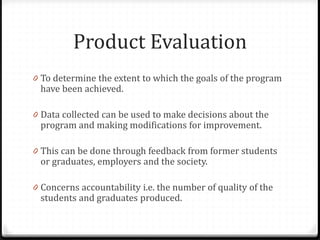
0 To determine the extent to which the goals of the program
have been achieved.
0 Data collected can be used to make decisions about the
program and making modifications for improvement.
0 This can be done through feedback from former students
or graduates, employers and the society.
0 Concerns accountability i.e. the number of quality of the
students and graduates produced.
Thank you

Edu555 curriculum evaluation, cipp model week 4

  • 1.
    EDU555 CURRICULUM ANDINSTRUCTION WEEK 4
  • 2.
    Introduction 0 This lecturewill consist of the following: 1. Curriculum Evaluation: Types, Purposes, Procedures 2. CIPP Model
  • 3.
    Definition of Curriculum Evaluation 0Making judgments about the desirability of certain changes in students + using info to change teaching and the curriculum
  • 4.
    Definition Various definitions: 1. Tyler(1950): the process of determining to what extend educational objectives are being attained 2. Borg & Gall (1983): the process of making judgment abt the merit, value or worth of educational prog, projects, materials and techniques
  • 5.
    Definition 3. Smith &Glass (1987): the process of establishing value judgments based on evidence abt a program / product 4. Stufflebeam et al. (1971): .. The process of delineating, obtaining & providing useful info for judging decision alternatives
  • 6.
    Definition 0 Provus (1971):the comparison of performance to some standards to determine whether discrepancies existed
  • 7.
    Types of Evaluation 0Scriven (1967) 1) Formative evaluation 0 on-going program 0 program improvement 0 provide data abt educational program  to assist developer in improving the program
  • 8.
    Types of Evaluation 2)Summative evaluation 0 done at the completion of a program 0 concerned with overall effectiveness of the program 0 Provide data to determine the worth of the program
  • 9.
    Evaluation in curriculum development 0Evaluation – part of the curriculum development process 0 Enables curriculum makers reviewing and modifying – to cater the current and future needs
  • 10.
    Evaluation in curriculum development 0Curriculum shd be continuously reviewed & reviewed 0 WHY?? 0 maintaining and sustaining: quality of the program relevance  in meeting adequacy the ever changing quantity needs
  • 11.
    Evaluation in curriculum development 0QUESTIONS SHOULD BE ASKED: 1) Are the program (curriculum) meeting existing or expected needs? 2) Does the program contain extraneous and outdated materials? 3) Are the students able to perform adequately once they finish their study?
  • 12.
    Evaluation in curriculum development 0Wentling (1980): EVALUATION MUST DO MORE THAN : 0 just analyse the extend to which a program had adhered to an original plan 0 OR attained its primary goals and objectives
  • 13.
    Evaluation in curriculum development 0So, based on Wentling’s (1980) suggestion.. 0 Curriculum evaluation needs to go beyond the assessment of student behaviour 0 It should include the overall effect on students, teachers and society
  • 14.
    Evaluation in curriculum development 0The task of evaluating the curriculum involves a COMPLEX PROCESS 0 A comprehensive evaluation framework or model is necessary to achieve a systematic, effective and efficient evaluation
  • 15.
    CIPP Model ForEvaluation 0 Introduced by Daniel Stufflebeam in 1966. 0 A comprehensive framework for guiding formative and summative evaluation of  Programs (Curriculum, course design, etc.)  Projects  Personnel  Products  Institutions  Systems
  • 16.
    CIPP Model ForEvaluation 0 The model has been widely applied by:  Government officials  Foundation officers  Program and project staffs  International assistance personnel  School administrators  Evaluators, etc.
  • 17.
    Model (framework) for CurriculumEvaluation 0 CIPP model (Finch & Bjorquist, 1977) CONTEXT EVALUATION INPUT EVALUATION PROCESS EVALUATION PRODUCT EVALUATION CURRICULUM INITIATION AND STRUCTURING CURRICULUM OPERATION
  • 18.
    Context Evaluation 0 Involvesanalysis of goals and needs in a specific education setting 0 Needs  a discrepancy between an existing condition and desired condition 0 Evaluation of context includes:  Environment  Students  Background  School climate  Goals and objectives of offering the program, etc.
  • 19.
    Input Evaluation 0 Concernsjudgment about resources and strategies needed to accomplish program goals and objectives 0 This includes the quality of:  The curriculum and syllabus  Students  Teachers  Staffs  Facilities and infrastructures, etc.
  • 20.
    Process Evaluation 0 Involvesthe collection of data once the program has been designed and put into operation. 0 Data which is collected over a period of time is useful in detecting strengths and weaknesses of the program. 0 Process including:  Teachers’ methods  The facilities used  The students performance, etc.
  • 21.
    Product Evaluation 0 Todetermine the extent to which the goals of the program have been achieved. 0 Data collected can be used to make decisions about the program and making modifications for improvement. 0 This can be done through feedback from former students or graduates, employers and the society. 0 Concerns accountability i.e. the number of quality of the students and graduates produced.
  • 22.