Instructional Objectives
Bloom’s RevisedTaxonomy
ntvasokan@gmail.com
9445191369
Dr.N.Asokan
Overview of the Presentation
1 . P u r p o s e o f t h i s t r a i n i n g
2. Issues and Concerns of Teach ers
3 . I m p o r t a n t E d u c a t i o n a l G o a l s
4 . B a s i c T e a c h i n g M o d e l
5. Instructional Objectives- Definition, Advantages and Need
6. General Objectives and Specific Objectives
7. Methods of Stating Objectives
8. Six General rules for Stating Specific Objectives
9. Bloom’s Taxonomy of educational objectives
10. Advantages of Taxonomy
11. Bloom’s Revised Taxonomy of educational objectives
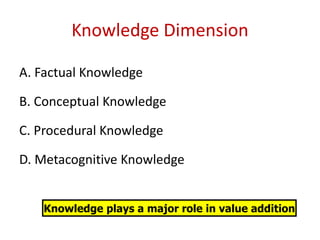
12. Knowledge Dimension
13. Cognitive Dimension - Examples of Objectives
14. Take away
2
Purpose
To expand
the capacity of individual
and
Organization
for
Best Performance
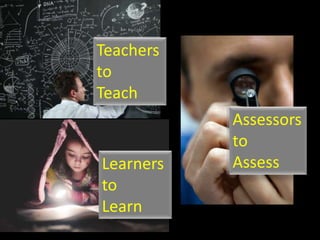
Teachers to Teach
Learners to Learn
Assessors to Assess
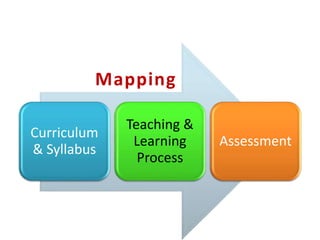
Mapping
Curriculum
& Syllabus
Teaching &
Learning
Process
Assessment
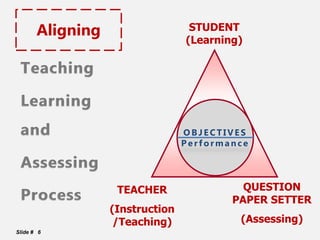
Slide # 6
O BJECTIVES
P erformance
STUDENT
(Learning)
QUESTION
PAPER SETTER
(Assessing)
TEACHER
(Instruction
/Teaching)
Aligning
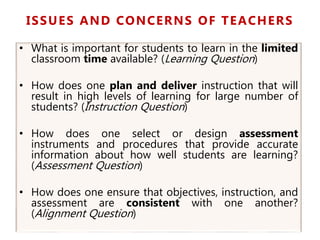
ISSUES AND CONCERNS OF TEACHERS
• What is important for students to learn in the limited
classroom time available? (Learning Question)
• How does one plan and deliver instruction that will
result in high levels of learning for large number of
students? (Instruction Question)
• How does one select or design assessment
instruments and procedures that provide accurate
information about how well students are learning?
(Assessment Question)
• How does one ensure that objectives, instruction, and
assessment are consistent with one another?
(Alignment Question)
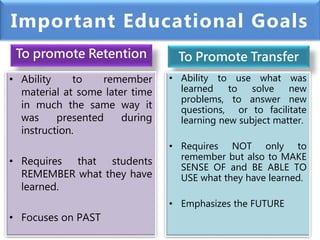
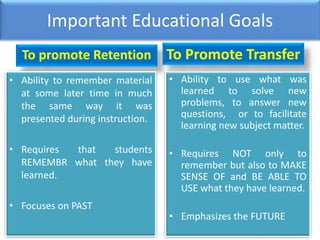
Important Educational Goals
To promote Retention
• Ability to remember
material at some later time
in much the same way it
was presented during
instruction.
• Requires that students
REMEMBER what they have
learned.
• Focuses on PAST
To Promote Transfer
• Ability to use what was
learned to solve new
problems, to answer new
questions, or to facilitate
learning new subject matter.
• Requires NOT only to
remember but also to MAKE
SENSE OF and BE ABLE TO
USE what they have learned.
• Emphasizes the FUTURE
Learning
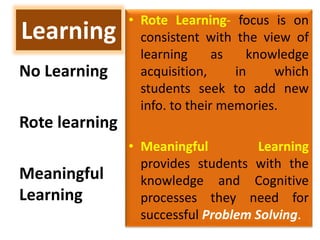
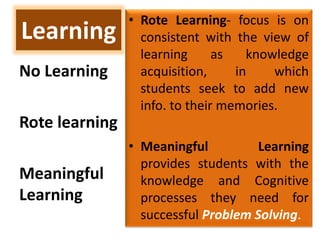
• Rote Learning- focus is on
consistent with the view of
learning as knowledge
acquisition, in which
students seek to add new
info. to their memories.
• Meaningful Learning
provides students with the
knowledge and Cognitive
processes they need for
successful Problem Solving.
No Learning
Rote learning
Meaningful
Learning
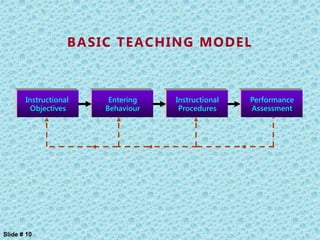
BASIC TEACHING MODEL
Instructional
Objectives
Entering
Behaviour
Instructional
Procedures
Performance
Assessment
Slide # 10
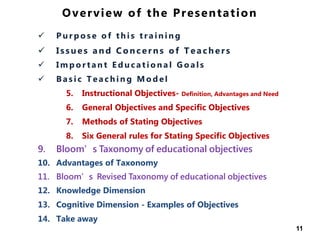
Overview of the Presentation
 P u r p o s e o f t h i s t r a i n i n g
 Issues and Concerns of Teach ers
 I m p o r t a n t E d u c a t i o n a l G o a l s
 B a s i c T e a c h i n g M o d e l
5. Instructional Objectives- Definition, Advantages and Need
6. General Objectives and Specific Objectives
7. Methods of Stating Objectives
8. Six General rules for Stating Specific Objectives
9. Bloom’s Taxonomy of educational objectives
10. Advantages of Taxonomy
11. Bloom’s Revised Taxonomy of educational objectives
12. Knowledge Dimension
13. Cognitive Dimension - Examples of Objectives
14. Take away
11
Objectives
• In life, objectives help us to focus our
attention and our efforts, they indicate what
we want to accomplish.
• In education, objectives indicate what we
want students to learn; they are
“ explicit formulations of the ways in which
students are expected to be changed by the
educative process”
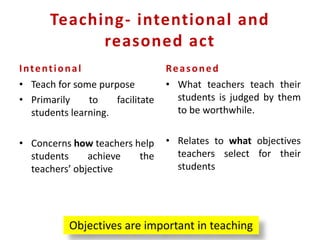
Teaching- intentional and
reasoned act
Intentional
• Teach for some purpose
• Primarily to facilitate
students learning.
• Concerns how teachers help
students achieve the
teachers’ objective
Reasoned
• What teachers teach their
students is judged by them
to be worthwhile.
• Relates to what objectives
teachers select for their
students
Objectives are important in teaching
The learning environments the
teachers create,
activities, and experience they
provide should be
aligned with, or be consistent with,
the selected objectives
When we teach,
we want our students to learn.
What we want them to learn
as a result of our teaching are our
objectives
• Aims
• Purpose
• Goals
• Guiding outcomes
• Content standards
• Curriculum standards
Objectives are present in virtually all teaching
Need for Instructional
Objectives
Specifies what the students should learn to do
Serves as sign post to the students.
Provides direction to the teacher in the
teaching learning process to attain the stated
objectives.
Provides guidance to the question paper
setter for evaluating students achievements.
DEFINITION OF
INSTRUCTIONAL OBJECTIVES
Instructional objectives are statements,
which communicate in behavioural terms
the expected performance of the students
at the end of instruction.
(i) General Objectives (G.O.)
(ii) Specific Objectives (S.O.)
TYPES OF OBJECTIVES
18
General Objectives- Definition
• Very general statements, which describe in
implicit terms the overall aims of the total
teaching learning process.
• They are not explicit.
• Stated in broad term to encompass a class or
domain of student performance.
General Objectives - Examples
• To understand women, gender and
development issues.
• To equip the students with requisite skills to
work with NGOs
• To empower the learner to actively participate
in governance
• To serve as social facilitators in bringing
transformation in the lives of youth
• To become professional youth worker
General Objectives - Examples
• To understand the concept of Data Flow
Diagram.
• To comprehend the use of scanner.
• To understand the concept of semiconductor.
• To understand the concept of DBMS.
On completion of the study the student will be able:
Specific Objectives - Definition
• Specify what the student will be able to do on completion
of learning. (Student Centered)
• Expressed in terms of student’s terminal cognitive process /
behavioral terms. ( Learning Based)
• Identify the end product of instruction in terms of
observable performance of students. (Explicit)
• Indicate a very specific learning outcome which can be
easily be tested for achievement. (Assessable
Statement)
Specific Objectives- Format
The most useful form of stating objectives is to
express them in terms which identify both the
kind of cognitive process/behavior to be
developed in the student and the
knowledge/content … in which this behavior is to
operate.
Objectives must be stated in terms of learner’s terminal behavior.
Format / Definition
• The students will be able to, (verb) or learn to,
(noun).
• Verb describes the intended the cognitive
process
• Noun describes the knowledge / content
students are expected to acquire or construct
Example
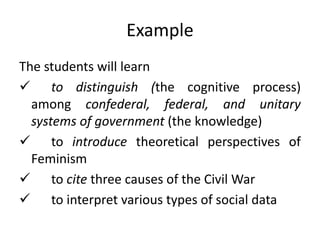
The students will learn
 to distinguish (the cognitive process)
among confederal, federal, and unitary
systems of government (the knowledge)
 to introduce theoretical perspectives of
Feminism
 to cite three causes of the Civil War
 to interpret various types of social data
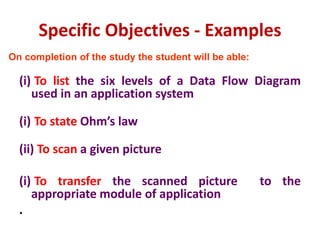
Specific Objectives - Examples
(i) To list the six levels of a Data Flow Diagram
used in an application system
(i) To state Ohm’s law
(ii) To scan a given picture
(i) To transfer the scanned picture to the
appropriate module of application
.
On completion of the study the student will be able:
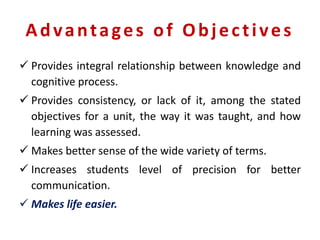
Advantages of Objectives
 Provides integral relationship between knowledge and
cognitive process.
 Provides consistency, or lack of it, among the stated
objectives for a unit, the way it was taught, and how
learning was assessed.
 Makes better sense of the wide variety of terms.
 Increases students level of precision for better
communication.
 Makes life easier.
METHODS OF STATING OBJECTIVES
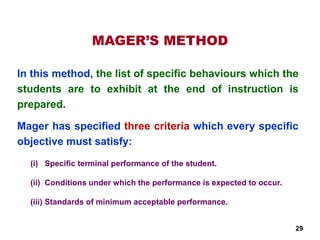
(i) Mager’s method
(ii) Gronlund’s method
28
MAGER’S METHOD
(i) Specific terminal performance of the student.
(ii) Conditions under which the performance is expected to occur.
(iii) Standards of minimum acceptable performance.
In this method, the list of specific behaviours which the
students are to exhibit at the end of instruction is
prepared.
Mager has specified three criteria which every specific
objective must satisfy:
29
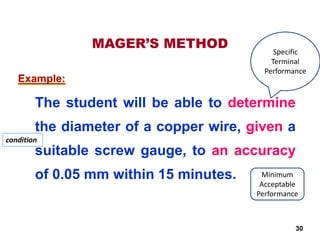
MAGER’S METHOD
The student will be able to determine
the diameter of a copper wire, given a
suitable screw gauge, to an accuracy
of 0.05 mm within 15 minutes.
Example:
30
Specific
Terminal
Performance
condition
Minimum
Acceptable
Performance
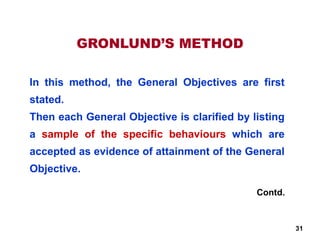
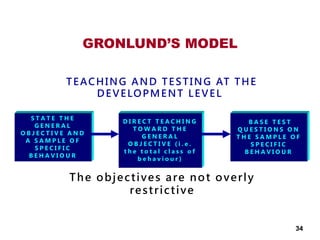
GRONLUND’S METHOD
In this method, the General Objectives are first
stated.
Then each General Objective is clarified by listing
a sample of the specific behaviours which are
accepted as evidence of attainment of the General
Objective.
Contd.
31
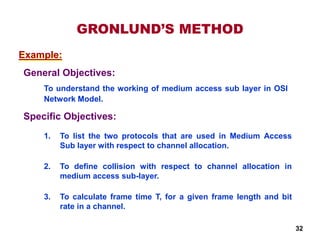
Example:
1. To list the two protocols that are used in Medium Access
Sub layer with respect to channel allocation.
2. To define collision with respect to channel allocation in
medium access sub-layer.
3. To calculate frame time T, for a given frame length and bit
rate in a channel.
Specific Objectives:
General Objectives:
To understand the working of medium access sub layer in OSI
Network Model.
GRONLUND’S METHOD
32
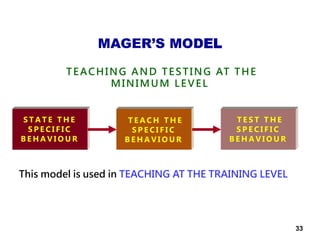
This model is used in TEACHING AT THE TRAINING LEVEL
S T A T E T H E
S P E C I F I C
B E H A V I O U R
T E A C H T H E
S P E C I F I C
B E H A V I O U R
T E S T T H E
S P E C I F I C
B E H A V I O U R
TEACHING AND TESTING AT THE
MINIMUM LEVEL
MAGER’S MODEL
33
S T A T E T H E
G E N E R A L
O B J E C T I V E A N D
A S A M P L E O F
S P E C I F I C
B E H A V I O U R
D I R E C T T E A C H I N G
T O W A R D T H E
G E N E R A L
O B J E C T I V E ( i . e .
t h e t o t a l c l a s s o f
b e h a v i o u r )
B A S E T E S T
Q U E S T I O N S O N
T H E S A M P L E O F
S P E C I F I C
B E H A V I O U R
The objectives are not overly
restrictive
TEACHING AND TESTING AT THE
DEVELOPMENT LEVEL
GRONLUND’S MODEL
34
SIX RULES
FOR
STATING
SPECIFIC OBJECTIVES
GENERAL RULES FOR STATING
SPECIFIC OBJECTIVES
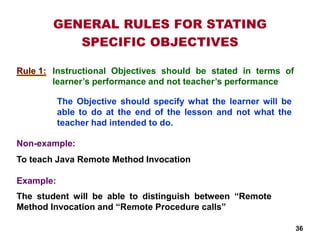
Instructional Objectives should be stated in terms of
learner’s performance and not teacher’s performance
The Objective should specify what the learner will be
able to do at the end of the lesson and not what the
teacher had intended to do.
Non-example:
To teach Java Remote Method Invocation
Example:
The student will be able to distinguish between “Remote
Method Invocation and “Remote Procedure calls”
Rule 1:
36
GENERAL RULES FOR STATING
SPECIFIC OBJECTIVES
The mere description of subject matter should be avoided
An objective should specify both the kind of behaviour
expected and the subject or context to which that
behaviour applies.
Non-example:
Multithreading technique
Example:
The student will be able to write a Java program to show Indian
Standard Time by applying multithreading technique
Rule 2:
37
.
Rule 3:
Non-example:
The student will be able to know the network hardware
Example:
The student will be able to state the functions of the four
types of connectivity hardware
GENERAL RULES FOR STATING
SPECIFIC OBJECTIVES
Use verbs that refer to any observable activity
displayed by a learner
Use Action Verbs
38
State in terms of learning outcome instead of the
learning process
Non-example:
The student gains knowledge of Compiler
Example:
The student will be able to draw the structure of seven
phases of a compiler
GENERAL RULES FOR STATING
SPECIFIC OBJECTIVES
Rule 4:
Describe in detail the final outcome of learning
(end product) and not the process of learning itself.
39
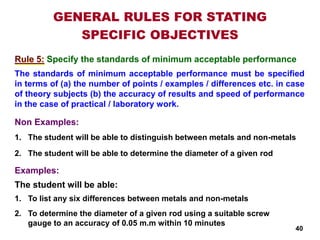
Specify the standards of minimum acceptable performance
Examples:
GENERAL RULES FOR STATING
SPECIFIC OBJECTIVES
Rule 5:
1. To list any six differences between metals and non-metals
2. To determine the diameter of a given rod using a suitable screw
gauge to an accuracy of 0.05 m.m within 10 minutes
1. The student will be able to distinguish between metals and non-metals
2. The student will be able to determine the diameter of a given rod
The student will be able:
40
The standards of minimum acceptable performance must be specified
in terms of (a) the number of points / examples / differences etc. in case
of theory subjects (b) the accuracy of results and speed of performance
in the case of practical / laboratory work.
Non Examples:
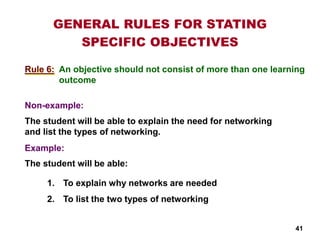
An objective should not consist of more than one learning
outcome
Non-example:
Example:
GENERAL RULES FOR STATING
SPECIFIC OBJECTIVES
Rule 6:
1. To explain why networks are needed
2. To list the two types of networking
The student will be able to explain the need for networking
and list the types of networking.
The student will be able:
41
Overview of the Presentation
 P u r p o s e o f t h i s t r a i n i n g
 Issues and Concerns of Teach ers
 I m p o r t a n t E d u c a t i o n a l G o a l s
 B a s i c T e a c h i n g M o d e l
 Instructional Objectives- Definition, Advantages and Need
 General Objectives and Specific Objectives
 Methods of Stating Objectives
 Six General rules for Stating Specific Objectives
9. Bloom’s Taxonomy of educational objectives
10. Advantages of Taxonomy
11. Bloom’s Revised Taxonomy of educational objectives
12. Knowledge Dimension
13. Cognitive Dimension - Examples of Objectives
14. Take away
42
Objectives: Emphasis on
student-oriented
learning-based
explicit
and
assessable statements
of
intended cognitive outcomes
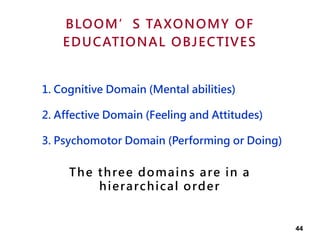
1. Cognitive Domain (Mental abilities)
2. Affective Domain (Feeling and Attitudes)
3. Psychomotor Domain (Performing or Doing)
The three domains are in a
hierarchical order
BLOOM’S TAXONOMY OF
EDUCATIONAL OBJECTIVES
44
Advantages of Taxonomy
• Helps to organize the knowledge which helps
subconscious mind for faster retrieval.
• Lead to better IQ and better “First thing first”
• Provides a common way of thinking about and a
common vocabulary that enhances
communication among engineers.
• Makes working environment and life easier
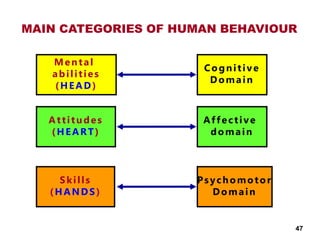
Mental
abilities
(HEAD)
Cognitive
Domain
Affective
domain
Attitudes
(HEART)
Skills
(HANDS)
Psychomotor
Domain
MAIN CATEGORIES OF HUMAN BEHAVIOUR
47
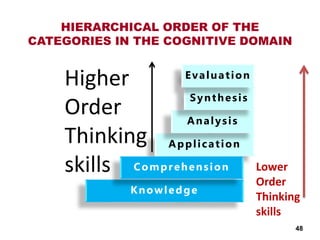
Application
Analysis
Synthesis
Evaluation
HIERARCHICAL ORDER OF THE
CATEGORIES IN THE COGNITIVE DOMAIN
48
Knowledge
Comprehension Lower
Order
Thinking
skills
Higher
Order
Thinking
skills
BLOOM’S REVISED
TAXONOMY
OF
EDUCATIONAL
OBJECTIVES
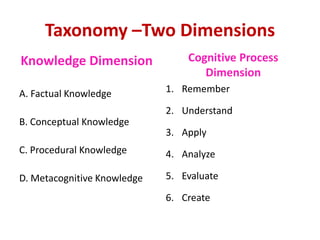
Taxonomy –Two Dimensions
Knowledge Dimension
A. Factual Knowledge
B. Conceptual Knowledge
C. Procedural Knowledge
D. Metacognitive Knowledge
Cognitive Process
Dimension
1. Remember
2. Understand
3. Apply
4. Analyze
5. Evaluate
6. Create
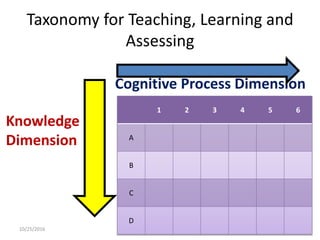
Taxonomy for Teaching, Learning and
Assessing
• Cognitive Process Dimension
10/25/2016 TNAU
Knowledge
Dimension
1 2 3 4 5 6
A
B
C
D
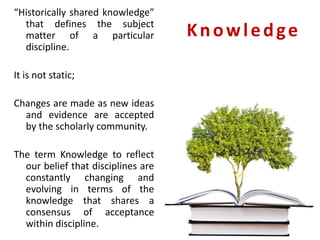
Knowledge
“Historically shared knowledge”
that defines the subject
matter of a particular
discipline.
It is not static;
Changes are made as new ideas
and evidence are accepted
by the scholarly community.
The term Knowledge to reflect
our belief that disciplines are
constantly changing and
evolving in terms of the
knowledge that shares a
consensus of acceptance
within discipline.
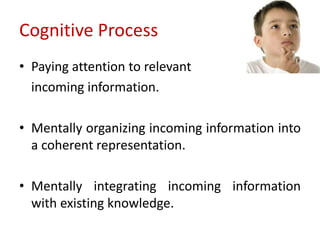
Cognitive Process
• Paying attention to relevant
incoming information.
• Mentally organizing incoming information into
a coherent representation.
• Mentally integrating incoming information
with existing knowledge.
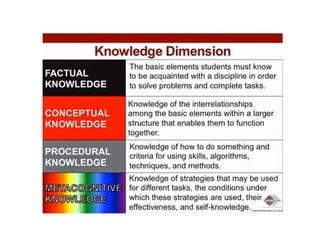
Knowledge Dimension
A. Factual Knowledge
B. Conceptual Knowledge
C. Procedural Knowledge
D. Metacognitive Knowledge
Knowledge plays a major role in value addition
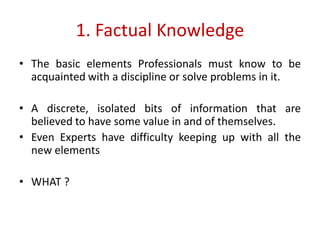
1. Factual Knowledge
• The basic elements Professionals must know to be
acquainted with a discipline or solve problems in it.
• A discrete, isolated bits of information that are
believed to have some value in and of themselves.
• Even Experts have difficulty keeping up with all the
new elements
• WHAT ?
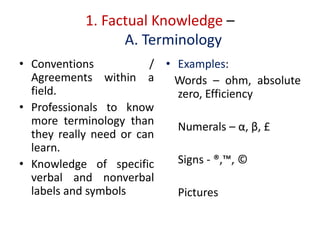
1. Factual Knowledge –
A. Terminology
• Conventions /
Agreements within a
field.
• Professionals to know
more terminology than
they really need or can
learn.
• Knowledge of specific
verbal and nonverbal
labels and symbols
• Examples:
Words – ohm, absolute
zero, Efficiency
Numerals – α, β, £
Signs - ®,™, ©
Pictures
Knowledge of
• Counselling
• NGOs
• Government Agencies
• Policies
• Gender issues
• Welfare programmes
• Youth empowerment
1.Factual Knowledge –
B. Specific Details and Elements
• Refers to events, location, people, dates,
sources of information.
• Facts – findings arrived at by means other
than agreements made for communication.
• Knowledge of specific facts and sources of
facts
Examples
Facts important to health (AIDS, Diabetics).
Major products, services and location of Intel,
Microsoft, Google.
Website addresses
Mr.RatanTata, Mr.Narayanmoorthy,
August 15, September 11
Major products and exports of India
Examples- Knowledge of
• Major factors about particular cultures an
societies
• Practical facts important to health, citizenship,
and other human needs and concerns
• More significant names, places and events in the
news
• Reputation of a given author for presenting and
interpreting facts on government problems
• Reliable source of information for
2. Conceptual Knowledge
• The interrelationships among the basic elements
within a larger structure that enable them to
function together.
• More complex, organized knowledge form.
• Disciplinary Knowledge – the way the experts in
the discipline THINK about a phenomena (Solar
System, Computer System)
• WHY?
Why the seasons occur
• Earth
• Sun
• Rotation
• Revolution
• These are not simple isolated facts about
Earth & Sun, rather ideas about the
relationships between them and how they are
linked to the seasonal changes
2. Conceptual Knowledge –
A. Classification and Categories
• Connectivity between and among specific
elements.
• Classic sign of learning and development.
• Reflect a conceptual change.
Example s
• Types of materials – Magnetic
(Dia, Para, Ferro), Semi conducting, Construction.
• Parts of sentences (nouns, verbs, adjectives).
• Telecommunication Systems
(GSM, GPRS, DECT, UMTS)
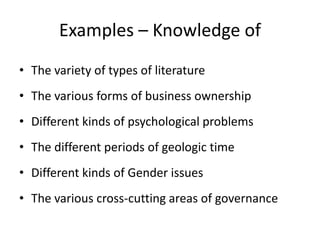
Examples – Knowledge of
• The variety of types of literature
• The various forms of business ownership
• Different kinds of psychological problems
• The different periods of geologic time
• Different kinds of Gender issues
• The various cross-cutting areas of governance
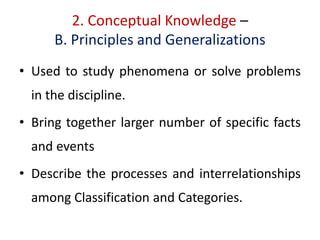
2. Conceptual Knowledge –
B. Principles and Generalizations
• Used to study phenomena or solve problems
in the discipline.
• Bring together larger number of specific facts
and events
• Describe the processes and interrelationships
among Classification and Categories.
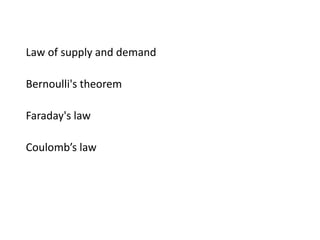
ExamplesFundamental laws of thermodynamics
Law of supply and demand
Bernoulli's theorem
Faraday's law
Coulomb’s law
Principles of Chemistry that are relevant to life processes and health
Major principles involved in learning
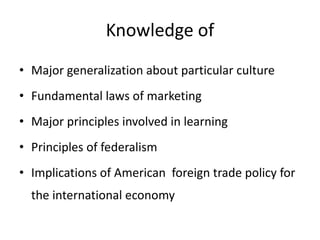
Knowledge of
• Major generalization about particular culture
• Fundamental laws of marketing
• Major principles involved in learning
• Principles of federalism
• Implications of American foreign trade policy for
the international economy
2. Conceptual Knowledge –
C. Theories, models and structures.
• Interrelationships
among Principles
and Generalizations.
• Examples:
Organization structure (Chairman,
Director, Principal, Registrar, HoD,
Prof, Asst.Prof, Lecturer).
Formulation of Theory of evolution
Genetic models (e.g., DNA)
8085, 8086 Microprocessor
Architecture.
8051 Microcontroller Architecture.
Theory of Computation.
Knowledge of
• Overall structure of multilateral organizations
• Basic structural organization of the local city
govt.
• Complete formulation of theory of evolution
• Genetic models (DNA)
3. Procedural Knowledge
• How to do something, methods of inquiry, and
criteria for using skills, algorithms,
techniques, and methods (collectively known
as procedures).
• Reflects knowledge of different “processes”.
• Factual & Conceptual - Products
• HOW?
Examples
• Algorithms for performing long divisions
• Solving quadratic equations
• General Methods for designing and performing
experiments
• Procedures for reading maps
• Estimating the age of physical artifacts
• Collecting historical data
• Procedures for spelling words in English
• Generating grammatically correct sentences
3. Procedural Knowledge –
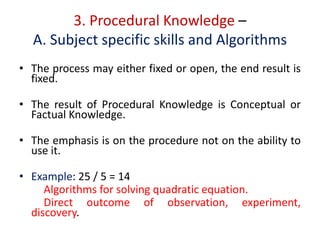
A. Subject specific skills and Algorithms
• The process may either fixed or open, the end result is
fixed.
• The result of Procedural Knowledge is Conceptual or
Factual Knowledge.
• The emphasis is on the procedure not on the ability to
use it.
• Example: 25 / 5 = 14
Algorithms for solving quadratic equation.
Direct outcome of observation, experiment,
discovery.
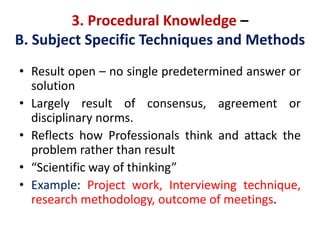
3. Procedural Knowledge –
B. Subject Specific Techniques and Methods
• Result open – no single predetermined answer or
solution
• Largely result of consensus, agreement or
disciplinary norms.
• Reflects how Professionals think and attack the
problem rather than result
• “Scientific way of thinking”
• Example: Project work, Interviewing technique,
research methodology, outcome of meetings.
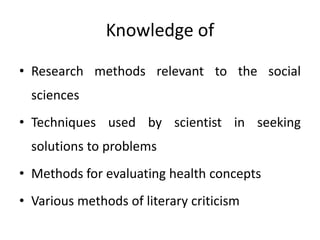
Knowledge of
• Research methods relevant to the social
sciences
• Techniques used by scientist in seeking
solutions to problems
• Methods for evaluating health concepts
• Various methods of literary criticism
“Scientific way of thinking”
• Mathematization of problems not originally
presented as mathematics problem.
• Grocery store – choosing a check out line
3. Procedural Knowledge –
C. Criteria for determining when to use
appropriate procedures.
• Know the conditions under which the procedures
are to be applied.
• Know when & where to use knowledge, which
often involves knowing the ways they have been
used in the past
• Knowledge of situations in which Professionals
may use metacognitive Knowledge.
Experience
Criteria vary markedly from subject matter to subject matter
• Power failure in a function
• Crisis management
• Accident
• Fire
• Knowledge of the criteria for determining
which statistical procedures to use with data
collected in a particular experiment
4. Metacognitive Knowledge
• Cognition in general as well as awareness of
and knowledge about one’s own cognition.
• Emphasis on making Professionals more
aware of and responsible for their own
knowledge and thought. (There is no blame)
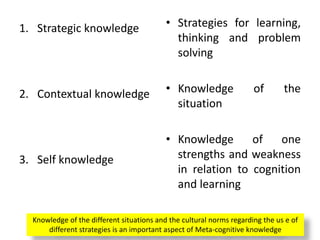
1. Strategic knowledge
2. Contextual knowledge
3. Self knowledge
• Strategies for learning,
thinking and problem
solving
• Knowledge of the
situation
• Knowledge of one
strengths and weakness
in relation to cognition
and learning
Knowledge of the different situations and the cultural norms regarding the us e of
different strategies is an important aspect of Meta-cognitive knowledge
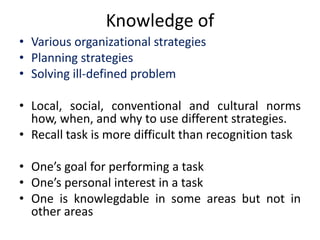
Knowledge of
• Various organizational strategies
• Planning strategies
• Solving ill-defined problem
• Local, social, conventional and cultural norms
how, when, and why to use different strategies.
• Recall task is more difficult than recognition task
• One’s goal for performing a task
• One’s personal interest in a task
• One is knowlegdable in some areas but not in
other areas
Know – Do not know
• Professionals need to develop self knowledge
and awareness about their own knowledge,
cognition and their own motivation
• Know what you KNOW
• Know what you DONOT KNOW
Important Educational Goals
To promote Retention
• Ability to remember material
at some later time in much
the same way it was
presented during instruction.
• Requires that students
REMEMBR what they have
learned.
• Focuses on PAST
To Promote Transfer
• Ability to use what was
learned to solve new
problems, to answer new
questions, or to facilitate
learning new subject matter.
• Requires NOT only to
remember but also to MAKE
SENSE OF and BE ABLE TO
USE what they have learned.
• Emphasizes the FUTURE
Learning
• Rote Learning- focus is on
consistent with the view of
learning as knowledge
acquisition, in which
students seek to add new
info. to their memories.
• Meaningful Learning
provides students with the
knowledge and Cognitive
processes they need for
successful Problem Solving.
No Learning
Rote learning
Meaningful
Learning
Cognitive Process
• Paying attention to relevant
incoming information.
• Mentally organizing incoming information into
a coherent representation.
• Mentally integrating incoming information
with existing knowledge.
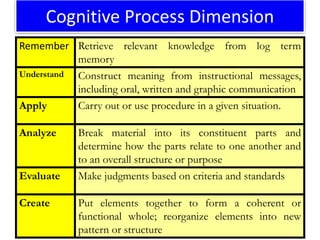
Cognitive Process Dimension
Remember Retrieve relevant knowledge from log term
memory
Understand Construct meaning from instructional messages,
including oral, written and graphic communication
Apply Carry out or use procedure in a given situation.
Analyze Break material into its constituent parts and
determine how the parts relate to one another and
to an overall structure or purpose
Evaluate Make judgments based on criteria and standards
Create Put elements together to form a coherent or
functional whole; reorganize elements into new
pattern or structure
1. Remember
• Retrieving relevant knowledge
from long term memory
• Relevant Knowledge – F,C,P & M or
some combination
• Essential for meaningful learning
• Either as isolation or as integrated within the
larger context
1. Remember – 1.1. Recognizing
• Retrieving relevant knowledge from long term
memory in order to compare it with presented
information.
• Example: Important Dates, Events, Data
Resistance values, IC nos.
• Identifying
Assessment Format
• Verification – True or False
– To recognize the correct dates of important events
in U.S. History
• Matching – Match the following
– To recognize authors of British literary works
• Forced Choice – Multiple Choice
– To recognize the number of sides in basic
geometric shapes
Objective and Assessment
• To recognize the number of sides in basic
geometric shapes.
• How many sides does a pentagon have?
• To recognize the names of registers in 8085 micro
processor?
• List the names of registers of 8085 micro
processor.
• To recognize the number of transistors in Intel
4004.
• How many transistors in Intel 4004?
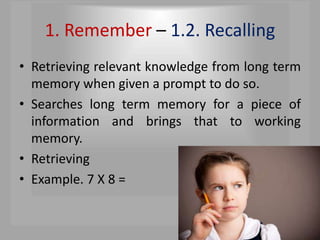
1. Remember – 1.2. Recalling
• Retrieving relevant knowledge from long term
memory when given a prompt to do so.
• Searches long term memory for a piece of
information and brings that to working
memory.
• Retrieving
• Example. 7 X 8 =
Objective and Assessment
• To recall whole number multiplication facts.
• Multiply 45 X 56.
• To recall meter is a measure of length.
• What is the major exports of India?
• Who wrote Ignited Minds?
Cueing and Embedding
• What is a meter? (with low cueing)
• In the metric system, what is a meter? (with
high cueing).
• With low embedding – single, isolated event
• With High embedding – within a context of
larger problem
2. Understand
Students understand
when they build
connections between the
“new” knowledge to be
gained and their prior
knowledge.
7 WAYS OF UNDERSTANDING
1. Interpreting
2. Exemplifying
3. Classifying
4. Inferring
5. Comparing
6.Summarizing
7.Explaining
2. Understand -2.1. Interpreting
• Change from one form of representation to
another.
• Words to words, words to picture, numbers to
words, musical notes to tones
• Translating, paraphrasing, representing,
clarifying.
• To paraphrase important speeches and
documents from the civil war period in U.S.
history
Objective and Assessment
• To draw a graph between Voltage and current.
• Draw a graph between Voltage and current.
• To Draw block diagrams representations of systems.
• Draw block diagrams representations of systems.
• To translate number sentences expressed in words into
algebraic equations expressed in symbols.
• Write an equation (using B for boys and G for girls) that
corresponds to the statement “ There are twice as
many boys as girls in this class.
• To draw pictorial representation of various
natural phenomena
(Water Cycle, Sea breeze, Land breeze).
• Constructed response – Supply an answer
• Choose an answer – Multiple choice
2. Understand -2.2. Exemplifying
• Finding a specific example of a
concept or principle.
• Identifying the defining features of
the general concept or principle.
• Illustrating
Objective and Assessment
• To be able to give examples of
various kinds of chemical
compounds.
• Locate five inorganic compound on a
field trip and tell why its is inorganic?
Assessment Format
• Constructed Response – Students must create
an example
• Locate an inoragnic compound
• Selected Response – Student must select an
example from s given set
2. Understand -2.3. Classifying
• Determine that something (a particular
instance or example) belongs to a category
(Concept or Principle)
• Detecting relevant features or patterns that
“fit” both the specific instant and the concept
or principle
• Complementary process to Exemplifying
• Categorizing
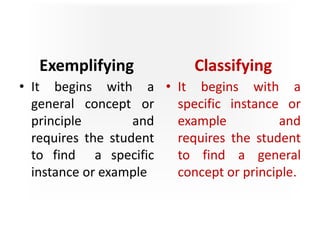
Exemplifying
• It begins with a
general concept or
principle and
requires the student
to find a specific
instance or example
Classifying
• It begins with a
specific instance or
example and
requires the student
to find a general
concept or principle.
To classify observed or described cases of
mental disorders
To categorize the species of various prehistoric
animals
Objective and Assessment
• To determine the categories to which numbers
belong.
• Circle all prime numbers for the following list.
• To classify the electrical machines.
• Classify the following electrical machines into
A.C and D.C machines.
2. Understand -2.4. Summarizing
• Abstracting a general theme or major points.
• A single statement that represents presented
information or abstracts of a general theme.
• When given information, a student provides a
summary or abstracts a general theme
• Generalizing
Objective and Assessment
• To summarize the purposes of various
subroutines in a programme.
• Write a sentence describing the sub goal that
each section of the program accomplishes
within the overall program.
• To summarize the major contributions of
famous social workers
• To summarize the best practices
2. Understand -2.5. Inferring
• Drawing a logical conclusion from presented
information.
• Involves finding a pattern within a series of
examples.
• Extrapolating, Interpolating, Predicting,
Concluding
Objective and Assessment
• To infer the pattern in the series of numbers.
• What number will come next in the series
1,2,3,5,8,13,21,… (completion task)
• To infer the analogy of the form. (Analogy task)
• Nation is to President, State is to ________.
• AND,OR,NOT and XOR (Oddity task)
2. Understand -2.6. Comparing
• Detecting correspondence (similarities & differences)
between two ideas, objects, events, problems.
• Includes finding one-to-one correspondence between
elements and patterns in one object, event or idea.
• Determine how a well known event is like a less
familiar event
• Contrasting, Matching, Mapping
Objective and Assessment
• To compare an electrical circuit with a water
flow system.
• Compare battery, wire and resistor in an
electrical circuit with pump, pipes and pipe
construction in a water flow system.
• Compare TRIAC and DIAC.
• Compare Intel80386 and Intel80486
Mapping
A student must show how each part
of one object, idea, problem or
situation corresponds to (or maps
into) each part of another.
2. Understand -2.7. Explaining
• Constructing a cause – and – effect model of a
system.
• Determine how a change in one part of the
system or one “link” in the chain affects a
change in another part.
• Reasoning, Trouble shooting, Redesigning,
Predicting.
Objective and Assessment
• To explain Ohm’s law.
• Explain what happens to the rate of the
current when a second battery is added to a
circuit.
• Explain masking and etching process in IC
fabrication.
• Explain 565 phase lock loop circuit
functioning.
Reasoning: A student is asked to offer a
reason for a given event.
Why does air enter a bicycle tire pump
when you pull up on the handle?
Answer, it is forced in because the air
pressure is less inside the pump than
outside, involves finding a principle that
accounts for a given event.
Troubleshooting: A student is asked to
diagnose what could have gone wrong in a
malfunctioning system.
Suppose you pull up and press down on the
handle of a bicycle tire pump several times
but no air comes out. What’s wrong?
Student must find an explanation for a
symptom. “There is a hole in the cylinder” or
“A valve is stuck in the open position”
Redesigning: A student is asked to change
the system to accomplish some goal
How could you improve a bicycle tire pump
so that it would be more efficient?
Student must imagine altering one or more
of the components in the system.
“Apply lubricant between the piston and the
cylinder”
Predicting: A student is asked to change in one
part of a system will effect a change in another
part of a system.
What would happen if you increased the diameter
of the cylinder in a bicycle tire pump?
Student “operate” the mental model of the pump
to see that the amount of air moving through the
pump could be increased by increasing the
diameter of the cylinder.
3. Apply – 3.1. Execute
• Use of skills and algorithms, routinely carries
out a procedure when confronted with a
familiar task.
• Consists of a sequence of steps that are
generally followed in a fixed order , when the
steps are performed correctly, the end result is
a predetermined answer.
• Student is given a familiar task that can be
performed using a well known procedure.
• Emphasis on the procedure as well as the
result.
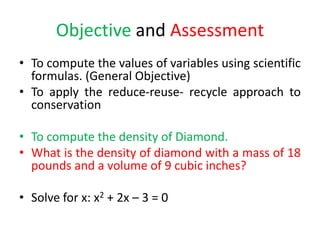
Objective and Assessment
• To compute the values of variables using scientific
formulas. (General Objective)
• To apply the reduce-reuse- recycle approach to
conservation
• To compute the density of Diamond.
• What is the density of diamond with a mass of 18
pounds and a volume of 9 cubic inches?
• Solve for x: x2 + 2x – 3 = 0
Objective and Assessment
• To write a program in C language for
iteratively solving load flow equations using
Gauss-Seidel method with provision for
acceleration factor and for dealing with P-V
buses.
• Solve load flow equations using Gauss-Seidel
method with provision for acceleration factor
and for dealing with P-V buses.
Objective and Assessment
• To carryout fault analysis for a sample power
system for LLLG fault.
• To write C programs to simulate UNIX
commands like ls, grep.
• To write a programs for String manipulation
operations using 8086.
• To study of basic digital IC’s. (General Objective)
• To verify truth table for NAND gate.
3. Apply – 3.2. Implementing
• Selects and uses a procedure to perform an
unfamiliar task.
• Selects – understanding the type of problem
encountered.
• Uses – range of procedures that are available.
• No single procedure may be a ‘Perfect Fit’ for the
problem. Needs modification in the procedure.
• Use of technique and methods than skills and
algorithms.
Techniques and Methods
It has two qualities that make students
particularly amenable to implementing.
1. The procedure may be more like a “Flow
Chart” than a fixes sequence, that is, the
procedure may have “decision points” built
into it.
2. There often is no single, fixed answer that is
expected when the procedure is applied
correctly.
• To solve a variety of personal finance
problems
• To use the most effective , efficient, and
affordable method of conducting a research
study to address a specific research question
Objective and Assessment
• To implement the IIR and FIR filter using
MATLAB.
• To implement the processing techniques using
instructions of TMS320c5X.
• To implement the Producer-Consumer
problems using semaphores.
• To implement text compression algorithm.
• To implement Bresenham’s algorithm for line.
Objective and Assessment
• To solve a variety of personal finance
problems.
• Choose the most economical financing
package for a new car.
• Choose the bank which gives most economical
housing loan.
Student must not only apply a
procedure (engage in
implementing) but also rely on
conceptual understanding of the
problem, the procedure, or both
Analyze- An extension of Understanding
and prelude of Evaluating or Creating
Examples:
• Distinguish fact from opinion (or reality from
fantasy)
• Connect conclusions with supporting statements
• Determine how ideas are related to one another
• Ascertain the unstated assumptions involved in
what is said
• Find evidence in support of the author’s purpose
4. Analyze – 4.1. Differentiating
• Discriminates relevant from irrelevant,
important from unimportant, and then
attends to the relevant or important
information.
• Important aspects – all aspects (compare).
• Focusing, Distinguishing, Selecting
• To determine the major points in research
reports
• To select the main steps in a written
description of how something working
Objective and Assessment
• To differentiate between apple and Orange.
• Internal seeds are relevant, Color and shape
are irrelevant. (compare – all are relevant).
• To differentiate between NAND and NOR gate.
• To differentiate between LASER and MASER
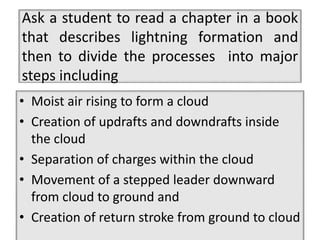
Ask a student to read a chapter in a book
that describes lightning formation and
then to divide the processes into major
steps including
• Moist air rising to form a cloud
• Creation of updrafts and downdrafts inside
the cloud
• Separation of charges within the cloud
• Movement of a stepped leader downward
from cloud to ground and
• Creation of return stroke from ground to cloud
4. Analyze – 4.2. Organizing
• Determining how elements fit or function
within a structure.
• Builds systematic and coherent connections
among pieces of presented information.
• It occurs in conjunction with differentiating.
• Structuring, Integrating, finding, outlining.
• To structure a historical description into
evidence for and against a particular
explanation
• To analyze research report in terms of four
sections: hypothesis, method, data and
conclusion
• To outline textbook lessons
• To organize field work practicum
Objective and Assessment
• To analyze project report in terms of four
sections: Objective/ hypothesis, Method, Data
and Conclusion.
• Produce an outline of the project work.
• Content page of any book
• Table, matrix, hierarchical diagram.
4. Analyze – 4.3. Attributing
• Processes of deconstruction in which a student
determines the intensions of the author of the
presented information
• An extension beyond basic understanding to infer.
• Determine the underlying point of view or intension of
the author.
• Others point of view
• To determine the motives for a series of
actions by characters in a story
• To determine the point of view of the author
of an essay on a controversial topic in terms of
his/her theatrical perspective
Examples
• Movies.
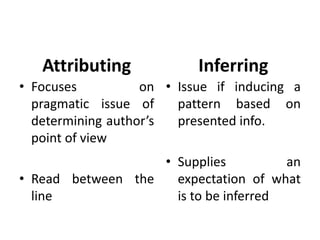
Attributing
• Focuses on
pragmatic issue of
determining author’s
point of view
• Read between the
line
Inferring
• Issue if inducing a
pattern based on
presented info.
• Supplies an
expectation of what
is to be inferred
5. Evaluate
• Making judgments based on criteria and
standards
• Criteria – Quality, Effectiveness, Efficiency and
Consistency
• STDs.- Quantiative (Is this a sufficient amount?)
Qualitative (Is this good enough?)
The standards are applied to the criteria
• Is this process sufficiently effective?
• Is this product of sufficient quality?
• Judgments made by use of standards of
performance with clearly defined criteria /
specifications
Not all judgments are Evaluative
5. Evaluate – 5.1. Checking (PDCA)
• Detecting inconsistencies within a process or
product.
• Determine whether a process or product has
internal consistency.
• Determine if a Director /Principal / HoD’s
conclusions follow from observed data.
• Coordinating, Monitoring, Testing
Determining how well the plan is working
Objective and Assessment
• To determine whether a student’s conclusion
follows from the observed data in the lab
experiments.
• Read a observation / record note of a DBMS
lab experiment and determine whether or not
a student’s conclusion follows from the
observed data in the lab experiments.
Judgments based on criteria and standards.
5. Evaluate – 5.2. Critiquing
• Judging a product or operation based on
externally imposed criteria and standards.
• Judge which of two methods is the best way to
solve a given problem.
• Critiquing lies at the core of critical thinking.
• Judgment based on the positive and negative
features.
Examples
• To evaluate a proposed solution to asocial
problem.
• To evaluate the reasonableness of a hypothesis
• To evaluate a proposal to achieve 100% result
with in three years.
• To evaluate a proposal to achieve 100%
attendance of all the faculty.
• To evaluate a roadmap to achieve 50% placement
for the students.
To judge which of two alternative methods is
a more effective and efficient way of solving
given problem
• The critique could be based on positive,
negative or both kinds of criteria and yield
both positive and negative consequences.
6. Create
• Make a new product by mentally reorganizing
some elements or parts into a pattern or
structure not clearly present before.
• Coordinated with the students previous learning
experiences.
• Production of unusual products, often a s result
of some special skill.
• Emphasis Originality or Uniqueness.
6. Create - Process
1. Problem representation: In which student
attempts to understand the task and
generate possible solutions.
2 Solution Planning: In which student examines
the possibilities and devises a workable plan.
3. Solution Execution: In which student
successfully carries out the plan.
6. Create – 6.1. Generating
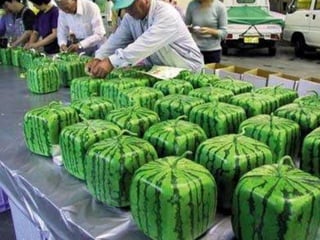
• Coming up with alternative hypothesis based
on criteria.
• Transcends the boundaries or constraints or
prior knowledge and existing theories.
• Creative thinking
• To generate multiple useful solutions for social
problems
• To generate hypothesis to explain observed
phenomena
• To generate alternative methods for achieving
a particular result
Objective and Assessment
• To generate multiple useful solutions for college
problems.
• Suggest as many ways as you can to assure that
everyone has 100% attendance.
• Suggest to improve the pass %.
• What are the possible uses of WWW – uses task
• What would happen if there was a flat income tax
rather than a graduated income tax? -
consequences task
6. Create – 6.2. Planning
• Devising a procedure for accomplishing task.
• Developing a plan for solving the problem.
• Designing
6. Create – 6.3. Producing
• Inventing a product.
• Carry out a plan for solving a given problem
that meets certain specifications.
• Requires 4 types of knowledge
• Constructing
• To plan research papers on given social topics
• To design studies to test various hypothesis
• To develop worked out solutions
• To describe solution plans
• To select solution plans for a given problem
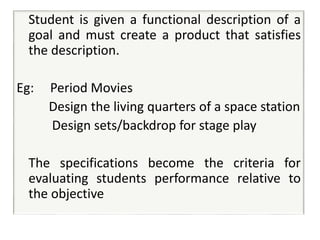
Student is given a functional description of a
goal and must create a product that satisfies
the description.
Eg: Period Movies
Design the living quarters of a space station
Design sets/backdrop for stage play
The specifications become the criteria for
evaluating students performance relative to
the objective
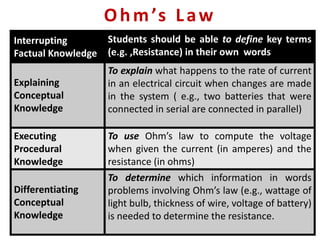
Ohm’s Law
Interrupting
Factual Knowledge
Students should be able to define key terms
(e.g. ,Resistance) in their own words
Explaining
Conceptual
Knowledge
To explain what happens to the rate of current
in an electrical circuit when changes are made
in the system ( e.g., two batteries that were
connected in serial are connected in parallel)
Executing
Procedural
Knowledge
To use Ohm’s law to compute the voltage
when given the current (in amperes) and the
resistance (in ohms)
Differentiating
Conceptual
Knowledge
To determine which information in words
problems involving Ohm’s law (e.g., wattage of
light bulb, thickness of wire, voltage of battery)
is needed to determine the resistance.
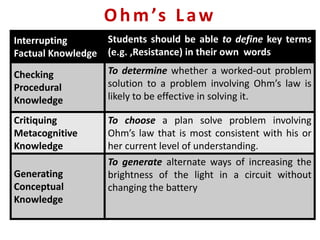
Ohm’s Law
Interrupting
Factual Knowledge
Students should be able to define key terms
(e.g. ,Resistance) in their own words
Checking
Procedural
Knowledge
To determine whether a worked-out problem
solution to a problem involving Ohm’s law is
likely to be effective in solving it.
Critiquing
Metacognitive
Knowledge
To choose a plan solve problem involving
Ohm’s law that is most consistent with his or
her current level of understanding.
Generating
Conceptual
Knowledge
To generate alternate ways of increasing the
brightness of the light in a circuit without
changing the battery
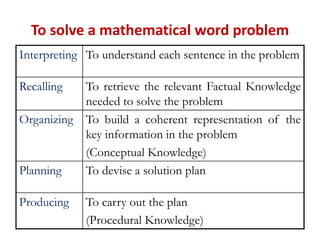
To solve a mathematical word problem
Interpreting To understand each sentence in the problem
Recalling To retrieve the relevant Factual Knowledge
needed to solve the problem
Organizing To build a coherent representation of the
key information in the problem
(Conceptual Knowledge)
Planning To devise a solution plan
Producing To carry out the plan
(Procedural Knowledge)
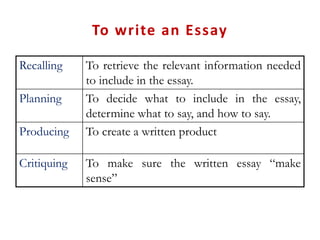
To write an Essay
Recalling To retrieve the relevant information needed
to include in the essay.
Planning To decide what to include in the essay,
determine what to say, and how to say.
Producing To create a written product
Critiquing To make sure the written essay “make
sense”
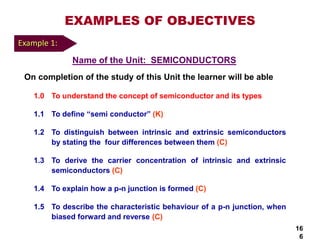
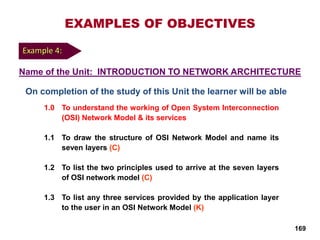
On completion of the study of this Unit the learner will be able
1.0 To understand the concept of semiconductor and its types
1.1 To define “semi conductor” (K)
1.2 To distinguish between intrinsic and extrinsic semiconductors
by stating the four differences between them (C)
1.3 To derive the carrier concentration of intrinsic and extrinsic
semiconductors (C)
1.4 To explain how a p-n junction is formed (C)
1.5 To describe the characteristic behaviour of a p-n junction, when
biased forward and reverse (C)
EXAMPLES OF OBJECTIVES
16
6
Example 1:
Name of the Unit: SEMICONDUCTORS
On completion of the study of this Unit the learner will be able
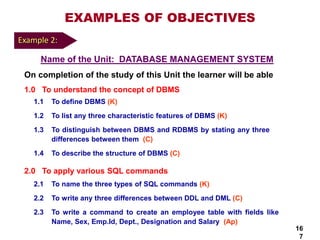
1.1 To define DBMS (K)
1.2 To list any three characteristic features of DBMS (K)
1.3 To distinguish between DBMS and RDBMS by stating any three
differences between them (C)
1.4 To describe the structure of DBMS (C)
EXAMPLES OF OBJECTIVES
16
7
Example 2:
1.0 To understand the concept of DBMS
2.1 To name the three types of SQL commands (K)
2.2 To write any three differences between DDL and DML (C)
2.3 To write a command to create an employee table with fields like
Name, Sex, Emp.Id, Dept., Designation and Salary (Ap)
2.0 To apply various SQL commands
Name of the Unit: DATABASE MANAGEMENT SYSTEM
On completion of the study of this Unit the learner will be able
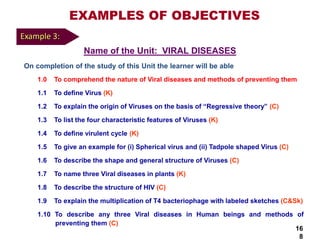
1.0 To comprehend the nature of Viral diseases and methods of preventing them
1.1 To define Virus (K)
1.2 To explain the origin of Viruses on the basis of “Regressive theory” (C)
1.3 To list the four characteristic features of Viruses (K)
1.4 To define virulent cycle (K)
1.5 To give an example for (i) Spherical virus and (ii) Tadpole shaped Virus (C)
1.6 To describe the shape and general structure of Viruses (C)
1.7 To name three Viral diseases in plants (K)
1.8 To describe the structure of HIV (C)
1.9 To explain the multiplication of T4 bacteriophage with labeled sketches (C&Sk)
1.10 To describe any three Viral diseases in Human beings and methods of
preventing them (C)
EXAMPLES OF OBJECTIVES
16
8
Example 3:
Name of the Unit: VIRAL DISEASES
EXAMPLES OF OBJECTIVES
On completion of the study of this Unit the learner will be able
1.0 To understand the working of Open System Interconnection
(OSI) Network Model & its services
1.1 To draw the structure of OSI Network Model and name its
seven layers (C)
1.2 To list the two principles used to arrive at the seven layers
of OSI network model (C)
1.3 To list any three services provided by the application layer
to the user in an OSI Network Model (K)
Example 4:
Name of the Unit: INTRODUCTION TO NETWORK ARCHITECTURE
169
Overview of the Presentation
 P u r p o s e o f t h i s t r a i n i n g
 Issues and Concerns of Teach ers
 I m p o r t a n t E d u c a t i o n a l G o a l s
 B a s i c T e a c h i n g M o d e l
 Instructional Objectives- Definition, Advantages and Need
 General Objectives and Specific Objectives
 Methods of Stating Objectives
 Six General rules for Stating Specific Objectives
 Bloom’s Taxonomy of educational objectives
 Advantages of Taxonomy
 Bloom’s Revised Taxonomy of educational objectives
 Knowledge Dimension
 Cognitive Dimension - Examples of Objectives
14. Take away
170
Take away
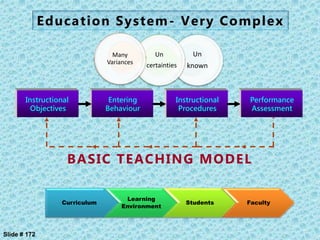
BASIC TEACHING MODEL
Instructional
Objectives
Entering
Behaviour
Instructional
Procedures
Performance
Assessment
Slide # 172
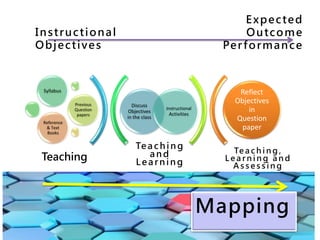
Education System- Very Complex
Un
known
Un
certainties
Many
Variances
Curriculum
Learning
Environment
Students Faculty
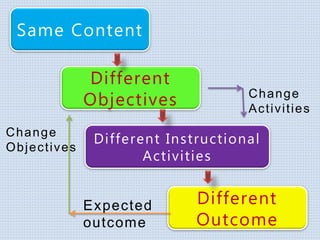
Same Content
Different
Objectives
Different Instructional
Activities
Different
Outcome
Expected
outcome
Change
Objectives
Change
Activities
Tea chin g
a n d
Learn in g
Te a c h i n g ,
L e a r n i n g a n d
A s s e s s i n g
Discuss
Objectives
in the class
Instructional
Activities
Syllabus
Previous
Question
papers
Reference
& Text
Books
Reflect
Objectives
in
Question
paper
Teaching
Instructional
Objectives
Expected
Outcome
Performance
Mapping
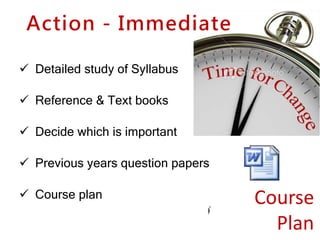
Action - Immediate
 Detailed study of Syllabus
 Reference & Text books
 Decide which is important
 Previous years question papers
 Course plan Course
Plan
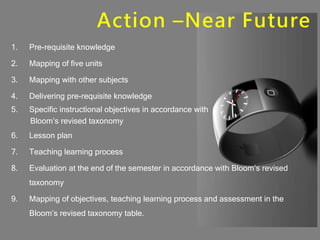
Action –Near Future
1. Pre-requisite knowledge
2. Mapping of five units
3. Mapping with other subjects
4. Delivering pre-requisite knowledge
5. Specific instructional objectives in accordance with
Bloom’s revised taxonomy
6. Lesson plan
7. Teaching learning process
8. Evaluation at the end of the semester in accordance with Bloom’s revised
taxonomy
9. Mapping of objectives, teaching learning process and assessment in the
Bloom’s revised taxonomy table.
Action – Long Term Future
• Train the colleague on Taxonomy
• Share the classroom experience
• Best Practices
• Lead the faculties
• Excellence
Teachers
to
Teach
Learners
to
Learn
Assessors
to
Assess
Purpose
To expand
the capacity of individual
and
Organization
for
Best Performance
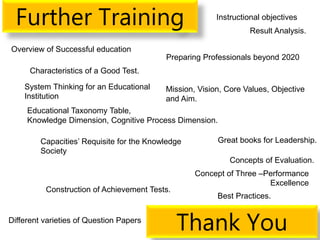
Further Training
Thank You
Overview of Successful education
Instructional objectives
Educational Taxonomy Table,
Knowledge Dimension, Cognitive Process Dimension.
Concepts of Evaluation.
Construction of Achievement Tests.
Characteristics of a Good Test.
Different varieties of Question Papers
Result Analysis.
System Thinking for an Educational
Institution
Capacities’ Requisite for the Knowledge
Society
Preparing Professionals beyond 2020
Great books for Leadership.
Mission, Vision, Core Values, Objective
and Aim.
Best Practices.
Concept of Three –Performance
Excellence
Thank You
Thank You

Instructional Objectives: Bloom's Revised Taxonomy

  • 1.
  • 2.
    Overview of thePresentation 1 . P u r p o s e o f t h i s t r a i n i n g 2. Issues and Concerns of Teach ers 3 . I m p o r t a n t E d u c a t i o n a l G o a l s 4 . B a s i c T e a c h i n g M o d e l 5. Instructional Objectives- Definition, Advantages and Need 6. General Objectives and Specific Objectives 7. Methods of Stating Objectives 8. Six General rules for Stating Specific Objectives 9. Bloom’s Taxonomy of educational objectives 10. Advantages of Taxonomy 11. Bloom’s Revised Taxonomy of educational objectives 12. Knowledge Dimension 13. Cognitive Dimension - Examples of Objectives 14. Take away 2
  • 3.
    Purpose To expand the capacityof individual and Organization for Best Performance
  • 4.
    Teachers to Teach Learnersto Learn Assessors to Assess
  • 5.
  • 6.
    Slide # 6 OBJECTIVES P erformance STUDENT (Learning) QUESTION PAPER SETTER (Assessing) TEACHER (Instruction /Teaching) Aligning
  • 7.
    ISSUES AND CONCERNSOF TEACHERS • What is important for students to learn in the limited classroom time available? (Learning Question) • How does one plan and deliver instruction that will result in high levels of learning for large number of students? (Instruction Question) • How does one select or design assessment instruments and procedures that provide accurate information about how well students are learning? (Assessment Question) • How does one ensure that objectives, instruction, and assessment are consistent with one another? (Alignment Question)
  • 8.
    Important Educational Goals Topromote Retention • Ability to remember material at some later time in much the same way it was presented during instruction. • Requires that students REMEMBER what they have learned. • Focuses on PAST To Promote Transfer • Ability to use what was learned to solve new problems, to answer new questions, or to facilitate learning new subject matter. • Requires NOT only to remember but also to MAKE SENSE OF and BE ABLE TO USE what they have learned. • Emphasizes the FUTURE
  • 9.
    Learning • Rote Learning-focus is on consistent with the view of learning as knowledge acquisition, in which students seek to add new info. to their memories. • Meaningful Learning provides students with the knowledge and Cognitive processes they need for successful Problem Solving. No Learning Rote learning Meaningful Learning
  • 10.
  • 11.
    Overview of thePresentation  P u r p o s e o f t h i s t r a i n i n g  Issues and Concerns of Teach ers  I m p o r t a n t E d u c a t i o n a l G o a l s  B a s i c T e a c h i n g M o d e l 5. Instructional Objectives- Definition, Advantages and Need 6. General Objectives and Specific Objectives 7. Methods of Stating Objectives 8. Six General rules for Stating Specific Objectives 9. Bloom’s Taxonomy of educational objectives 10. Advantages of Taxonomy 11. Bloom’s Revised Taxonomy of educational objectives 12. Knowledge Dimension 13. Cognitive Dimension - Examples of Objectives 14. Take away 11
  • 12.
    Objectives • In life,objectives help us to focus our attention and our efforts, they indicate what we want to accomplish. • In education, objectives indicate what we want students to learn; they are “ explicit formulations of the ways in which students are expected to be changed by the educative process”
  • 13.
    Teaching- intentional and reasonedact Intentional • Teach for some purpose • Primarily to facilitate students learning. • Concerns how teachers help students achieve the teachers’ objective Reasoned • What teachers teach their students is judged by them to be worthwhile. • Relates to what objectives teachers select for their students Objectives are important in teaching
  • 14.
    The learning environmentsthe teachers create, activities, and experience they provide should be aligned with, or be consistent with, the selected objectives
  • 15.
    When we teach, wewant our students to learn. What we want them to learn as a result of our teaching are our objectives • Aims • Purpose • Goals • Guiding outcomes • Content standards • Curriculum standards Objectives are present in virtually all teaching
  • 16.
    Need for Instructional Objectives Specifieswhat the students should learn to do Serves as sign post to the students. Provides direction to the teacher in the teaching learning process to attain the stated objectives. Provides guidance to the question paper setter for evaluating students achievements.
  • 17.
    DEFINITION OF INSTRUCTIONAL OBJECTIVES Instructionalobjectives are statements, which communicate in behavioural terms the expected performance of the students at the end of instruction.
  • 18.
    (i) General Objectives(G.O.) (ii) Specific Objectives (S.O.) TYPES OF OBJECTIVES 18
  • 19.
    General Objectives- Definition •Very general statements, which describe in implicit terms the overall aims of the total teaching learning process. • They are not explicit. • Stated in broad term to encompass a class or domain of student performance.
  • 20.
    General Objectives -Examples • To understand women, gender and development issues. • To equip the students with requisite skills to work with NGOs • To empower the learner to actively participate in governance • To serve as social facilitators in bringing transformation in the lives of youth • To become professional youth worker
  • 21.
    General Objectives -Examples • To understand the concept of Data Flow Diagram. • To comprehend the use of scanner. • To understand the concept of semiconductor. • To understand the concept of DBMS. On completion of the study the student will be able:
  • 22.
    Specific Objectives -Definition • Specify what the student will be able to do on completion of learning. (Student Centered) • Expressed in terms of student’s terminal cognitive process / behavioral terms. ( Learning Based) • Identify the end product of instruction in terms of observable performance of students. (Explicit) • Indicate a very specific learning outcome which can be easily be tested for achievement. (Assessable Statement)
  • 23.
    Specific Objectives- Format Themost useful form of stating objectives is to express them in terms which identify both the kind of cognitive process/behavior to be developed in the student and the knowledge/content … in which this behavior is to operate. Objectives must be stated in terms of learner’s terminal behavior.
  • 24.
    Format / Definition •The students will be able to, (verb) or learn to, (noun). • Verb describes the intended the cognitive process • Noun describes the knowledge / content students are expected to acquire or construct
  • 25.
    Example The students willlearn  to distinguish (the cognitive process) among confederal, federal, and unitary systems of government (the knowledge)  to introduce theoretical perspectives of Feminism  to cite three causes of the Civil War  to interpret various types of social data
  • 26.
    Specific Objectives -Examples (i) To list the six levels of a Data Flow Diagram used in an application system (i) To state Ohm’s law (ii) To scan a given picture (i) To transfer the scanned picture to the appropriate module of application . On completion of the study the student will be able:
  • 27.
    Advantages of Objectives Provides integral relationship between knowledge and cognitive process.  Provides consistency, or lack of it, among the stated objectives for a unit, the way it was taught, and how learning was assessed.  Makes better sense of the wide variety of terms.  Increases students level of precision for better communication.  Makes life easier.
  • 28.
    METHODS OF STATINGOBJECTIVES (i) Mager’s method (ii) Gronlund’s method 28
  • 29.
    MAGER’S METHOD (i) Specificterminal performance of the student. (ii) Conditions under which the performance is expected to occur. (iii) Standards of minimum acceptable performance. In this method, the list of specific behaviours which the students are to exhibit at the end of instruction is prepared. Mager has specified three criteria which every specific objective must satisfy: 29
  • 30.
    MAGER’S METHOD The studentwill be able to determine the diameter of a copper wire, given a suitable screw gauge, to an accuracy of 0.05 mm within 15 minutes. Example: 30 Specific Terminal Performance condition Minimum Acceptable Performance
  • 31.
    GRONLUND’S METHOD In thismethod, the General Objectives are first stated. Then each General Objective is clarified by listing a sample of the specific behaviours which are accepted as evidence of attainment of the General Objective. Contd. 31
  • 32.
    Example: 1. To listthe two protocols that are used in Medium Access Sub layer with respect to channel allocation. 2. To define collision with respect to channel allocation in medium access sub-layer. 3. To calculate frame time T, for a given frame length and bit rate in a channel. Specific Objectives: General Objectives: To understand the working of medium access sub layer in OSI Network Model. GRONLUND’S METHOD 32
  • 33.
    This model isused in TEACHING AT THE TRAINING LEVEL S T A T E T H E S P E C I F I C B E H A V I O U R T E A C H T H E S P E C I F I C B E H A V I O U R T E S T T H E S P E C I F I C B E H A V I O U R TEACHING AND TESTING AT THE MINIMUM LEVEL MAGER’S MODEL 33
  • 34.
    S T AT E T H E G E N E R A L O B J E C T I V E A N D A S A M P L E O F S P E C I F I C B E H A V I O U R D I R E C T T E A C H I N G T O W A R D T H E G E N E R A L O B J E C T I V E ( i . e . t h e t o t a l c l a s s o f b e h a v i o u r ) B A S E T E S T Q U E S T I O N S O N T H E S A M P L E O F S P E C I F I C B E H A V I O U R The objectives are not overly restrictive TEACHING AND TESTING AT THE DEVELOPMENT LEVEL GRONLUND’S MODEL 34
  • 35.
  • 36.
    GENERAL RULES FORSTATING SPECIFIC OBJECTIVES Instructional Objectives should be stated in terms of learner’s performance and not teacher’s performance The Objective should specify what the learner will be able to do at the end of the lesson and not what the teacher had intended to do. Non-example: To teach Java Remote Method Invocation Example: The student will be able to distinguish between “Remote Method Invocation and “Remote Procedure calls” Rule 1: 36
  • 37.
    GENERAL RULES FORSTATING SPECIFIC OBJECTIVES The mere description of subject matter should be avoided An objective should specify both the kind of behaviour expected and the subject or context to which that behaviour applies. Non-example: Multithreading technique Example: The student will be able to write a Java program to show Indian Standard Time by applying multithreading technique Rule 2: 37
  • 38.
    . Rule 3: Non-example: The studentwill be able to know the network hardware Example: The student will be able to state the functions of the four types of connectivity hardware GENERAL RULES FOR STATING SPECIFIC OBJECTIVES Use verbs that refer to any observable activity displayed by a learner Use Action Verbs 38
  • 39.
    State in termsof learning outcome instead of the learning process Non-example: The student gains knowledge of Compiler Example: The student will be able to draw the structure of seven phases of a compiler GENERAL RULES FOR STATING SPECIFIC OBJECTIVES Rule 4: Describe in detail the final outcome of learning (end product) and not the process of learning itself. 39
  • 40.
    Specify the standardsof minimum acceptable performance Examples: GENERAL RULES FOR STATING SPECIFIC OBJECTIVES Rule 5: 1. To list any six differences between metals and non-metals 2. To determine the diameter of a given rod using a suitable screw gauge to an accuracy of 0.05 m.m within 10 minutes 1. The student will be able to distinguish between metals and non-metals 2. The student will be able to determine the diameter of a given rod The student will be able: 40 The standards of minimum acceptable performance must be specified in terms of (a) the number of points / examples / differences etc. in case of theory subjects (b) the accuracy of results and speed of performance in the case of practical / laboratory work. Non Examples:
  • 41.
    An objective shouldnot consist of more than one learning outcome Non-example: Example: GENERAL RULES FOR STATING SPECIFIC OBJECTIVES Rule 6: 1. To explain why networks are needed 2. To list the two types of networking The student will be able to explain the need for networking and list the types of networking. The student will be able: 41
  • 42.
    Overview of thePresentation  P u r p o s e o f t h i s t r a i n i n g  Issues and Concerns of Teach ers  I m p o r t a n t E d u c a t i o n a l G o a l s  B a s i c T e a c h i n g M o d e l  Instructional Objectives- Definition, Advantages and Need  General Objectives and Specific Objectives  Methods of Stating Objectives  Six General rules for Stating Specific Objectives 9. Bloom’s Taxonomy of educational objectives 10. Advantages of Taxonomy 11. Bloom’s Revised Taxonomy of educational objectives 12. Knowledge Dimension 13. Cognitive Dimension - Examples of Objectives 14. Take away 42
  • 43.
  • 44.
    1. Cognitive Domain(Mental abilities) 2. Affective Domain (Feeling and Attitudes) 3. Psychomotor Domain (Performing or Doing) The three domains are in a hierarchical order BLOOM’S TAXONOMY OF EDUCATIONAL OBJECTIVES 44
  • 46.
    Advantages of Taxonomy •Helps to organize the knowledge which helps subconscious mind for faster retrieval. • Lead to better IQ and better “First thing first” • Provides a common way of thinking about and a common vocabulary that enhances communication among engineers. • Makes working environment and life easier
  • 47.
  • 48.
    Application Analysis Synthesis Evaluation HIERARCHICAL ORDER OFTHE CATEGORIES IN THE COGNITIVE DOMAIN 48 Knowledge Comprehension Lower Order Thinking skills Higher Order Thinking skills
  • 49.
  • 51.
    Taxonomy –Two Dimensions KnowledgeDimension A. Factual Knowledge B. Conceptual Knowledge C. Procedural Knowledge D. Metacognitive Knowledge Cognitive Process Dimension 1. Remember 2. Understand 3. Apply 4. Analyze 5. Evaluate 6. Create
  • 52.
    Taxonomy for Teaching,Learning and Assessing • Cognitive Process Dimension 10/25/2016 TNAU Knowledge Dimension 1 2 3 4 5 6 A B C D
  • 53.
    Knowledge “Historically shared knowledge” thatdefines the subject matter of a particular discipline. It is not static; Changes are made as new ideas and evidence are accepted by the scholarly community. The term Knowledge to reflect our belief that disciplines are constantly changing and evolving in terms of the knowledge that shares a consensus of acceptance within discipline.
  • 54.
    Cognitive Process • Payingattention to relevant incoming information. • Mentally organizing incoming information into a coherent representation. • Mentally integrating incoming information with existing knowledge.
  • 55.
    Knowledge Dimension A. FactualKnowledge B. Conceptual Knowledge C. Procedural Knowledge D. Metacognitive Knowledge Knowledge plays a major role in value addition
  • 57.
    1. Factual Knowledge •The basic elements Professionals must know to be acquainted with a discipline or solve problems in it. • A discrete, isolated bits of information that are believed to have some value in and of themselves. • Even Experts have difficulty keeping up with all the new elements • WHAT ?
  • 58.
    1. Factual Knowledge– A. Terminology • Conventions / Agreements within a field. • Professionals to know more terminology than they really need or can learn. • Knowledge of specific verbal and nonverbal labels and symbols • Examples: Words – ohm, absolute zero, Efficiency Numerals – α, β, £ Signs - ®,™, © Pictures
  • 59.
    Knowledge of • Counselling •NGOs • Government Agencies • Policies • Gender issues • Welfare programmes • Youth empowerment
  • 60.
    1.Factual Knowledge – B.Specific Details and Elements • Refers to events, location, people, dates, sources of information. • Facts – findings arrived at by means other than agreements made for communication. • Knowledge of specific facts and sources of facts
  • 61.
    Examples Facts important tohealth (AIDS, Diabetics). Major products, services and location of Intel, Microsoft, Google. Website addresses Mr.RatanTata, Mr.Narayanmoorthy, August 15, September 11 Major products and exports of India
  • 62.
    Examples- Knowledge of •Major factors about particular cultures an societies • Practical facts important to health, citizenship, and other human needs and concerns • More significant names, places and events in the news • Reputation of a given author for presenting and interpreting facts on government problems • Reliable source of information for
  • 63.
    2. Conceptual Knowledge •The interrelationships among the basic elements within a larger structure that enable them to function together. • More complex, organized knowledge form. • Disciplinary Knowledge – the way the experts in the discipline THINK about a phenomena (Solar System, Computer System) • WHY?
  • 64.
    Why the seasonsoccur • Earth • Sun • Rotation • Revolution • These are not simple isolated facts about Earth & Sun, rather ideas about the relationships between them and how they are linked to the seasonal changes
  • 65.
    2. Conceptual Knowledge– A. Classification and Categories • Connectivity between and among specific elements. • Classic sign of learning and development. • Reflect a conceptual change.
  • 66.
    Example s • Typesof materials – Magnetic (Dia, Para, Ferro), Semi conducting, Construction. • Parts of sentences (nouns, verbs, adjectives). • Telecommunication Systems (GSM, GPRS, DECT, UMTS)
  • 67.
    Examples – Knowledgeof • The variety of types of literature • The various forms of business ownership • Different kinds of psychological problems • The different periods of geologic time • Different kinds of Gender issues • The various cross-cutting areas of governance
  • 68.
    2. Conceptual Knowledge– B. Principles and Generalizations • Used to study phenomena or solve problems in the discipline. • Bring together larger number of specific facts and events • Describe the processes and interrelationships among Classification and Categories.
  • 69.
    ExamplesFundamental laws ofthermodynamics Law of supply and demand Bernoulli's theorem Faraday's law Coulomb’s law Principles of Chemistry that are relevant to life processes and health Major principles involved in learning
  • 70.
    Knowledge of • Majorgeneralization about particular culture • Fundamental laws of marketing • Major principles involved in learning • Principles of federalism • Implications of American foreign trade policy for the international economy
  • 71.
    2. Conceptual Knowledge– C. Theories, models and structures. • Interrelationships among Principles and Generalizations. • Examples: Organization structure (Chairman, Director, Principal, Registrar, HoD, Prof, Asst.Prof, Lecturer). Formulation of Theory of evolution Genetic models (e.g., DNA) 8085, 8086 Microprocessor Architecture. 8051 Microcontroller Architecture. Theory of Computation.
  • 72.
    Knowledge of • Overallstructure of multilateral organizations • Basic structural organization of the local city govt. • Complete formulation of theory of evolution • Genetic models (DNA)
  • 73.
    3. Procedural Knowledge •How to do something, methods of inquiry, and criteria for using skills, algorithms, techniques, and methods (collectively known as procedures). • Reflects knowledge of different “processes”. • Factual & Conceptual - Products • HOW?
  • 74.
    Examples • Algorithms forperforming long divisions • Solving quadratic equations • General Methods for designing and performing experiments • Procedures for reading maps • Estimating the age of physical artifacts • Collecting historical data • Procedures for spelling words in English • Generating grammatically correct sentences
  • 76.
    3. Procedural Knowledge– A. Subject specific skills and Algorithms • The process may either fixed or open, the end result is fixed. • The result of Procedural Knowledge is Conceptual or Factual Knowledge. • The emphasis is on the procedure not on the ability to use it. • Example: 25 / 5 = 14 Algorithms for solving quadratic equation. Direct outcome of observation, experiment, discovery.
  • 77.
    3. Procedural Knowledge– B. Subject Specific Techniques and Methods • Result open – no single predetermined answer or solution • Largely result of consensus, agreement or disciplinary norms. • Reflects how Professionals think and attack the problem rather than result • “Scientific way of thinking” • Example: Project work, Interviewing technique, research methodology, outcome of meetings.
  • 78.
    Knowledge of • Researchmethods relevant to the social sciences • Techniques used by scientist in seeking solutions to problems • Methods for evaluating health concepts • Various methods of literary criticism
  • 79.
    “Scientific way ofthinking” • Mathematization of problems not originally presented as mathematics problem. • Grocery store – choosing a check out line
  • 80.
    3. Procedural Knowledge– C. Criteria for determining when to use appropriate procedures. • Know the conditions under which the procedures are to be applied. • Know when & where to use knowledge, which often involves knowing the ways they have been used in the past • Knowledge of situations in which Professionals may use metacognitive Knowledge. Experience Criteria vary markedly from subject matter to subject matter
  • 81.
    • Power failurein a function • Crisis management • Accident • Fire • Knowledge of the criteria for determining which statistical procedures to use with data collected in a particular experiment
  • 82.
    4. Metacognitive Knowledge •Cognition in general as well as awareness of and knowledge about one’s own cognition. • Emphasis on making Professionals more aware of and responsible for their own knowledge and thought. (There is no blame)
  • 83.
    1. Strategic knowledge 2.Contextual knowledge 3. Self knowledge • Strategies for learning, thinking and problem solving • Knowledge of the situation • Knowledge of one strengths and weakness in relation to cognition and learning Knowledge of the different situations and the cultural norms regarding the us e of different strategies is an important aspect of Meta-cognitive knowledge
  • 84.
    Knowledge of • Variousorganizational strategies • Planning strategies • Solving ill-defined problem • Local, social, conventional and cultural norms how, when, and why to use different strategies. • Recall task is more difficult than recognition task • One’s goal for performing a task • One’s personal interest in a task • One is knowlegdable in some areas but not in other areas
  • 85.
    Know – Donot know • Professionals need to develop self knowledge and awareness about their own knowledge, cognition and their own motivation • Know what you KNOW • Know what you DONOT KNOW
  • 86.
    Important Educational Goals Topromote Retention • Ability to remember material at some later time in much the same way it was presented during instruction. • Requires that students REMEMBR what they have learned. • Focuses on PAST To Promote Transfer • Ability to use what was learned to solve new problems, to answer new questions, or to facilitate learning new subject matter. • Requires NOT only to remember but also to MAKE SENSE OF and BE ABLE TO USE what they have learned. • Emphasizes the FUTURE
  • 87.
    Learning • Rote Learning-focus is on consistent with the view of learning as knowledge acquisition, in which students seek to add new info. to their memories. • Meaningful Learning provides students with the knowledge and Cognitive processes they need for successful Problem Solving. No Learning Rote learning Meaningful Learning
  • 88.
    Cognitive Process • Payingattention to relevant incoming information. • Mentally organizing incoming information into a coherent representation. • Mentally integrating incoming information with existing knowledge.
  • 89.
    Cognitive Process Dimension RememberRetrieve relevant knowledge from log term memory Understand Construct meaning from instructional messages, including oral, written and graphic communication Apply Carry out or use procedure in a given situation. Analyze Break material into its constituent parts and determine how the parts relate to one another and to an overall structure or purpose Evaluate Make judgments based on criteria and standards Create Put elements together to form a coherent or functional whole; reorganize elements into new pattern or structure
  • 90.
    1. Remember • Retrievingrelevant knowledge from long term memory • Relevant Knowledge – F,C,P & M or some combination • Essential for meaningful learning • Either as isolation or as integrated within the larger context
  • 91.
    1. Remember –1.1. Recognizing • Retrieving relevant knowledge from long term memory in order to compare it with presented information. • Example: Important Dates, Events, Data Resistance values, IC nos. • Identifying
  • 92.
    Assessment Format • Verification– True or False – To recognize the correct dates of important events in U.S. History • Matching – Match the following – To recognize authors of British literary works • Forced Choice – Multiple Choice – To recognize the number of sides in basic geometric shapes
  • 93.
    Objective and Assessment •To recognize the number of sides in basic geometric shapes. • How many sides does a pentagon have? • To recognize the names of registers in 8085 micro processor? • List the names of registers of 8085 micro processor. • To recognize the number of transistors in Intel 4004. • How many transistors in Intel 4004?
  • 94.
    1. Remember –1.2. Recalling • Retrieving relevant knowledge from long term memory when given a prompt to do so. • Searches long term memory for a piece of information and brings that to working memory. • Retrieving • Example. 7 X 8 =
  • 95.
    Objective and Assessment •To recall whole number multiplication facts. • Multiply 45 X 56. • To recall meter is a measure of length. • What is the major exports of India? • Who wrote Ignited Minds?
  • 96.
    Cueing and Embedding •What is a meter? (with low cueing) • In the metric system, what is a meter? (with high cueing). • With low embedding – single, isolated event • With High embedding – within a context of larger problem
  • 97.
    2. Understand Students understand whenthey build connections between the “new” knowledge to be gained and their prior knowledge.
  • 98.
    7 WAYS OFUNDERSTANDING 1. Interpreting 2. Exemplifying 3. Classifying 4. Inferring 5. Comparing 6.Summarizing 7.Explaining
  • 99.
    2. Understand -2.1.Interpreting • Change from one form of representation to another. • Words to words, words to picture, numbers to words, musical notes to tones • Translating, paraphrasing, representing, clarifying.
  • 100.
    • To paraphraseimportant speeches and documents from the civil war period in U.S. history
  • 101.
    Objective and Assessment •To draw a graph between Voltage and current. • Draw a graph between Voltage and current. • To Draw block diagrams representations of systems. • Draw block diagrams representations of systems. • To translate number sentences expressed in words into algebraic equations expressed in symbols. • Write an equation (using B for boys and G for girls) that corresponds to the statement “ There are twice as many boys as girls in this class.
  • 102.
    • To drawpictorial representation of various natural phenomena (Water Cycle, Sea breeze, Land breeze). • Constructed response – Supply an answer • Choose an answer – Multiple choice
  • 103.
    2. Understand -2.2.Exemplifying • Finding a specific example of a concept or principle. • Identifying the defining features of the general concept or principle. • Illustrating
  • 104.
    Objective and Assessment •To be able to give examples of various kinds of chemical compounds. • Locate five inorganic compound on a field trip and tell why its is inorganic?
  • 105.
    Assessment Format • ConstructedResponse – Students must create an example • Locate an inoragnic compound • Selected Response – Student must select an example from s given set
  • 106.
    2. Understand -2.3.Classifying • Determine that something (a particular instance or example) belongs to a category (Concept or Principle) • Detecting relevant features or patterns that “fit” both the specific instant and the concept or principle • Complementary process to Exemplifying • Categorizing
  • 107.
    Exemplifying • It beginswith a general concept or principle and requires the student to find a specific instance or example Classifying • It begins with a specific instance or example and requires the student to find a general concept or principle.
  • 108.
    To classify observedor described cases of mental disorders To categorize the species of various prehistoric animals
  • 109.
    Objective and Assessment •To determine the categories to which numbers belong. • Circle all prime numbers for the following list. • To classify the electrical machines. • Classify the following electrical machines into A.C and D.C machines.
  • 110.
    2. Understand -2.4.Summarizing • Abstracting a general theme or major points. • A single statement that represents presented information or abstracts of a general theme. • When given information, a student provides a summary or abstracts a general theme • Generalizing
  • 111.
    Objective and Assessment •To summarize the purposes of various subroutines in a programme. • Write a sentence describing the sub goal that each section of the program accomplishes within the overall program. • To summarize the major contributions of famous social workers • To summarize the best practices
  • 112.
    2. Understand -2.5.Inferring • Drawing a logical conclusion from presented information. • Involves finding a pattern within a series of examples. • Extrapolating, Interpolating, Predicting, Concluding
  • 113.
    Objective and Assessment •To infer the pattern in the series of numbers. • What number will come next in the series 1,2,3,5,8,13,21,… (completion task) • To infer the analogy of the form. (Analogy task) • Nation is to President, State is to ________. • AND,OR,NOT and XOR (Oddity task)
  • 114.
    2. Understand -2.6.Comparing • Detecting correspondence (similarities & differences) between two ideas, objects, events, problems. • Includes finding one-to-one correspondence between elements and patterns in one object, event or idea. • Determine how a well known event is like a less familiar event • Contrasting, Matching, Mapping
  • 115.
    Objective and Assessment •To compare an electrical circuit with a water flow system. • Compare battery, wire and resistor in an electrical circuit with pump, pipes and pipe construction in a water flow system. • Compare TRIAC and DIAC. • Compare Intel80386 and Intel80486
  • 116.
    Mapping A student mustshow how each part of one object, idea, problem or situation corresponds to (or maps into) each part of another.
  • 117.
    2. Understand -2.7.Explaining • Constructing a cause – and – effect model of a system. • Determine how a change in one part of the system or one “link” in the chain affects a change in another part. • Reasoning, Trouble shooting, Redesigning, Predicting.
  • 118.
    Objective and Assessment •To explain Ohm’s law. • Explain what happens to the rate of the current when a second battery is added to a circuit. • Explain masking and etching process in IC fabrication. • Explain 565 phase lock loop circuit functioning.
  • 119.
    Reasoning: A studentis asked to offer a reason for a given event. Why does air enter a bicycle tire pump when you pull up on the handle? Answer, it is forced in because the air pressure is less inside the pump than outside, involves finding a principle that accounts for a given event.
  • 120.
    Troubleshooting: A studentis asked to diagnose what could have gone wrong in a malfunctioning system. Suppose you pull up and press down on the handle of a bicycle tire pump several times but no air comes out. What’s wrong? Student must find an explanation for a symptom. “There is a hole in the cylinder” or “A valve is stuck in the open position”
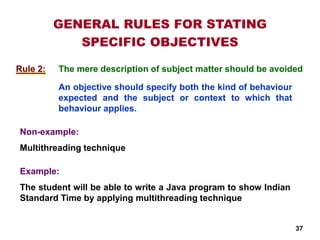
  • 121.
    Redesigning: A studentis asked to change the system to accomplish some goal How could you improve a bicycle tire pump so that it would be more efficient? Student must imagine altering one or more of the components in the system. “Apply lubricant between the piston and the cylinder”
  • 122.
    Predicting: A studentis asked to change in one part of a system will effect a change in another part of a system. What would happen if you increased the diameter of the cylinder in a bicycle tire pump? Student “operate” the mental model of the pump to see that the amount of air moving through the pump could be increased by increasing the diameter of the cylinder.
  • 123.
    3. Apply –3.1. Execute • Use of skills and algorithms, routinely carries out a procedure when confronted with a familiar task. • Consists of a sequence of steps that are generally followed in a fixed order , when the steps are performed correctly, the end result is a predetermined answer. • Student is given a familiar task that can be performed using a well known procedure. • Emphasis on the procedure as well as the result.
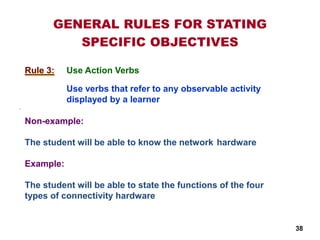
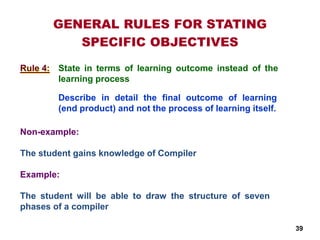
  • 124.
    Objective and Assessment •To compute the values of variables using scientific formulas. (General Objective) • To apply the reduce-reuse- recycle approach to conservation • To compute the density of Diamond. • What is the density of diamond with a mass of 18 pounds and a volume of 9 cubic inches? • Solve for x: x2 + 2x – 3 = 0
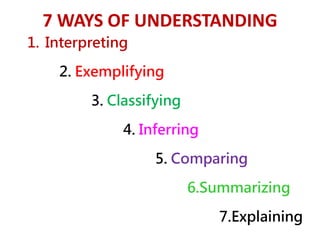
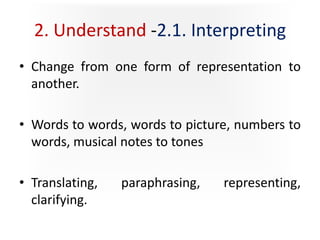
  • 125.
    Objective and Assessment •To write a program in C language for iteratively solving load flow equations using Gauss-Seidel method with provision for acceleration factor and for dealing with P-V buses. • Solve load flow equations using Gauss-Seidel method with provision for acceleration factor and for dealing with P-V buses.
  • 126.
    Objective and Assessment •To carryout fault analysis for a sample power system for LLLG fault. • To write C programs to simulate UNIX commands like ls, grep. • To write a programs for String manipulation operations using 8086. • To study of basic digital IC’s. (General Objective) • To verify truth table for NAND gate.
  • 127.
    3. Apply –3.2. Implementing • Selects and uses a procedure to perform an unfamiliar task. • Selects – understanding the type of problem encountered. • Uses – range of procedures that are available. • No single procedure may be a ‘Perfect Fit’ for the problem. Needs modification in the procedure. • Use of technique and methods than skills and algorithms.
  • 128.
    Techniques and Methods Ithas two qualities that make students particularly amenable to implementing. 1. The procedure may be more like a “Flow Chart” than a fixes sequence, that is, the procedure may have “decision points” built into it. 2. There often is no single, fixed answer that is expected when the procedure is applied correctly.
  • 129.
    • To solvea variety of personal finance problems • To use the most effective , efficient, and affordable method of conducting a research study to address a specific research question
  • 130.
    Objective and Assessment •To implement the IIR and FIR filter using MATLAB. • To implement the processing techniques using instructions of TMS320c5X. • To implement the Producer-Consumer problems using semaphores. • To implement text compression algorithm. • To implement Bresenham’s algorithm for line.
  • 131.
    Objective and Assessment •To solve a variety of personal finance problems. • Choose the most economical financing package for a new car. • Choose the bank which gives most economical housing loan.
  • 132.
    Student must notonly apply a procedure (engage in implementing) but also rely on conceptual understanding of the problem, the procedure, or both
  • 133.
    Analyze- An extensionof Understanding and prelude of Evaluating or Creating Examples: • Distinguish fact from opinion (or reality from fantasy) • Connect conclusions with supporting statements • Determine how ideas are related to one another • Ascertain the unstated assumptions involved in what is said • Find evidence in support of the author’s purpose
  • 134.
    4. Analyze –4.1. Differentiating • Discriminates relevant from irrelevant, important from unimportant, and then attends to the relevant or important information. • Important aspects – all aspects (compare). • Focusing, Distinguishing, Selecting
  • 135.
    • To determinethe major points in research reports • To select the main steps in a written description of how something working
  • 136.
    Objective and Assessment •To differentiate between apple and Orange. • Internal seeds are relevant, Color and shape are irrelevant. (compare – all are relevant). • To differentiate between NAND and NOR gate. • To differentiate between LASER and MASER
  • 137.
    Ask a studentto read a chapter in a book that describes lightning formation and then to divide the processes into major steps including • Moist air rising to form a cloud • Creation of updrafts and downdrafts inside the cloud • Separation of charges within the cloud • Movement of a stepped leader downward from cloud to ground and • Creation of return stroke from ground to cloud
  • 138.
    4. Analyze –4.2. Organizing • Determining how elements fit or function within a structure. • Builds systematic and coherent connections among pieces of presented information. • It occurs in conjunction with differentiating. • Structuring, Integrating, finding, outlining.
  • 139.
    • To structurea historical description into evidence for and against a particular explanation • To analyze research report in terms of four sections: hypothesis, method, data and conclusion • To outline textbook lessons • To organize field work practicum
  • 140.
    Objective and Assessment •To analyze project report in terms of four sections: Objective/ hypothesis, Method, Data and Conclusion. • Produce an outline of the project work. • Content page of any book • Table, matrix, hierarchical diagram.
  • 141.
    4. Analyze –4.3. Attributing • Processes of deconstruction in which a student determines the intensions of the author of the presented information • An extension beyond basic understanding to infer. • Determine the underlying point of view or intension of the author. • Others point of view
  • 142.
    • To determinethe motives for a series of actions by characters in a story • To determine the point of view of the author of an essay on a controversial topic in terms of his/her theatrical perspective
  • 143.
  • 144.
    Attributing • Focuses on pragmaticissue of determining author’s point of view • Read between the line Inferring • Issue if inducing a pattern based on presented info. • Supplies an expectation of what is to be inferred
  • 145.
    5. Evaluate • Makingjudgments based on criteria and standards • Criteria – Quality, Effectiveness, Efficiency and Consistency • STDs.- Quantiative (Is this a sufficient amount?) Qualitative (Is this good enough?)
  • 146.
    The standards areapplied to the criteria • Is this process sufficiently effective? • Is this product of sufficient quality? • Judgments made by use of standards of performance with clearly defined criteria / specifications Not all judgments are Evaluative
  • 147.
    5. Evaluate –5.1. Checking (PDCA) • Detecting inconsistencies within a process or product. • Determine whether a process or product has internal consistency. • Determine if a Director /Principal / HoD’s conclusions follow from observed data. • Coordinating, Monitoring, Testing Determining how well the plan is working
  • 148.
    Objective and Assessment •To determine whether a student’s conclusion follows from the observed data in the lab experiments. • Read a observation / record note of a DBMS lab experiment and determine whether or not a student’s conclusion follows from the observed data in the lab experiments. Judgments based on criteria and standards.
  • 149.
    5. Evaluate –5.2. Critiquing • Judging a product or operation based on externally imposed criteria and standards. • Judge which of two methods is the best way to solve a given problem. • Critiquing lies at the core of critical thinking. • Judgment based on the positive and negative features.
  • 150.
    Examples • To evaluatea proposed solution to asocial problem. • To evaluate the reasonableness of a hypothesis • To evaluate a proposal to achieve 100% result with in three years. • To evaluate a proposal to achieve 100% attendance of all the faculty. • To evaluate a roadmap to achieve 50% placement for the students.
  • 151.
    To judge whichof two alternative methods is a more effective and efficient way of solving given problem • The critique could be based on positive, negative or both kinds of criteria and yield both positive and negative consequences.
  • 152.
    6. Create • Makea new product by mentally reorganizing some elements or parts into a pattern or structure not clearly present before. • Coordinated with the students previous learning experiences. • Production of unusual products, often a s result of some special skill. • Emphasis Originality or Uniqueness.
  • 153.
    6. Create -Process 1. Problem representation: In which student attempts to understand the task and generate possible solutions. 2 Solution Planning: In which student examines the possibilities and devises a workable plan. 3. Solution Execution: In which student successfully carries out the plan.
  • 154.
    6. Create –6.1. Generating • Coming up with alternative hypothesis based on criteria. • Transcends the boundaries or constraints or prior knowledge and existing theories. • Creative thinking
  • 156.
    • To generatemultiple useful solutions for social problems • To generate hypothesis to explain observed phenomena • To generate alternative methods for achieving a particular result
  • 157.
    Objective and Assessment •To generate multiple useful solutions for college problems. • Suggest as many ways as you can to assure that everyone has 100% attendance. • Suggest to improve the pass %. • What are the possible uses of WWW – uses task • What would happen if there was a flat income tax rather than a graduated income tax? - consequences task
  • 158.
    6. Create –6.2. Planning • Devising a procedure for accomplishing task. • Developing a plan for solving the problem. • Designing
  • 159.
    6. Create –6.3. Producing • Inventing a product. • Carry out a plan for solving a given problem that meets certain specifications. • Requires 4 types of knowledge • Constructing
  • 160.
    • To planresearch papers on given social topics • To design studies to test various hypothesis • To develop worked out solutions • To describe solution plans • To select solution plans for a given problem
  • 161.
    Student is givena functional description of a goal and must create a product that satisfies the description. Eg: Period Movies Design the living quarters of a space station Design sets/backdrop for stage play The specifications become the criteria for evaluating students performance relative to the objective
  • 162.
    Ohm’s Law Interrupting Factual Knowledge Studentsshould be able to define key terms (e.g. ,Resistance) in their own words Explaining Conceptual Knowledge To explain what happens to the rate of current in an electrical circuit when changes are made in the system ( e.g., two batteries that were connected in serial are connected in parallel) Executing Procedural Knowledge To use Ohm’s law to compute the voltage when given the current (in amperes) and the resistance (in ohms) Differentiating Conceptual Knowledge To determine which information in words problems involving Ohm’s law (e.g., wattage of light bulb, thickness of wire, voltage of battery) is needed to determine the resistance.
  • 163.
    Ohm’s Law Interrupting Factual Knowledge Studentsshould be able to define key terms (e.g. ,Resistance) in their own words Checking Procedural Knowledge To determine whether a worked-out problem solution to a problem involving Ohm’s law is likely to be effective in solving it. Critiquing Metacognitive Knowledge To choose a plan solve problem involving Ohm’s law that is most consistent with his or her current level of understanding. Generating Conceptual Knowledge To generate alternate ways of increasing the brightness of the light in a circuit without changing the battery
  • 164.
    To solve amathematical word problem Interpreting To understand each sentence in the problem Recalling To retrieve the relevant Factual Knowledge needed to solve the problem Organizing To build a coherent representation of the key information in the problem (Conceptual Knowledge) Planning To devise a solution plan Producing To carry out the plan (Procedural Knowledge)
  • 165.
    To write anEssay Recalling To retrieve the relevant information needed to include in the essay. Planning To decide what to include in the essay, determine what to say, and how to say. Producing To create a written product Critiquing To make sure the written essay “make sense”
  • 166.
    On completion ofthe study of this Unit the learner will be able 1.0 To understand the concept of semiconductor and its types 1.1 To define “semi conductor” (K) 1.2 To distinguish between intrinsic and extrinsic semiconductors by stating the four differences between them (C) 1.3 To derive the carrier concentration of intrinsic and extrinsic semiconductors (C) 1.4 To explain how a p-n junction is formed (C) 1.5 To describe the characteristic behaviour of a p-n junction, when biased forward and reverse (C) EXAMPLES OF OBJECTIVES 16 6 Example 1: Name of the Unit: SEMICONDUCTORS
  • 167.
    On completion ofthe study of this Unit the learner will be able 1.1 To define DBMS (K) 1.2 To list any three characteristic features of DBMS (K) 1.3 To distinguish between DBMS and RDBMS by stating any three differences between them (C) 1.4 To describe the structure of DBMS (C) EXAMPLES OF OBJECTIVES 16 7 Example 2: 1.0 To understand the concept of DBMS 2.1 To name the three types of SQL commands (K) 2.2 To write any three differences between DDL and DML (C) 2.3 To write a command to create an employee table with fields like Name, Sex, Emp.Id, Dept., Designation and Salary (Ap) 2.0 To apply various SQL commands Name of the Unit: DATABASE MANAGEMENT SYSTEM
  • 168.
    On completion ofthe study of this Unit the learner will be able 1.0 To comprehend the nature of Viral diseases and methods of preventing them 1.1 To define Virus (K) 1.2 To explain the origin of Viruses on the basis of “Regressive theory” (C) 1.3 To list the four characteristic features of Viruses (K) 1.4 To define virulent cycle (K) 1.5 To give an example for (i) Spherical virus and (ii) Tadpole shaped Virus (C) 1.6 To describe the shape and general structure of Viruses (C) 1.7 To name three Viral diseases in plants (K) 1.8 To describe the structure of HIV (C) 1.9 To explain the multiplication of T4 bacteriophage with labeled sketches (C&Sk) 1.10 To describe any three Viral diseases in Human beings and methods of preventing them (C) EXAMPLES OF OBJECTIVES 16 8 Example 3: Name of the Unit: VIRAL DISEASES
  • 169.
    EXAMPLES OF OBJECTIVES Oncompletion of the study of this Unit the learner will be able 1.0 To understand the working of Open System Interconnection (OSI) Network Model & its services 1.1 To draw the structure of OSI Network Model and name its seven layers (C) 1.2 To list the two principles used to arrive at the seven layers of OSI network model (C) 1.3 To list any three services provided by the application layer to the user in an OSI Network Model (K) Example 4: Name of the Unit: INTRODUCTION TO NETWORK ARCHITECTURE 169
  • 170.
    Overview of thePresentation  P u r p o s e o f t h i s t r a i n i n g  Issues and Concerns of Teach ers  I m p o r t a n t E d u c a t i o n a l G o a l s  B a s i c T e a c h i n g M o d e l  Instructional Objectives- Definition, Advantages and Need  General Objectives and Specific Objectives  Methods of Stating Objectives  Six General rules for Stating Specific Objectives  Bloom’s Taxonomy of educational objectives  Advantages of Taxonomy  Bloom’s Revised Taxonomy of educational objectives  Knowledge Dimension  Cognitive Dimension - Examples of Objectives 14. Take away 170
  • 171.
  • 172.
    BASIC TEACHING MODEL Instructional Objectives Entering Behaviour Instructional Procedures Performance Assessment Slide# 172 Education System- Very Complex Un known Un certainties Many Variances Curriculum Learning Environment Students Faculty
  • 173.
  • 174.
    Tea chin g an d Learn in g Te a c h i n g , L e a r n i n g a n d A s s e s s i n g Discuss Objectives in the class Instructional Activities Syllabus Previous Question papers Reference & Text Books Reflect Objectives in Question paper Teaching Instructional Objectives Expected Outcome Performance Mapping
  • 175.
    Action - Immediate Detailed study of Syllabus  Reference & Text books  Decide which is important  Previous years question papers  Course plan Course Plan
  • 176.
    Action –Near Future 1.Pre-requisite knowledge 2. Mapping of five units 3. Mapping with other subjects 4. Delivering pre-requisite knowledge 5. Specific instructional objectives in accordance with Bloom’s revised taxonomy 6. Lesson plan 7. Teaching learning process 8. Evaluation at the end of the semester in accordance with Bloom’s revised taxonomy 9. Mapping of objectives, teaching learning process and assessment in the Bloom’s revised taxonomy table.
  • 177.
    Action – LongTerm Future • Train the colleague on Taxonomy • Share the classroom experience • Best Practices • Lead the faculties • Excellence
  • 178.
  • 179.
    Purpose To expand the capacityof individual and Organization for Best Performance
  • 180.
    Further Training Thank You Overviewof Successful education Instructional objectives Educational Taxonomy Table, Knowledge Dimension, Cognitive Process Dimension. Concepts of Evaluation. Construction of Achievement Tests. Characteristics of a Good Test. Different varieties of Question Papers Result Analysis. System Thinking for an Educational Institution Capacities’ Requisite for the Knowledge Society Preparing Professionals beyond 2020 Great books for Leadership. Mission, Vision, Core Values, Objective and Aim. Best Practices. Concept of Three –Performance Excellence
  • 181.