




Instructional
Objectives
Presented by
Shakila Bano
 “Instructional objectives are specific
statement of learner behavior of outcomes
that are expected to be exhibited after
completion of the unit of instruction”
 Example :after completing this lesson
student will be able to Write the name of
month in order.
They provide an important role
both in instructional process and
assessment process
Guides both teaching and
learning
Communicate the intend of the
instruction from others
Provide guidelines to assess the
learning outcomes of student.
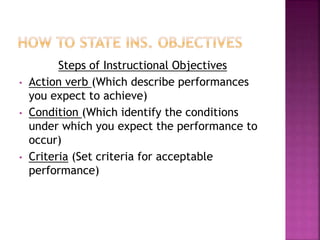
Steps of Instructional Objectives
• Action verb (Which describe performances
you expect to achieve)
• Condition (Which identify the conditions
under which you expect the performance to
occur)
• Criteria (Set criteria for acceptable
performance)
It is one of the criteria
states instructional
objectives in this
statement what learner
may be able to do
Like microscope
Don’t state in terms of
 Teacher performance
 Learning process
 Course content
 Two objectives
State in term of performance
Know ,identify, Match apply, write etc.
 Knowledge
 Understanding
 Application
 Thinking skill
 General skills
 Attitudes
 Interests
 Appreciation
 adjustment
 Terminology
 Specific facts
 Concepts and principals
 Methods and procedure
 Concepts and principals
 Methods and procedures
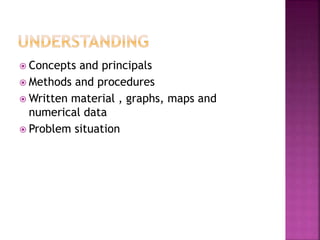
 Written material , graphs, maps and
numerical data
 Problem situation
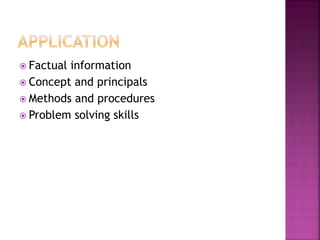
 Factual information
 Concept and principals
 Methods and procedures
 Problem solving skills
 Critical thinking
 Scientific thinking
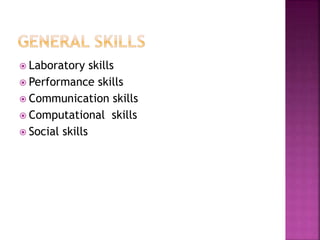
 Laboratory skills
 Performance skills
 Communication skills
 Computational skills
 Social skills
 Social attitudes
 Scientific attitudes
 Personal interests
 Educational interests
 Vocational interests
 Literature, art, and music
 Social scientific achievements
 Social adjustment
 Emotional development
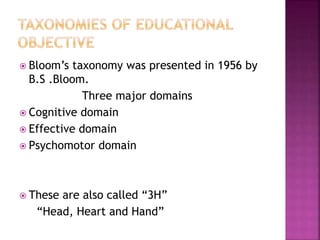
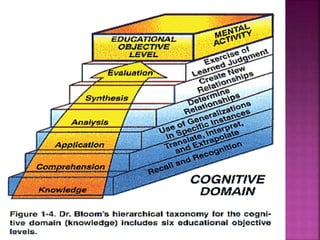
 Bloom’s taxonomy was presented in 1956 by
B.S .Bloom.
Three major domains
 Cognitive domain
 Effective domain
 Psychomotor domain
 These are also called “3H”
“Head, Heart and Hand”
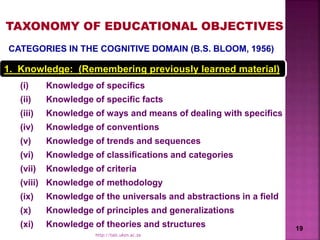
(i) Knowledge of specifics
(ii) Knowledge of specific facts
(iii) Knowledge of ways and means of dealing with specifics
(iv) Knowledge of conventions
(v) Knowledge of trends and sequences
(vi) Knowledge of classifications and categories
(vii) Knowledge of criteria
(viii) Knowledge of methodology
(ix) Knowledge of the universals and abstractions in a field
(x) Knowledge of principles and generalizations
(xi) Knowledge of theories and structures
TAXONOMY OF EDUCATIONAL OBJECTIVES
CATEGORIES IN THE COGNITIVE DOMAIN (B.S. BLOOM, 1956)
1. Knowledge: (Remembering previously learned material)
19
http://talc.ukzn.ac.za
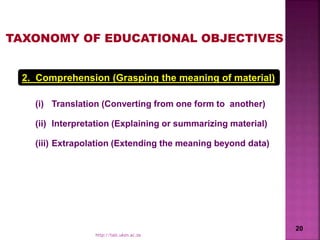
2. Comprehension (Grasping the meaning of material)
(i) Translation (Converting from one form to another)
(ii) Interpretation (Explaining or summarizing material)
(iii) Extrapolation (Extending the meaning beyond data)
TAXONOMY OF EDUCATIONAL OBJECTIVES
20
http://talc.ukzn.ac.za
3. Application
This refers to the ability to use learned material in
new and concrete situations. This may include the
application of such things as rules, methods,
concepts, principles, laws and theories and solving
of problems.
TAXONOMY OF EDUCATIONAL OBJECTIVES
21
http://talc.ukzn.ac.za
4. Analysis: (Breaking down material into its parts)
(i) Analysis of elements (Identifying the parts)
(ii) Analysis of relationships (Identifying the relationship)
(iii) Analysis of organisational principles (Identifying the
way the parts are organised)
TAXONOMY OF EDUCATIONAL OBJECTIVES
22
http://talc.ukzn.ac.za
5. Synthesis: (Putting parts together into a whole)
(i) Production of a unique communication
(ii) Production of a plan or proposed set of operations
(iii) Derivation of a set of abstract relations
TAXONOMY OF EDUCATIONAL OBJECTIVES
23
http://talc.ukzn.ac.za
6. Evaluation (Judging the value of a thing for a
given purpose using definite criteria)
(i) Judgements in terms of internal evidence
(ii) Judgements in terms of external criteria
TAXONOMY OF EDUCATIONAL OBJECTIVES
24
http://talc.ukzn.ac.za
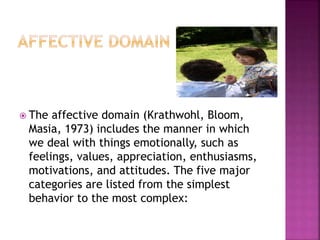
 The affective domain (Krathwohl, Bloom,
Masia, 1973) includes the manner in which
we deal with things emotionally, such as
feelings, values, appreciation, enthusiasms,
motivations, and attitudes. The five major
categories are listed from the simplest
behavior to the most complex:
 Receiving: the student is aware of or attending to
something in the environment.
 Responding: the students displays some new
behavior as a result of experiences and responds
to the experiences.
 Valuing: the students displays definite
involvement or commitment toward some
experience.
 Organization: the student has integrated a new
value into his or her general set of values and
can give it its proper place in a priority system.
 Characterization by value: the students acts
consistently according to the value and is firmly
committed to the experience.
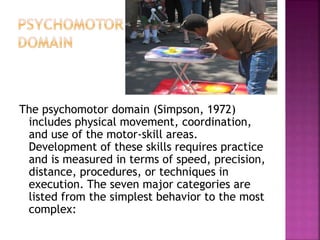
The psychomotor domain (Simpson, 1972)
includes physical movement, coordination,
and use of the motor-skill areas.
Development of these skills requires practice
and is measured in terms of speed, precision,
distance, procedures, or techniques in
execution. The seven major categories are
listed from the simplest behavior to the most
complex:
Professor Simpson, Harrow and Dave worked
out for this domain.
 Perception
 Set
 Guided response
 Mechanism
 Complex overt response
 Adaptation
 Origination
 It deals with the use of sense organs.
 Observing computer for operating.
2- SET
It refer to readiness to take particular type of
action. This includes
a) Mental readiness to act.
b) Physical readiness to act.
c) Motional readiness to act.
 It includes early stages for learning skills
 Imitation
 Trail & Error
 Exp Perform Experiment operating
microscope as demonstrated.
 Learned responses become habitual.
 Performance with confidence &proficiency.
 Exp….. Setting lab equipment operating
different equipment.
 Performance without hesitation.
 Learned responses are performed skillfully.
 Exp…. Operating Computer
skillfully,driving,swimming
6--- Adaptation
Previous skills in new situation
7----Origination
Creativity New methods .Dress, music.
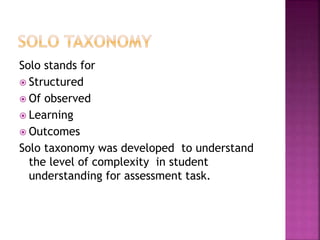
Solo stands for
 Structured
 Of observed
 Learning
 Outcomes
Solo taxonomy was developed to understand
the level of complexity in student
understanding for assessment task.
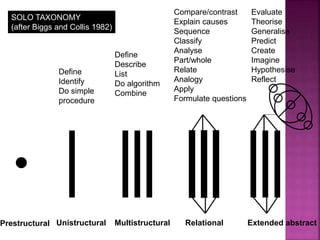
Unistructural Multistructural Relational Extended abstract
Define
Identify
Do simple
procedure
Define
Describe
List
Do algorithm
Combine
Compare/contrast
Explain causes
Sequence
Classify
Analyse
Part/whole
Relate
Analogy
Apply
Formulate questions
Evaluate
Theorise
Generalise
Predict
Create
Imagine
Hypothesise
Reflect
SOLO TAXONOMY
(after Biggs and Collis 1982)
Prestructural
METHODS OF STATING OBJECTIVES
(i) Mager’s method
(ii) Gronlund’s method
38
http://talc.ukzn.ac.za
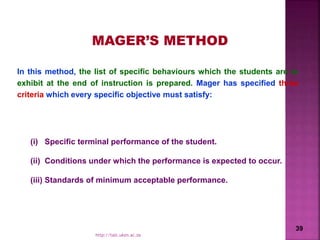
MAGER’S METHOD
(i) Specific terminal performance of the student.
(ii) Conditions under which the performance is expected to occur.
(iii) Standards of minimum acceptable performance.
In this method, the list of specific behaviours which the students are to
exhibit at the end of instruction is prepared. Mager has specified three
criteria which every specific objective must satisfy:
39
http://talc.ukzn.ac.za
MAGER’S METHOD
The student will be able to determine the diameter of a
copper wire, given a suitable screw gauge, to an accuracy of
0.05 mm within 15 minutes.
Example:
40
http://talc.ukzn.ac.za
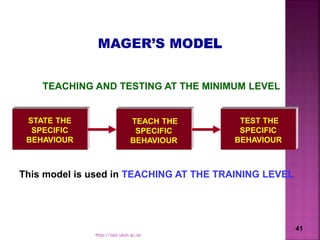
This model is used in TEACHING AT THE TRAINING LEVEL
STATE THE
SPECIFIC
BEHAVIOUR
TEACH THE
SPECIFIC
BEHAVIOUR
TEST THE
SPECIFIC
BEHAVIOUR
TEACHING AND TESTING AT THE MINIMUM LEVEL
MAGER’S MODEL
41
http://talc.ukzn.ac.za
 List of a representative sample of specific
outcome
 Begin each specific objective from action
verb
 Make sure relevancy of each specific
objective to general objective
 Consult reference material for specific
component .
 Keep every objective at appropriate level of
specification.
 Keep the specific objectives according to
content.
GRONLUND’S METHOD
In this method, the General Objectives are first stated. Then each
General Objective is clarified by listing a sample of the specific
behaviours which are accepted as evidence of attainment of the
General Objective.
Contd.
43
http://talc.ukzn.ac.za
Example:
1. To list the two protocols that are used in Medium Access
Sub layer with respect to channel allocation.
2. To define collision with respect to channel allocation in
medium access sub-layer.
3. To calculate frame time T, for a given frame length and bit
rate in a channel.
Specific Objectives:
General Objectives:
To understand the working of medium access sub layer in OSI
Network Model.
GRONLUND’S METHOD
44
http://talc.ukzn.ac.za
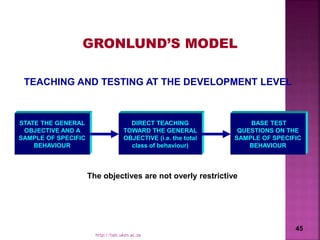
STATE THE GENERAL
OBJECTIVE AND A
SAMPLE OF SPECIFIC
BEHAVIOUR
DIRECT TEACHING
TOWARD THE GENERAL
OBJECTIVE (i.e. the total
class of behaviour)
BASE TEST
QUESTIONS ON THE
SAMPLE OF SPECIFIC
BEHAVIOUR
The objectives are not overly restrictive
TEACHING AND TESTING AT THE DEVELOPMENT LEVEL
GRONLUND’S MODEL
45
http://talc.ukzn.ac.za
 State each general objectives as learning
outcomes
 Begins each general objective with action
verb
 In each objective there might be only one
general learning outcome
 State each objective at the proper level of
generality
 Keep general objective free from course
content
 Minimize the overlap with other objectives
Thank You
http://talc.ukzn.ac.za

Assessment 2......

  • 1.
  • 2.
     “Instructional objectivesare specific statement of learner behavior of outcomes that are expected to be exhibited after completion of the unit of instruction”  Example :after completing this lesson student will be able to Write the name of month in order.
  • 3.
    They provide animportant role both in instructional process and assessment process Guides both teaching and learning Communicate the intend of the instruction from others Provide guidelines to assess the learning outcomes of student.
  • 4.
    Steps of InstructionalObjectives • Action verb (Which describe performances you expect to achieve) • Condition (Which identify the conditions under which you expect the performance to occur) • Criteria (Set criteria for acceptable performance)
  • 5.
    It is oneof the criteria states instructional objectives in this statement what learner may be able to do Like microscope
  • 6.
    Don’t state interms of  Teacher performance  Learning process  Course content  Two objectives State in term of performance Know ,identify, Match apply, write etc.
  • 7.
     Knowledge  Understanding Application  Thinking skill  General skills  Attitudes  Interests  Appreciation  adjustment
  • 8.
     Terminology  Specificfacts  Concepts and principals  Methods and procedure
  • 9.
     Concepts andprincipals  Methods and procedures  Written material , graphs, maps and numerical data  Problem situation
  • 10.
     Factual information Concept and principals  Methods and procedures  Problem solving skills
  • 11.
     Critical thinking Scientific thinking
  • 12.
     Laboratory skills Performance skills  Communication skills  Computational skills  Social skills
  • 13.
     Social attitudes Scientific attitudes
  • 14.
     Personal interests Educational interests  Vocational interests
  • 15.
     Literature, art,and music  Social scientific achievements
  • 16.
     Social adjustment Emotional development
  • 17.
     Bloom’s taxonomywas presented in 1956 by B.S .Bloom. Three major domains  Cognitive domain  Effective domain  Psychomotor domain  These are also called “3H” “Head, Heart and Hand”
  • 19.
    (i) Knowledge ofspecifics (ii) Knowledge of specific facts (iii) Knowledge of ways and means of dealing with specifics (iv) Knowledge of conventions (v) Knowledge of trends and sequences (vi) Knowledge of classifications and categories (vii) Knowledge of criteria (viii) Knowledge of methodology (ix) Knowledge of the universals and abstractions in a field (x) Knowledge of principles and generalizations (xi) Knowledge of theories and structures TAXONOMY OF EDUCATIONAL OBJECTIVES CATEGORIES IN THE COGNITIVE DOMAIN (B.S. BLOOM, 1956) 1. Knowledge: (Remembering previously learned material) 19 http://talc.ukzn.ac.za
  • 20.
    2. Comprehension (Graspingthe meaning of material) (i) Translation (Converting from one form to another) (ii) Interpretation (Explaining or summarizing material) (iii) Extrapolation (Extending the meaning beyond data) TAXONOMY OF EDUCATIONAL OBJECTIVES 20 http://talc.ukzn.ac.za
  • 21.
    3. Application This refersto the ability to use learned material in new and concrete situations. This may include the application of such things as rules, methods, concepts, principles, laws and theories and solving of problems. TAXONOMY OF EDUCATIONAL OBJECTIVES 21 http://talc.ukzn.ac.za
  • 22.
    4. Analysis: (Breakingdown material into its parts) (i) Analysis of elements (Identifying the parts) (ii) Analysis of relationships (Identifying the relationship) (iii) Analysis of organisational principles (Identifying the way the parts are organised) TAXONOMY OF EDUCATIONAL OBJECTIVES 22 http://talc.ukzn.ac.za
  • 23.
    5. Synthesis: (Puttingparts together into a whole) (i) Production of a unique communication (ii) Production of a plan or proposed set of operations (iii) Derivation of a set of abstract relations TAXONOMY OF EDUCATIONAL OBJECTIVES 23 http://talc.ukzn.ac.za
  • 24.
    6. Evaluation (Judgingthe value of a thing for a given purpose using definite criteria) (i) Judgements in terms of internal evidence (ii) Judgements in terms of external criteria TAXONOMY OF EDUCATIONAL OBJECTIVES 24 http://talc.ukzn.ac.za
  • 25.
     The affectivedomain (Krathwohl, Bloom, Masia, 1973) includes the manner in which we deal with things emotionally, such as feelings, values, appreciation, enthusiasms, motivations, and attitudes. The five major categories are listed from the simplest behavior to the most complex:
  • 26.
     Receiving: thestudent is aware of or attending to something in the environment.  Responding: the students displays some new behavior as a result of experiences and responds to the experiences.  Valuing: the students displays definite involvement or commitment toward some experience.
  • 27.
     Organization: thestudent has integrated a new value into his or her general set of values and can give it its proper place in a priority system.  Characterization by value: the students acts consistently according to the value and is firmly committed to the experience.
  • 28.
    The psychomotor domain(Simpson, 1972) includes physical movement, coordination, and use of the motor-skill areas. Development of these skills requires practice and is measured in terms of speed, precision, distance, procedures, or techniques in execution. The seven major categories are listed from the simplest behavior to the most complex:
  • 29.
    Professor Simpson, Harrowand Dave worked out for this domain.  Perception  Set  Guided response  Mechanism  Complex overt response  Adaptation  Origination
  • 30.
     It dealswith the use of sense organs.  Observing computer for operating. 2- SET It refer to readiness to take particular type of action. This includes a) Mental readiness to act. b) Physical readiness to act. c) Motional readiness to act.
  • 31.
     It includesearly stages for learning skills  Imitation  Trail & Error  Exp Perform Experiment operating microscope as demonstrated.
  • 32.
     Learned responsesbecome habitual.  Performance with confidence &proficiency.  Exp….. Setting lab equipment operating different equipment.
  • 33.
     Performance withouthesitation.  Learned responses are performed skillfully.  Exp…. Operating Computer skillfully,driving,swimming 6--- Adaptation Previous skills in new situation 7----Origination Creativity New methods .Dress, music.
  • 35.
    Solo stands for Structured  Of observed  Learning  Outcomes Solo taxonomy was developed to understand the level of complexity in student understanding for assessment task.
  • 37.
    Unistructural Multistructural RelationalExtended abstract Define Identify Do simple procedure Define Describe List Do algorithm Combine Compare/contrast Explain causes Sequence Classify Analyse Part/whole Relate Analogy Apply Formulate questions Evaluate Theorise Generalise Predict Create Imagine Hypothesise Reflect SOLO TAXONOMY (after Biggs and Collis 1982) Prestructural
  • 38.
    METHODS OF STATINGOBJECTIVES (i) Mager’s method (ii) Gronlund’s method 38 http://talc.ukzn.ac.za
  • 39.
    MAGER’S METHOD (i) Specificterminal performance of the student. (ii) Conditions under which the performance is expected to occur. (iii) Standards of minimum acceptable performance. In this method, the list of specific behaviours which the students are to exhibit at the end of instruction is prepared. Mager has specified three criteria which every specific objective must satisfy: 39 http://talc.ukzn.ac.za
  • 40.
    MAGER’S METHOD The studentwill be able to determine the diameter of a copper wire, given a suitable screw gauge, to an accuracy of 0.05 mm within 15 minutes. Example: 40 http://talc.ukzn.ac.za
  • 41.
    This model isused in TEACHING AT THE TRAINING LEVEL STATE THE SPECIFIC BEHAVIOUR TEACH THE SPECIFIC BEHAVIOUR TEST THE SPECIFIC BEHAVIOUR TEACHING AND TESTING AT THE MINIMUM LEVEL MAGER’S MODEL 41 http://talc.ukzn.ac.za
  • 42.
     List ofa representative sample of specific outcome  Begin each specific objective from action verb  Make sure relevancy of each specific objective to general objective  Consult reference material for specific component .  Keep every objective at appropriate level of specification.  Keep the specific objectives according to content.
  • 43.
    GRONLUND’S METHOD In thismethod, the General Objectives are first stated. Then each General Objective is clarified by listing a sample of the specific behaviours which are accepted as evidence of attainment of the General Objective. Contd. 43 http://talc.ukzn.ac.za
  • 44.
    Example: 1. To listthe two protocols that are used in Medium Access Sub layer with respect to channel allocation. 2. To define collision with respect to channel allocation in medium access sub-layer. 3. To calculate frame time T, for a given frame length and bit rate in a channel. Specific Objectives: General Objectives: To understand the working of medium access sub layer in OSI Network Model. GRONLUND’S METHOD 44 http://talc.ukzn.ac.za
  • 45.
    STATE THE GENERAL OBJECTIVEAND A SAMPLE OF SPECIFIC BEHAVIOUR DIRECT TEACHING TOWARD THE GENERAL OBJECTIVE (i.e. the total class of behaviour) BASE TEST QUESTIONS ON THE SAMPLE OF SPECIFIC BEHAVIOUR The objectives are not overly restrictive TEACHING AND TESTING AT THE DEVELOPMENT LEVEL GRONLUND’S MODEL 45 http://talc.ukzn.ac.za
  • 46.
     State eachgeneral objectives as learning outcomes  Begins each general objective with action verb  In each objective there might be only one general learning outcome  State each objective at the proper level of generality  Keep general objective free from course content  Minimize the overlap with other objectives
  • 47.