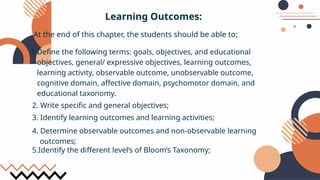
Learning Outcomes:
At theend of this chapter, the students should be able to;
1.Define the following terms: goals, objectives, and educational
objectives, general/ expressive objectives, learning outcomes,
learning activity, observable outcome, unobservable outcome,
cognitive domain, affective domain, psychomotor domain, and
educational taxonomy.
2. Write specific and general objectives;
3. Identify learning outcomes and learning activities;
4. Determine observable outcomes and non-observable learning
outcomes;
5.Identify the different level’s of Bloom’s Taxonomy;
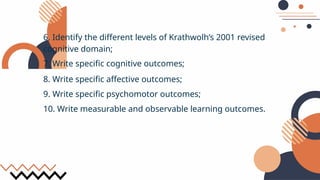
3.
6. Identify thedifferent levels of Krathwolh’s 2001 revised
cognitive domain;
7. Write specific cognitive outcomes;
8. Write specific affective outcomes;
9. Write specific psychomotor outcomes;
10. Write measurable and observable learning outcomes.
4.
Introduction
Instructional goals andobjectives play a very important role in both
instructional process and assessment process. This serves as a guide both
for teaching and learning process, communicate the purpose of instruction
to other stakeholders, and to provide guidelines for assessing the
performance of the students. Assessing the learning outcomes of the
students is one of the very critical functions of teachers. A classroom
teacher should classify the objectives of the lesson because it is very
important for the selection of the teaching method and the selection of the
instructional materials. The instructional material should be appropriate for
the lesson so that the teacher can motivate the students properly. The
objectives can be classified according to the learning, outcomes of the
lesson that will be discussed.
5.
PURPOSES OF INSTRUCTIONALGOALS AND OBJECTIVES
The purposes of the instructional goals and objectives.
1.It provides direction for the instructional process by
clarifying the intended learning outcomes.
2.It conveys instructional intent to other stakeholders
such as students, parents, school officials, and the
public.
3.It provides basis for assessing the performance of the
students by describing the performance to be
measured.
6.
GOALS AND OBJECTIVES
Theterms goals and objectives are two different concepts
but they are related to each other. Goals and objectives are
very important, most especially when you want to achieve
something for the students in any classroom activities.
Goals can never be accomplished without objectives and
you cannot get the objectives that you need in order that
you can accomplish what you want to achieve. Below are
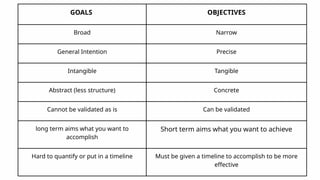
the different descriptions between goals and objectives.
7.
GOALS OBJECTIVES
Broad Narrow
GeneralIntention Precise
Intangible Tangible
Abstract (less structure) Concrete
Cannot be validated as is Can be validated
long term aims what you want to
accomplish
Short term aims what you want to achieve
Hard to quantify or put in a timeline Must be given a timeline to accomplish to be more
effective
8.
Goals, General Educational
ProgramObjectives, and
Instructional Objectives
Goals - A broad statement of very general
educational outcomes that do not include specific
level of performance. It tent to change infrequently
and in response to the societal pressure, e.g., learn
problem solving skills; develop high level thinking
skills; appreciate the beauty of art; be creative; and
be competent in the basic skills in the area or
grammar.
9.
General Educational ProgramObjectives
More narrowly defined statements of educational
outcomes that apply to specific educational
program; formulated on the annual basis; developed
by program coordinators, principals, and other
school administrators.
10.
Instructional Objectives -
Specificstatement of the learners behavior or
outcomes that are expected to be exhibited by the
students after completing a unit of instruction.
11.
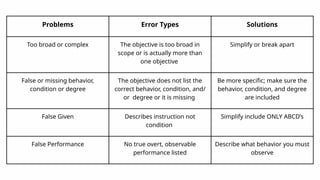
Problems Error TypesSolutions
Too broad or complex The objective is too broad in
scope or is actually more than
one objective
Simplify or break apart
False or missing behavior,
condition or degree
The objective does not list the
correct behavior, condition, and/
or degree or it is missing
Be more specific; make sure the
behavior, condition, and degree
are included
False Given Describes instruction not
condition
Simplify include ONLY ABCD’s
False Performance No true overt, observable
performance listed
Describe what behavior you must
observe
1. Audience
Who? Whoare the specific people the objectives are aimed at?
Four Main things That
Objective
Should Specify
2. Observable Behavior
What? What do you expect them to be able to do? This should be an
overt, observable behavior, even if the actual behavior is covert or
mental in nature. If you cannot see it, heat it, touch it, taste it, or
smell it, you cannot be sure your audience really learned it.
14.
3. Special Conditions
Thethird components of instructional objectives is the special
conditions under which the behavior must be displayed by the
students. How? Under what circumstances will be learning occur?
What will the student be given or already be expected to know to
accomplish the learning?
15.
4. Stating CriterionLevel
The fourth component of the instructional objectives is stating the
criterion level. The criterion level of acceptable performance specifies how
many of the items must the students answer correctly for the teacher to
attain his/her objectives. How much? Must a specific set of criterion be
met? Do you want total mastery (100%), do you want them to response
correctly 90% of the time, among others? A common (and totally non
scientific) setting is 90% of the time.
16.
Educational objective isalso known as
instructional objective. There are two types of
educational objectives: specific or behavioral
objectives and general or expressive objectives
(Kubiszyn and Borich, 2007).
Types of Educational Objectives
17.
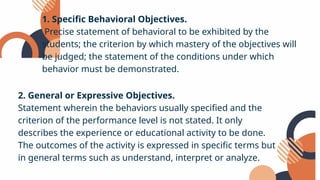
1. Specific BehavioralObjectives.
Precise statement of behavioral to be exhibited by the
students; the criterion by which mastery of the objectives will
be judged; the statement of the conditions under which
behavior must be demonstrated.
2. General or Expressive Objectives.
Statement wherein the behaviors usually specified and the
criterion of the performance level is not stated. It only
describes the experience or educational activity to be done.
The outcomes of the activity is expressed in specific terms but
in general terms such as understand, interpret or analyze.
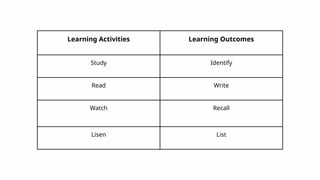
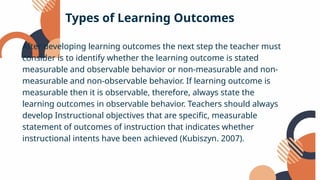
After developing learningoutcomes the next step the teacher must
consider is to identify whether the learning outcome is stated
measurable and observable behavior or non-measurable and non-
measurable and non-observable behavior. If learning outcome is
measurable then it is observable, therefore, always state the
learning outcomes in observable behavior. Teachers should always
develop Instructional objectives that are specific, measurable
statement of outcomes of instruction that indicates whether
instructional intents have been achieved (Kubiszyn. 2007).
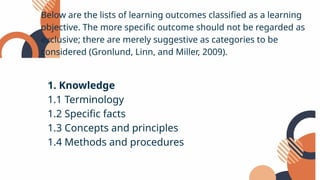
Types of Learning Outcomes
Below are thelists of learning outcomes classified as a learning
objective. The more specific outcome should not be regarded as
exclusive; there are merely suggestive as categories to be
considered (Gronlund, Linn, and Miller, 2009).
1. Knowledge
1.1 Terminology
1.2 Specific facts
1.3 Concepts and principles
1.4 Methods and procedures
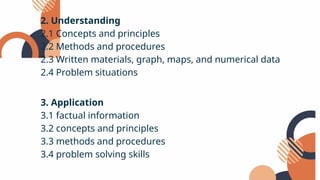
23.
2. Understanding
2.1 Conceptsand principles
2.2 Methods and procedures
2.3 Written materials, graph, maps, and numerical data
2.4 Problem situations
3. Application
3.1 factual information
3.2 concepts and principles
3.3 methods and procedures
3.4 problem solving skills
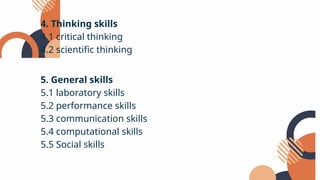
24.
4. Thinking skills
4.1critical thinking
4.2 scientific thinking
5. General skills
5.1 laboratory skills
5.2 performance skills
5.3 communication skills
5.4 computational skills
5.5 Social skills
Benjamin S. Bloom(1948, as cited by Gabuyo, 2011), a
well-known psychologist and educator, took the initiative
to lead in formulating and classifying the goals and
objectives of the educational process.The three domains
of educational activities were determined: the cognitive
domain, affective domain and the psychomotor domain.
29.
1. Cognitive Domaincalled for outcomes of mental activity such as
memorizing, reading problem solving, analyzing, synthesizing and
drawing conclusions.
2. Affective Domain describes learning objectives that emphasize a
feeling tone, an emotion, or a degree of acceptance or rejection.
Affective objectives vary from simple attention to selected phenomena
to complex but internally consistent qualities of character and
conscience. We found a large number of such objectives in the
literature expressed as interests, attitudes, appreciations, values, and
emotional sets or biases (Krathwohl et al., 1964 as cited by Esmane,
2011). It refers to the persons’ awareness and internalization of
objects and simulations, it focus on the emotions of the learners.
30.
3. Psychomotor Domainis characterized by the progressive levels of
behaviors from observation to mastery of physical skills (Simpson,
1972 as cited by Esmane, 2011). This includes physical movements,
coordination, and use of the motor-skill areas. Development of these
skills requires practice and is measured in terms of speed, precision,
distance, procedures, or techniques in execution. It focused on the
physical and kinesthetic skills of the learner. This domain is
characterized by the progressive levels of behaviors from observation
to mastery of physical skills.
31.
1. The objectivesshould include all important outcomes of the
course or subject matter.
2. The objectives should be in harmony with the content standards
of the state and with the general goals of the school.
3. The objectives should be in harmony with the sound principles of
learning.
4. The objectives should be realistic in terms of the abilities of the
students, time and and the available facilities
CRITERIA FOR SELECTING APPROPRIATE
OBJECTIVES






![Writing instructional objectives[2013]](https://cdn.slidesharecdn.com/ss_thumbnails/writinginstructionalobjectives2013-130701161054-phpapp02-thumbnail.jpg?width=640&height=640&fit=bounds)


