OBJECTIVE:
• 1. Define Curriculum.
• 2. Describe the Curriculum Development
Process.
• 3.Discuss the Importance of Curriculum
Implementation.
• 4. Lead Teachers in Curriculum Implementation.
• 5. Guide Teachers in Preparing an Enrichment
Curriculum.
CURRICULUM BASIC
• Curriculum – is basically what
students are expected to
learn in the classroom and
how the lesson are taught. it
refers to all educational
experiences that students go
through, for which the school
takes responsibility.
CURRICULUM DEVELOPMENT MODEL
• 1. THE RALPH TYLER MODEL- It’s the most widely
used model because of its simplicity and clarity. It begins
with the identification of a tentative list of educational
objectives based on stakeholders input.
•
• TYLER MODEL PRINCIPLES
• 1. Determining Learning Objectives
• 2. Selecting and Creating Appropriate Learning
experiences.
• 3. Organizing Learning Experiences.
• 4. Evaluating the Curriculum.
CURRICULUM DEVELOPMENT MODEL
• 2. The Kellough and kellough Model- This model
provides additional screens to those identified by
Ralph Tyler.
• - Educational Philosophy
• - Effects of Group Outside the Classroom.
• -Assessment Procedures.
• - Mechanism for Revision,
CURRICULUM IMPLEMENTATION
• Curriculum Implementation- Refers to
the actual use of the curriculum or
syllabus. The adoption of the
curriculum refers to ones intention to
use the curriculum, be it school heads
or a teacher, but adoption does not
indicate whether the curriculum is
implemented or not.
CURRICULUM IMPLEMENTATION PERSPECTIVE
• Three Perspective in Curriculum
Implementation
• 1. Technical Perspective
• 2. Political Perspective
• 3. Cultural Perspective
CURRICULUM ENRICHMENT
• CORE CURRICULUM
- Refers to the essential guide that teachers
use to determine the subjects to be taught
and how to teach these subjects.
- Also known as the Mastery Curriculum
- Refers to the knowledge and skills that the
students need to develop as part of a
standardized learning plan.
• CURRICULUM ENRICHMENT
– A plan
– It provides excitement and restores fun in the curriculum.
– Extends the mastery curriculum by providing a series of planned
activities to reinforce the latter’s content.
– Really about “enriching the learning environment. Learning
experience and teaching approaches. (Renzulli and Ries)
• ENRICHMENT
• -the learning that goes beyond what is prescribed by the
mastery curriculum.
CURRICULUM ENRICHMENT
PRINCIPLES OF CURRICULUM ENRICHMENT
• Each learner is Unique
• Learning is more effective when students enjoy
what they are doing.
• Learning is more meaningful and enjoyable
when content and process are learned in the
context of a real and present problems.
• The acquisition of knowledge and skills are
enhanced when students construct their own
meaning through knowledge and skills
application.
TYPE OF ENRICHMENT
• TYPE 1 ENRICHMENT
– -Extend the regular curriculum by providing students a wide
range of experiences and regular activities in order to introduce
a variety of exciting areas of interest.
TYPE 2 ENRICHMENT
- Covers the activities designed for specific students who are
interested to develop skills that are beyond what the regular
curriculum and type 1 enrichment could offer.
TYPE 3 ENRICHMENT
- most suitable for gifted and talented students.
- Students investigate real problems as individuals or small groups.
They become producers of knowledge rather than consumers,
actively formulating a problem, designing research and presenting a
product.
Thank you!
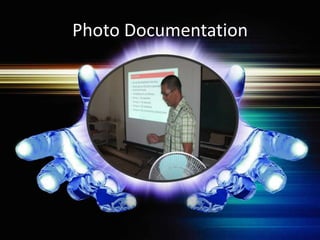
Photo Documentation
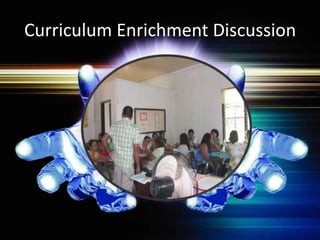
Curriculum Enrichment Discussion
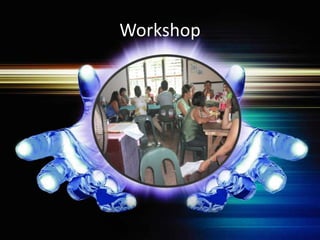
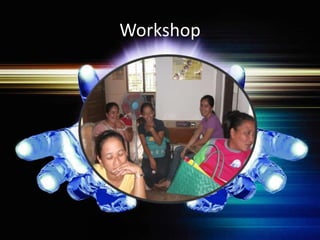
Workshop
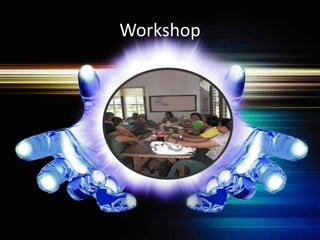
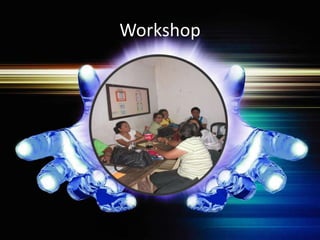
Workshop
Workshop
Workshop

Curriculum enrichment

  • 2.
    OBJECTIVE: • 1. DefineCurriculum. • 2. Describe the Curriculum Development Process. • 3.Discuss the Importance of Curriculum Implementation. • 4. Lead Teachers in Curriculum Implementation. • 5. Guide Teachers in Preparing an Enrichment Curriculum.
  • 3.
    CURRICULUM BASIC • Curriculum– is basically what students are expected to learn in the classroom and how the lesson are taught. it refers to all educational experiences that students go through, for which the school takes responsibility.
  • 4.
    CURRICULUM DEVELOPMENT MODEL •1. THE RALPH TYLER MODEL- It’s the most widely used model because of its simplicity and clarity. It begins with the identification of a tentative list of educational objectives based on stakeholders input. • • TYLER MODEL PRINCIPLES • 1. Determining Learning Objectives • 2. Selecting and Creating Appropriate Learning experiences. • 3. Organizing Learning Experiences. • 4. Evaluating the Curriculum.
  • 5.
    CURRICULUM DEVELOPMENT MODEL •2. The Kellough and kellough Model- This model provides additional screens to those identified by Ralph Tyler. • - Educational Philosophy • - Effects of Group Outside the Classroom. • -Assessment Procedures. • - Mechanism for Revision,
  • 6.
    CURRICULUM IMPLEMENTATION • CurriculumImplementation- Refers to the actual use of the curriculum or syllabus. The adoption of the curriculum refers to ones intention to use the curriculum, be it school heads or a teacher, but adoption does not indicate whether the curriculum is implemented or not.
  • 7.
    CURRICULUM IMPLEMENTATION PERSPECTIVE •Three Perspective in Curriculum Implementation • 1. Technical Perspective • 2. Political Perspective • 3. Cultural Perspective
  • 8.
    CURRICULUM ENRICHMENT • CORECURRICULUM - Refers to the essential guide that teachers use to determine the subjects to be taught and how to teach these subjects. - Also known as the Mastery Curriculum - Refers to the knowledge and skills that the students need to develop as part of a standardized learning plan.
  • 9.
    • CURRICULUM ENRICHMENT –A plan – It provides excitement and restores fun in the curriculum. – Extends the mastery curriculum by providing a series of planned activities to reinforce the latter’s content. – Really about “enriching the learning environment. Learning experience and teaching approaches. (Renzulli and Ries) • ENRICHMENT • -the learning that goes beyond what is prescribed by the mastery curriculum. CURRICULUM ENRICHMENT
  • 10.
    PRINCIPLES OF CURRICULUMENRICHMENT • Each learner is Unique • Learning is more effective when students enjoy what they are doing. • Learning is more meaningful and enjoyable when content and process are learned in the context of a real and present problems. • The acquisition of knowledge and skills are enhanced when students construct their own meaning through knowledge and skills application.
  • 11.
    TYPE OF ENRICHMENT •TYPE 1 ENRICHMENT – -Extend the regular curriculum by providing students a wide range of experiences and regular activities in order to introduce a variety of exciting areas of interest. TYPE 2 ENRICHMENT - Covers the activities designed for specific students who are interested to develop skills that are beyond what the regular curriculum and type 1 enrichment could offer. TYPE 3 ENRICHMENT - most suitable for gifted and talented students. - Students investigate real problems as individuals or small groups. They become producers of knowledge rather than consumers, actively formulating a problem, designing research and presenting a product.
  • 12.
  • 13.
  • 14.
  • 15.
  • 16.
  • 17.
  • 18.