Classroom
Management
                  Ayesha Aamir
    IDERAK…….step towards learning
     for contact: ash_planti@hotmail.com
Objective


• To understand the importance of
  class room management in
  teaching learning process.
WHY CLASS ROOM MANAGEMENT

        groups of people

         live and work

          organization

         solve or chaos.
              BECAUSE


     SURVIVAL FOR FITTEST
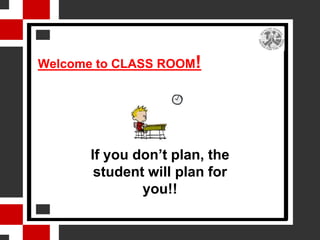
Welcome to CLASS ROOM!


       If you don’t plan, the
        student will plan for
               you!!
WHAT matters ?
•   You are not alone in class…
•   . . . It’s different for EVERY ONE!!
•   Anger shouldn't be part of the curriculum….
•   Focus on what a teacher can Change?
•   Must make learning relevant to students’’’’
•   It is more natural to be off-task – ENGAGE…
• Listens, RESPECT, listens, RESPECT, listens,
  RESPECT…….
• Design lessons for student mastery as
  REMEBER
              • Who Am I Planning For?
            • What Am I Supposed To Do?
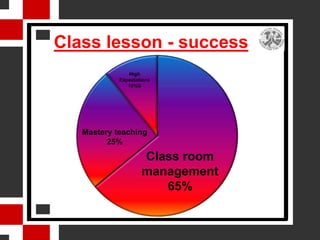
Class lesson - success
               High
            Expectations
               10%S


   Mastery teaching
         25%

                    Class room
                    management
                       65%
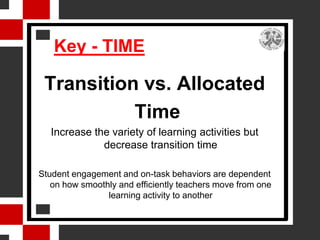
Key - TIME

 Transition vs. Allocated
           Time
   Increase the variety of learning activities but
              decrease transition time

Student engagement and on-task behaviors are dependent
   on how smoothly and efficiently teachers move from one
                learning activity to another
Understanding Our
       Students

Dealing With Student Behavior in
       Today’s Classrooms
•   One in six youths (age 10-17) has seen or knows someone who has
    been shot.
•   At least 160,000 students skip class each day because they fear
    physical harm.
•   More than 150,000 school age children bring a gun to school each
    school day.
•   70% of those arrested in hate crimes are under age 19.

             CHANGING FAMILY STYLE IN
                    PAKISTAN
•   In the last two decades, there has been a 200% growth in single
    parent households.
•   The number of moms leaving home for work each morning has risen
    65% in the past 20 years.
•   Nearly 1 in 4 children in Pakistan are living below the poverty level.
Teachers who are ready
   maximize student
 learning and minimize
  student misbehavior
       are called
 EFFECTIVE TEACHER
“Effective teachers MANAGE
their classrooms.
Ineffective teachers DISCIPLINE
their classrooms.”
PUNISHMENT
    VS.
 DISCIPLINE
Why Do We Punish?

– Because it works
   • Punishment is effective for
     approximately 95% of our students
– It’s quick
   • Punishment produces a rapid (but often
     temporary) suppression of behavior
– It requires lower level thinking skills.
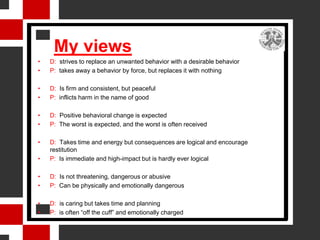
My views
•   D: strives to replace an unwanted behavior with a desirable behavior
•   P: takes away a behavior by force, but replaces it with nothing

•   D: Is firm and consistent, but peaceful
•   P: inflicts harm in the name of good

•   D: Positive behavioral change is expected
•   P: The worst is expected, and the worst is often received

•   D: Takes time and energy but consequences are logical and encourage
    restitution
•   P: Is immediate and high-impact but is hardly ever logical

•   D: Is not threatening, dangerous or abusive
•   P: Can be physically and emotionally dangerous

•   D: is caring but takes time and planning
•   P: is often “off the cuff” and emotionally charged
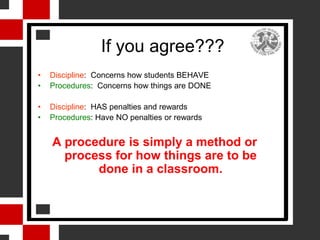
If you agree???
•   Discipline: Concerns how students BEHAVE
•   Procedures: Concerns how things are DONE

•   Discipline: HAS penalties and rewards
•   Procedures: Have NO penalties or rewards


    A procedure is simply a method or
      process for how things are to be
           done in a classroom.
Four Guiding
  Principles
      of
Classroom
Management
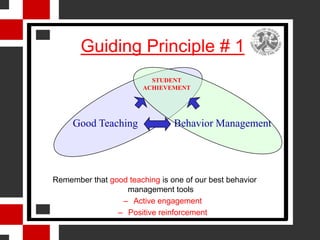
Guiding Principle # 1
                          STUDENT
                        ACHIEVEMENT


     Good Teaching              Behavior Management


Remember that good teaching is one of our best behavior
                  management tools
                 – Active engagement
                – Positive reinforcement
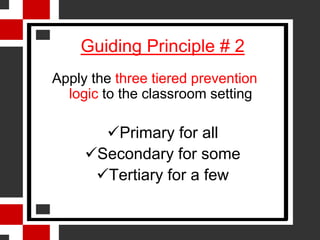
Guiding Principle # 2
Apply the three tiered prevention
  logic to the classroom setting

       Primary for all
     Secondary for some
      Tertiary for a few
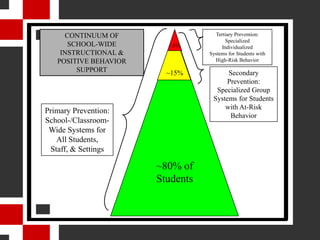
CONTINUUM OF                   Tertiary Prevention:
                                         Specialized
      SCHOOL-WIDE        ~5%           Individualized
    INSTRUCTIONAL &               Systems for Students with
   POSITIVE BEHAVIOR                High-Risk Behavior
        SUPPORT          ~15%           Secondary
                                       Prevention:
                                    Specialized Group
                                   Systems for Students
                                       with At-Risk
Primary Prevention:
                                        Behavior
School-/Classroom-
 Wide Systems for
   All Students,
 Staff, & Settings

                       ~80% of
                       Students
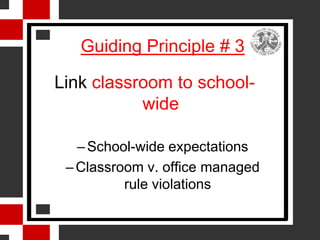
Guiding Principle # 3

Link classroom to school-
           wide

   – School-wide expectations
 – Classroom v. office managed
          rule violations
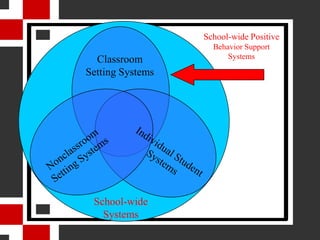
School-wide Positive
                    Behavior Support
  Classroom             Systems

Setting Systems


 School-wide
   Systems
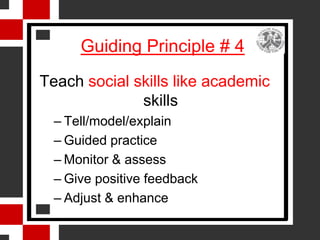
Guiding Principle # 4
Teach social skills like academic
              skills
  – Tell/model/explain
  – Guided practice
  – Monitor & assess
  – Give positive feedback
  – Adjust & enhance
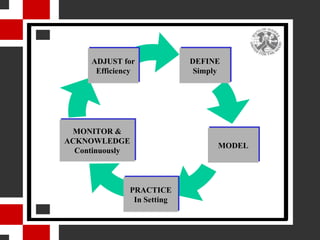
ADJUST for             DEFINE
      Efficiency             Simply


 MONITOR &
ACKNOWLEDGE
                                  MODEL
  Continuously


              PRACTICE
               In Setting
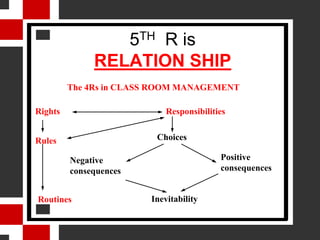
5TH R is
              RELATION SHIP
         The 4Rs in CLASS ROOM MANAGEMENT

Rights                      Responsibilities


Rules                    Choices

         Negative                         Positive
         consequences                     consequences


Routines                Inevitability
Reinforce Positive
      Behavior/
Redirect Inappropriate
      Behavior
OUTSIDE

Effective classroom
management begins
     _________
   the classroom
        door.
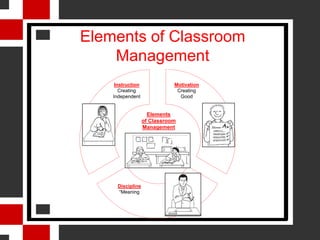
Elements of Classroom
    Management
     Instruction              Motivation
       Creating                Creating
    Independent                 Good


                     Elements
                   of Classroom
                   Management


      Discipline
      “Meaning
“There is absolutely no research correlation between
 success and family background, race, national origin,
financial status, or even educational accomplishments.
  There is but one correlation with success, and that is
                       ATTITUDE.”

                                       Harry K. Wong (2)
References
•Colvin, G., & Lazar, M. (1997). The effective elementary classroom: Managing for
success. Longmont, CO: Sopris West.
•Colvin, G., Sugai, G., & Patching, W. (1993). Pre-correction: An instructional strategy for
managing predictable behavior problems. Intervention in School and Clinic, 28, 143-150.
•Darch, C. B., & Kameenui, E. J. (2003). Instructional classroom management: A proactive
approach to behavior management. (2nd ed.). White Plains, NY: Longman.
•Jones, V. F. & Jones, L. S. (2001). Comprehensive classroom management: Creating
communities of support and solving problems (6th ed.). Boston: Allyn & Bacon.
•Kameenui, E. J., & Carnine, D. W. (2002). Effective teaching strategies that accommodate
diverse learners (2nd ed.). Upper Saddle River, NJ: Merrill.
•Latham, G. I. (1997). Behind the schoolhouse door: Eight skills every teacher should have.
Utah State University.
•Latham, G. (1992). Interacting with at-risk children: The positive position. Principal, 72(1),
26-30.
•Martella, R. C., Nelson, J. R., & Marchand-Martella, N. E. (2003). Managing disruptive
behaviors in the schools: A schoolwide, classroom, and individualized social learning
approach. Boston, MA: Allyn & Bacon.
•Paine, S. C., Radicchi, J., Rosellini, L. C., Deutchman, L., & Darch, C. B. (1983).
Structuring your classroom for academic success. Champaign, IL: Research Press
Thank you
Any queries…. PLZ