EDU555 CURRICULUM AND INSTRUCTION
CURRICULUM DEVELOPMENT DIVISION
(CDD)
PRESENTATION OVERVIEW
1. Roles and Function
2. National Education Philosophy
3. Curriculum Cycle
4. Curriculum Structure and Emphases
5. Curriculum Review – Moving Forward
VISION
QUALITY SCHOOL
CURRICULUM FOR WORLD
CLASS EDUCATION
OUR MISSION
To develop an integrated
school curriculum for the
holistic development of the
individuals’ full potential to fulfil
the aspirations of the nation.
AIMS
The development of the school
curriculum towards increasing
the quality of education in line
with the National Philosophy of
Education
ROLES AND FUNCTIONS OF THE CURRICULUM
DEVELOPMENT DIVISION (CDD)
1. Design and develop the school
curriculum
2. Disseminate and implement curriculum
3. Monitor curriculum implementation
4. Prepare curriculum support materials
5. Conduct research for the development
and evaluation of curriculum
THE NATIONAL EDUCATION
PHILOSOPHY
 Education in Malaysia is an ongoing effort towards further
developing the potential of individuals in a holistic and
integrated manner so as to produce Malaysian citizens who
are intellectually, spiritually, emotionally and physically
balanced and harmonious, based on a firm belief in and
devotion to God.
 Such an effort is designed to produce Malaysian citizens who
are knowledgeable and competent, who possess high moral
standards, and who are responsible and capable of achieving
a high level of personal well-being as well as being able to
contribute to the betterment of the family, the society and the
nation at large
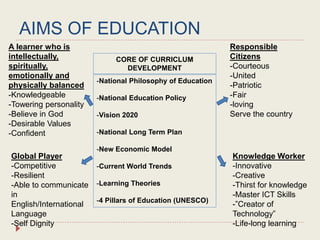
AIMS OF EDUCATION
CORE OF CURRICLUM
DEVELOPMENT
-National Philosophy of Education
-National Education Policy
-Vision 2020
-National Long Term Plan
-New Economic Model
-Current World Trends
-Learning Theories
-4 Pillars of Education (UNESCO)
A learner who is
intellectually,
spiritually,
emotionally and
physically balanced
-Knowledgeable
-Towering personality
-Believe in God
-Desirable Values
-Confident
Global Player
-Competitive
-Resilient
-Able to communicate
in
English/International
Language
-Self Dignity
Responsible
Citizens
-Courteous
-United
-Patriotic
-Fair
-loving
Serve the country
Knowledge Worker
-Innovative
-Creative
-Thirst for knowledge
-Master ICT Skills
-”Creator of
Technology”
-Life-long learning
THE NATIONAL CURICULUM IN THE 1996
EDUCATION ACT
“... an educational programme that includes
curriculum and co-curricular activities which
encompasses all the knowledge, skills, norms,
values, cultural elements and beliefs to help
develop a pupil fully with respect to the physical,
spiritual, mental and emotional desirable moral
values and to transmit knowledge”
Educational Act 1996
[Education (national Curriculum) Regulation 1997]
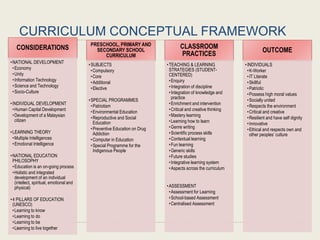
CURRICULUM CONCEPTUAL FRAMEWORK
CONSIDERATIONS
•NATIONAL DEVELOPMENT
•Economy
•Unity
•Information Technology
•Science and Technology
•Socio-Culture
•INDIVIDUAL DEVELOPMENT
•Human Capital Development
•Development of a Malaysian
citizen
•LEARNING THEORY
•Multiple Intelligences
•Emotional Intelligence
•NATIONAL EDUCATION
PHILOSOPHY
•Education is an on-going process
•Holistic and integrated
development of an individual
(intellect, spiritual, emotional and
physical)
•4 PILLARS OF EDUCATION
(UNESCO)
•Learning to know
•Learning to do
•Learning to be
•Learning to live together
PRESCHOOL, PRIMARY AND
SECONDARY SCHOOL
CURRICULUM
•SUBJECTS
•Compulsory
•Core
•Additional
•Elective
•SPECIAL PROGRAMMES
•Patriotism
•Environmental Education
•Reproductive and Social
Education
•Preventive Education on Drug
Addiction
•Computer in Education
•Special Programme for the
Indigenous People
CLASSROOM
PRACTICES
•TEACHING & LEARNING
STRATEGIES (STUDENT-
CENTERED)
•Enquiry
•Integration of discipline
•Integration of knowledge and
practice
•Enrichment and intervention
•Critical and creative thinking
•Mastery learning
•Learning how to learn
•Genre writing
•Scientific process skills
•Contextual learning
•Fun learning
•Generic skills
•Future studies
•Integrative learning system
•Aspects across the curriculum
•ASSESSMENT
•Assessment for Learning
•School-based Assessment
•Centralised Assessment
OUTCOME
•INDIVIDUALS
•K-Worker
•IT Literate
•Skillful
•Patriotic
•Possess high moral values
•Socially united
•Respects the environment
•Critical and creative
•Resilient and have self dignity
•Innovative
•Ethical and respects own and
other peoples’ culture
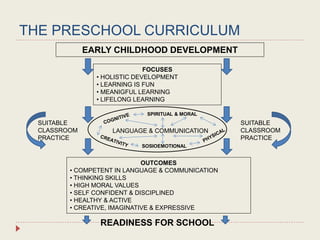
THE PRESCHOOL CURRICULUM
EARLY CHILDHOOD DEVELOPMENT
FOCUSES
• HOLISTIC DEVELOPMENT
• LEARNING IS FUN
• MEANIGFUL LEARNING
• LIFELONG LEARNING
OUTCOMES
• COMPETENT IN LANGUAGE & COMMUNICATION
• THINKING SKILLS
• HIGH MORAL VALUES
• SELF CONFIDENT & DISCIPLINED
• HEALTHY & ACTIVE
• CREATIVE, IMAGINATIVE & EXPRESSIVE
SPIRITUAL & MORAL
SOSIOEMOTIONAL
LANGUAGE & COMMUNICATION
READINESS FOR SCHOOL
SUITABLE
CLASSROOM
PRACTICE
SUITABLE
CLASSROOM
PRACTICE
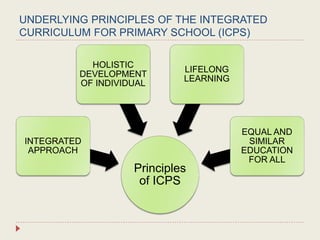
UNDERLYING PRINCIPLES OF THE INTEGRATED
CURRICULUM FOR PRIMARY SCHOOL (ICPS)
Principles
of ICPS
INTEGRATED
APPROACH
HOLISTIC
DEVELOPMENT
OF INDIVIDUAL
LIFELONG
LEARNING
EQUAL AND
SIMILAR
EDUCATION
FOR ALL
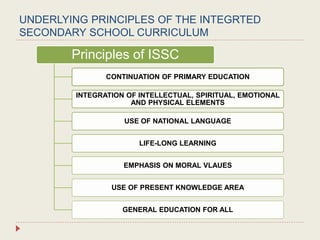
UNDERLYING PRINCIPLES OF THE INTEGRTED
SECONDARY SCHOOL CURRICULUM
Principles of ISSC
CONTINUATION OF PRIMARY EDUCATION
INTEGRATION OF INTELLECTUAL, SPIRITUAL, EMOTIONAL
AND PHYSICAL ELEMENTS
USE OF NATIONAL LANGUAGE
LIFE-LONG LEARNING
EMPHASIS ON MORAL VLAUES
USE OF PRESENT KNOWLEDGE AREA
GENERAL EDUCATION FOR ALL
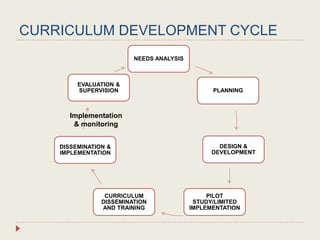
CURRICULUM DEVELOPMENT CYCLE
NEEDS ANALYSIS
PLANNING
DESIGN &
DEVELOPMENT
PILOT
STUDY/LIMITED
IMPLEMENTATION
CURRICULUM
DISSEMINATION
AND TRAINING
DISSEMINATION &
IMPLEMENTATION
EVALUATION &
SUPERVISION
Implementation
& monitoring
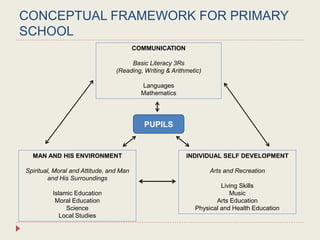
CONCEPTUAL FRAMEWORK FOR PRIMARY
SCHOOL
COMMUNICATION
Basic Literacy 3Rs
(Reading, Writing & Arithmetic)
Languages
Mathematics
MAN AND HIS ENVIRONMENT
Spiritual, Moral and Attitude, and Man
and His Surroundings
Islamic Education
Moral Education
Science
Local Studies
INDIVIDUAL SELF DEVELOPMENT
Arts and Recreation
Living Skills
Music
Arts Education
Physical and Health Education
PUPILS
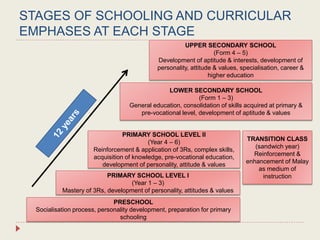
STAGES OF SCHOOLING AND CURRICULAR
EMPHASES AT EACH STAGE
UPPER SECONDARY SCHOOL
(Form 4 – 5)
Development of aptitude & interests, development of
personality, attitude & values, specialisation, career &
higher education
LOWER SECONDARY SCHOOL
(Form 1 – 3)
General education, consolidation of skills acquired at primary &
pre-vocational level, development of aptitude & values
PRIMARY SCHOOL LEVEL II
(Year 4 – 6)
Reinforcement & application of 3Rs, complex skills,
acquisition of knowledge, pre-vocational education,
development of personality, attitude & values
PRIMARY SCHOOL LEVEL I
(Year 1 – 3)
Mastery of 3Rs, development of personality, attitudes & values
PRESCHOOL
Socialisation process, personality development, preparation for primary
schooling
TRANSITION CLASS
(sandwich year)
Reinforcement &
enhancement of Malay
as medium of
instruction
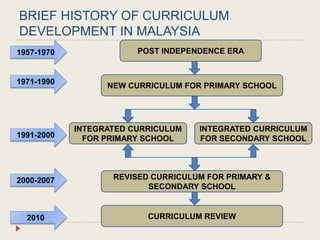
BRIEF HISTORY OF CURRICULUM
DEVELOPMENT IN MALAYSIA
POST INDEPENDENCE ERA
NEW CURRICULUM FOR PRIMARY SCHOOL
INTEGRATED CURRICULUM
FOR PRIMARY SCHOOL
INTEGRATED CURRICULUM
FOR SECONDARY SCHOOL
REVISED CURRICULUM FOR PRIMARY &
SECONDARY SCHOOL
CURRICULUM REVIEW
1957-1970
1971-1990
1991-2000
2000-2007
2010
SUBJECTS OFFERED AND DEVELOPED BY
THE CURRICULUM DEVELOPMENT DIVISION
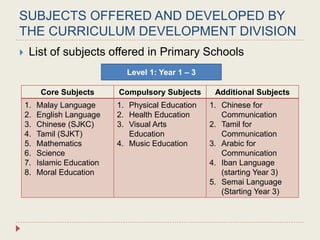
 List of subjects offered in Primary Schools
Level 1: Year 1 – 3
Core Subjects Compulsory Subjects Additional Subjects
1. Malay Language
2. English Language
3. Chinese (SJKC)
4. Tamil (SJKT)
5. Mathematics
6. Science
7. Islamic Education
8. Moral Education
1. Physical Education
2. Health Education
3. Visual Arts
Education
4. Music Education
1. Chinese for
Communication
2. Tamil for
Communication
3. Arabic for
Communication
4. Iban Language
(starting Year 3)
5. Semai Language
(Starting Year 3)
SUBJECTS OFFERED AND DEVELOPED BY
THE CURRICULUM DEVELOPMENT DIVISION
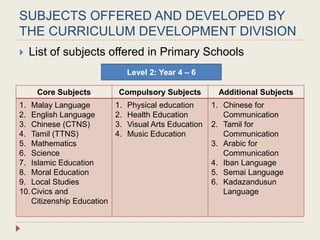
 List of subjects offered in Primary Schools
Level 2: Year 4 – 6
Core Subjects Compulsory Subjects Additional Subjects
1. Malay Language
2. English Language
3. Chinese (CTNS)
4. Tamil (TTNS)
5. Mathematics
6. Science
7. Islamic Education
8. Moral Education
9. Local Studies
10.Civics and
Citizenship Education
1. Physical education
2. Health Education
3. Visual Arts Education
4. Music Education
1. Chinese for
Communication
2. Tamil for
Communication
3. Arabic for
Communication
4. Iban Language
5. Semai Language
6. Kadazandusun
Language
SUBJECTS OFFERED AND DEVELOPED BY
THE CURRICULUM DEVELOPMENT DIVISION
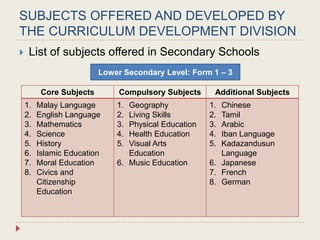
 List of subjects offered in Secondary Schools
Level 1: Year
Core Subjects Compulsory Subjects Additional Subjects
1. Malay Language
2. English Language
3. Mathematics
4. Science
5. History
6. Islamic Education
7. Moral Education
8. Civics and
Citizenship
Education
1. Geography
2. Living Skills
3. Physical Education
4. Health Education
5. Visual Arts
Education
6. Music Education
1. Chinese
2. Tamil
3. Arabic
4. Iban Language
5. Kadazandusun
Language
6. Japanese
7. French
8. German
Lower Secondary Level: Form 1 – 3
SUBJECTS OFFERED AND DEVELOPED BY
THE CURRICULUM DEVELOPMENT DIVISION
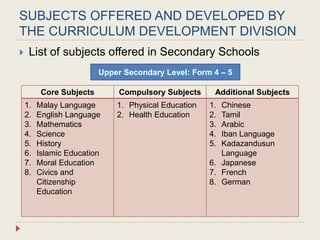
 List of subjects offered in Secondary Schools
Level 1: Year
Core Subjects Compulsory Subjects Additional Subjects
1. Malay Language
2. English Language
3. Mathematics
4. Science
5. History
6. Islamic Education
7. Moral Education
8. Civics and
Citizenship
Education
1. Physical Education
2. Health Education
1. Chinese
2. Tamil
3. Arabic
4. Iban Language
5. Kadazandusun
Language
6. Japanese
7. French
8. German
Upper Secondary Level: Form 4 – 5
SUBJECTS OFFERED AND DEVELOPED BY
THE CURRICULUM DEVELOPMENT DIVISION
 List of subjects offered in Secondary Schools
Level 1: Year
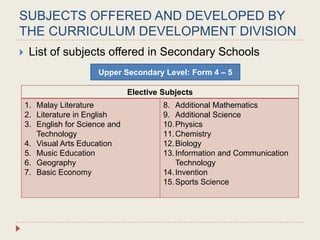
Elective Subjects
1. Malay Literature
2. Literature in English
3. English for Science and
Technology
4. Visual Arts Education
5. Music Education
6. Geography
7. Basic Economy
8. Additional Mathematics
9. Additional Science
10.Physics
11.Chemistry
12.Biology
13.Information and Communication
Technology
14.Invention
15.Sports Science
Upper Secondary Level: Form 4 – 5
SUBJECTS OFFERED AND DEVELOPED BY
THE CURRICULUM DEVELOPMENT DIVISION
 List of subjects offered in Secondary Schools
Level 1: Year
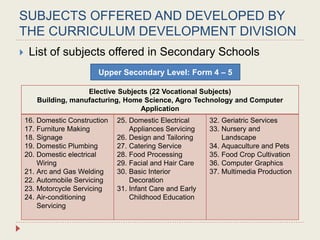
Elective Subjects (22 Vocational Subjects)
Building, manufacturing, Home Science, Agro Technology and Computer
Application
16. Domestic Construction
17. Furniture Making
18. Signage
19. Domestic Plumbing
20. Domestic electrical
Wiring
21. Arc and Gas Welding
22. Automobile Servicing
23. Motorcycle Servicing
24. Air-conditioning
Servicing
25. Domestic Electrical
Appliances Servicing
26. Design and Tailoring
27. Catering Service
28. Food Processing
29. Facial and Hair Care
30. Basic Interior
Decoration
31. Infant Care and Early
Childhood Education
32. Geriatric Services
33. Nursery and
Landscape
34. Aquaculture and Pets
35. Food Crop Cultivation
36. Computer Graphics
37. Multimedia Production
Upper Secondary Level: Form 4 – 5
SUBJECTS OFFERED AND DEVELOPED BY
THE CURRICULUM DEVELOPMENT DIVISION
 List of subjects offered in Secondary Schools
Level 1: Year
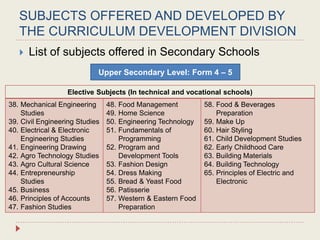
Elective Subjects (In technical and vocational schools)
38. Mechanical Engineering
Studies
39. Civil Engineering Studies
40. Electrical & Electronic
Engineering Studies
41. Engineering Drawing
42. Agro Technology Studies
43. Agro Cultural Science
44. Entrepreneurship
Studies
45. Business
46. Principles of Accounts
47. Fashion Studies
48. Food Management
49. Home Science
50. Engineering Technology
51. Fundamentals of
Programming
52. Program and
Development Tools
53. Fashion Design
54. Dress Making
55. Bread & Yeast Food
56. Patisserie
57. Western & Eastern Food
Preparation
58. Food & Beverages
Preparation
59. Make Up
60. Hair Styling
61. Child Development Studies
62. Early Childhood Care
63. Building Materials
64. Building Technology
65. Principles of Electric and
Electronic
Upper Secondary Level: Form 4 – 5
SUBJECTS OFFERED AND DEVELOPED BY
THE CURRICULUM DEVELOPMENT DIVISION
 List of subjects offered in Secondary Schools
Level 1: Year
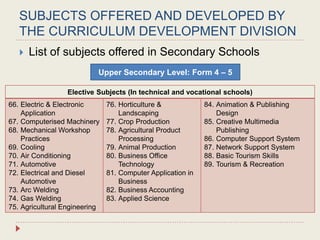
Elective Subjects (In technical and vocational schools)
66. Electric & Electronic
Application
67. Computerised Machinery
68. Mechanical Workshop
Practices
69. Cooling
70. Air Conditioning
71. Automotive
72. Electrical and Diesel
Automotive
73. Arc Welding
74. Gas Welding
75. Agricultural Engineering
76. Horticulture &
Landscaping
77. Crop Production
78. Agricultural Product
Processing
79. Animal Production
80. Business Office
Technology
81. Computer Application in
Business
82. Business Accounting
83. Applied Science
84. Animation & Publishing
Design
85. Creative Multimedia
Publishing
86. Computer Support System
87. Network Support System
88. Basic Tourism Skills
89. Tourism & Recreation
Upper Secondary Level: Form 4 – 5
SUBJECTS OFFERED AND DEVELOPED BY
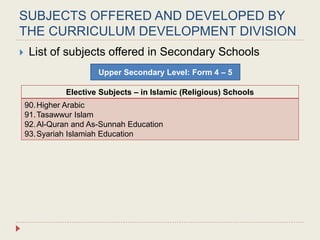
THE CURRICULUM DEVELOPMENT DIVISION
 List of subjects offered in Secondary Schools
Upper Secondary Level: Form 4 – 5
Elective Subjects – in Islamic (Religious) Schools
90.Higher Arabic
91.Tasawwur Islam
92.Al-Quran and As-Sunnah Education
93.Syariah Islamiah Education
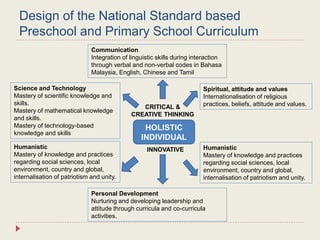
Design of the National Standard based
Preschool and Primary School Curriculum
Communication
Integration of linguistic skills during interaction
through verbal and non-verbal codes in Bahasa
Malaysia, English, Chinese and Tamil
Spiritual, attitude and values
Internationalisation of religious
practices, beliefs, attitude and values.
Humanistic
Mastery of knowledge and practices
regarding social sciences, local
environment, country and global,
internalisation of patriotism and unity.
Science and Technology
Mastery of scientific knowledge and
skills.
Mastery of mathematical knowledge
and skills.
Mastery of technology-based
knowledge and skills
Humanistic
Mastery of knowledge and practices
regarding social sciences, local
environment, country and global,
internalisation of patriotism and unity.
Personal Development
Nurturing and developing leadership and
attitude through curricula and co-curricula
activities.
HOLISTIC
INDIVIDUAL
CRITICAL &
CREATIVE THINKING
INNOVATIVE
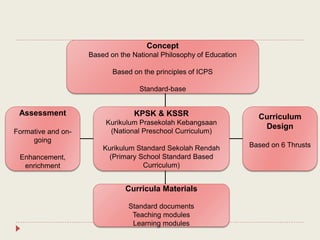
Concept
Based on the National Philosophy of Education
Based on the principles of ICPS
Standard-base
KPSK & KSSR
Kurikulum Prasekolah Kebangsaan
(National Preschool Curriculum)
Kurikulum Standard Sekolah Rendah
(Primary School Standard Based
Curriculum)
Curricula Materials
Standard documents
Teaching modules
Learning modules
Assessment
Formative and on-
going
Enhancement,
enrichment
Curriculum
Design
Based on 6 Thrusts
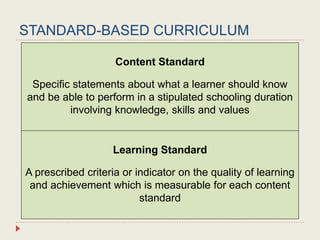
STANDARD-BASED CURRICULUM
Content Standard
Specific statements about what a learner should know
and be able to perform in a stipulated schooling duration
involving knowledge, skills and values
Learning Standard
A prescribed criteria or indicator on the quality of learning
and achievement which is measurable for each content
standard
Enhance the Malay language and Strengthen English
1 October 2009
MBMMBI
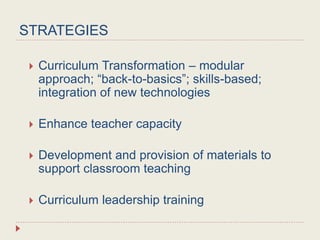
STRATEGIES
 Curriculum Transformation – modular
approach; “back-to-basics”; skills-based;
integration of new technologies
 Enhance teacher capacity
 Development and provision of materials to
support classroom teaching
 Curriculum leadership training
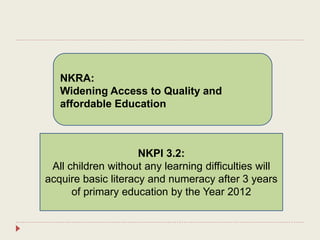
NKRA:
Widening Access to Quality and
affordable Education
NKPI 3.2:
All children without any learning difficulties will
acquire basic literacy and numeracy after 3 years
of primary education by the Year 2012
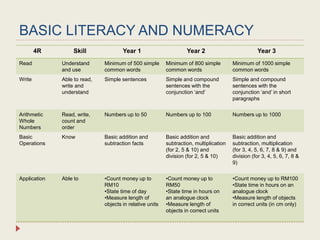
BASIC LITERACY AND NUMERACY
4R Skill Year 1 Year 2 Year 3
Read Understand
and use
Minimum of 500 simple
common words
Minimum of 800 simple
common words
Minimum of 1000 simple
common words
Write Able to read,
write and
understand
Simple sentences Simple and compound
sentences with the
conjunction ‘and’
Simple and compound
sentences with the
conjunction ‘and’ in short
paragraphs
Arithmetic
Whole
Numbers
Read, write,
count and
order
Numbers up to 50 Numbers up to 100 Numbers up to 1000
Basic
Operations
Know Basic addition and
subtraction facts
Basic addition and
subtraction, multiplication
(for 2, 5 & 10) and
division (for 2, 5 & 10)
Basic addition and
subtraction, multiplication
(for 3, 4, 5, 6, 7, 8 & 9) and
division (for 3, 4, 5, 6, 7, 8 &
9)
Application Able to •Count money up to
RM10
•State time of day
•Measure length of
objects in relative units
•Count money up to
RM50
•State time in hours on
an analogue clock
•Measure length of
objects in correct units
•Count money up to RM100
•State time in hours on an
analogue clock
•Measure length of objects
in correct units (in cm only)
THANK YOU

Curriculum development division, moe.pdf 5

  • 1.
    EDU555 CURRICULUM ANDINSTRUCTION CURRICULUM DEVELOPMENT DIVISION (CDD)
  • 2.
    PRESENTATION OVERVIEW 1. Rolesand Function 2. National Education Philosophy 3. Curriculum Cycle 4. Curriculum Structure and Emphases 5. Curriculum Review – Moving Forward
  • 3.
  • 4.
    OUR MISSION To developan integrated school curriculum for the holistic development of the individuals’ full potential to fulfil the aspirations of the nation.
  • 5.
    AIMS The development ofthe school curriculum towards increasing the quality of education in line with the National Philosophy of Education
  • 6.
    ROLES AND FUNCTIONSOF THE CURRICULUM DEVELOPMENT DIVISION (CDD) 1. Design and develop the school curriculum 2. Disseminate and implement curriculum 3. Monitor curriculum implementation 4. Prepare curriculum support materials 5. Conduct research for the development and evaluation of curriculum
  • 7.
    THE NATIONAL EDUCATION PHILOSOPHY Education in Malaysia is an ongoing effort towards further developing the potential of individuals in a holistic and integrated manner so as to produce Malaysian citizens who are intellectually, spiritually, emotionally and physically balanced and harmonious, based on a firm belief in and devotion to God.  Such an effort is designed to produce Malaysian citizens who are knowledgeable and competent, who possess high moral standards, and who are responsible and capable of achieving a high level of personal well-being as well as being able to contribute to the betterment of the family, the society and the nation at large
  • 8.
    AIMS OF EDUCATION COREOF CURRICLUM DEVELOPMENT -National Philosophy of Education -National Education Policy -Vision 2020 -National Long Term Plan -New Economic Model -Current World Trends -Learning Theories -4 Pillars of Education (UNESCO) A learner who is intellectually, spiritually, emotionally and physically balanced -Knowledgeable -Towering personality -Believe in God -Desirable Values -Confident Global Player -Competitive -Resilient -Able to communicate in English/International Language -Self Dignity Responsible Citizens -Courteous -United -Patriotic -Fair -loving Serve the country Knowledge Worker -Innovative -Creative -Thirst for knowledge -Master ICT Skills -”Creator of Technology” -Life-long learning
  • 9.
    THE NATIONAL CURICULUMIN THE 1996 EDUCATION ACT “... an educational programme that includes curriculum and co-curricular activities which encompasses all the knowledge, skills, norms, values, cultural elements and beliefs to help develop a pupil fully with respect to the physical, spiritual, mental and emotional desirable moral values and to transmit knowledge” Educational Act 1996 [Education (national Curriculum) Regulation 1997]
  • 10.
    CURRICULUM CONCEPTUAL FRAMEWORK CONSIDERATIONS •NATIONALDEVELOPMENT •Economy •Unity •Information Technology •Science and Technology •Socio-Culture •INDIVIDUAL DEVELOPMENT •Human Capital Development •Development of a Malaysian citizen •LEARNING THEORY •Multiple Intelligences •Emotional Intelligence •NATIONAL EDUCATION PHILOSOPHY •Education is an on-going process •Holistic and integrated development of an individual (intellect, spiritual, emotional and physical) •4 PILLARS OF EDUCATION (UNESCO) •Learning to know •Learning to do •Learning to be •Learning to live together PRESCHOOL, PRIMARY AND SECONDARY SCHOOL CURRICULUM •SUBJECTS •Compulsory •Core •Additional •Elective •SPECIAL PROGRAMMES •Patriotism •Environmental Education •Reproductive and Social Education •Preventive Education on Drug Addiction •Computer in Education •Special Programme for the Indigenous People CLASSROOM PRACTICES •TEACHING & LEARNING STRATEGIES (STUDENT- CENTERED) •Enquiry •Integration of discipline •Integration of knowledge and practice •Enrichment and intervention •Critical and creative thinking •Mastery learning •Learning how to learn •Genre writing •Scientific process skills •Contextual learning •Fun learning •Generic skills •Future studies •Integrative learning system •Aspects across the curriculum •ASSESSMENT •Assessment for Learning •School-based Assessment •Centralised Assessment OUTCOME •INDIVIDUALS •K-Worker •IT Literate •Skillful •Patriotic •Possess high moral values •Socially united •Respects the environment •Critical and creative •Resilient and have self dignity •Innovative •Ethical and respects own and other peoples’ culture
  • 11.
    THE PRESCHOOL CURRICULUM EARLYCHILDHOOD DEVELOPMENT FOCUSES • HOLISTIC DEVELOPMENT • LEARNING IS FUN • MEANIGFUL LEARNING • LIFELONG LEARNING OUTCOMES • COMPETENT IN LANGUAGE & COMMUNICATION • THINKING SKILLS • HIGH MORAL VALUES • SELF CONFIDENT & DISCIPLINED • HEALTHY & ACTIVE • CREATIVE, IMAGINATIVE & EXPRESSIVE SPIRITUAL & MORAL SOSIOEMOTIONAL LANGUAGE & COMMUNICATION READINESS FOR SCHOOL SUITABLE CLASSROOM PRACTICE SUITABLE CLASSROOM PRACTICE
  • 12.
    UNDERLYING PRINCIPLES OFTHE INTEGRATED CURRICULUM FOR PRIMARY SCHOOL (ICPS) Principles of ICPS INTEGRATED APPROACH HOLISTIC DEVELOPMENT OF INDIVIDUAL LIFELONG LEARNING EQUAL AND SIMILAR EDUCATION FOR ALL
  • 13.
    UNDERLYING PRINCIPLES OFTHE INTEGRTED SECONDARY SCHOOL CURRICULUM Principles of ISSC CONTINUATION OF PRIMARY EDUCATION INTEGRATION OF INTELLECTUAL, SPIRITUAL, EMOTIONAL AND PHYSICAL ELEMENTS USE OF NATIONAL LANGUAGE LIFE-LONG LEARNING EMPHASIS ON MORAL VLAUES USE OF PRESENT KNOWLEDGE AREA GENERAL EDUCATION FOR ALL
  • 14.
    CURRICULUM DEVELOPMENT CYCLE NEEDSANALYSIS PLANNING DESIGN & DEVELOPMENT PILOT STUDY/LIMITED IMPLEMENTATION CURRICULUM DISSEMINATION AND TRAINING DISSEMINATION & IMPLEMENTATION EVALUATION & SUPERVISION Implementation & monitoring
  • 15.
    CONCEPTUAL FRAMEWORK FORPRIMARY SCHOOL COMMUNICATION Basic Literacy 3Rs (Reading, Writing & Arithmetic) Languages Mathematics MAN AND HIS ENVIRONMENT Spiritual, Moral and Attitude, and Man and His Surroundings Islamic Education Moral Education Science Local Studies INDIVIDUAL SELF DEVELOPMENT Arts and Recreation Living Skills Music Arts Education Physical and Health Education PUPILS
  • 16.
    STAGES OF SCHOOLINGAND CURRICULAR EMPHASES AT EACH STAGE UPPER SECONDARY SCHOOL (Form 4 – 5) Development of aptitude & interests, development of personality, attitude & values, specialisation, career & higher education LOWER SECONDARY SCHOOL (Form 1 – 3) General education, consolidation of skills acquired at primary & pre-vocational level, development of aptitude & values PRIMARY SCHOOL LEVEL II (Year 4 – 6) Reinforcement & application of 3Rs, complex skills, acquisition of knowledge, pre-vocational education, development of personality, attitude & values PRIMARY SCHOOL LEVEL I (Year 1 – 3) Mastery of 3Rs, development of personality, attitudes & values PRESCHOOL Socialisation process, personality development, preparation for primary schooling TRANSITION CLASS (sandwich year) Reinforcement & enhancement of Malay as medium of instruction
  • 17.
    BRIEF HISTORY OFCURRICULUM DEVELOPMENT IN MALAYSIA POST INDEPENDENCE ERA NEW CURRICULUM FOR PRIMARY SCHOOL INTEGRATED CURRICULUM FOR PRIMARY SCHOOL INTEGRATED CURRICULUM FOR SECONDARY SCHOOL REVISED CURRICULUM FOR PRIMARY & SECONDARY SCHOOL CURRICULUM REVIEW 1957-1970 1971-1990 1991-2000 2000-2007 2010
  • 18.
    SUBJECTS OFFERED ANDDEVELOPED BY THE CURRICULUM DEVELOPMENT DIVISION  List of subjects offered in Primary Schools Level 1: Year 1 – 3 Core Subjects Compulsory Subjects Additional Subjects 1. Malay Language 2. English Language 3. Chinese (SJKC) 4. Tamil (SJKT) 5. Mathematics 6. Science 7. Islamic Education 8. Moral Education 1. Physical Education 2. Health Education 3. Visual Arts Education 4. Music Education 1. Chinese for Communication 2. Tamil for Communication 3. Arabic for Communication 4. Iban Language (starting Year 3) 5. Semai Language (Starting Year 3)
  • 19.
    SUBJECTS OFFERED ANDDEVELOPED BY THE CURRICULUM DEVELOPMENT DIVISION  List of subjects offered in Primary Schools Level 2: Year 4 – 6 Core Subjects Compulsory Subjects Additional Subjects 1. Malay Language 2. English Language 3. Chinese (CTNS) 4. Tamil (TTNS) 5. Mathematics 6. Science 7. Islamic Education 8. Moral Education 9. Local Studies 10.Civics and Citizenship Education 1. Physical education 2. Health Education 3. Visual Arts Education 4. Music Education 1. Chinese for Communication 2. Tamil for Communication 3. Arabic for Communication 4. Iban Language 5. Semai Language 6. Kadazandusun Language
  • 20.
    SUBJECTS OFFERED ANDDEVELOPED BY THE CURRICULUM DEVELOPMENT DIVISION  List of subjects offered in Secondary Schools Level 1: Year Core Subjects Compulsory Subjects Additional Subjects 1. Malay Language 2. English Language 3. Mathematics 4. Science 5. History 6. Islamic Education 7. Moral Education 8. Civics and Citizenship Education 1. Geography 2. Living Skills 3. Physical Education 4. Health Education 5. Visual Arts Education 6. Music Education 1. Chinese 2. Tamil 3. Arabic 4. Iban Language 5. Kadazandusun Language 6. Japanese 7. French 8. German Lower Secondary Level: Form 1 – 3
  • 21.
    SUBJECTS OFFERED ANDDEVELOPED BY THE CURRICULUM DEVELOPMENT DIVISION  List of subjects offered in Secondary Schools Level 1: Year Core Subjects Compulsory Subjects Additional Subjects 1. Malay Language 2. English Language 3. Mathematics 4. Science 5. History 6. Islamic Education 7. Moral Education 8. Civics and Citizenship Education 1. Physical Education 2. Health Education 1. Chinese 2. Tamil 3. Arabic 4. Iban Language 5. Kadazandusun Language 6. Japanese 7. French 8. German Upper Secondary Level: Form 4 – 5
  • 22.
    SUBJECTS OFFERED ANDDEVELOPED BY THE CURRICULUM DEVELOPMENT DIVISION  List of subjects offered in Secondary Schools Level 1: Year Elective Subjects 1. Malay Literature 2. Literature in English 3. English for Science and Technology 4. Visual Arts Education 5. Music Education 6. Geography 7. Basic Economy 8. Additional Mathematics 9. Additional Science 10.Physics 11.Chemistry 12.Biology 13.Information and Communication Technology 14.Invention 15.Sports Science Upper Secondary Level: Form 4 – 5
  • 23.
    SUBJECTS OFFERED ANDDEVELOPED BY THE CURRICULUM DEVELOPMENT DIVISION  List of subjects offered in Secondary Schools Level 1: Year Elective Subjects (22 Vocational Subjects) Building, manufacturing, Home Science, Agro Technology and Computer Application 16. Domestic Construction 17. Furniture Making 18. Signage 19. Domestic Plumbing 20. Domestic electrical Wiring 21. Arc and Gas Welding 22. Automobile Servicing 23. Motorcycle Servicing 24. Air-conditioning Servicing 25. Domestic Electrical Appliances Servicing 26. Design and Tailoring 27. Catering Service 28. Food Processing 29. Facial and Hair Care 30. Basic Interior Decoration 31. Infant Care and Early Childhood Education 32. Geriatric Services 33. Nursery and Landscape 34. Aquaculture and Pets 35. Food Crop Cultivation 36. Computer Graphics 37. Multimedia Production Upper Secondary Level: Form 4 – 5
  • 24.
    SUBJECTS OFFERED ANDDEVELOPED BY THE CURRICULUM DEVELOPMENT DIVISION  List of subjects offered in Secondary Schools Level 1: Year Elective Subjects (In technical and vocational schools) 38. Mechanical Engineering Studies 39. Civil Engineering Studies 40. Electrical & Electronic Engineering Studies 41. Engineering Drawing 42. Agro Technology Studies 43. Agro Cultural Science 44. Entrepreneurship Studies 45. Business 46. Principles of Accounts 47. Fashion Studies 48. Food Management 49. Home Science 50. Engineering Technology 51. Fundamentals of Programming 52. Program and Development Tools 53. Fashion Design 54. Dress Making 55. Bread & Yeast Food 56. Patisserie 57. Western & Eastern Food Preparation 58. Food & Beverages Preparation 59. Make Up 60. Hair Styling 61. Child Development Studies 62. Early Childhood Care 63. Building Materials 64. Building Technology 65. Principles of Electric and Electronic Upper Secondary Level: Form 4 – 5
  • 25.
    SUBJECTS OFFERED ANDDEVELOPED BY THE CURRICULUM DEVELOPMENT DIVISION  List of subjects offered in Secondary Schools Level 1: Year Elective Subjects (In technical and vocational schools) 66. Electric & Electronic Application 67. Computerised Machinery 68. Mechanical Workshop Practices 69. Cooling 70. Air Conditioning 71. Automotive 72. Electrical and Diesel Automotive 73. Arc Welding 74. Gas Welding 75. Agricultural Engineering 76. Horticulture & Landscaping 77. Crop Production 78. Agricultural Product Processing 79. Animal Production 80. Business Office Technology 81. Computer Application in Business 82. Business Accounting 83. Applied Science 84. Animation & Publishing Design 85. Creative Multimedia Publishing 86. Computer Support System 87. Network Support System 88. Basic Tourism Skills 89. Tourism & Recreation Upper Secondary Level: Form 4 – 5
  • 26.
    SUBJECTS OFFERED ANDDEVELOPED BY THE CURRICULUM DEVELOPMENT DIVISION  List of subjects offered in Secondary Schools Upper Secondary Level: Form 4 – 5 Elective Subjects – in Islamic (Religious) Schools 90.Higher Arabic 91.Tasawwur Islam 92.Al-Quran and As-Sunnah Education 93.Syariah Islamiah Education
  • 27.
    Design of theNational Standard based Preschool and Primary School Curriculum Communication Integration of linguistic skills during interaction through verbal and non-verbal codes in Bahasa Malaysia, English, Chinese and Tamil Spiritual, attitude and values Internationalisation of religious practices, beliefs, attitude and values. Humanistic Mastery of knowledge and practices regarding social sciences, local environment, country and global, internalisation of patriotism and unity. Science and Technology Mastery of scientific knowledge and skills. Mastery of mathematical knowledge and skills. Mastery of technology-based knowledge and skills Humanistic Mastery of knowledge and practices regarding social sciences, local environment, country and global, internalisation of patriotism and unity. Personal Development Nurturing and developing leadership and attitude through curricula and co-curricula activities. HOLISTIC INDIVIDUAL CRITICAL & CREATIVE THINKING INNOVATIVE
  • 28.
    Concept Based on theNational Philosophy of Education Based on the principles of ICPS Standard-base KPSK & KSSR Kurikulum Prasekolah Kebangsaan (National Preschool Curriculum) Kurikulum Standard Sekolah Rendah (Primary School Standard Based Curriculum) Curricula Materials Standard documents Teaching modules Learning modules Assessment Formative and on- going Enhancement, enrichment Curriculum Design Based on 6 Thrusts
  • 29.
    STANDARD-BASED CURRICULUM Content Standard Specificstatements about what a learner should know and be able to perform in a stipulated schooling duration involving knowledge, skills and values Learning Standard A prescribed criteria or indicator on the quality of learning and achievement which is measurable for each content standard
  • 30.
    Enhance the Malaylanguage and Strengthen English 1 October 2009 MBMMBI
  • 31.
    STRATEGIES  Curriculum Transformation– modular approach; “back-to-basics”; skills-based; integration of new technologies  Enhance teacher capacity  Development and provision of materials to support classroom teaching  Curriculum leadership training
  • 32.
    NKRA: Widening Access toQuality and affordable Education NKPI 3.2: All children without any learning difficulties will acquire basic literacy and numeracy after 3 years of primary education by the Year 2012
  • 33.
    BASIC LITERACY ANDNUMERACY 4R Skill Year 1 Year 2 Year 3 Read Understand and use Minimum of 500 simple common words Minimum of 800 simple common words Minimum of 1000 simple common words Write Able to read, write and understand Simple sentences Simple and compound sentences with the conjunction ‘and’ Simple and compound sentences with the conjunction ‘and’ in short paragraphs Arithmetic Whole Numbers Read, write, count and order Numbers up to 50 Numbers up to 100 Numbers up to 1000 Basic Operations Know Basic addition and subtraction facts Basic addition and subtraction, multiplication (for 2, 5 & 10) and division (for 2, 5 & 10) Basic addition and subtraction, multiplication (for 3, 4, 5, 6, 7, 8 & 9) and division (for 3, 4, 5, 6, 7, 8 & 9) Application Able to •Count money up to RM10 •State time of day •Measure length of objects in relative units •Count money up to RM50 •State time in hours on an analogue clock •Measure length of objects in correct units •Count money up to RM100 •State time in hours on an analogue clock •Measure length of objects in correct units (in cm only)
  • 34.