BLOOMS TAXONOMY
What is it and how
prepare it.
Objectives :
 By the end of sesssion idions will be able to over the
systemic approach .
 Define the bloom’s taxonomy .
 Learning the domains of bloom ‘s taxonomy .
 Explain The levels of thinking .
 Bloom’s Taxonomy and Research.
 Sources .
 "Instruction is effective to the
degree that it succeeds in
changing students in desired
directions and not in undesired
directions."
 Robert F. Mager
Definition of Behavioral
Objectives
 "Intended change brought about in a learner."
(Popham, et. al. 1969)
 "A statement of what students ought to be able to do
as a consequence of instruction." (Goodlad, in Popham
et al., 1969)
 "Explicit formulations of ways in which students are
expected to be changed by the educative process."
(Bloom, 1956)
Definition of Behavioral
Objectives
 "What the students should be able to do at the end of a
learning period that they could not do beforehand." (Mager,
1962)
 "An objective is a description of a performance you want
learners to be able to exhibit before you consider them
competent. An objective describes an intended result of
instruction, rather than the process of instruction itself."
(Mager, 1975)
 "Properly constructed education objectives represent
relatively specific statements about what students should
be able to do following instruction." (Gallagher and Smith,
1989)
Definition of Behavioral
Objectives
 According to Guilbert (1984) in article entitled "How to
Devise Educational Objectives" the qualities of specific
learning objectives are:
 Relevant
 Unequivocal
 Feasible
 Logical
 Observable
 Measurable
Characteristics of effective objectives as
described by Westberg and Jason (1993) in
Collaborative Clinical Education.
 Consistent with overall goals of the school
 Clearly stated
 Realistic and doable
 Appropriate for learners' stages of development
 Appropriately comprehensive
 Worthy, complex outcomes
 Not treated as if they were etched in stone
 Not regarded as the only valuable outcomes
What is it???
 Bloom’s Taxonomy is a chart of ideas
Named after
the creator,
Benjamin
Bloom
A Taxonomy is an
arrangement of
ideas
or a way to
group things
together
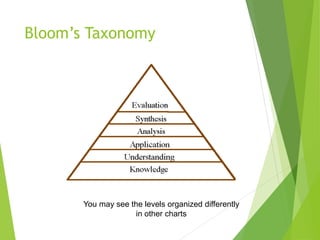
Bloom’s Taxonomy
You may see the levels organized differently
in other charts
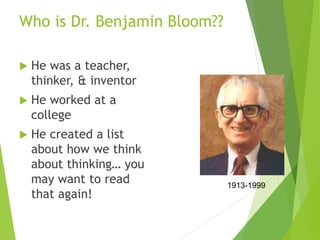
Who is Dr. Benjamin Bloom??
 He was a teacher,
thinker, & inventor
 He worked at a
college
 He created a list
about how we think
about thinking… you
may want to read
that again!
1913-1999
Purpose and Function of Behavioral
Objectives
 Guide for the teacher relative to
the design of instruction
 Guide for the teacher for
evaluation/test design (e.g.
written tests, OSCEs, etc)
 Guide for the learner relative to
learning focus
 Guide for the learner relative to
self assessment
 Statements of objectives tell
others what we value.
 Causes careful thinking about
what is to be accomplished
through instruction.
 Helps relationship between
teacher and learner because with
explicit objectives the instructor
is viewed less in an adversarial
role because students are not
forced to guess what is to be
learned.
 Enhances possibility to create
focused independent learning
materials.
Purpose and Function of Behavioral
Objectives
 Makes teaching more directed and
organized.
 Communicates to colleagues what
you are teaching thus enhancing
collaboration and teamwork with
colleagues.
 Helps facilitate those situations in
which we want students to
demonstrate competency (The
objectives can be specified in such
as way as to specify competency.)
 Aids in program evaluation
 Forces teacher to think carefully
about what is important
 Helps avoid unnecessary repetitions
in teaching
 Helps bridge the gap between
vague, but relevant, and
important, institutional goals and
actual instruction
 Provides visibility and
accountability of decisions made
by teachers and learners.
 Provides models for the creation
of objectives by students
 Helps students make decisions
regarding prioritizing
 Provides feedback to learners as
objectives are accomplished.
LEARNING DOMAINS OF BLOOM ‘S
TAXONOMY
 The committee identified three domains of educational activities or
learning .
Cognitive:
Mental skill ( knowledge )
Affective :
Growth in feeling or emotional areas ( Attitude or self )
Psychomotor :
Manual or physical skills .
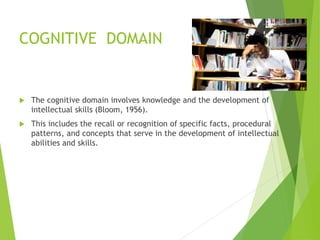
COGNITIVE DOMAIN
 The cognitive domain involves knowledge and the development of
intellectual skills (Bloom, 1956).
 This includes the recall or recognition of specific facts, procedural
patterns, and concepts that serve in the development of intellectual
abilities and skills.
COGNITIVE DOMAIN
 There are six major categories of cognitive an
processes, starting from the simplest to the most
complex (see the table below for an in-Knowledge
 Comprehension
 Application
 Analysis
 Synthesis
 Evaluation
 depth coverage of each category):
Cognitive Processes and Levels
 While Bloom's original cognitive taxonomy did mention
three levels of knowledge or products that could be
processed, they were not discussed very much and
remained one-dimensional:
 Factual - The basic elements students must know to be
acquainted with a discipline or solve problems.
 Conceptual – The interrelationships among the basic
elements within a larger structure that enable them to
function together.
 Procedural - How to do something, methods of inquiry,
and criteria for using skills, algorithms, techniques, and
methods.
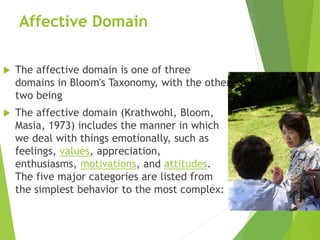
Affective Domain
 The affective domain is one of three
domains in Bloom's Taxonomy, with the other
two being
 The affective domain (Krathwohl, Bloom,
Masia, 1973) includes the manner in which
we deal with things emotionally, such as
feelings, values, appreciation,
enthusiasms, motivations, and attitudes.
The five major categories are listed from
the simplest behavior to the most complex:
Affective Domain
 Receiving Phenomena:
Awareness, willingness to hear,
selected attention.
 Examples:
Listen to others with respect. Listen
for and remember the name of newly
introduced people.
 Key Words:
acknowledge, asks, attentive,
courteous, dutiful, follows, gives,
listens, understands
Affective Domain
 Responds to Phenomena:
Active participation on the part of the learners.
Attend and react to a particular phenomenon.
Learning outcomes may emphasize compliance in
responding, willingness to respond, or satisfaction in
responding (motivation).
 Examples:
Participates in class discussions. Gives a presentation.
Questions new ideals, concepts, models, etc. in order to fully
understand them. Know the safety rules and practice them.
 Key Words:
answers, assists, aids, complies, conforms, discusses, greets,
helps, labels, performs, presents, tells
Affective Domain
 Valuing:
The worth or value a person attaches to a particular object,
phenomenon, or behavior. This ranges from simple acceptance to
the more complex state of commitment. Valuing is based on the
internalization of a set of specified values, while clues to these
values are expressed in the learner's overt behavior and are often
identifiable.
 Examples:
Demonstrates belief in the democratic process. Is sensitive
towards individual and cultural differences (value diversity). Shows
the ability to solve problems. Proposes a plan to social
improvement and follows through with commitment. Informs
management on matters that one feels strongly about.
 Key Words:
appreciates, cherish, treasure, demonstrates, initiates, invites,
joins, justifies, proposes, respect, shares
Affective Domain
 Organization:
Organizes values into priorities by contrasting different values,
resolving conflicts between them, and creating an unique value
system. The emphasis is on comparing, relating, and synthesizing
values.
 Examples:
Recognizes the need for balance between freedom and responsible
behavior. Explains the role of systematic planning in solving
problems. Accepts professional ethical standards. Creates a life
plan in harmony with abilities, interests, and beliefs. Prioritizes
time effectively to meet the needs of the organization, family, and
self.
 Key Words :
compares, relates, synthesizes
Affective Domain
 Internalizes Values
(characterization): Has a value system that controls their behavior.
The behavior is pervasive, consistent, predictable, and most
important characteristic of the learner. Instructional objectives are
concerned with the student's general patterns of adjustment
(personal, social, emotional).
 Examples:
Shows self-reliance when working independently. Cooperates in
group activities (displays teamwork). Uses an objective approach
in problem solving. Displays a professional commitment to
ethical practice on a daily basis. Revises judgments and changes
behavior in light of new evidence. Values people for what they are,
not how they look.
 Key Words:
acts, discriminates, displays, influences, modifies, performs,
qualifies, questions, revises, serves, solves, verifie
Psychomotor Domain
 The psychomotor domain (Simpson, 1972)
includes physical movement,
coordination, and use of the motor-skill
areas. Development of these skills
requires practice and is measured in
terms of speed, precision, distance,
procedures, or techniques in execution.
Thus, psychomotor skills rage from
manual tasks, such as digging a ditch or
washing a car, to more complex tasks,
such as operating a complex piece of
machinery or dancing.
Psychomotor Domain
The seven major categories are listed from the simplest
behavior to
Perception (awareness):
The ability to use sensory cues to guide motor activity. This
ranges from sensory stimulation, through cue selection, to
translation.the most complex:
 Examples:
Detects non-verbal communication cues. Estimate where a ball
will land after it is thrown and then moving to the correct location
to catch the ball. Adjusts heat of stove to correct temperature by
smell and taste of food. Adjusts the height of the forks on a forklift
by comparing where the forks are in relation to the pallet.
 Key Words:
chooses, describes, detects, differentiates, distinguishes,
identifies, isolates, relates, sele
Psychomotor Domain
 Set:
Readiness to act. It includes mental, physical, and emotional sets.
These three sets are dispositions that predetermine a person's
response to different situations (sometim
 Examples:
Knows and acts upon a sequence of steps in a manufacturing
process. Recognize one's abilities and limitations. Shows desire to
learn a new process (motivation). NOTE: This subdivision of
Psychomotor is closely related with the “Responding to
phenomena” subdivision of the Affective domain.
 Key Words:
begins, displays, explains, moves, proceeds, reacts, shows,
states, volunteees called mindsets).
Psychomotor Domain
 Mechanism (basic proficiency): This is the intermediate
stage in learning a complex skill. Learned responses
have become habitual and the movements can be
performed with some confidence and proficiency.
 Examples:
Use a personal computer. Repair a leaking faucet.
Drive a car.
 Key Words:
assembles, calibrates, constructs, dismantles,
displays, fastens, fixes, grinds, heats, manipulates,
measures, mends, mixes, organizes, sketches.
Psychomotor Domain
 Guided Response:
The early stages in learning a complex skill that
includes imitation and trial and error. Adequacy of
performance is achieved by practicing.
 Examples:
Performs a mathematical equation as demonstrated.
Follows instructions to build a model. Responds
hand-signals of instructor while learning to operate a
forklift.
 Key Words:
copies, traces, follows, react, reproduce, responds
Psychomotor Domain
 Complex Overt Response (Expert): The skillful
performance of motor acts that involve complex movement
patterns. Proficiency is indicated by a quick, accurate, and highly
coordinated performance, requiring a minimum of energy. This
category includes performing without hesitation, and automatic
performance. For example, players are often utter sounds of
satisfaction or expletives as soon as they hit a tennis ball or throw
a football, because they can tell by the feel of the act what the
result will produce.
 Examples: Maneuvers a car into a tight parallel parking spot.
Operates a computer quickly and accurately. Displays competence
while playing the piano.
 Key Words: assembles, builds, calibrates, constructs,
dismantles, displays, fastens, fixes, grinds, heats, manipulates,
measures, mends, mixes, organizes, sketches.
 NOTE: The Key Words are the same as Mechanism, but will have
adverbs or adjectives that indicate that the performance is
Psychomotor Domain
 Adaptation:
Skills are well developed and the individual can modify
movement patterns to fit special requirements.
 Examples:
Responds effectively to unexpected experiences. Modifies
instruction to meet the needs of the learners. Perform a
task with a machine that it was not originally intended to
do (machine is not damaged and there is no danger in
performing the new task).
 Key Words:
adapts, alters, changes, rearranges, reorganizes, revises,
varies.
Psychomotor Domain
 Origination:
Creating new movement patterns to fit a particular
situation or specific problem. Learning outcomes
emphasize creativity based upon highly developed
skills.
 Examples:
Constructs a new theory. Develops a new and
comprehensive training programming. Creates a new
gymnastic routine.
 Key Words:
arranges, builds, combines, composes, constructs,
creates, designs, initiate, makes, originates.
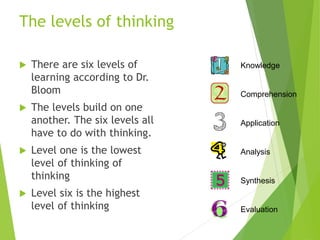
The levels of thinking
 There are six levels of
learning according to Dr.
Bloom
 The levels build on one
another. The six levels all
have to do with thinking.
 Level one is the lowest
level of thinking of
thinking
 Level six is the highest
level of thinking
Knowledge
Comprehension
Application
Analysis
Synthesis
Evaluation
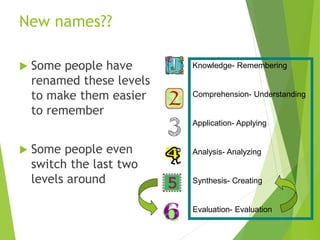
New names??
 Some people have
renamed these levels
to make them easier
to remember
 Some people even
switch the last two
levels around
Knowledge- Remembering
Comprehension- Understanding
Application- Applying
Analysis- Analyzing
Synthesis- Creating
Evaluation- Evaluation
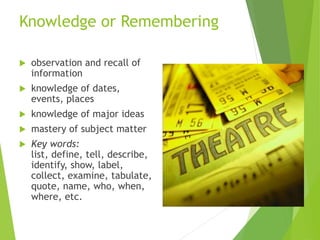
Knowledge or Remembering
 observation and recall of
information
 knowledge of dates,
events, places
 knowledge of major ideas
 mastery of subject matter
 Key words:
list, define, tell, describe,
identify, show, label,
collect, examine, tabulate,
quote, name, who, when,
where, etc.
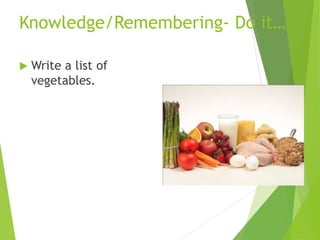
Knowledge/Remembering- Do it…
 Write a list of
vegetables.
Comprehension or Understanding
 understanding information
 grasp meaning
 translate knowledge into new
context
 interpret facts, compare,
contrast
 order, group, infer causes
 predict consequences
 Key words:
summarize, describe,
interpret, contrast, predict,
associate, distinguish,
estimate, differentiate,
discuss, extend
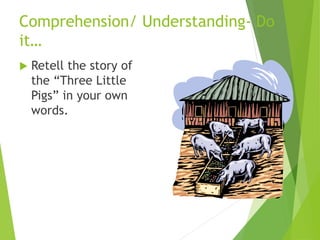
Comprehension/ Understanding- Do
it…
 Retell the story of
the “Three Little
Pigs” in your own
words.
Application or Applying
 use information
 use methods, concepts,
theories in new
situations
 solve problems using
required skills or
knowledge
 Key words:
apply, demonstrate,
calculate, complete,
illustrate, show, solve,
examine, modify, relate,
change, classify,
experiment, discover
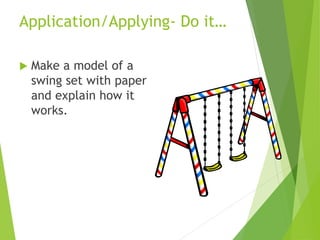
Application/Applying- Do it…
 Make a model of a
swing set with paper
and explain how it
works.
Analysis or Analyzing
 seeing patterns
 organization of parts
 recognition of hidden
meanings
 identification of
components
 Key words:
analyze, separate, order,
explain, connect, classify,
arrange, divide, compare,
select, explain, infer
Analysis/ Analyzing- Do it…
 Make a family tree
showing
relationships.
Synthesis or Creating
 use old ideas to create new
ones
 generalize from given facts
 relate knowledge from several
areas
 predict, draw conclusions
 Key words:
combine, integrate, modify,
rearrange, substitute, plan,
create, design, invent, what
if?, compose, formulate,
prepare, generalize, rewrite
Synthesis/Creating- Do it…
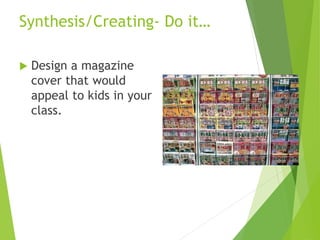
 Design a magazine
cover that would
appeal to kids in your
class.
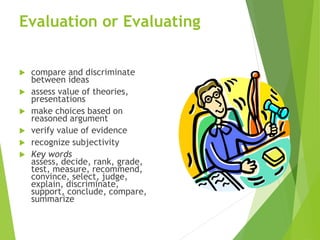
Evaluation or Evaluating
 compare and discriminate
between ideas
 assess value of theories,
presentations
 make choices based on
reasoned argument
 verify value of evidence
 recognize subjectivity
 Key words
assess, decide, rank, grade,
test, measure, recommend,
convince, select, judge,
explain, discriminate,
support, conclude, compare,
summarize
Evaluation/Evaluating- Do it…
 Make a booklet about
5 rules you see as
important. Convince
others.
Bloom’s Taxonomy and Research
 When doing research you should
always start with the lower levels
of thinking
 You must have basic knowledge
before you can advance to
deeper ideas
 One great way to improve your
knowledge is to READ, READ,
READ about your research topic
 When doing research, always be
sure to stretch your thinking to
the higher levels of thinking
 After you’ve explored your basic
knowledge base, challenge your
self to new ideas
 Always keep a Bloom’s Taxonomy
“cheat” sheet with you to help
you hit the higher levels of
thinking
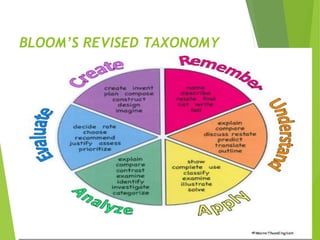
Bloom’s Taxonomy- Do it…
 Print out the next
slide. This is a kid’s
friendly copy of
Bloom’s Taxonomy
and put it in your
research folder for
quick reference.
BLOOM’S REVISED TAXONOMY

Taxonomy.ppt

  • 1.
    BLOOMS TAXONOMY What isit and how prepare it.
  • 2.
    Objectives :  Bythe end of sesssion idions will be able to over the systemic approach .  Define the bloom’s taxonomy .  Learning the domains of bloom ‘s taxonomy .  Explain The levels of thinking .  Bloom’s Taxonomy and Research.  Sources .
  • 3.
     "Instruction iseffective to the degree that it succeeds in changing students in desired directions and not in undesired directions."  Robert F. Mager
  • 4.
    Definition of Behavioral Objectives "Intended change brought about in a learner." (Popham, et. al. 1969)  "A statement of what students ought to be able to do as a consequence of instruction." (Goodlad, in Popham et al., 1969)  "Explicit formulations of ways in which students are expected to be changed by the educative process." (Bloom, 1956)
  • 5.
    Definition of Behavioral Objectives "What the students should be able to do at the end of a learning period that they could not do beforehand." (Mager, 1962)  "An objective is a description of a performance you want learners to be able to exhibit before you consider them competent. An objective describes an intended result of instruction, rather than the process of instruction itself." (Mager, 1975)  "Properly constructed education objectives represent relatively specific statements about what students should be able to do following instruction." (Gallagher and Smith, 1989)
  • 6.
    Definition of Behavioral Objectives According to Guilbert (1984) in article entitled "How to Devise Educational Objectives" the qualities of specific learning objectives are:  Relevant  Unequivocal  Feasible  Logical  Observable  Measurable
  • 7.
    Characteristics of effectiveobjectives as described by Westberg and Jason (1993) in Collaborative Clinical Education.  Consistent with overall goals of the school  Clearly stated  Realistic and doable  Appropriate for learners' stages of development  Appropriately comprehensive  Worthy, complex outcomes  Not treated as if they were etched in stone  Not regarded as the only valuable outcomes
  • 8.
    What is it??? Bloom’s Taxonomy is a chart of ideas Named after the creator, Benjamin Bloom A Taxonomy is an arrangement of ideas or a way to group things together
  • 9.
    Bloom’s Taxonomy You maysee the levels organized differently in other charts
  • 10.
    Who is Dr.Benjamin Bloom??  He was a teacher, thinker, & inventor  He worked at a college  He created a list about how we think about thinking… you may want to read that again! 1913-1999
  • 11.
    Purpose and Functionof Behavioral Objectives  Guide for the teacher relative to the design of instruction  Guide for the teacher for evaluation/test design (e.g. written tests, OSCEs, etc)  Guide for the learner relative to learning focus  Guide for the learner relative to self assessment  Statements of objectives tell others what we value.  Causes careful thinking about what is to be accomplished through instruction.  Helps relationship between teacher and learner because with explicit objectives the instructor is viewed less in an adversarial role because students are not forced to guess what is to be learned.  Enhances possibility to create focused independent learning materials.
  • 12.
    Purpose and Functionof Behavioral Objectives  Makes teaching more directed and organized.  Communicates to colleagues what you are teaching thus enhancing collaboration and teamwork with colleagues.  Helps facilitate those situations in which we want students to demonstrate competency (The objectives can be specified in such as way as to specify competency.)  Aids in program evaluation  Forces teacher to think carefully about what is important  Helps avoid unnecessary repetitions in teaching  Helps bridge the gap between vague, but relevant, and important, institutional goals and actual instruction  Provides visibility and accountability of decisions made by teachers and learners.  Provides models for the creation of objectives by students  Helps students make decisions regarding prioritizing  Provides feedback to learners as objectives are accomplished.
  • 13.
    LEARNING DOMAINS OFBLOOM ‘S TAXONOMY  The committee identified three domains of educational activities or learning . Cognitive: Mental skill ( knowledge ) Affective : Growth in feeling or emotional areas ( Attitude or self ) Psychomotor : Manual or physical skills .
  • 14.
    COGNITIVE DOMAIN  Thecognitive domain involves knowledge and the development of intellectual skills (Bloom, 1956).  This includes the recall or recognition of specific facts, procedural patterns, and concepts that serve in the development of intellectual abilities and skills.
  • 15.
    COGNITIVE DOMAIN  Thereare six major categories of cognitive an processes, starting from the simplest to the most complex (see the table below for an in-Knowledge  Comprehension  Application  Analysis  Synthesis  Evaluation  depth coverage of each category):
  • 16.
    Cognitive Processes andLevels  While Bloom's original cognitive taxonomy did mention three levels of knowledge or products that could be processed, they were not discussed very much and remained one-dimensional:  Factual - The basic elements students must know to be acquainted with a discipline or solve problems.  Conceptual – The interrelationships among the basic elements within a larger structure that enable them to function together.  Procedural - How to do something, methods of inquiry, and criteria for using skills, algorithms, techniques, and methods.
  • 17.
    Affective Domain  Theaffective domain is one of three domains in Bloom's Taxonomy, with the other two being  The affective domain (Krathwohl, Bloom, Masia, 1973) includes the manner in which we deal with things emotionally, such as feelings, values, appreciation, enthusiasms, motivations, and attitudes. The five major categories are listed from the simplest behavior to the most complex:
  • 18.
    Affective Domain  ReceivingPhenomena: Awareness, willingness to hear, selected attention.  Examples: Listen to others with respect. Listen for and remember the name of newly introduced people.  Key Words: acknowledge, asks, attentive, courteous, dutiful, follows, gives, listens, understands
  • 19.
    Affective Domain  Respondsto Phenomena: Active participation on the part of the learners. Attend and react to a particular phenomenon. Learning outcomes may emphasize compliance in responding, willingness to respond, or satisfaction in responding (motivation).  Examples: Participates in class discussions. Gives a presentation. Questions new ideals, concepts, models, etc. in order to fully understand them. Know the safety rules and practice them.  Key Words: answers, assists, aids, complies, conforms, discusses, greets, helps, labels, performs, presents, tells
  • 20.
    Affective Domain  Valuing: Theworth or value a person attaches to a particular object, phenomenon, or behavior. This ranges from simple acceptance to the more complex state of commitment. Valuing is based on the internalization of a set of specified values, while clues to these values are expressed in the learner's overt behavior and are often identifiable.  Examples: Demonstrates belief in the democratic process. Is sensitive towards individual and cultural differences (value diversity). Shows the ability to solve problems. Proposes a plan to social improvement and follows through with commitment. Informs management on matters that one feels strongly about.  Key Words: appreciates, cherish, treasure, demonstrates, initiates, invites, joins, justifies, proposes, respect, shares
  • 21.
    Affective Domain  Organization: Organizesvalues into priorities by contrasting different values, resolving conflicts between them, and creating an unique value system. The emphasis is on comparing, relating, and synthesizing values.  Examples: Recognizes the need for balance between freedom and responsible behavior. Explains the role of systematic planning in solving problems. Accepts professional ethical standards. Creates a life plan in harmony with abilities, interests, and beliefs. Prioritizes time effectively to meet the needs of the organization, family, and self.  Key Words : compares, relates, synthesizes
  • 22.
    Affective Domain  InternalizesValues (characterization): Has a value system that controls their behavior. The behavior is pervasive, consistent, predictable, and most important characteristic of the learner. Instructional objectives are concerned with the student's general patterns of adjustment (personal, social, emotional).  Examples: Shows self-reliance when working independently. Cooperates in group activities (displays teamwork). Uses an objective approach in problem solving. Displays a professional commitment to ethical practice on a daily basis. Revises judgments and changes behavior in light of new evidence. Values people for what they are, not how they look.  Key Words: acts, discriminates, displays, influences, modifies, performs, qualifies, questions, revises, serves, solves, verifie
  • 23.
    Psychomotor Domain  Thepsychomotor domain (Simpson, 1972) includes physical movement, coordination, and use of the motor-skill areas. Development of these skills requires practice and is measured in terms of speed, precision, distance, procedures, or techniques in execution. Thus, psychomotor skills rage from manual tasks, such as digging a ditch or washing a car, to more complex tasks, such as operating a complex piece of machinery or dancing.
  • 24.
    Psychomotor Domain The sevenmajor categories are listed from the simplest behavior to Perception (awareness): The ability to use sensory cues to guide motor activity. This ranges from sensory stimulation, through cue selection, to translation.the most complex:  Examples: Detects non-verbal communication cues. Estimate where a ball will land after it is thrown and then moving to the correct location to catch the ball. Adjusts heat of stove to correct temperature by smell and taste of food. Adjusts the height of the forks on a forklift by comparing where the forks are in relation to the pallet.  Key Words: chooses, describes, detects, differentiates, distinguishes, identifies, isolates, relates, sele
  • 25.
    Psychomotor Domain  Set: Readinessto act. It includes mental, physical, and emotional sets. These three sets are dispositions that predetermine a person's response to different situations (sometim  Examples: Knows and acts upon a sequence of steps in a manufacturing process. Recognize one's abilities and limitations. Shows desire to learn a new process (motivation). NOTE: This subdivision of Psychomotor is closely related with the “Responding to phenomena” subdivision of the Affective domain.  Key Words: begins, displays, explains, moves, proceeds, reacts, shows, states, volunteees called mindsets).
  • 26.
    Psychomotor Domain  Mechanism(basic proficiency): This is the intermediate stage in learning a complex skill. Learned responses have become habitual and the movements can be performed with some confidence and proficiency.  Examples: Use a personal computer. Repair a leaking faucet. Drive a car.  Key Words: assembles, calibrates, constructs, dismantles, displays, fastens, fixes, grinds, heats, manipulates, measures, mends, mixes, organizes, sketches.
  • 27.
    Psychomotor Domain  GuidedResponse: The early stages in learning a complex skill that includes imitation and trial and error. Adequacy of performance is achieved by practicing.  Examples: Performs a mathematical equation as demonstrated. Follows instructions to build a model. Responds hand-signals of instructor while learning to operate a forklift.  Key Words: copies, traces, follows, react, reproduce, responds
  • 28.
    Psychomotor Domain  ComplexOvert Response (Expert): The skillful performance of motor acts that involve complex movement patterns. Proficiency is indicated by a quick, accurate, and highly coordinated performance, requiring a minimum of energy. This category includes performing without hesitation, and automatic performance. For example, players are often utter sounds of satisfaction or expletives as soon as they hit a tennis ball or throw a football, because they can tell by the feel of the act what the result will produce.  Examples: Maneuvers a car into a tight parallel parking spot. Operates a computer quickly and accurately. Displays competence while playing the piano.  Key Words: assembles, builds, calibrates, constructs, dismantles, displays, fastens, fixes, grinds, heats, manipulates, measures, mends, mixes, organizes, sketches.  NOTE: The Key Words are the same as Mechanism, but will have adverbs or adjectives that indicate that the performance is
  • 29.
    Psychomotor Domain  Adaptation: Skillsare well developed and the individual can modify movement patterns to fit special requirements.  Examples: Responds effectively to unexpected experiences. Modifies instruction to meet the needs of the learners. Perform a task with a machine that it was not originally intended to do (machine is not damaged and there is no danger in performing the new task).  Key Words: adapts, alters, changes, rearranges, reorganizes, revises, varies.
  • 30.
    Psychomotor Domain  Origination: Creatingnew movement patterns to fit a particular situation or specific problem. Learning outcomes emphasize creativity based upon highly developed skills.  Examples: Constructs a new theory. Develops a new and comprehensive training programming. Creates a new gymnastic routine.  Key Words: arranges, builds, combines, composes, constructs, creates, designs, initiate, makes, originates.
  • 31.
    The levels ofthinking  There are six levels of learning according to Dr. Bloom  The levels build on one another. The six levels all have to do with thinking.  Level one is the lowest level of thinking of thinking  Level six is the highest level of thinking Knowledge Comprehension Application Analysis Synthesis Evaluation
  • 32.
    New names??  Somepeople have renamed these levels to make them easier to remember  Some people even switch the last two levels around Knowledge- Remembering Comprehension- Understanding Application- Applying Analysis- Analyzing Synthesis- Creating Evaluation- Evaluation
  • 33.
    Knowledge or Remembering observation and recall of information  knowledge of dates, events, places  knowledge of major ideas  mastery of subject matter  Key words: list, define, tell, describe, identify, show, label, collect, examine, tabulate, quote, name, who, when, where, etc.
  • 34.
    Knowledge/Remembering- Do it… Write a list of vegetables.
  • 35.
    Comprehension or Understanding understanding information  grasp meaning  translate knowledge into new context  interpret facts, compare, contrast  order, group, infer causes  predict consequences  Key words: summarize, describe, interpret, contrast, predict, associate, distinguish, estimate, differentiate, discuss, extend
  • 36.
    Comprehension/ Understanding- Do it… Retell the story of the “Three Little Pigs” in your own words.
  • 37.
    Application or Applying use information  use methods, concepts, theories in new situations  solve problems using required skills or knowledge  Key words: apply, demonstrate, calculate, complete, illustrate, show, solve, examine, modify, relate, change, classify, experiment, discover
  • 38.
    Application/Applying- Do it… Make a model of a swing set with paper and explain how it works.
  • 39.
    Analysis or Analyzing seeing patterns  organization of parts  recognition of hidden meanings  identification of components  Key words: analyze, separate, order, explain, connect, classify, arrange, divide, compare, select, explain, infer
  • 40.
    Analysis/ Analyzing- Doit…  Make a family tree showing relationships.
  • 41.
    Synthesis or Creating use old ideas to create new ones  generalize from given facts  relate knowledge from several areas  predict, draw conclusions  Key words: combine, integrate, modify, rearrange, substitute, plan, create, design, invent, what if?, compose, formulate, prepare, generalize, rewrite
  • 42.
    Synthesis/Creating- Do it… Design a magazine cover that would appeal to kids in your class.
  • 43.
    Evaluation or Evaluating compare and discriminate between ideas  assess value of theories, presentations  make choices based on reasoned argument  verify value of evidence  recognize subjectivity  Key words assess, decide, rank, grade, test, measure, recommend, convince, select, judge, explain, discriminate, support, conclude, compare, summarize
  • 44.
    Evaluation/Evaluating- Do it… Make a booklet about 5 rules you see as important. Convince others.
  • 45.
    Bloom’s Taxonomy andResearch  When doing research you should always start with the lower levels of thinking  You must have basic knowledge before you can advance to deeper ideas  One great way to improve your knowledge is to READ, READ, READ about your research topic  When doing research, always be sure to stretch your thinking to the higher levels of thinking  After you’ve explored your basic knowledge base, challenge your self to new ideas  Always keep a Bloom’s Taxonomy “cheat” sheet with you to help you hit the higher levels of thinking
  • 46.
    Bloom’s Taxonomy- Doit…  Print out the next slide. This is a kid’s friendly copy of Bloom’s Taxonomy and put it in your research folder for quick reference.
  • 47.